
In This Article
Your bathroom is a small, warm, damp box that gets steamed up every single day. If mold had a dream vacation rental, this would be it.
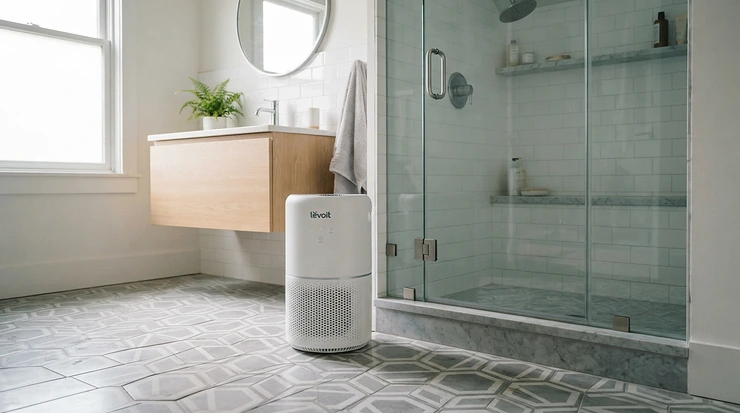
So what is an air purifier for bathroom mold and mildew? It’s a compact, HEPA-equipped air cleaner sized for small, humid rooms. It traps airborne mold spores and musty odor molecules before they settle on damp grout, ceilings and towels. It cleans the air only. It can’t dry the room or remove mold already growing on surfaces.
That second sentence matters more than any spec in this guide. The EPA’s own mold guidance says eliminating every spore indoors is virtually impossible, and that controlling moisture is what controls mold. A HEPA filter is a dense mat of fibers built to catch particles down to 0.3 microns, and mold spores are far bigger than that. So the filtering part is easy. The hard part is picking a unit that fits a tiny room, tolerates steam and doesn’t sound like a leaf blower.
I researched current specs, professional test results and review themes for this roundup. I haven’t handled any of these units myself, so every opinion below is analysis of published data, not a diary entry. Where the evidence is thin, I’ll say so.
Quick Comparison: Air Purifier for Bathroom Mold and Mildew Picks
| Product | Best For | Maker’s Coverage Rating | Noise Range | Price Range* |
|---|---|---|---|---|
| Levoit Core Mini-P | Tiny powder rooms, tight budgets | 254 sq ft (1 ACH) / 53 sq ft (4.8 ACH) | 25–44 dB | Under $60 |
| GermGuardian AC4825E | Budget buyers who want a tower | ~153–167 sq ft | ~47–54 dBA | Roughly $90–$130 |
| Clorox Medium Room Turbo+ | Fast post-shower clearing | 5 ACH in ~215 sq ft | 4 speeds, low to turbo | Roughly $100–$150 |
| Levoit Core 300S | Smart auto-mode fans | ~219 sq ft | Quiet sleep mode | Roughly $100–$200 |
| Coway Airmega AP-1512HH Mighty | Best all-rounder for larger baths | 361 sq ft | 25–53 dB | $200–$250 range |
| Blueair Blue Pure 311i Max | Quiet, high airflow | Up to ~387 sq ft | ~40–58 dBA | Around $190–$230 |
| Rabbit Air MinusA2 | Wall-mounted premium pick | 815 sq ft (SPA-780A) | 25.6–51.3 dB | $550–$650 range |
*Prices change constantly. Check current price before buying. Ranges reflect what I found at the time of research.
Here’s the takeaway. Nearly every unit here is oversized for a typical 40–60 square foot bathroom, and that’s good news. Extra airflow means the room’s air gets cycled fast after a shower. The catch is noise and cost, so the smaller units (Levoit Core Mini-P, GermGuardian AC4825E) win on price while the Blueair Blue Pure 311i Max and Rabbit Air MinusA2 win on quiet power. If your bathroom is a closet-sized half bath, don’t pay for capacity you’ll never use.
💬 Just one click — help others make better buying decisions too!😊
Top 7 Air Purifier for Bathroom Mold and Mildew Options: Expert Analysis
Every pick below is real, currently sold and judged on specs plus reported review themes. Where I couldn’t verify a claim, I say so.
1. Levoit Core Mini-P — smallest, cheapest way to start
This is the pint-sized option, at 2.2 pounds and about 10 inches tall. It fits on a shelf above the towel bar, which is where small bathrooms keep their dignity.
Levoit lists a CADR of 34 CFM and a rated noise range of 25–44 dB. It’s rated for 254 square feet at one air change per hour, or 53 square feet at 4.8 changes per hour. That second figure is the one that counts here. In a 5×8 foot bathroom with 8-foot ceilings (320 cubic feet), 34 CFM works out to roughly six theoretical air changes an hour. That’s decent for a unit this small, though real-world mixing is never perfect.
Based on the spec comparison, this is a spot-treatment tool, not a whole-room fix. It’s best for powder rooms and small baths where you mostly want to cut spores and musty smells after showers. Professional testers I found generally describe the Core line as solid for small rooms. I couldn’t verify a deep pool of independent review themes for the Mini-P specifically, so treat the evidence as moderate.
Pros:
- ✅ Costs less than most replacement filters for bigger units
- ✅ Takes up almost no counter space
- ✅ Low 25 dB sleep-mode noise
Cons:
- ❌ Too small for bathrooms over about 60 sq ft
- ❌ Small filter means frequent replacements
Price: under $60. Value verdict: the cheapest sensible entry point for a half bath.
2. GermGuardian AC4825E — budget tower with optional UV-C
The standout here is the UV-C light, but it’s also the least important thing about it. The GermGuardian AC4825E pairs an H13-rated HEPA filter with a charcoal pre-filter and a switchable UV-C bulb.
Published CADR figures run 118 dust, 108 smoke and 125 pollen CFM, with room ratings around 153–167 square feet. HouseFresh’s testing found it took 104 minutes to clear their test room, noticeably slower than its CADR suggested, and that reviewer called UV-C unhelpful on portable purifiers at this price. Another test found the UV light added only about 1% to air-quality improvement. On paper, the UV-C pitch for killing spores sounds great. In practice, the HEPA filter is doing the real work.
The 8.5-pound tower is also energy-hungry for its output, at 44 watts on max with UV on. And the UV bulb needs replacing roughly yearly. Still, a Live Science review noted roughly 4.5 stars on Amazon, so plenty of owners seem satisfied for the money.
Pros:
- ✅ True HEPA plus charcoal at a low price
- ✅ UV-C can be switched off to save energy
- ✅ Easy three-speed controls
Cons:
- ❌ Slower real-world cleaning than the CADR implies
- ❌ UV bulb adds an ongoing replacement cost
Price: roughly $90–$130. Value verdict: fine if you want a floor-standing budget tower, but skip the UV-C hype.
3. Clorox Medium Room Turbo+ — Turbo Timer for post-shower clearing
Think of this as the sprinter. The Clorox Medium Room Turbo+ has four fan speeds plus a Turbo Timer you can set for 10, 20 or 30 minutes of maximum airflow.
That timer is the whole pitch for bathrooms. You finish a hot shower, hit Turbo, and the unit blasts through the post-steam air without you babysitting it. It uses a three-stage 360-degree filter (pre-filter, True HEPA, activated carbon) and claims five air changes an hour in about 215 square feet. The activated carbon is a quiet hero for musty odors, which True HEPA alone doesn’t touch.
The honest analysis: Clorox’s non-Turbo medium-room version is CADR-rated 148 smoke, 154 dust and 160 pollen CFM, but I couldn’t verify a separate certified CADR for the Turbo+ variant. Bob Vila’s testing team named it best bang for the buck for mold, which is a reasonable endorsement. Independent bathroom-specific review data is thin, so lean on the spec logic.
Pros:
- ✅ Turbo Timer handles post-shower air automatically
- ✅ Activated carbon helps with musty smells
- ✅ Filter lasts about 6–12 months
Cons:
- ❌ Turbo setting will be loud in a small room
- ❌ Few independent bathroom-specific tests
Price: roughly $100–$150. Value verdict: great if you shower and leave; the timer earns its keep.
4. Levoit Core 300S — smart auto mode that adjusts itself
If you want a purifier that reacts to steam spikes without your input, this is the pick. The Levoit Core 300S adds a PM2.5 sensor, Wi-Fi app control and voice-assistant support to the Core 300 body.
CADR is 240 cubic meters per hour, roughly 141 CFM, and Levoit-based coverage claims land around 219 square feet. That converts to a theoretical 26 air changes an hour in a 320-cubic-foot bathroom. Overkill in the best way.
Reviewers aren’t unanimous. RTINGS found it did a slightly worse job than the cheaper, non-smart Core 300 in repeated testing, calling its filtration performance middling. TechRadar noted minor flaws in response times and fan speeds. Modern Castle reported 94% particle removal in a 14×10 room after an hour. What I’d flag: auto mode reacts to particles, not humidity, so it won’t “see” steam as such. Still, that sleep mode and scheduling make this a convenient set-and-forget unit.
Pros:
- ✅ Auto mode adjusts fan speed to particle levels
- ✅ App scheduling for pre-shower runs
- ✅ Quiet overnight sleep mode
Cons:
- ❌ Reportedly slightly slower than the non-smart Core 300
- ❌ Sensor tracks particles, not humidity
Price: roughly $100–$200 depending on sales. Value verdict: pay the smart premium only if scheduling matters to you.
5. Coway Airmega AP-1512HH Mighty — the proven all-rounder for larger baths
This one has been a reviewer favorite for years. The Coway Airmega AP-1512HH Mighty combines a pre-filter, a deodorizing carbon filter and True HEPA, with an optional ionizer.
Coway rates it for 361 square feet, with noise running 25 dB at the lowest speed up to 53 dB on high. Bob Vila’s team named it best overall for mold, and RTINGS gave it solid scores for particle filtration and bedrooms. Its auto sensor adjusts fan speed, and an Eco mode shuts the fan off after 30 minutes of clean air.
Here’s my caution: reviewers note the high setting is too loud for sleeping, and a bathroom amplifies noise because of all that tile. I’d also switch the ionizer off. The EPA advises avoiding air cleaners that intentionally produce ozone, and ionizers can emit some. HEPA and carbon do the job without it.
Pros:
- ✅ True HEPA plus carbon for mold spores and odors
- ✅ Eco mode saves energy between showers
- ✅ Long track record with reviewers
Cons:
- ❌ Larger footprint than a bathroom shelf allows
- ❌ Ionizer is best left off
Price: $200–$250 range. Value verdict: the sensible mid-range choice for large primary baths or adjoining rooms.
6. Blueair Blue Pure 311i Max — high airflow with a calm voice
Quiet and powerful rarely arrive together. The Blueair Blue Pure 311i Max manages it with a big cylindrical filter, a washable fabric pre-filter and app control.
Blueair cites a CADR of 250 CFM, and HouseFresh measured an AHAM PM2.5 figure of 252 CFM. In their test it cleared a 728-cubic-foot room to zero PM1 in 27 minutes, beating a Dyson Big+Quiet BP06 and trailing a Levoit Vital 200S. Top speed reaches 57.7 dBA, so the “quiet” label applies at lower speeds. Running costs came out around $122 a year including filters.
The checkable bonus is that Blueair lists CARB Zero Ozone verification, which matters for a small room. One tracked listing shows roughly 4.5 stars across a couple thousand ratings, though I can’t vouch for that source’s methodology. For a bathroom, it’s powerful enough that you’d run it on a low setting, so the real value is silence plus headroom.
Pros:
- ✅ Very high CADR for the price
- ✅ CARB zero-ozone verified
- ✅ Washable pre-filter cuts upkeep
Cons:
- ❌ Large for a small bathroom counter
- ❌ Loud on top speed
Price: around $190–$230. Value verdict: excellent if your bathroom shares air with a hallway or bedroom.
7. Rabbit Air MinusA2 — wall-mounted premium with a customizable filter
If the floor is precious and the budget is not, this is the unusual choice. The Rabbit Air MinusA2 is wall-mountable, slim and offers swappable filters (Germ Defense, Toxin Absorber, Pet Allergy or Odor Remover).
The SPA-780A is rated for 815 square feet, with CADR of 200 pollen, 193 dust and 180 smoke, and noise from 25.6 to 51.3 dB. Mounted high on a wall, it keeps airflow off any splash zones. Rabbit Air’s own materials describe the Germ Defense filter as the spore-focused option, which makes sense for this guide, though that’s a manufacturer claim.
HouseFresh noted setup isn’t the simplest, and the price is steep. A smaller 2026 bathroom doesn’t need 815 square feet of capacity. But you’re paying for design, whisper-level low speeds and the wall-mount, not raw cleaning power per dollar.
Pros:
- ✅ Wall-mount frees up counter and floor
- ✅ Customizable filters for odor or germ focus
- ✅ Very quiet at low speeds
Cons:
- ❌ Premium price for a small room
- ❌ Setup takes some patience
Price: $550–$650 range. Value verdict: justified only for design-conscious owners with a large or open-plan bathroom.
How to Choose an Air Purifier for Bathroom Mold and Mildew
A short list beats a long one. Here are the steps that actually matter:
- Insist on True HEPA. It’s the only filter type the EPA specifically ties to capturing particles like mold. “HEPA-type” claims are marketing.
- Match CADR to the room, not the box. A simple method: multiply your bathroom’s cubic feet by the air changes you want, divide by 60. A 320-cubic-foot bathroom at 6 changes an hour needs roughly 32 CFM.
- Add activated carbon. Mold’s musty smell comes from gases, and HEPA doesn’t catch gases.
- Reject ozone makers. The EPA’s Guide to Air Cleaners in the Home warns against devices that intentionally produce ozone, a lung irritant.
- Check noise on low. Bathrooms echo. Pick based on the lowest speed you’d really use.
- Plan for filters. Cheap units with expensive, frequent filters cost more over time.
- Look for washable pre-filters. They protect the HEPA layer from lint and dust.
Mold Spores: What You’re Actually Trying to Filter
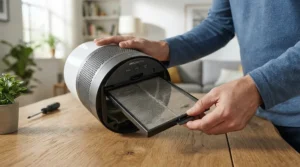
Mold spores are the airborne seeds mold uses to spread. They’re typically 3 to 40 microns across, which is gigantic compared with the 0.3-micron particles HEPA is rated for. Any True HEPA filter catches them well.
Here’s the part many product pages skip. Filtering mold spores from the air doesn’t stop mold from growing. Spores are everywhere, and mold needs moisture to take hold. Once spores land on a damp surface with food (soap scum, drywall paper, dust), they colonize. A purifier shrinks the number of spores floating around, which lowers what you breathe and what lands on surfaces. But the spores already living in your grout aren’t going anywhere.
Think of it as sweeping the floor while a faucet drips. The sweeping helps, but you’d still fix the faucet. That’s why every credible source I found frames purifiers as a supporting player: useful during and after cleanup, for people sensitive to mold, and as an extra layer. They’re not a cure.
Air Purifier for Bathroom Humidity: What It Can and Can’t Do
Let’s be blunt. An air purifier for bathroom humidity doesn’t exist, at least not in the sense of lowering it. Standard purifiers filter particles and don’t remove water vapor. The purifier doesn’t dry the air, and the EPA says indoor relative humidity should stay below 60 percent, ideally between 30 and 50 percent.
If a listing implies a purifier alone will fix a steamy bathroom, scroll on. Humidity is handled by ventilation (an exhaust fan vented outdoors) or dehumidifying. A purifier supports that setup by filtering what mold sheds into the air.
Still, humidity affects purifiers themselves. Some buying guides caution that sustained moisture can shorten HEPA filter life, so I’d treat that as a reason to keep the unit out of direct steam and to run it after showers rather than inside the cloud. Keep it on a dry surface away from the tub or shower, plug it into a GFCI-protected outlet and check your model’s manual for placement guidance, since many aren’t rated for splash zones. A cheap hygrometer will tell you whether the room is actually drying out.
Air Purifier for Windowless Bathroom: A Special Case
A windowless bathroom is the hardest version of this problem. No window means no passive drying, so everything depends on the exhaust fan, and if that fan is weak, missing or venting into an attic, moisture lingers for hours.
For an air purifier for windowless bathroom use, I’d rank priorities this way:
- Fix or upgrade the fan first. A common rule of thumb is about 1 CFM per square foot of floor space, with a minimum around 50 CFM. A timer or humidity-sensing switch removes the “did I forget?” factor.
- Run the purifier right after showers, ideally with the door cracked so air can exchange with the rest of the house.
- Choose a compact, quiet unit like the Levoit Core Mini-P or Clorox Medium Room Turbo+, because there’s nowhere to hide a bulky tower.
- Add a small dehumidifier if the fan can’t keep up, and measure results with a hygrometer.
One more thought. In a windowless bathroom, the purifier is more valuable than usual because you can’t air the room out. It’s your only way of cleaning the air you can’t ventilate, but it still can’t pull water out.
Features That Actually Matter (And Those That Don’t)
Matter: True HEPA, a CADR that suits the room, activated carbon, low-speed noise and an easy-to-clean pre-filter. These decide whether your unit works and whether you’ll keep running it.
Sort of matter: auto mode (nice if reliable), timers (very handy for post-shower runs) and filter-change reminders. The Clorox Medium Room Turbo+ timer and the Levoit Core 300S scheduling are genuinely useful here.
Mostly don’t matter: UV-C bulbs, “plasma” or ionizer modes and sleek app dashboards. HouseFresh’s skepticism of UV-C on portable purifiers, and the roughly 1% extra improvement found in another test of the GermGuardian AC4825E, suggest the light is more marketing than muscle. Ionizers carry the ozone caution from the EPA. If you want them anyway, make sure you can turn them off, as with the Coway Airmega AP-1512HH Mighty.
Also ignore giant square-footage claims. They’re often calculated at one air change per hour, which is slow. For a bathroom, the “4.8 ACH” style number is the more honest one.
Air Purifier vs. Exhaust Fan vs. Dehumidifier: What Each Does
| Tool | Removes Moisture? | Captures Mold Spores? | Best For |
|---|---|---|---|
| Air purifier | No | Yes (HEPA) | Cleaning airborne spores and odors |
| Exhaust fan (vented outside) | Yes | Partly (pushes air out) | Primary humidity control during/after showers |
| Dehumidifier | Yes | No | Chronic dampness, windowless baths |
| Open door/window | Some | No | Bonus ventilation, not a plan |
The pattern is clear. Moisture tools stop mold from growing, and the purifier handles what’s already airborne. The EPA’s guidance lists venting bathrooms outside, using dehumidifiers and increasing ventilation among its core moisture-control steps. A purifier isn’t on that list for a reason.
So if you can afford only one thing, buy the better fan or a dehumidifier before you buy a purifier. If you can afford two, the combination of a vented fan and a small HEPA unit is hard to beat. If you’re renting a bathroom with a flimsy fan, a Levoit Core Mini-P plus a humidity monitor gives you the best floor of protection for the least money.
Setup and Placement Guide: Getting the Most Out of Your Unit
Even the best air purifier for bathroom mold and mildew underperforms when it’s placed badly. Here’s how to avoid that.
Placement. Put it on a dry, stable surface at least a couple of feet from the shower or tub. Leave breathing room on all sides, since blocked intakes cut airflow. Avoid sinks where splashes happen.
Timing. Start the unit before the shower if you can (the smart models let you schedule that), then run it at least 30 minutes after, longer if the room stays damp. Many guides suggest running exhaust fans 20 to 30 minutes after showers, and the purifier can follow the same rhythm.
Settings. Use low or auto for ongoing running, and save high or turbo for post-shower clearing. Keep ionizer modes off.
First 30 days checklist:
- Check the pre-filter weekly for lint and dust.
- Set a calendar reminder for the HEPA filter based on the manufacturer’s schedule (Clorox suggests 6–12 months for its filter).
- Place a hygrometer next to the purifier to confirm humidity is trending toward the 30–50% range.
- Wipe down the unit’s exterior monthly with a dry cloth.
One common mistake: leaving the unit in the steam cloud. Moisture and electronics don’t mix, and a purifier running in thick steam won’t do better than one running after the steam clears.
Real-World Scenarios: Which Pick Fits Which Bathroom?
Scenario 1: The college renter. Think of a 35-square-foot bathroom in a rental with a weak fan, a tight budget and a landlord who won’t upgrade anything. Spending under $60 on the Levoit Core Mini-P, plus a few-dollar hygrometer, covers the basics. Leave the door cracked and wipe the shower walls.
Scenario 2: The family bath. Picture a 60-square-foot shared bathroom used four times a morning, with steam from back-to-back showers. The Clorox Medium Room Turbo+ and its 30-minute Turbo Timer match the usage pattern. Hit Turbo after the last shower and let it work while everyone leaves.
Scenario 3: The primary suite. A 90-square-foot en suite with a soaking tub, open to the bedroom, calls for something quiet and strong. The Blueair Blue Pure 311i Max can run at low speeds almost silently while still moving serious air. If design matters and money doesn’t, the Rabbit Air MinusA2 mounts on the wall and stays out of the way.
Scenario 4: The allergy-prone household. For someone sensitive to mold, a mid-range HEPA-and-carbon pick like the Coway Airmega AP-1512HH Mighty gives them solid filtering for the bathroom and, when moved, the bedroom. Just keep the ionizer off.
Humidity Control and Mildew Prevention: The Real Fix
If a purifier is the supporting actor, humidity control is the star. Here’s a practical problem-to-solution guide.
Problem: steam lingers after showers. Solution: run the exhaust fan during the shower and for 20 to 30 minutes after. Upgrade to a fan sized at roughly 1 CFM per square foot, ideally on a timer or humidistat.
Problem: mildew keeps returning on grout and caulk. Solution: squeegee walls and door after showers, and re-caulk cracked seams. Mildew prevention is mostly about drying surfaces within hours, since the EPA advises cleaning and drying damp spots within 48 hours at most.
Problem: no fan, no window. Solution: a small dehumidifier and a crack in the door, plus a purifier for the airborne side of things.
Problem: musty smell persists. Solution: check for hidden moisture behind fixtures or under flooring. A purifier with carbon will cut the odor, but a persistent smell can signal a hidden leak. Consumer Reports’ bathroom mold prevention advice echoes the point that cutting moisture sources comes first.
Problem: visible mold patches. Solution: for small areas, clean with appropriate protection (the CDC suggests an N95, gloves and eye protection), then fix the moisture source. Large or recurring growth calls for a professional.
Long-Term Cost and Maintenance: What You’ll Really Spend
| Tier | Upfront | Ongoing Cost Notes | Example Picks |
|---|---|---|---|
| Budget | Under ~$130 | Frequent small filters; UV bulb on one model | Levoit Core Mini-P, GermGuardian AC4825E |
| Mid-range | ~$100–$250 | Filters every 6–12 months | Clorox Medium Room Turbo+, Levoit Core 300S, Coway Airmega AP-1512HH Mighty |
| Premium | ~$190–$650 | Higher filter prices, lower noise | Blueair Blue Pure 311i Max, Rabbit Air MinusA2 |
Cost per year varies more than sticker prices suggest. HouseFresh estimated roughly $122 a year to run the Blueair Blue Pure 311i Max with filters, and about $121 a year for the GermGuardian AC4825E (energy plus replacements). Those figures assume heavier use than a bathroom unit sees, since you’ll run on low or only after showers.
The analysis: the cheapest purifier isn’t always the cheapest to own. A tiny unit with a small filter can mean more frequent replacements, while a larger unit with a washable pre-filter stretches the HEPA’s life. Run your purifier in short, targeted sessions and your costs drop.
FAQ
❓ Can an air purifier for bathroom mold and mildew remove mold already on my walls?
❓ Is it safe to run a purifier in a steamy bathroom?
❓ How long should I run a purifier after a shower?
❓ Do I need a special filter for a windowless bathroom?
❓ Can one purifier cover my bathroom and bedroom?
Conclusion
Here’s the short version. The best air purifier for bathroom mold and mildew is a True HEPA unit with carbon, sized to your room, quiet enough to actually run and placed on a dry surface. For tiny budgets, the Levoit Core Mini-P is a sensible start. For quick post-shower clearing, the Clorox Medium Room Turbo+ has the Turbo Timer. For smart scheduling, there’s the Levoit Core 300S. For a dependable all-rounder, the Coway Airmega AP-1512HH Mighty earns its reputation. And if quiet power or design is the priority, the Blueair Blue Pure 311i Max and Rabbit Air MinusA2 deliver. The GermGuardian AC4825E works as a low-cost tower, as long as you ignore the UV-C pitch.
But don’t let any box convince you it’s a magic wand. Humidity control and mildew prevention do the heavy lifting: a vented fan, a hygrometer, dry surfaces and quick leak repairs. The purifier cleans up the airborne leftovers.
Recommended for You
- Air Purifier For Bathroom Odor: 7 Best Picks To Try In 2026
- Air Purifier For Garage Gym: 7 Proven Picks For 2026
- Garage Air Purifier For Exhaust Fumes: 7 Best Picks (2026)
Disclaimer: This article contains affiliate links. As an Amazon Associate, I earn from qualifying purchases. If you purchase products through these links, we may earn a small commission at no additional cost to you.
✨ Found this helpful? Share it with your friends! 💬🤗
