
In This Article
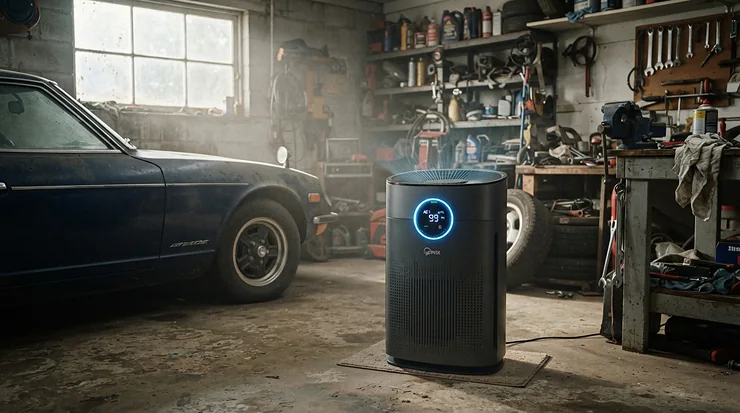
You pull in, shut off the engine, and walk through the mudroom door. Two minutes later the back hallway smells like a gas station’s cousin. That lingering whiff is the garage talking, and it’s talking to your living room. A garage air purifier for exhaust fumes is the gadget most people reach for next.
It can help, with one big caveat. Purifiers with deep carbon beds can adsorb many odor-causing gases and VOCs. True HEPA media can trap soot-like exhaust particulates. But the EPA’s Guide to Air Cleaners in the Home states that carbon monoxide is not readily captured by residential gas-phase filters. So no purifier on this list is a carbon monoxide solution. A CO alarm, an air-sealed door and smart habits do that job.
That honesty shapes everything below. We researched seven real, widely sold models, from a budget particle workhorse to a pound-heavy carbon beast. For each one we translate the spec sheet into what it means in a cold, dusty box with a car in it.
You’ll also get a practical guide to attached garage ventilation and a plain-English look at exhaust particulates. There’s a buyer’s framework for choosing between a heavy duty air purifier for garage use and a lighter air purifier for attached garage rooms.
Prices are ranges from our 2026 research, so check current listings. Let’s clear the air. 🚗
Quick Comparison: 7 Garage Air Purifier for Exhaust Fumes Options at a Glance
Start with the carbon column. For fumes, how much carbon a unit holds matters more than almost anything else on the box. HEPA grade, app features and color all come after it.
| Model | Approx. Carbon | Price Range | Best For |
|---|---|---|---|
| Winix 5510 | About 0.5 lb pellets | $150–$200 | Dust and light odors on a budget |
| Levoit Core 400S-P | About 240 g pelleted (heavier upgrade filters exist) | $180–$230 | Smart auto mode, light fumes |
| Oransi TrueCarbon 200C | 3.2 lb granular | $340–$400 | Gas and odor focus (pair with a HEPA unit) |
| Alen BreatheSmart 75i (Fresh filter) | 3.6 lb | Mid-$400s to low $500s | Two-car garages, HEPA plus carbon |
| Austin Air HealthMate HM400 | 15 lb carbon/zeolite | $600–$850 | Long filter life, set-and-forget |
| Airpura V600 | 18 lb | High-$800s to about $900 | Maximum chemical capacity |
| IQAir HealthPro Plus | About 5 lb | $900–$1,200 | Sealed build, ultrafine particles, long warranty |
Looking at the table, the jump from the Winix 5510 to the Oransi TrueCarbon 200C is about six times the carbon for roughly twice the money. That makes the TrueCarbon 200C the best carbon-per-dollar move here. If particles matter as much as smells, the Alen BreatheSmart 75i is the cheapest way to get real HEPA and meaningful carbon in one box. The Austin Air HealthMate HM400 and Airpura V600 are for garages where fumes are a daily fact of life.
💬 Just one click — help others make better buying decisions too!😊
Top 7 Garage Air Purifier for Exhaust Fumes Picks: Expert Analysis
Every model below is a real, currently sold product. We grounded each write-up in manufacturer specs and published reviews rather than invented test stories. Where we couldn’t verify a pool of independent garage-specific reviews, we say so.
1. Winix 5510 — budget particle workhorse
The Winix 5510 is the pick for a garage where dust, sanding residue and soot-like particles are a bigger headache than chemical smell.
It uses four stages: a pre-filter, activated carbon, True HEPA and a PlasmaWave ionizer. Its smoke CADR lands around 230–250 CFM depending on the test source. That’s enough airflow to turn over a one-car garage several times an hour. The True HEPA stage does the particle work. The carbon layer is modest, about half a pound by one comparison. Think deodorizing layer, not fume sponge.
Buy it if your problem is mostly particles and you want a cheap unit near the workbench. Skip it as your only defense against gasoline vapor from fuel cans or a mower, because that thin carbon will saturate fast. Review aggregations of Winix purifiers broadly describe them as durable budget machines, but with weak VOC performance and mixed feelings about PlasmaWave.
Pros:
- ✅ True HEPA captures fine garage dust and soot
- ✅ Low price makes a second unit affordable
- ✅ Compact enough to tuck near a workbench
Cons:
- ❌ Thin carbon bed saturates fast near fumes
- ❌ PlasmaWave ionizer draws mixed reviews
Typically in the $150–$200 range: strong value as a particle filter, weak value as a gas filter.
2. Levoit Core 400S-P — smart sensor that reacts to dust
What sets the Levoit Core 400S-P apart is its laser PM2.5 sensor. In Auto mode it ramps the fan when particle levels spike, such as right after you pull the car in.
The spec sheet lists about 260 CFM of CADR and roughly 403 square feet of coverage, with a washable pre-filter, an H13 True HEPA layer and pelleted carbon. Reviewers report carbon mass in the neighborhood of 240 grams in the standard filter. They report heavier Smoke Remover and Toxin variants, with the Smoke Remover reportedly near 450 grams. In practice, the sensor sees particles, not gases. There’s no dedicated VOC sensor, so Auto mode won’t react to a gasoline smell.
Our take: it’s a smart, quiet-ish-on-low, easy-to-live-with unit for a one-car garage or a mudroom-side bay. Upgrade to a heavier carbon filter if fumes are the point. Published reviews consistently flag two things: the carbon layer is thin for heavy fumes, and replacement filters (around $50) are the main ongoing cost.
Pros:
- ✅ Auto mode reacts to particle spikes
- ✅ App and voice-assistant control
- ✅ Upgrade filters add extra carbon
Cons:
- ❌ Standard carbon too thin for heavy fumes
- ❌ Replacement filters add up annually
Roughly $180–$230: excellent value if you pair it with an upgraded carbon filter.
3. Oransi TrueCarbon 200C — most carbon per dollar
The Oransi TrueCarbon 200C is built around one idea: lots of carbon, in a bed more than two inches deep. The manufacturer lists 3.2 pounds of granular carbon treated with potassium permanganate. The filter measures about 10 x 10 x 2.2 inches inside a 10-pound unit rated for roughly 375 square feet.
There’s one crucial detail. This model has no HEPA stage, and the maker says to use only its TrueCarbon filter in it. In practice, air gets plenty of contact time with the carbon, which is what you want for exhaust odors and solvent vapors. But particles pass through untouched, so pair it with a HEPA unit like the Winix 5510 or Levoit Core 400S-P.
Walmart’s listing showed an average near 4.6 out of 5 at the time of research, with reviewers praising smoke and odor removal. A recurring Reddit complaint is the cost of replacement carbon, which runs under $100. Treat it as a consumable.
Pros:
- ✅ Over 3 lb of granular carbon at this price
- ✅ Light 10 lb unit is easy to reposition
- ✅ Treated carbon aimed at stubborn VOCs
Cons:
- ❌ No HEPA stage, so no particle capture
- ❌ Replacement carbon filter costs nearly $100
Around $340–$400: the best value here for fumes specifically.
4. Alen BreatheSmart 75i — two-car coverage with real HEPA
The Alen BreatheSmart 75i is the one to price out if you want HEPA and meaningful carbon without buying two machines. With the Fresh filter, it combines H13 True HEPA with about 3.6 pounds of activated carbon.
Alen lists a 347 CFM CADR and rated coverage up to 1,300 square feet. Here’s why that matters. A 20 x 20 x 8 foot two-car garage holds about 3,200 cubic feet. At 347 CFM that’s one full air change roughly every nine minutes. Add Wi-Fi, onboard sensors and a 27-pound body, and it’s a capable, quiet-on-low machine.
The catch: the base “Pure” filter has no carbon. You must choose Fresh (or a heavier option) to get fume capability. Reviewers praise the coverage and low-speed noise. They flag the price, and Alen’s “Forever Guarantee” requires product registration and an active filter subscription, so read the terms.
Pros:
- ✅ HEPA and 3.6 lb carbon in one machine
- ✅ Covers two-car garages at high airflow
- ✅ App, sensors and several filter options
Cons:
- ❌ Must order the Fresh filter to get carbon
- ❌ Lifetime guarantee needs registration and filter plan
Mid-$400s to low $500s: fair value for a one-box HEPA-plus-carbon solution.
5. Austin Air HealthMate HM400 — five-year filters, steel build
The Austin Air HealthMate HM400 is the old-school tank of the group. Its sealed filter drum holds 15 pounds of a coconut-shell carbon and zeolite blend plus 60 square feet of medical-grade HEPA. The housing is steel with rolling casters, and the whole unit weighs about 47 pounds.
The maker rates the motor at up to 400 CFM free-flow, but air passing through the dense filter is closer to 250 CFM. That trade is deliberate: slower airflow through more carbon means longer dwell time. Noise runs about 50 dB on low and 66 dB on high.
The detail to weigh: Austin’s five-year pro-rated filter warranty is for normal residential conditions, and the company says heavy contaminant loads can shorten filter life. A garage is a heavier load than a bedroom. Ask Austin whether your use qualifies before buying, and plan on replacing filters earlier. Reviewers praise the build quality and low long-run cost, and note the weight and fan noise at top speed.
Pros:
- ✅ 15 lb carbon-zeolite blend resists saturation
- ✅ Steel body with casters shrugs off garage knocks
- ✅ Five-year pro-rated filter and mechanical warranty
Cons:
- ❌ Heavy at about 47 pounds
- ❌ Loud on top speed, about 66 dB
Roughly $600–$850 depending on retailer: pricey up front, cheap per year if filters last.
6. Airpura V600 — heaviest carbon bed here
The Airpura V600 carries 18 pounds of enhanced carbon, the largest bed on this list. It’s potassium-iodide-treated coconut shell, with a potassium-permanganate upgrade available. Behind it sits a 40-square-foot True HEPA filter and a fan rated up to 560 CFM free-flow. Delivered airflow through the filters is estimated at about 100, 246 and 366 CFM at low, medium and high.
The best feature for a garage is that the HEPA and carbon filters are separate. Carbon saturates first in a fume-heavy space, and you can replace it (roughly every two years, per retailer specs) without buying new HEPA (about five years). Retailer specs list roughly 28 dB on low and 62 dB on high.
One honest note: we couldn’t verify a large pool of independent garage-specific reviews. Retailer pages include owner comments about handling renovation VOCs and mention a mild carbon smell that fades after the first days. Availability and sellers vary, so check current Amazon listings before buying.
Pros:
- ✅ 18 lb carbon bed is the largest here
- ✅ Carbon and HEPA filters replace separately
- ✅ Variable fan from near-silent to powerful
Cons:
- ❌ Premium price for a garage appliance
- ❌ Stock and seller availability vary by retailer
High-$800s to about $900: justified only if fumes are a daily reality.
7. IQAir HealthPro Plus — sealed Swiss build, ultrafine focus
The IQAir HealthPro Plus is the premium pick. It uses three stages: a PreMax pre-filter, a V5-Cell gas filter (about 5 pounds of granular carbon plus impregnated alumina) and a HyperHEPA particle filter. IQAir rates it for about 1,125 square feet, and filters last roughly 18 months, 2 years and 4 years respectively.
The V5-Cell’s carbon-plus-alumina blend targets a broader range of gases than carbon alone. The sealed housing limits unfiltered air from slipping around the filters. The company doesn’t submit the unit for AHAM CADR testing, and reviewers report roughly 260–300 CFM.
Our take: choose it if the garage adjoins a nursery or an asthmatic household and you want strict particle control. For pure fume capacity it costs more per pound of carbon than the Austin Air HealthMate HM400 or Airpura V600. Reviewers praise build quality and the 10-year warranty (with registration). They question the price against its airflow.
Pros:
- ✅ Sealed design limits unfiltered air bypass
- ✅ Carbon plus alumina blend targets more gases
- ✅ Ten-year warranty with registration
Cons:
- ❌ Costs several times more than budget picks
- ❌ Airflow modest for a unit this large
Roughly $900–$1,200: great engineering, so-so value for fumes alone.
Top 7 Compared: Specs and Value
| Model | Airflow (CFM) | Carbon | Typical Filter Life | Price Range | Best For |
|---|---|---|---|---|---|
| Winix 5510 | About 230–250 | About 0.5 lb | About 1 year | $150–$200 | Budget particle control |
| Levoit Core 400S-P | About 260 | About 240 g (upgrades up to ~450 g) | 9–12 months | $180–$230 | Smart auto mode |
| Oransi TrueCarbon 200C | Compact fan, ~375 sq ft | 3.2 lb | Varies with fume load | $340–$400 | Fume-first, paired with HEPA |
| Alen BreatheSmart 75i | About 347 | 3.6 lb (Fresh) | Up to ~15 months | Mid-$400s to low $500s | Two-car garages |
| Austin Air HealthMate HM400 | ~250 delivered (400 free-flow) | 15 lb | Up to 5 years (residential) | $600–$850 | Low-maintenance heavy use |
| Airpura V600 | ~100–366 delivered (560 free-flow) | 18 lb | Carbon ~2 yrs, HEPA ~5 yrs | High-$800s to ~$900 | Maximum chemical capacity |
| IQAir HealthPro Plus | About 260–300 (reviewer-reported) | About 5 lb | Gas filter ~2 yrs, HyperHEPA ~4 yrs | $900–$1,200 | Ultrafine particles, warranty |
Looking at the numbers, airflow and carbon don’t move together. The Alen BreatheSmart 75i moves the most air, while the Airpura V600 and Austin Air HealthMate HM400 hold the most carbon. For a two-car garage with a daily commute car, the 75i or V600 are the logical heavyweights. A one-car garage with occasional fumes is well served by the Oransi TrueCarbon 200C plus a budget HEPA unit like the Winix 5510.
Attached Garage Ventilation: A Practical Setup Guide
A purifier works best as the second layer, not the first. Canadian research shows why. The Health Canada–National Research Council attached garage intervention study tested two fixes: exhaust ventilation in the garage and better sealing of the garage-house wall. Earlier airtightness testing found the house-garage interface is roughly as leaky as the rest of the house envelope. Homes with attached garages tend to show higher indoor benzene, carbon monoxide and nitrogen dioxide.
Here’s the order of operations:
- Seal the interior wall and door. Add weatherstripping and a door sweep, and caulk penetrations for wiring, pipes and ducts. This is the cheapest fix and it stops everything, including carbon monoxide.
- Keep ducts out of the garage. Never run HVAC returns through it.
- Move the sources. Store gasoline, solvents and paint in a detached shed if you can.
- Add exhaust ventilation carefully. Pulling air out needs makeup air. If a water heater or furnace sits in the garage, have a pro check for backdrafting first.
- Add the purifier. It handles what’s left.
Air Purifier for Attached Garage: Placement and Runtime
Place the unit inside the garage with a foot or two of clearance on every intake side. Keep it off wet floors, away from car doors and plugged into a GFCI-protected outlet. Check the manual’s operating temperature range, because garages swing far beyond living-room conditions.
For sizing, multiply length x width x height. A 20 x 20 x 8 foot garage is 3,200 cubic feet. A 250 CFM unit turns that over every 12.8 minutes (about 4.7 times per hour). A 12 x 20 x 8 one-car garage is 1,920 cubic feet, or one change every 7.7 minutes at the same airflow. As a reasonable starting point, run the purifier after each drive on high for 30–60 minutes, then drop to low.
Real-World Scenarios: Matching a Purifier to Your Garage
Specs only matter when they meet a real garage. Here are three profiles.
The weekend wrencher. Two-car attached garage, a project car, a few hours every weekend and a $500–$600 budget. Gas vapors and brake dust dominate. The Alen BreatheSmart 75i with the Fresh filter covers the volume and carries real carbon. If the budget allows, add an Oransi TrueCarbon 200C near the project bay.
The daily commuter. One-car attached garage, a bedroom above it, and the car starts every morning at 6:30. The key moves are sealing the wall and adding a CO alarm in the hallway. Then a Levoit Core 400S-P on Auto gives low-cost coverage for particle spikes. Budget: roughly $250 total.
The small-engine hobbyist. Detached-feeling attached garage with mowers, a generator, gas cans and a chainsaw. Frequent daily use means heavy carbon load. The Airpura V600 or Austin Air HealthMate HM400 earn their price here. The real fix is moving fuel containers outside and never running the generator indoors.
Problem → Solution Guide: Common Garage Air Complaints
Problem 1: “The smell still reaches the mudroom.” The house-garage wall is leaking. Seal the door and penetrations before buying a second purifier.
Problem 2: “My carbon filter quit after a few weeks.” Thin carbon mats saturate quickly in active garages. Move up to a bed measured in pounds, like the Oransi TrueCarbon 200C or Airpura V600.
Problem 3: “The pre-filter is caked with dust.” Vacuum it regularly. A clogged pre-filter cuts airflow and shortens the life of the Winix 5510 or Levoit Core 400S-P.
Problem 4: “It’s freezing or sweltering out there.” Check each manufacturer’s operating range before leaving a purifier in an unconditioned garage.
Problem 5: “I’m counting on the purifier for safety.” Don’t. No purifier replaces a carbon monoxide alarm and sound habits.
What Is a Garage Air Purifier for Exhaust Fumes?
A garage air purifier for exhaust fumes is a portable air cleaner that pairs activated carbon, which adsorbs odor-causing gases and VOCs, with a HEPA filter that traps fine particles such as soot. It can reduce some exhaust pollutants and odors in a garage, but it does not eliminate carbon monoxide.
Two filters, two jobs. HEPA captures solid and liquid particles. It does nothing for gases. Activated carbon grabs gas molecules on its surface, and it has a finite capacity. Once the surface fills, odors break through. That’s why pounds of carbon matter and why a thin mat in a budget unit may be exhausted within weeks near a strong source.
Skip anything built on ozone generation or ionization as its main trick. The EPA’s technical summary notes that photocatalytic oxidation cleaners are often ineffective at fully transforming gases and can generate ozone. A garage with fumes is the last place to add an unproven gas-conversion gadget. Stick with real carbon and real HEPA.
How to Choose a Garage Air Purifier for Exhaust Fumes
Here’s a seven-step checklist, in the order that matters.
- Weigh the carbon first. More carbon means more adsorption and a longer life. California’s Air Resources Board notes that gas-removal air cleaners are costly to buy and maintain and that standards for gas removal haven’t been developed. So you can’t lean on a certification. Use mass as your proxy.
- Match airflow to garage volume. Multiply L x W x H, then divide by the unit’s real CFM to get minutes per air change.
- Insist on true HEPA if particles matter. Carbon-only units like the Oransi TrueCarbon 200C leave particles alone.
- Check the build. Steel, casters and a sealed filter drum, as on the Austin Air HealthMate HM400, survive garages better than thin plastic.
- Budget the filters. Carbon is the consumable. Price a year of replacements, not just the unit.
- Avoid ozone and ionizer-first designs. They add risk without proven fume removal.
- Pair it with a CO alarm. Always.
Carbon Monoxide: What a Purifier Can’t Do (and What Can)
Here’s the plain version. Carbon monoxide is not readily captured by the adsorption used in residential gas-phase filters, according to EPA guidance. HEPA doesn’t touch it, and activated carbon doesn’t meaningfully adsorb it. Marketing that implies otherwise should make you wary. A purifier also can’t detect CO, so it will never warn you.
The risk is real. The CPSC’s guidance on responding to residential carbon monoxide incidents notes that a vehicle left idling in an attached garage can cause elevated CO, even with the garage door open. Never idle a car in an attached garage, and never run generators or gas-powered tools there.
What actually protects you:
- CO alarms. Install them on every level with sleeping areas and within about 15 feet of each bedroom door, per local fire-department guidance. Avoid placing standard alarms in the garage itself, since those spaces can trigger nuisance alarms. Check the manufacturer’s instructions.
- Know your local rules. Model fire-code language calls for CO detection in dwellings with attached garages. About 47 states require CO alarms in some form, and details vary by jurisdiction.
- Source control. Open the door and drive away. Let a cold engine run outside.
Exhaust Particulates: What HEPA Actually Catches
Engine exhaust isn’t just gas. It carries fine and ultrafine particles: soot, condensed hydrocarbons and metal-rich dust from brakes. These exhaust particulates are the part a purifier handles best.
True HEPA is rated to capture 99.97% of particles at 0.3 microns, the size filters find hardest to catch. Smaller and larger particles are caught at even higher rates. So any True HEPA unit, including the Winix 5510, Levoit Core 400S-P, Alen BreatheSmart 75i, Austin Air HealthMate HM400 and Airpura V600, is well suited to this job. The IQAir HealthPro Plus pushes harder on the ultrafine end, with a sealed design that limits bypass. Its maker claims capture down to 0.003 microns, though independent AHAM CADR verification isn’t offered.
Cold starts and idling put out the most particles. If you want to reduce exposure, move the car outside quickly and run the purifier on high afterward. A PM2.5 sensor, like the one in the Levoit Core 400S-P, can show you the spike and how fast it falls.
Heavy Duty Air Purifier for Garage vs Other Fixes
A heavy duty air purifier for garage use is powerful, but it’s one tool among several. Here’s how each option stacks up.
| Fix | Handles | Misses | Best For |
|---|---|---|---|
| Heavy duty carbon + HEPA purifier (e.g., Airpura V600, Austin Air HealthMate HM400) | Odors, VOCs, particles | Carbon monoxide; the source itself | Daily fume exposure |
| Sealing the house-garage wall | Everything, including CO migration | Pollution inside the garage | Every attached garage |
| Exhaust ventilation (e.g., an inline fan with carbon like the AC Infinity CLOUDLINE S8) | Dilutes and removes fumes | Needs makeup air; backdraft risk | Workshop-style use |
| CO alarm | Warning for CO | Removes nothing | Every home with an attached garage |
| Moving fuels and solvents to a shed | The source | Exhaust from vehicles | Storage-heavy garages |
The table makes the sequence clear. Sealing and a CO alarm come first because they address the pathway and the warning, and a purifier does neither. A ducted setup like the AC Infinity CLOUDLINE S8 shows how a fan with a carbon filter can push air outside. That’s a bigger project that calls for professional input if any combustion appliances share the space. A Airpura V600 or Austin Air HealthMate HM400 then mops up what’s left inside the garage.
Long-Term Cost & Maintenance
The sticker price is the opening bid. The real cost is filters. Carbon degrades invisibly, and no sensor tells you when it’s spent. Your nose is the indicator.
| Model | Replacement Item | Approx. Cost / Interval | Best For |
|---|---|---|---|
| Levoit Core 400S-P | Combined filter | Around $50 / 9–12 months | Low-cost smart operation |
| Oransi TrueCarbon 200C | Carbon filter | Under $100 / varies with fume load | Fume-heavy, budget-aware |
| Austin Air HealthMate HM400 | Whole filter drum | Averages roughly $40–$50 per year over up to 5 years | Low per-year cost |
| Airpura V600 | Carbon / HEPA separately | Carbon ~2 yrs, HEPA ~5 yrs (confirm prices) | Swapping saturated carbon cheaply |
| IQAir HealthPro Plus | V5-Cell / HyperHEPA | Gas filter around $100 / ~2 yrs; HyperHEPA about $200 / ~4 yrs | Long-run build quality |
On paper, the Austin Air HealthMate HM400 wins on cost per year, but garage loads may shorten that five-year figure. The Airpura V600‘s separate filters let you replace only what’s spent. For the budget picks, the Levoit Core 400S-P and Winix 5510, the cost is small, but expect yearly replacements.
Keep the maintenance simple. Vacuum pre-filters monthly, log your install dates, and replace carbon when odors break through. Wipe the housing and keep intakes clear.
Common Mistakes When Buying a Garage Air Purifier for Exhaust Fumes
- Treating a purifier as carbon monoxide protection. It isn’t. See above.
- Buying HEPA-only. A unit with no carbon doesn’t touch gasoline vapor.
- Trusting “activated carbon” on the label. Ask how much. A thin mat is a deodorizer.
- Skipping air sealing. A purifier fights a leak you could close with weatherstripping.
- Chasing ionizers and ozone gimmicks. Real carbon beats buzzwords.
- Running a car in a closed garage “just for a minute.” Idling is where elevated CO happens.
- Ignoring operating limits. Garages get colder and hotter than any manual assumes.
FAQ
❓ How many pounds of carbon should a garage air purifier have?
❓ Is it safe to leave an air purifier running in a garage all the time?
❓ Will a garage air purifier stop exhaust smell from entering my house?
❓ How often should I replace a garage air purifier's carbon filter?
❓ Is a heavy duty air purifier for garage use better than an exhaust fan?
Conclusion
A garage air purifier for exhaust fumes is a smart upgrade when you understand its job. It cuts odors, VOCs and exhaust particulates. It isn’t a lifeline for carbon monoxide, and it can’t fix a leaky wall.
Pick by carbon weight first and airflow second. For a budget start, the Winix 5510 plus the Levoit Core 400S-P handle particles and light smells. The Oransi TrueCarbon 200C adds serious fume capacity for the money. The Alen BreatheSmart 75i packs HEPA and carbon into a two-car-garage machine. The Austin Air HealthMate HM400 and Airpura V600 are for heavy, daily fume loads. The IQAir HealthPro Plus is the sealed, long-warranty premium option.
Whatever you buy, seal the house-garage wall, store fuels outside, never idle a car in the garage and install working CO alarms. That’s the combination that actually protects your household.
✨ Ready to clear your garage air?
🔍 Click on any highlighted product above to check current pricing and availability. Choose the model that fits your garage’s size and fume load, then pair it with a CO alarm and a well-sealed door. Your hallway (and lungs) will thank you!
Recommended for You
- Air Purifier For Garage Workshop Fumes: 7 Best Proven Picks (2026)
- Air Purifier For Shared Office: 7 Top Picks That Beat Fumes 2026
- Desk Air Purifier For Office: 7 Best Quiet Picks (2026)
Disclaimer: This article contains affiliate links. As an Amazon Associate, I earn from qualifying purchases. If you purchase products through these links, we may earn a small commission at no additional cost to you.
✨ Found this helpful? Share it with your friends! 💬🤗
