
In This Article
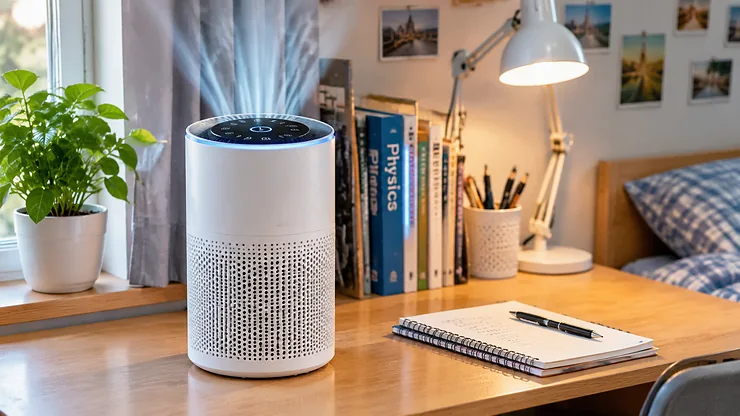
A portable air purifier for desk use is a compact, lightweight air cleaner, usually under three pounds and often fed by USB or a small adapter. It filters the few feet of air around your face instead of a whole room. Most pair a small fan with a HEPA filter to trim dust, pollen and pet dander at arm’s length.
Here’s the part the box art skips: “personal” really means personal. The U.S. EPA notes that portable air cleaners can help improve indoor air but cannot remove every pollutant, and a unit the size of a soda can won’t scrub a conference room. What it can do is shave particles out of the pocket of air you breathe for eight hours a day. For plenty of us, that’s exactly the job.
So consider this the legwork you’d otherwise do across fifteen browser tabs. This guide pulls together published specs, third-party lab-style tests, editorial reviews and aggregated owner ratings for seven real models, then translates the numbers into what they mean on an actual desk. One honesty note up front: this is research, not a hands-on test lab. Where owner reviews were thin, I say so instead of dressing things up.
Along the way you’ll get a playbook for choosing a portable air purifier for office desk setups, straight talk on a lightweight portable air purifier for allergies, a reality check on USB power, and a hard look at desk footprint. Research was done in November 2026. Prices drift, so treat every range below as a starting point and check the current price before you buy.
Portable Air Purifier for Desk: Quick Comparison Table
Here are all seven contenders side by side. Details and reasoning follow in the product breakdowns.
| Product | Power | Footprint | Noise | Best For |
|---|---|---|---|---|
| Levoit Core Mini-P | 12V wall adapter (not USB) | 6.5 × 6.5 × 10.4 in | 25-44 dB (rated) | Quiet all-day office use |
| UPLIFT Desktop Air Purifier | USB cable (bring a charger) | 4.8 in wide, 7.5 in tall | ~28 dB (claimed) | Standing-desk setups |
| Pure Enrichment PureZone Mini | USB-rechargeable battery | 8.5 × 3.3 × 2.7 in | No official figure found | Commuters and hot-desking |
| KIKI PURE A1 Mini | USB-C | Palm-sized, ~136 g | ~18 dB (claimed) | Laptop-port budget buyers |
| GoveeLife Mini | Plug-in (confirm on listing) | 6.2 × 6.2 × 10.7 in | ~24 dB low (claimed) | App control on a budget |
| KOIOS EPI810 | Wall plug; USB optional (slower fan) | 6.9 in wide, 7.5 in tall | ~40-52 dB (measured) | Cheapest starter unit |
| IQAir Atem Desk | Adapter with desk stand | Compact round unit on stand | 20-44 dB | Premium breathing-zone filtering |
Read the Power column first. Only the Pure Enrichment PureZone Mini, KIKI PURE A1 Mini and UPLIFT Desktop Air Purifier genuinely live on USB. If your desk has no spare outlet, that narrows the field fast. For silence, the Levoit Core Mini-P and IQAir Atem Desk lead the pack. The KOIOS EPI810 is the cheapest way in, but it posted the weakest measured performance of the group.
💬 Just one click — help others make better buying decisions too!😊
Top 7 Portable Air Purifier for Desk Picks: Expert Analysis
These are ordered loosely from best all-rounder to most specialized. Every spec gets translated into what it means once the unit sits next to your keyboard.
1. Levoit Core Mini-P — whisper-quiet pick for long workdays
Quiet is the whole pitch. Levoit rates the Levoit Core Mini-P at 25-44 dB, which should mean the low setting vanishes under keyboard clatter. It draws 7W, uses three-stage filtration, and carries a manufacturer CADR of 34 CFM. Levoit lists its sweet spot as about 53 square feet at 4.8 air changes per hour. Translation: it’s built to churn through the air in a small office or nook, not a living room.
At 6.5 × 6.5 × 10.4 inches and 2.2 pounds, the desk footprint is a little smaller than a dinner plate. The catch for USB fans is that it runs on a 12V wall adapter, so a laptop port won’t feed it.
The spec sheet won’t tell you this, but independent testing of the closely related Core Mini measured roughly 41.8 dBA on low and 53.6 dBA at the top. Real-world “low” is therefore a soft whoosh, not silence. Roundup reviewers consistently rank it among the best desk-friendly picks for quiet and compactness, though I couldn’t verify a large pool of owner reviews directly.
Pros:
- ✅ Genuinely quiet on low settings
- ✅ Small footprint for a real tower purifier
- ✅ Two-year limited warranty
Cons:
- ❌ Needs a wall outlet, not USB power
- ❌ CADR is modest for anything beyond a nook
Price sits in the budget tier, roughly $50-$70 in recent listings, so check the current price. Verdict: the safest all-rounder for call-heavy offices.
2. UPLIFT Desktop Air Purifier — USB-only and built for standing desks
The UPLIFT Desktop Air Purifier behaves like desk furniture. It’s 4.8 inches across and 7.5 inches tall, about the base of a large coffee mug, and it runs from a USB cable (38 inches included, wall charger not). That tiny desk footprint is its biggest argument.
Inside you get a True HEPA filter plus activated carbon, with a claimed 99.7% capture at 0.3 microns and a claimed 28 dB noise level. The carbon layer matters. The EPA points to carbon filters for gases, so HEPA-only models won’t touch lingering smells the way this one can. UPLIFT suggests a filter swap about every six months.
One Tom’s Guide writer’s editorial piece offers the most useful real-world color here. A match-smoke test took several hours before the smell faded. The air mostly shoots upward, so there’s no chilly blast, and the supplied cable was too short for comfortable placement. This unit suits people sitting 18-30 inches away who run it all day.
On owner sentiment, the brand’s page showed no customer reviews when I checked, so the evidence rests on that single editorial take.
Pros:
- ✅ Carbon plus HEPA for odors and particles
- ✅ Tiny desk footprint
- ✅ Gentle upward airflow, no chilly draft
Cons:
- ❌ Short cable and no wall charger included
- ❌ Slow on strong smells
Expect to spend around $60. Verdict: fair value, especially for USB-first desks.
3. Pure Enrichment PureZone Mini — cordless battery that goes where you go
The Pure Enrichment PureZone Mini is the one you can unplug and carry to a meeting. At roughly 0.58 pounds and 8.5 × 3.3 × 2.7 inches, it’s lighter than most phones with a case on. The rechargeable lithium battery is rated up to 12 hours on low, while the manual suggests anywhere from about 2.5 to 12 hours depending on speed. Charging takes roughly four hours.
It uses a two-stage setup with a carbon pre-filter and a True HEPA filter, three fan speeds, and a five-year warranty. Pure Enrichment suggests a filter change about every six months.
Be careful with the coverage claims. The brand’s own page lists personal-space coverage of about 6 square feet, while some retailers repeat a 54-square-foot figure. Treat it as a bubble around you, not a room cleaner. That’s still plenty for a seat, a car cup holder or a tray table.
Roughly 4.7 stars across 500-plus Walmart ratings suggests owners are happy, praising battery life, size and quiet operation. Feedback on long-term battery life is mixed, and one reviewer notes it can’t handle a 100-plus square foot office.
Pros:
- ✅ Cordless, so no outlet needed
- ✅ Feather-light and easy to carry
- ✅ Five-year warranty
Cons:
- ❌ Battery needs regular recharging
- ❌ Tiny effective coverage
It lands in the mid-$40s range. Verdict: strong value if mobility matters more than raw airflow.
4. KIKI PURE A1 Mini — palm-sized USB-C budget companion
The KIKI PURE A1 Mini is the lightest thing here, around 136 grams (about 4.8 ounces), and it runs on USB-C. That means your laptop or a power bank can feed it, which makes it a true USB power candidate. The brand talks up personal-space coverage of up to 100 square feet and a whisper-level 18 dB.
I’d take those as best-case marketing figures. A unit this small moves a limited volume of air, so think “air near me,” not “air in my cubicle farm.” On paper it offers HEPA-style filtration, one-touch operation and an optional night light.
Owner sentiment is polarized rather than glowing. One retailer listing showed 4.0 out of 5 across 20 reviews: 14 five-star ratings and 4 one-star ratings. Happy owners describe carrying it in a purse and powering it from a laptop port. Some mention a nurse using it at work to ease allergy symptoms. Several say they noticed fresher air within about thirty minutes, but that’s a perception, not a measurement.
Pros:
- ✅ Ultra-light and truly pocketable
- ✅ USB-C power from a laptop or power bank
- ✅ Simple one-button operation
Cons:
- ❌ Coverage claims look optimistic for its size
- ❌ Mixed owner reliability reports
Budget tier pricing, so check the current price. Verdict: a low-risk way to try a desk purifier if you accept its limits.
5. GoveeLife Mini — app control on a bargain budget
The GoveeLife Mini (model H7126) adds smart-home features most mini purifiers skip. It’s listed at 50 CFM CADR for rooms up to about 78 square feet, in a 6.2 × 6.2 × 10.7 inch body weighing 2.5 pounds. You also get three speeds, two modes, a timer, aroma-pad support and a one-year warranty.
The app deserves a reality check. One independent tester says it works essentially as a remote control, so don’t expect advanced air-quality intelligence. That same tester scored performance a middling 5.8 out of 10, noise 9.6 and overall 8.1. Measured noise ran about 40.1 dBA on low and 56.5 dBA at maximum, and odor handling was weak.
It makes the most sense for a bedroom-office hybrid where a bit of scheduling is nice. Retailer-syndicated ratings sat around 4.4 out of 5 from 39 reviews on the brand’s own site, with owners praising easy setup and quiet running.
Pros:
- ✅ App, timer and voice-assistant control
- ✅ Higher CADR than the tiniest units
- ✅ Very low running cost
Cons:
- ❌ Middling measured particle removal
- ❌ Only a one-year warranty
Recent listings fell in the $35-$45 range. Verdict: decent for smart-home fans, average for pure performance.
6. KOIOS EPI810 — cheapest ticket in, with real caveats
The KOIOS EPI810 is the budget wildcard. It’s 6.9 inches wide and 7.5 inches tall, under 2.5 pounds, with a True HEPA H13 filter, an activated carbon layer, two fan speeds and a built-in night light. It can run from a wall plug or a laptop USB cable, though Live Science found fan speed dropped on USB. That makes the USB option more novelty than feature.
Live Science’s 2022 review is the most sobering data point in this guide. In a 323-square-foot sealed room over 30 minutes, it cut particles smaller than 0.3 microns by about 52% on low and 75% on high. It was the weakest performer among the units that outlet had tested, at roughly 40 dB on low and 52 dB on high.
Owner ratings looked rosier, around 4.5 out of 5 on Amazon at review time. Negative reviews cited noise at top speed, a night light that’s tricky to switch off, a cheap feel and pricey replacement filters. That review is a few years old, so check for newer revisions.
Pros:
- ✅ Very affordable entry price
- ✅ Carbon layer helps with cooking smells
- ✅ Easy out-of-the-box setup
Cons:
- ❌ Weakest measured performance in testing
- ❌ Loud at top speed, pricey replacement filters
It was listed from roughly the mid-$40s to $50s at review time. Verdict: only for tight budgets and low expectations.
7. IQAir Atem Desk — premium breathing-zone specialist
The IQAir Atem Desk is the premium outlier. IQAir says its HyperHEPA filtration removes at least 99% of particles down to 0.003 microns, and it markets coverage of up to 150 square feet. A third-party test paints a narrower picture: a CADR of about 18 cfm and only a 33% particle drop over an hour in a 400-square-foot space. The takeaway is that this thing cleans your breathing zone, not your room.
Noise runs from about 20 dB on low to 44 dB on high, and filters last roughly a year at ten hours a day. A spec aggregator notes there’s no dedicated carbon stage, so it won’t meaningfully tackle odors or VOCs. Rolling Stone praised it, though I found that via IQAir’s own newsroom, so weigh the source. Aggregated impressions mostly highlight daytime quietness.
Pros:
- ✅ Exceptionally quiet on low
- ✅ Ultrafine particle filtration claims
- ✅ Individual factory testing per unit
Cons:
- ❌ Steep price for tiny measured CADR
- ❌ No carbon stage for smells
Expect around $400. Verdict: worth it only if you want brand-level filtration and quiet above all.
How to Choose a Portable Air Purifier for Desk Use
Picking well takes five minutes of homework. Work through these steps in order.
- Define the zone. Decide whether you’re protecting your breathing space or a small room. A personal unit covers arm’s length. A small tower covers a nook.
- Check CADR, not just “coverage.” The ENERGY STAR “2/3 rule” says look for a CADR of at least two-thirds of your room’s square footage. The EPA sizing table calls for about 65 cfm for a 100-square-foot room, so a 34-50 CFM unit is a personal or tiny-room tool.
- Match the power source to your desk. Count outlets, USB ports and cable reach before you buy.
- Prioritize noise. Anything above roughly 45 dB on the setting you’ll actually use will annoy you by Wednesday.
- Decide on carbon. Particles need HEPA. Smells and gases need an activated carbon layer.
- Price the filters. Replacement filters are the real recurring cost.
- Skip ozone. Avoid any “ionizer” that intentionally generates ozone.
Portable Air Purifier for Office Desk: What Works in Cubicles and Home Offices
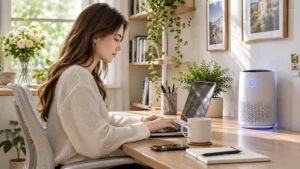
A portable air purifier for office desk use faces different constraints than a home setup. You share space, power and noise rules, and you can’t always dictate the building’s ventilation. That makes noise, plug access and desk footprint the deciding factors.
In an open office, aim for the quietest unit you can afford. The Levoit Core Mini-P and IQAir Atem Desk lead there on paper. If you hot-desk or work from shared tables, the cordless Pure Enrichment PureZone Mini or the USB-C KIKI PURE A1 Mini travel with you. If your desk is near a lunch area, a carbon layer, like in the UPLIFT Desktop Air Purifier, earns its keep.
Position matters as much as the model. Put the unit within arm’s length and keep the intake clear of papers. Check any shared-space or workplace policy first. Some offices restrict plug-in devices or anything with a night light. Remember what a personal unit can’t do: it won’t fix a stale, poorly ventilated building. It narrows the gap, nothing more.
Lightweight Portable Air Purifier for Allergies: Setting Honest Expectations
A lightweight portable air purifier for allergies is really a HEPA filter with a fan attached. HEPA is an efficiency standard, commonly 99.97% in the US and 99.95% in Europe. It’s designed to catch fine particles like pollen, dust and pet dander, which are the usual allergy triggers.
The lightest options here are the KIKI PURE A1 Mini at about 136 grams and the Pure Enrichment PureZone Mini at roughly 0.58 pounds. Both are easy to carry between rooms or to the office. The catch is airflow. Smaller fans move less air, so weight savings come at the cost of coverage. If your triggers are mostly airborne particles near your face, that’s a reasonable trade. If your whole room is the problem, a larger unit does the heavy lifting.
Don’t forget gases and scents. HEPA does nothing for odors, so look for carbon if smoke or cooking smells set you off. One honest caveat: no purifier replaces medical care. If allergies are affecting your sleep or breathing, talk to a doctor alongside any gear you buy.
USB Power: Which Desk Purifiers Really Run From a Laptop Port?
USB power sounds universal, but it hides limits. A typical USB 2.0 port supplies about 2.5 watts and a USB 3.0 port about 4.5 watts. Many purifiers draw more than that, so a laptop port may not do the job.
Here’s the picture for these seven. The KIKI PURE A1 Mini is explicitly USB-C. The UPLIFT Desktop Air Purifier is USB-only, but you supply the wall charger. The Pure Enrichment PureZone Mini charges over USB, then runs from its battery. The KOIOS EPI810 accepts USB but slows its fan when used that way. The Levoit Core Mini-P, at 7W on a 12V adapter, isn’t USB at all.
For reliable USB power, use a decent wall charger or a power bank rather than a crowded hub. If your UPLIFT Desktop Air Purifier cable falls short, a longer USB-C cable solves the problem cheaply. And if a purifier seems weak on laptop power, that’s usually the cause.
Desk Footprint: How Much Space You’re Really Giving Up
Desk space is currency, so footprint deserves its own section. Here’s how the seven stack up in size, weight, price and the signal I found on owner sentiment.
| Product | Size | Weight | Price Range | Rating Signal |
|---|---|---|---|---|
| Levoit Core Mini-P | 6.5 × 6.5 × 10.4 in | 2.2 lb | ~$50-$70 | Roundup favorite, no verified review pool |
| UPLIFT Desktop Air Purifier | 4.8 in wide, 7.5 in tall | Not found | Around $60 | No reviews yet, one editorial |
| Pure Enrichment PureZone Mini | 8.5 × 3.3 × 2.7 in | 0.58 lb | Mid-$40s | ~4.7 of 5, 500+ ratings |
| KIKI PURE A1 Mini | Palm-sized | ~0.3 lb | Budget tier | 4.0 of 5, 20 reviews |
| GoveeLife Mini | 6.2 × 6.2 × 10.7 in | 2.5 lb | $35-$45 | 4.4 of 5, 39 reviews |
| KOIOS EPI810 | 6.9 in wide, 7.5 in tall | Under 2.5 lb | Mid-$40s to $50s | 4.5 of 5 (2022), weak lab results |
| IQAir Atem Desk | Compact round on stand | Not found | Around $400 | Editorial praise, low measured CADR |
The slimmest desk footprint belongs to the PureZone Mini, which can lie flat or stand on its handle. Among towers, the UPLIFT Desktop Air Purifier is the most compact. Notice the trade-off: the smallest footprints come with the smallest airflow. If you value both, the Levoit Core Mini-P offers the best airflow-per-inch among the plug-in towers.
Portable Air Purifier for Desk vs Room Air Purifier
A portable air purifier for desk use and a full-size room unit solve different problems. Here’s the side-by-side.
| Factor | Desk Purifier | Room Purifier | Open Window or Nothing |
|---|---|---|---|
| Coverage | Arm’s-length zone | Whole room | Depends on outdoor air |
| Noise near you | Low to moderate | Moderate to loud on high | None |
| Footprint | Tiny | Large | None |
| Filter cost | Low per filter | Higher per filter | None |
| Best for | Cubicles, desks, travel | Bedrooms, living rooms | Mild days, clean outdoor air |
A desk unit wins on placement. It sits close to your nose, so even modest airflow matters more. A room unit wins on raw volume, especially for allergy sufferers who need whole-room relief. If you can only buy one, pick by the problem: personal bubble means desk purifier, whole-room means bigger machine. Many people end up with both, a tower in the bedroom and a mini at work.
Features That Actually Matter (And Those That Don’t)
Marketing loves a feature list. Here’s what’s worth caring about.
Matters: a real CADR, a carbon layer if you smell things, low noise on your daily setting, a reasonable filter replacement cost, and power that fits your desk.
Mostly doesn’t: claims of covering 1,000 square feet on a unit the size of a soup can, night lights, and fragrance or aromatherapy pads. A scented pad adds fragrance to the air rather than cleaning it, which can irritate sensitive noses. An app is a nice-to-have, and the independent tester described the GoveeLife Mini app as mostly a remote control.
The shiny number to distrust most is the “99.97%” headline. It describes the filter under test conditions, not the whole machine’s real-world performance. A great filter in a weak-fan body still moves little air, as the KOIOS EPI810 results illustrate.

Common Mistakes When Buying a Portable Air Purifier for Desk Use
- Believing the room-size claim. A 100-square-foot claim on a 136-gram unit is aspirational. Check CADR.
- Ignoring filter costs. The KOIOS EPI810 reportedly has filters costing close to half the unit price.
- Hiding it behind your monitor. Blocked intake means less air through the filter.
- Expecting odor magic from HEPA-only units. Without carbon, smells linger.
- Assuming USB equals universal. Many purifiers draw more than a laptop port provides.
- Buying an ozone generator. More on that in the safety section.
Long-Term Cost & Maintenance
Sticker price is only the beginning. Electricity is almost trivial. A 7W unit like the Levoit Core Mini-P running eight hours a day for 250 workdays uses about 14 kWh a year, roughly $2-$3 at typical US electricity rates (my assumption of around 17 cents per kWh).
Filters are the real expense. The Pure Enrichment PureZone Mini and UPLIFT Desktop Air Purifier both suggest roughly six-month swaps. The IQAir Atem Desk claims about a year at ten hours of daily use, but its premium price and replacement costs matter. For the KOIOS EPI810, factor in those expensive filters before declaring it a bargain.
Maintenance beyond filters is simple: wipe the intake grille, vacuum any pre-filter lightly, and keep batteries from sitting fully drained for months. A cheap purifier with expensive filters can cost more over two years than a pricier one with cheaper refills, so price the whole lifecycle.
Practical Usage Guide: Getting the Most From Your Desk Purifier
Setup matters more than most people expect.
Placement. Keep the unit within arm’s length, with the outlet pointed toward you and the intake clear. Avoid burying it behind a monitor or against a wall.
Fan speed and runtime. The EPA notes that filtration is greater at higher fan speeds and when the unit runs longer. Run it low during calls and bump it up when dust, pollen or cleaning is in play. Leaving it on across the workday beats blasting it for twenty minutes.
First 30 days. Mark your filter-change date on a calendar. Check the intake weekly. If you’re using USB power, test the unit on a wall charger first so you know its true performance.
Optimization tricks. Don’t pair it with a fan blowing the other way. Keep windows closed on high-pollen days. Wipe surfaces so dust isn’t constantly re-entering the air.
Common first-month mistakes. Forgetting the filter-replacement reminder, pairing a weak USB hub with a power-hungry unit, and expecting a smell-free desk from a HEPA-only unit.
✨ Ready to Upgrade Your Desk Air?
🔍 Take your desk air quality to the next level with these carefully selected products. Click on any highlighted item to check current pricing and availability. These picks can help you build a calmer, cleaner workspace you’ll actually enjoy using!
Real-World Scenarios: Which Desk Purifier Fits Which Person?
These are hypothetical profiles, not testimonials, built to show how the specs translate into decisions.
The cubicle worker. Picture someone in an open-plan office, eight hours a day, on frequent video calls, with one spare outlet. The best fit is the Levoit Core Mini-P for its low noise, or the IQAir Atem Desk if budget allows. Both handle the “hum during meetings” problem.
The spring allergy sufferer working from home. Triggers are pollen and dust, and the home office is small. A GoveeLife Mini with its timer and 50 CFM CADR suits a bedroom-office hybrid, and a Pure Enrichment PureZone Mini gives a portable top-up. Add a medical conversation if symptoms are serious.
The standing-desk coworking commuter. This person moves between a laptop bag, a train and a shared desk. The KIKI PURE A1 Mini or Pure Enrichment PureZone Mini offer the lightest carry, and the UPLIFT Desktop Air Purifier fits a permanent standing desk.
A simple decision rule helps. If you need quiet, choose a tower. If you need mobility, choose a battery or USB-C mini. If you need smell control, choose carbon. If you need the lowest cost, accept the performance trade-offs of a budget model.
Safety, Regulations and Compliance: Ozone, Batteries and Claims
Safety is mostly about avoiding the wrong technology. The EPA says ozone generators sold as air cleaners are not something to use in occupied spaces. Ozone can irritate airways, which defeats the purpose. Stick with mechanical HEPA filtration and be wary of any product that leans on “ionizer” or “negative ion” marketing without clear ozone testing.
Independent verification helps. The EPA does not certify or recommend specific brands, but programs like AHAM Verifide test CADR claims. Several listings I found referenced EPA or CARB certification language, so check the exact wording before treating it as a guarantee.
With rechargeable models like the Pure Enrichment PureZone Mini, follow the manufacturer’s charging guidance and don’t leave a swollen or hot battery unattended. For any plug-in unit, use a quality adapter. Finally, remember none of these devices diagnose or treat medical conditions.
FAQ
❓ Does a portable air purifier for desk use really help with allergies?
❓ Can I run a USB air purifier from my laptop all day?
❓ How often should I replace a desk purifier's filter?
❓ Is a portable air purifier for office desk use allowed at work?
❓ How much should I spend on a lightweight portable air purifier for allergies?
Conclusion
Choosing a portable air purifier for desk use comes down to one honest question: what’s your real problem? If it’s noise, the Levoit Core Mini-P is the calm choice. If USB power and a slim desk footprint rule your setup, the UPLIFT Desktop Air Purifier or KIKI PURE A1 Mini fit better. For cordless freedom, the Pure Enrichment PureZone Mini goes anywhere. The GoveeLife Mini brings app control for a small outlay, the KOIOS EPI810 is the budget gamble with measured trade-offs, and the IQAir Atem Desk is the premium specialist for people who prize quiet and filter pedigree.
Whatever you pick, set realistic expectations. These devices shape the air within arm’s reach, not an entire building. Match power source, noise and filter cost to your day, keep the intake clear, and replace filters on schedule. Do that, and even a modest unit can make a long workday feel a little fresher.
✨ Don’t Miss These Top Desk Picks!
🔍 Tap any highlighted product to check current pricing and availability, and give your workspace the cleaner air it deserves!
Recommended for You
- Portable Air Purifier For Dorm Room: 7 Smart Picks For 2026
- HEPA Car Air Purifier For Asthma: 7 Safest Picks 2026
- HEPA Car Air Purifier For Pet Dander: 7 Proven Picks For 2026
Disclaimer: This article contains affiliate links. As an Amazon Associate, I earn from qualifying purchases. If you purchase products through these links, we may earn a small commission at no additional cost to you.
✨ Found this helpful? Share it with your friends! 💬🤗
