
In This Article
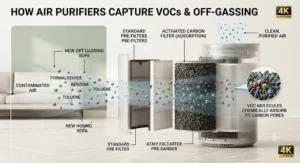
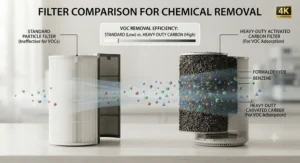
That smell hits you before you’ve even unpacked the first box. Sweet, sharp, faintly plasticky — the unmistakable signature of a house that’s still shedding its factory wrapper. If you’re hunting for an air purifier for new home VOCs off-gassing, you already know the smell isn’t just an inconvenience. It’s a cloud of volatile organic compounds pouring out of fresh paint, particleboard cabinets, foam underlayment, and that gorgeous new sectional sofa, all racing to reach equilibrium with your living room air. Standard air purifiers, the ones built around a HEPA filter and a whisper-thin carbon pad, were never designed for this fight. They’re built to trap dust, not to pull gas molecules out of thin air.

An air purifier for new home VOCs off-gassing is, at its core, any unit that pairs real particle filtration with a genuinely deep bed of activated carbon (or a chemisorbent blend) capable of adsorbing gas-phase pollutants like formaldehyde, toluene, and benzene rather than just moving them around the room. The EPA’s overview of indoor VOC impact notes that indoor VOC concentrations run consistently higher than outdoors — sometimes up to ten times higher — because thousands of everyday products release these compounds during and after use. That’s not a scare tactic; it’s the baseline reality of moving into anything new.
This guide walks through seven real, currently available purifiers built for exactly this problem, plus the science of how long off-gassing actually lasts, what “normal” formaldehyde levels look like, and a research-backed bake-out method you can run before you even move the last box in. No fluff, no invented reviews — just what the spec sheets and the peer-reviewed literature actually say.
Quick Comparison Table
| Product | Carbon Type/Amount | Best For | Price Range |
|---|---|---|---|
| Levoit Core 600S-P | ARC Formula carbon blend | Budget new furniture smell | $200–$260 range |
| Blueair Blue Pure 211+ Auto | Particle + carbon combo filter | Fast air changes, open rooms | $350–$450 range |
| Coway Airmega 400S | Dual Max2 HEPA + carbon filters | Smart new-construction homes | $500–$650 range |
| Alen BreatheSmart 75i (Fresh) | 3.6 lbs activated carbon | Customizable VOC targeting | $500–$750 range |
| Austin Air HealthMate Plus | 15 lbs carbon + zeolite | Whole-home heavy off-gassing | $600–$780 range |
| IQAir GC MultiGas XE | 12 lbs carbon + permanganate alumina | Extreme paint/renovation VOCs | Mid-$2,000s–low-$3,000s range |
| IQAir Atem Car | Compact carbon + HEPA cartridge | New car smell indoors | $150–$400 range |
Look at that carbon-amount column for a second, because it tells the real story here. A purifier with a few ounces of carbon dust bonded to a fiber mat and one with fifteen pounds of granulated activated carbon are not the same category of product, even if both wear the word “purifier” on the box. Budget picks like the Levoit and Blueair units genuinely help with light, ongoing furniture odor, but if you’re facing a freshly painted, newly framed house, the deep-carbon units — Austin Air and IQAir — are doing meaningfully more chemical adsorption per hour of runtime.
💬 Found a pick you like already? Bookmark this page and keep scrolling — the product breakdowns below explain exactly why each one earns its spot.
Top 7 Air Purifiers for New Home VOCs Off-Gassing: Expert Analysis
1. Levoit Core 600S-P — best budget pick for new furniture smell
The Levoit Core 600S-P built its reputation on raw airflow for the money, and that same brute-force fan is what makes it a surprisingly competent first line of defense against furniture odor. It pairs a 3-stage system — washable pre-filter, H13 HEPA, and a custom high-efficiency activated carbon filter using Levoit’s ARC Formula — with a CADR of roughly 410 CFM, enough to cycle a 635-square-foot room multiple times an hour. That fan speed matters more than people expect: even a modest carbon layer adsorbs more total VOC mass per day when air is pushed through it aggressively and often, rather than passively.
Based on the spec comparison with other Core-series models, the 600S-P’s biggest practical edge is the AirSight Plus laser sensor, which reacts to a fresh coat of polyurethane or a new dresser being unwrapped almost instantly and ramps the fan automatically. This is squarely a beginner-and-budget pick — it won’t out-adsorb a 15-pound carbon bed, but for someone just moving a few new furniture pieces into an already-finished home, it’s proportionate to the problem. Reviewers consistently note that the carbon filter noticeably dulls “new furniture smell” within the first day or two of continuous running, though it does little for heavy, whole-house formaldehyde loads from fresh cabinetry or flooring.
Pros:
- ✅ High CADR (~410 CFM) moves a lot of air through the carbon fast
- ✅ Laser sensor reacts quickly to new off-gassing events
- ✅ App and voice control make scheduling effortless
Cons:
- ❌ Carbon layer is thin compared to dedicated gas-phase units
- ❌ Gets notably loud at higher fan speeds
At around $200–$260, the 600S-P is a genuinely smart entry point if new furniture — not a full renovation — is your main headache.
2. Blueair Blue Pure 211+ Auto — fastest air changes for open living spaces
The Blue Pure 211+ Auto leans on Blueair’s HEPASilent approach: a particle filter combined with an integrated carbon layer, wrapped in a design that prioritizes silent, near-constant operation over raw carbon depth. AHAM-certified figures put it at 353 CFM for smoke and 380 CFM for pollen, enough to run a 550-square-foot room through nearly five complete air changes an hour on its highest setting, and the auto mode’s built-in particle sensor keeps it working quietly in the background rather than requiring manual babysitting.
What most buyers overlook about this model is that its carbon implementation is a coated-fiber design rather than loose activated pellets, which trades some raw adsorption capacity for a slimmer, quieter housing. That’s a fair trade for open-plan new-construction living rooms where you want continuous, low-noise coverage rather than an occasional deep clean. Aggregated review sentiment across major retailers consistently praises the whisper-quiet 23 dB low setting and criticizes the relatively frequent carbon filter changes needed if VOC levels stay elevated for months.
Pros:
- ✅ Near-silent 23 dB operation on low speed
- ✅ Auto mode adjusts fan speed to real-time pollution spikes
- ✅ Washable, swappable pre-filter colors match any room
Cons:
- ❌ Coated-fiber carbon adsorbs less per filter than pellet-based designs
- ❌ Requires the “Auto” specific replacement filter to keep rated CADR
Expect to pay in the $350–$450 range, positioning it as the mid-tier choice for someone who wants speed and quiet over maximum gas-phase capacity.
3. Coway Airmega 400S — best smart pick for new-construction open floor plans
Coway’s flagship large-room unit pairs dual Max2 filters — each combining True HEPA with an activated carbon layer — on opposite faces of the machine, giving it a manufacturer-rated CADR of 328 CFM for both smoke and dust and 400 CFM for pollen. Coverage tops out around 1,560 square feet at two full air changes per hour, which happens to be exactly the kind of open, high-ceilinged layout common in new-construction great rooms. On paper this means one unit can realistically cover a combined kitchen-living space rather than requiring two smaller purifiers stationed in separate corners.
Here’s what to weigh: the dual-filter design gives the Airmega 400S roughly twice the carbon surface area of a comparably priced single-filter competitor, even though its total carbon mass is still modest compared to dedicated deep-bed units. The IoCare app and real-time LED air quality ring are genuinely useful during the first weeks in a new build, when off-gassing intensity swings hour to hour depending on sun exposure and HVAC cycling. Reviewers consistently note the 22 dB sleep mode as class-leading and flag the annual filter replacement cost as the main long-term expense to budget for.
Pros:
- ✅ Dual filters cover large open-concept floor plans efficiently
- ✅ 22 dB sleep mode is nearly inaudible at night
- ✅ Real-time air quality ring shows results as you clean and unpack
Cons:
- ❌ Max2 filters need full replacement annually, not just the carbon layer
- ❌ Large footprint needs real floor space
Pricing typically lands in the $500–$650 range, making it the sweet spot for whole-open-plan coverage without stepping into medical-grade territory.
4. Alen BreatheSmart 75i (Fresh filter) — best customizable filter system for targeted VOCs
Alen built the BreatheSmart 75i around a modular idea: buy one chassis, then choose from Pure, Fresh, Pet, or Heavy Odor filter cartridges depending on what’s actually polluting your air that season. The Fresh filter is the one that matters here — it layers roughly 3.6 pounds of activated carbon behind the HEPA stage specifically to target household chemicals and VOCs, more carbon than nearly every other mid-priced purifier on this list except the deep-carbon flagships. AHAM-certified dust CADR sits around 351 CFM, with manufacturer coverage claims up to 1,300 square feet at a lighter two air-changes-per-hour rate.
The spec sheet won’t tell you this, but user reports suggest the Fresh filter’s carbon depth genuinely outperforms competitors in that same price bracket for lingering paint and adhesive odors, while the interchangeable panel system lets you swap back to a Pure filter once initial off-gassing subsides — useful given that VOC emission rates decline sharply after the first few months. Alen’s Forever Guarantee, tied to an active filter subscription, is a distinguishing feature that most competitors simply don’t offer, and reviewers frequently cite it as a reason to accept the higher upfront cost.
Pros:
- ✅ Fresh filter carries roughly 3.6 lbs of activated carbon
- ✅ Interchangeable filters let you retarget as VOC levels drop
- ✅ Lifetime warranty available with active filter subscription
Cons:
- ❌ Fresh filter costs more than Alen’s standard Pure cartridge
- ❌ App and smart features are noticeably basic
Depending on panel finish and filter choice, budget for the $500–$750 range — a reasonable middle ground between mainstream and medical-grade.
5. Austin Air HealthMate Plus — best for whole-home, heavy-duty off-gassing
If your new build still smells like a hardware store, the HealthMate Plus is the unit built for exactly that scenario. It packs an enormous 15 pounds of activated carbon and zeolite — over 780 cubic inches — alongside 60 square feet of medical-grade HEPA media, using potassium-iodide-impregnated carbon specifically chosen to target formaldehyde, benzene, and acrolein rather than generic household odor. Manufacturer coverage is rated to 1,500 square feet with two air exchanges per hour on speed two, and independent lab certification through Battelle backs the particle and gas removal claims.
What most buyers overlook about this model is the filter-life math: because the carbon bed is so massive, Austin Air backs it with a five-year filter warranty, meaning you’re not swapping cartridges every six to twelve months like you would on a thinner-carbon competitor — a real long-term cost advantage even though the upfront price is higher. Reviewers consistently describe the steel housing as genuinely built to outlast the house’s own off-gassing curve, while also flagging its 45-plus-pound weight and lack of smart-app features as the trade-offs for that industrial-grade carbon depth.
Pros:
- ✅ 15 lbs of activated carbon and zeolite — among the deepest available
- ✅ Five-year filter life dramatically lowers replacement costs
- ✅ Steel housing avoids the off-gassing plastic bodies can add
Cons:
- ❌ Heavy at roughly 45+ lbs, hard to relocate between rooms
- ❌ No smart app, WiFi, or auto mode
Expect a price in the $600–$780 range — steep next to mainstream HEPA units, but proportionate to fifteen pounds of carbon doing real chemisorption work.
6. IQAir GC MultiGas XE — most complete gas-phase filtration for extreme VOC and paint fume loads
The GC MultiGas XE is IQAir’s answer to genuinely severe chemical loads — think a full interior repaint plus new engineered flooring plus fresh cabinetry happening simultaneously. It combines 12 pounds of activated bituminous-coal carbon with pelletized aluminum oxide impregnated in potassium permanganate, a chemisorption pairing engineered to neutralize a far broader spectrum of gases than carbon alone, layered behind IQAir’s HyperHEPA stage that captures particles down to 0.003 microns. Coverage is rated to 1,125 square feet, and the XE variant adds an energy-efficient fan plus WiFi app integration for remote monitoring.
Based on the spec comparison with every other purifier on this list, the permanganate-treated alumina is the differentiator: standard activated carbon adsorbs VOCs physically and can eventually desorb them back into the air as it saturates, while the chemisorption reaction with permanganate actually breaks down certain gases like formaldehyde at the molecular level rather than just trapping them. That’s a meaningful distinction for anyone dealing with a genuinely toxic new-construction smell, not just a mild furniture scent. The trade-off is cost and gas-cartridge replacement frequency, which IQAir rates at six to eighteen months depending on pollutant load — considerably shorter than the Austin Air’s five-year window despite the similarly deep carbon bed.
Pros:
- ✅ 12 lbs of carbon plus permanganate-alumina chemisorption for formaldehyde
- ✅ HyperHEPA captures particles down to 0.003 microns
- ✅ WiFi app and real-time PM2.5 monitoring on the XE model
Cons:
- ❌ Among the most expensive consumer purifiers available
- ❌ Gas cartridges need replacement every 6–18 months
Pricing sits in the mid-$2,000s to low-$3,000s range at the time of research, positioning it firmly as the specialist’s tool for genuinely extreme chemical exposure rather than everyday furniture odor.
7. IQAir Atem Car — best for new car smell indoors
Not every off-gassing problem happens in a living room. New vehicles off-gas VOCs from adhesives, vinyl, foam padding, and interior trim at concentrations that can rival a freshly painted room in the first few weeks of ownership, and a full-size home purifier obviously isn’t a practical answer to that. The IQAir Atem Car is a compact, cupholder- or seat-mounted unit built specifically for cabin air, using a layered HEPA and activated carbon cartridge scaled down to work within a vehicle’s much smaller enclosed volume rather than a house-sized room.
Here’s what to weigh: because a car cabin is a fraction of even a small bedroom’s volume, the Atem Car’s modest carbon amount is actually proportionate to the job in a way it wouldn’t be for whole-home use — small carbon beds cycle a small air volume far more often than the same filter would in an open living room. Reviewers on major retail platforms consistently flag it as noticeably reducing the sharp “new car” smell within the first few days of daily commuting, while noting battery life and cabin noise at higher fan settings as the main limitations. If you’re also dealing with a newly renovated home, this is meant to complement — not replace — one of the whole-room units above.
Pros:
- ✅ Purpose-built scale for a car cabin’s small air volume
- ✅ Portable — moves between vehicles or a small office
- ✅ Combines HEPA and carbon in one compact cartridge
Cons:
- ❌ No meaningful coverage for room-sized off-gassing
- ❌ Smaller carbon mass saturates faster under heavy exposure
Depending on size and features chosen, expect a $150–$400 range — inexpensive insurance against months of driving around in a rolling VOC cloud.
Top 7 Products: Specs, Coverage & Ratings at a Glance
| Product | CADR (approx.) | Coverage | Noise (low) | Filter Life |
|---|---|---|---|---|
| Levoit Core 600S-P | 410 CFM | 635 sq ft | 26 dB | ~6–8 months |
| Blueair Blue Pure 211+ Auto | 353 CFM | 550 sq ft | 23 dB | ~6 months |
| Coway Airmega 400S | 328 CFM | 1,560 sq ft (2 ACH) | 22 dB | 12 months |
| Alen BreatheSmart 75i | 351 CFM | 1,300 sq ft | ~25 dB | 6–12 months |
| Austin Air HealthMate Plus | ~400 CFM | 1,500 sq ft | Moderate | 5 years |
| IQAir GC MultiGas XE | HyperHEPA-rated | 1,125 sq ft | Low | 6–18 months (gas) |
| IQAir Atem Car | N/A (cabin-scale) | Vehicle cabin | Low–moderate | 3–6 months |
Line these numbers up and the pattern is obvious: coverage area and filter longevity don’t move together the way you’d expect. The Austin Air covers a smaller footprint than the Coway on paper, but its five-year filter life makes it dramatically cheaper to run over a three-year span despite the higher sticker price. Meanwhile, the IQAir GC MultiGas trades filter longevity for the deepest chemisorption available, which matters enormously if your VOC source is a genuine renovation rather than a couch.
Benefits vs. Traditional Alternatives
| Approach | VOC/Formaldehyde Removal | Ongoing Cost | Effort Required |
|---|---|---|---|
| Carbon-based air purifier | High (with 3+ lbs carbon) | Moderate (filters) | Low — passive |
| Opening windows only | Moderate, weather-dependent | None | High — constant |
| HEPA-only purifier (no carbon) | Minimal — particles only | Low | Low but ineffective for gases |
| Bake-out + ventilation | High, but temporary spike-and-clear | Low (energy costs) | High — one-time event |
A carbon-based purifier and open windows aren’t actually competing strategies — they’re complementary, and treating them as an either/or choice is the single most common mistake people make. Ventilation dilutes the air you already have, while a Coway Airmega 400S or Austin Air HealthMate Plus running continuously keeps pulling new off-gassing out of the air between those ventilation cycles, including the overnight and winter stretches when windows stay shut. HEPA-only units, for what it’s worth, genuinely can’t help here at all — they simply weren’t engineered to interact with gas-phase molecules.
💬 Just one click — help others make better buying decisions too! 😊
The Bake-Out Method: Your Practical First-30-Days Guide
Before you even reach for a purifier, it’s worth understanding a technique researchers have studied for decades: the “bake-out” method. A peer-reviewed study on bake-out ventilation for building materials found that combining elevated indoor temperature with dilution ventilation has real potential to shorten emission cycles from new building materials, a process studied specifically for reducing off-gassing in newly renovated residential spaces. In practice, the method means raising indoor temperature to accelerate the release of trapped VOCs, then flushing that concentrated air out with heavy ventilation — essentially forcing the off-gassing curve to happen faster and get vented immediately, rather than slowly leaking into your everyday breathing air over months.
Here’s how to actually run it during your first 30 days:
Week 1 — Isolate and heat. Close interior doors to concentrated rooms (a freshly painted nursery, new cabinetry), and if your HVAC allows it, raise the temperature several degrees above normal for a few hours a day. Higher temperatures increase the vapor pressure of trapped solvents, pushing more VOCs out of the material and into the air where a purifier or ventilation can actually catch them.
Week 1–2 — Ventilate hard, then filter. Immediately after each heating session, open windows fully for 20–30 minutes to flush the concentrated air, then run your air purifier continuously on a higher fan setting to catch what didn’t escape through the window. This one-two combination — heat, vent, filter — is more effective than any single step alone.
Weeks 2–4 — Settle into steady-state operation. Drop the purifier to auto mode and maintain normal ventilation. Formaldehyde and other VOCs from new materials follow a steep initial decline, so most homes see a meaningfully lower baseline by the end of the first month even without a full bake-out.
Common first-30-days mistakes: running the purifier only at night, skipping ventilation because it’s cold outside, and assuming “no smell” means “no VOCs” — formaldehyde in particular is detectable by smell at levels that vary a lot between individuals, so a nose that’s adjusted to the smell isn’t a reliable air quality gauge.
Real-World Scenarios: Matching the Purifier to Your Situation
The first-time homebuyer with a spec-built house. You’ve just closed on a new-construction home with fresh carpet, cabinetry, and paint throughout — every room is off-gassing at once, and your budget is real but not unlimited. The Coway Airmega 400S in the main living area, paired with a Levoit Core 600S-P in the primary bedroom, covers the two spaces where you spend the most hours without requiring a five-figure purifier budget.
The renovator mid-project. You’re living in the house while contractors finish flooring and cabinet installs, with fresh adhesive and sealant fumes on top of typical furniture off-gassing. This is the scenario the Austin Air HealthMate Plus or IQAir GC MultiGas XE was actually built for — heavy, sustained chemical load that a thin-carbon consumer unit simply can’t keep pace with.
The apartment renter who just bought new furniture. No renovation, no fresh paint — just a new mattress, dresser, and sofa that arrived within the same week. A single Blueair Blue Pure 211+ Auto or Alen BreatheSmart 75i in the main living space is proportionate here; you don’t need whole-home industrial carbon capacity for a few pieces of furniture settling into equilibrium over a couple of months.
Problem → Solution: Fixing Common New-Home VOC Complaints
Problem: The smell is strongest in one specific room. Solution: isolate that room’s HVAC vents if possible and run a dedicated unit like the IQAir GC MultiGas XE or Austin Air HealthMate Plus directly in that space rather than relying on a whole-house unit to reach it through hallways.
Problem: Headaches or throat irritation despite running a purifier. Solution: verify the unit actually contains a real carbon layer, not just a thin carbon-coated pre-filter — check the spec sheet for a listed carbon weight, and if symptoms persist, consult a physician. Breathing problems and irritation of the eyes, nose, throat, or skin from formaldehyde exposure can affect anyone, though children, older adults, and people with asthma tend to notice symptoms first.
Problem: Filter seems to stop working after a few months. Solution: this is carbon saturation, and it’s completely normal — activated carbon has a finite adsorption capacity, and thin-bed units like budget HEPA-plus-carbon combos saturate faster under heavy VOC load than deep-bed units like the Austin Air or Alen Fresh filter.
Problem: New car smell lingers for weeks after purchase. Solution: run the IQAir Atem Car during daily commutes and crack windows briefly on dry days to supplement ventilation — cabin-scale VOC loads respond well to this combination even without a full bake-out.
What Is New Home Formaldehyde Off-Gassing?
New home formaldehyde off-gassing is the release of formaldehyde gas from composite wood products, adhesives, paints, and textiles as they cure and reach equilibrium with room air, typically peaking in the first weeks after installation and declining steadily over subsequent months. It’s one specific VOC among thousands, but it gets particular attention because of its documented health effects at elevated concentrations.
New Home Formaldehyde Levels: What’s Normal, What Isn’t
There’s no single federal standard for acceptable formaldehyde levels in a private home, which understandably frustrates people trying to figure out if their symptoms are related to their air. What regulators do have are reference points from manufactured housing and consumer product investigations. The U.S. Department of Housing and Urban Development set formaldehyde emission standards for manufactured housing of less than 0.2 ppm for plywood and 0.3 ppm for particle board, designed to keep ambient indoor levels around 0.4 ppm or below — a useful benchmark even for a traditionally built new home, since the underlying materials (pressed wood, laminate, adhesives) are often the same.
According to CDC/ATSDR guidance on formaldehyde in the home, exposure from new products or new construction generally runs much lower and lasts for less time than the occupational exposures linked to elevated cancer risk, and the estimated cancer risk from typical indoor air levels in a new home is considered low. That’s genuinely reassuring context, though it doesn’t erase the very real short-term irritation many people experience — burning eyes, sore throat, headaches — at levels well below anything considered dangerous long-term. If you want hard numbers rather than guesswork, a formaldehyde test kit or a professional indoor air quality assessment is the only way to know your actual reading, and a carbon-based purifier is the most practical way to bring that number down while materials finish curing.
Furniture Off-Gassing Duration: How Long Does It Actually Last?
This is the question almost everyone asks, and the honest answer is: longer than most people expect, but the intensity drops fast. A meta-analysis of VOC emission rates in new and renovated buildings found that emissions follow a multi-exponential decay pattern — a rapid decline during the first month or so, followed by a more gradual decline until an approximate steady state is reached after at least two years. In plain terms: the sharpest, smelliest phase is genuinely short, usually weeks rather than months, but a low-level tail of off-gassing can technically continue for a couple of years before fully leveling off.
Furniture specifically varies by material. Solid wood pieces finished with low-VOC coatings off-gas comparatively little and briefly. Pressed-wood furniture — particleboard, MDF, engineered veneers bonded with formaldehyde-based resins — off-gasses longer and more intensely, which is exactly why budget flat-pack furniture tends to carry that distinctive “new furniture smell” for weeks rather than days. Reviewers of carbon-equipped purifiers consistently report the sharpest smell reduction happens in the first one to two weeks of continuous operation, which lines up neatly with the steep initial decline researchers have documented — meaning your purifier is doing real, measurable work exactly when it matters most.
Air Purifier for New Furniture vs. New Construction: What Actually Changes
These two situations get lumped together constantly, but they call for different equipment. New furniture off-gassing is typically localized — one room, a handful of pieces, a moderate and short-lived VOC bump that a mid-tier unit like the Levoit Core 600S-P or Blueair Blue Pure 211+ Auto handles capably. New construction off-gassing is diffuse and sustained: it’s coming from the subfloor adhesive, the cabinet boxes, the fresh paint on every wall, the caulk around every window, often simultaneously across the whole house for weeks.
The practical difference shows up in carbon capacity. A room with a new dresser needs maybe a pound or two of active carbon capacity running continuously to keep pace. A newly built 2,000-square-foot home with fresh everything is putting out VOC loads that can genuinely overwhelm anything short of the Coway Airmega 400S, Alen BreatheSmart 75i, or — for serious cases — the Austin Air HealthMate Plus and IQAir GC MultiGas XE. If you’re not sure which category you’re in, the honest test is simple: does the smell noticeably fade when you leave the house for a day and come back, or does it feel constant and pervasive throughout? Pervasive points toward whole-home, and it’s worth sizing up accordingly.
How to Choose an Air Purifier for New Home VOCs Off-Gassing
- Check the carbon weight, not just “activated carbon” marketing copy. Look for a specific pound figure on the spec sheet — under a pound saturates within weeks under heavy VOC load, while three pounds or more holds up meaningfully longer.
- Match coverage area to your actual room, not the whole house. A single unit rated for 1,500 square feet won’t clean a closed bedroom any faster than a 600-square-foot unit — buy for the specific room with the worst off-gassing first.
- Confirm the filter type includes chemisorption for formaldehyde specifically, not just generic odor-focused carbon, if a lab test or strong chemical smell suggests formaldehyde is a significant contributor.
- Factor in replacement cost and frequency over three years, not just sticker price — a cheaper unit with frequent thin-filter swaps can cost more long-term than a pricier deep-carbon unit.
- Prioritize noise level if it’s running in a bedroom overnight, since the highest-VOC period is also when you’re least able to ventilate by opening windows.
- Consider smart sensors if off-gassing intensity varies, since auto-adjusting fan speed responds to spikes from fresh paint or new deliveries without manual attention.
- Don’t skip ventilation just because you bought a purifier — the two work together, not as substitutes for each other.
Common Mistakes When Buying an Air Purifier for VOCs
The single most common mistake is buying based on HEPA rating alone. A purifier can boast a flawless 99.97% HEPA claim and still do almost nothing for formaldehyde or paint fumes, because HEPA filters trap particles, not gas molecules — the two are entirely different filtration mechanisms. The second mistake is undersizing carbon capacity for a whole-house renovation, expecting a single Core-series or entry Blue Pure unit to keep pace with simultaneous off-gassing from paint, flooring, and cabinetry across multiple rooms. The third is ignoring ongoing filter costs, which for thin-carbon units can quietly exceed the original purchase price within two years of heavy new-home use.
Long-Term Cost & Maintenance
Sticker price tells an incomplete story. A Levoit Core 600S-P costs less upfront but typically needs filter replacement every six to eight months under heavy VOC load, while an Austin Air HealthMate Plus costs roughly three times as much initially but is backed by a five-year filter warranty. Run the math over three years and the gap narrows considerably — sometimes reversing entirely in favor of the deep-carbon unit once you account for filter purchases and the electricity a larger fan doesn’t necessarily consume more of, since larger units often run efficient motors at lower relative speeds thanks to bigger overall capacity. The IQAir GC MultiGas XE sits at the opposite extreme: premium upfront cost and a shorter six-to-eighteen-month gas-cartridge cycle, which only pencils out if you’re dealing with genuinely severe, ongoing chemical exposure rather than typical new-home settling.
Air Purifier for New Car Smell Indoors: Special Considerations
Car cabins present a fundamentally different off-gassing environment than a room. The enclosed volume is tiny, temperatures swing dramatically with sun exposure — which, per the bake-out research above, actively accelerates VOC release from vinyl and foam — and ventilation is limited to cracked windows or the HVAC’s outside-air setting. This is exactly why the IQAir Atem Car and similar cabin-scale units exist as a distinct category rather than just a smaller version of a room purifier: they’re tuned for rapid air changes in a tiny volume rather than sustained coverage of a large space.
If you’ve just bought a new car alongside moving into a new home, treat them as two separate problems requiring two separate tools. Running a whole-room purifier in your garage won’t meaningfully touch the VOC load building up inside a parked, closed vehicle in direct sun — a cabin-specific unit, combined with parking in shade and cracking windows when safely possible, is the more effective combination.
Safety, Regulations & Compliance Guide
No federally enforceable indoor air quality standards currently exist for VOCs in non-industrial settings in the United States, which is why so much of the available guidance comes from health agencies rather than binding law. That said, California’s Air Resources Board regulates formaldehyde emissions from composite wood products sold within the state, and manufactured housing standards from HUD offer the closest thing to a numeric benchmark for typical residential formaldehyde exposure. When shopping, look for purifiers that carry AHAM Verifide certification for CADR claims and, where available, independent lab testing for gas-phase removal rather than relying solely on manufacturer marketing language — third-party verification is the difference between a real spec and a hopeful one.
Frequently Asked Questions
❓ How long does new home off-gassing last?
❓ Does a HEPA filter remove VOCs?
❓ What formaldehyde level is considered safe in a new home?
❓ Can an air purifier remove new car smell?
❓ How much activated carbon do I need for a new home?
Conclusion
Moving into anything new — a house, an apartment full of fresh furniture, a car straight off the lot — means living alongside a wave of chemical off-gassing that peaks fast and fades slower than most people expect. The good news, backed by the research and specs above rather than marketing copy, is that the fix isn’t complicated: match your carbon capacity to the actual size of the problem, run a bake-out during those first critical weeks, and keep ventilating even after the purifier’s plugged in. Whether that means a budget-friendly Levoit Core 600S-P for a couple of new furniture pieces or a deep-carbon Austin Air HealthMate Plus for a whole freshly built home, the underlying principle is the same: more real activated carbon, running more consistently, beats any marketing claim printed on a box.
✨ Don’t Miss These Exclusive Deals!
🔍 Take your new home’s air quality to the next level with these carefully selected purifiers. Click on any highlighted pick above to check current pricing and availability, and start breathing genuinely fresher air while your home finishes settling in!
Recommended for You
- Air Purifier for VOCs: 7 Real Picks That Work in 2026
- Air Purifier for Basement Mold: 7 Proven Picks for 2026
- Air Purifier for Mold: 7 Proven Picks That Actually Help (2026)
Disclaimer: This article contains affiliate links. As an Amazon Associate, I earn from qualifying purchases. If you purchase products through these links, we may earn a small commission at no additional cost to you.
✨ Found this helpful? Share it with your friends! 💬🤗
