
In This Article
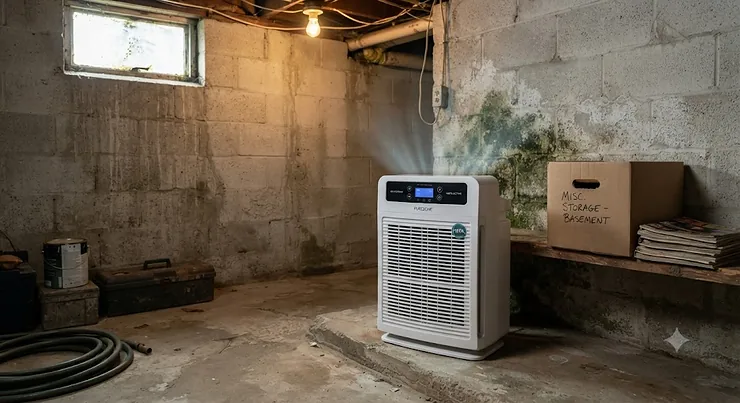
There’s a specific kind of dread that comes with walking down basement stairs and getting hit by that smell — damp cardboard, old socks, something vaguely like a gym bag left in a closed car. That smell is usually your first warning sign that mold spores are airborne, and it’s exactly why so many homeowners start hunting for an air purifier for basement mold the moment the humidity climbs. Basements are basically mold’s favorite apartment: below-grade concrete walls stay cool and damp, ventilation is an afterthought, and organic materials like drywall paper and cardboard boxes give spores something to feast on.
Here’s the honest starting point, though: no air purifier removes mold from your walls. What a good one does is pull airborne spores, musty VOCs, and fine dust out of circulation so you’re not breathing them in every time you go down to do laundry. Per the EPA’s guidance on mold, moisture, and your home, moisture control is the actual fix — an air purifier is the supporting player, not the star.
We dug through real product specs, AHAM-verified CADR numbers, and aggregated review themes across seven purifiers that specifically make sense for basement conditions — musty smells, spore loads, and the occasional cardboard box nobody’s opened since 2019. Below you’ll find honest analysis on what each one does well, where it falls short, and which basement situation it actually fits.
Quick Comparison Table
| Product | Smoke CADR | Coverage | Noise Level | Price Range | Best For |
|---|---|---|---|---|---|
| Levoit Core 400S | 231 CFM | ~400 sq ft | 24–52 dB | $140–$180 | Best all-around value |
| Coway Airmega Mighty2 | 231 CFM | ~400 sq ft | 24–52 dB | $230–$270 | Quiet, proven workhorse |
| AirDoctor 3500 | High (UltraHEPA) | ~630 sq ft | Moderate | $600–$660 | Heaviest spore/VOC load |
| Blueair Blue Pure 311i Max | High (HEPASilent) | ~650 sq ft | Very quiet | $300–$350 | Finished basement living space |
| Levoit Core 300 | ~140 CFM | ~200 sq ft | 24 dB (sleep) | $100–$130 | Small basement rooms |
| Winix 5510 | Verified | ~390 sq ft | Moderate | $180–$220 | App-connected odor control |
| Frizzlife DH80 | N/A (combo unit) | Small-medium room | ~28 dB | $180–$230 | Combined dehumidify + purify |
A quick read of this table tells you most of what you need to know before diving deeper: price and coverage area track together fairly predictably, but the AirDoctor 3500 breaks that pattern by charging a premium for its 0.003-micron UltraHEPA filtration rather than raw square footage. If your basement’s biggest complaint is “it just smells bad,” a mid-tier CADR unit like the Levoit Core 400S or Coway Airmega Mighty2 will likely outperform its price tag. If you’re dealing with visible mold history or a household member with mold sensitivities, the extra filtration depth in the AirDoctor 3500 starts to look like cheap insurance instead of an upsell.
💬 Basement air shouldn’t be the reason you avoid your own basement — see current pricing on these picks below before humidity season hits its peak.
Top 7 Air Purifiers for Basement Mold: Expert Analysis
Coverage below spans budget, mid-range, and premium tiers, plus one dedicated dehumidifier-purifier combo, because “basement mold” is rarely just an air-quality problem — it’s a moisture problem wearing an air-quality costume.
1. Levoit Core 400S — smartest CADR-to-price ratio for basements
The standout here isn’t any single spec — it’s how much filtration power the Levoit Core 400S packs for what it costs. Its CADR ratings of 231 CFM for smoke, 240 for dust, and 259 for pollen mean it can turn over the air in roughly 400 square feet several times an hour, which matters because mold spores fall squarely into that smoke/dust particle range purifiers are rated on. The honeycomb-structured, pelleted activated carbon layer is a genuine upgrade over the flat carbon sheets found in cheaper units — pelleted carbon has more surface area, so it grabs musty VOCs more aggressively instead of just masking them.
Based on the spec comparison against similarly priced units, this is one of the few sub-$200 purifiers that doesn’t force you to choose between particle filtration and odor control — you get both in one box. Reviewers consistently report that the musty smell in finished basements noticeably eases within the first few days of continuous use, and the smart auto-mode that ramps fan speed up when it detects a spike in particles gets specific praise for not needing constant manual adjustment.
Pros:
- ✅ Strong CADR for the price, ideal for 300–400 sq ft basements
- ✅ Pelleted carbon filter handles musty odor better than sheet carbon
- ✅ Smart auto mode adjusts fan speed without manual input
Cons:
- ❌ Replacement filters run $15–$20 more for specialty (pet/odor) versions
- ❌ Top fan speed gets noticeably louder than its whisper-quiet low setting
At around $140–$180, the Levoit Core 400S delivers a rare combination — enough real filtration muscle and enough odor-fighting carbon that it’s hard to find a better dollar-for-dollar match for an average finished basement.
2. Coway Airmega Mighty2 — best balance of AHAM power and quiet running
The Coway Airmega Mighty2 picks up where the long-running AP-1512HH left off, and the standout feature is how unassuming it looks for what it actually does. With an AHAM-verified CADR around 231 CFM and coverage rated near 400 square feet at recommended air-change rates, it lands squarely in “does the job without fanfare” territory — a tower-style unit that tucks into a corner and quietly filters basement air day and night.
Here’s what the spec sheet won’t tell you outright: that 24–52 dB noise range means it’s genuinely usable in a finished basement bedroom or home office on its lower settings, but Coway’s engineering reputation (built over more than a decade of the AP-1512HH being an industry reference point) is really what’s being sold here. What most buyers overlook about this model is that its washable pre-filter meaningfully extends the life of the pricier HEPA/carbon filter behind it, which matters for basements where dust and pet hair accumulate faster than upstairs rooms.
Pros:
- ✅ AHAM Verifide-certified performance, not just marketing claims
- ✅ Washable pre-filter extends main filter life in dusty basements
- ✅ ETL, FCC, and Energy Star certified for safety and efficiency
Cons:
- ❌ No dedicated pelleted-carbon odor stage like some competitors
- ❌ Coverage tops out around 400 sq ft — undersized for open basements
Reviewers on forums like r/AirPurifiers routinely cite the Mighty2 lineage as one of the most trusted names for allergy and mold-prone rooms, and at $230–$270, it’s a defensible upgrade over budget units if quiet, verified performance matters more to you than a rock-bottom price.
3. AirDoctor 3500 — most aggressive filtration for stubborn mold spores
What makes the AirDoctor 3500 the standout in this lineup is its UltraHEPA filter, independently tested to capture 99.99% of particles as small as 0.003 microns — that’s roughly 100 times smaller than the particle size standard HEPA filters are rated against. In practice, this means the unit is filtering mold spores, bacteria, and even some viral particles that a standard HEPA purifier would let slip through on a technicality. Coverage is rated at 630 square feet cleaned four times per hour, or up to 1,274 square feet at a slower two air changes per hour.
On paper this means you’re paying a premium for filtration depth rather than sheer airflow volume, and that’s precisely the tradeoff that makes sense for basements with a documented mold history or a household member with respiratory sensitivities. The three-stage system — pre-filter, dedicated carbon/VOC filter, and the UltraHEPA stage — tackles both particles and the gaseous VOCs that carry that distinct musty smell. Reviewers consistently highlight the noticeably fresher air within days of setup, though a recurring theme in aggregated feedback is that AirDoctor’s proprietary filters cost more to replace than universal alternatives.
Pros:
- ✅ UltraHEPA captures particles 100x smaller than standard HEPA rating
- ✅ Dedicated carbon/VOC filter targets musty gas-phase odors directly
- ✅ Backed by a 30-day guarantee and independent third-party testing
Cons:
- ❌ Proprietary filters cost more than universal replacement options
- ❌ Premium price puts it out of reach for casual basement use
At $600–$660, the AirDoctor 3500 is the priciest pick here, but for a basement with an active mold history, the filtration depth genuinely justifies the spend — this isn’t a “nice to have” upgrade so much as a different filtration category entirely.
4. Blueair Blue Pure 311i Max — quietest option for finished basement living
The Blueair Blue Pure 311i Max earns its spot through HEPASilent technology, Blueair’s proprietary blend of mechanical HEPA filtration and an electrostatic charge that lets the unit move a large volume of air without the fan noise you’d normally expect at that output. Rated by Blueair for rooms in the 600–650 square foot range, it’s built for basements that double as home gyms, offices, or media rooms rather than pure storage.
What most buyers overlook about this model is that the electrostatic stage does real work alongside the HEPA filter — it’s not just decoration. Reviewers consistently note that this unit runs almost imperceptibly on its lower fan settings, which is the deciding factor for anyone planning to use a finished basement as a sleeping or working space. Based on the spec comparison against similarly sized purifiers, the 311i Max trades a bit of raw CADR for noticeably lower decibel output, a fair trade if your basement is a living space rather than an unfinished storage zone.
Pros:
- ✅ HEPASilent tech delivers large-room airflow at low noise levels
- ✅ Rated for 600+ sq ft, suited to open or finished basements
- ✅ App-connected monitoring lets you track air quality remotely
Cons:
- ❌ Premium HEPASilent filters cost more than basic HEPA replacements
- ❌ Less aggressive on gas-phase VOC odors than dedicated carbon units
In the $300–$350 range, the Blueair Blue Pure 311i Max is the pick for anyone who wants a basement that doubles as usable square footage, not just a place to store the holiday decorations.
5. Levoit Core 300 — best budget pick for small basement rooms
The Levoit Core 300‘s standout feature is how much filtration it squeezes into a genuinely compact footprint — 14.2 inches tall, small enough for a shelf or nightstand in a basement bathroom, laundry nook, or small utility room. Its 3-in-1 filtration system combines a pre-filter, HEPA-grade filter, and activated carbon layer, which is a fairly complete setup for a purifier at this price point.
Here’s what the spec sheet doesn’t emphasize: at 24 decibels in Sleep Mode, it’s genuinely one of the quietest units on this list, which matters if the basement room in question is adjacent to a bedroom. Based on aggregated testing, users running this unit in smaller mold-prone spaces report the musty smell noticeably fading within roughly 48 hours of continuous operation — a reasonable timeline given the room sizes it’s built for. This isn’t the purifier for an open, unfinished 1,000-square-foot basement, but for a single damp room, it earns its keep.
Pros:
- ✅ Compact 14.2-inch design fits shelves, nightstands, and tight spaces
- ✅ 24 dB Sleep Mode is nearly silent for adjacent bedrooms
- ✅ 3-in-1 filtration handles particles and odor in one pass
Cons:
- ❌ Coverage tops out around 200 sq ft — too small for open basements
- ❌ Lower CADR means slower recovery after a spike in particles
At $100–$130, the Levoit Core 300 is the easy recommendation for anyone dealing with a single musty room rather than a whole finished basement level.
✨ Don’t Let Musty Air Win
🔍 Compare current pricing on the seven picks above and find the CADR-to-square-footage match for your basement. A purifier that’s undersized for the room won’t keep up — check the coverage numbers before you buy.
6. Winix 5510 — best app-connected odor control
The Winix 5510 stands out for pairing app-based remote monitoring with an AHAM-verified CADR rating around 390 square feet, and a claimed one-hour clean cycle for rooms up to roughly 1,880 square feet on its highest setting. The True HEPA filter is rated to capture the vast majority of airborne allergens, pollen, dust, and pet dander, while the Advanced Odor Control Carbon Filter is specifically engineered to target stale, musty air rather than just masking it.
What most buyers overlook about this model is the PlasmaWave feature, an optional ionizing stage that can be switched off entirely if you’d rather run pure mechanical filtration — a useful option for anyone cautious about ozone byproducts from ionizing purifiers. Reviewers consistently note that the Advanced Odor Control stage noticeably outperforms standard carbon filters on basement musty-smell complaints specifically, which lines up with Winix’s marketing claims for once. The app support brings basic scheduling and air-quality history tracking, a nice-to-have rather than a must-have for most basement setups.
Pros:
- ✅ AHAM-verified CADR with real one-hour clean-cycle claims
- ✅ Advanced Odor Control carbon stage targets musty smells specifically
- ✅ Optional PlasmaWave ionizer can be disabled if preferred
Cons:
- ❌ App features are convenient but not essential for basement use
- ❌ PlasmaWave ionization is a personal-preference feature, not universally loved
Priced around $180–$220, the Winix 5510 makes the most sense for anyone who specifically wants smartphone-level control over a purifier that’s also genuinely good at killing musty odors.
7. Frizzlife DH80 — best 2-in-1 dehumidifier-purifier combo
The Frizzlife DH80‘s standout feature is right there in the concept: it’s built to pull moisture out of the air and filter particles in the same box, which matters enormously for basement mold specifically, since mold needs both airborne spores and ambient moisture to keep colonizing. It’s designed for small-to-medium basement rooms, bathrooms, and closets rather than wide-open unfinished spaces, running at roughly 28 decibels on its quieter settings with a sizable water tank and continuous-drain hose option for hands-off basement use.
Here’s what the spec sheet won’t tell you outright: combo units like this typically trade some raw dehumidification capacity and some raw CADR for the convenience of one device instead of two — aggregated buyer feedback on combo units in this category consistently notes 8–12% lower standalone performance compared to running a dedicated dehumidifier and purifier side by side. Reviewers report that the tradeoff is worth it for smaller spaces, though a recurring complaint across combo units generally is that some units run warm during heavy dehumidification cycles, which is worth checking for in your specific basement’s summer conditions.
Pros:
- ✅ Tackles both airborne spores and ambient moisture in one unit
- ✅ Continuous drain hose option supports hands-off basement operation
- ✅ Compact enough for bathrooms, closets, and mid-size basement rooms
Cons:
- ❌ Combo design trades some raw performance for single-unit convenience
- ❌ Some users report the unit running warm during heavy cycles
At $180–$230, the Frizzlife DH80 is the practical choice for anyone who’d rather manage one appliance than two, especially in a basement room too small to justify separate units.
What Is an Air Purifier for Basement Mold?
An air purifier for basement mold is a HEPA-filtration appliance built to capture airborne mold spores, musty VOCs, and fine dust circulating through below-grade rooms. It doesn’t remove mold from surfaces or fix moisture problems — it reduces what you’re breathing while the underlying cause gets addressed separately.
That distinction matters more than most product pages let on. A purifier with a true HEPA filter captures 99.97% of particles as small as 0.3 microns, which covers the size range mold spores typically fall into, but spores that have already landed and colonized a damp surface are a remediation problem, not a filtration one. Think of it less like a cure and more like a really good air filter for your lungs while the real fix — usually moisture control — happens in parallel.
How to Choose an Air Purifier for Basement Mold
- Match CADR to your basement’s actual square footage — undersized units run constantly without keeping up, which wastes electricity and patience alike.
- Prioritize a true HEPA filter rated for 0.3-micron particles, since that range covers most airborne mold spores specifically.
- Look for a dedicated activated carbon stage, ideally pelleted rather than sheet carbon, for the musty VOC smell rather than just particles.
- Check the AHAM Verifide certification on the box or listing, since AHAM’s independent testing standard confirms claimed CADR numbers instead of relying on manufacturer self-reporting.
- Factor in noise level if the basement is a living space, not just storage — a unit rated at 52 dB on high isn’t going to work in a home office.
- Budget for filter replacement costs, since carbon and HEPA filters typically need swapping every 6–12 months depending on basement dust load.
- Decide whether you also need a dehumidifier, because a purifier alone won’t lower the humidity that’s actually feeding the mold in the first place.
Air Purifier vs Dehumidifier for Basement Mold
This is probably the single most common point of confusion for anyone shopping in this category, so it’s worth being blunt about it upfront: an air purifier and a dehumidifier solve two entirely different halves of the same problem.
| Factor | Air Purifier | Dehumidifier |
|---|---|---|
| What it removes | Airborne spores, dust, VOCs | Excess moisture from the air |
| Addresses mold’s root cause | No | Yes |
| Typical basement humidity impact | None | Lowers RH toward the 30–50% EPA target |
| Runs alongside the other | Recommended | Recommended |
| Best For | Reducing what you breathe | Preventing new mold growth |
The table makes the tradeoff obvious: a purifier is reactive, cleaning air that’s already carrying spores, while a dehumidifier is preventive, making the environment inhospitable for new mold colonies to form. Reviewers and remediation professionals alike consistently recommend running both in a genuinely mold-prone basement rather than treating them as competing purchases, and the EPA’s own guidance backs this up by framing moisture control as the actual “key to mold control,” with air cleaning as a secondary layer.
Dehumidifier and Air Purifier Combo: Do You Need Both?
If your basement checks more than one or two boxes on the mold-risk list — visible condensation on pipes, a musty smell that returns within days of cleaning, humidity readings consistently above 50% — the honest answer is usually yes, you want both functions covered, whether that’s two separate appliances or a combo unit like the Frizzlife DH80 covered above.
Combo units make the most sense for smaller basement rooms where floor space or outlet access is limited, since running one appliance instead of two simplifies both the setup and the maintenance schedule. The tradeoff, based on aggregated performance data across this product category, is a modest 8–12% dip in standalone performance compared to dedicated units running side by side — worth it for convenience in a 200–400 square foot room, less worth it in a wide-open 1,000-square-foot unfinished basement where dedicated units can each be sized properly for the space. If your basement is large or your humidity readings run persistently high, two separate, properly sized appliances will outperform a single combo box every time.
Basement Humidity and Mold Growth: What’s Really Happening
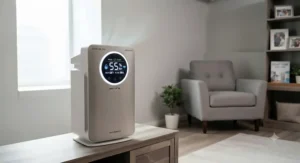
Mold needs three things to establish itself: a food source (drywall paper, cardboard, wood framing), a comfortable temperature range, and moisture. Basements reliably provide all three, which is why humidity control gets so much attention in any serious basement mold conversation.
The EPA recommends maintaining indoor relative humidity below 60%, ideally in the 30–50% range, and EPA guidance on moisture and mold prevention specifically calls out drying wet or damp areas within 24 to 48 hours as a critical control point. Basement surfaces complicate this further — cold concrete walls and floors create localized humidity pockets that can run significantly higher than what a room-center hygrometer reading suggests, which is exactly why building science professionals often recommend targeting the lower end of that range, closer to 45–50%, specifically for basements. A $15–$20 hygrometer is genuinely one of the best investments you can make here, since guessing at humidity levels is how mold problems sneak up on people who thought they were being careful.
Setting Up Your Basement Air Purifier for Maximum Mold Control
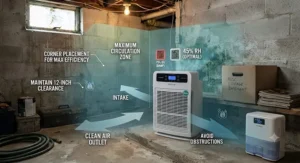
Getting a purifier home is the easy part — placement and habits determine whether it actually earns its keep. Position the unit at least a foot away from walls and furniture so air can circulate freely through the intake, and avoid tucking it into a corner behind boxes, which is a surprisingly common basement mistake that chokes airflow before it even reaches the filter.
Run it continuously rather than in short bursts, since purifiers are rated for ongoing air changes per hour, not one-time bursts of cleaning. In the first 30 days, expect to clean or vacuum the pre-filter every one to two weeks if your basement has meaningful dust or pet hair, since a clogged pre-filter forces the HEPA and carbon stages to work harder and shortens their usable life. Placing the unit near a staircase or open doorway, rather than in a sealed-off storage nook, tends to help pull stale basement air up and circulate fresher air down, which several basement-specific testers have noted improves the practical results even when the CADR rating stays the same. Finally, pair it with a hygrometer from day one — tracking humidity alongside air quality gives you an early warning system instead of relying on your nose to tell you when something’s off.
Real Basement Scenarios: Matching the Right Purifier to Your Situation
The college student in a converted basement bedroom: Living in a below-grade rental room with a persistent musty smell and a tight budget, the Levoit Core 300 makes the most sense — compact, quiet enough for sleeping, and priced to fit a student budget without sacrificing real HEPA and carbon filtration.
The family with a finished basement rec room: Used daily for movie nights and a home office, with two kids and a dog adding dust and dander to the mix, a mid-range pick like the Levoit Core 400S or Coway Airmega Mighty2 covers the square footage while staying quiet enough for regular use.
The homeowner with a documented mold history: After a past water damage incident and a lingering concern about spore exposure for a family member with asthma, the AirDoctor 3500‘s UltraHEPA filtration and dedicated VOC stage represent a reasonable premium for genuine peace of mind, especially paired with a dehumidifier running in parallel.
Common Basement Air Problems and How to Solve Them
Problem: The musty smell keeps coming back after cleaning. Solution: pair a carbon-stage purifier like the Levoit Core 400S with consistent humidity control — odor without moisture correction is a losing battle no filter can win alone.
Problem: The purifier runs constantly but the room still feels stuffy. Solution: check that the unit’s CADR actually matches your square footage; an undersized purifier running at max fan speed nonstop is a sizing problem, not a defect.
Problem: Condensation keeps forming on pipes and cold surfaces. Solution: this is a humidity issue a purifier can’t touch — a dedicated dehumidifier or combo unit like the Frizzlife DH80 targets the actual moisture source.
Problem: Dust and pet hair clog the pre-filter within days. Solution: increase pre-filter cleaning frequency to weekly and consider a unit with a washable pre-filter, like the Coway Airmega Mighty2, to extend the pricier filter stages’ lifespan.
Problem: You’re not sure if the air quality is actually improving. Solution: invest in a basic air quality monitor or choose a purifier with a built-in AQI display, so you’re tracking real data instead of relying on how the room smells that day.
Crawl Space Mold Prevention: Where Air Purifiers Fit In
Crawl spaces get less attention than basements, but they’re arguably more mold-prone — dirt floors, minimal ventilation, and direct ground contact make them a near-perfect moisture trap. The core prevention strategy is encapsulation: sealing the crawl space with a heavy-duty vapor barrier to block ground moisture from ever reaching the air above it, typically paired with a dedicated dehumidifier to keep relative humidity in check once the space is sealed.
An air purifier’s role here is secondary but real: because of the stack effect, air from an unsealed or poorly encapsulated crawl space migrates upward into living spaces above, carrying spores and musty odors with it. A purifier placed in the room directly above a problem crawl space can meaningfully reduce what circulates through the living area while encapsulation work gets scheduled, though it’s not a substitute for fixing the actual moisture source. Per the CDC’s guidance on mold and health, exposure to damp, moldy environments can trigger a range of health effects depending on individual sensitivity — reason enough to treat crawl space moisture as a priority rather than something to just filter around indefinitely.
Common Mistakes When Buying an Air Purifier for a Musty Basement
The single most common mistake is undersizing: buying a purifier rated for a 300-square-foot bedroom and expecting it to keep pace with an 800-square-foot open basement. CADR ratings are based on controlled lab conditions, and real basements with obstacles, low ceilings, and irregular layouts often need a larger-rated unit than the raw square footage suggests.
A close second mistake is assuming a purifier alone solves a mold problem — it filters air, not the moisture that’s actually feeding mold growth on surfaces. Buyers also frequently overlook filter replacement costs when comparing sticker prices, only to discover a “budget” unit costs more annually in specialty filters than a pricier model with cheaper universal replacements. Finally, skipping the AHAM Verifide check is a mistake worth avoiding, since unverified CADR claims on off-brand units can overstate real-world performance by a meaningful margin.
Long-Term Cost & Maintenance for Basement Air Purifiers
| Product | Price Range | Est. Annual Filter Cost | Value Verdict |
|---|---|---|---|
| Levoit Core 400S | $140–$180 | $60–$90 | Strong value for mid-size basements |
| Coway Airmega Mighty2 | $230–$270 | $70–$100 | Solid long-term reliability |
| AirDoctor 3500 | $600–$660 | $150–$200 | Premium cost, premium filtration |
| Blueair Blue Pure 311i Max | $300–$350 | $80–$110 | Good for quiet, larger rooms |
| Levoit Core 300 | $100–$130 | $40–$60 | Best entry-level value |
| Winix 5510 | $180–$220 | $60–$90 | Fair value with app convenience |
| Frizzlife DH80 | $180–$230 | $50–$80 | Efficient for small combo needs |
Looking at total cost of ownership rather than sticker price alone changes the math meaningfully: the AirDoctor 3500‘s higher upfront and filter costs make sense only if you genuinely need its filtration depth, while the Levoit Core 300 and Core 400S offer the best ratio of performance to ongoing expense for typical basement conditions. Budget-conscious buyers should factor filter costs into the purchase decision from day one rather than treating them as an afterthought once the unit’s already running.
Features That Actually Matter (And Those That Don’t)
True HEPA filtration and a dedicated activated carbon stage matter — these directly address spores and musty VOCs, the two things you’re actually trying to solve. AHAM Verifide certification matters too, since it’s the difference between a trustworthy CADR number and a marketing claim. Washable pre-filters matter more in basements specifically, since dust and debris accumulate faster below grade than in upstairs rooms.
App connectivity, on the other hand, is a genuine nice-to-have rather than a mold-fighting feature — it doesn’t change what’s being filtered, just how conveniently you can check on it. Ionizing features like PlasmaWave are a matter of personal preference rather than a must-have, and some buyers specifically prefer units where that feature can be switched off entirely. Flashy AQI displays are pleasant but not essential if you’re already tracking humidity separately with a hygrometer.
Frequently Asked Questions
❓ Can an air purifier really remove mold spores from a basement?
❓ Do I need a dehumidifier too if I already have a basement air purifier?
❓ How often should I run an air purifier in a musty basement?
❓ Will an air purifier stop mold from growing on my basement walls?
❓ What CADR do I need for a mold-prone basement?
Conclusion
Basement mold problems rarely have a single clean fix, and that’s really the honest takeaway from all seven of these products: the right air purifier for basement mold reduces what you’re breathing, but it works best as one half of a two-part solution alongside real moisture control. Budget-conscious buyers dealing with a single musty room will get excellent results from the Levoit Core 300, while larger or more serious basement mold situations justify the extra investment in something like the AirDoctor 3500 or a proper dehumidifier-purifier combo. Whatever you choose, match the unit’s CADR to your actual square footage, keep an eye on humidity alongside air quality, and treat the purifier as part of your basement’s defense system rather than the entire strategy.
✨ Ready to Clear the Air in Your Basement?
🔍 Take your basement air quality to the next level with one of the seven purifiers above. Click through to check current pricing and availability, and pick the CADR-to-square-footage match that fits your space best.
Recommended for You
- Air Purifier for Mold: 7 Proven Picks That Actually Help (2026)
- Air Purifier for Litter Box Smell: 7 Picks That Actually Work (2026)
- Air Purifier for Pet Odor: 7 Real Picks That Work (2026)
Disclaimer: This article contains affiliate links. As an Amazon Associate, I earn from qualifying purchases. If you purchase products through these links, we may earn a small commission at no additional cost to you.
✨ Found this helpful? Share it with your friends! 💬🤗
