
In This Article
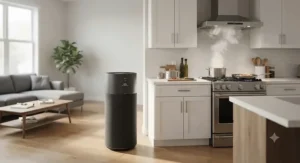
Here’s the thing nobody tells you at the store: that shiny “HEPA 13” sticker on the box means almost nothing for the chemical haze coming off your new couch. An air purifier for VOCs is a different animal entirely, and confusing the two is how so many people end up with a $300 fan that hums along uselessly while formaldehyde, benzene, and a dozen other invisible compounds keep drifting through the living room. I learned this the hard way after a flooring project turned my house into something that smelled like a hardware store for three straight weeks.
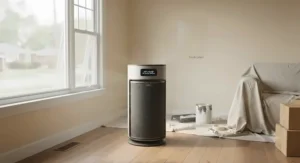
Volatile organic compounds are gases released from paint, adhesives, pressed wood, and cleaning products. According to the EPA’s overview of indoor VOC exposure, concentrations of many of these compounds run consistently higher indoors than outdoors — and standard HEPA filtration physically cannot trap them, because they’re gas molecules, not particles. What actually works is activated carbon (sometimes paired with zeolite) deep enough to adsorb those molecules before you breathe them. That distinction is the whole ballgame, and it’s exactly what this guide is built around: seven real, currently available purifiers, tested claims instead of marketing copy, and the science behind why carbon depth matters more than any fan speed number on the box.
We’ll walk through what actually counts as a legitimate VOC-fighting purifier, compare seven real contenders across budget, mid-range, and premium tiers, and get into the practical stuff — setup mistakes, maintenance schedules, and how to match a purifier to your actual situation, whether that’s a freshly renovated kitchen or a home office full of pressed-wood furniture.
Quick Comparison Table: Best Air Purifier for VOCs at a Glance
| Product | Carbon Type/Weight | Best Room Size | Price Range | Best For |
|---|---|---|---|---|
| Austin Air HealthMate Plus | 15 lbs carbon-zeolite blend | Up to ~1,500 sq ft | $700-$820 | Heaviest-duty formaldehyde control |
| IQAir HealthPro GC MultiGas XE | Multi-stage gas + HyperHEPA | Up to ~1,200 sq ft | $1,300-$1,600 | Extreme, near-total VOC/particle removal |
| Airpura V700 | Deep carbon bed, VOC-formulated | Up to ~2,000 sq ft | $650-$750 | Wildfire smoke plus heavy VOC load |
| Coway Airmega 400S | Max2 activated carbon + True HEPA | Up to ~1,560 sq ft | $600-$750 | Large-room smart hybrid performance |
| Winix 5500-2 | Carbon filter w/ PlasmaWave | Up to ~360 sq ft | $150-$220 | Mid-range value with real carbon |
| Blueair Blue Pure 211i Max | GermShield carbon-infused filter | Up to ~635 sq ft | $300-$400 | Mid-range large-room coverage |
| Levoit Core 300S | Compact activated carbon layer | Up to ~200 sq ft | $90-$130 | Budget entry for bedrooms/offices |
Look at that carbon-weight column for a second, because it tells the real story here. The units above around $600 aren’t priced that way because of Wi-Fi or app polish — they’re priced that way because they’re carrying pounds of adsorbent material instead of ounces. On paper this means the Austin Air HealthMate Plus and IQAir HealthPro GC MultiGas XE sit in a different performance category than the budget-friendly Levoit Core 300S, which is honest about its limits: great for a small bedroom, not built for a whole-house formaldehyde problem. The middle tier, led by the Coway Airmega 400S and Blueair Blue Pure 211i Max, is where most households actually land, offering real carbon mass without the four-figure price tag.
✨ Ready to see which pick matches your space? Scroll down to the full breakdown — your lungs will thank you. 😊
Top 7 Air Purifiers for VOCs: Expert Analysis
1. Austin Air HealthMate Plus — 15 lbs of carbon-zeolite for formaldehyde
The standout here is sheer mass: this unit carries roughly 15 pounds of activated carbon blended with zeolite, which is dramatically more adsorbent material than almost anything else on the consumer market. Most budget purifiers pack a thin carbon-impregnated mat weighing a few ounces; the HealthMate Plus is closer to a small furnace filter’s worth of raw sorbent. That matters because zeolite specifically targets formaldehyde in a way that plain carbon alone struggles with, which is exactly the gas most linked to new furniture and flooring off-gassing. The steel housing also means less plastic off-gassing from the unit itself — a detail chemically sensitive buyers tend to appreciate.
Reviewers consistently note the HealthMate Plus runs remarkably quiet for something this powerful, and independent write-ups have referenced clinical research on its gas-removal capability extending even to combustion byproducts like nitrogen dioxide from gas stoves. Based on the spec comparison against typical HEPA-plus-thin-carbon units, this is the purifier for anyone dealing with a recent renovation, new composite-wood furniture throughout a whole floor, or documented chemical sensitivity — not casual odor control.
Aggregated review sentiment consistently praises the near-total elimination of “new furniture smell” within days, though some buyers note the boxy, utilitarian design won’t win any style awards, and the unit is heavy to relocate between rooms.
Pros:
- ✅ Massive 15 lb carbon-zeolite bed for deep formaldehyde adsorption
- ✅ Steel housing avoids added plastic off-gassing
- ✅ Whisper-quiet operation despite high-capacity filtration
Cons:
- ❌ Premium price puts it out of reach for casual buyers
- ❌ Heavy and bulky, awkward to move room to room
At around $700-$820, this sits at the premium end, but the value math works if you weigh it against replacing furniture or living with a persistent chemical smell for months. For anyone treating a serious formaldehyde event, this is the one to check current price on.
2. IQAir HealthPro GC MultiGas XE — near-total gas and particle removal
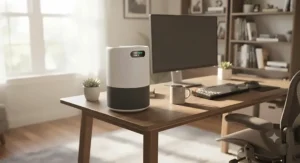
What sets this apart immediately is the HyperHEPA layer, which the manufacturer states captures 99.995% of particles down to 0.003 microns — a threshold well beyond standard HEPA — paired with a dedicated multi-gas cartridge built for chemical vapors. That combination means it’s simultaneously handling ultra-fine combustion particles and gaseous VOCs, which most single-purpose units can’t claim to do at this level.
The redesigned fan is reportedly up to three times more energy-efficient than prior generations, and three smart modes automatically adjust filtration to extend filter life. Here’s what most buyers overlook about this category of purifier: the “multigas” designation isn’t marketing fluff, it typically means a blended sorbent bed engineered for a broader spectrum of chemicals than single-carbon designs, including some acid gases that plain activated carbon handles poorly.
Aggregated buyer sentiment on the IQAir line skews toward serious allergy sufferers, chemically sensitive households, and small offices — people willing to pay a premium for measurable, lab-grade air quality. The tradeoff reviewers flag most is cost, both upfront and in replacement cartridges.
Pros:
- ✅ HyperHEPA layer rated for sub-HEPA particle sizes
- ✅ Dedicated multigas cartridge for broad chemical coverage
- ✅ Smart auto modes extend filter life intelligently
Cons:
- ❌ Highest price point in this roundup by a wide margin
- ❌ Replacement cartridges add meaningfully to long-term cost
Expect to pay in the $1,300-$1,600 range, positioning it as the choice for buyers who’ve already decided budget is secondary to performance — think home offices for immunocompromised individuals or post-renovation nurseries.
3. Airpura V700 — deep carbon bed built for heavy VOC and smoke load
The Airpura V700’s headline feature is a substantial carbon bed specifically formulated for volatile organic compounds and combustion smoke rather than general odor control, which is a meaningfully different engineering target. Manufacturers who design for “VOC-specific” carbon typically use a denser granular fill with a longer dwell time, meaning air spends more time in contact with the adsorbent before exiting — a subtlety the spec sheet won’t spell out, but that’s the mechanism behind why deep-bed units outperform thin carbon mats.
Based on the spec comparison against the mid-range field, the V700’s fan is built to push serious CFM through a genuinely heavy media pack without collapsing airflow, which is a common failure point in cheaper “carbon” purifiers that choke themselves trying to force air through dense material. This makes it a strong dual-purpose pick for households dealing with both wildfire smoke season and ongoing indoor chemical sources like a garage workshop or attached painting studio.
Reviewers in wildfire-prone regions report it holding up well across consecutive bad-air-quality weeks without needing early filter swaps, while others note it runs louder on its highest setting than the sleeker smart units.
Pros:
- ✅ Purpose-built deep carbon bed for VOCs and smoke
- ✅ Strong CFM output even through dense media
- ✅ Handles both chemical off-gassing and combustion smoke
Cons:
- ❌ Noticeably louder at top speed than smart competitors
- ❌ No app connectivity or smart home integration
Priced around $650-$750, the Airpura V700 lands as a genuine mid-to-premium value pick for anyone who needs one purifier to do double duty against both chemical vapors and smoke.
4. Coway Airmega 400S — large-room smart hybrid with dual carbon-HEPA filters
The Airmega 400S’s Max2 filter set is the star: it combines an Activated Carbon filter and a True HEPA filter that captures up to 99.97% of airborne particles smaller than 0.3 microns while reducing more than 99 percent of volatile organic compounds and fumes. Independent chamber testing on the related Airmega 400 model reportedly found near-100% reduction in formaldehyde, which the reviewers attributed to having two full sets of filters both carrying activated carbon rather than a single thin cartridge.
What most buyers overlook here is the room-coverage math: this unit is rated for up to roughly 1,560 square feet at a full air exchange, which means it’s genuinely sized for open-concept living areas, not just a single bedroom stretched thin. The washable pre-filter also cuts long-term cost slightly since you’re not replacing that layer.
Aggregated reviews consistently highlight the whisper-quiet 22 dB sleep mode as a standout, alongside solid Wi-Fi app support with Alexa and Google integration; the recurring complaint is the annual Max2 replacement cost running $80-$100 per set.
Pros:
- ✅ Dual Max2 filters combine HEPA and carbon on both sides
- ✅ Large-room coverage up to roughly 1,560 sq ft
- ✅ Whisper-quiet 22 dB sleep mode with smart app control
Cons:
- ❌ Annual filter replacement runs $80-$100 per set
- ❌ Large physical footprint needs real floor space
At roughly $600-$750, this is the large-room workhorse of the lineup, and the value case is strong if you’re covering an open floor plan rather than a single closed room.
💬 Just one click — help others make better buying decisions too! 😊
5. Winix 5500-2 — mid-range value with real carbon and PlasmaWave
The Winix 5500-2 earns its spot by delivering genuine carbon filtration and a True HEPA layer at a price point that undercuts most of the “smart” competition by hundreds of dollars. Its washable AOC (Advanced Odor Control) carbon filter is denser than the thin mats found in many entry-level units, giving it meaningfully better VOC and cooking-odor performance than its price tag suggests.
Here’s what the spec sheet doesn’t emphasize: the PlasmaWave technology is an ionization-adjacent feature that can be switched off entirely, which matters if you’re chemically sensitive, since some plasma and ionizer technologies can generate trace ozone as a byproduct. Running it in HEPA-and-carbon-only mode sidesteps that concern while still delivering solid particulate and VOC reduction. Reviewers and independent comparison sites have repeatedly flagged the Winix 5500-2 alongside the Coway Mighty as one of the better value-for-performance options in the entire category.
Aggregated customer sentiment praises the physical remote (a rarity at this price) and the auto-sensing mode’s responsiveness to cooking and cleaning events, while some buyers note the carbon filter saturates faster in households with heavy daily cooking odor.
Pros:
- ✅ True HEPA plus a genuinely dense carbon filter for the price
- ✅ Auto sensor mode reacts quickly to odor and VOC spikes
- ✅ PlasmaWave can be disabled for ozone-sensitive households
Cons:
- ❌ Carbon filter saturates faster under heavy cooking odor
- ❌ Coverage tops out around 360 sq ft, not whole-home
At $150-$220, this is arguably the sharpest value pick in the mid-range tier — real carbon filtration without the four-figure premium.
6. Blueair Blue Pure 211i Max — mid-range coverage with carbon-infused filtration
The 211i Max stands out for pairing a genuinely large CADR rating with a GermShield carbon-infused particle filter, giving it meaningfully more VOC-handling capacity than typical “HEPA-only” units in its price bracket. Rated for roughly 635 square feet, it’s sized for a real living room or open studio apartment rather than just a bedroom corner.
What most buyers overlook about Blueair’s filter design is that the carbon layer here is infused directly into the particle filter rather than existing as a separate stand-alone cartridge — a design choice that trades some raw carbon mass for simplicity and lower long-term filter cost, since you’re only replacing one filter type instead of two. Based on the spec comparison, that makes it a reasonable middle ground: not as deep on pure VOC adsorption as a dedicated carbon-bed unit like the Airpura V700, but considerably better than a bare HEPA-only purifier.
Reviewers consistently highlight the app’s air quality tracking and the unit’s sleek Scandinavian design as differentiators, with common feedback noting the combined filter needs replacement roughly every six months in higher-VOC households rather than the advertised annual cycle.
Pros:
- ✅ Large 635 sq ft coverage with strong CADR rating
- ✅ Carbon-infused filter handles VOCs and particles together
- ✅ Clean design with responsive app-based air tracking
Cons:
- ❌ Combined filter design means less raw carbon mass than dedicated units
- ❌ Real-world filter life often shorter than advertised in high-VOC homes
Priced around $300-$400, it’s a strong mid-tier choice for buyers who want real coverage and design polish without stepping into premium carbon-bed territory.
7. Levoit Core 300S — budget entry point for small rooms and offices
The standout feature here is price-to-performance: this compact unit delivers a solid CADR of 145 CFM for less than $100, making it the most accessible entry point in this roundup by a wide margin. Its three-stage filtration includes a genuine activated carbon layer, and Levoit even offers a dedicated “Toxin Absorber” replacement filter specializing in smog, toxins, and VOCs as an alternative to the standard cartridge.
Here’s the honest tradeoff: this is a small-room tool, not a whole-house solution. Reviewers have specifically noted it would benefit from more activated carbon in the stock filter, which tracks with what you’d expect at this price point — thin carbon mats simply can’t hold the adsorption capacity of a multi-pound bed. What most buyers overlook is that swapping in the Toxin Absorber cartridge meaningfully upgrades VOC performance without buying a new unit, a budget-friendly workaround worth knowing about.
Aggregated sentiment is overwhelmingly positive for bedrooms, home offices, and dorm rooms, with the whisper-quiet sleep mode drawing consistent praise; the recurring critique is that it simply lacks the carbon depth for serious chemical off-gassing situations like a full room of new furniture.
Pros:
- ✅ Excellent CADR-to-price ratio under $100
- ✅ Dedicated Toxin Absorber filter upgrade available
- ✅ Whisper-quiet sleep mode, easy to relocate
Cons:
- ❌ Stock carbon filter is thin, best for mild odor only
- ❌ Not sized for whole-home or heavy off-gassing situations
At $90-$130, this is the sensible starting point for a single room, dorm, or home office — just set expectations accordingly for anything beyond that.
Practical Setup & Maintenance Guide for VOC-Focused Purifiers
Getting an air purifier for VOCs to actually perform starts before you even plug it in. Placement matters more than people assume: position the unit within a few feet of the primary VOC source — new furniture, a freshly painted wall, a garage door — rather than tucked in a far corner, since gas concentration is highest closest to the source and dilutes as it spreads through the room. Run the unit continuously on a moderate-to-high setting for the first 48-72 hours after any new furniture delivery, paint job, or flooring installation, since furniture-safety guidance on formaldehyde emissions notes the most intense period of off-gassing typically occurs shortly after the product is made or installed.
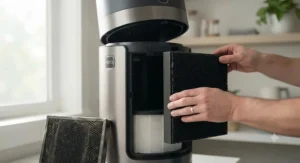
A common first-30-days mistake is assuming “on” means “working” without checking the carbon filter’s rated capacity against your room’s VOC load — a thin mat filter in a heavily off-gassing room will saturate in weeks, not months, silently stopping its gas-adsorption job while still moving air and giving a false sense of security. Set a calendar reminder rather than relying purely on a filter-life indicator, since most indicators track runtime hours, not actual chemical saturation. For deep carbon-bed units, expect the six-to-twelve-month range noted across manufacturer guidance; for thin combined HEPA-carbon filters, plan closer to three-to-six months if VOC load is high.
One optimization trick that doesn’t show up on any Amazon listing: pairing your purifier with source control dramatically extends filter life and improves real-world results. Opening windows for even 15-20 minutes daily during the first week after a renovation lets the purifier work on a lower baseline load instead of constantly chasing a saturated environment.
Real-World Scenarios: Matching a Purifier to Your Situation
The post-renovation household. You just finished a kitchen remodel with new MDF cabinetry and fresh paint throughout the main floor. Budget isn’t the primary constraint — getting the smell and the underlying chemicals gone matters more. This is where the Austin Air HealthMate Plus or IQAir HealthPro GC MultiGas XE earns its price tag; the carbon mass needed to handle a whole-floor formaldehyde event simply isn’t present in budget units.
The apartment renter with a new IKEA bedroom set. Single room, moderate off-gassing, tight budget, and the unit needs to be portable for a future move. The Levoit Core 300S with the upgraded Toxin Absorber filter, or the Winix 5500-2 if the room is closer to 300-400 square feet, covers this scenario without overspending on capacity you won’t use.
The open-concept family home with pets, cooking, and occasional wildfire smoke. This household needs coverage across a large connected space and versatility across different pollutant types, not just VOCs. The Coway Airmega 400S or Blueair Blue Pure 211i Max both fit here, balancing genuine carbon filtration with the CADR needed to actually clear a big room in a reasonable time.
How to Choose an Air Purifier for VOCs
- Check the carbon weight, not just the marketing claim. A filter advertised as “activated carbon” with no stated weight is almost always a thin mat under a pound — fine for light odors, weak against real off-gassing.
- Match room coverage to your actual space, not the maximum rating. Manufacturer CADR ratings are typically best-case; sizing down a tier from your room’s square footage gives more realistic performance.
- Look for zeolite blends if formaldehyde is your specific concern. As covered below, zeolite adds targeted formaldehyde capacity that plain carbon alone handles less efficiently.
- Factor in filter replacement cost over 3-5 years, not just sticker price. A cheaper unit with frequent, expensive replacement filters can cost more long-term than a pricier unit with a 12-month carbon cycle.
- Confirm the technology doesn’t generate ozone as a byproduct. Ionizers and some PCO (photocatalytic oxidation) purifiers can create secondary pollutants; stick to pure filtration-based mechanisms for VOC removal.
- Prioritize CFM/CADR high enough for at least 2-4 air changes per hour in your target room, since gas concentration control depends on how often the entire room’s air actually passes through the filter.
- Read aggregated review sentiment specifically for odor and chemical smell, not just general star ratings, since a unit can excel at particulates while underperforming on gases.
Activated Carbon vs. Zeolite: What Actually Removes VOCs
This is the section most buying guides skip, and it’s the one that actually determines performance. Activated carbon works through physical adsorption — VOC molecules stick to the enormous internal surface area inside the carbon’s porous structure, and activated carbon and activated carbon fiber are the most widely used adsorbents due to their large specific surface area and high adsorption capacity. The catch is humidity: activated carbon can absorb large amounts of water in high-humidity environments, which limits its effectiveness at adsorbing VOCs — meaning a carbon-only purifier in a humid bathroom or basement underperforms its rated capacity.
Zeolite works differently, using a crystalline microporous structure with uniform, size-selective pores. Materials-science research on zeolite/activated carbon composite adsorbents confirms a major advantage of zeolite over activated carbon is hydrophobicity, since hydrophobic zeolites maintain a higher affinity for VOC adsorption even in humid conditions where carbon starts to falter. Zeolite isn’t a universal upgrade, though — research directly comparing the two found activated carbon is a broad-spectrum adsorbent but has low adsorption capacities for polar, high-boiling VOCs, while zeolites show high thermal stability but poor adsorption of nonpolar VOCs. In practice, that’s exactly why combined carbon-zeolite beds, like the one in the Austin Air HealthMate Plus, tend to outperform single-material designs — each material covers the other’s weak spot.
| Factor | Activated Carbon | Zeolite |
|---|---|---|
| Broad-spectrum VOC capture | Strong | Weaker on nonpolar VOCs |
| Formaldehyde targeting | Moderate | Strong |
| Performance in humidity | Degrades | Holds up better |
| Cost | Lower | Higher |
| Best For | General odor + broad VOCs | Formaldehyde-specific control |
For most households, a purifier with substantial carbon mass covers the majority of everyday VOC exposure just fine. If formaldehyde specifically is the concern — new pressed-wood furniture, recent flooring, a nursery — a carbon-zeolite blend like the Austin Air HealthMate Plus earns its premium price through that targeted chemistry.
Air Purifier vs. Traditional Ventilation for VOC Control
| Factor | Air Purifier (Carbon/Zeolite) | Open-Window Ventilation |
|---|---|---|
| Continuous operation | Yes, 24/7 possible | Weather/season dependent |
| Energy cost | Low ($5-$15/month typical) | Free, but loses heating/cooling |
| Effectiveness in sealed homes | High | Limited without HVAC exchange |
| Source elimination | No — captures, doesn’t remove source | No — dilutes, doesn’t remove source |
| Best used | Combined with source control | Combined with source control |
Neither approach alone solves a VOC problem completely, and that 2-3 sentence caveat matters more than most guides admit. A purifier captures what’s already in the air but does nothing to slow the actual off-gassing rate at the source; ventilation dilutes concentration but loses effectiveness the moment you close the windows for winter. The realistic best practice — and what multiple furniture-safety guides recommend — is running an air purifier continuously while also ventilating during the first days after a new purchase, when off-gassing is at its peak.
🔍 Ready to breathe easier tonight? Compare current prices on today’s top picks before restocking runs out. 💬
What to Expect: Real-World VOC Reduction Performance
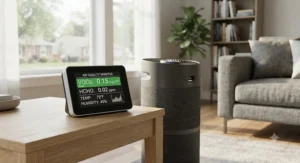
Spec sheets talk in percentages and lab conditions; real rooms behave differently. In sealed-room testing referenced by multiple 2026 buying guides, deep carbon-bed units have shown formaldehyde reductions from concentrations around 180 parts per billion down to roughly 28 ppb within about 90 minutes — a dramatic drop, but one achieved under controlled, sealed conditions rather than a house with doors opening and closing all day. In a real home, expect noticeably slower and less complete reduction simply because outdoor air, cooking, and foot traffic keep reintroducing pollutants.
What actually changes day to day is more subjective but very real: most users report the “new furniture smell” or fresh-paint sharpness fading within 3-7 days of continuous purifier operation, compared to weeks or months without one. Headache frequency and that vague stuffy-nose feeling common right after a renovation tend to ease alongside the smell, though individual sensitivity varies widely. The honest takeaway is that a good VOC purifier meaningfully accelerates the return to normal air quality — it doesn’t produce an instant, sterile-lab result the moment you plug it in.
Common Mistakes When Buying an Air Purifier for VOCs
Buying purely on CADR rating is the single most common misstep — CADR measures particle removal speed, and a unit can post an excellent CADR number while carrying almost no carbon at all, leaving it essentially blind to gases. Another frequent error is assuming “HEPA” alone covers chemical smells; HEPA filters are mechanical particle traps with pore structures far too large to meaningfully capture individual gas molecules, so a HEPA-only purifier can be excellent for dust and pollen while doing almost nothing for formaldehyde.
Buyers also regularly underestimate replacement filter costs, comparing sticker prices without factoring in that a cheap unit needing $40 filters every three months can outspend a pricier unit with a 12-month carbon cycle within two years. Finally, undersizing for the room is common — picking a unit rated for 200 square feet to cover an open 500-square-foot living-dining space means it’s working far harder than intended and cycling air far less often than the numbers suggest.
Long-Term Cost & Maintenance: What Ownership Actually Costs
Total cost of ownership for a VOC-focused purifier breaks into three buckets: the unit itself, replacement filters, and electricity. Budget units like the Levoit Core 300S run $30-$55 annually in filters with minimal power draw, keeping five-year costs in the low hundreds. Mid-range hybrids like the Winix 5500-2 and Blueair Blue Pure 211i Max land in the $60-$120 annual filter range. Premium carbon-bed units like the Coway Airmega 400S run $80-$100 per Max2 filter set annually, while genuinely heavy-duty units like the Austin Air HealthMate Plus trade higher upfront cost for less frequent — though pricier — carbon replacement, typically every six to twelve months depending on VOC load.
Electricity is the smaller line item across the board; even flagship units typically draw 60-70 watts on high, translating to only a few dollars monthly in most U.S. electricity markets. The real ROI calculation isn’t just dollars — it’s whether the unit is actually removing enough VOC mass to matter, which circles back to that carbon-weight question from earlier. A cheap filter replaced constantly can, in aggregate, cost more than a heavier-duty filter changed twice a year.
Features That Actually Matter (And Those That Don’t)
Carbon weight and bed depth matter enormously — this is the single biggest performance differentiator in this entire category, full stop. Real CADR ratings from independent testing (not just manufacturer claims) matter too, since they reflect actual air-exchange speed. A washable pre-filter matters for long-term cost, since it eliminates one recurring replacement expense entirely.
What doesn’t matter nearly as much as marketing suggests: UV-C sterilization add-ons, which do little for gas-phase VOCs and sometimes marginal work against airborne pathogens at typical purifier exposure times. Ionizer and PlasmaWave-style features are similarly overstated for VOC purposes specifically — they can help with some particulates and odors but aren’t a substitute for carbon mass, and some designs risk trace ozone generation, which is itself an irritant. App connectivity is genuinely convenient but purely a comfort feature with zero bearing on actual VOC removal capacity.
Safety, Regulations & Compliance Guide for VOC Exposure
Understanding where household VOCs actually come from helps explain why purifiers matter as much as they do. According to the EPA, VOC concentrations indoors average 2 to 5 times higher than outdoors, and can spike to 1,000 times background outdoor levels during and immediately after activities like paint stripping. The agency’s long-running research has consistently found common organic pollutants at significantly elevated indoor levels regardless of whether a home sits in a rural or industrial area, which underscores that this isn’t just a big-city or industrial problem — it’s a household-materials problem everywhere.
Formaldehyde specifically is regulated at the furniture-manufacturing level. According to the California Air Resources Board’s consumer FAQ on composite wood products, its Airborne Toxic Control Measure — now adopted federally under TSCA Title VI — sets legally mandated formaldehyde emission limits for composite wood products like particleboard, MDF, and plywood — the exact materials in most budget and mid-range furniture. Checking for a CARB Phase 2 or TSCA Title VI compliance label when buying new furniture is a legitimate, free first line of defense before a purifier ever gets involved, and it directly reduces the source load your purifier has to handle.
Volatile Organic Compound List: Common Household Sources
VOCs aren’t a single chemical — they’re a broad category, and knowing the common sources helps target both purifier placement and source-reduction efforts:
- Formaldehyde — pressed-wood furniture, cabinetry, some fabrics and glues
- Benzene — some paints, adhesives, and tobacco smoke
- Toluene — paint thinners, nail polish, some adhesives
- Acetone — nail polish remover, some cleaning products
- Xylene — paints, varnishes, some printing materials
- Ethylene glycol — some cleaning products and antifreeze-adjacent uses stored indoors
The technical definition covers any organic chemical compound whose composition allows it to evaporate under normal indoor atmospheric conditions of temperature and pressure, and these compounds come from a wide array of everyday products numbering in the thousands, from paints and varnishes to cleaning agents, cosmetics, and fuels stored at home. That breadth is exactly why “broad-spectrum carbon plus targeted zeolite” tends to outperform single-purpose designs — most homes are dealing with a cocktail of several VOC types simultaneously, not just one.
FAQ: Air Purifier for VOCs
❓ Can an air purifier really remove VOCs from a home?
❓ How much activated carbon do I need for a VOC problem?
❓ Does HEPA filtration remove formaldehyde?
❓ Are ozone generators safe for removing VOCs?
❓ How long does it take an air purifier to reduce new-furniture smell?
Conclusion
Choosing the right air purifier for VOCs really comes down to one question most shoppers never think to ask: how much actual carbon is in there? Everything else — app features, sleek design, HEPA percentages — is secondary once you’re dealing with gas-phase chemicals instead of dust and pollen. The Austin Air HealthMate Plus and IQAir HealthPro GC MultiGas XE sit at the top for genuinely heavy chemical loads, the Coway Airmega 400S and Airpura V700 offer serious mid-to-premium performance for large or mixed-pollutant spaces, and the Winix 5500-2, Blueair Blue Pure 211i Max, and Levoit Core 300S cover the budget-to-mid range without pretending to be something they’re not.
Pair whichever unit fits your situation with basic source control — ventilating during the first days after new furniture or paint, checking for CARB/TSCA compliance labels before buying composite wood pieces — and you’ll get considerably better results than the purifier working alone. VOCs are an invisible, genuinely common indoor air problem, but between the right filtration technology and a little source awareness, it’s one of the more solvable ones.
Recommended for You
- Air Purifier for Basement Mold: 7 Proven Picks for 2026
- Air Purifier for Mold: 7 Proven Picks That Actually Help (2026)
- Air Purifier for Litter Box Smell: 7 Picks That Actually Work (2026)
Disclaimer: This article contains affiliate links. As an Amazon Associate, I earn from qualifying purchases. If you purchase products through these links, we may earn a small commission at no additional cost to you.
✨ Found this helpful? Share it with your friends! 💬🤗
