
In This Article
Here’s the smell every homeowner dreads: that faint, damp, slightly sour funk that hits you the second you open the basement door. You scrub the visible spots, you crack a window, and two weeks later it’s back like it never left. If you’re here, you’ve probably already Googled “air purifier for mold” at 11 p.m. while standing in your bathroom wondering if that ceiling stain is actually a problem or just… paint being weird.
So let’s answer the obvious question first, because you deserve a straight answer before anything else: what is an air purifier for mold? It’s a HEPA-filtration appliance designed to capture airborne mold spores — typically 1 to 40 microns in size — along with the musty volatile compounds mold produces, reducing what you breathe without touching the mold actually growing on your walls, grout, or drywall.
That last part matters more than any marketing page will admit. An air purifier for mold is a genuinely useful tool, but it’s one piece of a bigger puzzle, not a magic eraser. We’ll get into exactly what it can and can’t do a little later, because that distinction is the difference between buying the right machine and wasting four hundred dollars on false hope.
What follows is a research-backed breakdown of seven real air purifiers currently sold for mold-prone spaces, spanning bargain bedroom units to Swiss-engineered medical-grade machines. We looked at independent lab testing, AHAM-verified CADR numbers, aggregated owner sentiment, and the actual chemistry of what mold spores are made of — not just spec sheets copied from Amazon listings. Whether you’re dealing with a musty crawlspace, a bathroom that never quite dries out, or a full-blown black mold scare, there’s a purifier on this list built for your specific situation. Let’s dig in.
Quick Comparison Table: Air Purifier for Mold at a Glance
If you’re short on time, here’s the fast version. This table sorts by budget tier so you can jump straight to your price range before reading the deep dives below.
| Purifier | Coverage | Key Tech | Price Range | Best For |
|---|---|---|---|---|
| GermGuardian AC4825 | Up to 153 sq ft (fast cycle) / 743 sq ft (1x/hr) | True HEPA + UV-C | Around $90-$110 | Tightest budgets, small musty rooms |
| Winix 5510 | Up to 360-390 sq ft | PlasmaWave + True HEPA | $170-$200 range | Basements on a budget |
| Levoit Core 400S | Up to 400 sq ft | Laser sensor + H13 HEPA | $180-$230 range | Smart-home living rooms |
| NuWave OxyPure Zero | Up to 2,002 sq ft | Washable Bio-Guard filtration | $380-$450 range | Big open spaces, zero filter waste |
| AirDoctor 3500 | Up to 630 sq ft (4 ACH) | UltraHEPA to 0.003 microns | $400s-$600s range | Mycotoxin-conscious buyers |
| Austin Air HealthMate HM400 | Up to 1,500 sq ft | 15 lbs carbon/zeolite + HEPA | $750-$850 range | Chronic musty odor, heavy VOC load |
| IQAir HealthPro Plus | Up to 1,125-1,240 sq ft | HyperHEPA medical-grade | $900-$1,200+ range | Severe mold sensitivity, medical-grade needs |
Looking at the spread above, there’s a clear pattern: coverage area and filtration depth climb together with price, but the jump isn’t always proportional to what you actually need. A 300-square-foot bedroom doesn’t benefit from IQAir HealthPro Plus-level mycotoxin filtration the way a water-damaged basement does, so matching the machine to the actual room — not just the biggest number on the box — is where most buyers waste money. Budget picks like the GermGuardian AC4825 and Winix 5510 genuinely hold their own in small-to-medium rooms, while the jump to AirDoctor 3500 or Austin Air HealthMate HM400 only pays off once you’re dealing with persistent moisture, larger square footage, or documented mold sensitivity.
💬 Bookmark this table now — you’ll want to compare it against the specs below before you decide.
Top 7 Air Purifiers for Mold: Expert Analysis
Each of these seven made the cut because they have verifiable HEPA or HEPA-equivalent filtration, real owner review data, and a documented track record specifically for mold-related air quality — not just general allergen marketing copy.
1. GermGuardian AC4825 — budget UV-C mold fighter for small rooms
The standout here is simple: this is one of the few sub-$100 purifiers that pairs True HEPA filtration with an actual UV-C germicidal bulb, and it’s been doing it since long before “UV-C” became a buzzword. The three-layer stack runs a charcoal pre-filter, a True HEPA filter rated to capture 99.97% of particles down to 0.3 microns, and an optional UV-C light that manufacturer-commissioned lab testing showed reduced Aspergillus niger — a common black-toned mold species — along with several bacteria and virus strains.
Here’s what most buyers overlook about this model: its official coverage numbers change dramatically depending on how hard you want the air changed. It clears a 153-square-foot room at a genuinely useful 4.8 air changes per hour, but only manages a single pass per hour in a room up to 743 square feet — a distinction that matters enormously for mold, since experts recommend hitting at least 4 ACH to meaningfully outpace ongoing spore release. Based on the spec comparison with pricier units, this one is best kept in a bedroom, home office, or small bathroom rather than an open basement.
Reviewers consistently report that the True HEPA filtration handles everyday dust and pollen well, and several long-term owners specifically mention it helping with musty bedroom odors when paired with the UV-C light running continuously. A recurring complaint in user reviews, however, is that the UV-C indicator light is hard to see in bright rooms, leading some owners to mistakenly leave it off entirely.
Pros:
- ✅ Genuinely affordable True HEPA plus UV-C combo
- ✅ CARB-certified with zero ozone emissions
- ✅ Compact footprint fits tight bathrooms and bedrooms
Cons:
- ❌ Full 4.8 ACH coverage limited to small rooms only
- ❌ UV-C on/off indicator is easy to miss
At around $90-$110, the GermGuardian AC4825 is the easiest entry point into mold-focused air purification, and the value holds up well as long as you’re realistic about its room-size ceiling.
2. Winix 5510 — best PlasmaWave value for musty basements
The Winix 5510 picked up the torch from the wildly popular (and now discontinued) Winix 5500-2, and it’s the rare successor that actually improved on the original instead of just repackaging it. The standout is PlasmaWave technology, which generates hydroxyls that work alongside — not instead of — the True HEPA filter to break down odor-causing compounds at a molecular level, rather than simply trapping them in a filter mat where they can linger.
The specs translate into real performance: AHAM-verified CADR sits around 232-253 CFM depending on the pollutant measured, giving it coverage of roughly 360-390 square feet at a strong air-exchange rate. What that means in practice is a basement or laundry room in the 300-square-foot range gets genuinely fast, repeated air turnover rather than a single slow pass. The washable AOC (Advanced Odor Control) carbon filter uses real granular carbon rather than the thin fabric sheets found in cheaper competitors, which is exactly why it holds up better against sustained musty smells instead of just masking them temporarily.
Aggregated owner sentiment is notably positive on odor control specifically — a recurring theme in reviews is that the carbon layer noticeably cuts basement mustiness within the first day of continuous use, something dust-only filters can’t do. The most common complaint is that PlasmaWave, while independently tested at zero measurable ozone output, still gets flagged by ozone-sensitive users who prefer to run it in HEPA-only mode.
Pros:
- ✅ Real granular carbon filter tackles musty odors, not just spores
- ✅ Strong CADR-to-price ratio among AHAM-verified models
- ✅ WiFi app control with schedule automation
Cons:
- ❌ Some ozone-sensitive users prefer disabling PlasmaWave
- ❌ Coverage tops out around 390 sq ft, too small for open basements
In the $170-$200 range, the Winix 5510 is arguably the strongest dollar-for-dollar pick on this list for anyone whose main complaint is smell, not just visible spore counts.
3. Levoit Core 400S — smartest all-rounder for living spaces
If the Winix 5510 is the odor specialist, the Levoit Core 400S is the generalist that makes everyday living easier. Its standout feature is the laser PM2.5 sensor built into the front display, which gives you a live numeric air quality reading instead of a vague colored light — genuinely useful when you’re trying to figure out whether disturbing a moldy box in storage actually spiked particle counts in the next room.
The H13 True HEPA filter captures 99.97% of particles at 0.3 microns, comfortably within range for the vast majority of mold spores (which run 1 to 40 microns), and AHAM-verified CADR figures land around 231-260 CFM for smoke depending on which generation you buy — Levoit updated the 400S-P version’s official numbers, so don’t be alarmed if you see slightly different figures across review sites. Coverage sits around 400 square feet, which comfortably handles a large bedroom or open-plan living area but starts to strain in genuinely large basements.
What most buyers overlook about this model is how much the WiFi and auto-mode features actually matter for mold control specifically: because the sensor automatically ramps the fan when it detects a spike (say, from disturbing a damp closet), you get faster spore capture during the exact moments that matter most, without having to remember to crank it manually. Reviewers consistently praise the app’s air-quality history graphs for making it obvious when a room’s air quality trends worse — often the first sign of a hidden moisture problem.
Pros:
- ✅ Laser PM2.5 sensor gives real-time numeric readings
- ✅ Auto mode reacts instantly to particle spikes
- ✅ Quiet 24 dB sleep mode for bedrooms
Cons:
- ❌ Noticeably louder at 52 dB on turbo speed
- ❌ Companion app occasionally lags or disconnects
Typically priced in the $180-$230 range, the Levoit Core 400S earns its reputation as an everyday-living-room pick rather than a specialist mold-remediation tool.
4. NuWave OxyPure Zero — zero-waste washable filters for big spaces
The headline feature is right there in the name: the NuWave OxyPure Zero uses a dual four-stage filtration system built entirely from washable, reusable components, meaning you theoretically never buy a replacement filter for the life of the unit. That’s a genuinely different value proposition from every HEPA-based competitor on this list, where filter costs quietly add up over the years.
Instead of a traditional HEPA filter, the core “Bio-Guard” layer uses electrostatic precipitation to trap particles as small as 0.1 microns — comfortably capturing mold spores and even reaching into the range of some bacteria and fine PM2.5 particles — and independent Intertek lab testing has certified 100% capture at that particle size along with CARB-verified ozone output roughly 70 times below the EPA’s safety threshold. Certified CADR figures run remarkably high for this price bracket: around 373 CFM for smoke, 380 for dust, and 410 for pollen, which is nearly 50% higher than the mid-range Levoit Core 400S. Coverage stretches to a genuinely large 2,002 square feet, making this one of the few purifiers on this list realistically sized for an open basement or a whole finished lower level.
Here’s what the spec sheet won’t tell you, but reviewers note: the washable filters need consistent maintenance — rinsing and fully air-drying the Bio-Guard cells on a schedule — or performance quietly degrades even though nothing needs replacing. Owners who stay on top of that maintenance report the “zero replacement cost” claim genuinely holds up over one to two years of ownership, offsetting the higher upfront price.
Pros:
- ✅ No recurring filter-replacement costs over the unit’s lifespan
- ✅ Exceptionally high CADR for its price bracket
- ✅ Covers up to 2,002 sq ft, ideal for open basements
Cons:
- ❌ Requires disciplined filter-washing schedule to maintain performance
- ❌ Higher upfront cost than comparable HEPA units
In the $380-$450 range, the NuWave OxyPure Zero rewards buyers who want long-term value in a large moisture-prone space and don’t mind a bit of hands-on filter maintenance.
5. AirDoctor 3500 — best for ultra-fine mycotoxins
Mold spores themselves run 1 to 40 microns, well within standard HEPA range — but the mycotoxins some mold species produce are dramatically smaller, down around 0.1 microns, which is exactly the gap the AirDoctor 3500 was built to close. Its UltraHEPA filter is independently tested to capture 99.99% of airborne particles as small as 0.003 microns, a full 100 times smaller than the conventional HEPA benchmark of 0.3 microns.
The three-stage system layers a pre-filter for large debris, a dual-action carbon/VOC filter infused with potassium permanganate for gas-phase pollutants, and the UltraHEPA stage itself. AHAM-style smoke CADR lands around 340 CFM, with coverage rated up to 630 square feet at a genuinely aggressive 4 air changes per hour (or 1,274 square feet at a gentler 2 ACH) — that 4-ACH benchmark echoes the air-change guidance researchers at Harvard’s indoor air quality program have recommended for optimal particle removal. Forbes named this specific model its pick for mold toxins in 2026, largely on the strength of that mycotoxin-range filtration most competitors simply don’t test for.
What the spec sheet won’t tell you: real owners report the auto-mode sensor is genuinely responsive, ramping up within seconds of disturbing dusty or damp materials, and multiple long-term reviews specifically mention the carbon/VOC layer cutting musty smells noticeably faster than plain HEPA-only competitors. A common complaint in user reviews is filter cost — replacement UltraHEPA and carbon/VOC filters run a recurring expense every 6 to 12 months that adds up over several years of ownership.
Pros:
- ✅ Captures particles 100x smaller than standard HEPA benchmark
- ✅ Dual-action carbon targets VOCs and musty gases directly
- ✅ Meets Harvard-recommended 4 ACH standard at 630 sq ft
Cons:
- ❌ Replacement filter costs are a recurring line-item expense
- ❌ Coverage claims scale down significantly at gentler fan speeds
Prices for the AirDoctor 3500 typically land in the $400s to $600s range depending on promotions, positioning it as the premium tier’s entry point rather than its ceiling.
6. Austin Air HealthMate HM400 — heaviest-duty carbon for chronic musty odors
Some purifiers chase filtration percentages; the Austin Air HealthMate HM400 chases sheer filter mass, and that’s precisely its standout feature. Fifteen pounds of activated carbon and zeolite blend sits ahead of over 60 square feet of medical-grade True HEPA media — both figures that dwarf the thin carbon sheets or small HEPA cartridges found in most consumer purifiers at similar or even higher price points.
That much carbon mass matters specifically for mold because musty odor compounds are gas-phase pollutants, and gas-phase filtration scales with adsorptive surface area, not fan speed. Based on the spec comparison, a unit with 15 pounds of carbon simply has more capacity to keep neutralizing musty VOCs day after day before the material saturates, compared to units with only a few ounces of carbon media. The True HEPA stage still handles the particulate side, capturing 99.97% of particles at 0.3 microns — squarely within mold spore range — while the steel housing and 360-degree intake pull air from every side of the unit at roughly 400 cubic feet per minute on high, covering spaces up to 1,500 square feet.
Reviewers consistently note this unit’s build quality and longevity as its defining trait: the 5-year mechanical warranty and pro-rated filter warranty reflect a genuinely different design philosophy than most disposable-cartridge competitors, and long-term owners report the filter media lasting 2-3 years of continuous 24/7 use before needing replacement. The recurring complaint is upfront cost and lack of smart features — there’s no app, no WiFi, no auto-mode, just a manual dial.
Pros:
- ✅ 15 lbs of carbon/zeolite dramatically outperforms thin carbon sheets on odor
- ✅ 60 sq ft of medical-grade HEPA media covers up to 1,500 sq ft
- ✅ 5-year mechanical and pro-rated filter warranty
Cons:
- ❌ No smart features, app control, or auto-sensing
- ❌ Heavier upfront investment than most HEPA-only competitors
At $750-$850, the Austin Air HealthMate HM400 is squarely for buyers whose primary pain point is persistent musty odor and chemical off-gassing, not just visible dust reduction.
7. IQAir HealthPro Plus — medical-grade HyperHEPA for severe mold sensitivity
At the top of this list sits the IQAir HealthPro Plus, and its standout feature is HyperHEPA filtration independently tested to remove at least 99.5% of all airborne particles down to 0.003 microns — a figure verified by specialized labs capable of measuring particles that small, well beyond what typical consumer HEPA testing even attempts. Swiss-engineered and built with a patented triple-sealing system designed to eliminate any air leakage around the filter housing, this is the model doctors and mold-remediation professionals most often cite by name.
The filtration stack runs a PreMax pre-filter for coarse particles like pollen, pet dander, and mold spores themselves, a V5-Cell activated carbon and alumina filter for gas-phase VOCs and odors, and the HyperHEPA stage for everything down to the ultra-fine range. Coverage runs up to 1,125-1,240 square feet depending on the exact model version, and sound pressure levels scale gently from a whisper-quiet 25 dB at the lowest setting up to 59 dB at maximum — still competitive given the filtration depth on offer. Independent lab testing on the HealthPro series has documented over 99.9% reduction of specific virus strains, underscoring just how far past standard HEPA thresholds this filtration reaches.
Aggregated review sentiment consistently frames this as the recommendation for genuinely severe cases — documented mold sensitivity, active remediation projects, or homes with a confirmed history of significant water damage — rather than everyday allergy management, where it’s simply overbuilt. The most common complaint by far is price, followed by ongoing filter costs that run meaningfully higher per year than any other unit on this list.
Pros:
- ✅ HyperHEPA certified to 0.003 microns, 100x smaller than standard HEPA
- ✅ Triple-sealed housing prevents unfiltered air leakage
- ✅ Widely cited by allergists and mold-remediation professionals
Cons:
- ❌ Highest upfront price on this entire list
- ❌ Annual filter costs run well above HEPA-only competitors
Ranging from $900 to $1,200-plus depending on configuration, the IQAir HealthPro Plus is a genuine investment — one best reserved for buyers with documented, serious mold-related health concerns rather than general peace of mind.
Top 7 Products: Full Spec Comparison
| Purifier | CADR (Smoke) | Filter Type | Coverage | Replacement Cost | Best For |
|---|---|---|---|---|---|
| GermGuardian AC4825 | Modest (not headline spec) | True HEPA + UV-C | 153-743 sq ft | ~$25-30 per filter, every 6-8 mo | Small rooms, bathrooms |
| Winix 5510 | ~232-253 CFM | True HEPA + PlasmaWave | 360-390 sq ft | ~$50/year | Basements, odor control |
| Levoit Core 400S | ~231-260 CFM | H13 True HEPA | ~400 sq ft | ~$50-70, every 6-8 mo | Living rooms, bedrooms |
| NuWave OxyPure Zero | ~373-410 CFM | Washable Bio-Guard ESP | Up to 2,002 sq ft | Near-zero (washable) | Large open basements |
| AirDoctor 3500 | ~340 CFM | UltraHEPA to 0.003 microns | Up to 630 sq ft (4 ACH) | ~$70-90, every 6-12 mo | Mycotoxin-conscious buyers |
| Austin Air HealthMate HM400 | ~400 CFM airflow | HEPA + 15 lbs carbon/zeolite | Up to 1,500 sq ft | ~$200, every 2-3 years | Chronic odor, VOC-heavy homes |
| IQAir HealthPro Plus | Rated by HyperHEPA %, not standard CADR | HyperHEPA to 0.003 microns | Up to 1,125-1,240 sq ft | Premium, highest on list | Severe sensitivity, medical-grade |
The clearest takeaway from this table is that CADR and coverage area climb almost in lockstep with price up through the AirDoctor 3500, but the Austin Air HealthMate HM400 breaks that pattern by trading raw CADR for sheer carbon mass, which is why it dominates on odor control specifically rather than headline air-change speed. Meanwhile, the NuWave OxyPure Zero‘s washable-filter approach means its long-term cost curve looks completely different from every HEPA-based competitor, even though its upfront price sits mid-pack.
✨ Don’t Miss These Exclusive Deals!
🔍 Take your fight against musty air to the next level with these carefully vetted picks. Click on any highlighted model above to check current pricing and availability before it changes. The right purifier can make your home feel — and smell — genuinely fresh again!
Practical Usage Guide: Setting Up Your Air Purifier for Maximum Mold Spore Capture
Buying the right machine is half the job; placement and maintenance decide whether it actually performs. First 48 hours matter most: run any new unit on its highest fan speed continuously for the first two days in the target room, rather than easing into auto-mode immediately, since this establishes a real baseline air-quality reading your sensor can compare against later.
Placement should prioritize airflow over aesthetics. Keep the unit at least 12-18 inches from walls and furniture on every open side, since blocked intake dramatically reduces effective CADR regardless of what the spec sheet promises. In a basement specifically, position the purifier as close to the suspected moisture source as safely possible — near a sump pump, a damp corner, or a laundry area — rather than centering it in open floor space, since spore concentration is highest closest to the source.
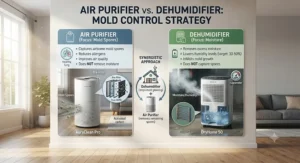
The single most common first-30-days mistake is neglecting the pre-filter. Nearly every unit on this list — from the GermGuardian AC4825 up through the IQAir HealthPro Plus — relies on a washable or vacuumable pre-filter to catch large debris before it reaches the expensive HEPA or carbon stage. Skipping monthly pre-filter cleaning shortens the life of every downstream filter and quietly tanks airflow within weeks. Pair your purifier with a dehumidifier keeping relative humidity below 50%, since even the best air purifier for mold can’t outrun a room that keeps generating new spores faster than it captures old ones.
Real-World Scenarios: Which Air Purifier for Mold Fits Your Situation
The renter with a musty bedroom closet. You’re not tearing out drywall in an apartment, but that faint smell every time you open the closet door is real. A compact, budget-friendly pick like the GermGuardian AC4825 running continuously with its UV-C light on addresses both the airborne spore count and gives some odor relief, without an upfront investment you can’t take with you when the lease ends.
The family with a finished basement rec room. Open floor plan, moderate humidity, kids and pets tracking moisture in and out — this is squarely NuWave OxyPure Zero or Winix 5510 territory depending on budget. The NuWave’s 2,002-square-foot ceiling comfortably covers an open basement layout, while the Winix’s carbon-heavy odor control shines in a space that gets used daily and needs to smell normal for guests.
The homeowner recovering from a documented water-damage event. If you’ve had a flood, a slow roof leak, or a plumbing failure and a remediation company has confirmed mold growth, this is where the premium tier earns its price tag. The AirDoctor 3500 or Austin Air HealthMate HM400 for heavier odor loads, stepping up to the IQAir HealthPro Plus if a physician has specifically flagged mold sensitivity as a health concern, gives you filtration depth that genuinely matches the severity of the underlying moisture problem — while you continue working with a certified remediation professional on the structural fix itself.
How to Choose an Air Purifier for Mold and Mildew
Picking the right air purifier for mold and mildew comes down to seven decision points, in roughly this order of importance:
- Confirm true HEPA or HEPA-equivalent filtration first. Anything without a certified 99.97%-at-0.3-microns rating (or better) shouldn’t be in your shortlist, since mold spores fall largely in the 1-40 micron range where true HEPA excels.
- Match CADR and coverage to your actual square footage, not the marketing maximum. Aim for a unit rated to hit 4-5 air changes per hour in your specific room, not just “rated for” that square footage at a single slow pass.
- Prioritize activated carbon if odor is your main complaint. Spore capture and smell reduction are two different jobs — a thin carbon sheet won’t touch a genuinely musty basement the way a heavier carbon/zeolite blend will.
- Decide whether UV-C matters for your situation. It offers a modest additional layer against spores directly exposed to the light, but shouldn’t be your primary filtration decision-maker.
- Factor in total filter-replacement cost over 2-3 years, not just the sticker price. A cheaper unit with expensive, frequent filter changes can cost more long-term than a pricier washable-filter model.
- Consider noise tolerance for bedrooms versus basements. A unit that’s whisper-quiet on low but loud on turbo may force an uncomfortable tradeoff in a sleeping space.
- Weigh smart features against reliability needs. WiFi and auto-sensing genuinely help catch spikes early, but simpler manual units sidestep app glitches and firmware headaches entirely.
Mold Spore Size and Why Micron Rating Matters for HEPA Filtration
Here’s the number that actually explains why HEPA filtration works so well for this specific problem: mold spores typically measure between 1 and 40 microns, with many common household species like Aspergillus and Cladosporium producing spores clustered around 2 to 10 microns. For comparison, a single human hair runs about 100 microns thick — meaning most mold spores are roughly ten times thinner than a strand of your own hair, but still comfortably larger than what a certified True HEPA filter is designed to catch.
A True HEPA filter, by the accepted industry definition, captures at least 99.97% of particles as small as 0.3 microns — well below the size of nearly every mold spore species. That’s the good news. The complication is mycotoxins, the secondary compounds certain mold species produce, which can measure as small as 0.1 microns or even smaller in fragmented form. This is exactly the gap that ultra-fine filtration technologies — like the AirDoctor 3500‘s UltraHEPA rated to 0.003 microns or the IQAir HealthPro Plus‘s HyperHEPA at that same threshold — were engineered to close, capturing particles roughly 100 times smaller than the standard HEPA benchmark.
For most households dealing with everyday mold-related allergy symptoms, standard True HEPA filtration is genuinely sufficient, since it comfortably covers the spore size range itself. Reaching for ultra-fine filtration specifically makes sense when mycotoxin exposure, rather than spore count alone, is the documented concern — typically after a professional assessment following serious water damage.
Does UV-C Germicidal Technology Actually Kill Mold Spores?
UV-C germicidal light is one of the most misunderstood features on this entire list, so let’s be precise about what it does and doesn’t do. In controlled lab conditions with sufficient exposure time and intensity, UV-C radiation can damage the DNA of mold spores enough to prevent them from germinating — which is the mechanism GermGuardian’s own testing against Aspergillus niger relies on. That’s a real, measurable effect, not marketing fluff.
Here’s what most buyers overlook, though: effectiveness depends entirely on exposure time and direct line-of-sight to the light source. A spore that passes through a UV-C chamber in a fraction of a second gets a dramatically smaller dose than one sitting stationary in a lab test chamber for minutes at a time, and most consumer-grade UV-C purifiers simply don’t have the contact time to guarantee spore inactivation on every single pass. Spores hiding in carpet fibers, wall cavities, or furniture never see the light at all, which is exactly why UV-C should be understood as a supplementary layer on top of HEPA filtration, not a replacement for it.
There’s also a nuance worth flagging honestly: some research suggests that damaging rather than fully destroying a spore can fragment it into smaller allergenic pieces, meaning a “killed” spore isn’t necessarily a harmless one from an allergy standpoint — the proteins that trigger reactions can persist regardless of whether the organism is technically alive. So if you’re specifically shopping for “an air purifier that kills mold spores,” the honest framing is: UV-C adds a genuine secondary layer of protection when paired with True HEPA capture, but the filtration stage is still doing the heavy lifting.
HEPA Air Purifier for Mold Removal vs Ozone Generators and Ionizers
Not every air-cleaning technology marketed for mold is created equal, and this comparison matters enough to spell out plainly.
| Technology | How It Works | Mold Effectiveness | Safety Profile |
|---|---|---|---|
| True HEPA (e.g. Levoit Core 400S) | Mechanically traps particles in dense fiber media | Excellent — spores are well within capture range | No byproducts, safe for continuous use |
| UV-C germicidal (e.g. GermGuardian AC4825) | Damages spore DNA on direct light exposure | Supplementary, exposure-time dependent | Safe when zero-ozone certified |
| Ionizers/PlasmaWave (e.g. Winix 5510) | Charges particles to clump and fall or neutralizes VOCs at a molecular level | Helps with odor-causing gases, not a spore-capture replacement | Verify independent zero-ozone testing |
| Ozone generators | Intentionally floods air with ozone gas | EPA and CARB both warn ozone doesn’t reliably kill mold and can be counterproductive | Lung irritant — avoid entirely |
The pattern here is unambiguous: mechanical HEPA filtration is the proven foundation for reducing airborne mold spores, and every credible technology on this list — carbon adsorption, UV-C, PlasmaWave-style ionization — functions as a genuine supplement to that foundation rather than a substitute for it. Ozone generators are the clear exception and don’t belong in this comparison as a legitimate mold solution at all; the EPA’s official guidance explicitly cautions against portable air cleaners that intentionally produce ozone, since it’s a documented lung irritant with no reliable mold-killing benefit to offset that risk.
Common Mistakes When Buying an Air Purifier for Mold and Mildew
The single biggest mistake is undersizing the unit for the room, then blaming the purifier when spore counts don’t budge — a 300-square-foot-rated machine in a 900-square-foot open basement is functionally just moving air around slowly rather than genuinely cycling it. A close second is skipping the carbon filter entirely and buying HEPA-only, then wondering why the room still smells musty even as visible dust drops — spore capture and odor control are separate jobs handled by separate filter media.
Buyers also frequently expect the purifier itself to eliminate an active, visible mold problem, when in reality no air purifier — regardless of price tier — reaches mold actually growing on a surface. That job belongs to physical remediation and moisture control, full stop. Another recurring mistake is ignoring maintenance schedules once a unit is installed; a saturated pre-filter or carbon layer doesn’t just stop helping, it can actively reduce the unit’s overall airflow and effectiveness across every filtration stage behind it. Finally, plenty of shoppers get seduced by “kills 99.9% of mold” marketing language on packaging without checking whether that claim was tested under lab conditions that bear any resemblance to a real room — always look for AHAM verification or genuinely independent lab data before trusting a headline percentage.
Black Mold (Stachybotrys) and Air Purifiers: What the Science Says
“Black mold” almost always refers colloquially to Stachybotrys chartarum, a greenish-black species that requires sustained moisture on cellulose-rich material like drywall, fiberboard, or paper to establish itself. According to the CDC’s official guidance, this species and other molds may cause nonspecific health symptoms, and — contrary to decades of alarmist media coverage — no test currently exists proving a direct causal link between Stachybotrys exposure and specific severe health outcomes in humans.
That doesn’t mean it’s harmless to ignore. The CDC is explicit that any mold found growing in a building should be removed regardless of species, since color and name alone don’t reliably indicate toxicity — plenty of non-hazardous molds also present as dark or black. For air purification purposes, Stachybotrys spores fall within the same general 1-40 micron range as other common mold species, meaning a properly rated True HEPA unit captures them just as effectively as any other spore type. Where things differ is mycotoxin production: some Stachybotrys strains generate trichothecene compounds under specific stress conditions, which is precisely the scenario where stepping up to ultra-fine filtration like the AirDoctor 3500 or IQAir HealthPro Plus offers genuine additional value over standard HEPA.
The practical takeaway is refreshingly unglamorous: if you find dark, greenish-black growth on a damp surface, treat it exactly like you’d treat any other confirmed mold — fix the moisture source, physically remove the growth (professionally, if the affected area exceeds roughly 10 square feet), and run appropriate HEPA filtration to manage airborne spores in the meantime. There’s no special “black mold purifier” category that outperforms a properly sized HEPA unit against this specific species.
Does an Air Purifier Help With Mold? Setting Realistic Expectations
Yes — with an important asterisk. An air purifier genuinely reduces the concentration of airborne mold spores circulating through a room, which measurably helps allergy and asthma symptoms triggered by inhaling those particles. What it does not do is remove mold already growing on walls, ceilings, carpets, or wood, and it does nothing to address the underlying moisture problem that let the mold establish itself in the first place.
The EPA’s guidance on portable air cleaners is unambiguous on this exact point: air cleaners may remove some mold-related particles and occasionally help with associated odors, but they will not resolve an active mold-and-moisture problem on their own. Think of it less like a cure and more like symptom management running alongside the actual fix — which is drying out the space, correcting whatever’s causing the moisture, and physically cleaning up existing growth, ideally with a certified remediation professional if the affected area is significant.
So the realistic framing for anyone asking whether an air purifier helps with mold is this: yes, meaningfully, for the airborne symptom side of the equation — reduced sneezing, less musty smell in the air, lower ongoing spore inhalation — but it’s one tool in a toolkit that also needs a dehumidifier, proper ventilation, and, for anything beyond a small isolated patch, an actual remediation plan.
Long-Term Cost & Maintenance: Filter Replacement and Total Cost of Ownership
Sticker price tells you almost nothing about what an air purifier for mold actually costs over its useful life, and the seven units above illustrate wildly different cost curves. The GermGuardian AC4825 and Levoit Core 400S both sit in the “cheap machine, recurring filter cost” category — expect to spend roughly $50-90 annually on replacement filters, meaning a three-year total cost of ownership can approach or exceed the unit’s original purchase price. The Winix 5510 follows a similar pattern with slightly better long-term carbon-filter economics thanks to its washable pre-filter stage reducing wear on the pricier downstream media.
The AirDoctor 3500 and Austin Air HealthMate HM400 sit in the premium-but-durable category: higher individual filter costs, but the Austin Air’s 15-pound carbon/zeolite blend and 60-square-foot HEPA media are engineered to last 2-3 years under continuous use rather than the 6-8 month cycle typical of thinner competitor filters, which meaningfully changes the multi-year math in its favor despite the steep upfront price. The NuWave OxyPure Zero breaks the pattern entirely with its washable-filter design — the ongoing cost genuinely approaches zero as long as owners maintain the recommended washing schedule, making it the strongest long-term value proposition in raw dollar terms despite a higher purchase price than budget HEPA units. The IQAir HealthPro Plus remains the priciest to maintain in absolute dollars, but buyers in that tier are typically prioritizing filtration depth over lifetime cost efficiency, and that tradeoff is a reasonable one for documented severe sensitivity cases.
Problem → Solution: Fixing Common Mold-Related Air Quality Issues
Problem: The musty smell comes back within days of cleaning. Solution — the smell is a volatile gas-phase compound, not a particle, so a HEPA-only purifier without real activated carbon won’t touch it; step up to a carbon-heavy option like the Winix 5510 or Austin Air HealthMate HM400, and pair it with a dehumidifier to stop new spores from generating fresh odor compounds in the first place.
Problem: Allergy symptoms persist even with a purifier running. Solution — check actual room coverage against your purifier’s rating; undersized units running at a low, quiet fan speed simply aren’t achieving enough air changes per hour to meaningfully drop particle counts, so either upsize the unit or run it on a higher, less quiet setting during peak symptom hours.
Problem: Visible mold keeps returning in the same spot. Solution — no air purifier addresses this; it’s a moisture-source problem requiring physical inspection, repair of the underlying leak or condensation issue, and remediation of existing growth, with the purifier running only to manage airborne spores disturbed during that cleanup process.
Problem: Uncertainty about whether it’s actually mold or just staining. Solution — professional testing is the only reliable answer here, since color alone doesn’t confirm species or toxicity per CDC guidance; in the meantime, running HEPA filtration is a reasonable precaution that carries no downside while you wait on results.

FAQ
❓ Does an air purifier help with mold and mildew smells specifically?
❓ What's the best air purifier for mold in a basement?
❓ Can a HEPA air purifier remove mold spores completely from a room?
❓ Is UV-C or ionizer technology necessary for mold-focused air purifiers?
❓ How often should I replace filters in a mold-prone room?
Conclusion
If there’s one thing worth remembering after all these specs and comparisons, it’s this: the right air purifier for mold is the one sized correctly for your actual room, paired with real activated carbon if odor is your issue, and treated as one part of a larger moisture-control plan rather than a standalone fix. Budget picks like the GermGuardian AC4825 and Winix 5510 genuinely earn their keep in bedrooms and modest basements, the Levoit Core 400S and NuWave OxyPure Zero cover everyday living spaces and larger open floors respectively, and the premium tier — AirDoctor 3500, Austin Air HealthMate HM400, and IQAir HealthPro Plus — exists for genuinely serious moisture history or documented sensitivity, not just peace-of-mind spending.
None of these machines will fix a leaking pipe or a damp crawlspace on their own, and no honest guide should pretend otherwise. What they will do — reliably, measurably — is pull airborne spores and musty compounds out of the room you’re standing in right now, which is exactly the relief most people searching for this topic actually need today while the bigger fix gets underway.
✨ Ready to Breathe Easier Tonight?
🔍 Whichever pick matches your space and budget, don’t let another musty week go by. Click through to check current pricing on your top choice and start clearing the air in the room that needs it most.
Recommended for You
- Air Purifier for Litter Box Smell: 7 Picks That Actually Work (2026)
- Air Purifier for Pet Odor: 7 Real Picks That Work (2026)
- Air Purifier for Large Dogs: 7 Real Picks That Beat Shedding (2026)
Disclaimer: This article contains affiliate links. As an Amazon Associate, I earn from qualifying purchases. If you purchase products through these links, we may earn a small commission at no additional cost to you.
✨ Found this helpful? Share it with your friends! 💬🤗
