
In This Article
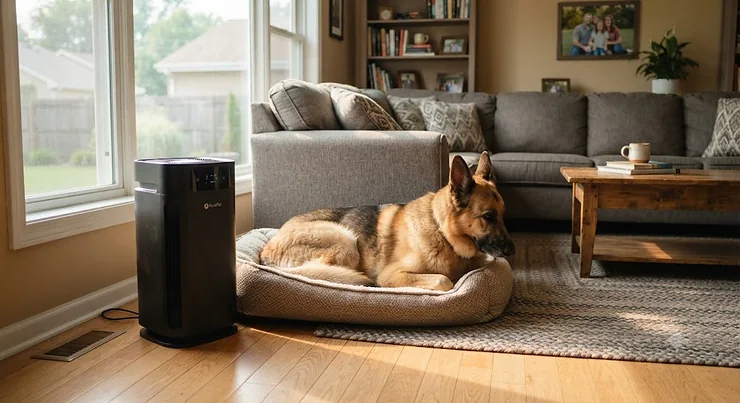
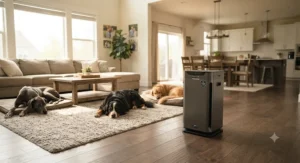
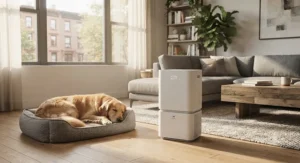
Live with a big dog and you already know the truth nobody puts on the adoption paperwork: the fur doesn’t stay on the dog. It rides the air currents in your living room, settles on your couch cushions, drifts into your coffee mug, and somehow ends up in the ice cube tray. An air purifier for large dogs isn’t a luxury gadget — it’s a machine built to handle a genuinely bigger job than a standard household unit, because a 90-pound Golden Retriever or Husky sheds dramatically more dander, fur fragments, and skin cells than a 12-pound lap dog ever could. What is an air purifier for large dogs? It’s a HEPA-based air cleaner sized and filtered specifically for high fur volume and dander load — larger pre-filters, higher clean air delivery rates, and coverage areas that don’t choke the moment your dog does a full-body shake.
The good news is that you don’t need to guess your way through Amazon listings to find one that works. Below, we’ve dug into seven real, currently available models — from budget-friendly workhorses to a Swiss-engineered machine that costs more than some people’s first car — and broken down exactly how each one performs against the specific demands of a big, furry household. As the EPA notes in its guidance on air cleaners, portable units can meaningfully reduce indoor particle levels, though they work best alongside good ventilation and regular cleaning — not as a replacement for either.
Quick Comparison Table
| Purifier | CADR (approx.) | Coverage (4-5 ACH) | Best For |
|---|---|---|---|
| Honeywell HPA300 | 300-320 CFM | ~465 sq ft | Best budget large-room pick |
| Levoit Core 600S-P | ~391-410 CFM | ~600 sq ft | Best dedicated pet pre-filter |
| Coway Airmega 400 | ~350 CFM | ~780-1,560 sq ft | Best true large/open-plan room |
| IQAir HealthPro Plus | ~300 CFM | ~1,125 sq ft | Best ultrafine dander filtration |
Look closely and you’ll notice CADR alone doesn’t crown a winner here — coverage claims swing wildly depending on how many air changes per hour a brand is willing to promise you. The Honeywell HPA300 wins on raw dollars-per-CFM, but it’s a blunt instrument with no auto mode. The Coway Airmega 400 and IQAir HealthPro Plus both trade some CADR for filtration depth and genuinely larger square footage, which matters enormously once you’re dealing with an open-plan home and two dogs instead of one.
💬 Already spotted your favorite? Scroll down to the full breakdown — your dog’s fur situation deserves more than a two-second glance.
Top 7 Air Purifiers for Large Dogs: Expert Analysis
1. Honeywell HPA300 — best CADR-per-dollar for large rooms
The HPA300 is the purifier equivalent of a pickup truck: unglamorous, a little loud, and absurdly good at the one job it was built for. Independent testing puts its CADR at roughly 300 CFM for smoke and 320 for dust, with an AHAM-verified coverage of 465 square feet at nearly five air changes per hour. For a room where a Labrador spends most of its day, that’s a legitimate workhorse rating, not a marketing number stretched thin.
What that spec actually means in practice: this unit clears a mid-size living room in well under 15 minutes on Turbo, which matters after a vigorous shake-off session sends a visible cloud of fur into the air. Based on the spec comparison with pricier rivals, the HPA300’s foam pre-filter plus three separate True HEPA cartridges is a clever cost-saving design — you can replace only the filter that’s actually dirty instead of tossing an entire combined cartridge. Reviewers consistently note that it’s one of the loudest units on this list at Turbo speed, and there’s no auto mode or air quality sensor, so you’re manually adjusting it based on how the room feels rather than what a sensor detects.
Pros:
- ✅ Exceptional CADR for the price point
- ✅ Modular filters let you replace only what’s worn
- ✅ AHAM-verified for genuinely large rooms
Cons:
- ❌ No auto mode or air quality sensor
- ❌ Noticeably loud on Turbo speed
Expect to pay in the $150-$200 range at the time of research, with prices fluctuating — always check current pricing before buying. For a single-dog household on a budget, this is hard to beat on value alone.
2. Winix 5500-2 — best value with odor-fighting PlasmaWave
The Winix 5500-2 has been a fixture on best-seller lists for years, and the reason is simple: it pairs a True HEPA filter with a washable activated carbon filter and PlasmaWave ionization technology, all for a price that undercuts most large-room competitors. Its CADR sits around 232-246 CFM depending on the pollutant measured, with a suggested room size of 360 square feet.
Here’s what most buyers overlook: the washable AOC carbon filter is a genuine cost-saver over the life of the unit, since you’re not buying a fresh carbon cartridge every few months the way you would with disposable-only designs. Reviewers consistently report that the auto mode’s sensor does a solid job ramping up the fan when a dog walks by and kicks dust into the air, then quietly stepping back down. On the downside, replacement HEPA filters for this unit run notably higher than some competitors, which chips away at the “budget” reputation over a few years of ownership. It’s also worth noting Winix has signaled the 5500-2 is being phased toward the newer 5510 model, though filters are expected to remain available for years, and plenty of retailers still carry it.
Pros:
- ✅ Washable carbon filter cuts long-term costs
- ✅ Auto mode with a genuinely responsive sensor
- ✅ Strong odor performance against “wet dog” smell
Cons:
- ❌ Replacement HEPA filters are pricier than rivals
- ❌ Being gradually phased out for the newer 5510
Price typically falls in the $180-$250 range, occasionally dipping lower during sales — never assume a discount is Amazon-exclusive or permanent.
3. Levoit Core 600S-P — best dedicated pet pre-filter
The “-P” suffix isn’t just branding — it signals Levoit’s pet-specific pre-filter variant, and for a heavy-shedding household, that distinction is worth paying attention to. The Core 600S-P uses an ultra-fine nylon pre-filter designed to grab loose hair and dander before it ever reaches the main HEPA-grade filter, extending the life of the pricier internal cartridge considerably.
On paper, this means fewer full filter swaps per year, which is the kind of detail that only becomes obvious after month four of dog ownership. VortexAir Technology 3.0 pushes a CADR around 391-410 CFM, enough to change the air in a roughly 600-square-foot room nearly five times an hour, or a much larger open space once per hour. What most buyers overlook about this model is the Auto Mode paired with a PM2.5 laser sensor — it genuinely throttles up when your Husky starts blowing coat, then eases off once particle counts settle. Reviewers consistently flag two things: the unit runs surprisingly loud at top speed (around 54 dB), and Levoit’s own filter labeling has been called into question in independent lab tests, even though real-world particle capture performance remains excellent regardless of the exact HEPA classification.
Pros:
- ✅ Pet-specific pre-filter extends main filter life
- ✅ App control plus a responsive PM2.5 sensor
- ✅ Strong CADR for the mid-range price bracket
Cons:
- ❌ Loud at maximum fan speed
- ❌ HEPA-grade labeling has drawn scrutiny in testing
Expect a price in the $250-$300 range at the time of research, positioning it squarely between budget and premium tiers.
4. Blueair Blue Pure 211+ Auto — quietest large-room automatic pick
Blueair’s HEPASilent technology combines mechanical filtration with an electrostatic charge, which is the engineering trick behind why this unit can move a lot of air without sounding like a leaf blower. The washable fabric pre-filter wraps around the entire 360-degree intake cylinder, and it’s specifically praised for capturing visible pet hair before it reaches the internal filter stack.
Here’s what the spec sheet won’t tell you outright: that fabric sleeve is genuinely one of the easiest pre-filters to clean in this entire lineup — pull it off, toss it in the washing machine, done. AHAM-verified CADR lands around 350 CFM, with coverage rated for 550 square feet at nearly five air changes per hour. On the quietest setting it measures around 23 dB, which honestly disappears into ambient household noise, and the built-in particle sensor handles fan adjustments automatically so you never have to think about it. The tradeoff is cost — both the unit itself and its replacement filters sit at a premium relative to competitors with similar CADR numbers, and this is a manual-color-swap design rather than a smart-app-connected one.
Pros:
- ✅ Whisper-quiet operation even at moderate speeds
- ✅ Washable, machine-cleanable pet hair pre-filter
- ✅ Fully automatic sensor-driven fan adjustment
Cons:
- ❌ Premium price for both unit and filters
- ❌ No app connectivity or smart scheduling
Pricing typically runs in the $350-$450 range depending on retailer and color option, so it’s worth comparing before you commit.
5. Coway Airmega 400 — best for genuinely large or open-plan rooms
If your big dog’s domain is a proper open-concept living space rather than a boxed-in bedroom, the Airmega 400 is built for exactly that scenario. Its dual Max2 filter cartridges combine HEPA filtration with activated carbon, sitting behind a washable mesh pre-filter designed to intercept fur and coarse debris before it clogs the good stuff.
Based on the spec comparison, the Airmega 400’s suggested coverage of roughly 1,560 square feet at two air changes per hour (or around 780 square feet at a more allergy-appropriate four-plus changes) puts it in a different league than most tower-style purifiers on this list. What most buyers overlook is the noise-to-power ratio: even at its top fan speed of roughly 53 dB, that’s remarkably quiet for a unit moving this much air, and the Sleep mode drops to near-silent territory. Reviewers consistently note the five-year warranty as a meaningful trust signal, and the square footprint — while excellent for airflow — does demand more floor space than a slim tower design. There’s also no smart app on this base model; that feature lives on the pricier 400S variant.
Pros:
- ✅ Coverage built for large or open-plan rooms
- ✅ Whisper-quiet even at higher fan speeds
- ✅ Five-year manufacturer warranty
Cons:
- ❌ Large square footprint demands real floor space
- ❌ No app or smart connectivity on the base model
Price generally falls in the $400-$500 range at the time of research, making it a serious mid-to-premium investment.
6. Levoit EverestAir — smartest high-airflow tower option
The EverestAir is Levoit’s attempt at a more refined, tower-style unit, and it largely delivers. A three-channel laser dust sensor reads PM1.0, PM2.5, and PM10 levels simultaneously, which is a genuinely useful upgrade over the single-sensor setups on cheaper models — it can distinguish between fine dander and coarser fur particles rather than lumping everything together.
What that sensor granularity means in practice: the EverestAir’s Auto Mode responds with more nuance to different air quality events, whether that’s your dog shaking off water after a bath or just baseline daily shedding. CADR sits around 354-360 CFM, with a rated coverage near 550 square feet at nearly five air changes per hour, or over 2,600 square feet at a single change per hour for whole-room circulation. The spec sheet won’t tell you this, but user reports suggest the adjustable vent angle is a small but genuinely useful touch for directing airflow away from a nearby dog bed. On the downside, replacement filters cost more than the Core series, and the higher upfront price makes it a harder sell than the Core 600S-P for buyers on a tighter budget.
Pros:
- ✅ Three-channel sensor reads multiple particle sizes
- ✅ Adjustable vents direct airflow precisely
- ✅ Strong CADR-to-noise ratio at 24-55 dB
Cons:
- ❌ Pricier filter replacements than the Core lineup
- ❌ Higher upfront cost than comparable CADR competitors
Expect pricing around $350-$450 at the time of research, similar to the Blueair 211+ Auto but with different strengths.
7. IQAir HealthPro Plus — best for ultrafine dander and multi-dog homes
This is the purifier equivalent of bringing in a specialist. IQAir’s HyperHEPA filtration is certified to capture particles as small as 0.003 microns — a full two orders of magnitude smaller than what standard HEPA filters are rated to catch — and it’s paired with roughly five pounds of activated carbon in the V5-Cell filter, an amount that dwarfs the thin carbon layers found in most consumer units.
Here’s what most buyers overlook about this level of filtration: dog dander itself is often smaller than the 0.3-micron threshold standard HEPA filters are tested against, which is exactly the range where HyperHEPA technology is designed to close the gap. Rated coverage runs up to 1,125 square feet, and the filters themselves last three to four years rather than the standard six-to-twelve months, which meaningfully changes the long-term cost math even against a high sticker price. Reviewers consistently note the tradeoffs are real: there’s no auto mode on the base HealthPro Plus (that lives on the pricier XE variant), energy consumption runs higher than efficiency-focused competitors, and the roughly ten-year warranty doesn’t offset an upfront cost that puts this firmly in specialist territory.
Pros:
- ✅ HyperHEPA filtration rated to 0.003 microns
- ✅ Filters last three to four years, not months
- ✅ Massive five-pound activated carbon capacity
Cons:
- ❌ Very high upfront cost near four figures
- ❌ No auto mode on the standard (non-XE) model
Pricing at the time of research sits in the $900-$1,000+ range — a genuine investment, best reserved for multi-dog households or households managing severe pet allergies.
Practical Usage Guide: Setup and Maintenance for Big-Dog Households
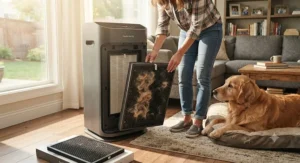
Getting an air purifier for large dogs right starts before you even plug it in. Placement matters more than most buyers assume — position the unit at least a foot or two from walls and furniture so air can circulate freely around the intake, and try to keep it near where your dog naps or plays most, rather than tucked in a corner nobody visits. During the first 30 days, expect the pre-filter to visibly accumulate fur far faster than any manual mentions; this is normal, not a sign of a defective unit.
A common mistake is treating the pre-filter like a “set it and forget it” component. In a heavy-shedding household, checking it weekly — and vacuuming or hand-picking visible fur off a mesh pre-filter — meaningfully extends the life of the more expensive main filter underneath. For washable pre-filters like those on the Coway Airmega 400 or Blueair Blue Pure 211+ Auto, a monthly rinse (fully dried before reinsertion) keeps airflow resistance low. Run the unit on Auto Mode where available rather than a fixed low speed; sensor-driven models like the Levoit EverestAir and Levoit Core 600S-P are specifically designed to ramp up during shedding events and idle quietly the rest of the time, which also extends motor life compared to running Turbo speed around the clock.
✨ Don’t Miss These Exclusive Deals!
🔍 Take your indoor air quality to the next level with a purifier actually built for a big dog’s shedding load. Click on any highlighted pick above to check current pricing and availability — your floors (and your allergies) will thank you.
Real-World Scenarios: Big Dogs, Different Homes
The apartment-dwelling Golden Retriever owner. A one-bedroom apartment with a single heavy shedder needs less raw square footage than the marketing copy suggests, but still benefits enormously from a dedicated pet pre-filter. The Levoit Core 600S-P fits this profile well: budget-conscious, app-controlled, and specifically engineered around the pre-filter-catches-hair-first design that a single dog’s daily output demands.
The multi-dog household with a husky and a lab. This is genuinely a different category of problem — double the shedding volume, often in an open-plan home. This is where the best air purifier golden retriever husky owners actually gravitate toward tends to skew larger and quieter, since two dogs means the unit runs nearly around the clock. The Coway Airmega 400 or IQAir HealthPro Plus are the more defensible choices here; their larger coverage ratings and deeper carbon capacity are built for sustained, heavier particulate loads rather than occasional bursts.
The severe-allergy household with a heavy-shedding breed. According to the American Kennel Club’s guidance on shedding, double-coated breeds tend to shed heaviest during seasonal coat blowouts in spring and fall, which is exactly when heavy shedding dog breeds air quality complaints spike in owner forums. For this household, a purifier with genuinely deep HEPA-grade filtration and a large carbon reservoir — like the IQAir HealthPro Plus — earns its price tag by handling the seasonal surge without needing filter changes every few weeks.
Problem → Solution: Fixing the Top Big-Dog Air Quality Complaints
Problem: visible fur clumps drift across the floor within hours of vacuuming. Solution: a unit with a large, easily accessible pre-filter positioned to catch bulk fur before it circulates — the Blueair Blue Pure 211+ Auto‘s washable fabric sleeve is purpose-built for this.
Problem: persistent “wet dog” or urine odor even after cleaning. Solution: prioritize a deep activated carbon layer over raw CADR numbers. The IQAir HealthPro Plus‘s five-pound V5-Cell carbon filter or the Levoit Core 600S-P‘s ARC Formula carbon layer both target gaseous odors that fabric cleaning alone can’t touch.
Problem: allergy symptoms flare specifically during shedding season. Solution: run the purifier on Auto Mode continuously rather than switching it on only when symptoms appear — sensor-equipped units like the Levoit EverestAir ramp up automatically the moment particle counts spike.
Problem: filters clog within weeks instead of the advertised months. Solution: this is almost always a pre-filter maintenance issue in heavy-shedding homes; increase pre-filter cleaning frequency to weekly rather than monthly, particularly with models like the Honeywell HPA300 that use a thinner foam layer.
Problem: the unit is too loud to run overnight in the bedroom. Solution: check dB ratings at sleep speed specifically, not just the advertised maximum — the Coway Airmega 400 and Blueair Blue Pure 211+ Auto both drop into the low-20s dB range on their quietest settings.
How to Choose an Air Purifier for Large Dogs
- Start with your actual room size, then size up 20-30%. Manufacturer coverage claims typically assume just one to two air changes per hour; for a shedding household, you want closer to four or five.
- Prioritize CADR over marketing buzzwords. A verified CADR number from AHAM testing tells you more than adjectives like “powerful” or “advanced.”
- Check pre-filter design specifically. A dedicated pet or fur pre-filter, like those on the Levoit Core 600S-P or Blueair Blue Pure 211+ Auto, meaningfully extends the life of the expensive main filter.
- Weigh carbon capacity if odor is a concern. Litter boxes, wet dog smell, and marking issues all respond better to deeper carbon layers than to particle filtration alone.
- Factor in noise at the speed you’ll actually run it. A quiet low setting matters more day-to-day than a loud Turbo mode you’ll rarely use.
- Look for independent certification where it exists. The Asthma and Allergy Foundation of America’s certification program tests specific models against allergen-reduction standards, which adds a layer of verification beyond a brand’s own claims.
- Total the real annual cost, not just the sticker price. Filter replacement frequency and cost vary enormously between brands and can flip which unit is actually cheaper over three years.
Air Changes Per Hour for Large Rooms: The Math That Actually Matters
| Air Changes/Hour | What It Means for Dander Control | Suitable For |
|---|---|---|
| 1 ACH | Basic circulation, slow particle drop | Whole-home background filtration |
| 2 ACH | Noticeable improvement over hours | Large open-plan living spaces |
| 4-5 ACH | Meaningful allergen reduction | Recommended for pet/allergy households |
Manufacturers love to publish an eye-popping square-footage number, but that figure is almost always calculated at a single air change per hour — fine for background circulation, but not nearly aggressive enough for a household managing active dander and fur. What most buyers overlook is that the same unit’s “real” coverage for allergy purposes is often less than a quarter of the headline number once you recalculate for four or five air changes per hour. This is exactly why the Coway Airmega 400‘s dual rating — 1,560 square feet at two ACH versus roughly 780 at a more allergy-appropriate rate — matters more than the bigger number alone.
Large Pre-Filter Capacity: Why Size Determines How Long Your Filter Survives Large Breed Dog Hair
A large pre-filter dog hair capacity isn’t a nice-to-have feature — it’s arguably the single biggest factor separating a purifier that lasts and one that clogs within weeks in a big-dog home. The pre-filter’s entire job is to intercept bulk fur and coarse debris before it reaches the internal HEPA media, and a small or thin pre-filter simply saturates faster under a large breed’s fur volume than a wide-surface-area design does.
This is where an air purifier large breed dog hair situation really separates the field. The Blueair Blue Pure 211+ Auto‘s 360-degree fabric sleeve offers a genuinely large surface area relative to its footprint, while the Levoit Core 600S-P‘s nylon pre-filter is specifically engineered around fur capture rather than general dust. Reviewers consistently note that undersized pre-filters lead to premature main-filter replacement — an expensive mistake that a slightly larger upfront investment in pre-filter design tends to prevent.
High-Capacity Air Purifiers and Dog Dander: What CADR Really Means
A high capacity air purifier dog dander situation demands is really just a CADR number large enough to outpace continuous particle generation, rather than merely clearing a static room once. CADR — Clean Air Delivery Rate — measures the volume of filtered air a unit delivers per minute for a specific pollutant, and it’s the most reliable apples-to-apples comparison metric across brands, assuming the figure comes from AHAM-verified testing rather than a manufacturer’s internal claim.
Here’s what the spec sheet won’t tell you: dog dander behaves more like smoke than like dust in terms of particle size, so the smoke CADR figure — not the pollen number — is usually the more relevant comparison point for pet owners. Among the models here, the Levoit Core 600S-P and Levoit EverestAir post some of the highest raw CADR figures, while the IQAir HealthPro Plus trades a lower CADR number for filtration depth that catches particles standard CADR testing doesn’t even measure.
Air Purifier for Big Dogs with Heavy Shedding vs a Standard Home Purifier
The difference between an air purifier for big dogs with heavy shedding and a generic household unit comes down to three things: pre-filter design, carbon depth, and sustained runtime durability. A standard purifier built for general dust and light odor control is typically tested and optimized around occasional, moderate particle loads — the kind of environment without a 70-pound dog generating a constant stream of dander and fur.
Pet-specific and heavy-duty models compensate in several concrete ways. The Levoit Core 600S-P‘s dedicated pet pre-filter and ARC carbon formula target dander and odor more aggressively than the brand’s standard Core units. The Coway Airmega 400 and IQAir HealthPro Plus both offer meaningfully larger real-world coverage, which matters because a big dog’s particle output doesn’t stay confined to one room. Based on the spec comparison across both categories, a generic purifier can still function in a light-shedding, single-small-dog household — but it will likely need pre-filter cleaning and main filter replacement far more often than its own manual suggests once a large, heavy-shedding breed enters the picture.
Common Mistakes When Buying an Air Purifier for Large Dogs
Buyers frequently size a unit to their room’s square footage without adjusting for air changes per hour, ending up with a purifier technically “rated” for the space but functionally underpowered for allergy control. Another frequent misstep: ignoring pre-filter design in favor of chasing the highest CADR number, then being surprised when the main filter clogs within a couple of months. Some shoppers also skip verifying odor performance separately from particle performance — a unit with excellent dust and dander capture but a thin carbon layer will do very little against a stubborn “wet dog” smell, since these are functionally different filtration jobs handled by different filter stages entirely.
Features That Actually Matter (And Those That Don’t)
Auto mode paired with a genuine particle sensor is worth paying for — it meaningfully reduces both energy use and noise compared to running a fixed high speed continuously. Washable pre-filters are also a legitimate value feature in a shedding household, cutting long-term costs noticeably. On the other hand, app connectivity and smart-home integration, while convenient, don’t affect actual air cleaning performance one bit — they’re a comfort feature, not a filtration one. Similarly, flashy air-quality-percentage displays look impressive but are far less useful than a straightforward PM2.5 numeric readout when you’re trying to judge whether the unit is actually keeping pace with your dog’s shedding.
Frequently Asked Questions
❓ Do I need a special air purifier for large dogs, or will any HEPA unit work?
❓ How often should I replace filters in a heavy-shedding household?
❓ Does air purifier placement matter for a big dog's favorite room?
❓ Can an air purifier eliminate pet odor completely?
❓ Is a higher CADR always better for a large-dog household?
Conclusion
There’s no single “best” air purifier for large dogs — there’s a best one for your specific room, your specific dog, and your specific budget. If you’re managing one heavy shedder in a mid-size room, the Levoit Core 600S-P or Honeywell HPA300 will handle the job without draining your wallet. If you’ve got an open-plan home with two dogs blowing coat every spring, the Coway Airmega 400 earns its higher price tag through genuine coverage. And if you’re dealing with severe allergies stacked on top of a heavy-shedding breed, the IQAir HealthPro Plus is the specialist tool built for exactly that scenario. Whichever you choose, remember that the purifier is only half the equation — regular pre-filter maintenance is what actually keeps any of these units performing at their rated numbers month after month.
✨ Ready to Breathe Easier?
🐾 Your dog isn’t going to stop shedding, but your air quality doesn’t have to suffer for it. Check current pricing on today’s pick, and give your lungs — and your black yoga pants — a break.
Recommended for You
- Air Purifier for Dog Allergies: 7 Real Picks That Help (2026)
- Air Purifier for Cat Hair and Dander Large Room: 7 Picks (2026)
- Air Purifier for Cat Allergies: 7 Real Picks That Actually Help (2026)
Disclaimer: This article contains affiliate links. As an Amazon Associate, I earn from qualifying purchases. If you purchase products through these links, we may earn a small commission at no additional cost to you.
✨ Found this helpful? Share it with your friends! 💬🤗
