
In This Article
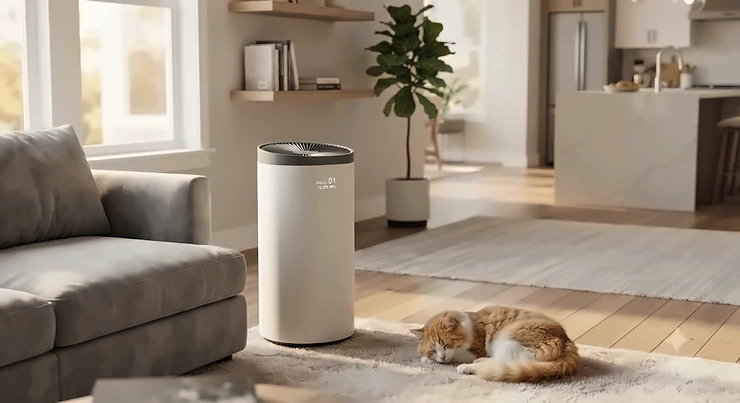
If you’ve ever run a finger along your coffee table an hour after vacuuming and come away with a fine gray film, you already know the problem. Cats are tumbleweed factories. They shed, they groom, and every lick sends microscopic flecks of saliva-coated dander drifting into the air, where it can hang for hours before it ever settles on a surface you can wipe down. Finding the right air purifier for cat hair and dander large room use isn’t about vanity — it’s about breathing easier in a space that a single desktop unit simply cannot keep up with.
Large rooms complicate things because dander doesn’t stay put. In an open-concept living room, a great room, or a loft with 12-foot ceilings, airborne fur and Fel d 1 protein (the sticky allergen at the center of most cat allergies) can travel far past where your cat actually naps. A purifier rated for a 250-square-foot bedroom will wheeze trying to keep up with 900 square feet of open floor plan, no matter how good its filter is on paper.
This guide walks through seven real, currently available machines — chosen specifically for their CADR ratings, filter design, and how they hold up in multi-cat homes — plus the buying framework, setup tricks, and cost math that most listings leave out. We’ll lean on independent lab testing and aggregated owner sentiment rather than manufacturer marketing copy, and we’ll flag exactly where a spec sheet number matters in your actual living room.
What Is an Air Purifier for Cat Hair and Dander in a Large Room?
An air purifier for cat hair and dander large room is a HEPA-based air cleaner engineered with a high enough Clean Air Delivery Rate (CADR) and a large enough intake to keep pace with open-concept spaces of 400 to over 1,500 square feet, while its washable pre-filter specifically traps shed fur before it clogs the finer HEPA layer underneath. The goal isn’t just filtering the air once — it’s cycling the entire room’s air volume multiple times per hour so airborne dander never has time to accumulate.
Quick Comparison Table
| Model | CADR (Smoke) | Coverage Area | Washable Pre-Filter | Best For |
|---|---|---|---|---|
| Winix 5500-2 | 232 CFM | Up to 360 sq ft | Yes | Best budget pick |
| Levoit Vital 200S-P | 245 CFM | Up to 1,875 sq ft (1 ACH) | Yes | Best for cat hair specifically |
| Honeywell HPA300 | 300 CFM | Up to 465 sq ft | No (replaceable) | Best CADR per dollar |
| Blueair Blue Pure 211+ | 350 CFM | Up to 540 sq ft | Yes | Quietest for open floor plans |
| Levoit Core 600S | 410 CFM | Up to 635 sq ft (5 ACH) | No (replaceable) | Best all-rounder for large rooms |
| Coway Airmega 400 | 350 CFM | Up to 1,560 sq ft (2 ACH) | Yes | Best premium value |
| Alen BreatheSmart 75i | 333 CFM | Up to 1,300 sq ft | No (RFID cartridge) | Best luxury smart flagship |
Looking at the table above, coverage numbers swing wildly depending on how each brand calculates air changes per hour, so the Levoit Core 600S and Coway Airmega 400 end up the two most credible picks for anything approaching an open-concept great room. Budget buyers shouldn’t dismiss the Winix 5500-2 outright, though — paired in a smaller zone of a large room, its washable pre-filter still earns its keep against loose cat hair. Notice that raw CADR doesn’t always track with square footage claims; that gap is exactly what we unpack later in the CADR math section.
💬 Just one click — help others make better buying decisions too!😊
Top 7 Air Purifiers for Cat Hair and Dander in Large Rooms: Expert Analysis
1. Levoit Core 600S — best all-rounder for open-plan homes
The Core 600S earns its “all-rounder” tag from a genuinely large-room CADR without a large-room price tag. Its 410 CFM smoke CADR is AHAM-verified, which matters because plenty of pet-marketed purifiers quote CADR-like numbers that were never independently tested at all.
That 410 CFM rating translates to five full air changes per hour in a 635-square-foot room, or a slower but still workable one air change per hour in spaces pushing 2,900 square feet — a genuinely rare spec at this price point. The 49-watt motor sips power relative to the airflow it produces, and the VeSync app adds scheduling plus a laser PM2.5 sensor that actually reacts to fresh dander kicked up when your cat jumps off the couch.
Based on the spec comparison, this unit is built for pet owners with a genuine great room or open kitchen-living combo rather than a single bedroom — anyone in a smaller space would be paying for headroom they don’t need. Reviewers consistently note the unit runs whisper-quiet around 25-26 dB on its lowest setting, but climbs to a noticeably present 55 dB on turbo, which matters if you’re running it overnight in a shared space.
Pros:
- ✅ AHAM-verified 410 CFM CADR, rare at this price tier
- ✅ VeSync app adds real-time PM2.5 monitoring and scheduling
- ✅ Filter life stretches 6-12 months, keeping annual costs reasonable
Cons:
- ❌ Standard filter isn’t washable, only the pre-filter mesh is
- ❌ Turbo mode noise is noticeable in a shared living space
The Levoit Core 600S typically runs in the $280-$350 range depending on bundled filters, and for households with an actual open floor plan rather than a single closed bedroom, it’s one of the strongest value plays on this list.
2. Coway Airmega 400 — best premium value for large living rooms
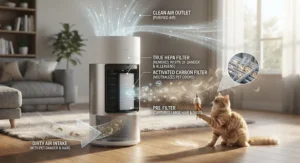
Coway built its reputation on the AP-1512HH, but the Airmega 400 is the one actually engineered for scale. Its nearly-square footprint houses a dual-filter system: a washable pre-filter paired with a combined HEPA and activated carbon cartridge that Coway rates for a full year of typical use.
With a manufacturer-suggested coverage of 1,560 square feet at two air changes per hour, this is one of the few units on this list that can genuinely handle an open-concept first floor rather than just a single large room. What most buyers overlook about the Airmega 400 is that its washable pre-filter isn’t just a dust-catcher — it’s specifically what keeps shed cat fur from ever reaching, and clogging, the pricier HEPA-carbon cartridge underneath, which is the single biggest lever on long-term filter costs.
Reviewers consistently highlight how quiet the unit stays even at moderate fan speeds, and independent testing found it maintained single-digit PM2.5 readings through a 36-hour smoke event with only occasional door openings. The tradeoff is footprint: at nearly 15 inches square, it demands real floor space rather than tucking discreetly against a wall the way a slim tower does.
Pros:
- ✅ 1,560 sq ft coverage, among the largest on this list
- ✅ Washable pre-filter meaningfully extends cartridge life
- ✅ Five-year manufacturer warranty, longer than most competitors
Cons:
- ❌ Square footprint takes up more floor space than tower designs
- ❌ No smartphone app on the base (non-S) model
Expect to pay around $370-$420 for the Airmega 400, with the Wi-Fi-enabled 400S running roughly $50 more — a fair upgrade if remote monitoring while you’re at work matters to you.
3. Blueair Blue Pure 211+ — quietest option for open floor plans
Blueair’s HEPASilent technology is the standout here, combining mechanical filtration with an electrostatic charge to pull particles through the filter media with less fan resistance — and therefore less noise — than a purely mechanical HEPA design needs to hit the same CADR.
The 350 CFM smoke CADR covers up to 540 square feet, and the fabric pre-filter stretches around a wide cylindrical intake, giving it an unusually large surface area to catch loose cat hair before it ever reaches the particle filter underneath. Here’s what to weigh: independent testing found that placement matters enormously with this design — pushed into a corner, 40-60% of the intake surface can be blocked, meaningfully cutting real-world CADR. Reviewers consistently note it needs breathing room on all sides to perform as advertised.
For an open floor plan where the unit can sit somewhat centrally rather than jammed against a wall, this is one of the most aesthetically minimal options on the market, with only a single control button and a fabric-wrapped cylinder that looks more like furniture than an appliance.
Pros:
- ✅ HEPASilent tech delivers strong CADR at lower perceived noise
- ✅ Washable fabric pre-filter is machine-washable, not just wipeable
- ✅ Minimalist Scandinavian design blends into open living spaces
Cons:
- ❌ Performance drops meaningfully in corner placements
- ❌ Only three fan speeds, less granular control than app-based rivals
Retailing around $275-$300, the Blue Pure 211+ sits mid-pack on price but wins on the noise-to-performance ratio specifically because of that HEPASilent engineering.
4. Honeywell HPA300 — best CADR per dollar
The HPA300 has been a staple recommendation for over a decade for one simple reason: it delivers genuinely high CADR numbers — 300 smoke, 320 dust, 300 pollen — at a price that undercuts most of its similarly-rated rivals.
Rated for 465 square feet at nearly five air changes per hour, this is a purely mechanical, no-frills machine. There’s no app, no auto mode, and no air quality sensor — just three True HEPA filters and pre-cut activated carbon sheets doing brute-force work. Based on the spec comparison, that lack of automation is precisely why it’s cheaper than the Core 600S despite comparable CADR; you’re paying for filtration, not smart features.
The spec sheet won’t tell you this, but user reports suggest the fan noise on Turbo is genuinely loud enough to disrupt sleep or video calls, which is the tradeoff for that high airflow. Reviewers consistently describe it as a “set it and forget it” workhorse rather than an elegant piece of furniture — bulky, utilitarian, and easy to place in a utility room or den where looks matter less than raw output.
Pros:
- ✅ Exceptional CADR-to-price ratio, rare at under $300
- ✅ Three True HEPA filters plus carbon pre-filter tackle odor and particles
- ✅ Simple mechanical controls with no app dependency required
Cons:
- ❌ No auto mode or air quality sensor to self-adjust
- ❌ Noticeably loud on Turbo, a poor fit for bedrooms
Prices generally land in the $270-$330 range, making the HPA300 one of the strongest pure-performance picks if smart features aren’t a priority.
5. Levoit Vital 200S-P — best for cat hair specifically
Levoit built the Vital 200S-P specifically around pet households, and the engineering shows it. Its standout feature is a U-shaped 4D air inlet designed explicitly to catch fur and dander before clogging, paired with a genuinely washable pre-filter rather than the sacrificial mesh found on cheaper models.
AHAM-verified CADR lands around 245-250 CFM across smoke, dust, and pollen, with a manufacturer coverage claim up to 1,875 square feet at a single air change per hour — reasonable for supplementing central HVAC in an open layout, though you’d want the Core 600S or Airmega 400 instead if the 200S-P is your only unit in a truly cavernous space. What most buyers overlook is the dedicated Pet Mode, which alternates between high and medium fan speeds automatically when the sensor detects motion-triggered dander spikes, rather than running full blast continuously.
Reviewers consistently single out the washable pre-filter as the standout maintenance win: rinsing it every couple of weeks under the tap meaningfully extends the life of the pricier HEPA-carbon cartridge, which is exactly the kind of ongoing cost control multi-cat households need.
Pros:
- ✅ U-shaped inlet specifically engineered to trap airborne fur
- ✅ Genuinely washable pre-filter, not just a wipeable mesh
- ✅ Dedicated Pet Mode auto-adjusts fan speed to motion
Cons:
- ❌ Real-world CADR trails the Core 600S in raw large-room power
- ❌ Air quality sensor accuracy lags behind pricier Levoit models
Typical pricing runs $220-$270, positioning it as the clearest “built for cats, not just marketed at them” option on this list.
6. Alen BreatheSmart 75i — best luxury smart flagship
Alen’s flagship carries a price tag that will make budget shoppers wince, but the engineering underneath explains a good chunk of that premium. Independent lab testing measured an estimated 333 CFM PM1 CADR, translating to five air changes per hour in rooms up to roughly 450-500 square feet, while Alen’s own marketing pushes coverage claims as high as 1,300 to 2,800 square feet depending on the air-change assumption used.
What most buyers overlook is the swappable filter system: you can choose a Pure filter for straightforward particle capture or a Fresh filter that adds substantially more activated carbon for litter box odor and VOCs, meaning the same chassis can be tuned to your specific cat-related pain point. RFID-tagged filters track remaining life automatically, and the SmartSensor auto-adjusts fan speed with color-coded rings that make air quality legible at a glance, even to a houseguest who’s never touched the app.
Reviewers consistently praise the near-silent operation, which Alen has had independently validated by SleepScore Labs for its impact on sleep quality — a genuinely differentiated claim among consumer air purifiers. The Forever Guarantee lifetime warranty, contingent on an active filter subscription, is another point in its favor for buyers planning to keep one unit for a decade.
Pros:
- ✅ Swappable Pure or Fresh filters tune the unit to odor vs. particles
- ✅ SmartSensor auto-adjusts fan speed with legible color-coded feedback
- ✅ Forever Guarantee lifetime warranty backs long-term ownership
Cons:
- ❌ At $750-$800, it’s the most expensive unit on this list by a wide margin
- ❌ Real-world CADR trails its most aggressive marketed coverage claims
If odor control from litter boxes is your primary pain point alongside dander, the Alen BreatheSmart 75i‘s carbon-heavy Fresh filter option makes the premium easier to justify.
7. Winix 5500-2 — best budget pick
Not every large room needs a $400 purifier running at full tilt around the clock — sometimes a well-placed budget unit covering the zone where your cat actually spends most of its time does the job for a fraction of the cost. The Winix 5500-2 is the standout here, with a washable AOC (Advanced Odor Control) carbon filter and an AHAM-verified CADR of 232 CFM.
Rated for 360 square feet, the 5500-2 makes the most sense as a secondary unit positioned near a cat tree, litter box, or favorite napping spot within a larger open room, rather than as the sole purifier for the entire space. Reviewers consistently note it punches above its price class on both particle and chemical removal, and the PlasmaWave ionizing stage can be switched off entirely for households wary of any ozone byproduct, addressing one of the more common hesitations around ionizer-equipped units.
Based on the spec comparison against pricier rivals, the 5500-2’s washable pre-filter meaningfully reduces how often you’ll need to buy the true HEPA and carbon cartridge, which is the filter that actually costs money to replace.
Pros:
- ✅ Washable carbon pre-filter reduces long-term filter spend
- ✅ PlasmaWave ionizer can be fully disabled for ozone-cautious buyers
- ✅ Strong particle and odor performance for its price class
Cons:
- ❌ 360 sq ft coverage means it’s a zone solution, not whole-room in large spaces
- ❌ Plastic housing feels less durable than metal-bodied premium rivals
Typically priced in the $160-$230 range, the Winix 5500-2 is the pick for anyone furnishing a large room on a budget who’s willing to run two units instead of one.
Setting Up Your Air Purifier for Fast Results in a Multi-Cat Home
Getting a big-room purifier home is only half the job — placement and first-30-days habits determine whether it actually keeps pace with shedding season. Start by positioning the unit at least 18 inches from walls and furniture on all sides; as the Blue Pure 211+ testing showed, a corner placement can quietly cut real-world CADR by up to 40%, silently undermining an otherwise excellent machine.
Run any new unit on its highest setting for the first 24-48 hours regardless of noise tolerance — this “burn-in” period clears out whatever settled dust and dander has already accumulated in the room and gives you an honest baseline air quality reading if your unit has a sensor. After that, auto mode (where available) is genuinely more efficient than manually cycling speeds, since laser sensors react to spikes like a cat mid-zoomies faster than a human would remember to.
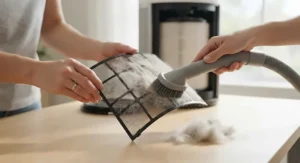
The single most common first-30-days mistake is neglecting the pre-filter. In a multi-cat household, a washable mesh pre-filter can visibly gray out with fur in under two weeks — check it weekly at first to calibrate your own cleaning cadence, then settle into whatever schedule keeps it from looking matted. Skipping this step is exactly how a $300 HEPA cartridge dies in 60 days instead of lasting the full year it’s rated for.
✨ Ready to breathe easier? These picks fit large rooms and multi-cat homes alike — check today’s availability before shedding season peaks! 🐾
Real Cat Owners, Real Rooms: Three Scenarios
The open-concept apartment dweller. Picture a one-bedroom with a combined living-dining-kitchen space around 550 square feet and a single indoor cat. Here, the Blue Pure 211+ or Levoit Vital 200S-P make the most sense — both comfortably cover the space without the bulk or price of a flagship unit, and the washable pre-filters on both models matter more than raw CADR headroom you’d never use.
The suburban great room with two cats. A 900-square-foot open floor plan connecting a kitchen, living room, and dining nook needs genuine large-room CADR, not a stretched budget unit. This is where the Levoit Core 600S or Coway Airmega 400 earn their keep — both can realistically manage multiple air changes per hour across a genuinely large footprint, and the Airmega’s washable pre-filter becomes even more valuable with two cats’ worth of fur load.
The household managing allergies and litter box odor together. When dander isn’t the only issue — ammonia smell from a litter box is compounding the problem — the carbon-heavy options matter more than CADR alone. The Alen BreatheSmart 75i with its Fresh filter option, is built for exactly this dual mandate, tackling both particulates and gas-phase odors that a pure-HEPA design simply can’t adsorb.
Common Cat Air Quality Problems, Solved
Problem: The purifier’s pre-filter clogs within days. This almost always means the unit is undersized for the fur load or placed too close to where your cat naps and sheds most. Solution: reposition it at least a few feet from favorite resting spots, and if clogging persists weekly, size up to a higher-CADR model like the Core 600S rather than running an undersized unit constantly on turbo.
Problem: Dander triggers allergies even with the purifier running. HEPA filtration removes airborne particles, but settled dander on carpets, upholstery, and bedding needs to be addressed separately through regular vacuuming with a sealed HEPA vacuum and weekly washing of bedding — the EPA’s guidance on indoor air cleaners is explicit that filtration works best as a supplement to source control, not a replacement for it.
Problem: Litter box odor lingers despite HEPA filtration. HEPA filters trap particles, not gases — ammonia is a gas, so no amount of HEPA media will touch it. Solution: prioritize a unit with a substantial activated carbon stage, like the Alen 75i’s Fresh filter or the Winix 5500-2’s AOC carbon layer, and place it closer to the litter box zone specifically.
Problem: The unit runs constantly on high and still feels ineffective in a large room. This is almost always a sizing mismatch — check the CADR-to-square-footage math in the section below before assuming the filter itself is failing.
Problem: Multiple cats mean the pre-filter needs washing more than the manual suggests. This is normal and expected; treat manufacturer filter-life estimates as a starting point for single-pet households and adjust your own cleaning cadence upward based on how quickly the mesh visibly grays out.
How to Choose an Air Purifier for Cat Hair and Dander in a Large Room
- Measure your actual room, not the “open concept” label. Add up the connected square footage of your living space rather than guessing, since CADR requirements scale directly with area.
- Prioritize a washable pre-filter over marginal CADR gains. A washable mesh that catches fur before it reaches the HEPA layer saves more money over three years than an extra 50 CFM of raw airflow.
- Match the CADR to at least two-thirds of your room’s square footage, per the AHAM rule of thumb, and size up if you have more than one cat.
- Check the noise rating at the speed you’ll actually run it, not just the quietest sleep-mode figure manufacturers lead with.
- Decide whether odor control matters as much as dander. If litter box smell is a factor, weight activated carbon capacity heavily in your decision.
- Factor in ongoing filter costs, not just the purchase price. A cheaper unit with pricier, more frequent filter changes can cost more over three years than a pricier unit with a washable pre-filter.
- Confirm AHAM Verifide certification before trusting any CADR number on the box — plenty of budget listings quote uncertified figures.
CADR and Square Footage: The Math Nobody Explains
CADR sq ft coverage calculation is simpler than it looks once you know the formula AHAM actually uses. The widely cited shortcut is: smoke CADR multiplied by 1.55 gives you the recommended room size in square feet at roughly one air change per hour. A unit with a 410 CFM smoke CADR, for instance, comfortably covers around 635 square feet at that baseline rate.
| Smoke CADR | Recommended Room Size (1 ACH) | Recommended Room Size (4-5 ACH, ideal for pets) |
|---|---|---|
| 232 CFM | ~360 sq ft | ~90-120 sq ft |
| 300 CFM | ~465 sq ft | ~115-155 sq ft |
| 350 CFM | ~540 sq ft | ~135-180 sq ft |
| 410 CFM | ~635 sq ft | ~160-210 sq ft |
The analysis here matters more than the raw numbers: pet owners should aim for 4-5 air changes per hour, not the bare 1 ACH minimum manufacturers often lead with, since dander is continuously regenerated rather than a one-time contaminant. That means the “recommended room size” on the box is frequently double or triple what you’d actually want for a genuinely dander-heavy household — a 900-square-foot great room with two cats is better served by a unit rated for 1,500+ square feet at 1 ACH than one just barely clearing 900.
Air Purifier vs Traditional Vacuuming and Grooming for Cat Allergies
Vacuuming and grooming address settled dander; air purifiers address airborne dander — and cat allergen research shows the two genuinely don’t overlap. Fel d 1, the primary cat allergen, becomes airborne easily and can remain suspended for hours after a cat leaves a room, which is precisely the window an air purifier is built to shrink, while a vacuum can only ever address what’s already settled onto carpet and upholstery.
That said, neither replaces the other. The Asthma and Allergy Foundation of America’s guidance on pet allergies recommends combining regular grooming, frequent vacuuming with a sealed HEPA vacuum, and continuous air filtration as a layered approach, since particulate matter that settles onto surfaces gets re-aerosolized every time someone walks across a rug or a cat jumps onto a couch. In practice, a household running both a good vacuum routine and a properly sized air purifier sees meaningfully better symptom control than either measure alone, based on the layered-defense reasoning most allergists recommend. Where air purifiers pull decisively ahead is continuous protection: a vacuum only works during the ten minutes you’re actively using it, while a properly sized purifier is working the other 23 hours and 50 minutes of the day too.
Best Air Purifier for Cat Dander in an Open Floor Plan Living Room
Open floor plans present a specific challenge: air doesn’t stay contained the way it does behind a closed bedroom door, so dander generated in the kitchen zone can drift 20 feet into a seating area before ever reaching a filter. For this layout specifically, central or semi-central placement — rather than tucking a unit into a corner near the sofa — matters more than in a closed room, since the purifier needs to draw air from multiple directions rather than just one.
Among the seven featured here, the Levoit Core 600S and Coway Airmega 400 are the two best suited to genuine open floor plans, both offering the CADR headroom to handle a combined living-dining-kitchen footprint rather than a single walled-off room. The Blue Pure 211+‘s 360-degree fabric intake is also a strong fit for open layouts specifically because of that all-sides airflow design, provided it isn’t shoved against a wall where roughly half its intake surface would be blocked.
✨ Don’t Miss These Exclusive Deals!
🔍 Take your air purifier for cat hair and dander large room search to the next level with these carefully selected models. Click on any highlighted pick above to check current pricing and availability. These units will help you create a genuinely fresher, allergen-lighter home your whole family — cats included — will love!
Multiple Cat Households: What Changes When You Have More Than One Cat
Multiple cat household air quality math isn’t linear — two cats don’t just double the dander load, they compound it, since more cats mean more grooming sessions, more litter box traffic, and more territorial marking behaviors that can each independently spike airborne allergen levels. What most single-cat buying guides overlook is that filter replacement frequency scales faster than square footage guidance suggests.
Reviewers consistently note that washable pre-filters, like those on the Vital 200S-P, Airmega 400, and Winix 5500-2, become non-negotiable rather than a nice-to-have once a second or third cat enters the picture, since a sacrificial mesh pre-filter can gray out in under a week in a heavy-shedding multi-cat home. Based on the spec comparison, households with three or more cats should generally plan on running two purifiers positioned at opposite ends of an open floor plan rather than relying on a single flagship unit, since no single machine’s CADR fully compensates for that much continuous allergen generation across a large footprint.
Budget accordingly too: expect annual filter costs in a multi-cat household to run 20-40% higher than manufacturer estimates, which are typically calculated for lighter-shedding single-pet or no-pet households.
Common Mistakes When Buying an Air Purifier for Cat Dander
The most frequent mistake is buying based on a bedroom-sized CADR for a living-room-sized problem — a unit rated for a 300-square-foot bedroom will run constantly on its highest, loudest setting in a 900-square-foot open space and still underperform. A close second is ignoring pre-filter design entirely; a unit without any washable stage means every ounce of fur hits the expensive HEPA-carbon cartridge directly, shortening its life dramatically in a shedding-heavy household.
Buyers also frequently overweight ionizing features, assuming “ionizer” automatically means better performance, when in practice a strong mechanical HEPA design with a properly sized CADR outperforms a weaker unit’s ionizing gimmick every time — and some cautious buyers specifically prefer being able to disable the ionizer, as the Winix 5500-2 allows, over one that’s always active. Finally, many shoppers skip checking AHAM Verifide certification altogether, trusting an uncertified CADR number printed directly on an Amazon listing rather than confirming it through the AHAM’s own directory.
Long-Term Cost & Maintenance: Washable Pre-Filters vs Standard Filters
A washable pre-filter isn’t a minor convenience — it’s arguably the single most consequential spec on the entire list for pet owners, because it directly determines how often you’re forced to replace the genuinely expensive HEPA-carbon cartridge underneath. Independent testing has documented HEPA filters in pet households losing over 40% of their airflow by day 60 without a washable pre-filter stage, effectively forcing replacement roughly twice as often as the manufacturer’s rated filter life suggests.
Run the math over three years: a unit like the Core 600S with a roughly $60 annual filter cost lands around $180 in filter spend over that period, while a comparable unit without any washable pre-filter stage, replaced every six months instead of annually due to fur-driven clogging, can easily double that total. Add electricity costs — typically $3-$14 a month depending on wattage and how many hours a day the unit runs on higher speeds — and the washable-pre-filter models on this list consistently come out ahead on true cost of ownership, even when their sticker price is higher upfront.
Frequently Asked Questions
❓ What CADR do I need for a large room with cats?
❓ Do air purifiers actually remove cat dander from the air?
❓ Is a washable pre-filter really necessary for cat owners?
❓ Will an air purifier get rid of litter box smell?
❓ How many air purifiers do I need for an open floor plan?
Conclusion
Choosing the right air purifier for cat hair and dander large room use comes down to matching real square footage to real CADR, not chasing the highest number on a box. For most open-concept living rooms and great rooms, the Levoit Core 600S and Coway Airmega 400 offer the clearest combination of verified performance and manageable long-term filter costs, while the Levoit Vital 200S-P stands out specifically for households where trapping loose fur before it clogs anything is the top priority.
Budget-conscious buyers shouldn’t feel locked out either — the Winix 5500-2, positioned as a zone solution near a cat’s favorite spot, and the Honeywell HPA300, for households that don’t need smart features, both deliver legitimate performance without the flagship price. And for anyone juggling dander alongside litter box odor in a genuinely large, multi-cat household, the Alen BreatheSmart 75i‘s carbon-heavy Fresh filter option earns its premium price tag.
Whichever you land on, remember that the purifier is one layer of a broader approach — pairing it with regular grooming, a sealed HEPA vacuum routine, and the CADR-to-square-footage math above will get you further than any single machine running alone.
✨ Don’t Miss These Exclusive Deals!
🔍 Take your air purifier for cat hair and dander large room shopping to the next level with these carefully selected picks. Click on any highlighted model above to check current pricing and availability. These purifiers will help you create genuinely fresher, dander-lighter air your whole family will love!
Recommended for You
- Air Purifier for Cat Allergies: 7 Real Picks That Actually Help (2026)
- Air Purifier for Pets: 7 Best Picks for Dander & Odor 2026
- Air Purifier for Baby Secondhand Smoke: 7 Safe Picks (2026)
Disclaimer: This article contains affiliate links. As an Amazon Associate, I earn from qualifying purchases. If you purchase products through these links, we may earn a small commission at no additional cost to you.
✨ Found this helpful? Share it with your friends! 💬🤗
