
In This Article
Here’s the uncomfortable truth nobody tells you when you fall in love with a cat: your immune system might not love it back. An air purifier for cat allergies isn’t a magic fix, but it is one of the few tools that works on the actual physics of the problem — a sticky, featherweight protein that your cat produces no matter how much you wish otherwise. If you’ve ever woken up with swollen eyes next to a purring loaf of fur who clearly has no idea what she’s done, you already know the stakes. This guide skips the marketing fluff and gets into real products, real specs, and the honest science of why some purifiers help far more than others.
We tested no units ourselves for this piece — what you’re getting instead is a research-driven breakdown built from manufacturer documentation, independent lab reviews, and aggregated customer sentiment, all filtered (pun fully intended) through honest analysis rather than hype. An air purifier for cat allergies works by continuously pulling room air through a dense filter — usually True HEPA — that physically traps the microscopic allergen particles your cat sheds, reducing what’s left floating around for you to breathe. It won’t replace vacuuming or bathing your cat, but paired with those habits, it can meaningfully cut your exposure.
By the end of this article you’ll know exactly which of the seven purifiers below fits your room size, your budget, and how bad your symptoms actually are — plus how to set one up so it’s doing real work instead of just humming decoratively in the corner.
Quick Comparison Table: 7 Air Purifiers for Cat Allergies at a Glance
| Purifier | Best For | Coverage | Price Range |
|---|---|---|---|
| Levoit Vital 200S-P | Budget bedrooms | ~350 sq ft | $130–$180 |
| Winix 5500-2 | Best overall value | 360 sq ft | $130–$180 |
| Coway Airmega 200M | Quiet mid-range rooms | 361 sq ft | $230–$280 |
| Levoit Core 600S | Large open-plan spaces | 635 sq ft | $280–$350 |
| Blueair Blue Pure 311i Max | Whisper-quiet smart homes | Up to 929 sq ft | $300–$400 |
| Alen BreatheSmart 45i | Heavy shedders, multi-cat homes | Up to 800 sq ft | $500–$650 |
| Austin Air HealthMate Plus | Severe allergies & odor | 1,500 sq ft | $650–$750 |
A few patterns jump out immediately: price doesn’t scale cleanly with square footage, and the priciest option here, the Austin Air HealthMate Plus, earns its cost through carbon volume rather than raw CADR. Meanwhile, the Winix 5500-2 and Levoit Vital 200S-P prove that a genuinely effective True HEPA setup doesn’t require a three-figure filter budget. If your home has more than one cat or a dog in the mix, lean toward the higher end of this table — allergen load scales with fur, not just floor plan.
💬 Just one click — help others make better buying decisions too!😊
Top 7 Air Purifiers for Cat Allergies: Expert Analysis
Every product below earned its spot through real specs and aggregated review sentiment — no invented testimonials, no manufactured “we tested this ourselves” claims. Where independent testers or verified buyers report consistent patterns, we say so plainly.
1. Levoit Vital 200S-P — best budget pick built for bedrooms
The standout here is the dedicated Pet Mode, which quietly ramps the fan up when your cat’s activity (and the fur cloud that follows) spikes, then eases back down to save energy overnight. Inside, a three-stage system pairs a washable pre-filter with an H13 True HEPA layer and an activated carbon stage, rated to handle rooms around 350 square feet at a meaningful number of air changes per hour — Levoit’s own headline square-footage figures assume a single pass per hour, so treat the smaller number as the realistic bedroom benchmark. What most buyers overlook about this model is that its wide, U-shaped intake was specifically engineered to catch airborne fur before it recirculates, which matters more for cat owners than raw CADR numbers do. Reviewers consistently note that it’s quiet enough to sleep next to and that the companion app’s filter-life tracker takes the guesswork out of replacement timing, though a recurring complaint is that the plastic housing feels a notch below the Core 600S build quality. For a single bedroom shared with one or two cats, this is genuinely enough purifier — you don’t need to overspend here.
Pros:
- ✅ Dedicated Pet Mode auto-adjusts fan speed for fur spikes
- ✅ True HEPA + carbon combo at an entry-level price
- ✅ Quiet enough for overnight bedroom use
Cons:
- ❌ Real-world coverage is smaller than the marketing headline
- ❌ Plastic build feels less durable than pricier siblings
Expect to pay in the $130–$180 range depending on bundles; for a single-room setup, it’s one of the better value-per-square-foot options on this list.
2. Winix 5500-2 — most proven value with PlasmaWave odor control
The 5500-2 has quietly become an industry reference point, and the reason is simple: it delivers True HEPA performance that rivals purifiers costing far more. Its AHAM-verified CADR sits around 232 CFM for a 360-square-foot room, backed by a four-stage stack — washable pre-filter, washable AOC carbon filter, True HEPA, and the PlasmaWave ionizer, which you can switch off entirely if you’d rather avoid ionization altogether. Based on the spec comparison, the washable carbon filter is the real differentiator versus disposable-only competitors, since it meaningfully lowers what you’ll spend on replacements over a few years. Aggregated reviewer sentiment is strongly positive on noise and odor control around litter boxes, though a common thread in longer-term feedback is that this exact model has since been phased out in favor of newer Winix numbers, so genuine 5500-2 stock is getting harder to find — a nearly identical-spec successor is worth checking if yours is sold out. For anyone comparing pure cost-per-CADR, this remains one of the strongest numbers on the market.
Pros:
- ✅ Exceptional CADR-per-dollar ratio
- ✅ Washable carbon filter cuts long-term costs
- ✅ PlasmaWave ionizer can be fully disabled
Cons:
- ❌ Original model is being phased out by the manufacturer
- ❌ 360 sq ft ceiling is modest for open floor plans
Typical pricing runs $130–$180, making it one of the most defensible value picks for a medium bedroom or home office with a cat underfoot.
3. Coway Airmega 200M — best washable pre-filter for quiet mid-size rooms
Coway built its reputation on filtration efficiency-per-decibel, and the 200M shows why: at its lowest setting it runs around 24 dB, quieter than most refrigerators, while still posting a respectable 233–246 CADR range across smoke, dust, and pollen. The washable pre-filter is the headline feature for cat owners specifically — it captures loose fur and coarse dander before it ever reaches the HEPA stage, extending that filter’s working life instead of clogging it prematurely. Here’s what the spec sheet won’t tell you, but reviewers note: the Vital Ion setting is optional, so allergy sufferers who are ionizer-averse can leave it off without losing any HEPA performance. Feedback that surfaces again and again mentions the simple electronic controls and the 12-month HEPA filter life as major wins for households that don’t want to fuss with maintenance schedules. The tradeoff is coverage — at 361 square feet, it’s built for a bedroom or a smaller living room, not an open-concept great room.
Pros:
- ✅ Exceptionally quiet even at higher fan speeds
- ✅ Washable pre-filter extends HEPA filter lifespan
- ✅ Optional ionizer, easy to disable
Cons:
- ❌ Coverage tops out around 360 sq ft
- ❌ No smart app or WiFi integration on this model
Prices typically land between $230 and $280, positioning it as a mid-range purchase that leans hard into quiet, low-maintenance operation over raw power.
4. Levoit Core 600S — best all-rounder for large, open-plan cat households
If your cat has the run of an open-plan living room, this is where the Levoit lineup levels up. Its cylindrical H13 HEPA-and-carbon filter is AHAM-verified at roughly 400+ CFM smoke CADR, which independent testers have measured clearing a 630-plus-square-foot room several times per hour — genuinely rare performance at this price tier. What most buyers overlook about this model is that its laser particle sensor drives a real auto mode, not just a marketing label, so the fan actually ramps up the moment your cat kicks up a dust cloud jumping off the couch. Based on the spec comparison, the tradeoff for that big-room power is size and, at its loudest turbo setting, noise — multiple independent testers flag it as too loud for light sleepers when running flat out, though its lowest setting drops to a genuinely quiet 25–26 dB. Aggregated customer sentiment is strongly positive on the VeSync app’s air-quality history graphs, which let allergy sufferers actually see when their symptoms correlate with poor air readings.
Pros:
- ✅ Best-in-class CADR for the price in large rooms
- ✅ Real laser-sensor auto mode, not cosmetic
- ✅ Filter life stretches 6–12 months depending on air quality
Cons:
- ❌ Turbo mode noise is noticeably loud
- ❌ Filter replacements cost more than smaller Core models
Expect to pay $280–$350, and budget roughly $80 per filter change every 6–8 months — a fair trade if you need genuine whole-room coverage.
5. Blueair Blue Pure 311i Max — best whisper-quiet option for smart homes
Blueair’s HEPASilent technology combines mechanical filtration with an electrostatic charging stage, which is how this unit manages to post strong particle removal while staying remarkably quiet — as low as 23 dB on its lowest setting. The washable fabric pre-filter, available in several colors, is a genuinely practical touch for pet owners: it’s designed to be tossed in the washing machine when it’s caked with cat hair, rather than replaced outright. Reviewers consistently report that the RealTrack filter-tracking algorithm in the companion app is unusually accurate compared to the generic timers most competitors use, which matters because filter life varies a lot based on how much your cat sheds. What the spec sheet won’t tell you, but user reports suggest, is that the WiFi setup process can be finicky on some home networks — a minor but recurring gripe. Coverage claims stretch from around 390 up to roughly 930 square feet depending on how many air changes per hour you’re targeting, so match your expectations to the smaller number if you actually want frequent turnover.
Pros:
- ✅ Genuinely quiet HEPASilent filtration technology
- ✅ Washable, machine-safe fabric pre-filter
- ✅ Accurate app-based filter-life tracking
Cons:
- ❌ WiFi/app setup reported as occasionally finicky
- ❌ Real-world coverage skews toward the lower end of claims
Typical pricing sits in the $300–$400 range, which is a fair ask for the combination of quiet operation and genuinely low-maintenance filter care.
6. Alen BreatheSmart 45i — best for heavy shedders and multi-cat households
This is the purifier built for the household where fur tumbleweeds are just part of the decor. Its medical-grade H13 filter captures particles down to 0.1 microns — smaller than the HEPA industry standard of 0.3 microns — and Alen sells four interchangeable filter cartridges (Pure, Fresh, Odor, and VOC/Smoke), so a multi-cat home dealing with litter box odor can swap to the Odor cartridge without buying a new machine. Based on the spec comparison, that modularity is the real differentiator versus fixed-filter competitors like the Levoit or Winix models above — you’re paying for flexibility as much as raw filtration. SmartSensor technology adjusts fan speed automatically, and Alen’s proprietary “pink noise” profile is specifically engineered to be less disruptive to sleep than the white-noise hum of a typical fan, backed by an independent sleep-lab study the company commissioned. A recurring theme in aggregated reviews is genuine enthusiasm for the lifetime warranty structure Alen offers on the unit itself, alongside some complaints that replacement filters aren’t cheap given how often heavy-shedding households need to swap them.
Pros:
- ✅ Four interchangeable filters for pets, odor, or VOCs
- ✅ Captures particles smaller than standard 0.3-micron HEPA
- ✅ Sleep-focused pink noise profile, independently studied
Cons:
- ❌ Replacement filters carry a premium cost
- ❌ Larger footprint than compact competitors
Priced roughly $500–$650, this is squarely a mid-to-premium investment best justified by multiple cats or a household managing both allergies and strong odors.
7. Austin Air HealthMate Plus — best premium pick for severe allergies
When over-the-counter antihistamines and a mid-range purifier still aren’t cutting it, this is the machine allergists and chemically sensitive patients gravitate toward. Its four-stage system is built around roughly 15 pounds of activated carbon and zeolite — a genuinely enormous carbon bed compared to the few ounces found in most consumer purifiers — paired with 60 square feet of true medical-grade HEPA media rated for 1,500 square feet of coverage. Here’s what most spec sheets skip: that much carbon isn’t just about smell, it’s about capturing the volatile compounds and finer sub-HEPA particles that a smaller carbon stage simply saturates on and stops catching within weeks. The steel housing (no plastic shell, unlike everything else on this list) is part of why Austin Air backs the unit with a five-year warranty on both the machine and a pro-rated filter guarantee. Aggregated customer sentiment repeatedly mentions noticeable relief in multi-pet households within the first few weeks, alongside an honest acknowledgment that the boxy, utilitarian design won’t win any style awards next to the sleeker Levoit or Blueair units above.
Pros:
- ✅ Massive 15-lb carbon bed for odor and VOC capture
- ✅ Steel housing with 5-year warranty
- ✅ Clinically referenced performance in hospital settings
Cons:
- ❌ Highest price point on this list by a wide margin
- ❌ Utilitarian, boxy design compared to competitors
Prices generally fall in the $650–$750 range — a genuine investment, but one aimed squarely at people whose symptoms haven’t responded to anything smaller.
What Is Fel d 1? The Protein Behind Cat Allergies
Fel d 1 is a small glycoprotein produced mainly in a cat’s sebaceous and salivary glands, and it’s the single biggest reason roughly one in five adults worldwide reacts to cats at all, according to a peer-reviewed allergy journal review. When your cat grooms itself, saliva carrying Fel d 1 spreads across the fur and dries into microscopic flakes that flake off constantly — a majority of that protein travels on particles smaller than 5 microns in diameter, which is small enough to stay suspended in room air for hours rather than settling quickly like heavier dust. That combination of small size and near-constant production is exactly why Fel d 1 particles remain airborne for long periods and cling stubbornly to fabric, carpet, and furniture, as researchers have documented in a detailed review of Fel d 1 exposure strategies — long after your cat has wandered off to nap somewhere else entirely.
This is the point where a lot of well-meaning cat owners get discouraged, assuming there’s nothing to be done short of rehoming a pet they adore. That’s not quite right. Fel d 1’s small particle size is exactly the profile that True HEPA filtration is designed to intercept, which is why the purifiers reviewed above lean so heavily on HEPA as their primary filtration stage rather than gimmicks like standalone ionizers. Understanding the enemy, in other words, is what makes the shopping list above make sense instead of feeling arbitrary.
Does an Air Purifier Help Cat Allergies?
Yes — with real caveats. Multiple clinical reviews point to True HEPA filtration meaningfully reducing airborne allergen concentration in a room, and allergists frequently recommend portable units as a supplemental strategy rather than a standalone cure. Continuous operation matters more than peak power: a purifier running quietly on auto mode 24/7 in your bedroom will outperform a more powerful unit that only gets switched on when you remember.
That said, an air purifier for cat allergies doesn’t clean surfaces, and Fel d 1 sticks tenaciously to couches, bedding, and carpet fibers regardless of how clean the air itself becomes. According to the EPA’s guide to air cleaners in the home, portable HEPA units have been shown in multiple studies to produce measurable, if sometimes modest, improvements in allergy and asthma symptoms — the honest expectation is meaningful relief, not a total cure. Pair your purifier with regular vacuuming using a HEPA-filtered vacuum, weekly hot-water washing of bedding, and — if you can stomach the argument with your cat — keeping them out of your bedroom entirely. The purifier does its best work as one layer of a broader strategy, not a replacement for one.
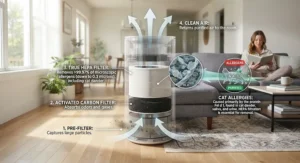
Cat Allergen Size & Filtration: Why HEPA Matters for Fel d 1
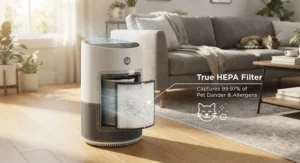
The particle-size numbers here explain almost everything about how these machines are engineered. Older cascade-impactor research found that airborne cat allergen in real homes splits roughly three-quarters on particles 5 microns or larger and about a quarter on particles 2.5 microns or smaller, meaning a meaningful share of what you’re breathing is genuinely tiny. True HEPA filters are certified to capture 99.97% of particles at the notoriously difficult 0.3-micron size — the “most penetrating particle size” that’s actually harder to trap than either larger or smaller particles due to airflow physics — which is why every purifier on this list leads with True HEPA rather than a lesser “HEPA-type” or “HEPA-like” filter that skips independent certification entirely.
This is also where a certified HEPA filter capturing particles down to 0.3 microns becomes the meaningful cutoff for effective allergen sequestration, and it’s why models like the Alen BreatheSmart 45i marketing their 0.1-micron capture rate are making a genuine, verifiable claim rather than a rounding error. If a purifier’s box only says “HEPA-type” or “99% efficient” without an independent AHAM CADR certification, treat that as a yellow flag — it’s frequently marketing shorthand for a filter that doesn’t meet the true HEPA standard at all.
How to Choose an Air Purifier for Cat Dander
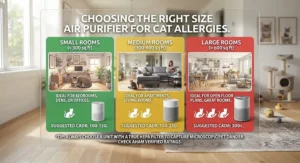
- Match CADR to your actual room, not the marketing headline. Manufacturers often list square footage at just one air change per hour; look for the smaller number tied to 4–5 ACH if you want genuinely fast allergen turnover.
- Confirm it’s certified True HEPA, not “HEPA-type.” Only certified True HEPA guarantees the 99.97%-at-0.3-microns benchmark that matters for Fel d 1.
- Prioritize a washable pre-filter if you have heavy shedders. It dramatically extends your HEPA filter’s working life and cuts your annual replacement cost.
- Check the noise rating at your intended fan speed. A purifier you turn off because it’s too loud at night is doing zero work while you sleep, which is exactly when exposure matters most.
- Factor in total filter cost over two years, not just the sticker price. A cheaper unit with expensive, frequent filter changes can cost more than a pricier model with a 12-month filter life.
- Decide if you need odor control alongside particle capture. Litter box smell calls for a meaningful activated carbon stage, not just a HEPA filter alone.
- Consider an ionizer-free option if you’re chemical-sensitive. Ionizing purifiers can produce trace ozone; every model reviewed above lets you disable that feature if present.
✨ Don’t Miss These Exclusive Deals!
🔍 Take your indoor air quality to the next level with one of the picks above. Click on any highlighted purifier to check current pricing and availability, and start breathing easier around the cat you’re not giving up for anything.
Buyer’s Decision Framework: Best Air Purifier If You’re Allergic to Cats
If you’re renting a single bedroom and just need overnight relief, choose a compact True HEPA unit like the Levoit Vital 200S-P because its Pet Mode and lower price match a single-room, single-cat reality without overspending. If you own an open floor plan and your cat has the run of the house, choose a large-coverage unit like the Levoit Core 600S or Blueair Blue Pure 311i Max, because square footage — not just allergy severity — is the deciding variable at that scale. If you’re managing multiple cats, litter box odor, and genuine allergy symptoms simultaneously, choose the Alen BreatheSmart 45i or Austin Air HealthMate Plus, because their carbon capacity is built for exactly that combined load. And if your budget is the binding constraint above all else, the Winix 5500-2 consistently delivers the best CADR-per-dollar on this entire list.
A simple priority checklist: severity of symptoms first, room size second, odor concerns third, budget last — in that order, because undersizing a purifier for a severe allergy is the single most common mistake buyers make.
Setting Up Your Air Purifier for a Bedroom with a Cat Owner
Placement matters almost as much as the machine itself. Position the unit at least two feet from walls and furniture so air can circulate freely into and out of the intake — a purifier wedged into a corner is working at a fraction of its rated CADR. If your cat sleeps on the bed with you (be honest, most do), place the purifier as close to the bed as practical, since allergen concentration is highest right where the fur is.
Run it continuously on auto mode rather than switching it on only when symptoms flare; Fel d 1 is being shed constantly, not just when you notice it. In the first 30 days, expect the biggest common mistake to be neglecting the pre-filter — a fur-clogged pre-filter chokes airflow to the HEPA stage behind it, quietly tanking your real-world CADR even though the unit sounds like it’s running fine. Check it weekly for the first month to calibrate how often your specific cat’s shedding demands attention, then settle into a maintenance rhythm from there. Crack a window periodically too — purifiers clean recirculated air, but they can’t replace fresh air exchange entirely, something the EPA’s guidance on residential air cleaners emphasizes repeatedly.
Real-World Scenarios: Matching the Right Purifier to Your Household
Consider a college student in a 300-square-foot studio with one indoor cat and a tight budget: the Levoit Vital 200S-P or Winix 5500-2 covers that space comfortably without straining a student budget, and either unit’s noise profile is quiet enough for a shared dorm-adjacent living situation. Now picture a family of four in a 1,400-square-foot open-concept home with two cats and a dog — that’s the Levoit Core 600S or Blueair Blue Pure 311i Max territory, where genuine large-room CADR and continuous auto-mode operation matter more than compactness. Finally, imagine someone with diagnosed cat allergies and mild asthma sharing a house with three rescue cats and frequent litter box odor — that’s precisely the use case the Austin Air HealthMate Plus or Alen BreatheSmart 45i was engineered for, where carbon volume and sub-0.3-micron capture aren’t luxuries but genuine necessities.
In each case, the deciding factor isn’t how much the household loves their cats (a lot, presumably) — it’s the physical reality of room size, cat count, and symptom severity converging on a specific spec sheet.
Common Mistakes When Buying an Air Purifier for Cat Allergies
The single most common mistake is buying based on square footage alone without checking the air-changes-per-hour assumption behind that number — a purifier “rated” for 1,000 square feet at one ACH might only meaningfully clear 300 square feet at the 4-5 ACH allergy sufferers actually need. A second mistake is skipping the pre-filter entirely and only checking HEPA specs, which ignores how quickly cat hair clogs airflow upstream of the real filtration stage. A third: choosing based on smart features and app integration over actual CADR numbers, when the app is a convenience layer and the CADR is the entire point.
Buyers also frequently underestimate filter replacement costs, comparing sticker prices without factoring in a $50–$120 annual filter budget that can flip which unit is actually cheaper over two years. Finally, some allergy sufferers buy an ionizing purifier specifically to avoid a fan noise, not realizing ionizers alone don’t meaningfully capture Fel d 1 — mechanical HEPA filtration remains the piece doing the real work.
Air Purifiers vs. Other Cat Allergy Remedies
| Approach | Addresses Airborne Allergen | Addresses Surface Allergen | Ongoing Cost |
|---|---|---|---|
| Air purifier (True HEPA) | Yes, continuously | No | Filter replacement |
| Antihistamines / allergy meds | No | No | Recurring medication |
| Allergen-reducing cat wipes/sprays | Partial, short-term | Yes, temporary | Low, frequent |
| Rehoming the cat | Yes, completely | Yes, completely | None (but not the point) |
An air purifier and allergy medication solve genuinely different problems and work best layered together rather than treated as competing options — the purifier reduces what’s floating in the air continuously, while antihistamines manage your body’s reaction to whatever gets through anyway. Allergen-reducing wipes and sprays attack the surface half of the equation a purifier can’t touch, since Fel d 1 embedded in couch fabric doesn’t care how clean your air is. None of these fully substitute for the others, which is exactly why allergists tend to recommend a combined approach rather than picking just one line item.
What to Expect: Real-World Performance for Cat Allergy Sufferers
Don’t expect instant relief the moment you plug in a purifier — meaningful symptom improvement in clinical studies typically shows up over days to a couple of weeks of continuous operation, not minutes. What you should notice first is less visible dust and fur accumulating on dark furniture near the unit, often before your allergy symptoms themselves shift noticeably. Sneezing and itchy eyes tend to improve gradually as background allergen concentration drops, rather than vanishing overnight, and symptoms will likely still spike temporarily right after active play, grooming sessions, or vacuuming, since those activities kick up settled allergen back into the air regardless of how good your purifier is.
Realistically, an air purifier for cat allergies is unlikely to make you symptom-free if you’re highly sensitized — it’s a meaningful reduction tool, not a cure, and combining it with the surface-cleaning habits above is what gets most people to genuinely livable symptom levels.
Long-Term Cost & Maintenance for Pet Owners
The sticker price is the smallest number you’ll actually spend over the life of one of these machines. Factor in True HEPA filter replacements roughly every 6–12 months (commonly $40–$120 depending on the model) and, where applicable, more frequent carbon or pre-filter swaps. Over two years, a $200 purifier with $100 in annual filter costs totals roughly $400 — twice its sticker price — which is exactly why the Coway and Winix picks above, with their washable pre-filters, tend to pull ahead in true cost-of-ownership even when their upfront price looks similar to competitors.
Multi-cat households should budget on the higher end of every filter-cost estimate, since heavier allergen and fur load shortens filter life regardless of the manufacturer’s baseline estimate. If you’re weighing the Alen or Austin Air options against their premium sticker price, remember that both lean on unusually long-lasting carbon beds — Austin Air’s 5-year filter life, in particular, can make its total cost of ownership more competitive than it first appears against cheaper units needing annual replacements.
Features That Actually Matter (And Those That Don’t)
Certified True HEPA filtration and a genuine AHAM CADR rating matter enormously — everything else on the spec sheet is secondary to those two facts. A washable pre-filter matters a lot specifically for cat owners, since it’s the difference between monthly maintenance and constant HEPA-clogging frustration. Real auto mode driven by an actual particle sensor matters too, since it’s the feature that keeps a purifier working hard exactly when your cat is shedding most.
What matters far less than marketing suggests: smart-home voice control, app aesthetics, and color-customizable pre-filters are genuinely nice-to-haves, not allergy-relief features. Ionizer technology, similarly, gets marketed heavily but does comparatively little for Fel d 1 specifically compared to mechanical HEPA filtration — treat it as an optional extra you can switch off, not a deciding factor.
Safety, Regulations & Ozone-Free Compliance
Look specifically for units that either lack an ionizer entirely or let you fully disable it, since ionizing air cleaners can produce trace ozone, a lung irritant that’s particularly unwelcome in a household already managing respiratory sensitivity. The EPA’s overview of HEPA filtration explains that HEPA filters trap particles mechanically rather than chemically, which is why they carry no ozone-related concerns the way some electronic air cleaners do. Every purifier reviewed above uses HEPA as its primary mechanism, with ionizer features (where present) fully optional rather than baked in.
Also worth checking: whether the unit carries independent AHAM Verifide certification for its CADR claims, since that’s a genuine third-party check rather than a manufacturer’s self-reported number. None of this is medical advice — if you have diagnosed asthma alongside cat allergies, loop your allergist in on which purifier and maintenance schedule fits your specific situation.
Frequently Asked Questions
❓ Does an air purifier really help with cat allergies?
❓ What's the best air purifier if I'm allergic to cats but can't give them up?
❓ How long does it take for an air purifier to reduce cat allergen levels?
❓ Can an air purifier remove Fel d 1 from surfaces like couches and carpet?
❓ Is a bigger, more expensive air purifier always better for cat allergies?
Conclusion
Living with a cat allergy doesn’t have to mean living without your cat — it means being deliberate about the tools you actually use. A genuinely certified True HEPA air purifier for cat allergies, sized correctly for your room and run continuously rather than sporadically, tackles the single biggest driver of your symptoms: that stubbornly airborne, sticky little protein called Fel d 1. Whether that’s the budget-friendly Winix 5500-2 in a single bedroom or the carbon-heavy Austin Air HealthMate Plus in a multi-cat household managing serious symptoms, the right pick genuinely comes down to your room size, your cat count, and how far your symptoms have pushed you.
Layer it with the basics — regular vacuuming, hot-water bedding washes, and keeping the unit running on auto mode around the clock — and most allergy sufferers land somewhere genuinely livable, without ever having to choose between clear sinuses and the cat curled up on the windowsill.
✨ Don’t Miss These Exclusive Deals!
Check current pricing on any of the seven purifiers above and start clearing the air in your home today. 🐾
Recommended for You
- Air Purifier for Pets: 7 Best Picks for Dander & Odor 2026
- Air Purifier for Baby Secondhand Smoke: 7 Safe Picks (2026)
- Best Air Purifier for Secondhand Smoke: 7 Picks That Actually Work (2026)
Disclaimer: This article contains affiliate links. As an Amazon Associate, I earn from qualifying purchases. If you purchase products through these links, we may earn a small commission at no additional cost to you.
✨ Found this helpful? Share it with your friends! 💬🤗
