
In This Article
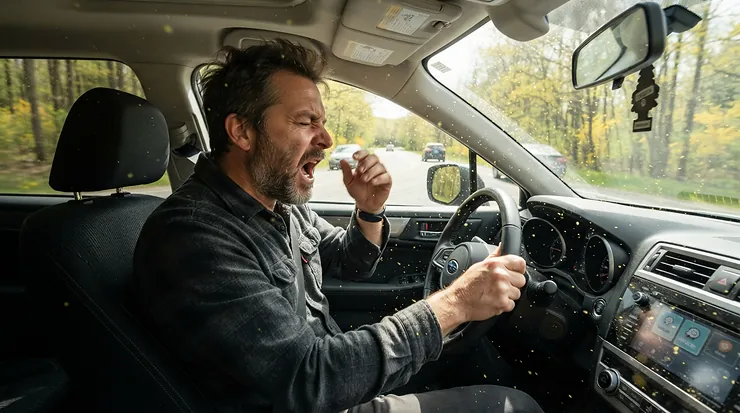
You know the drill. You step outside in spring, sneeze twice, and think, “At least my car will be safe.” Then you start the engine and the sneezing gets worse. Welcome to the cruel irony of the sealed metal box we call a commute.
A car air purifier for allergies is one of the few gadgets that can actually change that daily experience. Your car’s interior is tiny, which cuts both ways. Pollen, road dust, and exhaust particles concentrate fast in a small cabin. The same small volume means a compact HEPA unit can make a noticeable dent. If you drive 30 minutes each way, that’s roughly five hours a week breathing whatever your vents deliver.
Here’s what I did for this guide. I researched current models, compared their published specs, and read how independent roundups describe them. I did not test any of these devices myself, and I won’t pretend otherwise. What you’ll get is honest analysis built on real specs and clearly labeled review sentiment. Where I couldn’t verify something, I’ll say so.
By the end, you’ll know which of seven real models fits your car, your budget, and your sneezing threshold. You’ll also learn what the marketing glosses over, such as ozone, cartridge costs, and why a cabin filter alone isn’t the whole story.
Quick Comparison Table: 7 Car Air Purifier for Allergies Options
| Product | Filtration Type | Best For | Price Range* |
|---|---|---|---|
| IQAir Atem Car | HyperHEPA, premium multi-stage | Severe allergies, asthma, odors | $200-$300 |
| Philips GoPure GP5212 | HEPA-class with carbon layer | Drivers wanting a known brand | $100-$200 |
| LUFTRUM C401A | H13 HEPA + PM2.5 sensor | Data-minded commuters | $60-$100 |
| ALIENONE AP-C1-D | H13 HEPA + pre-filter + photocatalyst | Ride-share drivers, cup holders | $50-$90 |
| MOOKA M01 | H13 HEPA | Tight budgets | $40-$70 |
| Aucleia Mini | True H13 HEPA | Small cars, whisper-quiet use | $30-$60 |
| TDBYWAE Portable | H13 True HEPA, USB | One device for car and home | $40-$70 |
*Ranges are approximate at the time of research. Prices change often, so check current price before buying.
Notice the pattern. The expensive unit sells itself on filter engineering and the budget units sell themselves on the H13 label. That label matters, but it isn’t the whole story. The IQAir Atem Car justifies its premium mainly if you have asthma or severe symptoms. For mild seasonal sniffles, the MOOKA M01 or Aucleia Mini cover the basics for a fraction of the cost. The LUFTRUM C401A sits in the middle, mostly because its sensor lets you see what the filter is doing.
💬 Just one click — help others make better buying decisions too!😊
What Is a Car Air Purifier for Allergies?
A car air purifier for allergies is a compact, plug-in or battery-powered device that pulls in cabin air and pushes it through a filter, usually HEPA, to trap pollen, dust, and other airborne irritants. It sits in a cup holder, on a seat, or on the dash. It supplements your car’s built-in cabin filter rather than replacing it.
Two points are worth knowing. First, “HEPA” is not a marketing flourish. The EPA explains that a HEPA filter can theoretically remove at least 99.97% of dust, pollen, mold, bacteria, and airborne particles at 0.3 microns, which is the hardest size to catch. Particles bigger or smaller get trapped even more efficiently. Second, if a label says “HEPA-type” or “HEPA-like,” that is not the same promise. Look for the 99.97% at 0.3 microns spec.
That second point is where most shoppers get burned. A product can wear the word HEPA on the box without meeting the standard behind it. We’ll come back to that in the buying criteria.
Top 7 Car Air Purifier for Allergies Picks: Expert Analysis
A note on method before we dive in. The sources I found for these models vary widely in quality. Some are established outlets with real editorial testing, and others are affiliate roundups that mostly repeat manufacturer claims. Where I describe review sentiment, I’m summarizing what those sources actually say. Where verification is thin, I flag it.
1. IQAir Atem Car — built for severe allergy and asthma sufferers
The IQAir Atem Car is the heavyweight of the bunch. It’s a Swiss-designed, German-made unit that pairs HyperHEPA filtration with gas and odor handling. That makes it the only pick here aimed at drivers who treat air quality as a medical concern rather than a comfort feature.
Key specs matter less than what they imply. HyperHEPA is IQAir’s own class, positioned above standard HEPA for the finest particles. In practice, that means ultrafine road pollution gets targeted, not just pollen. The gas-handling stage is why a major automotive outlet singled it out as best for odors.
Based on the spec comparison, this is the model to weigh if your allergist has used the words “asthma trigger.” It’s overkill if you sneeze for three weeks each April and recover. A reasonable framing is insurance versus convenience.
Reviewer sentiment, as reported by automotive and roundup sites, is consistently positive on filtration quality and odor control. The recurring caveats involve cost and the ongoing price of replacement filters.
Pros:
- ✅ Premium multi-stage filtration with gas and odor handling
- ✅ Strong fit for asthma and severe allergy profiles
- ✅ Established brand with a long filtration track record
Cons:
- ❌ Highest purchase price in this lineup
- ❌ Replacement filters add meaningful long-term cost
Price range: roughly $200-$300; check current price. Value verdict: worth it only if your symptoms justify medical-grade ambition.
2. Philips GoPure GP5212 — familiar brand, multi-stage cleaning
The Philips GoPure GP5212 is the “nobody got fired for buying Philips” option. It’s a multi-stage purifier with HEPA-class filtration and an activated carbon layer, designed specifically for vehicle use rather than adapted from a desk unit.
Why does that distinction matter? Car-specific units are engineered around 12V power and cup-holder or console placement. You plug it in and forget it. The carbon layer helps with the “new car smell, old car funk” problem that HEPA alone can’t touch, since carbon handles gases and odors while HEPA handles particles.
One honest caveat. Availability for this model has varied over time, so verify that it’s actually in stock and that replacement filters are obtainable before you commit. A purifier you can’t re-filter is a paperweight with a power cord.
An established automotive outlet gave it an honorable mention, calling it effective but noting it takes up noticeable space. For a compact hatchback, that footprint could matter. In a truck or SUV, it likely won’t.
Pros:
- ✅ Designed specifically for in-car use
- ✅ HEPA-class plus activated carbon for odors
- ✅ Recognizable brand with accessible support
Cons:
- ❌ Bulkier than cup-holder-sized rivals
- ❌ Stock and filter availability may fluctuate
Price range: roughly $100-$200; check current price. Value verdict: solid mid-tier if you find it in stock.
3. LUFTRUM C401A — H13 HEPA with a live PM2.5 sensor
The LUFTRUM C401A earns its slot because of one feature: it measures. A built-in PM2.5 sensor means you aren’t guessing whether the purifier is doing anything. You watch the reading change as you drive through a pollen-heavy corridor.
Why does that matter for allergies? Because a purifier that runs silently gives you no feedback. The sensor lets you find your worst commute stretches and adjust your behavior, like switching to recirculate before that notorious industrial exit. It turns a mystery box into an instrument.
Pair that with H13 HEPA filtration, and you get a car-specific design at a mid-tier price. Based on the spec comparison, it’s the best “informed buyer” choice here. It’s less about raw power and more about knowing.
On reviews, I could only verify roundup-level coverage that describes it as a best-value car-specific model. I couldn’t confirm a deep, independent review pool, so treat performance claims as manufacturer-stated until more data accumulates.
Pros:
- ✅ Real-time PM2.5 reading builds confidence
- ✅ H13 HEPA at a mid-range price
- ✅ Car-specific design
Cons:
- ❌ Independent review depth is limited
- ❌ Sensor accuracy at this price is unverified
Price range: roughly $60-$100; check current price. Value verdict: great for data-lovers, a leap of faith for skeptics.
4. ALIENONE AP-C1-D — discreet cup-holder design with H13 HEPA
The ALIENONE AP-C1-D is a cylinder, which sounds boring until you realize cylinders fit cup holders and nothing else here does it as cleanly. It combines H13 True HEPA with a pre-filter and a photocatalyst stage in a compact body.
The pre-filter is the unsung hero. It catches hair, lint, and big dust before they reach the HEPA layer, so the expensive filter lasts longer. For anyone with a dog that rides shotgun, that’s real money saved over a year.
At roughly 30 dB, it’s a murmur rather than a whine. That quietness matters when you’re driving with a sleeping toddler in the back or running ride-share rides where a noisy fan would annoy passengers. One roundup specifically recommends it for ride-share drivers needing a discreet unit.
The photocatalyst claim deserves some skepticism, as these stages often have modest real-world impact. Treat it as a bonus rather than a selling point.
Pros:
- ✅ Fits standard cup holders neatly
- ✅ Pre-filter protects the HEPA cartridge
- ✅ Quiet at around 30 dB
Cons:
- ❌ Compact size means modest airflow
- ❌ Photocatalyst benefit is hard to verify
Price range: roughly $50-$90; check current price. Value verdict: the sweet spot for most commuters.
5. MOOKA M01 — the budget H13 starter
The MOOKA M01 is the “I just want to try this” purifier. It’s an H13 HEPA unit aimed at drivers who want filtration without a four-figure-feeling investment. In roundups, it’s repeatedly named a top budget option.
Budget doesn’t mean bad, but it does mean trade-offs. Cheaper units typically use smaller fans and thinner build quality. The practical effect is less air moved per minute, which means the device works best when you run it continuously rather than expecting instant relief.
Based on the spec comparison, it handles a compact sedan better than a minivan. Think of it as a personal-bubble tool. It cleans the air around you more than it scrubs the whole cabin.
I could only verify roundup-level coverage of this model, with little independent testing. That’s common at this price tier, and it’s the main reason I’d point you to retailers with easy return policies.
Pros:
- ✅ Very low entry cost
- ✅ H13 HEPA in a small package
- ✅ Simple, no-fuss operation
Cons:
- ❌ Limited independent testing available
- ❌ Better suited to small cabins
Price range: roughly $40-$70; check current price. Value verdict: low risk, decent upside for a first purifier.

6. Aucleia Mini — whisper-quiet and ultra-compact
The Aucleia Mini wins the quiet contest, listing roughly 22 dB. That’s library-level hush, quieter than most purifiers twice its price. If noise makes you cranky on long drives, this is the purifier that won’t contribute to the problem.
It uses True H13 HEPA with a stated 99.97% efficiency. That aligns with the HEPA standard, though the real-world result depends on airflow, and a mini fan can only move so much air. In a compact coupe or small hatchback, that’s fine. In a seven-seater, it’s a gesture.
The honest analysis is this: tiny devices work best when positioned close to your face, such as on the center console or dash. They aren’t magic. They’re a small, quiet filter that cleans your immediate breathing zone.
The coverage I found positions it as a compact, budget-friendly HEPA purifier for car and office use. Deeper independent reviews were thin.
Pros:
- ✅ Extremely quiet operation
- ✅ True H13 HEPA at a bargain price
- ✅ Doubles as an office desk purifier
Cons:
- ❌ Limited airflow for larger vehicles
- ❌ Few independent long-term reviews
Price range: roughly $30-$60; check current price. Value verdict: perfect for small cars and noise-sensitive drivers.
7. TDBYWAE Portable Purifier — one device for the car and the bedroom
The TDBYWAE Portable Purifier takes a different approach. It’s a USB-powered H13 True HEPA unit marketed for pets, dust, dander, and pollen, and it’s rated for a bedroom-size area at home, with the car as a secondary use.
That dual-purpose pitch is clever and worth interrogating. If you want a single purifier that rides to work with you and sleeps on your nightstand, you save money. The trade-off is that dual-use devices rarely excel at either job. A car-specific design fits a cup holder, while a home-oriented one may sit awkwardly on a dash.
Based on the spec comparison, it works best if you’d actually use it in both places. If you only want car use, the ALIENONE AP-C1-D or MOOKA M01 are better targeted.
Roundups describe it as a best-value pick for both car and home. As elsewhere in this tier, I couldn’t verify extensive independent testing.
Pros:
- ✅ Works in car, bedroom, and office
- ✅ H13 True HEPA with USB power
- ✅ Strong value for multi-use buyers
Cons:
- ❌ Not purpose-built for car cup holders
- ❌ Limited independent review depth
Price range: roughly $40-$70; check current price. Value verdict: excellent if you’ll use it in two places.
Top 7 at a Glance: Which Car Air Purifier for Allergies Wins Where?
| Product | Noise | Strength | Weak Spot | Best For |
|---|---|---|---|---|
| IQAir Atem Car | Moderate | Medical-grade ambition | Price | Asthma sufferers |
| Philips GoPure GP5212 | Moderate | Car-specific, carbon layer | Size, stock | Brand loyalists |
| LUFTRUM C401A | Low | PM2.5 sensor | Limited reviews | Data lovers |
| ALIENONE AP-C1-D | ~30 dB | Cup-holder fit | Small airflow | Daily commuters |
| MOOKA M01 | Low | Price | Testing depth | First-time buyers |
| Aucleia Mini | ~22 dB | Silence | Small coverage | Compact cars |
| TDBYWAE Portable | Low | Dual use | Not car-specific | Car + home use |
Looking at the table, the IQAir Atem Car and Philips GoPure GP5212 justify their prices through engineering and brand support, while the budget group trades certainty for savings. If silence is your top priority, the Aucleia Mini is hard to beat. If you want proof the thing is working, the LUFTRUM C401A is the only one here that shows you.
✨ Don’t Miss These Exclusive Deals!
🔍 Take your commute to the next level with these carefully selected purifiers. Click on any highlighted item to check current pricing and availability. These tools can help you breathe easier on every drive!
How to Choose a Car Air Purifier for Allergies
Choosing well takes five minutes and saves a lot of regret. Work through these in order.
- Check the HEPA claim. Look for 99.97% at 0.3 microns, not just “HEPA-type.” Marketing language is slippery, but that number isn’t.
- Match airflow to your cabin. A small fan in a minivan struggles. Compact cars forgive weaker units.
- Think about noise. If it’s louder than your audio, you’ll switch it off, which defeats the purpose.
- Confirm cartridge availability. A purifier is only as good as its next filter. Verify replacements exist and what they cost.
- Skip ozone and heavy ionizers. Ozone irritates lungs and is exactly what allergy sufferers don’t need.
- Check the power setup. USB or 12V plug-in beats batteries for daily use.
- Consider your triggers. Pollen needs particle filtration. Smoke and odors need carbon.
Think of it like buying running shoes. The “best” one is the one that fits your actual route and body, not the one with the flashiest ad.

Car Air Purifier for Dust and Pollen: What Actually Helps
Dust and pollen are cousins but behave differently. Pollen grains are relatively large and get trapped easily, even by decent cabin filters. Fine dust, especially the kind kicked up by road traffic and brake wear, is smaller and sneakier.
That’s why a car air purifier for dust and pollen needs real HEPA filtration, not a sponge in a plastic tube. Standard cabin pollen filters generally catch larger pollen grains. HEPA-grade media is what handles the smaller fragments pollen breaks into. If you’re allergic to grass, ragweed, or tree pollen, both layers help.
Placement matters here more than most people realize. Put the purifier where it can draw air near your face, such as the center console, rather than in the footwell where dust pools. Run it before you start driving when possible, so it clears the cabin while you buckle in.
Seasonal timing also helps. Pollen counts typically peak in the morning and on dry, windy days. If you can, drive with windows closed and recirculation on during peak pollen hours. Combine that with a purifier, and you cut exposure from two directions at once.
Car Air Purifier for Long Commutes: Why Runtime and Comfort Matter
Long commutes change the math. A purifier you tolerate for ten minutes becomes an annoyance by minute forty-five, so a car air purifier for long commutes needs to be quiet, steady, and effortless.
Consider three things.
Noise. A subtle drone becomes maddening over two hours. The Aucleia Mini at around 22 dB and the ALIENONE AP-C1-D at around 30 dB are the quietest of the lot, according to their listed specs.
Power. Choose a model that draws from your car’s power socket or USB, not batteries. Dead batteries mid-commute are a letdown.
Filter wear. More hours means faster filter loading. If you drive an hour daily, a filter might need attention sooner than the manufacturer’s average-use estimate suggests.
Then there’s the human factor. Long drives mean dry cabin air from heater or AC, which can irritate nasal passages and make allergy symptoms feel worse. Pair your purifier with a bottle of water and the occasional fresh-air break at a safe, low-pollen stop. The goal isn’t a sterile bubble. It’s a calmer, cleaner baseline.
Pollen Filtration: Cabin Filter vs Portable Purifier
Let’s separate two things people constantly confuse. Your car already has a cabin air filter in most modern vehicles, and it does real work. A study in Birmingham, UK, evaluated standard pollen and activated carbon cabin filters across ten vehicles and found they reduce fine particles entering the cabin, though pollen-only filters did little for gases like NO2.
So here’s the honest picture of pollen filtration in a car. Your factory filter is your first line of defense. A portable HEPA purifier is your second. Neither is perfect alone.
| Feature | Factory Cabin Filter | Portable HEPA Purifier | Best For |
|---|---|---|---|
| Location | Inside the HVAC system | In cabin, near you | Both complement each other |
| Pollen capture | Good for larger grains | Strong, including smaller fragments | Allergy sufferers |
| Gas handling | Only with carbon layer | Only with carbon stage | Odor-sensitive drivers |
| Upkeep | Replace yearly or as advised | Replace cartridge on schedule | Regular maintenance |
| Cost | Low, replaceable at service | Moderate to high upfront | Depends on budget |
The comparison shows why you shouldn’t treat them as rivals. The cabin filter protects the air coming in, and the portable unit cleans the air already inside, including what you bring in on clothing and pets. If your cabin filter is old, replace it first. It’s the cheapest allergy upgrade in the whole article.
HEPA Cartridge: What to Know Before You Buy a Replacement
The HEPA cartridge is where purifier economics get interesting. The device is a one-time cost, but the cartridge is a recurring one. That’s the razor-and-blades business model, and it’s worth knowing before you fall in love with a cheap unit.
Three factors to weigh.
Availability. Before buying any model, confirm replacement cartridges are sold and in stock. This matters most for lesser-known brands, where support can vanish.
Compatibility. Cartridges are usually model-specific. Don’t assume a generic HEPA cartridge fits.
Real HEPA versus pretend HEPA. Third-party cartridges sometimes use lesser media. Stick with manufacturer-verified replacements unless you can confirm the filtration spec. The EPA is clear that all air cleaners require periodic filter replacement to function properly.
Here’s a practical rule. Set a calendar reminder for filter checks instead of trusting your memory. When airflow drops or odors creep back, the cartridge is probably saturated. A clogged HEPA cartridge isn’t just ineffective, it can strain the fan and reduce airflow to almost nothing.
Common Mistakes When Buying a Car Air Purifier for Allergies
Some errors come up again and again.
Buying based on “99.9%” claims alone. Those numbers often reference ideal conditions, tiny rooms, or unnamed particle sizes. Look for the standard (99.97% at 0.3 microns), not the sparkle.
Ignoring ozone and ionizers. This is the biggest trap. Some ionic units produce ozone as a byproduct. The California Air Resources Board warns that ozone generators are ineffective at cleaning air and that inhaling ozone poses serious health risks. Avoid anything that intentionally emits ozone, period.
Skipping the cabin filter. A shiny purifier can’t rescue a rotten, clogged cabin filter.
Overbuying size. A bulky unit that blocks your cup holder or gear shifter becomes a distraction, and drivers stop using it.
Forgetting recirculation. Fresh-air mode pulls in outdoor pollen. On bad days, recirculate.
Ignoring cartridge costs. The cheapest purifier can become the most expensive after two filter swaps.
Avoid these and you’re already ahead of most buyers.
Practical Usage Guide: Setting Up Your Purifier for Maximum Relief
Buying the unit is half the job. Here’s how to get the most out of it.
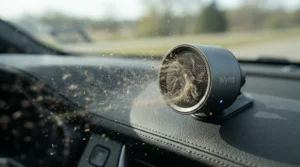
Day one setup. Place it where air can flow freely and aim the outlet toward your breathing zone. Avoid burying it under jackets or in the footwell.
First drive. Start it before you pull out. Let it run during the initial minutes, when cabin air is typically stalest.
Pair it with smart habits. Use recirculation on high-pollen days, close windows in heavy traffic, and vacuum seats and mats weekly. Pollen clings to fabric and returns to the air every time you sit down.
Maintenance schedule. Check the pre-filter or surface monthly, clean per the manual, and replace the HEPA cartridge on the manufacturer’s schedule or sooner if you drive a lot.
Common first-30-day mistakes. Forgetting to remove the protective plastic from the filter is shockingly common. Another is running it on the lowest setting forever and concluding it “doesn’t work.” Try medium or high during peak pollen days.
Track your symptoms for a couple of weeks. If you feel better in the car, that’s useful information. If not, check placement, filter condition, and cabin filter before you give up.
Real-World Scenarios: Matching the Right Purifier to Your Drive
Specs are abstract, so here are three realistic profiles with reasoning.
The asthma-prone commuter. Imagine someone driving 45 minutes each way through dense traffic with a history of asthma. Based on the spec comparison, the IQAir Atem Car fits best because its filtration stack and odor handling target exactly those exposures. The budget is higher, but the stakes are too.
The ride-share driver. Eight hours a day, with passengers coming and going. Noise and discretion matter as much as filtration. The ALIENONE AP-C1-D suits this scenario, with its cup-holder fit and roughly 30 dB operation keeping things unobtrusive.
The college student with a small hatchback. Limited cash, seasonal pollen misery, a 20-minute drive. The Aucleia Mini or MOOKA M01 gives real HEPA filtration without hurting the wallet. They’re best used close to the driver.
Each case follows the same logic. Match the device to the exposure, not the other way around. If you split time between home and car, the TDBYWAE Portable Purifier makes a lot of sense, since one purchase covers both.
Problem and Solution Guide: Fixing Common Car Allergy Headaches
Problem: Sneezing starts the moment you turn on the AC. Solution: Your cabin filter may be clogged or moldy. Replace it, then run a purifier like the LUFTRUM C401A and watch the PM2.5 reading drop.
Problem: The purifier seems to do nothing. Solution: Check airflow, filter installation, and placement. A clogged HEPA cartridge is a common culprit.
Problem: Musty smells even with filtration. Solution: HEPA doesn’t handle odors well. Look at a carbon-equipped model such as the Philips GoPure GP5212 or IQAir Atem Car, and check for damp floor mats.
Problem: Pollen is worst after parking outside. Solution: Close windows, run the purifier before driving, and use recirculation for the first few minutes.
Problem: Noise annoys you. Solution: Choose a quiet unit like the Aucleia Mini and run it on medium rather than high.
Most car allergy problems have a simple fix once you identify which part of the air path is failing.
Long-Term Cost and Maintenance: What You’ll Really Spend
Sticker price is just the opening bid. True ownership cost includes cartridges, power, and replacement frequency.
| Product | Upfront Range | Ongoing Cost | Value Take |
|---|---|---|---|
| IQAir Atem Car | $200-$300 | Highest filter costs | Premium, long-term investment |
| Philips GoPure GP5212 | $100-$200 | Moderate | Fine if filters stay available |
| LUFTRUM C401A | $60-$100 | Low to moderate | Good value with sensor |
| ALIENONE AP-C1-D | $50-$90 | Low | Pre-filter extends HEPA life |
| MOOKA M01 | $40-$70 | Low | Budget starter |
| Aucleia Mini | $30-$60 | Low | Budget quiet option |
| TDBYWAE Portable | $40-$70 | Low | Two-in-one value |
Looking at the numbers, the premium IQAir Atem Car costs more upfront but delivers the most robust filtration for people who truly need it. Meanwhile, the ALIENONE AP-C1-D quietly wins on total cost thanks to its pre-filter, which keeps the HEPA layer cleaner for longer. Budget buyers should remember that a $40 unit with expensive cartridges can cost more over two years than a $90 model with cheap ones.
Cost per use is a helpful lens. If a $60 purifier gets used five days a week for two years, it costs under a dime per drive. That’s a bargain compared with a pack of antihistamines.
Safety, Ozone and Regulations: What to Avoid
This is the section most affiliate articles skip, and it’s the one that matters for your lungs.
Some air cleaners, particularly ionizers and certain “photocatalytic” or plasma designs, can emit ozone as a side effect. In California, that’s regulated. The state’s air board limits ozone emissions from indoor air cleaning devices to under 0.050 ppm and requires certification for air cleaners sold there, including online. Mechanical HEPA filters generally don’t create ozone, which is part of their appeal.
What does that mean for your car? Three practical rules.
First, prefer purely mechanical HEPA filtration. Second, be skeptical of “ionic,” “plasma,” or “activated oxygen” claims. Third, if a product lists ozone-generating features, skip it. Allergy sufferers often have sensitive airways, and ozone is an irritant, not a solution.
Also remember that a purifier isn’t medical treatment. If your symptoms are severe, talk to an allergist. Purifiers reduce exposure. They don’t replace professional care.

FAQ
❓ How much does a good car air purifier cost?
❓ Can a car air purifier really reduce pollen?
❓ Do I still need a cabin air filter?
❓ Are ionic car air purifiers safe for allergies?
❓ How often should I replace the HEPA cartridge?
Conclusion
So what’s the short version? A car air purifier for allergies can make your commute noticeably more bearable, as long as you pick a genuine HEPA unit, place it well, and keep the filter fresh. It isn’t a miracle, and it isn’t a gimmick. It’s one layer in a system that includes your cabin filter, your habits, and your timing.
If your symptoms are serious, the IQAir Atem Car is the most robust choice in this lineup. For most drivers, the ALIENONE AP-C1-D hits the best balance of fit, noise, and cost. Tight budget? The MOOKA M01 and Aucleia Mini deliver real HEPA filtration without much risk. If you want evidence of results, the LUFTRUM C401A shows you the numbers, and if you want a two-in-one, the TDBYWAE Portable Purifier earns its place. The Philips GoPure GP5212 remains a reasonable pick if you can confirm stock and filter supply.
One last honest note. Several of these models have limited independent testing, so buy from retailers with easy returns and give any purifier a couple of weeks of fair use. Your nose will tell you the truth faster than any spec sheet.
✨ Ready to breathe easier on every drive?
🚗 Compare the picks above, check current pricing, and choose the purifier that fits your commute!
Recommended for You
- Car Air Purifier For Pet Odor: 7 Best Picks Ranked (2026)
- Car Air Purifier For Smokers: 7 Best Picks That Work (2026)
- Air Purifier For Apartment With Pets: 7 Best Picks (2026)
Disclaimer: This article contains affiliate links. As an Amazon Associate, I earn from qualifying purchases. If you purchase products through these links, we may earn a small commission at no additional cost to you.
✨ Found this helpful? Share it with your friends! 💬🤗
