
In This Article
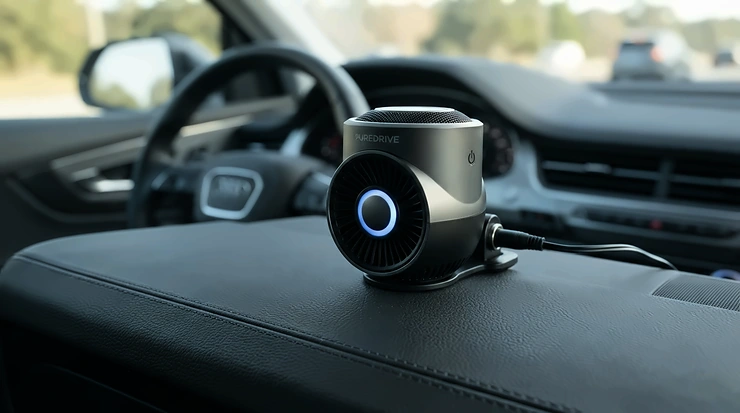
A portable car air purifier for odor is a compact, USB- or 12V-powered device that pulls cabin air through a filter, usually a mix of HEPA for particles and activated carbon for gases, to trap smells from food, smoke, pets and fumes. It does not mask scent. Done right, it quietly removes the molecules causing the stink.

Here’s the awkward truth about every car interior: it’s a small, sealed box that bakes in the sun, collects crumbs, and hosts a rotating cast of gym bags, takeout containers and, in some households, a very good boy who rolls in things. Odors don’t just visit. They move in. The fix isn’t another dangling cardboard pine tree. It’s a portable car air purifier for odor control that works on the actual chemistry of the smell.
The key material is activated carbon, a processed form of charcoal riddled with microscopic pores that grab gas molecules by adsorption. Think of it as Velcro for smells. Not every “purifier” has it, which is why a shopper who grabs the first gadget with a glowing LED can end up with a fan that moves smelly air around politely.
This guide covers seven real products, from a portable car air purifier under $25 option all the way to a premium unit. We look at cup holder unit designs, odor absorption versus masking, and what actually helps with a portable car air purifier for pet smell problems. Everything below is based on published specs, retailer and editorial round-ups, and aggregated review themes, not claimed hands-on testing. Where reliable review data is thin, I’ll say so. Prices are ranges at the time of research and may vary.
Quick Comparison: 7 Portable Car Air Purifier for Odor Options at a Glance
| Pick | Type | Price Range | Best For |
|---|---|---|---|
| Basic Concepts Bamboo Charcoal Bags | Passive charcoal | Well under $25 | Silent odor absorption, tight budgets |
| PURE Car Air Purifier Premium Air Ionizer & Car Charger | Plug-in ionizer + charger | Around $25 | Dust in a pinch, two-in-one charging |
| Pure Enrichment PureZone Mini | Fan + multi-stage filter | $35-$50 | Cup holder unit on a modest budget |
| Scosche FrescheAIR 2 | HEPA H13, auto-start | $50-$70 | Set-and-forget daily commuters |
| Philips GoPure GP5212 | 3-stage filter | $70-$90 | Smoke and fumes from a known brand |
| Westinghouse WH10P | HEPA + NCCO tech | $100-$150 | One unit for car, desk and bedroom |
| IQAir Atem Car | HyperHEPA-style premium | $350-$450 | Maximum odor performance, heavy-duty use |
Read the table as a ladder, not a ranking. The Basic Concepts Bamboo Charcoal Bags and the PURE Car Air Purifier Premium Air Ionizer & Car Charger sit at the portable car air purifier under $25 rung, but they solve different problems: one absorbs odors passively, the other mostly moves charged particles. For active, fan-driven filtering, the jump to the Pure Enrichment PureZone Mini or Scosche FrescheAIR 2 is where cup holder convenience begins. The IQAir Atem Car is the splurge, and its price makes sense only if odors are a daily battle.
💬 Just one click — help others make better buying decisions too!😊
Top 7 Portable Car Air Purifier for Odor Picks: Expert Analysis
1. Basic Concepts Bamboo Charcoal Bags — silent odor absorption for pocket change
Not every portable car air purifier for odor needs a fan. These little bags are filled with bamboo-derived activated charcoal, and they work by passive adsorption: odor molecules drift in, stick to the carbon surface, and stay put. Editorial testers have rated this style among the best for the money.
Here’s what the spec sheet won’t say loudly: there are no moving parts, no noise and no power draw, but also no airflow. Odor absorption happens only as fast as air drifts past the bag, so it suits slow, steady smells (musty seats, gym-bag funk) better than a sudden fast-food emergency. Placing one under a seat and one in a door pocket helps. On paper this is the most honest portable car air purifier under $25 you can buy, because it asks for nothing but a sunny windowsill every few weeks.
Verified aggregated review data is limited for this specific product, so treat claims as modest: it’s an odor absorption helper, not a particle filter.
Pros:
- ✅ Silent, no charging, no moving parts
- ✅ Real activated carbon odor absorption
- ✅ Easy to tuck into seat pockets
Cons:
- ❌ Slow, passive action with no fan
- ❌ Does nothing for dust or pollen
Price range: typically well under $25, check current price. Value verdict: the best entry point for anyone whose budget is firmly small.

2. PURE Car Air Purifier Premium Air Ionizer & Car Charger — dual-purpose plug-in for the thrifty
This one plugs into the 12V socket, emits negative ions and doubles as a dual USB charger, so it earns its spot even if the purifying part underwhelms. It’s a standard recommendation in “best value” lists, and its tiny size is a selling point and a limitation at once.
The honest analysis: ionizers attract airborne particles toward surfaces, which can reduce dust, but the U.S. EPA has noted that ion generators do not remove gases or odors, and some can produce small amounts of ozone as a by-product. So as a portable car air purifier for odor, this is the weakest technology on the list. Buy it for charging with a possible dust bonus, not for rescuing a smoky cabin.
Reviewer themes I can verify are mostly about its small size and its role as a budget accessory, rather than dramatic odor results.
Pros:
- ✅ Charger and ionizer in one slot
- ✅ Tiny and easy to install
- ✅ Very low cost of entry
Cons:
- ❌ Ionizers don’t remove gases or odors well
- ❌ Possible low-level ozone by-product
Price range: hovers around $25, so check current price to see whether it dips under. Value verdict: fine as a charger, skip it if odor is the main complaint.
3. Pure Enrichment PureZone Mini — cup holder unit with real fan power
Editors at The Drive named this their best overall pick, and it’s easy to see why: it’s built as a true cup holder unit, with a two-stage purification design and a published airflow figure of roughly 9 cubic feet per minute for a small floor area.
What that means in practice: it’s sized for one cabin, not a minivan party. Nine cubic feet per minute is modest, but in a sedan’s few dozen cubic feet of air it cycles the space repeatedly on a longer drive. Check whether the filter stack includes a carbon layer before you rely on it for smoke or pet smell; the HEPA stage alone won’t absorb odors.
Reviewers consistently mention some white noise during operation and call out the compact size as both a benefit and a limit.
Pros:
- ✅ Genuine cup holder fit
- ✅ Fan-driven multi-stage filtering
- ✅ Well regarded by editorial round-ups
Cons:
- ❌ Audible white noise while running
- ❌ Small airflow for large SUVs
Price range: $35-$50. Value verdict: an excellent middle step when you want a fan without the premium bill.
4. Scosche FrescheAIR 2 — auto-start HEPA for daily commuters
Scosche designed this one for the lazy-genius commute. It fits a cup holder, includes an H13 HEPA filter and a USB-C cable, and its automatic mode switches on when the car starts. Manual mode offers two fan speeds.
Spec interpretation: the 99.5% PM2.5 capture claim speaks to fine particles like smoke ash and dust, which is helpful because smoke odor rides on particles. But HEPA is not an odor remover by itself, and the product is marketed as a purifier and deodorizer without clear carbon-mass numbers. If your problem is gas-phase smells, ask whether a carbon layer is present.
Because it plugs in and wakes up with the engine, it removes the “I forgot to turn it on” failure mode, which quietly decides whether any purifier gets used.
Verifiable review volume is limited, so rely on specs over star-count hype.
Pros:
- ✅ Auto mode starts with the engine
- ✅ H13 HEPA for fine particles
- ✅ USB-C and cup holder friendly
Cons:
- ❌ Carbon content isn’t clearly specified
- ❌ Only two fan speeds
Price range: $50-$70. Value verdict: strong for commuters who value convenience over absolute odor muscle.
5. Philips GoPure GP5212 — familiar brand, three-stage filter
Retail listings describe the Philips GoPure GP5212 as a three-stage system aimed at exhaust fumes, VOCs, bacteria, smoke and odors, and claim it can cycle a standard sedan or SUV in under ten minutes. Those are manufacturer-style claims, but three filtering stages is a more serious layout than the cheapest options.
What matters: multi-stage designs usually pair a particle filter with a gas-adsorbing layer, which is the combination a portable car air purifier for odor actually needs. The trade-off is cost and eventual filter replacement. Expect to buy replacement filters on a schedule, because a saturated carbon layer stops absorbing.
User reports across various Philips car units point to a sleek cup holder shape and a louder turbo mode, though I’d rely on the spec sheet for this exact model rather than the broader brand anecdotes.
Pros:
- ✅ Three-stage filtering targets smoke and fumes
- ✅ Cup holder friendly silhouette
- ✅ Established brand with filter availability
Cons:
- ❌ Replacement filters add ongoing cost
- ❌ Turbo speeds tend to be louder
Price range: $70-$90. Value verdict: a sensible mid-range anchor if you want a name-brand portable car air purifier for odor.

6. Westinghouse WH10P — one purifier for car, desk and bedroom
Calling it a car-only gadget undersells it. The Drive named the Westinghouse WH10P its most versatile pick, since you can carry it between spaces. It pairs a HEPA filter with NCCO (nano-confined catalytic oxidation) technology, and retailer round-ups describe coverage for a roughly 65 sq ft space.
Why that matters: in a car, a unit rated for a small room has ample headroom, so it should cycle a cabin quickly. The flip side is size. This is not a slim cup holder unit, so check your console before buying, and remember that catalytic technologies still deserve a glance at independent ozone-emission testing.
Verified aggregated review sentiment is scarce here, so base your decision on versatility and filter specs.
Pros:
- ✅ Works in car, office and bedroom
- ✅ HEPA plus catalytic stage
- ✅ Headroom for larger cabins
Cons:
- ❌ Bulkier than true cup holder models
- ❌ Higher cost than entry-level units
Price range: $100-$150. Value verdict: worth it if the same unit will earn its keep at home too.
7. IQAir Atem Car — premium odor performance with a mount
The Drive picked the IQAir Atem Car as best for odors, and independent rating sites list it near the top at roughly $400. IQAir markets it as filtering pollution, odors, gases and car fumes, and its listings emphasize German manufacture and a convenient car mount.
Analysis: most cheap units lean on a thin sponge of carbon. Premium designs generally use more filter media and sturdier fans, which is the real reason price climbs. That extra media is what delivers odor absorption long enough to matter on a daily smoky or pet-heavy commute. IQAir also publicly states its purifiers produce no ozone, a meaningful reassurance given the safety questions covered later.
You’re paying for capacity, not cleverness. If your car smells occasionally, this is overkill.
Pros:
- ✅ Top editorial pick for odors
- ✅ Larger filter capacity than budget units
- ✅ Ozone-free claims from the maker
Cons:
- ❌ Price is many times the budget options
- ❌ Mounts rather than dropping into a cup holder
Price range: $350-$450. Value verdict: justified for heavy-odor drivers, excessive for casual use.
| Product | Core Tech | Form | Odor Strategy | Price Range |
|---|---|---|---|---|
| Basic Concepts Bamboo Charcoal Bags | Bamboo charcoal | Passive bag | Absorption only | Under $25 |
| PURE Car Air Purifier Premium Air Ionizer & Car Charger | Ionizer | 12V plug-in | Limited | Around $25 |
| Pure Enrichment PureZone Mini | Two-stage filter | Cup holder unit | Check carbon content | $35-$50 |
| Scosche FrescheAIR 2 | H13 HEPA | Cup holder unit | Particles first | $50-$70 |
| Philips GoPure GP5212 | Three-stage filter | Cup holder style | Gas + particles | $70-$90 |
| Westinghouse WH10P | HEPA + NCCO | Portable | Catalytic stage | $100-$150 |
| IQAir Atem Car | Premium filtration | Mounted | Strongest | $350-$450 |
Looking at the table, the Philips GoPure GP5212 is the best middle-ground if your priority is a branded, multi-stage cabin unit, while the Basic Concepts Bamboo Charcoal Bags deliver the cheapest honest odor absorption. If you’re after maximum performance and can stomach the cost, the IQAir Atem Car stands alone. The cheapest powered option, the PURE Car Air Purifier Premium Air Ionizer & Car Charger, sacrifices odor removal for price.
✨ Don’t Miss These Exclusive Deals!
🔍 Take your drive to the next level with these carefully selected products. Click on any highlighted item to check current pricing and availability. These tools will help you create the fresh, clean cabin your family will love!
How to Set Up and Use a Portable Car Air Purifier for Odor in Your First 30 Days
Most cabin odor problems start with a source, not the air. Before any gadget runs, pull out floor mats, check under the seats and vacuum crumbs. A purifier removes airborne molecules, but a rotting french fry beneath a seat will keep supplying new ones.
Week one: place a cup holder unit like the Scosche FrescheAIR 2 where airflow isn’t blocked, and run it on the highest setting for the first few drives to clear built-up odor. Set it to auto or a lower speed afterward. Pair it with one or two Basic Concepts Bamboo Charcoal Bags under the front seats for steady odor absorption.
Week two: crack windows briefly on a sunny day to flush stale air, since filters work best when the cabin isn’t already saturated. Week three: check whether the filter looks dusty and whether the smell is creeping back. Week four: set a calendar reminder for filter replacement and “recharge” your charcoal bags in sunlight, a commonly recommended practice for bamboo charcoal products.
Common first-month mistakes include running the unit on low only, blocking the intake with a coffee cup, and forgetting that carbon fills up. A saturated filter simply stops absorbing, so odors can return and people blame the device.
Real-World Scenarios: Matching the Right Purifier to Your Life
The rideshare driver. Eight hours a day, wide mix of passengers, constant food smells. Based on filter capacity and runtime, the IQAir Atem Car is the unit built for this duty cycle. If budget is tight, pair a Pure Enrichment PureZone Mini with a pair of charcoal bags and replace consumables more often.
The college student on a budget. Commuting, gym bag in the trunk, maybe $25 to spend. Here a portable car air purifier under $25 means the Basic Concepts Bamboo Charcoal Bags, plus a weekly airing-out routine. The PURE Car Air Purifier Premium Air Ionizer & Car Charger can add a USB port, but don’t expect it to defeat gym funk.
The family with a dog and a minivan. Wet-dog smell, muddy paws, kids’ snack residue. The Philips GoPure GP5212 or the Westinghouse WH10P offer filtering depth with room to grow, and the Westinghouse can also move indoors during off-season. Combine either with regular seat vacuuming and washable covers.
The smoker-adjacent commuter. Secondhand smoke odor clings to upholstery and headliners. A HEPA plus carbon unit helps with the airborne component, but the surfaces still need cleaning. Treat the purifier as maintenance, not a cure.
Problem-Solution Guide: Fixing the Most Common Cabin Odor Complaints
Problem: the purifier smells sharp or electrical. That “after a thunderstorm” scent can signal ozone. The Virginia Department of Health explains that air cleaners producing ozone aren’t recommended because levels can’t be tightly controlled. Stop using the unit and choose a filter-based option.
Problem: smell returns within days. The source is probably still present, or the carbon is saturated. Clean the seat track, mats and trunk, then swap the filter or recharge the bags.
Problem: the unit is too loud. Run it on a lower speed and rely on longer runtime, or step up to a quieter premium design like the IQAir Atem Car.
Problem: weak airflow. Check that the intake isn’t blocked and that the filter isn’t clogged. A budget cup holder unit like the Pure Enrichment PureZone Mini moves modest air volume, so give it time on longer drives.
Problem: musty smell after rain. Moisture feeds mold and mildew, which no purifier fixes alone. Dry the carpets and check door seals, then use odor absorption as the follow-up.
How to Choose a Portable Car Air Purifier for Odor
- Look for activated carbon. HEPA captures particles; carbon adsorbs gases. For smells, carbon matters most.
- Match airflow to your cabin. A small fan suits a compact sedan; larger SUVs benefit from stronger units.
- Prefer filter-based designs over ionizers. Filters don’t rely on charged particles and avoid ozone concerns.
- Check the fit. A cup holder unit needs a cup holder that actually fits its base; otherwise consider a mounted design.
- Confirm the power source. USB-A, USB-C and 12V plugs aren’t interchangeable.
- Plan filter costs. Cheap units with pricey replacements cost more over time.
- Check noise. A whine you can’t stand ends up in the glovebox.
Odor Absorption vs. Masking: What Actually Works
Masking adds a stronger smell on top of a weaker one. Fragrance diffusers, hanging trees and scent sponges all do this. They feel effective for about ten minutes, until the underlying odor returns underneath the fragrance.
Odor absorption removes the molecules. Activated carbon holds them in its pores through physical adsorption. A critical review of odor adsorption on activated carbon notes that real-world performance depends on many variables and that complex mixtures behave differently from single-compound lab tests. Translation: your car’s “eau de everything” smell is harder to adsorb than any clean lab sample.
The key limit: carbon stores odor molecules rather than destroying them, so capacity is finite. Heat can also release some adsorbed compounds, which is why a car baking in July can bring smells back from a tired filter. This is why filter replacement schedules matter for any portable car air purifier for odor.
Cup Holder Unit: What to Know Before You Buy
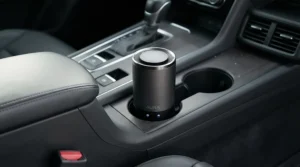
A cup holder unit is the format that makes a portable car air purifier for odor feel effortless: drop it in, plug it in, forget it. The Pure Enrichment PureZone Mini and Scosche FrescheAIR 2 are built this way, and the Philips GoPure GP5212 follows the same silhouette.
Check three things. First, base diameter: some cars have shallow or oddly angled holders. Second, cable routing: a cord that crosses the shifter is a nuisance. Third, intake position: if your drink or phone blocks the vents, performance drops.
The tradeoff is that you lose a cup holder. Households with kids or long commutes sometimes need that slot for a water bottle. In that case a mounted option like the IQAir Atem Car or a passive Basic Concepts Bamboo Charcoal Bags setup solves the space problem.
Portable Car Air Purifier Under $25: What’s Realistic
A portable car air purifier under $25 can help, but expectations should match the price. At this level the realistic options are passive charcoal bags and plug-in ionizers. Editorial rating sites note that non-reusable purifiers can start around $20, while high-quality systems climb into the hundreds.
Charcoal bags such as Basic Concepts Bamboo Charcoal Bags deliver actual odor absorption at the lowest cost. Ionizers such as the PURE Car Air Purifier Premium Air Ionizer & Car Charger or the filterless Twinkle Birds Car Air Purifier and Ionizer tend to cost around the same range but are more about particles than smells.
The smart play on a tight budget: spend the $25 on charcoal, clean the source of the smell, and save for a filter-based cup holder unit later. Think of it as treating the symptom now and the cause when payday arrives.
Portable Car Air Purifier for Pet Smell: Dog and Cat Strategy
Pet odor is a two-part problem: airborne dander and hair, and the volatile compounds from skin oils, saliva and accidents. HEPA handles the dander side; activated carbon handles the odor side. Home air purifier guidance consistently stresses that a carbon filter is what removes pet odors, and that HEPA standards don’t cover odors at all.
For a portable car air purifier for pet smell, that means choosing a design with real carbon, such as the multi-stage Philips GoPure GP5212 or the premium IQAir Atem Car, and keeping pet hair under control so it doesn’t clog the intake. Pet hair can clog filters quickly, so vacuum seats first.
Add a washable seat cover and keep Basic Concepts Bamboo Charcoal Bags under the seats for continuous odor absorption. A quick note on expectations: a purifier won’t fix a urine accident soaked into upholstery. Treat the stain with an enzyme cleaner and let the air purifier handle the lingering vapor.
Ozone, Ionizers and Safety: What to Know Before You Buy
Ozone is a lung irritant, and some air cleaners emit it deliberately or as a by-product. The EPA’s guidance says ozone generators sold as air cleaners can’t be recommended, and that at concentrations that don’t exceed public health standards, ozone has little potential to remove indoor contaminants. The California Air Resources Board has also published hazard warnings about ozone-generating “air purifiers.”
Ion generators produce ozone indirectly in some cases. A car cabin is a tiny, poorly ventilated space, so any ozone has little room to dissipate. That’s why filter-based cup holder units and charcoal-based odor absorption are the safer routes.
Practical safety checks: avoid products that advertise “ozone” or “shock treatment,” look for CARB certification where available, and stop using any unit that leaves a sharp electrical smell. Never run a purifier on soaked electronics or cover its vents.
Features That Actually Matter (And Those That Don’t)
Matter: activated carbon content, filter replacement availability, a secure cup holder fit, reasonable noise and a power source that suits your car. These decide whether the unit performs and whether you keep using it.
Don’t matter as much: glowing LED rings, “99.9% removal” headline claims without context, scent sponges and app connectivity. A pretty light show doesn’t absorb a single molecule of odor.
Depends: air quality sensors. They can be useful for auto mode, but a basic unit that simply runs at a sensible speed often does the job.
Marketing red flags: claims of “eliminating” every odor instantly, vague “nano” or “plasma” terms without specs, and absolute numbers with no test standard. When a claim sounds too tidy, check the manufacturer’s spec sheet for filter materials.
Portable Car Air Purifier for Odor vs. Traditional Alternatives
| Option | Odor Absorption | Particle Removal | Ongoing Cost | Best For |
|---|---|---|---|---|
| Fan-driven purifier with carbon | Strong | Good with HEPA | Filters | Philips GoPure GP5212, IQAir Atem Car |
| HEPA-only cup holder unit | Weak | Strong | Filters | Scosche FrescheAIR 2 for dust and smoke particles |
| Ionizer | Weak | Moderate | Low | PURE Car Air Purifier Premium Air Ionizer & Car Charger for charging add-on |
| Passive charcoal bags | Moderate, slow | None | Very low | Basic Concepts Bamboo Charcoal Bags |
| Hanging air fresheners | Masking only | None | Recurring | Quick scent only |
| Professional detailing | Strong at source | Varies | One-time fee | Severe smoke, mold or spills |
Looking at the comparison, carbon-equipped powered units deliver the most complete answer, while charcoal bags are the cheapest real odor absorption. The Scosche FrescheAIR 2 is better suited to particle-heavy problems than gas-heavy ones. Professional detailing beats any gadget when the source is embedded in upholstery, so use a purifier to maintain the result.
Long-Term Cost and Maintenance
The sticker price is only the start. A budget Pure Enrichment PureZone Mini can cost more over a year than expected if filters are replaced frequently. A premium IQAir Atem Car costs more upfront but may spread cost over longer filter life.
A rough way to think about it: divide total cost (unit plus a year of filters) by months of use. A sub-$25 charcoal setup might cost a few dollars per month; a premium unit costs more per month but may deliver far stronger odor absorption. Neither is automatically better, since value depends on how bad the odor is.
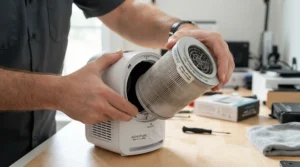
Maintenance checklist: inspect filters monthly, replace when odor returns, sun-dry charcoal bags, wipe the intake grille and avoid running the unit in extreme heat when parked. Heat can shorten the life of electronics and release adsorbed odors from carbon.
FAQ
❓ Does a portable car air purifier remove cigarette smoke smell?
❓ Can a cup holder unit really fit most cars?
❓ Are charcoal bags enough for pet smell?
❓ How often should I replace a car air purifier filter?
❓ Is it safe to leave a purifier running when the car is parked?
Conclusion
Picking a portable car air purifier for odor comes down to one question: what’s actually causing the smell? If it’s a faint musty note, Basic Concepts Bamboo Charcoal Bags may be all you need. If you want a fan-driven cup holder unit that starts with the engine, the Scosche FrescheAIR 2 or Pure Enrichment PureZone Mini are sensible steps up. The Philips GoPure GP5212 suits smoke and fumes, the Westinghouse WH10P travels between spaces, and the IQAir Atem Car is the heavyweight for serious odors.
Whatever you choose, remember three rules: prioritize activated carbon over gimmicks, steer clear of ozone-producing devices, and clean the source of the smell first. A purifier is a maintenance tool, not a miracle, but a good one makes every drive noticeably more pleasant.
✨ Ready for a fresher ride?
🚗 Compare the picks above, check current pricing and availability, and choose the portable car air purifier for odor that fits your car, your budget and your nose. Your next commute can smell like nothing at all, which is the highest compliment a car can earn!
Recommended for You
- Car Air Purifier For Allergies: 7 Smart, Safe Picks (2026)
- Car Air Purifier For Pet Odor: 7 Best Picks Ranked (2026)
- Car Air Purifier For Smokers: 7 Best Picks That Work (2026)
Disclaimer: This article contains affiliate links. As an Amazon Associate, I earn from qualifying purchases. If you purchase products through these links, we may earn a small commission at no additional cost to you.
✨ Found this helpful? Share it with your friends! 💬🤗
