
In This Article
You can open every window, crank the fan, and chain-vent each cigarette out of a cracked sunroof. The car still smells like an ashtray the moment you shut the door. That’s not your imagination, and it’s not a lack of effort. A small cabin turns smoke into a concentrated soup, and the soup moves into the seats, the headliner, and the dashboard plastic. Then it seeps back out for weeks.
That’s why a car air purifier for smokers has become one of the most practical accessories you can buy in 2026. It won’t turn your car into a hospital cleanroom. But paired with a few smart habits, the right unit pulls smoke particles out of the air, adsorbs the gases behind that stale smell, and gives your cabin a fighting chance between cigarettes.
Here’s the honest part. The market is a jungle. Tiny vent-clip gadgets promise “99.9% removal” on a sticker. Some devices are filter-free ionizers that rely on charged particles. A few cheap ones are quietly ozone generators in disguise. Telling them apart takes some spec-reading and a little skepticism.
So this guide does the sorting. It covers seven real models, from budget to premium, and what their specs mean in a real driver’s seat. It also explains how a carbon filter differs from HEPA, why vehicle odor is stubborn, and how to run a plug in car air purifier so it works when you need it. Along the way you’ll see what the research says about smoke in cars, which isn’t pretty but is useful.
One caveat up front: I haven’t personally tested these products. Everything below comes from published specs, manufacturer claims, and aggregated review themes from the sources linked. Where I couldn’t verify something, I say so.
Quick Comparison: Car Air Purifier for Smokers at a Glance
Seven models, one table. Price ranges are approximate and move constantly, so check current pricing before you buy.
| Product | Filtration | Power | Approx. Price Range | Best For |
|---|---|---|---|---|
| IQAir Atem Car | HyperHEPA (0.003 micron rated) | 12V car outlet | Premium tier | IQAir Atem Car: heavy smokers wanting maximum filtration |
| Philips GoPure GP5212 | HEPA + HESA gas-absorbing layer | 12V lighter port | Mid-to-upper range | Philips GoPure GP5212: all-round daily use, auto start |
| LUFTRUM C401A | H13 HEPA + PM2.5 sensor | USB / car adapter | Under $100 | LUFTRUM C401A: data-minded drivers |
| MOOKA M01 | 3-stage H13 HEPA, 360° intake | USB | Under $60 | MOOKA M01: dual-use car and desk |
| AIRFEEL Mini | H13 HEPA + aroma diffuser | USB | Under $60 | AIRFEEL Mini: cup-holder fit, scent lovers |
| NuvoMed Car Purifier | HEPA + activated carbon | 12V plug | Around $30 range | NuvoMed Car Purifier: tight budgets, plug-and-forget |
| Yakry Ionizer | Filter-free ionizer | USB | Under $35 | Yakry Ionizer: low-maintenance background help |
Reading the table, the IQAir Atem Car and Philips GoPure GP5212 are the picks if you want genuine filtration muscle and can stomach the price. The LUFTRUM C401A, MOOKA M01, and AIRFEEL Mini form a sensible middle, each built around H13 HEPA at modest prices. The NuvoMed Car Purifier is the cheapest route to a real carbon filter plus HEPA, while the Yakry Ionizer is a supplementary tool, not a primary one, for reasons we’ll get to.
💬 Just one click — help others make better buying decisions too!😊
Top 7 Car Air Purifier for Smokers: Expert Analysis
1. IQAir Atem Car — medical-grade filtration for heavy smoke
The standout here is the HyperHEPA filter, rated by the manufacturer to capture particles down to 0.003 micron. For context, standard HEPA is specified at 0.3 micron, and cigarette smoke particles are mostly in the ultrafine range. That’s the gap this unit is built to close.
Based on the spec comparison, it’s the only model in this list that targets the particle sizes cigarette smoke actually lives at. It runs from a car power outlet and is designed to sit near the occupant’s breathing zone, which matters more than raw airflow in a small cabin. One roundup reports that owners see dramatic reductions in smoke haze and stale odor that vent-mounted ionizers couldn’t touch. Treat that as one outlet’s aggregation, and read verified purchase reviews yourself.
Pros:
- ✅ Ultrafine particle rating far beyond standard HEPA
- ✅ Credible, premium-brand build and support
- ✅ Targets personal breathing zone, not just the cabin
Cons:
- ❌ Highest price in this lineup
- ❌ Replacement filters add long-term cost
Expect to pay in the premium tier, so check current price. The value verdict: worth it if you smoke daily and drive for hours, overkill for occasional use.
2. Philips GoPure GP5212 — best auto-start convenience
Here’s a purifier that thinks for you. The Philips GoPure GP5212 turns on and off with the engine through the 12V lighter port, so you never have to remember it. That’s a bigger deal than it sounds. The best purifier is the one actually running.
Philips lists a PM2.5 clean air delivery rate of 16 m³/hour and claims it can filter half the air in a standard sedan or SUV in under ten minutes. Those are manufacturer figures, but they’re a useful yardstick. The filter also includes a HESA layer meant to absorb gaseous pollutants such as VOCs, which is the chemistry behind lingering vehicle odor. One automotive review notes it’s a decent size at roughly seven by seven inches and produces audible white noise.
Who’s it for? Commuters who smoke on the road and want a set-and-forget unit. The aggregated complaint to watch is size: it takes real space, so measure your armrest or under-seat area first.
Pros:
- ✅ Starts automatically with the ignition
- ✅ HEPA plus gas-absorbing layer
- ✅ Mounting accessories for flexible placement
Cons:
- ❌ Bulkier than cup-holder models
- ❌ Audible fan noise at higher speeds
Typical pricing sits in the mid-to-upper range; check current price. Value verdict: the best all-rounder if you want brand reliability without going premium.
3. LUFTRUM C401A — live PM2.5 readout for data nerds
The LUFTRUM C401A pairs an H13 HEPA filter with a real-time PM2.5 sensor, and that sensor changes the experience. Rather than guessing whether the air is clean, you watch the number drop after each cigarette. That feedback loop is oddly motivating, and it tells you when it’s time to swap a filter.
One review roundup highlights a roughly six-minute cabin air exchange. Another reviewer flags that some cars’ auxiliary ports don’t shut off with the ignition, which means a purifier left plugged in could keep running. It’s a small thing, but check your vehicle before you commit to a daily-driver setup.
Smart auto-detection ramps the fan with pollution levels, which helps keep noise down when the air is clean. Reviewers describe it as a polished-looking device for tech-oriented smokers.
Pros:
- ✅ Real-time PM2.5 sensor shows actual air quality
- ✅ H13 HEPA filter for fine particles
- ✅ Auto fan adjustment reduces noise
Cons:
- ❌ Verify your port shuts off with ignition
- ❌ Limited independent testing data found
Roughly the under-$100 range; check current price. Value verdict: strong middle-ground pick if the sensor sounds useful to you.
4. MOOKA M01 — dual-use car and desktop purifier
The MOOKA M01 has a clever pitch: it’s a three-stage H13 HEPA unit with 360-degree air intake, and it doesn’t care where it lives. One review source highlights its USB-C power, meaning it works in the car, at home, or in a hotel room.
That flexibility matters if you smoke in more than one place. The listing also mentions a fragrance sponge, which is a mixed blessing. Scent can mask odor in the short term, but masking isn’t removal. Use it sparingly, or not at all, until you’ve dealt with the real source of vehicle odor.
The honest spec-sheet caveat: the “430 sq ft” claim on the listing refers to rooms, not a car. In a cabin of roughly 100 cubic feet or so, it’s a much easier job, so the claim is conservative for your use. I couldn’t verify a large body of independent review data, so lean on verified purchase reviews.
Pros:
- ✅ H13 HEPA with 360-degree intake
- ✅ USB power works in cars and rooms
- ✅ Affordable entry into real HEPA filtration
Cons:
- ❌ Fragrance sponge can mask rather than fix odor
- ❌ Smaller filter area than premium units
Typically under $60; check current price. Value verdict: great for anyone who wants one device for the car and the home office.
5. AIRFEEL Mini — cup-holder fit with aroma diffuser
Shape matters in a car, and the AIRFEEL Mini is designed to slot into a cup holder. That keeps it low, out of the way, and within reach of the driver’s breathing zone. Not every purifier can say that.
It combines a True H13 HEPA filter with an essential oil diffuser. Smokers who like a lightly scented cabin will appreciate it. Just keep the same caution in mind: fragrance on top of smoke residue is a cover-up unless the underlying odor is being captured too. Without a dedicated carbon filter stage listed in the specs I found, treat it as a particle-first device.
The aggregated sentiment I could verify is thin, so I’d rather say so than invent praise. Read recent verified reviews for noise and battery or cable notes before ordering.
Pros:
- ✅ Cup-holder friendly compact design
- ✅ True H13 HEPA for fine smoke particles
- ✅ Built-in diffuser for scent lovers
Cons:
- ❌ No confirmed carbon stage for gaseous odor
- ❌ Small unit means modest airflow
Usually in the under-$60 range; check current price. Value verdict: best for light smokers who like scent and want a tidy cup-holder setup.

6. NuvoMed Car Purifier — cheapest carbon filter plus HEPA
Budget buyers, this one’s for you. The NuvoMed Car Purifier lists a removable HEPA filter plus an activated carbon filter aimed at cigarette smoke, bacteria, and odor. It plugs into a 12V outlet with an adapter included, and it starts automatically when the ignition comes on.
That combination, HEPA for particles and carbon for gases, is exactly the pairing smoke demands, and it’s rare at this price. The retail listing I found sat around the $30 range at a grocery-chain store, so availability may differ by seller. Check the listing you’re buying from.
The trade-off is scale. A budget plug in car air purifier like this won’t match the airflow of the Philips or the filtration depth of the IQAir. Think of it as a daily maintenance tool, not a deep-cleaning machine. I couldn’t verify a robust pool of independent reviews, so treat manufacturer claims like “99% of impurities” as marketing until proven otherwise.
Pros:
- ✅ Carbon plus HEPA at a very low price
- ✅ Starts with the ignition via 12V plug
- ✅ Removable filter for easy replacement
Cons:
- ❌ Modest airflow versus pricier models
- ❌ Limited independent review verification
Around the $30 range; check current price. Value verdict: a solid starter for casual smokers on a tight budget.
7. Yakry Ionizer — filter-free background helper
The Yakry Ionizer is a different animal. It clips onto a vent, runs on USB, and has no filter to replace. One roundup calls it the sweet spot for a maintenance-free entry point, and another calls it a background odor companion best paired with a HEPA unit.
That second framing is the right one. Ionizers charge airborne particles so they clump and drop onto surfaces. They don’t capture them in a filter. For a smoker, that can leave particles settling into the upholstery, which is precisely where thirdhand smoke comes from. CARB also notes that ionizers can emit ozone as a by-product of how they work, so look for a CARB-certified model if you live in California, and use caution elsewhere.
My analysis: buy it as an add-on, not the only defense.
Pros:
- ✅ No filters to buy or replace
- ✅ Silent, vent-clip design
- ✅ Very low upfront cost
Cons:
- ❌ Particles may settle on surfaces
- ❌ Possible ozone by-product with ionizers
Typically under $35; check current price. Value verdict: a cheap supplement, not a substitute for filtration.
How to Choose a Car Air Purifier for Smokers
Choosing well comes down to a handful of decisions. Work through them in order:
- Start with filtration type. A true HEPA filter captures particles; an activated carbon filter handles gases and odor. For cigarette smoke you want both, because smoke is both particles and chemistry.
- Check the HEPA grade. H13 is the target; it’s rated to capture 99.97% of particles at 0.3 micron. Vague claims like “HEPA-type” are a red flag.
- Match power to your habits. USB is convenient, but 12V plugs usually deliver more reliable power. Decide whether you want it running only while driving or also while parked.
- Consider airflow and noise. More airflow clears smoke faster but gets louder. A purifier you switch off because it’s annoying does nothing.
- Verify ozone behavior. Avoid anything marketed as an ozone generator. Prefer mechanical filters, and in California check the CARB certified list.
- Account for filter costs. Filters are the real long-term expense. Price a year of replacements before you buy.
- Check size and placement. Measure your cup holder, armrest, or under-seat area. A purifier that doesn’t fit gets left on the passenger seat.
Based on the spec comparison, a H13 HEPA plus carbon combo should be your minimum standard if you’re serious about cigarette smoke.
Plug In Car Air Purifier: Power, Placement and the Parked-Car Problem
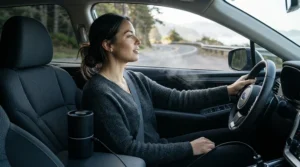
A plug in car air purifier lives or dies by its power source. The 12V lighter socket is the most reliable option, since it delivers steady current and many cars cut it when the ignition goes off. USB works but varies; some ports are underpowered, and some stay live after shutdown, which can drain a battery if you leave a unit running.
Auto-start units like the Philips GoPure GP5212 and the NuvoMed Car Purifier solve the “forgot to switch it on” problem. That alone probably improves real-world results more than a spec bump.
Placement is the second variable. Air near your face matters most, so a cup-holder or armrest location beats the trunk. Avoid blocking vents, and keep cables clear of the gearshift and pedals.
The parked-car problem is real too. A purifier that only runs while driving does nothing while smoke lingers in a sitting car. If you smoke before driving, give the unit a few minutes with the ignition on and the fan running before you shut the door on that smell for the night. For smokers, a quick note: if you want true parked-car operation you’ll need a battery-powered unit or a vent-clip device like the Yakry Ionizer drawing from a USB power bank.
Car Air Purifier for Odor Removal: What Actually Kills the Smell
Here’s the uncomfortable truth about a car air purifier for odor removal: smell is chemistry, not dust. HEPA filters trap particles but struggle with volatile organic compounds, the gases that make smoke smell like smoke. A particle-only filter can leave your cabin visibly clear and still stinking.
That’s where adsorption comes in. Activated carbon has a huge internal surface area that grabs odor molecules and holds them. The Philips GoPure GP5212 uses a gas-absorbing HESA layer for the same purpose, and the NuvoMed Car Purifier lists a carbon stage. Models without a carbon element, like the AIRFEEL Mini, lean on HEPA plus scent.
Don’t fall for masking. Air fresheners overlay perfume on top of the smell, which, as one guide points out, can only hide odors temporarily if they lack real odor-neutralizing agents like activated carbon or enzymes. Masking also gives smoke residue time to deepen.
If you want real odor control, combine a carbon-equipped purifier with deep cleaning of fabric surfaces. The purifier handles the air; the cleaning handles the reservoir.
Cigarette Smoke in Your Car: What You’re Actually Fighting
Let’s get specific about cigarette smoke in a vehicle, because the numbers explain why this is so stubborn. According to a Connecticut Department of Public Health fact sheet on tobacco smoke in cars, secondhand smoke concentrations in a vehicle can exceed those in a smoker’s home, even with the windows open and the fan on high.
Then there’s thirdhand smoke: the residue that settles into upholstery and re-releases into the air long after the cigarette is out. A 2023 peer-reviewed study in Environmental Research, published here, measured airborne nicotine in private cars. Cars where the driver smoked inside showed much higher median levels than non-smokers’ cars, and settled-dust contamination was up to six times higher.
That tells you two things. First, filtering the air matters because the air is where exposure happens. Second, no purifier removes the reservoir in the seats. The CT health guidance is blunt: washing and vacuuming reduces thirdhand smoke but won’t eliminate it.
My honest take: a purifier is a harm-reduction tool, not a license. The healthiest option is not smoking in the car, and if you’re thinking about quitting, that’s worth a conversation with your doctor.
Carbon Filter vs HEPA vs Ionizer: What Each One Really Does
Three technologies dominate this market, and they do different jobs. A carbon filter adsorbs gas and odor. A HEPA filter mechanically traps particles. An ionizer charges particles so they clump and fall.
| Technology | Targets | Strength | Weakness | Best For |
|---|---|---|---|---|
| Activated carbon filter | Odors, VOCs | Reduces stale smell | Saturates over time | Vehicle odor control |
| H13 HEPA | Fine particles, ash, tar droplets | Physical capture | Misses most gases | Visible haze, particles |
| Ionizer | Airborne particles | No filter costs | Settles particles, possible ozone | Light background help |
The table makes the case for combos. HEPA handles what you can see, carbon handles what you can smell, and the ionizer is optional. The NuvoMed Car Purifier and Philips GoPure GP5212 are the budget-to-mid options that combine more than one approach, whereas the Yakry Ionizer relies on ionization alone.
If you only remember one thing from this section: a carbon filter is the component most likely to be missing from cheap units. Check the spec sheet before you assume it’s there, and note that thin carbon layers can saturate quickly. Plan to replace filters on the manufacturer’s schedule.
✨ Don’t Miss These Exclusive Deals!
🔍 Ready to take your smoke control to the next level? Click on any highlighted product above to check current pricing and availability. A carbon-plus-HEPA purifier is the fastest way to breathe cleaner air on every drive!
Safety Guide: Ozone, Ionizers, and What to Avoid
Not every “air purifier” is safe to sit next to. The California Air Resources Board recommends against ozone generators in occupied spaces and notes that ozone from these devices does little to remove chemical pollutants. Some products even market ozone as “activated oxygen,” which sounds friendly but isn’t.
In California, indoor air cleaners must emit less than 0.050 parts per million of ozone to be legal. CARB keeps a public list of certified devices, but notes that certification doesn’t evaluate how well a cleaner actually works.
For a car, the logic is simple. A cabin is tiny and you’re breathing inside it. Skip anything that markets itself as an ozone generator, and be cautious about ionizers like the Yakry Ionizer, since ionizers can produce ozone as a by-product. Mechanical HEPA and carbon units are the safer default.
Also check cable heat and fuse limits. A cheap adapter pulling continuous power from a cigarette lighter socket is a poor place to economize.

Price Range and Value Analysis
Here’s how the seven models stack up on cost versus what you get. Prices are approximate ranges and change often.
| Product | Upfront Range | Ongoing Cost | Value Score Logic | Best For |
|---|---|---|---|---|
| IQAir Atem Car | Premium | Higher filter costs | Top filtration, top price | IQAir Atem Car: daily heavy smokers |
| Philips GoPure GP5212 | Mid-to-upper | Moderate filter costs | Balanced performance | Philips GoPure GP5212: commuters |
| LUFTRUM C401A | Under $100 | Moderate | Data plus HEPA | LUFTRUM C401A: tech lovers |
| MOOKA M01 | Under $60 | Low-moderate | Dual-use flexibility | MOOKA M01: car plus home |
| AIRFEEL Mini | Under $60 | Low-moderate | Compact and scented | AIRFEEL Mini: light smokers |
| NuvoMed Car Purifier | Around $30 | Low | Carbon plus HEPA cheaply | NuvoMed Car Purifier: budget buyers |
| Yakry Ionizer | Under $35 | None | No filters, limited scope | Yakry Ionizer: add-on use |
Looking at the cost picture, the NuvoMed Car Purifier and MOOKA M01 deliver the most filtration per dollar, while the IQAir Atem Car justifies its premium only if you smoke heavily and often. The Yakry Ionizer looks cheapest because it has no filters, but that’s precisely why it shouldn’t be your only protection.
Think in terms of cost per month of use. A mid-priced unit running every day for a year costs pennies per drive, far less than a professional detailing for smoke damage.
30-Day Vehicle Odor Reset: A Practical Usage Guide
A purifier alone won’t win the war against vehicle odor. Pair it with a one-month routine that attacks the source.
Week 1: Reset the reservoir.
- Empty ashtrays and wipe down hard surfaces with a mild cleaner.
- Vacuum seats, carpets, and the trunk thoroughly.
- Replace the cabin air filter, since it’s a common odor trap.
Week 2: Install and calibrate.
- Set up your purifier where airflow reaches your breathing zone.
- Run it on high for the first ten minutes of each drive, then drop to a quiet setting.
- If you chose the LUFTRUM C401A, watch the PM2.5 number to learn how fast your cabin recovers.
Week 3: Deep clean fabrics.
- Use a fabric-safe cleaner on upholstery and the headliner, working gently.
- Let the car air out with doors open in a safe, ventilated spot.
Week 4: Build habits.
- Crack windows for fresh air during and after smoking. Ventilation reduces odor-causing particles on surfaces.
- Check the filter condition and mark your replacement date.
Common first-month mistakes include forgetting the cabin filter, over-relying on air fresheners, and leaving a carbon filter in service past its useful life. Honest expectation: you’ll notice improvement, but fully erasing years of residue can take longer, and heavy cases may need professional detailing.
Real-World Scenarios: Three Smokers, Three Picks
Abstract advice only goes so far, so here are three profiles with matching recommendations. These are illustrative scenarios, not case studies of real people.
The long-haul commuter. Imagine someone driving 90 minutes each way, smoking several cigarettes per trip, with a mid-sized sedan. They need airflow, quiet operation, and automatic start. The Philips GoPure GP5212 fits: it starts with the ignition, tackles gas through its HESA layer, and has the CADR figure to keep up. A budget of mid-range makes sense because it runs for hours daily.
The rideshare driver. Here the car is a workplace, and passengers notice smell. The priority is the cleanest possible air at a professional standard. The IQAir Atem Car is the logical splurge: its ultrafine filtration and premium reputation make sense when your car is your income. Add a regular cleaning routine.
The weekend smoker on a budget. Light use, tight cash, no appetite for complexity. The NuvoMed Car Purifier delivers carbon plus HEPA at around the $30 range and runs automatically. Pair it with window ventilation and a monthly vacuum, and it covers the basics.
The pattern: match the machine to your hours, your budget, and how much smell matters to someone other than you.
Problem → Solution: Fixing Common Smoker’s Car Complaints
Problem: the smell returns within hours. Likely cause: residue in fabrics and the headliner re-releasing odor. Solution: clean upholstery, replace the cabin filter, and use a purifier with a real carbon stage like the NuvoMed Car Purifier.
Problem: the purifier seems to do nothing. Likely cause: wrong placement or the wrong technology. Solution: move it nearer your breathing zone, and confirm it contains H13 HEPA rather than only ionization. Particle-clumping ionizers like the Yakry Ionizer don’t capture smoke the way a filter does.
Problem: the unit is too loud. Solution: drop to a lower fan speed after the first few minutes. Smart units such as the LUFTRUM C401A adjust automatically.
Problem: the battery drains. Solution: confirm that your outlet shuts off with the ignition. Some auxiliary ports stay live, as one reviewer of the LUFTRUM noted.
Problem: the scent is overpowering. Solution: pull the fragrance sponge from the MOOKA M01 or skip the diffuser on the AIRFEEL Mini, and let the filter do the work.
FAQ
❓ What is the best car air purifier for smokers?
❓ Does a car air purifier remove cigarette smell?
❓ Can I run a plug in car air purifier overnight?
❓ Are ionizer car purifiers safe for smokers?
❓ How often should I replace the filter?
Conclusion
Smoking in a car creates a perfect storm: tiny space, heavy particles, and chemistry that sticks to everything. A car air purifier for smokers can’t erase that, but it can meaningfully reduce what you breathe and what your passengers notice.
If you want the strongest filtration and don’t mind the price, the IQAir Atem Car is the premium pick. For everyday convenience with real gas-absorbing tech, the Philips GoPure GP5212 is the best all-rounder. Value hunters should look at the LUFTRUM C401A, MOOKA M01, and AIRFEEL Mini, while the NuvoMed Car Purifier is the cheapest way to get carbon and HEPA together. Treat the Yakry Ionizer as a helper, never the whole plan.
Remember the three rules: pair HEPA with a carbon filter, clean the fabrics that hold thirdhand smoke, and avoid ozone-generating gimmicks. Do those, and your car will smell better and your lungs will thank you.
✨ Ready to clear the air?
Click through the products above to check current pricing and availability, and pick the purifier that fits your drive!
Recommended for You
- Air Purifier For Apartment With Pets: 7 Best Picks (2026)
- Air Purifier For Studio Apartment: 7 Best Picks To Buy In 2026
- Air Purifier For Small Apartment: 7 Best Picks For 2026
Disclaimer: This article contains affiliate links. As an Amazon Associate, I earn from qualifying purchases. If you purchase products through these links, we may earn a small commission at no additional cost to you.
✨ Found this helpful? Share it with your friends! 💬🤗
