
In This Article
Your dog is a delight. Your dog after a rainy trailhead and a swim in a questionable pond? That’s a different animal entirely. Anyone who has opened a car door on a hot afternoon and met a wall of wet fur, drool, and mystery kibble knows the feeling. It’s the moment a car air purifier for pet odor stops sounding like a gadget and starts sounding like a truce.
Here’s the honest framing up front: no little box can rewrite physics. A cabin is a small, sun-baked room, and pet smells are stubborn gases that cling to seat fabric, headliners, and floor mats. What a well-chosen car air purifier for pet odor can do is capture airborne fur and dander, pull a share of odor molecules through carbon filtration, and keep the air from re-saturating between cleanings. That’s useful. It’s just not magic.
This guide runs on manufacturer specs, published reviews, and aggregated buyer sentiment rather than staged testing. You won’t find an invented “I drove 500 miles with a beagle” story here. I compared seven real models, from a plug-in ionizer around $25 to a premium unit in the $400 range. I kept asking one question: what does this spec mean when a retriever has just shaken off in the back seat?
Along the way you’ll get a buying framework, a 30-day setup plan, advice for a family car, ozone safety notes, and a fair look at where purifiers fall short. Prices are ranges from the research period, so check current price before you buy.
Quick Comparison: Best Car Air Purifier for Pet Odor Picks at a Glance
| Product | Filtration | Power | Price Range | Best For |
|---|---|---|---|---|
| IQAir Atem Car | HyperHEPA Plus (particle + gas-phase media) | USB-C | In the $400 range | Heavy, daily pet odor |
| Philips GoPure GP5211 | SelectFilter Plus, particle sensor | Starts with ignition | Check current price | Hands-off commuters |
| PureZone Mini | Carbon pre-filter + H13 True HEPA | Rechargeable via USB | $35–$50 range | Small cabins, tight budgets |
| LUFTRUM | 4-stage, H13 True HEPA, PM2.5 sensor | Auto on/off | Check current price | Sensor-driven convenience |
| KOIOS H13 | Pre-filter + H13 HEPA + carbon | Verify on listing | Check current price | Car-and-office sharing |
| MOOKA M01 | 3-stage H13 HEPA, fragrance sponge | USB | Under $100 | Budget USB car air purifier |
| Twinkle Birds | Ionizer, no filter | Plug-in | Around $25 | Light freshening only |
Looking at the table, IQAir Atem Car is the only unit here that pairs particle and gas-phase media in one purpose-built cartridge, which explains the premium. PureZone Mini is the value anchor: a carbon pre-filter plus H13 True HEPA at a price that barely registers. Budget buyers should note that Twinkle Birds has no filter at all, so it freshens the air rather than capturing anything.
💬 Just one click — help others make better buying decisions too!😊
What Is a Car Air Purifier for Pet Odor?
A car air purifier for pet odor is a compact in-cabin device that pulls air through layered filters, typically a pre-filter, activated carbon, and a HEPA-grade layer, to trap pet hair, dander, and odor-causing gases. It runs on USB, a 12V socket, or a battery, and it cleans the air around you rather than the upholstery itself.
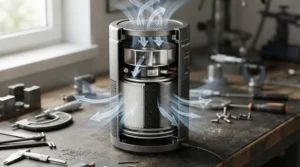
The carbon layer does the heavy lifting on smell. Activated carbon is processed to develop tiny pores that massively increase surface area, and gas molecules stick to that surface in a process called adsorption. HEPA media, meanwhile, handles the particles: fur, dander, pollen, dust.
That split matters because pet odor is a two-part problem. Part of it is airborne particulate riding on your dog’s coat. The other part is volatile compounds off-gassing from damp fur, saliva, and whatever your pet rolled in. A unit with only a HEPA filter is half an answer.
Still, there’s a ceiling. A purifier treats air, not surfaces, so any vehicle interior odor baked into seat foam will keep releasing smell. Think of the device as a bouncer, not a cleaning crew: it controls what’s floating around, but the mess on the floor is your job.
Top 7 Car Air Purifier for Pet Odor Picks: Expert Analysis
The seven models below span budget, mid-range, and premium tiers. Each analysis leans on published specs and genuine reviewer sentiment, and where independent review data is thin, I say so instead of papering over it.
1. IQAir Atem Car — best gas-phase filtration for stubborn smells
The standout is a single cartridge that combines particle filtration with gas-phase media, a rare setup in a car-sized device. IQAir states the HyperHEPA Plus filter captures at least 99% of particles down to 0.003 microns, and lists gas-phase action against VOCs, formaldehyde, benzene, and nitrogen dioxide. For pet owners, that gas-phase layer is the point. A smelly cabin is mostly molecules, not just fur.
The cartridge is rated for roughly a year at about three hours of daily use, so long-haul drivers should expect earlier swaps. Touch controls and Bluetooth are nice extras. The trade-off is size: reviewers note it’s bulkier and less pocketable than most rivals.
Based on the spec comparison, this suits multi-dog households, big shedders, and anyone hauling a cat carrier that has seen things. It’s overkill for the occasional groomer run.
Reviewers consistently praise its build and filtration depth. The recurring complaint is the price of replacement filters. The Drive names it best for odors, and Automoblog’s review team scored it 4.9 out of 5.
Pros:
- ✅ Particle and gas-phase media in one cartridge
- ✅ Filter rated for about a year of use
- ✅ Several mounting options in the cabin
Cons:
- ❌ Premium upfront cost
- ❌ Replacement filters add up over time
Pricing sits in the $400 range, and one reviewer estimated roughly $100 a year in electricity and filters. Verdict: worth it only if odor is a daily fight.
2. Philips GoPure GP5211 — smartest hands-off automation
Set it and forget it is the hook. The GP5211 has an infrared particle sensor, a three-color air quality indicator, automatic fan adjustment, and it switches on with your engine. Philips rates the filter at 350 hours and adds a replacement indicator.
Those 350 hours are a useful planning number. At two hours of driving a day, you’re swapping in under six months, so do the math for your commute. Philips also advertises its SelectFilter Plus technology for gases and says the filter is independently certified for reducing airborne allergens.
Here’s what the spec sheet won’t tell you: a particle sensor can’t “smell.” The light may glow reassuringly blue while a wet-dog aroma lingers, because sensors of this type track particulates, not odor gases. Treat the indicator as a dander-and-dust meter.
Independent review depth for this exact model is thinner than for the IQAir. A roundup at The Drive noted that Philips’s GoPure car unit is a roughly 7-by-7-inch device that takes up visible space, which suits an under-seat or headrest install better than a cup holder.
Pros:
- ✅ Turns on automatically with ignition
- ✅ Live air quality indicator
- ✅ Filter replacement reminder
Cons:
- ❌ Particle sensor doesn’t flag odor gases
- ❌ Larger footprint; filter supply varies by market
I couldn’t pin down a stable U.S. price range, so check current price. Verdict: smart for commuters who want zero fiddling.
3. PureZone Mini — best value carbon-plus-HEPA starter
The charm is simplicity. This is a two-stage unit: an activated carbon pre-filter feeds an H13 True HEPA layer, all in a body that weighs about 0.58 pounds and measures roughly 8.5 by 3.3 by 2.7 inches. A rechargeable battery gives up to 12 hours, and it draws just 5V and 8W.
Pure Enrichment says it cleans 6 square feet of air in 12 minutes, and a retailer listing shows a CADR of 4. That’s modest. A car cabin is small, so a close-range personal purifier works better than you’d expect. Still, a hands-on review site noted the carbon portion is a small bed, so it can saturate sooner under heavy pet odor. Replace the filter about every six months.
Based on those specs, it’s ideal for solo commuters, a back-seat crate, or a daily dog-park run. It’s not built for a minivan full of shedders.
On a major retailer, it carried roughly 4.7 stars across 500-plus ratings at research time. Buyers like using it cordlessly in the car, and one noted that frequent charging is easy with a USB port.
Pros:
- ✅ Cordless with up to 12 hours of battery
- ✅ Carbon pre-filter plus H13 True HEPA
- ✅ Five-year warranty
Cons:
- ❌ Low airflow for large cabins
- ❌ Small carbon bed saturates faster
Expect a $35–$50 range. Verdict: the smartest first purchase.
4. LUFTRUM — most sensor-driven convenience under the radar
Its pitch is a four-stage H13 True HEPA design with a PM2.5 sensor that powers the unit on and off automatically. The auto behavior solves a real-life problem: purifiers are only useful if they’re actually running, and most of us forget.
A word of caution on the “four-stage” label. Marketing stage counts say little about what’s inside, so confirm that one stage is genuine activated carbon and ask how much. Without a solid carbon layer, a unit is a dander catcher, not an odor fighter.
Based on the listing specs, it fits drivers who want automation without a Philips-sized footprint. Independent testing for this model is limited in my research, so lean on the return policy, not just the spec sheet.
Pros:
- ✅ Auto power on and off
- ✅ PM2.5 sensor feedback
- ✅ Multi-stage H13 True HEPA design
Cons:
- ❌ Little independent testing available
- ❌ Carbon amount unverified
Think budget-to-mid, so check current price. Verdict: promising, but verify the carbon before you commit.
5. KOIOS H13 — best for sharing between car and office
The hook is a clear three-stage layout: a pre-filter, an H13 True HEPA filter, and an activated carbon stage, plus a carry handle. That handle is more than a convenience. A purifier that moves from your desk to your car gets used year-round.
The explicit carbon layer is what earns it a spot on a pet-odor list. Roundups describe it as quiet, but “quiet” claims in this category vary wildly, and fans on high speed are rarely whisper-soft.
Based on the spec comparison, it suits commuters with a dog at home who also want clean desk air. Its larger body works better on a console, seat, or floor than a cup holder.
Aggregated buyer sentiment for this specific model was thin at research time, so I’d rather say that than invent a verdict.
Pros:
- ✅ Dedicated activated carbon stage
- ✅ H13 True HEPA filtration
- ✅ Handle for moving between car and office
Cons:
- ❌ Too bulky for a cup holder
- ❌ Noise claims unverified
Pricing sits in the mid-range, so check current price. Verdict: a sensible dual-use buy.
6. MOOKA M01 — friendliest budget USB car air purifier
The standout is its low barrier to entry. It’s a three-stage H13 HEPA unit with 360° air intake, USB power, and a fragrance sponge. As a USB car air purifier, it slots into almost any cabin.
That fragrance sponge deserves some skepticism. Perfume can cover pet smell, but it doesn’t remove it, and some drivers dislike the added scent. If you pick this model, consider skipping the sponge and letting the filters do the work.
Roundups of compact HEPA units in this class often flag fan noise on the top setting, so test the lowest speed first. It fits a single commuter or a small hatchback best, rather than a big SUV with a shedding Husky.
Retail-level feedback exists, but I couldn’t verify a deep independent review base for this exact model. Treat claims as manufacturer-stated.
Pros:
- ✅ USB power works in nearly any car
- ✅ H13 HEPA filtration
- ✅ Very low entry cost
Cons:
- ❌ Fragrance sponge masks more than it removes
- ❌ Carbon layer needs verifying
Expect a budget tier under $100. Verdict: fine for light duty, not for a strong smell.
7. Twinkle Birds — lowest cost, but no filter at all
The draw is zero maintenance. Instead of filters, this plug-in unit is an ionizer, so there’s nothing to replace. Automoblog rated it around 4.5 and priced it near $25, naming it best plug-in.
Here’s the catch, and it’s a big one for this topic: no filter means no carbon filtration and no HEPA capture of dander. Ionizers work by charging particles so they settle onto surfaces, which can leave fur and dander on your seats instead of in a filter. Some ionizing devices can also generate ozone, a lung irritant. I cover that in the safety section below.
Based on the design, it suits someone who wants light freshening between trips, not someone fighting real pet odor. For that job, it’s the weakest option here.
Pros:
- ✅ No filters to buy or swap
- ✅ Very low upfront cost
- ✅ Simple plug-in operation
Cons:
- ❌ No carbon filtration for odor gases
- ❌ Doesn’t capture dander the way HEPA does
Around $25. Verdict: skip it for serious pet odor.
| Product | Carbon Stage | Stated Filter Life | Rating Signal | Best For |
|---|---|---|---|---|
| IQAir Atem Car | Gas-phase media in HyperHEPA Plus | About 1 year at 3 h/day | 4.9 from one editorial review | Heavy daily odor |
| Philips GoPure GP5211 | SelectFilter Plus (detail limited) | 350 hours | Not independently verified | Set-and-forget commuters |
| PureZone Mini | Activated carbon pre-filter | About 6 months | About 4.7 on a retailer listing | Small cabins, budgets |
| LUFTRUM | Verify on listing | Check manual | Not independently verified | Sensor fans |
| KOIOS H13 | Activated carbon stage listed | Check manual | Not independently verified | Car-and-office use |
| MOOKA M01 | Verify on listing | Check manual | Not independently verified | Tight budgets |
| Twinkle Birds | None (ionizer) | No filter | About 4.5 from one editorial review | Light freshening |
Notice how thin the independent evidence gets below the top three. IQAir Atem Car, PureZone Mini, and Philips GoPure GP5211 have the clearest specs and the most published scrutiny, while LUFTRUM, KOIOS H13, and MOOKA M01 lean on listing claims. If you buy one of those, confirm the carbon layer and keep the receipt.
How to Choose a Car Air Purifier for Pet Odor
The best car air purifier for pet odor pairs a real activated carbon layer with an H13 True HEPA filter, enough airflow for your cabin, and a power source that suits your car. Follow these seven steps.
- Insist on a real carbon layer. Odor is gas, and only adsorbent media like carbon addresses it. Ask how much carbon is inside, not just whether the word appears.
- Pair it with H13 True HEPA. Pet dander and fur are particles, and a good HEPA layer is what traps them.
- Match airflow to your cabin. A compact sedan can live with a personal unit, while an SUV with a crate in back deserves more air movement.
- Pick your power source. A USB car air purifier is the easiest to run, and a rechargeable battery adds placement freedom.
- Check the noise. Road noise hides a lot, but you’ll hear a loud fan at a red light.
- Price the filters, not just the unit. Cheap devices with costly or hard-to-find cartridges become expensive fast.
- Avoid ozone. Skip any device that advertises ozone or “shock” treatment for occupied cars.
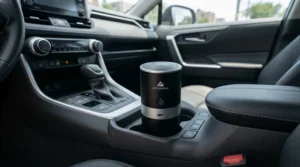
Carbon Filtration Explained: What It Really Does for Pet Smells
Carbon filtration works by adsorption, which means gas molecules stick to the surface of the carbon rather than being absorbed into it. A commonly cited surface area for activated carbon is 500 to 1,500 square meters per gram, which is why a small bed can hold a surprising amount of odor.
However, capacity is finite. Once the surface is covered, the filter stops capturing, and the smell comes back. That’s why a tiny carbon pad in a budget unit can feel brilliant for a month and then fade.
Conditions matter too. Adsorption generally performs better at lower temperature and lower humidity, and a parked car in summer is the opposite of that. Wet dogs add humidity on top.
A study indexed in EPA’s HERO database tested a coconut-shell activated carbon filter and found VOC-family removal efficiencies roughly between 51% and 78% with indoor air. It also found that some aldehydes were released from the filter at low concentrations. That was a lab chamber, not a car, but it’s a healthy reminder that carbon filtration helps rather than eliminates, and that spent carbon should be replaced.
The takeaway for your shopping: favor units with a meaningful carbon bed, replace cartridges on schedule, and combine carbon filtration with source cleanup.
USB Car Air Purifier: Power, Placement, and Real-World Limits
A USB car air purifier is the easiest category to live with. Units like PureZone Mini draw only about 8W at 5V, so a standard port handles them without drama, and rechargeable models skip the cable entirely.
Placement is where most people go wrong. Aim the intake and outlet toward where the pet sits, such as the rear footwell, a console, or a seat-back mount near the crate. A USB car air purifier tucked behind a seat does little for the cabin air you actually breathe.
Cable management matters. Keep cords clear of pedals, seat rails, and shifters, and use a quality adapter rather than a gas-station mystery plug.
One more limit is worth knowing. USB power is low, so airflow is low. That’s fine for a personal bubble, but it’s why larger cabins call for the bigger fans in models like KOIOS H13 or Philips GoPure GP5211. Finally, check whether your car’s ports stay live after the engine is off; a purifier running with the car parked can drain things you don’t want drained.
Car Air Purifier for Family Car: Kids, Car Seats, and Road Trips
A car air purifier for family car use has different priorities than a solo commuter’s setup. Kids spill milk, dogs shed on them, and everyone shares the same air for hours.
Start with placement and safety. Mount the unit where small hands can’t reach cords, filters, or buttons, and never leave loose filters or batteries in the cabin. A device that sits in a cup holder may be fine for a driver, but a toddler’s reach is longer than you’d think.
Noise counts more with a car air purifier for family car trips than anywhere else. A fan that drones can wake a napping child or wear on everyone’s nerves by hour three, so test the lowest speed. A quieter option like KOIOS H13 (as roundups describe it) or an automatic unit like Philips GoPure GP5211 that eases off when the air is clear can be easier to live with.
Pets and kids combine into the real challenge: dog smell plus snack residue plus a leaky sippy cup. In that case, choose a model with a genuine carbon bed, and plan for a bigger buffer of filter life. For a car air purifier for family car use, I’d lean toward IQAir Atem Car if you can afford it, or PureZone Mini if you can’t.
Vehicle Interior Odor: Where Pet Smells Actually Hide
Fighting vehicle interior odor means finding the source before buying anything. Here are four common problems and the solutions that actually fit them.
Problem 1: Wet-dog smell. Damp fur sheds moisture and odor into seat fabric. Solution: towel the dog before loading, crack a window while the cabin dries, and run a purifier like PureZone Mini on high until it clears.
Problem 2: Accidents. Urine and vomit soak into foam where air purifiers can’t reach. Solution: clean with an enzyme cleaner made for pet messes, then use carbon filtration to handle the leftovers.
Problem 3: Fur-packed vents. Dander in the HVAC path keeps recirculating smell. Solution: vacuum the vents, and consider replacing a clogged cabin air filter with a carbon version.
Problem 4: Hot-car baking. Sun releases trapped odors from fabric and plastic. Solution: shade, a windshield cover, and a purifier that starts automatically, like Philips GoPure GP5211.
The pattern is the same everywhere. A vehicle interior odor is a source problem first and an air problem second. Clean the source, then let a purifier hold the line.
Your First 30 Days: Practical Usage Guide
A good setup in the first month decides whether your purchase works. Here’s a simple schedule.
Day 1. Charge or plug in the unit, remove all packaging from the filter, and mount it facing the seat or crate. Run it on high for the first 15 minutes of each drive.
Week 1. Note when smell peaks. Right after a muddy walk? On hot afternoons? That tells you when to run the purifier on high and when to open windows.
Week 2. Wipe the pre-filter or intake grille. Pet hair collects fast, and a clogged intake cuts airflow.
Day 30. Check the filter. If the carbon layer looks grey or you notice odor returning faster, you’re ahead of schedule on replacement. Log the date so you aren’t guessing later.
Common mistakes in the first month are predictable. People block the intake with a seat pocket, keep the unit on low forever, or skip cleaning and expect the filter to do everything. Fix those three and most budget units perform better than their reviews suggest.
Real-World Scenarios: Which Pick Fits Your Car?
Here are three buyer profiles, each with a budget, an environment, and a frequency of use.
The college student with a lab and a compact car. She commutes about 8 miles daily with one medium dog on weekends, and has little to spend. A PureZone Mini fits her cup holder, charges over USB, and covers the weekend smell for roughly the price of a nice dinner. A MOOKA M01 is a fair alternative, as long as she confirms the carbon layer.
The suburban family with two kids and a golden retriever. They drive an SUV most days and fill it with snacks and shedding. They need a car air purifier for family car trips that’s quiet and keeps filters out of reach. Philips GoPure GP5211 adds automation, while KOIOS H13 adds an explicit carbon stage and a handle for moving between car and house.
The rideshare driver with a rescue and a lot of hours. He spends 40 hours a week in the car, and his passengers notice smell. Here, running costs matter, so IQAir Atem Car with its long filter life and gas-phase media earns its price, since each hour of use spreads the cost.
Car Air Purifier vs Traditional Alternatives
| Option | How It Works | Biggest Strength | Biggest Drawback | Best For |
|---|---|---|---|---|
| Car air purifier | Filters particles and gases | Treats the air continuously | Doesn’t clean surfaces | Ongoing pet odor |
| Hanging air freshener | Adds fragrance | Cheap, instant | Masks rather than removes | Light scent only |
| Charcoal bags | Passive adsorption | No power needed | Slow, limited reach | Parked-car upkeep |
| Enzyme cleaner | Breaks down organic residue | Fixes the source | Needs the stain found | Accidents, urine |
| Ozone generator | Produces ozone gas | Strong chemical reaction | Health risk; EPA cautions | Not recommended |
Looking at the table, a purifier and a cleaning product solve different halves of the problem. Enzymes fix the source; the purifier manages what’s floating around afterward. Charcoal bags are a decent passive helper, but they work slowly, and they can’t match a fan pulling air through carbon filtration.
My rule of thumb: use an enzyme cleaner on any mess, a purifier for daily air, and charcoal bags as a parked-car backup. Ozone belongs nowhere on this list.
Features That Actually Matter (And Those That Don’t)
Marketing for this category is loud, so let’s filter it.
What matters:
- A real, substantial carbon layer for odor gases
- Sealed H13 True HEPA so air doesn’t bypass the filter
- Enough airflow for your cabin size
- Filters you can actually buy later
- Noise you can tolerate
What doesn’t:
- Fragrance sponges, which scent the air instead of cleaning it
- Fancy LEDs and “mood” lighting
- Huge “99.9% down to 0.1 microns” numbers with no test standard attached
- Ionizer boasts
That last point deserves care. The EPA’s page on ozone generators sold as air cleaners says these devices intentionally produce ozone, that ozone can damage the lungs, and that at levels that stay within health standards it is generally ineffective at controlling indoor pollution. The page also notes that EPA does not certify air cleaning devices, so a “certified” claim deserves a second look.
In short, pay for carbon, HEPA, and airflow. Ignore the glitter.
Safety, Ozone, and Regulations Guide
Safety comes down to ozone and electrical basics. Ozone is a lung irritant, and pets and children are in the cabin with you, so avoid any device that produces it on purpose, and be cautious with ionizers that don’t publish ozone data.
California offers a useful benchmark. Since 2010, portable indoor air cleaners sold there must be certified by the state air board, and electronic ones must meet an ozone limit of 0.050 parts per million. The board’s list of CARB-certified air cleaning devices labels purely filter-based units as “Mechanical,” meaning they don’t generate ozone or ions.
A caveat: the regulation targets indoor air cleaners, and automotive plug-in units sit in a murkier space. So treat the list as a yardstick rather than a guarantee, and ask a brand directly about ozone testing if it uses ionization.
Practical habits help too. Never run an “ozone shock” treatment with people or animals inside, keep cords tidy, and stop using any unit that overheats or smells hot. A filter-only design, like those in PureZone Mini or IQAir Atem Car, sidesteps most of these concerns.
Long-Term Cost and Maintenance
The sticker price is only the first installment. The real cost of a car air purifier for pet odor is the unit plus filters plus electricity over a few years.
Start with the filter schedule. PureZone Mini asks for a new filter about every six months, IQAir Atem Car about once a year at roughly three hours of daily use, and Philips GoPure GP5211 every 350 hours. One reviewer estimated the IQAir’s electricity and filter costs at about $100 a year.
Here’s a simple formula: (unit price + filter cost × years) ÷ months of use. Run it for each candidate. A cheap unit with frequent filter swaps can cost more per month than a pricey one with a long-life cartridge.
Skipping replacement is the false economy. A saturated carbon bed stops adsorbing, and you’re left running a fan that does little. Set a phone reminder, log the install date, and don’t stretch cartridges past their stated life. Twinkle Birds avoids the schedule entirely, but only because it doesn’t filter.
FAQ
❓ Does a car air purifier for pet odor really remove dog smell?
❓ How quickly does a USB car air purifier clear pet smells?
❓ Is a car air purifier for family car use safe around kids?
❓ Do I still need to clean if I use carbon filtration?
❓ How often should I replace the filter in a car air purifier for pet odor?
Conclusion
A car air purifier for pet odor won’t turn a wet-dog cabin into a spa, but the right one makes a real, noticeable difference. The recipe is consistent: a meaningful carbon layer for odor gases, a True HEPA filter for fur and dander, enough airflow for your cabin, and filters you’ll actually replace.
For most people, PureZone Mini is the smart first buy, a low-risk way to get carbon filtration and HEPA together in a USB car air purifier. If odor is a daily fight, IQAir Atem Car is the premium answer, while Philips GoPure GP5211 suits drivers who want automation. Treat Twinkle Birds as a light freshener, and verify the carbon on LUFTRUM, KOIOS H13, and MOOKA M01 before you commit.
Finally, remember the bigger picture. A purifier manages the air; cleaning handles the source. Pair them, schedule your filter swaps, and you’ll spend more time enjoying the dog and less time apologizing for the car.
Recommended for You
- Car Air Purifier For Smokers: 7 Best Picks That Work (2026)
- Air Purifier For Apartment With Pets: 7 Best Picks (2026)
- Air Purifier For Studio Apartment: 7 Best Picks To Buy In 2026
Disclaimer: This article contains affiliate links. As an Amazon Associate, I earn from qualifying purchases. If you purchase products through these links, we may earn a small commission at no additional cost to you.
✨ Found this helpful? Share it with your friends! 💬🤗
