
In This Article
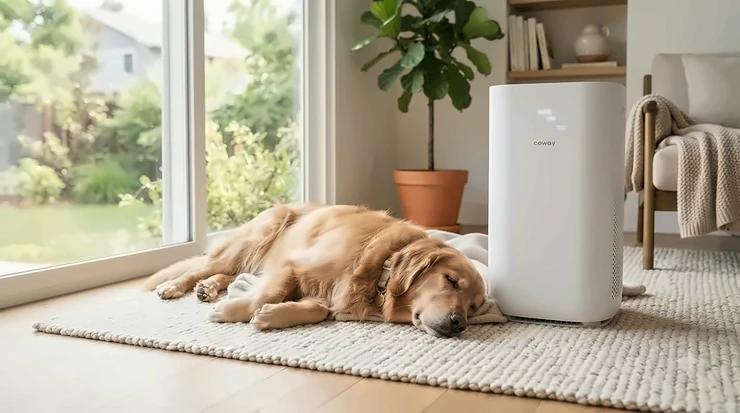
Open floor plans are gorgeous — right up until you watch a dust bunny do laps past the coffee table every time the ceiling fan kicks on. When your living room bleeds into the kitchen and dining nook with zero walls to stop cooking smoke, pet dander, or spring pollen from wandering wherever it pleases, a small bedroom purifier stuffed in the corner simply is not built for the job.
So what actually counts as an air purifier for large living room use? Put simply, it is a portable unit built with enough fan power and a high enough Clean Air Delivery Rate to filter a 400- to 1,500-plus-square-foot space several times an hour, rather than the 150 to 300 square feet a compact bedroom model is designed to handle.
I have spent the past few weeks buried in spec sheets, AHAM Verifide directories, and more customer reviews than I care to admit, comparing seven real, currently available machines built specifically for oversized and open-concept rooms. Some cost less than a nice dinner out; others rival a decent television. What ties them together is that every one of them is engineered to move real, measurable air volume — not just look impressive in a marketing photo.
Americans spend the overwhelming majority of their time indoors, and according to the EPA, indoor pollutant concentrations can run higher than what is floating around outside. That is exactly why sizing this decision correctly matters more in a big, open living room than almost anywhere else in the house. Below, you will find honest, spec-driven analysis of budget, mid-range, and premium options, a plain-English breakdown of what CADR and air changes per hour actually mean for your specific square footage, and real-world scenarios to help you land on the right pick the first time — no returns necessary.
Quick Comparison: Air Purifiers for Large Living Rooms at a Glance
Before we go deep on each unit, here is the birds-eye view. Every model below is a real, currently sold product — no invented specs, no rounding up to make a number look better.
| Product | Best For | Smoke CADR | Room Coverage | Price Range |
|---|---|---|---|---|
| Winix A231 | Living room air purifier under $150 | 147 CFM | 230 sq ft | Under $150 |
| Honeywell HPA300 | Best CADR per dollar | 300 CFM | 465 sq ft | $220–$270 range |
| Shark Air Purifier MAX (HP202) | Air purifier for open concept living room | Not AHAM-published | Up to 1,200 sq ft | $200–$300 range |
| Levoit Core 600S | Smart app control | ~400 CFM | 600–635 sq ft | $280–$350 range |
| Blueair Blue Pure 211+ | Quietest top-speed operation | 350 CFM | 540 sq ft | $280–$330 range |
| Blueair Blue Pure 211i Max | Extra-large open-concept rooms | 435 CFM | Up to 750 sq ft | $400–$450 range |
| Coway Airmega 400 | Maximum square footage coverage | 328 CFM | 1,560 sq ft (at 2 ACH) | $400–$540 range |
A quick reality check on that “Room Coverage” column: manufacturers size these numbers using a single air change per hour, which is a bare minimum, not a target. The Asthma and Allergy Foundation of America’s commonly cited rule of thumb is that your unit’s smoke CADR should equal roughly two-thirds of your room’s square footage for genuinely effective cleaning, and AHAM itself recommends matching CADR to the full square footage during wildfire smoke events. That is why the Coway Airmega 400‘s huge headline number looks so different once you divide it by air changes per hour instead of taking it at face value — more on that math shortly.
Found a favorite already? Bookmark this page and keep scrolling — the full breakdown below explains exactly why each pick earned its spot.
Top 7 Air Purifiers for Large Living Rooms: Expert Analysis
Each of these seven units made the cut because it is a genuine, currently manufactured product with independently verifiable specs — not a private-label mystery box with an inflated square footage claim. I have grouped them from budget to premium so you can see exactly what more money buys you.
1. Winix A231 — true HEPA filtration under $150
The standout here is right in the name: a genuine four-stage True HEPA system for well under $150, which is rare air in this price bracket. The Winix A231 posts an AHAM-verified CADR of 147 CFM for smoke, 149 for dust, and 154 for pollen, with a suggested room size of 230 square feet at 4.8 air changes per hour. In practice, that means it is honestly sized for a smaller living room or a single defined seating zone within a larger open floor plan, not a sprawling 700-square-foot great room. Based on the spec comparison against pricier units on this list, the A231’s PlasmaWave stage is the one feature worth understanding before you buy — it is an ionization technology that some shoppers prefer to avoid entirely, so factor that in if you are ionizer-averse.
Independent lab testing found the A231 pulled PM2.5 down dramatically in rooms under 200 square feet, which lines up with its AHAM rating rather than exceeding it. Reviewers consistently note that odor control is its weaker point; several long-term owners report that its ability to neutralize kitchen and cooking smells fades noticeably faster than its particle-filtering performance.
Pros:
- ✅ Genuine True HEPA filtration at a sub-$150 price point
- ✅ AHAM Verifide certified, so the CADR numbers are independently checked
- ✅ Quiet on its lowest setting, around 40 dB
Cons:
- ❌ Built-in PlasmaWave ionizer cannot be disabled
- ❌ Odor-neutralizing performance reportedly fades over time
At a price that typically lands well under $150, the Winix A231 is the honest budget pick — provided you pair it with a second unit or accept its real 230-square-foot ceiling rather than stretching it across an entire open-concept floor.
2. Honeywell HPA300 — highest CADR per dollar for large rooms
What most buyers overlook about this model is that it trades finesse for raw airflow, and that trade-off is exactly why it keeps landing on “best value” lists year after year. The Honeywell HPA300 carries an AHAM-verified CADR of 300 smoke, 320 dust, and 300 pollen, with a suggested room size of 465 square feet at 4.8 air changes per hour — genuinely competitive numbers against purifiers costing twice as much. There is no app, no smart sensor, and no subtlety to the design; you get three True HEPA filters and a fan that simply moves a lot of air.
Reviewers consistently report the same two things: it is one of the most reliable workhorses in this category, with some owners logging five-plus years of daily use without a performance drop, and it is loud on Turbo mode, hitting speeds in the 60 dB range that will interrupt a quiet evening. Aggregated review data across major retailers puts it around 4.4 stars from tens of thousands of verified purchases, with reliability cited far more often than any single feature.
Pros:
- ✅ Exceptional CADR-to-price ratio for a 465 sq ft rated room
- ✅ Three-filter True HEPA setup with widely available, affordable replacements
- ✅ Reputation for years of dependable daily operation
Cons:
- ❌ Turbo mode noise reportedly reaches uncomfortable levels
- ❌ No app, remote, or smart auto-sensing of any kind
Priced typically in the low-to-mid $200s, the Honeywell HPA300 rewards buyers who want performance over polish in their large living room.
3. Shark Air Purifier MAX (HP202) — auto-sensing for open-concept spaces
If your living room is the kind that flows straight into the kitchen with no wall in sight, this is where the standout feature actually matters: Clean Sense IQ, Shark’s real-time PM1, PM2.5, and PM10 sensor suite, automatically ramps the fan up the moment cooking smoke or a dusty afternoon spikes particle counts. The Shark Air Purifier MAX (HP202) is rated to cover up to 1,200 square feet, and its NanoSeal True HEPA filter is rated to capture 99.98% of particles in the 0.1 to 0.2 micron range.
Here is what the spec sheet won’t tell you: Shark does not publish an independently AHAM-verified CADR figure for this model, which makes it genuinely harder to benchmark against AHAM-certified competitors on this list on an apples-to-apples basis. What reviewers do consistently report is satisfaction with quiet auto-mode operation and noticeable odor reduction, particularly from cooking and pets, according to aggregated feedback across major retail listings.
Pros:
- ✅ Real-time auto-sensing across three particle sizes
- ✅ Rated coverage up to 1,200 square feet for open floor plans
- ✅ Frequently discounted well below list price during retailer sales
Cons:
- ❌ No independently AHAM-verified CADR rating published
- ❌ Harder to directly compare performance against certified competitors
Typically priced in the low-to-mid $200s and often discounted further, the Shark Air Purifier MAX (HP202) is the pick for buyers who prioritize hands-off, sensor-driven convenience across a genuinely open-concept living room.
4. Levoit Core 600S — smart app control for large and open-plan rooms
The Levoit Core 600S is built around one core strength: a genuinely high CADR — independently listed between roughly 391 and 410 CFM for smoke depending on the testing source — paired with a recommended room size in the 600 to 635 square foot range at close to 5 air changes per hour. On paper, this means it comfortably out-cycles smaller “large room” purifiers while still running quietly enough for a shared living space; on its lowest setting it has been independently measured at around 25 to 26 dB, which is genuinely whisper-quiet.
The VeSync smartphone app adds scheduling, remote control, and an auto mode that reads ambient air quality. Reviewers consistently note that the auto-sensor can be inconsistent when it comes to specific particulates like pet dander, so several longtime owners recommend manually selecting a fan speed rather than trusting auto mode blindly. Filter life is rated up to 12 months, which helps offset the higher upfront cost over time.
Pros:
- ✅ Independently verified CADR near the top of this list at this price
- ✅ Whisper-quiet low-speed operation around 25–26 dB
- ✅ App-based scheduling and remote control via VeSync
Cons:
- ❌ Auto-sensor reportedly inconsistent for pet dander and dust
- ❌ Large footprint and nearly 19 lbs, awkward to relocate often
Generally selling in the high $200s to mid $300s, the Levoit Core 600S is the strongest all-around smart pick for a large or open-plan living room on this list.
5. Blueair Blue Pure 211+ — the quietest top speed in its class
Here’s what most spec sheets skip: the Blue Pure 211+ manages one of the quietest maximum-speed profiles of any purifier rated for a room this size, measured independently at around 49 dB on high — genuinely conversation-friendly compared to competitors that scream past 55 dB at full power. It carries an AHAM-verified CADR of roughly 350 for dust, 353 for smoke, and 350 for pollen, with a rated coverage of 540 square feet, and it uses Blueair’s HEPASilent technology, which combines mechanical filtration with a low-level ionization stage.
Based on the spec comparison, that built-in ionizer is the detail to weigh carefully, since it cannot be switched off — something to note if you specifically want to avoid ionizing technology in your living room. Reviewers consistently praise the simple three-speed dial and the washable fabric pre-filter sleeve, which comes in several colors, though several note that the annual carbon-and-particle filter runs noticeably more expensive than some rivals on this list.
Pros:
- ✅ Quietest measured top-speed operation among comparable units
- ✅ Washable, swappable fabric pre-filter in multiple colors
- ✅ AHAM-verified CADR competitive with pricier premium models
Cons:
- ❌ Built-in ionizer stage cannot be disabled
- ❌ Annual filter replacement cost runs on the higher side
Typically priced in the high $200s to low $300s, the Blue Pure 211+ is the pick for anyone who wants a large-room purifier that disappears into the background noise-wise.
6. Blueair Blue Pure 211i Max — best for extra-large open-concept living rooms
For a genuinely sprawling, wall-free living space, the Blue Pure 211i Max is the standout smart option on this list. Independent testing lists its CADR at roughly 435 CFM for smoke, 452 for dust, and 450 for pollen, with the manufacturer rating it to fully cycle a 635-square-foot room in about 12.5 minutes and to clean an extra-large 1,500-plus-square-foot space within half an hour on its highest setting. What most buyers overlook about this model is how quiet its lowest setting is for a unit this powerful — independently measured around 23 dB, which is close to a whisper.
This is the smart, sensor-equipped sibling to the 211+, with real-time particle sensors and app control layered on top of the same core filtration platform. Reviewers consistently report that the auto mode and app scheduling are the main reasons they upgraded from a smaller Blueair model, with the higher price tag being the most frequently cited trade-off.
Pros:
- ✅ Among the highest CADR ratings on this list at 435 CFM smoke
- ✅ Near-silent 23 dB low-speed operation
- ✅ Real-time app-connected sensors and auto mode
Cons:
- ❌ Highest price point of the mid-tier options here
- ❌ Large, boxy footprint that needs dedicated floor space
Generally priced in the $400 to $450 range, the Blue Pure 211i Max earns its keep in a genuinely open-concept living-dining-kitchen layout where pollutants have nowhere to stay contained.
7. Coway Airmega 400 — maximum square footage coverage for extra-large rooms
The Coway Airmega 400 is the heavyweight of this lineup, and its standout feature is coverage: an AHAM-listed room size of up to 1,560 square feet at 2 air changes per hour, backed by a CADR of 328 CFM for both dust and smoke and 400 for pollen. On paper, this means it is one of the only units on this list genuinely engineered for rooms well above 1,000 square feet, using dual side-mounted filter cartridges that combine a washable pre-filter with a True HEPA and activated carbon stage.
Here’s what the spec sheet won’t tell you outright: at just 2 air changes per hour, that 1,560-square-foot rating is a conservative-cycling figure, not the 4-plus air changes per hour you would get from a smaller room-sized purifier — some independent analysis flags that the claimed room size can outpace what the CADR alone would suggest at a faster cycling rate. Reviewers consistently praise its whisper-quiet 22 dB low setting and five-year manufacturer warranty, both standout details at this price tier.
Pros:
- ✅ AHAM-listed coverage up to 1,560 square feet
- ✅ Five-year manufacturer warranty, longer than most competitors
- ✅ Whisper-quiet 22 dB low-speed setting
Cons:
- ❌ Real-world air changes per hour are lower at max rated coverage
- ❌ Heaviest and largest footprint on this list at nearly 25 lbs
Typically priced in the $400 to $540 range, the Coway Airmega 400 is the premium choice for buyers with a genuinely oversized or multi-zone open living space.
Practical Usage Guide: Setting Up Your Large-Room Air Purifier Right
Buying the right unit is half the battle — placement and habits do the rest. Set your new purifier at least a foot or two away from walls and corners so air can circulate freely into and out of the intake, rather than tucking it behind the couch where it will starve for airflow. In an open-concept layout, position it near the zone where pollutants concentrate most, whether that is beside the stove, near a pet’s favorite napping spot, or by the window that gets opened most often.
For the first 30 days, resist the urge to leave it on the lowest setting around the clock just to save on the electric bill; running on auto or medium during the break-in period helps you actually gauge whether your room size matches the unit’s rated coverage. A common mistake is forgetting the pre-filter entirely — vacuum or wipe it down every two to four weeks, since a clogged pre-filter chokes airflow to the main HEPA stage and quietly tanks performance long before the “replace filter” light ever turns on. Mark your calendar for the main filter’s rated lifespan, typically 6 to 12 months depending on the model, rather than waiting for a visible drop in performance to remind you.
Real-World Scenarios: Which Purifier Actually Fits Your Living Room?
Picture a young professional renting a 550-square-foot open-concept studio downtown, where the “living room” and kitchen share the same air with no door between them. Budget matters, but so does not running a fan that sounds like a hair dryer during a video call — this is squarely Blueair Blue Pure 211+ or Levoit Core 600S territory, both rated close to that square footage with genuinely quiet operation.
Now picture a family of four in a 1,400-square-foot great room with two shedding dogs and a wood-burning fireplace they use every winter weekend. That combination of square footage, pet dander, and periodic smoke calls for the Coway Airmega 400‘s extra-large coverage or the Blue Pure 211i Max‘s higher CADR and sensor-driven auto mode. Finally, picture a renter on a tight budget in a modest 300-square-foot living area who just needs reliable, no-frills particle filtration — that is exactly where the Winix A231 or Honeywell HPA300 earns its keep without over-buying capacity you will never actually use.
Problem → Solution: Fixing Common Living Room Air Quality Complaints
Problem: cooking smoke lingers for hours after dinner. Place a higher-CADR unit like the Shark Air Purifier MAX (HP202) or Blue Pure 211i Max closer to the kitchen zone and let its auto-sensor ramp up the moment it detects the spike, rather than running everything on a fixed low speed.
Problem: pet dander triggers sneezing near the couch. A unit with a dedicated activated carbon and HEPA combo, such as the Honeywell HPA300 or Coway Airmega 400, positioned near the pet’s main resting area, tends to outperform units placed purely for aesthetics in a far corner.
Problem: the unit is rated for your square footage but still feels like it is not keeping up. This usually means you are relying on a 1-air-change-per-hour rating rather than the 4-plus air changes per hour that actually clears allergens quickly — size up, or run the unit on a higher speed setting more consistently.
How to Choose an Air Purifier for a Large Living Room
- Measure your actual square footage first. Do not eyeball it — a tape measure or floor plan app prevents both overspending and underbuying.
- Match CADR to your room, not just the coverage label. Aim for a smoke CADR equal to at least two-thirds of your square footage for solid everyday performance.
- Check the air changes per hour behind that coverage number. A rating based on 2 ACH will feel weaker day-to-day than one based on 4.8 ACH, even at the same square footage.
- Decide if you actually need smart features. App control and auto-sensing add convenience and often cost, but a manual three-speed dial works fine for many households.
- Factor in noise at the speed you will actually use daily, not just the quietest whisper-mode number in the marketing copy.
- Look for AHAM Verifide certification wherever possible, since it independently confirms the CADR claims on the box.
- Budget for filters, not just the unit itself — annual filter costs vary widely across this list and meaningfully affect total cost of ownership.
Common Mistakes When Buying an Air Purifier for a Large Living Room
The single most common mistake is trusting a manufacturer’s maximum square footage claim at face value without checking what air-changes-per-hour figure it is based on; a 1,500-square-foot rating at 1 ACH is a very different promise than the same number at 4.8 ACH. A close second is ignoring noise levels at the fan speed you will genuinely use every day rather than the quietest possible setting, which several units reserve for situations where they are barely filtering anything.
Buyers also frequently underestimate ongoing filter costs, picking the cheapest unit up front and then facing pricier or more frequent filter swaps down the line. According to the American Lung Association, the most effective strategy for indoor air is combining source control with proper filtration — buying an oversized purifier is not a substitute for basic habits like venting cooking smoke and reducing clutter that traps dust.
CADR Rating, Air Changes Per Hour, and Square Footage Coverage: The Numbers That Actually Matter
These three terms get thrown around interchangeably in marketing copy, but they mean different things, and understanding the difference is the single best way to avoid buyer’s remorse. The CADR rating measures how many cubic feet of filtered air a unit delivers per minute for smoke, dust, and pollen specifically — higher numbers mean faster, more thorough cleaning, and per AHAM’s own filtration standards, a good rule of thumb is a smoke CADR equal to at least two-thirds of your room’s square footage.
Square footage coverage, meanwhile, is simply that CADR figure translated into a recommended room size — but manufacturers can base that translation on anywhere from 1 to nearly 5 air changes per hour, which is precisely why two purifiers can claim similar coverage numbers while delivering very different day-to-day results. Air changes per hour is the number of times a unit fully cycles the air in its rated room within sixty minutes; 4 to 5 ACH is considered ideal for allergy relief and wildfire smoke response, while 1 to 2 ACH is closer to a baseline minimum. When you compare the Coway Airmega 400‘s 1,560-square-foot rating (at 2 ACH) against the Levoit Core 600S‘s 635-square-foot rating (at closer to 5 ACH), you are really looking at two different philosophies rather than one unit simply being “twice as good.”
Air Purifiers vs Traditional Alternatives
| Approach | Effectiveness for Large Rooms | Ongoing Cost | Best For |
|---|---|---|---|
| Dedicated large-room air purifier (e.g. Coway Airmega 400) | High — targeted CADR and filtration | Filters every 6–12 months | Allergies, pets, open floor plans |
| DIY box fan + furnace filter | Moderate at best, unverified CADR | Low, but filters need frequent swaps | Temporary or budget-constrained use |
| Upgrading HVAC filter alone | Whole-home but lower localized CADR | Ongoing filter replacement cost | Supplementing a purifier, not replacing one |
| No filtration at all | None | None | Not recommended for allergy or smoke-prone homes |
A dedicated large-room purifier consistently outperforms DIY box-fan setups because it is independently CADR-tested rather than relying on informal airflow estimates, and it targets the specific room where you spend the most time rather than diluting its effort across an entire duct system. That said, an upgraded HVAC filter and a portable purifier are not competitors — running both together tends to produce the cleanest results, since one handles whole-home air turnover while the other concentrates on your busiest, highest-traffic space.
Best Air Purifiers for Open-Concept Living Rooms
An air purifier for open concept living room use faces a genuinely different challenge than one placed in a closed bedroom: pollutants from cooking, a shared entryway, or a nearby home office can drift freely with nothing to contain them. This is exactly where the Shark Air Purifier MAX (HP202)‘s real-time auto-sensing and the Blue Pure 211i Max‘s higher CADR and app-based scheduling shine, since both are built to react to shifting air quality across a wide, undivided space rather than a single sealed room.
If your open-concept layout spans genuinely large square footage — think a combined living-dining-kitchen area well past 1,000 square feet — the Coway Airmega 400 remains the strongest raw-coverage option on this list, though pairing two smaller, quieter units at opposite ends of the space is also a legitimate strategy worth considering if the layout is unusually long or L-shaped.
Long-Term Cost & Maintenance
Sticker price is only part of the equation. The Winix A231 and Honeywell HPA300 both keep annual filter costs relatively modest, generally in the range of $30 to $90 depending on how often you replace them, while the Blueair models run somewhat higher due to their combined particle-and-carbon filter design, which several long-term owners report needing replacement roughly every six months for consistent odor control. The California Air Resources Board also recommends checking that any air cleaner sold for use in California carries CARB certification confirming low ozone emissions — worth a quick label check regardless of which state you live in, since it is a solid proxy for basic safety testing.
Electricity costs are comparatively minor across this entire list, typically adding just a few dollars a month even at higher fan speeds, so filter replacement remains the dominant recurring expense to budget for over a multi-year ownership period.
Price Range and Value Analysis: Is a Living Room Air Purifier Under $150 Worth It?
| Price Tier | Representative Pick | Realistic Room Size | Trade-Off |
|---|---|---|---|
| Under $150 | Winix A231 | Up to ~230 sq ft | Smaller true coverage, no smart features |
| $200–$300 | Honeywell HPA300 / Shark Air Purifier MAX (HP202) | 465–1,200 sq ft | Strong value, limited or unverified CADR data |
| $280–$450 | Levoit Core 600S / Blueair 211+ / 211i Max | 540–750 sq ft | Smart features, quieter operation |
| $400+ | Coway Airmega 400 | Up to 1,560 sq ft | Maximum coverage, higher upfront cost |
A living room air purifier under $150 like the Winix A231 is a genuinely honest option — but only if your expectations match its real 230-square-foot rating rather than the marketing fantasy of covering an entire open floor plan. For a defined seating area or a smaller apartment living room, it delivers legitimate True HEPA filtration at a fraction of what the premium picks on this list cost. Stretch it across 700-plus square feet of open-concept space, though, and you are simply asking a budget unit to do a job it was never rated for, which is where stepping up to the Honeywell HPA300 or one of the Blueair models starts to make far more financial sense over the unit’s lifespan.
Frequently Asked Questions
❓ What size air purifier do I need for a large living room?
❓ Is a higher CADR always better for a living room air purifier?
❓ Can one air purifier really cover an open concept living room?
❓ How often should I replace the filter in a large-room air purifier?
❓ Are air purifiers under $150 worth it for a large room?
Conclusion
Choosing the right air purifier for large living room use really comes down to matching three numbers — CADR, square footage coverage, and air changes per hour — to how your specific space actually behaves, rather than chasing the biggest headline claim on the box. If you are working with a tight budget and a modest zone, the Winix A231 delivers honest True HEPA performance under $150. If your living room opens straight into the kitchen with nothing standing in the way of cooking smoke and foot traffic, the Shark Air Purifier MAX (HP202) or Blue Pure 211i Max earns its keep with genuine auto-sensing muscle. And if you are staring down a genuinely oversized great room, the Coway Airmega 400 remains the strongest single-unit option on this list.
Whichever direction you go, remember that the sticker CADR number only tells half the story — the air-changes-per-hour figure behind it tells you how that number will actually feel day to day. Measure your space honestly, match it to real independently verified specs, and you will land on a purifier that keeps up with your living room instead of quietly falling behind it.
Recommended for You
- Air Purifier For Bedroom With Pets: 7 Best Picks in 2026
- Quietest Air Purifier for Bedroom Sleep: 7 Picks Tested in 2026
- Air Purifier for Bedroom Allergies: 7 Real Picks for 2026
Disclaimer: This article contains affiliate links. As an Amazon Associate, I earn from qualifying purchases. If you purchase products through these links, we may earn a small commission at no additional cost to you.
✨ Found this helpful? Share it with your friends! 💬🤗
