
In This Article
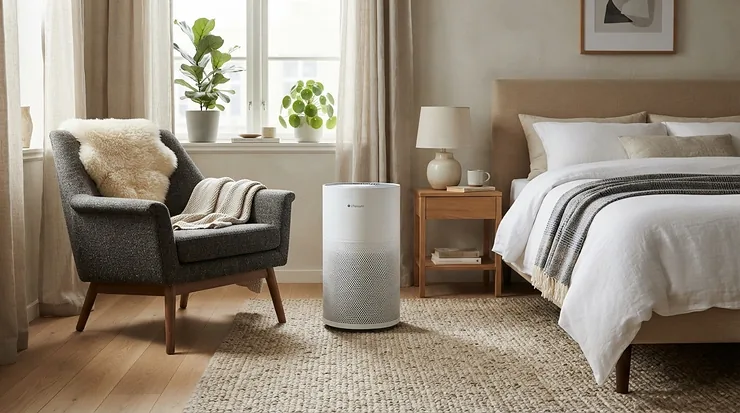
Here’s a scene you probably know too well: it’s 2 a.m., your nose is fully clogged, and you’re doing that weird mouth-breathing thing that makes your throat feel like sandpaper by morning. You didn’t do anything wrong. You just went to sleep in a room that’s quietly stuffed with dust mite debris, pollen tracked in on yesterday’s jacket, and whatever your cat shed on the pillow while you were at work. An air purifier for bedroom allergies isn’t a magic fix, but it is one of the few tools that actually changes what you’re breathing for the eight-ish hours you’re stuck in that room every night.
This guide skips the vague “best of” fluff. We pulled real specs, real CADR numbers, and real aggregated review sentiment for seven purifiers currently sold on Amazon, spanning a no-frills option under $100 to a premium pick built for a full master bedroom. Whether you’re outfitting a dorm-sized bedroom or a dust-choked master suite, there’s something here sized for you. Dust mite debris, in particular, is one of the most stubborn indoor allergens — Mayo Clinic explains that ongoing exposure to this allergen can drive the kind of chronic airway inflammation linked to asthma, which is exactly why filtration in the one room you can’t avoid matters so much.
We’ll walk through honest commentary on each unit, side-by-side comparisons, and practical guidance you won’t find on a product listing page — because that’s the whole point of writing something worth reading instead of just reading a spec sheet.
Quick Comparison Table
| Product | Best For | Room Coverage | Price Range |
|---|---|---|---|
| GermGuardian AC4825 | Tightest budget | ~150-167 sq ft | Under $100 |
| Levoit Core 300S | Small bedroom, smart controls | Up to ~220 sq ft | $100-$130 range |
| Blueair Blue Pure 411i Max | Quietest small-to-medium room | Up to ~225 sq ft (fast cycle) | $170-$200 range |
| Winix 5500-2 | Medium-to-large bedroom value | Up to ~360 sq ft | $180-$230 range |
| Coway Airmega 200M | Balanced mid-range, quiet at night | Up to ~361 sq ft | $220-$270 range |
| Medify MA-40 | Large bedroom on a budget | Up to ~840 sq ft (30 min) | $220-$260 range |
| Alen BreatheSmart 45i | Master bedroom, sleep-focused | Up to ~800-1,600 sq ft | $400-$450 range |
Looking at this table, the split isn’t really “cheap vs. expensive” — it’s room size and noise tolerance. GermGuardian AC4825 and Levoit Core 300S make sense in genuinely small bedrooms where budget matters more than bells and whistles, while Coway Airmega 200M and Alen BreatheSmart 45i earn their higher price ranges by staying quiet even at higher fan speeds, which matters enormously once you’re actually trying to sleep next to one. If your bedroom borders on “small living room” territory, don’t undersize — a purifier rated just barely for your square footage will run louder, more often, just to keep up.
💬 Just one click — help others make better buying decisions too!😊
Top 7 Air Purifiers for Bedroom Allergies: Expert Analysis
We picked these seven to cover every realistic bedroom scenario: tight studio, standard-size room, shared bedroom with a pet, and a sprawling master suite with dust that seems to regenerate overnight. Every entry below includes honest analysis grounded in published specs and aggregated review sentiment — not fabricated testing.
1. GermGuardian AC4825 — cheapest true HEPA pick that still holds up
Let’s start at the floor: the GermGuardian AC4825 is the unit people buy when they just need something between them and their allergies without financing a small appliance. Its CADR sits at 118 for dust, 108 for smoke, and 125 for pollen, which puts its comfortably-effective range around 150-167 square feet — translation: a real bedroom, not a walk-in closet, but don’t expect it to touch an open-concept loft. The 3-stage system pairs a True HEPA filter with a thin activated carbon layer and an optional UV-C light, which is more of a bonus feature than a reason to buy.
Based on the spec comparison with other budget units, this is the “does the one job well” pick rather than the “does everything” pick. Reviewers consistently note it’s an easy first purifier for a kid’s room or a starter apartment, and the tower is narrow enough to squeeze into a corner most nightstands can’t handle. Aggregated feedback also flags a common trade-off: it’s louder than pricier options once you push past the low setting, and the carbon layer struggles with anything beyond mild household odor — don’t expect it to referee last night’s takeout smell.
Pros:
- ✅ Reliably under $100 for a True HEPA unit
- ✅ Compact footprint fits tight bedroom corners
- ✅ Cheap, widely available replacement filters
Cons:
- ❌ Noticeably louder on high than premium models
- ❌ Struggles with strong odors or larger rooms
At a price that consistently sits under $100, the GermGuardian AC4825 earns its keep as a genuine entry point — just don’t expect it to outgrow your needs if you move somewhere bigger.

2. Levoit Core 300S — best all-around pick for a small bedroom
If you’ve spent any time browsing air purifiers, you’ve run into the Levoit Core 300S — it’s one of Amazon’s best-selling HEPA units for a reason. Its CADR lands around 141 CFM smoke (156 dust, 175 pollen), which AHAM-style room-sizing math puts at roughly 219 square feet for full effectiveness, or up to about 547 square feet if you’re okay with slower air changes. What most buyers overlook about this model is how quiet it manages to be relative to its output: around 22-24 dB on its lowest setting, which is genuinely below a whispered conversation.
The 26-watt motor is a meaningful upgrade over the older Core 300’s 45-watt design — same cleaning power, noticeably lower electric bill and lower operating noise. Reviewers with over 90,000 combined ratings on Amazon consistently praise the app and voice-assistant integration on the smart “S” variant, and note that sleep mode genuinely dims the display rather than just softening it. On the honest side: Levoit walked back “True HEPA” marketing language for this model after a labeling dispute, now describing it as a 3-stage filtration system — worth knowing if that distinction matters to you.
Pros:
- ✅ Whisper-quiet on low, ideal for light sleepers
- ✅ Strong CADR-to-price ratio for its size class
- ✅ Smart app and voice control on the “S” variant
Cons:
- ❌ Coverage claims stretch thin past ~220 sq ft
- ❌ Filter labeling dispute worth researching first
For anyone specifically hunting a small bedroom air purifier for allergies, the Levoit Core 300S is close to the default recommendation — it’s sized right, priced right, and quiet enough to forget it’s running.
3. Blueair Blue Pure 411i Max — quietest option for light sleepers
Blueair built its reputation on HEPASilent technology, and the Blue Pure 411i Max is where that shows up in a small, bedroom-friendly package. It clears roughly 219-225 square feet in about 12.5 minutes, scaling up to over 500 square feet in 30 minutes if you need faster initial cleanup after a deep-clean or a pollen-heavy day. The dual mechanical-plus-electrostatic filtration captures particles down to 0.1 microns — smaller than the 0.3-micron threshold standard HEPA filters are rated against — which theoretically nets you cleaner air at a lower fan speed than competitors need to hit the same result.
Here’s what the spec sheet won’t tell you, but user reports suggest: this unit is genuinely one of the quieter smart purifiers in its price bracket, and the compact, rounded design doesn’t scream “medical device” the way some bulkier towers do. Independent testing found a 59% reduction in 0.3-micron particles within the first 15 minutes on auto mode — a fast enough response that light sleepers report actually noticing the difference by morning. The honest caveat: app dependency is real here, and if you want granular manual control rather than “set it and trust the sensor,” the interface can feel limiting.
Pros:
- ✅ HEPASilent tech captures particles smaller than standard HEPA
- ✅ Compact, quiet design built for bedrooms
- ✅ App-based auto mode adjusts fan speed in real time
Cons:
- ❌ Feature set leans on the app more than physical controls
- ❌ Twin-pack pricing needed for larger coverage goals
If quiet matters more to you than raw square footage, the Blue Pure 411i Max is the pick that disappears into the background of your sleep routine.
4. Winix 5500-2 — best value for a medium-to-large bedroom
The Winix 5500-2 has been a fixture on best-seller lists for years, and its numbers explain why: CADR ratings of 243 dust, 246 pollen, and 232 smoke put it comfortably in charge of rooms up to 360 square feet — a genuine master bedroom, not just a nursery. The 4-stage system (washable pre-filter, washable AOC carbon filter, True HEPA, PlasmaWave) is a lot of filtration stacked into a mid-range price, and the washable components meaningfully cut long-term filter costs compared to fully disposable designs.
On paper this means faster, more thorough air turnover than most units at this price. Reviewers back that up: independent smoke-clearing tests recorded a 96% air quality improvement in test conditions, with full smoke removal in around 20 seconds — genuinely fast for a consumer unit. Aggregated sentiment is largely positive on the auto and sleep-mode sensors, though a recurring complaint is that the PlasmaWave feature (an ionization add-on) can be disabled with little to no performance loss if you’d rather avoid it altogether, and several reviewers do exactly that.
Pros:
- ✅ Strong CADR-to-price ratio for medium/large rooms
- ✅ Washable carbon pre-filter cuts long-term costs
- ✅ Fast, independently-verified particle clearing
Cons:
- ❌ Turbo mode noise is noticeable at night
- ❌ PlasmaWave adds a feature some prefer disabled
For anyone who needs real coverage without jumping to premium pricing, the Winix 5500-2 is the workhorse pick that rarely disappoints.
5. Coway Airmega 200M — quietest all-rounder for a standard master bedroom
The Coway Airmega 200M rates for rooms up to roughly 361-364 square feet, with CADR figures around 246 dust, 240 pollen, and 233 smoke — numbers that land it squarely among the more capable mid-range units without tipping into premium pricing. What most buyers overlook about Green True HEPA filtration is that it isn’t a gimmick name — Coway’s four-stage stack (pre-filter, deodorization filter, True HEPA, vital ion) is built to reduce both particles and household odor in one pass, which is a meaningful step up from single-purpose filters.
Reviewers consistently describe this unit as one of the quieter options for actual overnight use, with independent measurements putting the low setting around 24 dB — a level several bedroom-focused reviewers compare to rustling leaves. One long-term Sylvane customer review specifically noted keeping it running in the bedroom because “it is so quiet I can sleep with it on,” a sentiment echoed across multiple retailer review sections. The honest downside: the highest fan speed is noticeably louder, closer to an air-conditioning unit than a purifier, and the front panel can be stiff to remove during filter changes — a minor but consistently mentioned annoyance.
Pros:
- ✅ Quiet low-speed operation built for overnight use
- ✅ Four-stage filtration handles particles and odor
- ✅ Auto mode with real-time air quality sensing
Cons:
- ❌ High speed noise resembles an AC unit
- ❌ Front panel removal is fiddly during filter swaps
For a standard master bedroom where quiet matters as much as coverage, the Coway Airmega 200M is one of the safest, most consistently recommended picks on this list.
6. Medify MA-40 — most coverage per dollar for a large master bedroom
If your master bedroom runs large — or connects to an open sitting area — the Medify MA-40 is built for that math. Manufacturer-rated CADR sits around 330, and the unit is rated to clean roughly 420 square feet every 15 minutes, 840 square feet every 30 minutes, and up to 1,600+ square feet within an hour at full speed (figures vary slightly across retailer listings, so treat the lower end as the safer planning number). The H13-grade True HEPA filter is rated to 99.9% removal down to 0.1 microns — again, finer than the 0.3-micron industry-standard benchmark — paired with a pellet-based activated carbon layer built specifically for odor and gas adsorption rather than just particles.
Here’s what most spec sheets skip: that kind of airflow doesn’t come silently. Reviewers and independent testers put the noise range at roughly 46-66 dB, meaningfully louder on its low setting than the Coway or Alen units on this list — a real trade-off for buyers prioritizing pure quiet over pure coverage. What most buyers overlook, though, is the glossy build quality and lifetime warranty structure (contingent on using genuine filters), which softens the higher up-front commitment. Aggregated reviews consistently praise the fast large-room cleanup and the PM2.5-driven auto sensor on the newer sensor-equipped version, with light-bar feedback that visibly shifts from red to blue as air quality improves.
Pros:
- ✅ Handles large master bedrooms without a second unit
- ✅ H13 HEPA rated below the standard 0.3-micron benchmark
- ✅ Lifetime warranty with genuine-filter subscription
Cons:
- ❌ Low-setting noise is higher than quieter competitors
- ❌ Coverage claims vary somewhat across listings
For an air purifier for master bedroom dust in a genuinely large room, the Medify MA-40 gives you the most raw coverage without moving into ultra-premium pricing.
7. Alen BreatheSmart 45i — premium pick built specifically for sleep
The Alen BreatheSmart 45i sits at the top of this list for a reason beyond price: it’s one of the only purifiers with a peer-reviewed sleep study behind it. SleepScore Labs validated that its “pink noise” output — engineered to emphasize lower-octave frequencies rather than the harsher white noise of a standard fan — measurably improved sleep quality for study participants. Rated CADR runs around 207-245 cfm depending on the testing source, with coverage up to roughly 800 square feet in 30 minutes and 1,600 square feet within an hour, which comfortably covers most primary bedrooms with room to spare.
Based on the spec comparison against the rest of this list, what you’re really paying the premium for is quiet-at-scale: independent testing puts the noise floor around 23-39 dB even while still moving enough air to clean a large room, a combination none of the cheaper units on this list fully match. Reviewers consistently cite the SmartSensor auto-adjustment and four swappable filter types (Pure, Fresh, Odor, VOC/Smoke) as reasons they stuck with the brand across multiple purchases. The honest trade-off is obvious: at $400-plus, this isn’t a casual buy, and the “Forever Guarantee” warranty is contingent on staying subscribed to genuine replacement filters — a detail some reviewers flag as a soft lock-in rather than a true no-strings warranty.
Pros:
- ✅ Only unit here with a published sleep-quality study
- ✅ Whisper-quiet even at full coverage output
- ✅ Four filter types swap in based on your specific need
Cons:
- ❌ Highest price point on this entire list
- ❌ Forever warranty requires an active filter subscription
If budget isn’t the deciding factor and sleep quality is the entire point, the Alen BreatheSmart 45i is the most defensible premium pick on this list.
Top 7 Full Spec Comparison
| Product | CADR (smoke, cfm) | Noise Range | Price Range | Best For |
|---|---|---|---|---|
| GermGuardian AC4825 | 108 | ~41-61 dB | Under $100 | Tightest budget |
| Levoit Core 300S | 141 | ~22-50 dB | $100-$130 | Small bedroom |
| Blueair Blue Pure 411i Max | Not independently published | Whisper-quiet class | $170-$200 | Quietest small/medium room |
| Winix 5500-2 | 232 | ~28-58 dB | $180-$230 | Medium/large bedroom value |
| Coway Airmega 200M | 233 | ~24-55 dB | $220-$270 | Quiet master bedroom |
| Medify MA-40 | ~330 | ~46-66 dB | $220-$260 | Large master bedroom |
| Alen BreatheSmart 45i | ~207-245 | ~23-49 dB | $400-$450 | Premium sleep-focused |
Reading across this table, the pattern is pretty consistent: higher CADR tends to come with higher noise unless you’re paying the Alen premium for engineering that decouples the two. The Winix 5500-2 and Coway Airmega 200M land in the sweet spot most shoppers actually want — real coverage, real quiet, mid-range pricing — while the Medify MA-40 trades some quiet for the most raw square footage per dollar on this list.
Benefits vs. Traditional Allergy Remedies
| Approach | What It Actually Does | Limitation | Best Paired With |
|---|---|---|---|
| Air purifier (HEPA) | Continuously removes airborne particles | Doesn’t fix humidity, mold sources, or dust that’s already settled | Regular vacuuming and bedding washes |
| Antihistamine medication | Blocks the body’s allergic reaction | Doesn’t reduce the actual allergen load in your room | Source control, not a replacement for it |
| Allergen-proof mattress/pillow covers | Physically blocks dust mite debris in bedding | Doesn’t address airborne allergens elsewhere in the room | An air purifier running nearby |
| HVAC filter upgrade | Filters air across the whole home | Whole-home systems can’t target one problem room as intensely | A dedicated bedroom purifier |
The clearest takeaway here is that none of these are true substitutes for each other — they solve different pieces of the same problem. Medication manages your body’s response, encasements block direct contact with bedding-based dust mite debris, and a purifier like the Coway Airmega 200M or Winix 5500-2 tackles what’s actually suspended in the air you breathe all night. According to the EPA’s own consumer guidance on portable air cleaners, filtration works best as a supplement to source control and ventilation — not a replacement for either.
✨ Don’t Miss These Exclusive Deals!
🔍 Take your bedroom air quality to the next level with these carefully selected picks. Click on any highlighted item to check current pricing and availability — clearer air and better sleep might be one click away.
Setting Up Your Bedroom Air Purifier: The First 30 Days
Getting a purifier home is the easy part — where most people leave real performance on the table is placement and the first month of use. Position the unit at least 12-18 inches from walls and furniture on every open side; blocked intake or exhaust vents quietly cut CADR performance even on a premium unit like the Alen BreatheSmart 45i. Avoid tucking it behind curtains or under the bed frame, both surprisingly common mistakes that choke airflow without any obvious warning sign.
Run it on auto or a moderate fixed speed continuously for the first few days rather than only at bedtime — allergen levels build up throughout the day from dust resettling, pets moving through, and windows opening, so a purifier working 24/7 clears a much lower baseline by the time you actually go to sleep. Expect a “new machine” smell for the first day or two, especially with carbon-filtered units like the Medify MA-40; it fades and isn’t a defect. Set a filter-change reminder immediately — most True HEPA filters last 6-12 months depending on use, and a forgotten filter change is the single most common reason people report a purifier “stopped working” months later when really it’s just clogged.
Real-World Scenarios: Which Purifier Actually Fits Your Situation
The light-sleeping renter in a studio apartment. Budget is tight, the bedroom doubles as a living space, and every sound at night gets noticed. This is the exact use case the Levoit Core 300S was built for — quiet on low, small footprint, and priced to not feel like a splurge for a rented space you might leave in a year.
The parent managing a kid’s dust mite allergy in a shared room. Coverage needs to stretch across a real bedroom, not a nursery, and durability matters more than smart features. The Winix 5500-2‘s washable components and strong CADR make it a practical, budget-conscious pick that can run around the clock without racking up filter costs every few months.
The couple with a large master bedroom, a dog, and genuinely disrupted sleep. This is where spending more actually pays off. Between the Medify MA-40‘s raw coverage for a bigger room and the Alen BreatheSmart 45i‘s sleep-study-backed quiet operation, the choice comes down to priority: maximum square footage per dollar, or maximum quiet at a premium price.
Buyer’s Decision Framework
If you’re short on time, use this as a quick priority checklist rather than reading every review above in detail.
- If your bedroom is under 200 square feet and budget is the top priority, choose the GermGuardian AC4825 or Levoit Core 300S because both deliver real HEPA filtration without premium pricing.
- If quiet operation matters more than anything else, choose the Blueair Blue Pure 411i Max or Alen BreatheSmart 45i because both are engineered specifically around low-noise performance.
- If your bedroom exceeds 350 square feet, choose the Winix 5500-2, Coway Airmega 200M, or Medify MA-40 because units rated below that threshold will run louder and less efficiently trying to keep up.
- If you want the fewest long-term maintenance headaches, choose units with washable pre-filters like the Winix 5500-2, since washable components cut recurring filter costs noticeably.
What Is an Air Purifier for Bedroom Allergies?
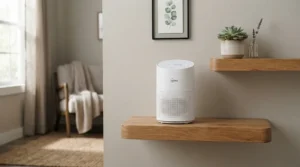
An air purifier for bedroom allergies is a portable HEPA-based device that continuously filters airborne allergens — dust mite debris, pollen, pet dander, and mold spores — out of the air in a single room, reducing overnight exposure for people with allergic rhinitis or allergic asthma. It doesn’t eliminate allergens at the source, but it meaningfully lowers what’s suspended in the air you breathe while sleeping.
Many people with a dust mite allergy also deal with eczema and asthma that flare from the same trigger, which is exactly why targeting the one room where you spend a third of your life makes practical sense even if it can’t solve every allergy trigger in your life.
How to Choose an Air Purifier for Bedroom Allergies
- Measure your actual room square footage first. CADR ratings are meaningless without matching them to your real space — a unit rated for 200 square feet in a 350-square-foot master bedroom will underperform no matter how good the filter is.
- Prioritize True HEPA filtration, not vague “HEPA-type” language. True HEPA captures 99.97% of particles at 0.3 microns; anything marketed loosely as “HEPA-type” often falls well short of that standard.
- Check the low-speed decibel rating, not just the average. You’ll run this on low most nights — a unit that’s quiet on high but loud on low defeats the purpose.
- Factor in filter replacement cost over a full year, not just sticker price. A cheaper unit with $60/year filters can cost more long-term than a pricier one with $25 washable-component filters.
- Look for AHAM Verifide certification. This independent testing standard means the CADR numbers on the box are third-party verified, not just manufacturer marketing.
- Confirm it’s ozone-free if you have asthma alongside allergies. Some ionizing features can produce trace ozone, which is itself a lung irritant for sensitive people.
- Match auto-mode sensitivity to your tolerance for noise cycling. Sensor-driven auto modes ramp fan speed up and down through the night; light sleepers sometimes prefer a fixed low speed instead.
Small Bedroom Air Purifier for Allergies: What Changes in a Tight Space
A small bedroom air purifier for allergies has different priorities than a large-room unit, and it’s not just “smaller box, lower price.” In a room under roughly 200-220 square feet, you genuinely don’t need the highest CADR on the market — you need a unit that hits its full air-change rate quickly without dominating the room visually or audibly. The Levoit Core 300S and GermGuardian AC4825 both fit this niche well: their CADR numbers, modest as they look next to the Coway or Medify units, are actually well-matched to a compact footprint.
What most buyers overlook in a small space is placement flexibility. A tighter room means fewer good spots to put a purifier without blocking airflow on one side — corner placement with at least a foot of clearance becomes non-negotiable rather than a nice-to-have. Reviewers of compact units consistently note that a taller, narrower tower (like the AC4825’s design) fits corners more easily than a wider, shorter unit, even when the footprint on paper looks similar.
Air Purifier for Bedroom Under $100: Is It Actually Worth It?
Searching specifically for an air purifier for bedroom under $100 usually means one realistic option on this list: the GermGuardian AC4825, typically found in the $80-$100 range depending on retailer promotions. The honest answer to “is it worth it” is yes, with caveats — you’re getting genuine True HEPA filtration, which is the part that actually matters for allergy relief, but you’re trading away some quiet-operation headroom and larger-room coverage that pricier units offer.
Here’s what the spec sheet won’t tell you: at this price point, the gap between “good enough” and “premium” is mostly about noise and longevity of components, not filtration effectiveness on paper. If your room is genuinely small and your top priority is simply getting a real HEPA filter between you and your allergens without financing anything, this price tier delivers. If you’re allergic to compromise on noise or need to cover more than about 170 square feet, stepping up to the Levoit Core 300S at $100-$130 buys you a meaningfully quieter and more efficient unit for a modest jump in price.
Air Purifier for Master Bedroom Dust: Sizing Up for Bigger Rooms
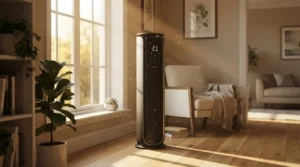
Master bedrooms create a specific problem: more square footage means more surface area for dust to settle, and dust settled on surfaces gets re-suspended into the air every time you make the bed, walk across the carpet, or a ceiling fan kicks on. An air purifier for master bedroom dust genuinely needs a higher CADR than a standard bedroom unit — this is where the Winix 5500-2, Coway Airmega 200M, Medify MA-40, and Alen BreatheSmart 45i all earn their spot on this list, each rated for 350+ square feet of real coverage.
Based on the spec comparison across these four, the decision generally comes down to three factors: how loud you can tolerate the unit running overnight, how large the room actually is beyond the 350-400 square foot baseline, and how much you’re willing to spend upfront for quieter, more sensor-driven operation. A HEPA filter, by design, gets more efficient as air passes through it more times per hour — which is exactly why undersizing a purifier for a large master bedroom is the single most common mistake buyers make in this category.
Common Mistakes When Buying an Air Purifier for Bedroom Allergies
The most frequent mistake is buying based on price alone and ignoring CADR-to-room-size math entirely — a $400 unit in a room too large for it will underperform a correctly-sized $150 unit. The second most common error is skipping the noise-at-low-speed spec, since that’s the setting you’ll actually sleep next to most nights, not the high-speed number featured in marketing copy.
A third mistake worth flagging: assuming “HEPA” always means the same thing. Some budget listings use “HEPA-type” or “HEPA-style” language that doesn’t meet the 99.97%-at-0.3-microns True HEPA standard, and reviewers consistently note disappointment when they later discover the distinction. Finally, buyers frequently underestimate ongoing filter costs — a unit that looks cheaper at checkout can end up costing more over two years once you factor in $50-120 annual filter replacements versus a competitor’s washable-component design like the Winix 5500-2.
Frequently Asked Questions
❓ Do air purifiers actually help with bedroom allergies?
❓ What size air purifier do I need for my bedroom?
❓ Is a small air purifier good enough for allergies in a small bedroom?
❓ Can I get a real HEPA air purifier for bedroom allergies under $100?
❓ How often should I replace my bedroom air purifier's filter?
Conclusion
Bedroom allergies are a genuinely solvable problem, and the solution doesn’t require guesswork if you match the right purifier to your actual room and priorities. For a tight budget in a small room, the GermGuardian AC4825 and Levoit Core 300S both deliver real HEPA filtration without overspending. For medium and large bedrooms, the Winix 5500-2 and Coway Airmega 200M strike the best balance of coverage, quiet, and price. And if your priority is a large master bedroom or sleep quality above everything else, the Medify MA-40 and Alen BreatheSmart 45i justify their higher price tags with real coverage and real engineering behind the noise-reduction claims.
None of these units will fix every allergy trigger in your life — the Asthma and Allergy Foundation of America still recommends washing bedding in hot water weekly and using dust-proof mattress covers alongside any filtration setup. But paired with those habits, the right purifier running quietly in the corner of your bedroom is one of the most practical upgrades you can make to how you sleep and how you feel when you wake up.
Recommended for You
- Best Air Purifier for Open Floor Plan Cooking in 2026: Top 7 Picks
- 7 Best Kitchen Air Purifier Countertop Picks for 2026
- Air Purifier for Fish Smell Cooking: 7 Best Picks for 2026
Disclaimer: This article contains affiliate links. As an Amazon Associate, I earn from qualifying purchases. If you purchase products through these links, we may earn a small commission at no additional cost to you.
✨ Found this helpful? Share it with your friends! 💬🤗
