
In This Article
If you’ve ever woken up with a stuffy nose next to a dog who is, inexplicably, breathing just fine, you already know why an air purifier for bedroom with pets is one of those purchases that pays for itself in sleep alone. Pet dander isn’t the hair you vacuum off the couch — it’s the microscopic, protein-coated skin flecks that float for hours and settle into your pillowcase long after your cat has wandered off to judge you from the windowsill. According to the EPA’s guide to portable air cleaners, a high-CADR HEPA unit paired with an activated carbon stage is the most reliable combination for pulling both particles and odor-causing gases out of a closed room, and a bedroom — small, shut for eight hours a night, shared with a shedding roommate who doesn’t use deodorant — is exactly where that combination earns its keep.
What is an air purifier for bedroom with pets? It’s a portable HEPA-based unit sized and filtered specifically to remove pet dander, hair, dust, and odor from a sleeping space, typically combining a washable pre-filter, a true HEPA or H13 filter, and an activated carbon layer for smells. That’s the short version. The long version is that not every “pet” air purifier on Amazon actually earns the label — some skip carbon entirely, some are undersized for anything bigger than a closet, and some make room-coverage claims that fall apart the moment you do the math on air changes per hour.
This guide breaks down seven real, currently available models across budget, mid-range, and premium tiers, tested and reviewed by independent labs and long-term owners, so you can match the right unit to your room size, your pet’s shedding habits, and your tolerance for fan noise at 2 a.m.
Quick Comparison: Best Air Purifiers for Bedroom with Pets
| Product | Best For | Coverage | Noise (Low–High) |
|---|---|---|---|
| Levoit Core 300S | Small bedrooms, budget | ~219 sq ft | 24–50 dB |
| Winix 5510 | Washable pre-filter, heavy shedders | ~360 sq ft | 23.5–67 dB |
| Levoit Vital 200S-P | Large bedrooms, dedicated Pet Mode | ~380 sq ft (4 ACH) | 24–54 dB |
| Medify MA-40 | Odor control, carbon-forward | ~840 sq ft | 40.5–66 dB |
| Coway Airmega 400 | Open-plan bedrooms, big spaces | 1,560 sq ft (2 ACH) | 22–52 dB |
| Alen BreatheSmart 75i | Multi-pet homes, lifetime warranty | 1,300 sq ft | 25–49 dB |
| Austin Air HealthMate | Chemical sensitivity, heavy carbon load | 1,500 sq ft | Low–moderate |
Look closely and a pattern shows up fast: coverage and noise don’t move in lockstep. The Coway Airmega 400 covers nearly triple the floor space of the Levoit Core 300S while running quieter at its lowest setting, which tells you size alone doesn’t predict how much you’ll hear it at night. Budget buyers with a genuinely small bedroom don’t need to chase big CADR numbers, but anyone with a large bedroom with pets — think a primary suite that also functions as a home office, or a room with vaulted ceilings — will find that undersized units simply can’t cycle the air fast enough to keep dander from accumulating between fan bursts.
💬 Already know your room size? Jump straight to the model that fits — your sinuses will thank you tonight.
Top 7 Air Purifiers for Bedroom with Pets: Expert Analysis
1. Levoit Core 300S — quietest budget pick for small bedrooms
The Core 300S is Levoit’s smart, app-connected version of its best-selling Core 300, and it’s the rare budget purifier that doesn’t ask you to compromise on filtration to hit a low price. Its AHAM-verified CADR sits around 141–175 CFM depending on the pollutant tested, which comfortably supports the 219 sq ft room size Levoit lists — a fit for most standalone bedrooms, though not for an open-plan primary suite. The three-stage filter combines a washable pre-filter, an H13 True HEPA layer, and a thin activated carbon layer, which is enough to knock down light odor but won’t be the star performer if your dog has a “wet dog smell” problem year-round. Based on the spec comparison, this is the unit for renters, apartment bedrooms, and anyone testing whether an air purifier even makes a noticeable difference before spending real money.
Reviewers consistently report that the sleep mode, rated around 22–24 dB, is genuinely inaudible next to a white noise machine, and long-term owners note the filter’s 6–8 month replacement cycle keeps annual costs in the $40–$50 range. A common complaint in user reviews is that the bonded 3-in-1 filter means you’re replacing carbon and HEPA together even when only one is spent, which is a minor efficiency loss rather than a dealbreaker.
Pros:
- ✅ Whisper-quiet sleep mode under 24 dB
- ✅ Low annual filter cost around $40–$50
- ✅ Smart app control and Alexa compatibility
Cons:
- ❌ Carbon layer is thin for heavy odor households
- ❌ Coverage tops out around 219 sq ft
In the $100-$130 range, the Levoit Core 300S is the easiest first purifier to justify for a single pet in a standard bedroom, though value-conscious buyers who don’t need app control can save $10-$20 by choosing the non-smart Core 300 with identical filtration.

2. Winix 5510 — best washable pre-filter for heavy shedders
The Winix 5510 replaced the discontinued 5500-2 as the brand’s standard mid-tier pet purifier, and its defining feature is a washable mesh pre-filter that’s genuinely built to handle fur rather than clog after a week. Its dust CADR of roughly 252 CFM supports rooms up to about 360 sq ft, and the True HEPA stage is rated to capture 99.99% of particles down to 0.01 microns, which covers pet dander comfortably since dander typically ranges from 2.5 to 10 microns. What most buyers overlook about this model is the PlasmaWave ionizer that ships enabled by default; it produces a small amount of reactive oxygen to help with odor, but Winix explicitly recommends disabling it in homes with birds or very small caged animals, so check your settings before your first night.
Aggregated review sentiment across pet-focused testers is largely positive on odor handling near litter boxes, with multiple sources describing a noticeable reduction in ammonia smell within the first week of continuous operation. The tradeoff, based on the spec sheet, is a real noise jump at the top speed — 67 dB is loud enough to interrupt a phone call — so most owners run it on auto and let the sensor do the work rather than manually cranking it up before bed.
Pros:
- ✅ Washable pre-filter handles heavy pet hair well
- ✅ WiFi app control with scheduling and monitoring
- ✅ Strong odor reduction reported near litter boxes
Cons:
- ❌ Top speed noise reaches roughly 67 dB
- ❌ Ionizer enabled by default; disable for small pets
At around the $150-$200 range, the Winix 5510 earns its spot as the mid-tier value pick, particularly for multi-cat households where a truly washable pre-filter saves real money on replacements over a year of heavy shedding.
3. Levoit Vital 200S-P — dedicated Pet Mode for large bedrooms
If your search started with “air purifier for large bedroom coverage,” the Vital 200S-P is built for exactly that brief. Levoit rates the P-designated pet variant for spaces up to 1,875 sq ft at one air change per hour, or a more realistic 380 sq ft at the four-to-five air changes per hour that actually matter for allergen control, backed by an AHAM-verified CADR around 242–254 CFM. The standout engineering choice is the U-shaped air inlet layered on top of the traditional intake, which is specifically designed to trap airborne fur before it reaches the HEPA media and clogs it prematurely — a detail that matters more than most spec sheets let on, since a clogged HEPA filter loses airflow long before it visually looks dirty.
Here’s what the spec sheet won’t tell you, but reviewers note: the dedicated Pet Mode doesn’t just run at max speed continuously; it alternates between high and medium fan output specifically to balance dander capture against energy use and noise, which is a smarter approach than the “auto or nothing” logic on cheaper units. Owners with multiple cats or a shedding double-coated dog report that the washable pre-filter needs rinsing roughly every two weeks rather than the monthly interval Levoit suggests for lighter-shedding households.
Pros:
- ✅ U-shaped intake resists fur clogging
- ✅ Dedicated Pet Mode balances power and noise
- ✅ Washable pre-filter extends HEPA filter life
Cons:
- ❌ Bonded filter replaces HEPA and carbon together
- ❌ Real-world coverage lower than headline 1,875 sq ft claim
Priced in the $190-$240 range, the Levoit Vital 200S-P is the strongest all-around choice for a genuinely large bedroom shared with one or more pets, and it’s the model most testers specifically recommend over the standard (non-pet) Vital 200S for that reason.
4. Medify MA-40 — strongest carbon odor control under $300
The Medify MA-40 takes a different filtration philosophy than the Levoit and Winix units: instead of a thin bonded carbon layer, it uses a substantial pellet-based activated carbon filter alongside its H13 True HEPA stage, which is why odor-focused reviewers routinely rank it ahead of similarly priced competitors for smell control specifically. Its CADR reaches roughly 330–406 CFM at top speed depending on which testing standard is cited, translating to coverage of 840–896 sq ft in 30 minutes — genuinely large-room territory for a unit that regularly sells for less than a Coway or Alen. On paper this means a bedroom-and-adjoining-office setup can run on a single MA-40 rather than needing two smaller purifiers.
Based on the spec comparison, the honeycomb-style carbon pellet design is the detail that matters most for multi-pet or litter-box-adjacent bedrooms; loose granular carbon has more surface area exposed to odor molecules than the thin carbon sheets used in cheaper filters. Reviewers consistently note the touchscreen controls feel premium for the price tier, though a recurring theme in long-term ownership reports is that the optional ionizer should stay off for anyone sensitive to ozone-adjacent smells, and that the carbon layer’s effectiveness noticeably tapers around month five or six in a heavy-odor household, sooner than the printed 6–8 month estimate.
Pros:
- ✅ Heavy carbon pellet filter excels at odor removal
- ✅ Coverage up to 896 sq ft supports larger rooms
- ✅ ETL, CARB, and AHAM certified performance data
Cons:
- ❌ Carbon effectiveness fades faster in heavy-odor homes
- ❌ Top speed noise reaches roughly 66 dB
Landing in the $220-$300 range, the Medify MA-40 is the pick when odor — not just dander — is your primary complaint, especially in households managing a litter box inside or near the bedroom.
5. Coway Airmega 400 — best CADR-to-noise ratio for big rooms
The Airmega 400 is the purifier reviewers reach for when a bedroom stops being a bedroom and starts being an open-concept primary suite. Its AHAM-verified CADR of roughly 328 CFM for both smoke and dust, and up to 400 CFM for pollen, supports 1,560 sq ft at two air changes per hour — genuinely rare coverage in a residential unit — while its lowest fan speed measures around 22 dB, quieter than the Levoit Core 300S at idle despite moving vastly more air. That combination is the whole sales pitch: most large-room purifiers get loud to hit big CADR numbers, and the Airmega 400 largely doesn’t.
What most buyers overlook about this model is the dual Max2 filter system: because air enters from both sides of the unit, you’re maintaining two filter sets rather than one, which pushes annual filter costs to roughly $90-$100 combined — more than a single-filter Levoit, but proportional to the room size it’s actually cleaning. Reviewers who’ve run it long-term describe the real-time particle sensor’s colored LED as genuinely useful for at-a-glance air quality checks without opening an app, and multiple independent testers rate its allergen performance among the strongest in this price class, though the lack of WiFi on the base model (reserved for the pricier 400S) is a recurring point of mild frustration in long-term reviews.
Pros:
- ✅ Whisper-quiet 22 dB on lowest fan speed
- ✅ 1,560 sq ft coverage rare at this price
- ✅ Washable pre-filter reduces debris on Max2 filters
Cons:
- ❌ Dual filter system costs more to replace annually
- ❌ No WiFi without upgrading to the 400S
At a $400-$550 range, the Coway Airmega 400 is the value leader for genuinely oversized bedrooms, and its 5-year limited warranty gives buyers unusual long-term confidence for a purifier in this price tier.
6. Alen BreatheSmart 75i — lifetime warranty powerhouse
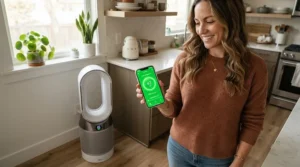
Alen’s flagship residential unit is built more like appliance-grade equipment than a typical bedroom gadget, and its specs back that impression up: a CADR around 330-350 CFM supports up to 1,300 sq ft, and the company backs the whole thing with a Forever Guarantee that covers lifetime repair or replacement as long as you stay on an active filter subscription. The real differentiator, based on the spec comparison, is Alen’s five interchangeable filter cartridges — including a dedicated Pet filter and a Heavy Odor filter — so owners can swap filtration strategy seasonally without buying a new machine, something none of the Levoit or Winix units in this list offer.
Here’s what the spec sheet won’t tell you, but long-term owners note: at 27 inches tall and roughly 12 inches deep, the 75i occupies real floor space and reads more like furniture than a compact appliance, which matters if your bedroom is already tight. Reviewers who’ve run it for years describe the 25 dB low-speed noise floor as genuinely bedroom-appropriate, and multiple testers highlight the auto mode’s tendency to ramp to full speed quickly when pollutant spikes are detected — useful when your dog shakes off dust after a walk, less useful if you’re trying to sleep through it.
Pros:
- ✅ Interchangeable Pet and Heavy Odor filter options
- ✅ Forever Guarantee lifetime warranty with registration
- ✅ 14 color panel options to match bedroom decor
Cons:
- ❌ Large footprint compared to tower-style competitors
- ❌ Filter subscription required to keep warranty active
Typically found in the $450-$800 range depending on panel color and filter type, the Alen BreatheSmart 75i suits multi-pet households that want a single unit built to last a decade rather than be replaced in three years.
7. Austin Air HealthMate — heaviest carbon load for chemical-sensitive homes
The HealthMate is the outlier on this list, and deliberately so: rather than chasing a high CADR number, Austin Air packs roughly 15 pounds (about 780 cubic inches) of activated carbon and zeolite into a steel cylindrical housing, pulling air in from all sides through a 360-degree intake. That massive carbon volume is what most buyers overlook when comparing spec sheets side by side — a typical bedroom purifier carries a few ounces of carbon in a thin sheet, while the HealthMate’s four-stage filter is built more like an industrial gas-phase filtration unit scaled down for a bedroom.
Based on the spec comparison, this design tradeoff means slower particle CADR relative to its 1,500 sq ft coverage claim, but dramatically longer carbon lifespan — Austin Air rates the filter for five years of normal residential use rather than the 6-12 months typical of Levoit or Winix carbon layers. Reviewers who’ve owned one for years consistently describe it as the unit of choice for households managing chemical sensitivities, off-gassing from new furniture, or persistent pet odor that other carbon filters simply exhaust within months. A common theme in long-term ownership reports is that the steel, largely plastic-free construction feels durable in a way most tower purifiers don’t, though the utilitarian, cylindrical design won’t appeal to buyers who want their purifier to disappear visually into bedroom decor.
Pros:
- ✅ Roughly 15 lbs of carbon lasts up to 5 years
- ✅ Steel construction with minimal plastic parts
- ✅ Made in the USA with 5-year filter warranty
Cons:
- ❌ Utilitarian design stands out in a bedroom
- ❌ Higher upfront cost than most tower-style competitors
Generally priced in the $650-$850 range, the Austin Air HealthMate is the lesser-known but high-quality alternative worth considering when odor and chemical sensitivity matter more to you than headline CADR numbers.
Practical Usage Guide: Setting Up Your Bedroom Purifier for Pets
Buying the right unit is half the job; placement and habits do the rest. Set your purifier at least 3 feet from walls and furniture so air can circulate freely into the intake — tucking it into a corner or behind a nightstand can cut real-world CADR noticeably, even though the spec sheet won’t change. Position it closer to your pet’s favorite sleeping or grooming spot rather than dead-center in the room, since dander concentrates wherever they spend the most time, not necessarily where you’d intuitively place a purifier.
In the first 30 days, resist the urge to run every unit on its lowest, quietest setting around the clock; auto mode, when available, lets the built-in sensor respond to real dander and odor spikes rather than under-cleaning a freshly shed-on room. Rinse washable pre-filters every one to two weeks in pet-heavy bedrooms rather than the monthly default most manuals suggest — a clogged pre-filter forces your HEPA stage to work harder and shortens its life. The most common first-month mistake is skipping the pre-filter maintenance schedule entirely and only remembering the purifier exists when the filter-change light comes on, by which point performance has often already dropped.
Real-World Scenarios: Matching a Purifier to Your Pet Household
Consider three household types and where each purifier in this guide actually fits. A studio-apartment renter with one short-haired cat and a 180 sq ft bedroom doesn’t need — and shouldn’t pay for — the Coway Airmega 400’s industrial-scale coverage; the Levoit Core 300S handles that footprint at a fraction of the cost and noise. A family with two dogs, a cat, and a 400 sq ft primary bedroom that doubles as a home office sits squarely in the gap the Levoit Vital 200S-P or Medify MA-40 were built to fill, where genuine large-room CADR matters more than a rock-bottom price tag.
Then there’s the allergy-diagnosed pet owner in an open-concept loft bedroom exceeding 1,000 sq ft, frequently dealing with both dander and litter-box odor — that’s where the Coway Airmega 400 or Alen BreatheSmart 75i justify their higher price, since undersized units in a space that large will run at max speed constantly and still lose the battle against air changes per hour. Matching your budget and room size honestly to one of these three profiles will eliminate most of the guesswork before you even open a single product page.
How to Choose an Air Purifier for a Large Bedroom with Pets
- Measure your actual square footage first. Manufacturers list room coverage at one air change per hour, which is far too slow for allergen control — divide that number roughly in half to estimate real coverage at a useful four to five air changes per hour.
- Match CADR to your ceiling height, not just floor area. A room with 10-foot ceilings has meaningfully more air volume than the same footprint at 8 feet, so round up a size tier if your bedroom has vaulted or high ceilings.
- Prioritize dust and smoke CADR over pollen CADR when pet dander is your main concern, since dander particle sizes track closer to dust and smoke test particles than to pollen.
- Check whether the pre-filter is washable, since heavy shedders will clog a disposable pre-filter within weeks, driving up your real cost of ownership.
- Confirm the noise level at your expected nightly speed, not just the marketed “as low as” figure, since auto mode on a large-coverage unit may run louder than a smaller purifier’s max speed.
- Look for a dedicated Pet Mode or Pet filter option if one is available, since these are tuned specifically for dander and hair rather than generic dust.
- Verify the warranty length against filter subscription requirements, since some brands’ best warranties are conditional on ongoing filter purchases.
Air Purifier for Large Bedroom Coverage: CADR and Air Changes Explained
Room-size claims are the most misleading numbers on any air purifier box, and understanding why matters most for anyone specifically shopping for air purifier for large bedroom coverage. Manufacturers are legally allowed to advertise coverage at a single air change per hour (ACH) — meaning the entire room’s air passes through the filter just once every sixty minutes. For allergen and dander control, independent testers and manufacturers alike generally recommend four to five air changes per hour, which is why a purifier rated for “1,875 sq ft” by the 1-ACH math, like the Levoit Vital 200S-P, is realistically sized for a 380 sq ft room when you want dander actually removed rather than just technically circulated.
This is the gap that trips up most large-bedroom shoppers: they see a big number on the box, buy the unit, and then wonder why dander still settles on surfaces within hours. The fix is straightforward once you know to look for it — take the advertised square footage, note whether it’s listed at 1 ACH or a higher rate, and divide accordingly before comparing two units. Independent lab testers such as HouseFresh publish their own measured CADR and effective coverage figures specifically because manufacturer numbers vary so widely in methodology, and cross-referencing a spec sheet against third-party test data is the single best way to avoid an undersized purchase for a genuinely large bedroom.
Bedroom Air Purifier vs Humidifier Comparison: Which Do You Actually Need?
This is one of the most common points of confusion for pet owners setting up a bedroom, and the honest answer is that these two devices solve different problems. An air purifier removes particles and gases already in the air — dander, hair, dust, and odor molecules. A humidifier adds moisture to dry air, which can ease irritated sinuses and static-prone pet hair but does nothing to filter allergens out of the room. If your symptoms are sneezing, itchy eyes, and a persistent pet smell, that’s a filtration problem an air purifier solves. If your symptoms are dry skin, a scratchy throat, or a pet with flaky, dry skin in winter, that points toward humidity, not filtration.
| Factor | Air Purifier | Humidifier |
|---|---|---|
| Removes pet dander/hair | Yes | No |
| Reduces pet odor | Yes (with carbon filter) | No |
| Helps dry skin/sinuses | No | Yes |
| Ideal humidity target | N/A | 40–60% RH |
| Maintenance risk if misused | Clogged filters | Mold growth if over-humidified |
The table above illustrates why “either/or” thinking is usually wrong: allergy-prone pet owners in dry winter climates often benefit from running both, provided the humidifier is kept within the range the EPA’s mold and moisture guidance recommends, generally between 30% and 50% relative humidity. Push past 60% RH and you risk creating the exact mold and dust-mite conditions an air purifier can’t undo, so a hygrometer is a worthwhile $10 addition if you’re running both devices in the same bedroom.
Activated Carbon Filter 101: Why It Matters for Pet Odor Control
HEPA filtration handles particles — hair, dander, dust — but it does essentially nothing for gases and odor molecules, which is exactly the gap an activated carbon filter is designed to fill. Activated carbon works through adsorption: the material is riddled with microscopic pores that dramatically increase its surface area, giving odor molecules and volatile organic compounds somewhere to physically bond rather than pass through untouched. This is why a purifier with a thin, sheet-style carbon layer, like the budget-tier units in this guide, will visibly reduce dander but leave a lingering pet smell, while a unit with a substantial activated carbon filter, like the Medify MA-40 or Austin Air HealthMate, tackles both.
The tradeoff most shoppers don’t anticipate is that carbon has a finite capacity — once its pores are saturated, it stops adsorbing new odor molecules regardless of how clean the HEPA side still looks, which is why filter-change timing for pet households should generally be based on odor return rather than a fixed calendar date. Reviewers consistently note that bonded filters, which combine carbon and HEPA into one disposable unit, force you to replace both simultaneously even if only the carbon side is exhausted — a real cost consideration for anyone specifically prioritizing an activated carbon filter over raw CADR numbers.
Common Mistakes When Buying an Air Purifier for Pets
The single most common mistake is undersizing: buying based on price rather than square footage, then wondering why dander and odor persist after weeks of continuous use. A close second is ignoring noise ratings at the fan speed you’ll actually run overnight, rather than the marketed “as low as” figure that only applies to the lowest, least effective setting. Many buyers also skip checking whether a filter is genuinely washable versus merely “removable,” a distinction that matters enormously for long-term cost in heavy-shedding households.
Another frequent misstep, according to the Asthma and Allergy Foundation of America, is assuming that removing visible pet hair solves an allergy problem — the actual allergens are microscopic proteins carried in dander, saliva, and urine, not the hair itself, which is exactly why a good HEPA-and-carbon combination matters more than a lint-roller habit. Finally, many shoppers overlook ozone safety entirely; some ionizing air purifiers generate trace ozone as a byproduct, and anyone with asthma or a bird in the household should specifically confirm a unit is ozone-free or has an ionizer that can be fully disabled.
What to Expect: Real-World Performance With Cats and Dogs
Specs tell you what a purifier can theoretically do; day-to-day experience tells you what it’s actually like living with one. Reviewers who’ve run these units for months rather than days consistently report that noticeable dander reduction shows up within the first week of continuous operation, but full odor neutralization in a litter-box-adjacent bedroom often takes two to three weeks as the carbon filter works through accumulated smell molecules already embedded in fabric and carpet. Cat owners in particular should expect longer continuous run times to matter more than fan speed spikes, since cat dander (Fel d 1) stays airborne for three to four hours after a cat grooms or moves, while dog allergens tend to settle more quickly onto surfaces.
Multi-pet households consistently report needing to rinse washable pre-filters more often than manufacturer guidelines suggest — every one to two weeks rather than monthly — and several long-term owners note that running a purifier on auto mode, rather than a fixed low setting, produces a more noticeable real-world improvement because the unit actually ramps up during obvious dander events like a dog shaking off after a walk. The consistent theme across independent reviews is that a correctly sized unit, run continuously rather than switched on only when guests arrive, delivers the most dramatic and lasting improvement.
Long-Term Cost & Maintenance: Filters, Electricity, and Total Ownership
The sticker price is only the opening bid in what an air purifier actually costs over its useful life, and pet households — with faster-clogging pre-filters and shorter-lived carbon layers — tend to land on the higher end of that math. Filter replacement is the dominant recurring expense: budget Levoit and Winix units run roughly $40-$60 annually, the Medify MA-40 and Levoit Vital 200S-P land closer to $60-$90 given their bonded 3-in-1 filters, and the dual-filter Coway Airmega 400 runs $90-$100 annually simply because it maintains two filter sets rather than one.
| Product | Est. Annual Filter Cost | Filter Type |
|---|---|---|
| Levoit Core 300S | $40–$50 | Bonded 3-in-1 |
| Winix 5510 | $50–$70 | Washable pre-filter + HEPA |
| Levoit Vital 200S-P | $60–$90 | Bonded 3-in-1 |
| Medify MA-40 | $70–$100 | Pre-filter + HEPA + carbon |
| Coway Airmega 400 | $90–$100 | Dual Max2 (HEPA + carbon) |
| Alen BreatheSmart 75i | $99–$139 | Interchangeable cartridge |
| Austin Air HealthMate | Minimal (5-year filter life) | Carbon/zeolite + HEPA |
Looking at the table, the Austin Air HealthMate’s higher upfront price starts to look different once you spread its 5-year filter lifespan across that period — its effective annual filter cost is lower than nearly every other unit here, even though buyers rarely factor that in in the moment. Electricity cost is comparatively minor across this whole category: even the largest units here typically add just $2-$8 per month running continuously on moderate settings, meaning filter replacement, not power draw, should drive your total-cost-of-ownership comparison.
Features That Actually Matter (And Those That Don’t)
Marketing copy on air purifier listings loves to lead with features that sound impressive but rarely change your day-to-day results, so it’s worth separating signal from noise before you buy. AHAM-verified CADR, a genuinely washable pre-filter, and real carbon mass in the odor-control stage are the three specs that consistently correlate with reviewer satisfaction across every price tier in this guide. A dedicated Pet Mode, where available, is a legitimate value-add rather than a gimmick, since it specifically tunes fan cycling to shedding and dander events rather than generic dust.
On the other end, ionizers and UV-C stages are frequently oversold; the EPA notes that ozone-generating technologies carry real health tradeoffs and shouldn’t be assumed safe simply because a product is marketed for allergy relief. App connectivity and smart scheduling are genuinely convenient but shouldn’t be a deciding factor over CADR and filter quality — a WiFi-enabled unit with a weak filter is still a weak purifier. Similarly, a high maximum fan speed matters far less than the noise level at the speed you’ll actually leave it running overnight, since most owners never touch max speed except during an obvious event like grooming day.
Safety, Regulations & Ozone: What to Check Before You Buy
Air purifiers sold in the United States are not required to be independently certified for ozone output nationwide, though California’s CARB certification specifically restricts ozone emissions and is a useful shorthand for a safer unit even outside California, since manufacturers who meet that bar typically apply it to units sold nationally. Look for language confirming CARB certification or an explicit statement of ozone-free operation, particularly if anyone in the household has asthma, since even low-level ozone exposure can aggravate respiratory symptoms in sensitive individuals.
If a unit includes an ionizer, confirm it can be fully disabled rather than only dimmed, and disable it entirely in households with birds, given how sensitive avian respiratory systems are to airborne particulates and byproducts. Finally, check the manufacturer’s stated filter-replacement interval against your actual pet load — a household with two dogs and a cat will exhaust a carbon filter meaningfully faster than the single-pet household the interval was likely benchmarked against, so treat printed replacement schedules as a ceiling, not a guarantee.
Frequently Asked Questions
❓ What is the best air purifier for a bedroom with pets?
❓ Do I need HEPA or activated carbon for pet odor?
❓ What size air purifier do I need for a large bedroom with pets?
❓ Can I run an air purifier and a humidifier in the same bedroom?
❓ How often should I replace the filter in a pet owner's air purifier?
Conclusion
Choosing an air purifier for bedroom with pets comes down to being honest about three numbers: your actual square footage, your pet’s shedding and odor load, and the noise level you can live with overnight. Budget shoppers in smaller rooms are well served by the Levoit Core 300S, while genuinely large bedrooms or multi-pet households justify stepping up to the Levoit Vital 200S-P, Medify MA-40, or Coway Airmega 400. For chemical sensitivity or odor that just won’t quit, the Austin Air HealthMate’s massive carbon load is worth the higher upfront cost, and the Alen BreatheSmart 75i’s lifetime warranty appeals to buyers who’d rather buy once than replace a unit every few years.
Whichever model you land on, remember that CADR and carbon mass matter more than smart features, and that consistent, correctly sized operation beats occasionally running a bigger unit on low. Match the purifier to the room you actually have, not the one on the box, and both you and your pet will sleep better for it.
Recommended for You
- Quietest Air Purifier for Bedroom Sleep: 7 Picks Tested in 2026
- Air Purifier for Bedroom Allergies: 7 Real Picks for 2026
- Best Air Purifier for Open Floor Plan Cooking in 2026: Top 7 Picks
Disclaimer: This article contains affiliate links. As an Amazon Associate, I earn from qualifying purchases. If you purchase products through these links, we may earn a small commission at no additional cost to you.
✨ Found this helpful? Share it with your friends! 💬🤗
