
In This Article
The first time smoke rolls into your neighborhood, it doesn’t knock. One evening the sky just turns the color of a bruised peach, your phone buzzes with an air quality alert, and suddenly the crack under your front door feels like a design flaw instead of a minor inconvenience. That’s the moment most people start Googling “portable air purifier wildfire smoke” at eleven at night, half-panicked, half-annoyed that they didn’t plan for this sooner. You’re not behind — you’re just early enough to actually do something useful about it.
A portable air purifier built for wildfire smoke is a standalone unit — no ductwork required — that pulls a room’s air through a dense HEPA filter and a bed of activated carbon, stripping out the microscopic soot particles and the acrid gases that make smoke smell like smoke in the first place. It’s not a luxury gadget. It’s closer to a fire extinguisher for your lungs: unglamorous, cheap insurance, and something you’re genuinely relieved to already own when the air outside turns orange.
This guide skips the marketing fluff and gets into what actually matters: real products with real specs, honest comparisons of what seven-hundred-dollar machines do that hundred-dollar ones can’t (and can’t do that they can), battery-powered options for apartment dwellers and evacuees, and the wattage math nobody bothers to explain. If you live somewhere fire season is now just “summer,” or you’ve got aging parents in a smoke-prone valley, this is the resource I wish existed the first time I had to figure this out under pressure.
What Is a Portable Air Purifier for Wildfire Smoke?
A portable air purifier for wildfire smoke is a self-contained, plug-in (or battery-powered) device that filters airborne particulate matter and gases from a single room using a true HEPA filter paired with activated carbon, rather than being wired into your home’s HVAC system. According to guidance from the U.S. Environmental Protection Agency, even closed windows and doors don’t fully stop fine smoke particles from infiltrating a home, which is exactly the gap these units are built to close.
Quick Comparison: Portable Air Purifiers for Wildfire Smoke
| Model | Room Coverage | Smoke CADR | Wattage | Price Range | Best For |
|---|---|---|---|---|---|
| Levoit Core 300 | ~220 sq ft | 140 CFM | 45W | Under $100 | Tightest budgets |
| Winix 5510 | ~390 sq ft | High (AHAM) | Moderate | $150-$200 range | Smart budget pick |
| Blueair Blue Pure 311i+ Max | ~600+ sq ft | Very high | Moderate-high | $250-$350 range | California apartments |
| Coway Airmega AP-1512HH | ~360 sq ft | ~246 CFM | Moderate | $200-$250 range | Most popular all-rounder |
| PureZone Mini | ~6-10 sq ft (personal) | N/A (personal use) | Battery/USB | Under $60 | Battery-powered, travel |
| Airdog Aircap | Personal/car | N/A (TPA tech) | Battery, low-draw | $100-$150 range | Evacuation kits, cars |
| Austin Air HealthMate Jr | ~200-700 sq ft | ~200 CFM | 28-56W | $400-$500 range | Heavy, sustained smoke |
Look at that spread for a second, because it tells you something the spec sheets alone won’t: room coverage and price don’t move in a straight line. The Coway costs more than the Winix but doesn’t cover dramatically more square footage — you’re paying for build quality and filter longevity as much as raw airflow. Meanwhile, the two battery-powered units on this list aren’t meant to replace a whole-room purifier at all; they’re meant to travel with you, which matters enormously if your area is under evacuation warnings rather than just a smoke advisory. If you’re outfitting a single bedroom in a 700-square-foot apartment, the Levoit or Winix already gets you there — don’t overspend on capacity you’ll never use.
💬 Already narrowing it down? Bookmark this page and share it with a neighbor who’s still using a box fan and a prayer.
💬 Just one click — help others make better buying decisions too!😊
Top 7 Portable Air Purifiers for Wildfire Smoke: Expert Analysis
1. Levoit Core 300 — best price-to-CADR ratio for small rooms
The Levoit Core 300 opens this list because it’s the unit most people should actually buy first, not the one that looks best on paper. Its 45-watt motor pushes a smoke CADR around 140 CFM, and independent lab testing has clocked it clearing incense smoke from a small test room in under a minute at top speed. What that means practically: in a bedroom or home office under roughly 220 square feet, this thing keeps pace with units costing two or three times as much.
Based on the spec comparison, the tradeoff is obvious and honestly fine — there’s no onboard air quality sensor, so it doesn’t auto-adjust fan speed, and you’ll be doing that manually. Reviewers consistently note that filter replacements are cheap and painless to swap, which matters more over three years of ownership than a fancy touchscreen ever will. This is the pick for renters, dorm rooms, and anyone who wants “good enough, forever” over “impressive, until the warranty runs out.”
Aggregated review sentiment across major retail and testing sites is remarkably consistent: people love the near-silent sleep mode and the simplicity, and the most common gripe is that it’s genuinely underpowered for anything larger than a bedroom.
Pros:
- ✅ Excellent CADR-per-dollar in its size class
- ✅ Whisper-quiet on its lowest sleep setting
- ✅ Filters are inexpensive and easy to replace
Cons:
- ❌ No auto mode or built-in air quality sensor
- ❌ Underpowered for rooms over roughly 220 sq ft
At around $90-$100, with replacement filters typically in the $20-$30 range, the Core 300 delivers outsized value for anyone furnishing a single small room on a real budget.
2. Winix 5510 — smart budget pick with real room-size headroom
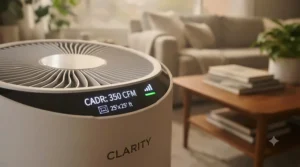
Where the Levoit tops out around a bedroom, the Winix 5510 is built to handle closer to 390 square feet, which pushes it into open-concept living room territory without a major price jump. It pairs a true HEPA filter with a carbon filter specifically chosen for odor absorption — a detail that matters more than people expect, because smoke’s lingering smell often outlasts the visible haze by hours.
Here’s what most buyers overlook about this model: it includes an auto mode driven by a built-in particle sensor, so during an actual smoke event it ramps itself up without you babysitting the dial at 3 a.m. Reviewers repeatedly single out the auto-sensing feature and the room coverage as the reasons it beats similarly priced competitors, while the more common complaint is that the sensor’s “clean air” threshold can feel a little generous compared to strict WHO guidance — it may ease off sooner than a health-conscious buyer would prefer.
For a renter in a two-bedroom apartment who wants one purifier to cover the main living space, this is a genuinely smart middle-ground choice, and it plays nicely as a second unit alongside a Core 300 in the bedroom.
Pros:
- ✅ Covers up to roughly 390 sq ft of open space
- ✅ Auto mode adjusts fan speed to real-time particle levels
- ✅ Strong carbon filtration cuts smoke odor, not just particles
Cons:
- ❌ Auto sensor can under-react to moderate smoke levels
- ❌ Larger footprint than pure bedroom-sized units
Expect a price in the $150-$200 range, positioning it as the natural step up once a single small purifier can’t keep pace with your square footage.
3. Blueair Blue Pure 311i+ Max — best for California apartments and shared HVAC buildings
If you live in a California apartment complex where central air is shared, poorly sealed, or simply absent, the Blue Pure 311i+ Max earns its spot here through sheer speed. Independent testing has clocked its smoke CADR high enough to clear a mid-sized room in around twelve minutes at top speed, and its footprint stays compact enough to tuck into a corner of a studio apartment without eating your floor plan.
What the spec sheet won’t tell you, but reviewers note repeatedly, is the filter-change indicator light — a small thing until you’re mid-smoke-event and realize your filter’s been saturated for two weeks. On paper this means fewer silent failures during exactly the window when failure matters most. Blueair’s SmokeStop-style carbon blend is also specifically engineered for the gas-phase pollutants wildfire smoke carries, not just particulate matter, which is a meaningfully different job than dust or pollen filtration.
Apartment dwellers consistently praise the low operating noise at medium speed and the fact that it doesn’t dominate a small living room visually. The recurring criticism is that, like most fast-CADR units, the top fan speed is noticeably louder — worth knowing if you’re a light sleeper running it overnight.
Pros:
- ✅ Very fast smoke clearance for its size class
- ✅ Filter-change indicator prevents silent performance loss
- ✅ Compact enough for studio and one-bedroom apartments
Cons:
- ❌ Top speed setting is noticeably loud
- ❌ Premium filters cost more than budget-tier competitors
Pricing typically lands in the $250-$350 range depending on configuration, positioning it as a mid-to-upper investment for renters who can’t rely on their building’s ventilation.
4. Coway Airmega AP-1512HH (Mighty) — the most broadly recommended all-rounder
The Coway AP-1512HH shows up on nearly every independent testing list for a reason: it consistently performs well at both high and low fan speeds, which is a harder trick than it sounds — plenty of units only shine at maximum output. Its washable pre-filter catches the big stuff (pet hair, ash flakes, coarse dust) before it ever touches the HEPA layer, which meaningfully extends the life of the expensive filter underneath.
Based on the spec comparison against similarly priced machines, the Coway’s real advantage isn’t raw CADR — it’s balance. Reviewers who own the AP-1512HH give it strong marks for reliability over years of ownership, not just performance out of the box, and that longevity is where the “expensive” filters actually earn their keep. It’s a slightly heavier, more substantial-feeling unit than the Blueair or Levoit, which some buyers read as a durability signal rather than a downside.
The one recurring criticism worth flagging: it lacks the app connectivity and voice-assistant integration some competitors offer, so if smart-home control matters to you, this isn’t the pick.
Pros:
- ✅ Strong performance at both high and low fan speeds
- ✅ Washable pre-filter extends HEPA filter lifespan
- ✅ Excellent long-term reliability reputation among owners
Cons:
- ❌ No smartphone app or voice assistant support
- ❌ Bulkier footprint than sleeker mid-range competitors
You’ll typically find the AP-1512HH in the $200-$250 range, making it one of the best-value picks for anyone who wants a “buy once, forget about it” purifier.
5. PureZone Mini Portable Air Purifier — best battery-powered personal unit
This is where the list pivots from whole-room machines to something built for a different job entirely: personal, on-the-go filtration. The PureZone Mini weighs under a pound, runs on a rechargeable lithium-ion battery rated for up to 12 hours, and uses a genuine two-stage system — activated carbon pre-filter plus true HEPA — shrunk down to fit a device roughly the size of a water bottle.
Here’s what most buyers overlook: this isn’t meant to clean a bedroom. It’s meant to clean the six or so square feet immediately around your face, which is a completely different and legitimate use case during an evacuation, a long drive through smoke-choked highways, or a night in a shelter where you have zero control over the building’s ventilation. Reviewers consistently frame it as a “car and travel” purifier first, bedroom backup second.
The honest tradeoff: because it’s cordless and compact, its CADR simply isn’t comparable to a full-size unit, and it shouldn’t be judged against one. Buyers who understand that going in report high satisfaction; buyers expecting bedroom-level clean air from a device this small tend to be disappointed.
Pros:
- ✅ Rechargeable battery runs up to 12 hours cordless
- ✅ Genuine two-stage HEPA and carbon filtration
- ✅ Under 1 lb — fits in a bag or car door pocket
Cons:
- ❌ Not a substitute for whole-room filtration
- ❌ Small filter surface area needs frequent replacement in heavy smoke
Priced under $60 in most cases, it’s an inexpensive add to any wildfire go-bag rather than a primary air-cleaning investment.
6. Airdog Aircap — battery-powered pick for cars and evacuation kits
The Aircap takes a genuinely different filtration approach worth understanding before you buy it: instead of a disposable HEPA cartridge, it uses an electrostatic (TPA) system with hand-washable plates, meaning you’re not restocking filters every few months. It’s roughly the size of a water bottle, battery-powered, and rated at a notably quiet 31 decibels even on its loudest setting — quiet enough to run overnight in a car during an overnight evacuation drive without it sounding like a hair dryer bolted to your dashboard.
What most buyers overlook about no-filter electrostatic designs like this one: because there’s no replaceable HEPA media, the manufacturer’s claimed particle-capture rate depends heavily on how consistently you rinse and dry the internal plates. Reviewers who stay on top of that maintenance report strong, sustained performance in cars and small offices; those who don’t tend to see the capture rate drift downward over time. It’s worth noting this model is restricted from shipping to California under that state’s air-cleaner regulations, so confirm availability in your area before buying.
For evacuation scenarios specifically — sitting in traffic on a smoke-choked highway, or running it in a hotel room after being displaced — the battery independence is the whole point.
Pros:
- ✅ No recurring filter costs — washable capture plates
- ✅ Extremely quiet even at top speed (31 dB)
- ✅ Purpose-built for car and evacuation use
Cons:
- ❌ Performance depends on regular plate cleaning
- ❌ Not shippable to California under state air-cleaner rules
Expect a price in the $100-$150 range, positioning it as a specialty pick for commuters and evacuation preparedness rather than a household’s primary purifier.
7. Austin Air HealthMate Jr (HM200) — premium choice for heavy, sustained wildfire smoke
When the CDC and FEMA-adjacent emergency literature references air purifiers specifically engineered for chemical and smoke events, Austin Air’s name comes up constantly, and the HealthMate Jr is the compact version of that reputation. It packs over 30 square feet of true HEPA media alongside roughly 6.5 pounds of activated carbon and zeolite — a genuinely industrial amount of gas-phase filtration crammed into a household-sized cylinder.
Based on the spec comparison, this unit’s real strength isn’t particle CADR speed (it’s actually a bit slower on pure particle tests than some smaller competitors) — it’s sustained odor and VOC neutralization during weeks of heavy smoke exposure, which is a different problem than a quick living-room refresh. Reviewers who’ve run it through multiple fire seasons consistently praise the five-year filter life and the fact that annual filter costs stay remarkably low despite the premium upfront price. The recurring, honest criticism is fan noise at higher speeds and a slower particle-clearing time versus lighter competitors — this is a marathon machine, not a sprinter.
For households in genuinely smoke-heavy regions who want a “set it and mostly forget it” solution for years at a time, it’s hard to beat.
Pros:
- ✅ Industrial-grade carbon and zeolite for VOC/odor removal
- ✅ Five-year filter life keeps long-term costs low
- ✅ Steel construction built for years of continuous use
Cons:
- ❌ Noticeably louder at higher fan speeds
- ❌ Slower raw particle-clearing speed than lighter competitors
Pricing typically runs $400-$500, with filter replacements averaging under $50 per year — a total cost of ownership that quietly beats flashier machines over a five-year span.
How HEPA Filters Actually Capture 0.3 Micron Smoke Particles
A true HEPA filter is certified to capture 99.97% of airborne particles at 0.3 microns — a benchmark chosen deliberately, because 0.3 microns sits in what filtration engineers call the “most penetrating particle size,” the size range hardest for any fibrous filter to trap. Wildfire smoke particles typically fall in the 0.4 to 0.7 micron range, meaning a certified HEPA filter is actually working in its strong zone, not its weak one, when it comes to smoke.
Here’s the part that trips people up: HEPA filters don’t work like a sieve, catching only particles bigger than the mesh holes. They trap particles through three combined mechanisms — impaction, interception, and diffusion — which is exactly why they’re just as effective, sometimes more effective, against tiny particles as larger ones. Independent certification through AHAM’s Verifide program is what separates a manufacturer’s marketing claim from an actual verified number, since AHAM tests are conducted by accredited third-party labs rather than self-reported by the brand.
The carbon layer sitting alongside the HEPA filter is doing an entirely separate job: HEPA traps particulate matter, but it does essentially nothing against the gaseous VOCs and that acrid smell that make a smoke event feel inescapable. That’s why every genuinely effective wildfire purifier on this list pairs HEPA with a substantial activated carbon bed — one without the other leaves half the problem untouched.
Battery-Powered Air Purifiers for Wildfire Smoke and Evacuation Kits
Grid power is not a guarantee during a wildfire. Rolling blackouts during Public Safety Power Shutoffs are now routine in fire-prone regions, and if you’re told to evacuate, your first-choice HEPA tower is staying behind, plugged into an outlet you’re driving away from. This is the exact gap battery-powered units like the PureZone Mini and Airdog Aircap fill — not as replacements for your main purifier, but as a second line of defense that travels with you.
If you’re building a wildfire evacuation kit, treat air purification the same way you’d treat a flashlight or a first-aid kit: something you grab without thinking, because you assembled it in advance. A practical setup looks like this — a personal battery-powered unit clipped to your car’s air vent or console for the drive itself, a spare charge cable, and a plan for where you’ll plug in a proper HEPA unit once you reach a hotel, shelter, or relative’s house.
| Feature | PureZone Mini | Airdog Aircap |
|---|---|---|
| Battery life | Up to 12 hours | ~1 hr high / 3 hrs low per charge |
| Filter type | True HEPA + carbon | Washable electrostatic (TPA) |
| Noise (loudest) | Low-moderate | 31 dB |
| Best use case | Travel, bedside, shelters | Cars, commutes, evacuation drives |
| Price range | Under $60 | $100-$150 range |
Reading the table above, the PureZone wins on runtime and simplicity, while the Aircap wins on long-term cost since there’s no filter to keep buying — but it demands more upkeep from you personally. If you’re the type who forgets to rinse a filter plate every few weeks, the PureZone’s disposable HEPA cartridge is the more forgiving choice, even if it costs a little more over time.
✨ Building a go-bag this weekend? Grab a battery-powered unit now — you’ll be glad it’s already charged the next time the sky turns orange.
Best Small Air Purifiers for Wildfire Smoke: Choosing for Tight Spaces
Small apartments and dorm rooms create a specific problem: most air purifier marketing assumes you’re filling a living room, when what you actually need is quiet, efficient coverage for maybe 150 to 250 square feet without the unit eating a third of your floor space. The Levoit Core 300 exists almost entirely to solve this, and its cylindrical footprint — under nine inches in diameter — means it tucks beside a nightstand without becoming furniture you have to plan a room around.
The mistake people make in small spaces is assuming bigger CADR is automatically better. It isn’t, once you’re oversized for the room — you’re just paying for airflow capacity you’ll never use, and often accepting more noise and higher wattage for no real benefit. For a small bedroom, matching a unit’s suggested square footage closely to your actual room size (not your whole apartment) gets you quieter operation and lower energy costs without sacrificing air quality.
Air Purifier Wattage and Portable Power, Explained
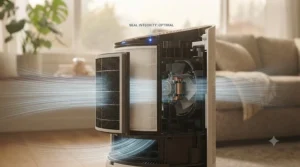
Wattage is the number everyone skips past on the spec sheet, right up until their electricity bill jumps during a two-week smoke event when they’re running the unit 24/7. The good news: even the more power-hungry units on this list draw relatively modest wattage compared to something like a space heater or window AC unit — we’re talking roughly 25 to 55 watts across most of these machines at typical operating speeds.
Here’s the practical math: a 45-watt unit run continuously for a month costs somewhere in the neighborhood of $3-$5 at average U.S. residential electricity rates, while a 26-watt smart model can cost less than half that. Multiply that by however many units you’re running per apartment, and it’s still dramatically cheaper than most people assume — running clean air isn’t the expensive part of a smoke event; replacing filters and, if it comes to it, evacuating are.
For battery-powered units, the relevant number isn’t watts but runtime-per-charge, since you’re not plugged into anything. A unit rated for 12 hours on a full charge gives you a full overnight cycle without needing to hunt for an outlet — genuinely useful information if you’re sheltering somewhere with limited power access.
Setting Up Your Portable Air Purifier: A Practical Usage Guide
Getting a new purifier out of the box and running it correctly during an actual smoke event are two different skill levels, and most people never learn the second one until they’re already coughing.
First, placement matters more than most manuals explain. Set the unit in the room you’ll spend the most time in — ideally a bedroom, since you’ll be breathing that air for eight uninterrupted hours — and keep at least a foot of clearance on all sides so air can actually circulate through it rather than recycling stale air trapped against a wall.
Second, per EPA guidance on reducing indoor smoke exposure, the strategy that actually works is creating a single “clean room” rather than trying to purify your whole home evenly. Pick the room with the fewest windows and no fireplace, close it off, and concentrate your purifier’s power there instead of spreading thin air-cleaning capacity across every room.
Third, during the first thirty days, resist the urge to run everything on low to save on noise — run new filters on high for the first hour after installation, per most manufacturer guidance, to properly seat the filter media and clear any manufacturing residue. After that, running continuously on a medium setting during active smoke events beats cycling the unit on and off, since restarts waste more energy pulling the air quality back down than steady operation ever does.
Common first-month mistakes: forgetting to remove the plastic film covering a brand-new HEPA filter, placing the unit directly against a wall or curtain that blocks intake, and waiting for visible smoke haze indoors before turning the purifier on — by then, you’re already behind.
Real-World Scenarios: Matching the Right Purifier to Your Situation
The California apartment renter. You’re in a 650-square-foot one-bedroom with shared, aging HVAC that does nothing to filter smoke. Your best bet is the Blue Pure 311i+ Max in the living room for speed, paired with a Levoit Core 300 in the bedroom for quiet overnight coverage — two smaller units beat one oversized one for split floor plans.
The family in a smoke-heavy foothill town. You’re dealing with weeks, not days, of poor air quality every fire season, in a house over 1,000 square feet. The Austin Air HealthMate Jr in the main living space, backed by a Coway AP-1512HH in the primary bedroom, gives you sustained VOC control where you spend your days and dedicated particle filtration where you sleep.
The commuter who evacuates on short notice. Your biggest risk window is the two hours you might spend driving through active smoke to reach safety. The Airdog Aircap clipped near your car’s vents, plus a PureZone Mini as backup, means you’re never breathing raw wildfire smoke during the drive itself, regardless of what’s happening to your home’s HVAC system.
How to Choose a Portable Air Purifier for Wildfire Smoke
- Measure your actual room, not your apartment. Match the unit’s suggested square footage to the specific room you’ll run it in most — oversizing wastes money, undersizing leaves you exposed.
- Confirm true HEPA, not “HEPA-type.” Only certified true HEPA filtration reliably hits the 99.97% capture rate at 0.3 microns that wildfire smoke requires.
- Check for a substantial activated carbon layer. Particle filtration alone won’t touch the gases and smell that define a smoke event.
- Look for AHAM Verifide certification. It confirms the CADR number on the box was independently tested, not just claimed.
- Decide if you need battery independence. If evacuation risk is real in your area, at least one battery-powered unit belongs in your kit.
- Calculate wattage against realistic runtime. If you’ll run it 24/7 for weeks, energy cost differences between models actually add up.
- Price the filters, not just the unit. A cheaper purifier with expensive, frequent filter replacements can cost more over three years than a pricier unit with a five-year filter.
Common Mistakes When Buying an Air Purifier for Wildfire Smoke
The single most common mistake is buying based on square footage alone without checking the smoke-specific CADR number — a unit rated for “large rooms” using its dust or pollen CADR can still underperform on smoke particles specifically, since manufacturers aren’t required to lead with the lowest number.
A close second: assuming any purifier with a carbon component is equally good at odor control. Carbon quantity varies wildly between models — a thin carbon sheet barely dents lingering smoke smell, while several pounds of activated carbon pellets, like Austin Air uses, genuinely neutralizes it over hours.
Third, people frequently buy a single oversized unit for an entire home instead of two or three smaller units placed strategically. Airflow doesn’t travel efficiently through hallways and closed doors, so one purifier in a central location often leaves bedrooms comparatively unprotected overnight — exactly when you need clean air most.
Portable Air Purifiers vs. Whole-House HVAC Filtration
| Factor | Portable Air Purifier | Whole-House HVAC Filter |
|---|---|---|
| Setup | Plug in, done | Requires compatible ductwork |
| Coverage | Room-by-room, targeted | Whole home, if system runs constantly |
| Smoke-specific performance | Purpose-built HEPA + carbon | Depends on MERV rating, often lower |
| Portability | Fully portable, evacuation-ready | Fixed to the building |
| Best For | Renters, targeted clean rooms, evacuees | Homeowners with modern HVAC systems |
The analysis here is straightforward: a whole-house system only helps if it’s actively circulating and fitted with a high-MERV filter, and even then, most residential HVAC systems aren’t rated to handle continuous heavy smoke loads the way a dedicated portable HEPA unit is. Portable units also win decisively for renters, since you can’t swap out a landlord’s HVAC filter media, and they’re the only option that comes with you if you evacuate. For homeowners with a newer HVAC system already fitted with a high-efficiency filter, running both in tandem — HVAC on recirculate mode plus a portable unit in your clean room — offers the strongest overall protection.
Long-Term Cost and Maintenance: Filters, Wattage, and Real Ownership Costs
Sticker price is the least important number on any of these machines. What actually determines cost over a five-year span is filter frequency multiplied by filter price, plus wattage multiplied by your local electricity rate, run continuously during smoke season.
A budget unit like the Core 300 with $20-$30 filters replaced roughly every six to eight months costs meaningfully more in filters over five years than its low upfront price suggests, while the Austin Air HealthMate Jr’s higher initial cost is offset by a five-year filter life that rarely needs touching. Neither is objectively “cheaper” — it depends entirely on how many years you plan to own the unit and how heavily your region is affected by smoke season after season.
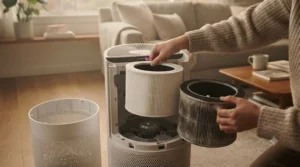
Maintenance beyond filter swaps is minimal but not optional: vacuum the exterior intake grilles monthly during active smoke events, since ash and soot accumulate faster than normal household dust and can restrict airflow. For electrostatic units like the Aircap, rinsing the capture plates on the schedule the manufacturer recommends isn’t a suggestion — skip it, and captured particles start recirculating instead of staying trapped.

Compact Air Purifiers for Smoke Emergencies: Building a Go-Bag
If you live somewhere evacuation orders are a realistic possibility, air purification deserves a permanent spot in your emergency kit, right alongside water and a first-aid kit. Per CDC safety guidance for wildfires and wildfire smoke, people with asthma, COPD, heart disease, or who are pregnant face meaningfully higher risk from smoke exposure, which makes portable, pre-charged air filtration a genuinely protective addition rather than an overcautious one.
A practical go-bag setup: a fully charged battery-powered unit like the PureZone Mini or Airdog Aircap, a spare charging cable, at least one backup filter if your model uses disposable HEPA media, and NIOSH-approved N95 respirators for the moments you can’t stay indoors at all. Keep the whole kit in one bag by your door — the goal is grabbing it without thinking, not assembling it while smoke is already visible outside your window.
Frequently Asked Questions
❓ Do portable air purifiers actually work against wildfire smoke?
❓ What CADR do I need for wildfire smoke specifically?
❓ Can a battery-powered air purifier replace a full-size unit at home?
❓ How often should I replace my air purifier's filter during fire season?
❓ Is a HEPA filter enough, or do I need activated carbon too?
Conclusion
Wildfire season isn’t going anywhere, and neither is the mild dread that shows up every time the air quality app on your phone turns an ominous shade of purple. But this isn’t a problem you have to solve with panic-buying at 11 p.m. — a Levoit Core 300 in the bedroom, something with real carbon capacity in the living room, and a battery-powered unit tucked into your evacuation bag covers the overwhelming majority of situations you’re likely to face, at a total cost that’s genuinely modest next to what a bad smoke week can do to your lungs. Pick based on your actual square footage, your actual risk of evacuation, and how many years you plan to own the thing — not on whichever unit has the flashiest app. Clean air is one of the few emergency preparedness items that also quietly improves your ordinary Tuesday, carbon filter and all.
✨ Don’t Miss These Exclusive Deals!
🔍 Take your indoor air quality to the next level with these carefully selected picks. Click through to check current pricing and availability before the next smoke advisory hits your area!
Recommended for You
- Air Purifier for Wildfire Smoke: 7 Picks That Actually Work (2026)
- 7 Best Air Purifiers for Smoke in 2026
- 7 Best Air Purifiers for an Asthmatic Child in 2026
Disclaimer: This article contains affiliate links. As an Amazon Associate, I earn from qualifying purchases. If you purchase products through these links, we may earn a small commission at no additional cost to you.
✨ Found this helpful? Share it with your friends! 💬🤗
