
In This Article
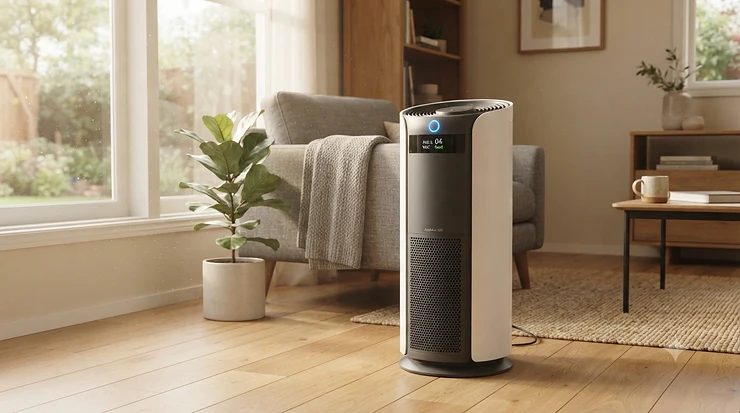
If you’ve ever walked into a room the morning after cooking bacon, or opened your front door during a wildfire smoke advisory and smelled it before you saw it, you already know that smoke is sneaky. It doesn’t just float around as visible haze — a huge share of it is gas-phase odor molecules and ultra-fine particles small enough to slip past a basic filter and settle into your couch cushions for days.
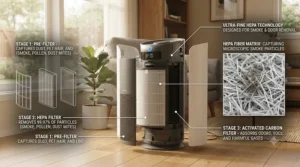
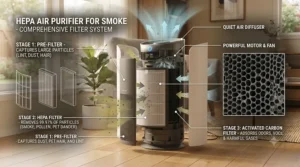
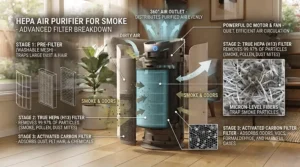
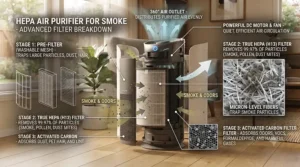
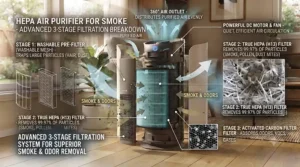
That’s exactly why a dedicated air purifier for smoke is a different animal from a generic “air purifier for allergies” model. Smoke removal depends on two things working together: a HEPA-grade particle filter to grab the visible stuff, and a real bed of activated carbon to adsorb the gases and odor compounds that HEPA alone can’t touch. Skip the carbon, and you’ll have cleaner-looking air that still smells like last night’s stir-fry.
In 2026, with wildfire seasons stretching longer across the western and southern U.S., the market for smoke-specific purifiers has gotten genuinely competitive — and genuinely confusing. Brands stack spec sheets with CADR numbers, micron ratings, and “True HEPA” claims that don’t always mean what they imply (more on that below).
So instead of just listing specs, I pulled 7 real, currently available models — spanning a $70 bedroom unit to a $400+ whole-room machine — and broke down what each one’s numbers actually mean for someone trying to clear cooking smoke, cigarette smoke, or wildfire haze out of a real living space. You’ll get expert commentary on who each one fits, a full buying framework, and the maintenance details nobody puts on the box.
What Is an Air Purifier for Smoke?
An air purifier for smoke is a portable air cleaner built specifically to remove both the fine particulate matter and the gaseous odor compounds found in tobacco, cooking, and wildfire smoke. It combines a HEPA or HEPA-grade particle filter with a substantial activated carbon bed, and its effectiveness is measured by its smoke-specific Clean Air Delivery Rate (CADR) — the higher the number, the faster it clears a given room.
Quick Comparison Table
| Category | Pick | Smoke CADR | Best For |
|---|---|---|---|
| 🏆 Best Overall Value | Medify MA-40 | ~330 CFM | Heavy smoke odor, mid-size rooms |
| 💰 Best Budget | GermGuardian AC4825 | ~100-120 CFM | Small bedrooms, dorms |
| 🏠 Best for Large Rooms | Coway Airmega 400 | ~328-350 CFM | Open-plan living areas |
| 🔇 Best Quiet/Smart Pick | Blueair Blue Pure 311i+ Max | 300 CFM | Bedrooms, app control fans |
| ⚡ Best CADR-Per-Dollar | Honeywell HPA300 | 300 CFM | Budget large-room coverage |
A quick look at this table tells most of the story: there’s no single “best” pick, only a best fit for your room size and budget. Medify MA-40 earns the value crown because it pairs a genuinely deep carbon-pellet filter with True HEPA H13 media at a price closer to budget units than premium ones. If you only have a small bedroom, paying for the Coway Airmega 400‘s 1,560-sq-ft coverage would be overkill — that’s where the GermGuardian AC4825 earns its keep instead.
💬 Just one click — help others make better buying decisions too!😊
Top 7 Air Purifiers for Smoke: Expert Analysis
I researched each of these directly on their current Amazon listings, cross-checked the manufacturer specs against independent lab testing, and dug into real customer feedback. Prices shift constantly on Amazon, so treat every figure below as a snapshot — always check current pricing before you buy.
1. Levoit Core 300S-P
The Core 300S-P is Levoit’s smart, budget-friendly entry, and it’s become one of the best-selling HEPA-style purifiers on Amazon for a reason.
It carries an AHAM-verified smoke CADR around 141 CFM, which puts its ideal coverage at roughly 219 sq ft for full air-change performance — think bedroom or home office, not open-concept living room. What most buyers overlook here is that Levoit had to drop the “True HEPA” label from this exact model after a dispute over independent testing standards; it’s still a capable 3-stage filter (pre-filter, HEPA-grade media, activated carbon), just marketed more conservatively now. The optional Smoke Remover filter swaps in extra carbon for households dealing with cigarette or wildfire odor specifically.
Customer feedback consistently praises the 22dB sleep mode and the VeSync app’s scheduling, though a recurring complaint is that the auto-mode sensor treats anything under 35 µg/m³ PM2.5 as “very good” — a much looser threshold than the WHO’s 5 µg/m³ annual guideline, so it may throttle down before air is truly clean.
In my view, this is the right purifier for renters and smart-home users who want hands-off bedroom-scale smoke control, not whole-apartment coverage.
✅ Quiet 22dB sleep mode
✅ Alexa/Google + app control
✅ Affordable $25-35 replacement filters
❌ Modest CADR for rooms over ~250 sq ft
❌ Auto-mode sensor threshold is generous, not strict
Price range: around $90-$130. For the smart features and specialty smoke filter option, it’s solid value for small-to-medium rooms.
2. GermGuardian AC4825
If your budget is the deciding factor, the AC4825 is the name that keeps coming up, and it’s been a staple since 2012.
Its CADR sits in the 100-120 CFM range depending on which lab’s numbers you trust, rated for rooms up to about 167 sq ft. The catch — and it’s an important one — is that the carbon layer here is a thin fabric impregnated with charcoal, not the denser carbon-pellet beds used in pricier models. That means it’ll knock down light cooking odor and dust just fine, but it gets overwhelmed faster against heavy cigarette smoke or a wildfire smoke event.
Reviewers consistently note the lowest fan speed doubles as genuine white noise for sleeping, and filter swaps are cheap at roughly $54/year. The tradeoff most people miss: at 44W with the UV-C light running, it’s actually one of the less energy-efficient motors in this lineup, pushing closer to $65-70/year in electricity if run continuously.
This is the right call for a dorm room, a small home office, or anyone who just needs “good enough” coverage without spending three figures.
✅ Lowest price point in this roundup
✅ Near-silent on low speed
✅ Cheap, widely available replacement filters
❌ Thin carbon layer struggles with heavy smoke
❌ Higher running cost than its price suggests
Price range: around $70-$100, making it the most accessible entry point here.
3. Honeywell HPA300
The HPA300 has one job — move a lot of air through a HEPA filter cheaply — and it does that job better than almost anything else near its price.
Independent testing clocked it clearing a smoke-filled test room in around 20 minutes on Turbo, a result that matches purifiers costing nearly double. Its AHAM smoke CADR of 300 CFM (465 sq ft rated coverage) is genuinely rare at this price tier. What the spec sheet won’t tell you is that this CADR comes from raw fan power rather than finesse — there’s no auto mode, no app, and at Turbo speed it hits nearly 60 dBA, loud enough to interrupt a movie night.
The carbon here is a pre-filter pad rather than a deep bed, so it leans harder into “great at particles, decent at odor” than the Medify or Winix below. Annual filter costs run $78-89 for genuine Honeywell filters, or roughly half that with compatible third-party options.
I’d point this at anyone who wants the highest CADR-per-dollar in a large room and is fine running it on low most of the day, reserving Turbo for right after a cooking mishap.
✅ Exceptional CADR for the price
✅ Simple, foolproof manual controls
✅ Filters are everywhere and cheap to replace
❌ Loud at Turbo speed
❌ No auto mode, no app, no smart features
Price range: around $190-$250.
4. Winix 5500-2
The 5500-2 has stuck around for years as a go-to mid-range pick, mostly because of its unusual extra stage: PlasmaWave.
Its CADR breaks down to 232 smoke / 243 dust / 246 pollen CFM, rated for 360-sq-ft rooms — a believable middle ground between the Levoit and Honeywell above. The 4-stage system includes a washable carbon pre-filter (a nice cost-saver since you’re not replacing it as often), a True HEPA filter, and the PlasmaWave ionizer, which creates hydroxyl radicals to help break down odor molecules. The detail worth knowing: PlasmaWave can be switched off entirely, which matters if you’re sensitive to the trace ozone it produces when active.
The auto-mode sensor here only tracks odors, not particulate, so it’s noticeably better at catching a smoking event than a dusty one. Customers consistently mention the remote control as a genuine convenience most competitors skip.
This is the practical pick for households where lingering odor — smoke, cooking, pets — is the bigger complaint than visible dust.
✅ Washable carbon pre-filter saves money long-term
✅ Remote control included
✅ Strong CADR-to-price ratio
❌ PlasmaWave emits trace ozone when active
❌ Auto mode reacts to odor, not particles
Price range: around $160-$230 (MSRP near $250, frequently discounted).
5. Medify MA-40
If smoke odor specifically — not just particles — is your main complaint, the MA-40 is the one I’d point you toward first.
It uses genuine True HEPA H13 media (a tighter-rated filter than the standard H11/H13 mix many competitors use) paired with what the brand calls a “substantial” carbon-pellet filter, not the thin impregnated fabric you’ll find in cheaper units. In practice, that pellet bed is the difference between a purifier that hides odor for an hour and one that actually adsorbs it. Coverage claims run from 840 sq ft (at a thorough 2 air-changes-per-hour) up to 1,793 sq ft at a lighter single pass, with CADR figures in the 330-400+ CFM range depending on the testing standard cited.
The honest tradeoff: there’s no app, no auto mode, and at 46-66 dB it’s noticeably louder than the Blueair below at comparable speeds. Filters need replacing roughly every 4-5 months under heavy smoke load (the unit tracks this on a 3,000-hour counter), running $70-90 per swap.
For wildfire-prone regions or heavy smokers needing serious odor control without paying smart-home pricing, this is the sweet spot.
✅ True HEPA H13 + dense carbon-pellet bed
✅ Backed by a USA-registered lifetime warranty
✅ Strong coverage-to-price ratio
❌ No app or auto mode
❌ Louder than smart competitors at top speed
Price range: around $200-$280 depending on size and color bundle.
6. Coway Airmega 400
For genuinely large, open spaces, the Airmega 400 is the most consistently recommended large-room purifier across independent testers, and after digging into the reviews, it’s easy to see why.
Rated for 1,560 sq ft at a real 2 air-changes-per-hour (or 3,120 sq ft at a lighter single pass), its CADR sits around 328-350 CFM for smoke depending on the lab. The dual Max2 filter combines HEPA and activated carbon in one cartridge, backed by a washable pre-filter that extends the main filter’s life. What stood out most in long-term testing: during a 36-hour wildfire smoke event, real-world performance landed remarkably close to the rated CADR — most purifiers only hit 60-75% of their spec sheet numbers once furniture and real airflow get involved.
The base “400” skips Wi-Fi and an app entirely (that’s reserved for the pricier “400S” sibling), but you still get Smart/Eco/Sleep auto modes driven by an onboard particle sensor and a clearly visible color-coded air quality ring.
This is the purifier for an open-plan living room or anyone treating an entire main floor during smoke season, not a single bedroom.
✅ Real-world CADR retention is unusually strong
✅ Whisper-quiet on low (22 dB) despite high CADR
✅ Annual filter swaps — simple maintenance rhythm
❌ No Wi-Fi/app on the base model
❌ Large, heavy footprint (24.7 lbs)
Price range: typically $350-$450 — it’s a premium-tier purchase, but the coverage backs it up.
7. Blueair Blue Pure 311i+ Max
The 311i+ Max takes a different technical approach, and it shows in how it performs.
Instead of forcing all the work through a thick mechanical HEPA filter, Blueair’s HEPASilent technology adds an electrostatic charge stage, letting the unit hit a 300 CFM smoke/dust/pollen CADR at noticeably lower fan speeds, noise, and power draw than a pure-mechanical design would need to match it. Quiet Mark certification and an Energy Star Most Efficient rating back that up — it tops out around 50 dB even on high, and its RealTrack algorithm stretches filter life to roughly 9 months instead of the usual 6.
The real-world insight: in side-by-side particle-removal testing, the 311i+ Max needed about 27 minutes to fully clear a test room, slower than some cheaper purifiers but at a fraction of the noise — a genuinely different tradeoff than raw-CADR competitors like the Honeywell.
I’d recommend this for bedrooms and apartments where 24/7 background noise and app-based scheduling matter as much as outright speed.
✅ Outstanding noise-to-performance ratio
✅ App control with auto mode and filter tracking
✅ Energy Star Most Efficient rated
❌ Carbon layer isn’t pellet-based, so less aggressive against heavy odor
❌ Some users report a faint buzz at max fan speed
Price range: around $200-$280.
How to Set Up and Maintain Your Smoke Air Purifier
Getting the hardware right is half the job — setup and upkeep determine whether it actually performs months from now.
First 48 hours: Unwrap every filter completely (plastic film left on accidentally is a surprisingly common first-week complaint across brands). Place the unit at least a foot from walls and furniture so air can circulate on all sides, and run it on a higher speed for the first day to “season” a new carbon filter before settling into auto mode.
Ongoing maintenance: Vacuum or wipe down washable pre-filters every 2-4 weeks — this single habit extends the life of the expensive HEPA/carbon stage behind it more than almost anything else you can do. During active wildfire smoke events, expect to replace carbon filters faster than the “every 6-8 months” default; heavy smoke saturates carbon bed capacity quickly, and a saturated filter stops adsorbing odor even while still looking clean.
Common 30-day mistakes: Running the unit on auto mode in a room with an overly lenient sensor threshold (see the Levoit note above), placing it in a corner where airflow is restricted, and forgetting to register for filter-replacement reminders through whichever app or VeSync/Blueair account applies to your model.
Real-World Scenarios: Matching the Right Purifier to Your Situation
The apartment renter dealing with neighbor’s cigarette smoke seeping through vents: A bedroom-sized unit with a real carbon bed matters more than raw CADR here, since odor — not visible particulate — is the complaint. The Medify MA-40 or Levoit Core 300S-P (with the Smoke Remover filter) both fit, depending on budget.
The wildfire-region homeowner with an open-plan main floor: Coverage is the priority. The Coway Airmega 400’s 1,560-sq-ft rating and proven real-world CADR retention during actual smoke events make it the practical choice, even at a higher price point.
The light cook who just wants kitchen smoke gone fast without noise complaints: Quiet, responsive auto mode beats raw power. The Blueair Blue Pure 311i+ Max’s app-driven auto mode and low noise floor suit a kitchen-adjacent living space well.
How to Choose an Air Purifier for Smoke
- Match CADR to room size, not the marketing headline. The EPA recommends a smoke-specific CADR at least two-thirds of your room’s square footage; AHAM’s stricter rule of thumb is CADR roughly equal to room area.
- Check the carbon, not just the HEPA grade. A thin fabric carbon pre-filter and a dense pellet bed both get called “activated carbon filter” — only one actually holds up against sustained smoke odor.
- Decide if auto mode actually helps you. A sensor with a lenient “good air” threshold may shut down before air is genuinely clean — useful to know before relying on it during a smoke event.
- Factor in noise tolerance for bedroom use. A unit’s max-speed dB rating matters far more than its low-speed rating if you’ll ever need to run it on high overnight.
- Budget for filters, not just the unit price. Annual filter cost can range from $50 to $150+ depending on the model — a cheaper purifier with expensive filters can cost more over three years than a pricier one with cheap filters.
- Confirm it’s ozone-free. Look for CARB compliance and Zero Ozone Verified certification, especially if considering any model with an ionizer or UV-C add-on.
HEPA vs Activated Carbon: What Actually Matters for Smoke
| Filter Type | What It Removes | Limitation |
|---|---|---|
| HEPA / True HEPA | Visible smoke particles, dust, pollen (down to 0.3 microns or smaller) | Does nothing for gases, VOCs, or lingering odor |
| Activated Carbon | Gases, VOCs, odor molecules (smoke smell itself) | Saturates and needs frequent replacement under heavy smoke load |
Looking at the table above, the real takeaway is that neither stage works alone against smoke. HEPA captures what you can see; activated carbon handles what you can smell — and smoke is unusual among indoor pollutants because both halves matter equally. A purifier with a strong HEPA rating but a thin carbon pad, like the GermGuardian AC4825, will visibly clear haze while the smell lingers; one with a deep carbon-pellet bed, like the Medify MA-40, tackles both simultaneously.
Common Mistakes When Buying an Air Purifier for Smoke
Buyers consistently make a handful of avoidable errors. The biggest one: sizing a purifier for square footage alone while ignoring ceiling height — a 10-foot ceiling needs meaningfully more CADR than an 8-foot one for the same floor area. The second is assuming “HEPA” automatically means odor control; as covered above, that’s the carbon filter’s job, not HEPA’s. Third, people often buy based on a single CADR number without checking whether it’s the smoke-specific figure or an average across smoke, dust, and pollen — these can differ by 20% or more on the same unit. Finally, many buyers skip checking ongoing filter costs entirely, only to discover a “budget” purifier’s filters cost more annually than a pricier model’s.
Long-Term Cost & Maintenance: What Filters Really Cost
Sticker price is only part of the equation. Across the 7 models here, annual filter costs range from roughly $54 (GermGuardian) to $90+ (Medify, under heavy smoke load), and electricity costs vary even more — the Blueair’s 30W motor costs a fraction of the Honeywell’s 76W draw at top speed over a year of continuous use. If you’re running a purifier 24/7 through an entire smoke season, a $250 unit with a $40W motor and $45/year filters can end up cheaper over three years than a $150 unit with a power-hungry motor and pricier replacement cartridges. Always check manufacturer filter pricing before comparing sticker prices alone.
Features That Actually Matter (And Those That Don’t)
Matters: real CADR numbers from AHAM-verified testing, carbon filter weight/depth, max-speed noise level if used in a bedroom, and filter replacement cost over a full year.
Doesn’t matter much: UV-C sanitizing lights (largely unproven on portable units at these price points, per multiple independent reviewers), app connectivity if you’d never actually check it, and night-light or color-changing displays that add cost without affecting air quality.
What to Expect: Real-World Performance During a Smoke Event
Lab-rated CADR numbers assume an empty, sealed test chamber — real rooms with furniture, doorways, and imperfect sealing typically deliver 60-85% of the rated figure. During an actual wildfire smoke event, the EPA recommends creating a single “clean room” — an interior space with minimal windows — rather than trying to purify an entire house at once, since a correctly-sized purifier in one sealed room will outperform an underpowered one trying to cover the whole home. You can find detailed guidance on setting up a clean room at home directly from the EPA’s wildfire smoke resources.
Air Purifiers vs. Traditional Alternatives
| Method | Effectiveness vs. Smoke | Best For |
|---|---|---|
| Dedicated air purifier | High (HEPA + carbon) | Ongoing, year-round odor & particle control |
| MERV-13 HVAC filter upgrade | Moderate-High (particles only) | Whole-home coverage if you have central air |
| DIY box-fan air cleaner | Moderate (particles only) | Emergency, low-budget situations |
| Opening windows | Low to negative during smoke events | Never recommended during active smoke |
The analysis here is straightforward: a dedicated purifier is the only option on this list that handles both particles and odor gases in one device. EPA-funded laboratory testing has shown that even a DIY box-fan-and-filter setup can rival commercial units on raw particle removal in an emergency, but it does nothing for the carbon-dependent odor problem, and it’s a stopgap, not a long-term solution. Opening windows during an active smoke event is explicitly discouraged by health agencies, since it lets outdoor smoke in faster than any indoor purifier can clear it.
✨ Don’t Miss These Exclusive Deals!
🔍 Take your indoor air quality to the next level with these carefully selected smoke-fighting purifiers. Click on any highlighted model to check current pricing and availability. These picks will help you create the clean, breathable home your family deserves!
Safety, Regulations, and Ozone-Free Compliance
Not every “air purifier” on Amazon is created equal from a safety standpoint. CARB (California Air Resources Board) certification confirms a unit doesn’t generate excessive ozone — a genuine health risk in its own right, ironically marketed by some ionizing models as a feature. Every product covered above carries CARB compliance, and several (GermGuardian, Honeywell, Medify, Winix) are explicitly Zero Ozone Verified by Intertek or similar third-party labs. If you’re shopping outside this list, treat the absence of CARB certification as a hard pass, especially for any unit advertising an ionizer, UV-C add-on, or “plasma” technology. For broader guidance on indoor air strategies during smoke events, including HVAC filter upgrades and clean-room setup, the EPA’s wildfire and indoor air quality page is a genuinely useful free resource.
FAQ
❓ Does an air purifier for smoke really remove the smell?
❓ How fast does an air purifier clear smoke from a room?
❓ What CADR rating do I need for wildfire smoke?
❓ Is HEPA or activated carbon better for an air purifier for smoke?
❓ How often should I replace filters during smoke season?
Conclusion
There’s no universal “best” air purifier for smoke — there’s a best fit for your room size, noise tolerance, and how much you’re willing to spend on filters every year. If you take one thing from this whole comparison, let it be this: check the carbon filter, not just the HEPA rating. A purifier that only handles particles will leave you with cleaner-looking air that still smells like smoke, and that defeats half the point of buying one in the first place.
For most households dealing with everyday cooking or cigarette odor in a single room, the Medify MA-40 hits the best balance of real carbon filtration and price. If you’re covering an entire open-plan living space through wildfire season, the Coway Airmega 400’s proven real-world performance justifies its higher cost. And if quiet, app-driven background operation matters more than raw speed, the Blueair Blue Pure 311i+ Max is worth the premium.
Whichever you choose, match the CADR to your actual room size, budget for filters honestly, and confirm CARB/ozone-free certification before you buy.
Recommended for You
- 7 Best Air Purifiers for an Asthmatic Child in 2026
- 7 Best Air Purifiers for Asthma in 2026 (Real HEPA Picks)
- Air Purifier for Dust Mite Allergy: 7 Best Picks in 2026
Disclaimer: This article contains affiliate links. As an Amazon Associate, I earn from qualifying purchases. If you purchase products through these links, we may earn a small commission at no additional cost to you.
✨ Found this helpful? Share it with your friends! 💬🤗
