
In This Article
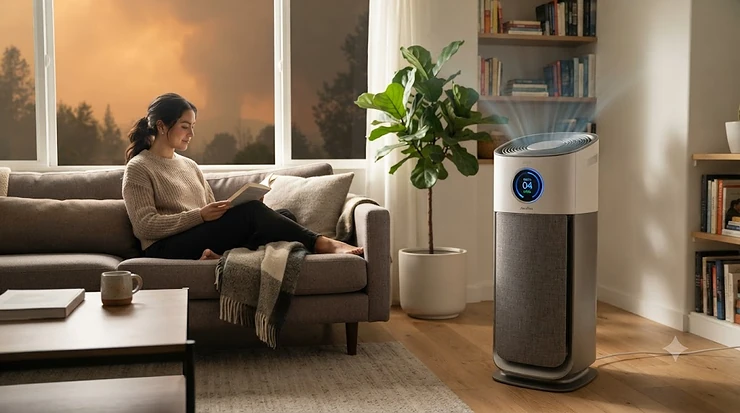
The sky turns the color of a bruise, your phone buzzes with an air quality alert, and suddenly the inside of your own living room smells like a campfire that never got put out. That’s wildfire smoke season, and if you’ve lived through even one bad week of it, you already know that closing the windows is not the same thing as solving the problem. An air purifier for wildfire smoke is a portable filtration device built to strip fine particulate matter and gaseous compounds out of your indoor air fast enough to matter during an active smoke event, not just a general-purpose dust catcher with a marketing makeover. The distinction matters more than most shoppers realize, because plenty of purifiers that do a fine job on pet dander get overwhelmed the moment PM2.5 concentrations spike into the hundreds
 .
.
Here’s what most buying guides skip: wildfire smoke is really two separate problems wearing one trench coat. There’s the particulate side — the microscopic ash and soot that a good HEPA filter traps — and there’s the gas side, the formaldehyde, benzene, and acrolein that slip straight through HEPA media like it isn’t even there. The EPA’s wildfire indoor air quality guidance covers this dual threat in more depth if you want the full regulatory picture. Based on the spec comparisons in this guide, a purifier that only excels at one half of that equation will leave you breathing cleaner-looking air that still smells and behaves like a chemistry set. We researched seven real, currently available models spanning roughly $180 to $1,000, verified their published CADR ratings and filtration architecture, and pulled in aggregated review sentiment from independent testers who’ve actually run these machines through smoke and fog tests. What follows is a straightforward breakdown of what each one does well, who it’s actually built for, and where the marketing outruns the engineering.
Quick Comparison: 7 Air Purifiers for Wildfire Smoke
| Product | Best For | Room Coverage | Price Range |
|---|---|---|---|
| Winix 5510 | Budget bedrooms | Up to ~390 sq ft | Under $250 |
| Blueair Blue Pure 311i+ Max | Ultra-quiet smart pick | Up to ~500 sq ft | $220–$300 range |
| Levoit Core 600S | Open-plan living rooms | Up to ~635 sq ft | $250–$350 range |
| Coway Airmega 400S | Whole-floor smart coverage | Up to ~1,500 sq ft | $450–$550 range |
| Austin Air HealthMate Jr. | Heavy odor & VOC removal | Up to ~700 sq ft | $450–$600 range |
| AirDoctor AD5500 | Whole-home / open-concept | Up to ~1,000+ sq ft | $900–$1,000 range |
| IQAir HealthPro Plus | Ultrafine particle + gas removal | Up to ~1,125 sq ft | Around $900 |
Looking at the spread above, the gap between the Winix 5510 and the IQAir HealthPro Plus isn’t just price — it’s a completely different philosophy about what “clean air” means. Budget and mid-tier units on this list lean on True HEPA plus a modest carbon layer, which handles typical wildfire events in a single room competently. The premium end (AirDoctor, IQAir, and to a lesser extent Austin Air) is built for people who need whole-floor coverage or who are dealing with weeks of heavy, lingering smoke rather than an occasional bad-air afternoon.
💬 Just one click — help others make better buying decisions too!😊
💬 Bookmark this comparison — it’s easier to reference than scrolling back through seven reviews later!😊
What Is an Air Purifier for Wildfire Smoke?
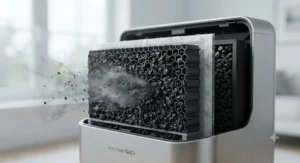
An air purifier for wildfire smoke is a standalone electric filtration unit that pulls room air through a True HEPA filter (to capture fine and ultrafine particles) and an activated carbon filter (to adsorb gases and odors), then recirculates cleaned air back into the room. Unlike general allergy purifiers, models suited for wildfire events prioritize high smoke-specific CADR and substantial carbon mass to handle both the particulate and gas components of smoke simultaneously.
Top 7 Air Purifiers for Wildfire Smoke: Expert Analysis
1. Winix 5510 — best CADR-per-dollar for bedrooms
The Winix 5510 punches well above its price tag, and that’s really the whole story here. Its four-stage system — washable pre-filter, activated carbon, True HEPA, and Winix’s PlasmaWave ionizer — delivers a smoke CADR that independent testing places at 253 CFM (430 m³/h), which covers rooms up to about 392 square feet. In practice that means it can cycle a 320-square-foot bedroom nearly five times an hour, which is the kind of air-change rate you actually want when an outdoor AQI alert is flashing red. Based on the spec comparison, that CADR sits right alongside purifiers costing $100 more.
What most buyers overlook about this model is how the noise curve behaves: independent lab measurements found it produces just 40.2 dBA at its lowest speed, quiet enough to sleep through, though it climbs to a noticeably louder 65.7 dBA at maximum speed. That trade-off is fine for a bedroom you run on auto overnight, less fine if you’re expecting library-quiet performance during a heavy smoke event when you’ll want it on high.
Reviewers consistently note that the 5510 improved air quality readings dramatically in controlled tests — one independent lab recorded a 96% improvement in air quality within 60 minutes in a 320-square-foot test room. Aggregated owner sentiment also flags the smart app as functional but basic compared to pricier competitors, and a few users wish the carbon filter were larger for sustained heavy-smoke seasons.
Pros:
✅ Strong smoke CADR for its price bracket
✅ Very quiet on low speed for overnight bedroom use
✅ Real-time smart app and auto mode included
Cons:
❌ Loud at max fan speed during heavy smoke events
❌ Carbon filter saturates faster than heavier-duty rivals
The Winix 5510 typically runs in the under-$250 range, with prices occasionally dipping lower during retailer promotions — check current price before buying. For a single bedroom or home office, it’s tough to beat the value here.
2. Blueair Blue Pure 311i+ Max — quietest smart pick for light sleepers
Blueair built its reputation on a filtration approach called HEPASilent, which blends mechanical HEPA-grade media with electrostatic charging so the fan doesn’t have to work as hard to pull air through dense filter material. The practical upshot: this is one of the quietest capable purifiers you can put in a bedroom. Manufacturer testing shows it operating quieter than a whisper on low at 25 dB and no louder than 50 dB on high, and Blueair recommends placing it in a room around 525 square feet for maximum performance.
Here’s what the spec sheet won’t tell you outright: the “+” designation on this model matters. Standard 311i Max units lean more heavily on electrostatic filtration, while the 311i+ Max variant is positioned for households that want stronger true-HEPA-style particle capture alongside that quiet electrostatic assist — a meaningful distinction if wildfire smoke, not just everyday dust, is your primary concern. The smart app also tracks filter life using a proprietary algorithm rather than a flat timer, which is a genuinely useful touch most competitors skip.
Aggregated reviewer feedback is largely enthusiastic about the design and quiet operation, with owners in one product review thread specifically praising its performance against pet odor and describing near-silent operation at low speed. A recurring critique across independent lab tests is that filter replacements land on the pricier side of the mid-range category, and the design, while attractive, takes up meaningful floor footprint for its stated coverage.
Pros:
✅ Genuinely whisper-quiet at low fan speed
✅ Smart filter-life tracking beats simple timers
✅ Scandinavian design blends into most rooms
Cons:
❌ Filter replacements cost more than category average
❌ Lower raw CADR than similarly priced HEPA-only rivals
Expect this one in the $220–$300 range depending on color and retailer bundle — always check current pricing, as Blueair runs frequent seasonal promotions.
3. Levoit Core 600S — best for open-plan living rooms
If your wildfire smoke problem isn’t confined to one bedroom but creeping through an open-concept living-dining space, the Core 600S is built for exactly that scenario. Independent AHAM-verified testing puts its CADR at 410 CFM for smoke, dust, and pollen, covering up to 635 square feet with 5 air changes per hour. That’s a meaningfully larger footprint than the budget tier above, and it shows in real-world testing: one lab recorded it reducing elevated particulate readings to safe levels in just over 30 minutes in a 620-square-foot room.
What most buyers overlook is a labeling wrinkle that’s worth knowing about honestly rather than glossing over: Levoit previously marketed this filter as HEPA H13 but dropped that specific claim in 2023 following a regulatory challenge, even though independent testing indicates the actual filtration performance is unchanged. The carbon layer uses Levoit’s ARC Formula, which reviewers note handles cooking smells and light smoke competently, though it’s not the heavyweight carbon load you’d find in a dedicated odor-control unit.
Reviewers consistently flag the VeSync smart app as one of the stronger implementations in this price tier, with real-time PM2.5 history and scheduling that competitors often charge more for. The most common complaint in aggregated feedback is that the auto-mode sensor is more reliable for smoke and combustion particles than for dust and pet dander — worth knowing if your household deals with both.
Pros:
✅ Large-room CADR that rivals purifiers twice the price
✅ Excellent VeSync app with real-time PM2.5 history
✅ Filters last up to 12 months under normal use
Cons:
❌ Loud at top speed — not ideal for a bedroom
❌ Auto-sensor less reliable for dust than for smoke
The Core 600S generally sits in the $250–$350 range — check current price, since Levoit frequently bundles it with extra filters during fire-season promotions.
4. Coway Airmega 400S — best whole-floor coverage with smart control
Coway has been building air purifiers since 1994, and the Airmega 400S is where that experience shows most clearly. Its dual-intake design pulls air from both sides of the unit through Coway’s combined Max2 filter — HEPA and activated carbon fused into a single cartridge — and manufacturer-listed CADR figures put it at 328 CFM for both smoke and dust, with a coverage rating up to 1,560 square feet at a two-air-change-per-hour standard. Independent third-party testing in real living-room conditions during an actual wildfire smoke episode found indoor PM2.5 held between 4 and 9 µg/m³ throughout a 36-hour event, which is about as strong a real-world endorsement as this category gets.
Here’s what the spec sheet doesn’t quite capture: the noise curve on this unit is unusually well-behaved. Testing shows a range of 22 dB in sleep mode up to 53 dB at maximum fan speed, and most households running it on auto or medium speed will land in the 35–42 dB range, which is genuinely unobtrusive for a unit covering this much square footage. The Wi-Fi-enabled 400S adds Coway’s IoCare app for remote monitoring and scheduling, a roughly $50 premium over the non-connected Airmega 400.
Aggregated review sentiment is strongly positive on cleaning performance and quiet operation, with owners specifically calling out reliability. The most consistent critique is that annual filter and energy costs run higher than mid-tier alternatives, and at nearly 25 pounds with a nearly square footprint, it demands real floor space rather than tucking neatly against a wall.
Pros:
✅ Covers an entire open floor plan, not just one room
✅ Remarkably quiet for its coverage class
✅ Real-world tested during an actual wildfire smoke event
Cons:
❌ Higher annual filter and electricity cost than mid-tier units
❌ Large square footprint needs dedicated floor space
Typical pricing lands in the $450–$550 range — always check current pricing, since the non-Wi-Fi Airmega 400 runs about $50 less if you don’t need app control.
5. Austin Air HealthMate Jr. — heaviest carbon load for stubborn smoke odor
Every other purifier on this list treats activated carbon as a supporting player. Austin Air treats it as the main event. The HealthMate Jr. packs 6.5 to 7 pounds of granular carbon and zeolite blend around a 30-square-foot medical-grade HEPA filter, and that carbon mass is precisely why serious odor-and-VOC guides keep pointing to Austin Air units as a benchmark for gas-phase filtration. Manufacturer coverage is rated up to 700 square feet, with the unit standing 16.5 inches tall and weighing 21 pounds.
What most buyers overlook is that raw particle-clearing speed and gas-adsorption capacity are two different engineering problems, and Austin Air optimized hard for the second one. Independent testing on the full-size HealthMate (using the same filtration architecture at larger scale) found it cleared particulates more slowly than lighter HEPA-forward competitors, precisely because pushing air through that much dense carbon media restricts airflow. If your primary complaint during wildfire season is the lingering campfire smell rather than raw particle counts, that trade-off works decisively in your favor; if raw speed is your priority, it won’t.
Reviewers and independent testers consistently describe the build quality as genuinely industrial — steel construction, a filter rated for five years under normal residential use, and a five-year pro-rated filter warranty that beats nearly everything else in this guide. The most common critique in aggregated feedback centers on noise at higher fan speeds and a purchase price that feels steep for the coverage area compared to HEPA-forward alternatives.
Pros:
✅ Unmatched carbon mass for smoke odor and VOCs
✅ Five-year filter life keeps long-term costs low
✅ Steel construction built for continuous operation
Cons:
❌ Slower raw particle-clearing speed than HEPA-forward rivals
❌ Noticeably louder at higher fan speeds
Expect to pay in the $450–$600 range depending on the specific filter variant — check current price, as Austin Air periodically runs out of stock on the Junior size during active fire seasons.
6. AirDoctor AD5500 — widest single-unit coverage for whole-home defense
When a room-by-room approach isn’t realistic — say, you’ve got an open-concept main floor with vaulted ceilings — the AD5500 is built to be the one purifier that handles it. AirDoctor’s UltraHEPA filtration is rated to capture 99.99% of particles as small as 0.003 microns, and the manufacturer rates the unit for spaces up to 1,043 square feet at four air changes per hour, a standard the company ties to Harvard University research on effective allergen removal. Independent lab testing recorded a smoke CADR in the 384–546 CFM range depending on test methodology, which places it among the most powerful single-zone purifiers currently sold.
What the spec sheet won’t tell you outright is how the dual-sided intake design changes the real-world math: because the AD5500 pulls contaminated air from two directions simultaneously rather than one, it processes a genuinely large room’s worth of air without needing an oversized single fan running flat-out, which helps explain why owners in aggregated reviews describe it as “quiet operation” relative to its output. The AirDoctor Halo sensor system displays real-time air quality with color-coded feedback and drives the auto mode, a detail reviewers consistently call out as more responsive than expected for the price tier.
Aggregated customer sentiment leans strongly positive on filtration power and design for large or open spaces, with reviewers specifically noting it as a fit for people managing allergies, pets, or wildfire smoke in sprawling homes. The recurring complaint across independent write-ups is the steep upfront cost and correspondingly pricier proprietary replacement filters, since AirDoctor’s patented filter design means no generic third-party alternatives exist.
Pros:
✅ Largest single-room coverage rating on this list
✅ UltraHEPA captures particles smaller than standard HEPA
✅ Dual intake keeps noise reasonable for its output
Cons:
❌ Highest upfront price point in this guide
❌ Proprietary filters cost more with no third-party options
Pricing generally sits in the $900–$1,000 range — check current pricing, as AirDoctor frequently offers seasonal bundle discounts on filter subscriptions.
7. IQAir HealthPro Plus — medical-grade filtration for ultrafine particles
IQAir built its name on hospital and cleanroom air filtration, and the HealthPro Plus is the residential expression of that engineering pedigree. Its HyperHEPA filter is independently tested to remove at least 99.5% of all airborne particles, including ultrafine particles smaller than 0.1 microns — a size range standard True HEPA filters aren’t even rated to measure. The gas-filtration side is just as serious: the unit houses roughly 5 pounds of activated carbon, putting it in the same weight class as the carbon-heavy Austin Air unit above, and coverage is rated up to 1,125 square feet.
Here’s what most buyers overlook: IQAir deliberately doesn’t publish a standard CADR number the way most competitors do, because the company argues the metric undersells performance on the ultrafine particles HyperHEPA is designed to catch. Independent testers who’ve run comparable smoke-box tests estimate real-world performance around 300 CFM, respectable but not chart-topping on paper — the actual selling point is filtration depth rather than raw speed. Reviewers and testers note the trade-off honestly: this is a heavy, motor-intensive unit, and running it at the higher speeds needed to cover its full rated square footage produces noise in the 54–61 dB range, loud enough that most owners settle into a lower, quieter speed for typical daily use.
Aggregated owner sentiment consistently praises filter longevity — the HyperHEPA filter is rated to last up to four years versus the 6-to-12-month cycle typical of cheaper units, which meaningfully offsets the high sticker price over time. The most frequent critique across independent reviews is the complete absence of smart features on the base model (no app, no auto-mode) and the genuinely high initial cost.
Pros:
✅ Captures ultrafine particles standard HEPA can’t measure
✅ Filters last years instead of months
✅ Serious carbon capacity for persistent smoke odor
Cons:
❌ No smart app or auto-mode on the base model
❌ Loud at the higher speeds needed for full coverage
Pricing runs around $900, occasionally more with the XE smart variant — check current price, since IQAir’s non-connected HealthPro Plus and Wi-Fi-enabled XE version are priced differently.
✨ Don’t Miss These Exclusive Deals!
🔍 Take Your Indoor Air Quality to the Next Level
Click on any highlighted model above to check current pricing and availability. Whichever tier fits your budget, getting a properly sized purifier running before the next smoke advisory hits is the single best thing you can do for your family’s lungs this fire season.
How to Choose an Air Purifier for Wildfire Smoke
Choosing the right unit comes down to matching a handful of specs to your actual living situation, not chasing the highest number on the box. Here’s the reasoning, step by step:
- Match CADR to your room’s square footage, not the manufacturer’s max claim. Look for a smoke-specific CADR rating that hits at least 4–5 air changes per hour for the room you’ll actually place it in — a whole-house open floor plan needs a very different unit than a single bedroom.
- Confirm it’s True HEPA, not “HEPA-type” or “HEPA-like.” Only certified True HEPA media reliably captures particles down to 0.3 microns; vague marketing language is a signal to look elsewhere.
- Check the activated carbon weight, not just its presence. A thin carbon-impregnated sponge saturates within weeks of heavy smoke exposure; look for models listing carbon mass in pounds, not just “activated carbon filter” on the box.
- Verify CARB certification. Any unit sold for California residents must be certified ozone-free by the California Air Resources Board — this matters nationwide, since ozone-generating “ionizers” can add a pollutant rather than remove one.
- Weigh noise at the fan speed you’ll actually use. A purifier that’s silent on low but needs turbo speed to hit its rated coverage will end up either underperforming or too loud to sleep near.
- Factor in filter replacement cost over a full year, not just the sticker price. A cheaper unit with $80 quarterly filters can cost more over 12 months than a pricier purifier with a 12-month filter cycle.
- Consider smart features only if you’ll use them. Auto-mode and app connectivity are genuinely convenient for reactive fire seasons, but they add cost you don’t need if you’re comfortable running the unit on high manually during smoke events.
Wildfire Smoke vs Regular Smoke Particles: What’s Actually Different
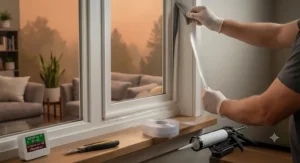
Not all smoke is created equal, and treating wildfire smoke like the smoke from a fireplace or a cigarette is where a lot of buyers go wrong. Regular indoor smoke sources — cooking, tobacco, a wood stove — tend to produce a relatively narrow band of particle sizes from a single, known fuel source. Wildfire smoke is a different animal entirely: it’s the byproduct of homes, vehicles, plastics, insulation, and vegetation burning simultaneously at extreme temperatures, which produces a far more chemically complex mixture of fine particulates and gases.
The particle size itself is the critical technical detail. Wildfire smoke particles typically range from roughly 0.4 to 0.7 microns, squarely within the range a quality True HEPA filter captures efficiently. But wildfire smoke also carries adsorbed toxic chemicals from burned synthetic materials — formaldehyde, benzene, acrolein, and polycyclic aromatic hydrocarbons that a standard cigarette or campfire simply doesn’t produce in the same concentration. This is precisely why a purifier that performs adequately against cooking smoke can still leave you breathing a chemical soup during a major wildfire event unless it’s also carrying a substantial carbon filter.
Practically speaking, this means the “which purifier handles smoke” question has two different correct answers depending on the smoke source. For everyday cooking or light tobacco odor, a HEPA-forward unit with modest carbon is plenty. For actual wildfire events, you want the heavier carbon load found in units like the Austin Air HealthMate Jr. or IQAir HealthPro Plus, paired with strong particle capture — treating the two threats as one problem is where budget shoppers most often get burned.
PM2.5 and Wildfire Smoke Health Risk
PM2.5 — particulate matter measuring 2.5 micrometers or smaller — is the primary health threat wildfire smoke poses, and understanding why requires a little perspective on scale. A human hair measures roughly 70 micrometers across, making PM2.5 particles somewhere around 30 times smaller. At that size, these particles bypass the natural filtration systems in your nose and throat almost entirely, penetrating deep into lung tissue and, from there, crossing directly into the bloodstream.
The health consequences aren’t hypothetical or distant. Smoke can cause burning eyes and a runny nose immediately, and the microscopic particles can get deep into the lungs and cause bronchitis, asthma attacks, heart attacks, and strokes, according to the Centers for Disease Control and Prevention and the Environmental Protection Agency. These fine particles have been linked to premature death among people with existing heart and lung disease, and children, older adults, and pregnant women face elevated risk even during moderate smoke events. During the 2023 Canadian wildfire season, PM2.5 concentrations in New York City reportedly surged past 400 µg/m³ — more than 25 times the WHO’s recommended daily limit.
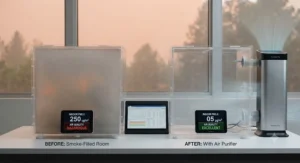
What’s less widely understood is how effective good indoor filtration actually is against this specific threat. Research cited by Consumer Reports, drawing on University of California, Berkeley findings, indicates a properly sized HEPA air purifier can cut indoor levels of these irritants roughly in half even when outdoor conditions are severe, and the best-performing units can reduce particle concentrations by as much as 85 percent, according to the EPA. That’s the practical argument for running one continuously through fire season rather than only switching it on once you can already smell smoke — by the time you notice the odor, PM2.5 levels have often already been elevated for a while.
Understanding the AQI Index and When to Run Your Purifier
The Air Quality Index, or AQI, is the standardized 0–500 scale the EPA uses to communicate how polluted outdoor air is on a given day, and it’s the single best trigger for deciding when your purifier needs to be running on high rather than idling on auto. The scale breaks into color-coded bands: green (0–50) is good, yellow and orange indicate moderate to unhealthy-for-sensitive-groups conditions, and red through maroon (151 and above) signal unhealthy to hazardous air that affects even healthy adults. During major wildfire events, AQI readings can climb past 500 and go “beyond the index,” with some regions recording values of 600, 800, or higher during catastrophic fire seasons.
You can check real-time AQI conditions for your specific location through the AirNow.gov Fire and Smoke Map, the EPA’s official resource, which combines satellite smoke imagery with ground-level measurements from official monitoring stations. What most people miss is that the number on your phone reflects outdoor conditions, not what’s happening inside your sealed house — indoor PM2.5 during a smoke event typically runs somewhere around 55% to 60% of outdoor levels even with doors and windows closed, which is exactly the gap a purifier is designed to close further.
As a practical rule of reasoning: once your local AQI crosses into the orange band (101+), it’s time to switch your purifier to a higher fan speed and treat one room as a genuine clean-air refuge — closing its door, running the unit continuously, and limiting activities like cooking that add particles back into that space. Below that threshold, auto mode on a properly sized unit is usually sufficient to keep pace.
Practical Usage Guide: Setting Up Your Purifier for Fire Season
Getting real performance out of any purifier on this list comes down to a handful of setup habits that most owners skip in the rush to just plug it in and hope. First, placement matters more than people expect: keep the unit at least a foot from walls and furniture on all sides so air can actually circulate through it, and place it in the room where your household spends the most time rather than an unused guest bedroom. Central placement in an open floor plan generally outperforms a corner.
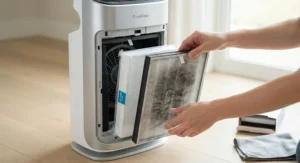
Before smoke season even starts, do a filter check. If your carbon filter has already absorbed a season’s worth of cooking odors and light pollution, it’s got less capacity left for an actual wildfire event — swap it proactively rather than waiting for a saturation smell to tell you it’s time. During an active smoke event, run the unit on its highest sustainable speed rather than a quiet auto setting; the EPA specifically recommends running portable air cleaners continuously on the highest fan speed to maximize filtration during smoke events, and treat one closed-door room as your household’s designated clean-air space per EPA’s clean room guidance.
The most common first-30-days mistake is under-sizing: buying a purifier rated for a single bedroom and expecting it to handle an open-concept living-kitchen combo. The second most common mistake is neglecting maintenance — a pre-filter clogged with visible dust restricts airflow and quietly tanks your CADR long before the “replace filter” light comes on. Wipe washable pre-filters monthly during active fire season, not just when the indicator prompts you.
Real-World Scenarios: Matching a Purifier to Your Situation
The apartment renter in a smoke-prone region. A single bedroom or studio under 400 square feet, tight budget, no interest in whole-home coverage. The Winix 5510 or Blueair Blue Pure 311i+ Max both fit here — compact, quiet enough for nightly use, and priced to make sense for a rental you might not stay in for years.
The family in an open-concept suburban home. Living room flows into kitchen and dining, 600+ square feet of connected space, kids or a family member with asthma. The Levoit Core 600S or Coway Airmega 400S are the better fits — both are engineered for larger coverage with strong smart-app support for hands-off monitoring during a multi-day smoke event.
The household dealing with chronic, heavy smoke seasons. Rural or Western-region homeowners who deal with weeks of hazardous AQI most years, or anyone with heightened chemical sensitivity to VOCs. This is where the carbon-heavy Austin Air HealthMate Jr. and the premium AirDoctor AD5500 or IQAir HealthPro Plus earn their higher price tags — sustained, serious filtration for conditions that aren’t going away by next weekend.
Whole House Air Purifier for Wildfire Smoke: Portable Units vs HVAC Filtration
“Whole house air purifier” gets used loosely in marketing, so it’s worth being precise about what’s actually available. True whole-house filtration means upgrading the filter inside your central HVAC system, typically to a MERV 13 rating, which filters air throughout the home every time the system cycles. Portable units like the seven reviewed above only clean the room they’re physically placed in, though a large-coverage model like the AirDoctor AD5500 or Coway Airmega 400S can functionally cover an entire open floor plan.
| Approach | Coverage | Typical Cost | Best For |
|---|---|---|---|
| Portable HEPA purifier (large room) | Single large room or open floor | $250–$600 | Renters, targeted rooms, flexibility |
| Portable HEPA purifier (whole-home-rated) | 1,000+ sq ft open concept | $900–$1,000 | Homeowners with open floor plans |
| HVAC MERV 13 filter upgrade | Entire ducted home | $20–$80 per filter, changed quarterly | Homeowners with central air already running |
| Combined approach (HVAC + portable) | Entire home + reinforced bedroom | Varies | Chronic heavy-smoke regions |
The analysis here is straightforward: an HVAC filter upgrade is genuinely the most cost-effective way to filter an entire home, but only if your system’s fan runs continuously or on a scheduled cycle — many residential systems only run when heating or cooling is actively needed, which does nothing during a smoke event unless you manually override the fan to “on.” A portable purifier, by contrast, runs continuously regardless of your thermostat and gives you a guaranteed clean-air zone even if the rest of the ductwork is compromised. For most households, running both — a MERV 13 furnace filter plus a large-coverage portable unit in the main living space — delivers noticeably better protection than either alone.
💬 One click could help a neighbor breathe easier too — share this comparison!😊
Air Purifier for Smoke Smell from Wildfires: HEPA vs Carbon, Explained
If your specific complaint during fire season is the lingering campfire smell rather than visible haze, you’re dealing with a gas-phase problem, and HEPA filtration alone genuinely cannot solve it. HEPA media is a mechanical filter — it physically traps particles as air passes through — but odor molecules and volatile organic compounds are small enough and chemically different enough to pass straight through even the finest HEPA fibers. Only activated carbon, and specifically enough of it, adsorbs those gas-phase compounds effectively.
This is where carbon weight becomes the spec that actually predicts odor performance, and it’s wildly inconsistent across the market. Budget purifiers often include a thin, carbon-impregnated sponge with well under a pound of actual adsorptive material — fine for light cooking smells, quickly overwhelmed by sustained wildfire exposure. The units on this list built specifically for odor-heavy conditions carry dramatically more: the Austin Air HealthMate Jr. packs roughly 6.5 pounds of carbon-zeolite blend, and the IQAir HealthPro Plus carries about 5 pounds, both multiples of what’s found in HEPA-forward competitors.
The honest advice here is to match the fix to the actual complaint. If your household’s issue is genuinely just smell with otherwise fine air quality readings, prioritizing carbon mass over raw CADR makes sense. If you’re dealing with both visible haze and persistent odor — the more common scenario during an active wildfire event — you need a unit that scores well on both fronts, which narrows the realistic field to the Coway Airmega 400S, AirDoctor AD5500, and IQAir HealthPro Plus from this list.
Long-Term Cost & Maintenance
The sticker price on any of these units is only part of the real cost of ownership, and skipping this math is how budget-conscious buyers end up spending more over three years than they would have with a pricier unit upfront. Filter replacement frequency varies enormously across this list — from roughly six months on budget carbon filters to a genuinely remarkable five years on the Austin Air’s filter media.
| Product | Filter Life | Est. Annual Filter Cost | Est. Annual Energy Cost |
|---|---|---|---|
| Winix 5510 | ~12 months | ~$80 | ~$50–$60 |
| Blueair Blue Pure 311i+ Max | 6–9 months | ~$60–$90 | ~$25–$35 |
| Levoit Core 600S | 6–12 months | ~$75–$120 | ~$40–$50 |
| Coway Airmega 400S | ~12 months | ~$70–$80 | ~$130–$150 combined |
| Austin Air HealthMate Jr. | Up to 5 years | ~$0–$90 (amortized) | ~$40–$60 |
| AirDoctor AD5500 | 6–12 months (proprietary) | ~$200–$300 | ~$50–$70 |
| IQAir HealthPro Plus | 3–4 years (HyperHEPA) | ~$100–$150 (amortized) | ~$70–$100 |
Interpreting the table above, the Austin Air and IQAir units look expensive at checkout but become genuinely competitive — sometimes cheaper — once you amortize their multi-year filter life across the ownership period. The AirDoctor AD5500, by contrast, carries both the highest upfront cost and among the highest ongoing filter costs, since its patented filter design locks buyers into proprietary replacements with no generic alternative on the market. If total cost of ownership over three to five years matters more to your budget than the number on the price tag today, run this math before deciding.
Common Mistakes When Buying an Air Purifier for Wildfire Smoke
Even well-intentioned shoppers trip over the same handful of pitfalls every fire season. First, buying based on square footage alone without checking the specific smoke or particle CADR — some manufacturers publish a generic “room size” figure calculated at a lower air-change rate than you actually want during an active event, which can make an undersized unit look adequate on paper. Second, ignoring carbon weight entirely and assuming any purifier with “activated carbon” on the box will handle odor — as covered above, the actual mass of carbon varies by a factor of ten or more across this category.
Third, waiting until smoke is already in the air to buy. Retailers and manufacturers alike see demand spikes and occasional stock shortages the moment a major fire makes news, and shipping delays during peak demand can leave you without protection during the exact week you need it most. Fourth, underestimating noise tolerance — a unit that’s rated quiet on its lowest speed can become genuinely disruptive at the higher speed you’ll actually need to run during a severe smoke event, so check dB ratings across the full speed range, not just the marketing headline number.
Finally, neglecting the total cost of ownership math from the section above, and assuming the cheapest unit at checkout is the cheapest unit to actually run. A $180 purifier with $90 quarterly filter costs can outspend a $350 purifier with $80 annual filters within eighteen months.
Buyer’s Decision Framework
Use this simple framework to cut through the seven options above quickly:
- If your budget is under $300 and you need one bedroom covered, choose the Winix 5510 or Blueair Blue Pure 311i+ Max — because both deliver strong CADR-per-dollar in a compact, quiet footprint.
- If you have an open-concept living space under 700 square feet, choose the Levoit Core 600S — because its 410 CFM smoke CADR and smart app genuinely match that scale of room.
- If you need one unit to cover an entire floor and want smart monitoring, choose the Coway Airmega 400S — because its dual-intake design and app-based control are purpose-built for exactly that footprint.
- If lingering smoke smell is your primary complaint, not just haze, choose the Austin Air HealthMate Jr. — because its carbon mass dwarfs anything else in this price range.
- If you have a large, open-concept home and budget isn’t the deciding factor, choose the AirDoctor AD5500 — because its coverage rating and dual-sided intake are built for exactly that scenario.
- If you or a family member has chemical sensitivities or severe respiratory conditions, choose the IQAir HealthPro Plus — because HyperHEPA filtration and a 5-pound carbon filter offer the deepest protection on this list.
Safety, Regulations & Compliance Guide
A handful of regulatory details are worth knowing before you buy, because they separate genuinely safe units from ones that quietly make air quality worse. First, confirm CARB certification — the California Air Resources Board requires portable air cleaners sold in the state to be certified as producing no meaningful ozone emissions, and reputable manufacturers list this certification openly for units sold nationwide, not just in California. Ozone-generating “ionizer” technology, still found in some budget purifiers, can itself function as a lung irritant, which defeats the entire purpose during a respiratory health event.
Second, check for Energy Star certification if energy cost matters to your household, since running a purifier continuously through a multi-week smoke season adds up. Third, if you or a family member has asthma or another chronic respiratory condition, the EPA’s guidance for reducing indoor exposure recommends closing windows and doors, using fans or air conditioning to manage heat instead of ventilating with outside air, and setting up a dedicated clean-air room with a properly sized portable air cleaner as core strategies during active smoke events. None of the seven units reviewed here use ozone-generating ionization as a primary cleaning mechanism, which is a meaningful safety baseline worth confirming on any purifier you’re considering outside this list.
FAQ
❓ Do air purifiers actually work for wildfire smoke?
❓ What CADR do I need for wildfire smoke specifically?
❓ Can a regular air purifier remove wildfire smoke smell?
❓ How often should I run my air purifier during wildfire season?
❓ Is a whole-house HVAC filter better than a portable air purifier for smoke?
Conclusion
If there’s one theme running through every product in this guide, it’s that “best air purifier for wildfire smoke” isn’t a single answer — it’s a question that depends on your square footage, your budget, and whether your household is fighting particles, odor, or both. The Winix 5510 and Blueair Blue Pure 311i+ Max earn their spots for renters and single-room budgets. The Levoit Core 600S and Coway Airmega 400S step up for families managing larger, connected living spaces. And the Austin Air HealthMate Jr., AirDoctor AD5500, and IQAir HealthPro Plus each solve a more specific, more serious problem: chronic odor, whole-home open-concept coverage, and ultrafine medical-grade filtration, respectively.
None of these machines will stop a wildfire, and none will make it safe to skip evacuation orders or ignore an official air quality alert. What a properly sized unit will do is meaningfully cut the particulate and gas load you’re breathing during the days and weeks smoke lingers in your region, which — given what PM2.5 exposure actually does to cardiovascular and respiratory health — is not a small thing. Pick the tier that matches your space and your specific complaint, get it running before the next red-flag warning rather than during it, and keep an eye on your local AQI so you know when to push the fan speed up.
✨ Ready to Breathe Easier This Fire Season?
🔍 Compare current pricing on any of the seven purifiers above and get one running before the next smoke advisory hits your area. Clean indoor air isn’t a luxury during wildfire season — it’s a genuinely protective health decision your future self will thank you for.
Recommended for You
- 7 Best Air Purifiers for Smoke in 2026
- 7 Best Air Purifiers for an Asthmatic Child in 2026
- 7 Best Air Purifiers for Asthma in 2026 (Real HEPA Picks)
Disclaimer: This article contains affiliate links. As an Amazon Associate, I earn from qualifying purchases. If you purchase products through these links, we may earn a small commission at no additional cost to you.
✨ Found this helpful? Share it with your friends! 💬🤗
