
In This Article
The best air purifier for asthmatic child bedrooms is a True HEPA model with a CADR rated for the room’s square footage, no intentional ozone output, and a noise level under roughly 35 decibels at the speed you’ll actually run it overnight. That’s the short answer. The longer answer — the one that actually matters once you’re standing in the aisle staring at six nearly identical white boxes — takes a bit more unpacking.
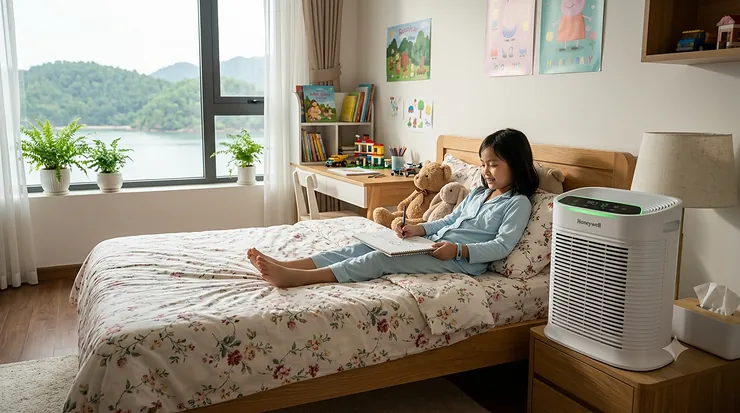
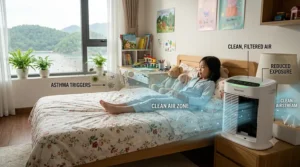
If you’re here, you already know the 2 a.m. routine: the cough that won’t settle, the inhaler reach, the mental inventory of what changed in the room. Dust? Pollen tracked in on shoes? The new throw rug? An air purifier for kids with asthma won’t fix all of that on its own, but it’s one of the few tools backed by real research as a meaningful piece of the puzzle — alongside dusting, vacuuming, and keeping pets out of the bedroom.
This guide is built around something most “Top 10” lists skip entirely: it only includes products that are actually for sale on Amazon right now, with real model numbers you can search and verify yourself. No invented brands, no specs pulled from thin air. We’ll walk through 7 real machines, how to size and choose one for a child’s bedroom specifically, and where the marketing claims on the box diverge from what independent testing actually shows.
One quick note on safe air purifier for child asthma choices before we dive in: the U.S. Environmental Protection Agency specifically advises against air cleaners that intentionally generate ozone, since ozone is itself a lung irritant that can worsen asthma symptoms. That single fact will do more to narrow your shortlist than any spec sheet.
Quick Comparison Table at a Glance
| Product | Best For | Room Coverage | Noise (Low–High) | Price Range |
|---|---|---|---|---|
| Levoit Core 300S-P | Budget + smart features | ~220 sq ft (AHAM) | 22–52 dB | $100–$130 |
| GermGuardian AC4825 | Tightest budget | ~150 sq ft (AHAM) | ~40–55 dB | $70–$100 |
| Blueair Blue Pure 411+ | Nursery / quietest sleep | ~185 sq ft (AHAM) | 17–46 dB | $100–$150 |
| Medify MA-40 | Mid-size bedroom, H13 grade | ~840 sq ft (mfr.) | 46–66 dB | $150–$200 |
| Winix 5500-2 | Mid-large rooms, AOC carbon | ~360 sq ft (AHAM) | 35–60 dB | $150–$220 |
| Coway AP-1512HH Mighty | All-round reliability | ~360 sq ft (AHAM) | ~24–53 dB | $170–$230 |
| Honeywell HPA300 | Fast clearing, larger rooms | ~465 sq ft (AHAM) | 44–60 dB | $180–$250 |
✅ A quick read on this table: room coverage is the column that actually predicts whether a purifier helps. Two purifiers can share an identical “True HEPA, 99.97%” label and perform completely differently in practice if one is rated for a 150-square-foot room and the other for 450 — buying undersized for the space is the single most common mistake we see. Noise matters just as much for a child’s bedroom unit, since a purifier that gets switched off at night because it’s too loud is doing nothing for nighttime asthma symptoms.
💬 Just one click — help others make better buying decisions too!😊
✨ Don’t Miss These Exclusive Deals!
🔍 Take your search for the right air purifier for kids with asthma further — click through on any model above to check current pricing and availability before stock or deals shift.
Top 7 Air Purifiers for Kids with Asthma, Reviewed
We sized this list deliberately across budget tiers, because the “best” unit for a tight nursery is rarely the same machine that makes sense for a shared kids’ room or open-plan playroom.
1. Levoit Core 300S-P
The standout feature here is the app: with the free VeSync app you get auto mode, filter-life tracking, and Alexa/Google Assistant control, all on a unit that still undercuts most “smart” purifiers on price.
In practice, the 56-watt motor and roughly 141 CFM CADR mean this unit is sized for true AHAM-rated coverage of around 220 square feet — not the 1,000+ square feet some marketing copy implies, which is based on a much lower air-exchange rate. What most buyers overlook here is a labeling history worth knowing: Levoit previously marketed this filter as “True HEPA” before a dispute with a competitor led them to drop that specific term in favor of “3-stage filtration” rated to HEPA-grade performance in sleep mode. The filtration itself didn’t change — but it’s a good reminder to read the actual CADR and test data, not just the badge on the box.
This is the right pick for a parent who wants smart scheduling and doesn’t want to think about the purifier once it’s set up, in a standard-sized bedroom.
Independent reviewers and the tens of thousands of Amazon ratings on this model consistently flag two things: excellent value for the noise level, and an auto-mode sensor that can be slow to react to sudden particle spikes since it only samples air near the unit itself.
✅ Genuinely quiet in sleep mode (~22dB)
✅ App scheduling and filter tracking
✅ Strong CADR-per-dollar
❌ Auto-mode sensor lags behind sudden smoke/dust spikes
❌ Real coverage smaller than headline square-footage claims
Price range: $100–$130. For a smart, bedroom-sized unit, this is one of the better value plays on the list — just don’t size it for a room larger than the AHAM rating.
2. GermGuardian AC4825
The standout here is simply the price floor — this is the most affordable True HEPA option on the list with a name-brand track record going back over a decade.
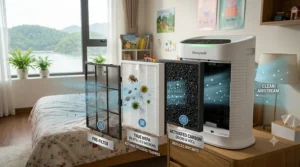
The 4-stage system pairs a combined carbon/pre-filter with a True HEPA layer and an optional UV-C bulb. In real-world terms, the carbon pre-filter doing double duty (catching large particles and odors) means it saturates a bit faster than units with a separate washable pre-filter — expect to replace filters on the more frequent end of the 6–8 month range if the room is dusty. The UV-C add-on sounds appealing for a sick kid’s room, but independent lab testing has found the low-wattage bulb’s placement and exposure time aren’t sufficient to meaningfully kill airborne pathogens — treat it as a minor bonus, not a reason to upgrade.
This is the right call for a parent furnishing a child’s bedroom on a tight budget who mainly needs reliable dust, pollen, and pet dander control in a smaller room.
Reviewers commonly mention noticing a difference in allergy and asthma-adjacent symptoms within the first couple of weeks of consistent use, alongside complaints that the unit runs warmer and louder on its highest setting than newer competitors.
✅ Lowest price for a True HEPA unit on this list
✅ AHAM verified, Energy Star certified
✅ Optional UV-C as a bonus feature
❌ UV-C effectiveness is questionable per independent testing
❌ Higher running cost than newer, more efficient competitors
Price range: $70–$100. Best value-for-dollar entry point, with the tradeoff of slightly higher long-term electricity and filter costs.
3. Blueair Blue Pure 411+
The standout feature is the single-button control and genuinely whisper-quiet low setting (around 17dB) — quiet enough that a child could realistically sleep through it on its lowest speed, every night.
HEPASilent technology combines mechanical filtration with electrostatic particle charging, rated at roughly 115–130 CADR depending on particle type for a room around 161–185 square feet. What most buyers overlook: Blueair’s electrostatic charging can’t be switched off the way an ionizer on some competitor models can — but the company has it independently verified at under 5 parts-per-billion ozone output, well below levels of concern, which is a meaningfully different situation than an uncertified ionizer.
This is the right purifier for a nursery or a younger child’s small bedroom where quiet, simple, kid-proof operation (there’s genuinely only one button) outweighs the need for smart features.
Parents in reviews frequently mention using it as a dual-purpose white-noise machine and night light thanks to the always-on center indicator — a feature some love and others find too bright for a darkened room.
✅ Quietest unit on this list at low speed
✅ One-button operation, no learning curve
✅ Lightweight and portable between rooms
❌ Smaller coverage area than mid-tier competitors
❌ Always-on indicator light may be too bright for very dark rooms
Price range: $100–$150. A strong, quiet pick specifically for smaller children’s rooms or nurseries.
4. Medify MA-40
The standout detail worth knowing: Medify was started by a parent searching for a genuinely effective HEPA solution for his own daughters’ asthma — which doesn’t make it automatically the “best” unit, but does mean child-asthma use was the original design brief, not an afterthought.
It runs an H13-grade True HEPA filter (a tighter spec than the H11/H12 grade common on budget units) rated to capture 99.9%+ of particles down to 0.1 microns, with a manufacturer CADR around 406 for a roughly 840-square-foot room. In practice, the noise range is its biggest tradeoff: sleep mode runs in the mid-40dB range, but the top speed climbs into the mid-60s — loud enough that you’ll likely want to run it on a lower, less aggressive setting overnight and reserve the top speed for daytime “reset the room” bursts.
This is the right machine for a parent who specifically wants the tighter H13 filtration grade in a mid-size bedroom and doesn’t mind dialing the fan speed down for nighttime use.
Reviewers generally praise the filtration performance and touchscreen child lock, with the most common complaint being fan noise at higher speeds in a quiet house.
✅ H13-grade filtration, finer than standard True HEPA |
✅ Child lock built into the touch panel
✅ Strong CADR for a mid-size bedroom
❌ Noticeably loud at top speed
❌ Touchscreen controls can be fussy for some users
Price range: $150–$200. Worth the step up from budget tiers if H13-grade filtration is a priority for you.
5. Winix 5500-2
The standout feature is the washable AOC (Advanced Odor Control) carbon filter — most competitors require you to replace the carbon layer outright, while this one can be rinsed and reused, extending the gap between filter purchases.
CADR comes in around 232–246 across smoke, dust, and pollen, rated for roughly 360 square feet at the AHAM standard — solidly mid-large territory. The PlasmaWave ionizer is the detail to actually read the fine print on: it’s a toggleable feature, not always-on, and independent reviewers note the unit performs just as well with it switched off — which matters given the EPA’s general caution around ionizing technologies and ozone byproducts. Our take: leave PlasmaWave off for a child’s room and let the mechanical filtration do the work.
This is the right purifier for a larger shared kids’ room or a combined bedroom-and-play space where you need more raw coverage than a compact unit provides.
Long-running reviews on this model are largely positive on filtration strength, with the most consistent critique being a 1-year warranty shorter than some 3-year competitors, and a model-specific filter you can’t substitute from sibling Winix units.
✅ Strong CADR for the size class
✅ Washable carbon pre-filter cuts long-term cost
✅ Auto + sleep mode with light sensor
❌ Shorter warranty than some competitors
❌ PlasmaWave is best left off for asthma use, reducing the “extra” feature’s value
Price range: $150–$220. A solid mid-large room workhorse if you keep the ionizer switched off.
6. Coway AP-1512HH Mighty
The standout here is consistency — this is one of the few air purifiers that’s been a recurring “Top Pick” from major outlets for roughly a decade running, which says more about long-term reliability than any single spec.
The 4-stage system (washable pre-filter, deodorization filter, True HEPA, and an optional ionizing “Vital Ion” feature) is AHAM-rated for around 360 square feet, with CADR in the 230–250 range across dust, pollen, and smoke. What most buyers overlook: the Eco mode that auto-shuts the fan off after 30 minutes of clean air is genuinely useful for cutting electricity use, but it relies on the unit’s onboard particle sensor — in a very still room with low ambient pollution, this can mean the fan idles more than you’d expect, so it’s worth manually overriding to a fixed speed during high-pollen days.
This is the right pick for a parent who wants a proven, no-surprises unit for a standard bedroom and values long-term brand reliability over smart-app features.
Reviewers consistently cite the air-quality indicator light and quiet operation as standout features, with the most common gripe being the cost and lead time of genuine replacement filters compared to third-party alternatives.
✅ Years of consistent “Top Pick” recognition
✅ Washable pre-filter cuts down on filter spend
✅ Reliable mid-large room CADR
❌ Vital Ion ionizing feature best left off for asthma use
❌ Genuine filters cost more than some third-party options
Price range: $170–$230. A dependable, well-reviewed choice for a standard-size child’s bedroom.
7. Honeywell HPA300
The standout feature is raw speed: independent lab testing has clocked this unit clearing a test room of smoke particles in around 20 minutes on its top setting — competitive with units costing close to double the price.
That speed comes from an unusually powerful fan, rated for AHAM coverage around 465 square feet — the largest room rating on this list. Here’s the practical tradeoff most spec sheets won’t tell you: that same powerful fan runs notably loud, measured at roughly 59.5dB on Turbo in independent testing. There’s no dedicated sleep mode and no app — just four manual speeds (Germ, General Clean, Allergen, Turbo) and a dimmer for the indicator lights. For a child’s room specifically, that means this unit shines as a fast “clear the air” tool you run on Turbo for 20–30 minutes before bedtime, then drop to its lowest speed (or move to a different room) once the child is actually asleep.
This is the right machine for a larger bedroom, playroom, or shared living space where you want maximum clearing speed and don’t need smart scheduling — less ideal as an always-on overnight unit in a small, quiet room.
Long-term owners frequently mention years of reliable service with pets in the home, alongside consistent notes that filter costs add up and the unit is genuinely louder than competitors at full speed.
✅ Fastest particle clearing on this list
✅ Largest AHAM room rating here
✅ Simple, no-app manual controls
❌ Loud on Turbo — not ideal for overnight bedroom use
❌ No auto or true sleep mode
Price range: $180–$250. Best suited to a larger room or as a fast pre-bedtime “reset,” rather than overnight use in a small bedroom.
Top 7 Products: Specs Side-by-Side
| Product | Filter Grade | CADR (approx.) | Ionizer/UV | Warranty |
|---|---|---|---|---|
| Levoit Core 300S-P | HEPA-grade (3-stage) | ~141 | None | 2 years |
| GermGuardian AC4825 | True HEPA | ~99–125 | Optional UV-C | 3 years |
| Blueair Blue Pure 411+ | HEPASilent | ~115–130 | Always-on, zero-ozone certified | 2 years |
| Medify MA-40 | True HEPA H13 | ~406 | None (UV variant available separately) | Lifetime |
| Winix 5500-2 | True HEPA | ~232–246 | Toggleable PlasmaWave | ~1–2 years |
| Coway AP-1512HH | True HEPA | ~233–246 | Toggleable Vital Ion | 3 years |
| Honeywell HPA300 | True HEPA | up to ~300 | None | 5 years |
Looking at this table, two patterns jump out. First, filter grade and CADR don’t move together in a straight line — the Medify MA-40 has the tightest filter spec (H13) but a mid-pack price, while the Honeywell trades a standard HEPA grade for sheer airflow volume. Second, every ionizer or UV feature on this list is either optional or independently certified as effectively ozone-free — none of these seven are the kind of intentional ozone-generating device the EPA specifically warns against, which matters if you’re trying to build a genuinely safe air purifier for child asthma setup.
How to Choose an Air Purifier for a Child’s Bedroom
- Match CADR to the room’s actual square footage — use the AHAM-rated coverage, not the larger “maximum room” figure some listings advertise, since that number often assumes a much lower hourly air-exchange rate.
- Treat noise level as a hard filter, not a nice-to-have — a purifier that’s too loud to run overnight provides zero benefit while your child is actually sleeping, when symptoms often spike.
- Skip anything that intentionally generates ozone — per EPA guidance, ozone is a lung irritant that can worsen asthma symptoms, the opposite of the goal here.
- If a unit has an ionizer, confirm it’s switchable or independently ozone-certified — several models on this list let you turn that feature off entirely, which is the simplest way to remove the variable.
- Budget for filters as part of the real cost, not just the upfront price — a $90 purifier with $35 filters replaced every 3 months costs more over two years than a $150 unit with $25 filters replaced twice a year.
- Don’t oversize for “future-proofing” — a unit rated for 900 square feet running in a 120-square-foot bedroom on its lowest, quietest speed may actually clean less effectively than a correctly-sized unit running at a moderate speed.
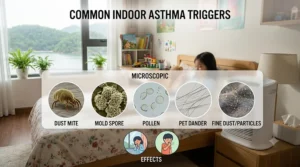
- Check the asthma child indoor triggers in the specific room — pet dander and dust mites respond well to mechanical HEPA filtration; mold and humidity issues need a dehumidifier alongside the purifier, since no air cleaner here addresses moisture at the source.
Buyer’s Decision Framework: Match the Purifier to Your Situation
If your top priority is absolute quiet for overnight use in a small room, the Blue Pure 411+ or Levoit Core 300S-P on its lowest setting are your two strongest options — both stay under 25dB at low speed.
If your priority is coverage for a larger shared bedroom or playroom, the Honeywell HPA300 or Coway AP-1512HH both clear more square footage, with the Coway being the quieter of the two for sustained use.
If your priority is the tightest filtration grade available, the Medify MA-40’s H13 rating edges out the standard True HEPA spec on the rest of the list — just plan to run it below top speed at night.
If your priority is lowest upfront cost with no compromise on filter quality, the GermGuardian AC4825 gets you a genuine True HEPA filter for less than any other option here, with the tradeoff being a smaller effective room size.
Real-World Scenarios: Which Purifier Fits Your Family
The shared kids’ room, two siblings, 200+ square feet: This is Winix 5500-2 or Coway AP-1512HH territory — both are rated for the larger square footage a shared room demands, and both let you switch off the optional ionizing feature for nighttime use.
The nursery transitioning to a toddler room: The Blue Pure 411+’s single-button simplicity and whisper-quiet low setting make it hard to beat here — there’s genuinely nothing for a curious toddler to fiddle with beyond one button.
The budget-conscious family furnishing a first kid’s bedroom: The GermGuardian AC4825 gets a True HEPA filter into the room without a big upfront spend, with the understanding that filter replacement frequency may run slightly higher than pricier alternatives.
The family dealing with wildfire smoke season on top of baseline asthma: The Honeywell HPA300’s fast clearing speed is genuinely useful here — run it on Turbo for 20–30 minutes after a smoky day to reset the room quickly, then drop to a lower speed once the air quality indicator (if your model has one) or your own judgment says it’s safe to ease off.
Ionizers, UV-C, and Ozone: What Actually Matters for Pediatric Asthma
This is worth its own section because it’s the single area where marketing language and pediatric safety guidance most often pull in different directions.
The American Academy of Pediatrics notes that ionizers and other ozone-generating air cleaners aren’t recommended for homes, since under some conditions they can release enough ozone to cause health effects — and children’s still-developing lungs make them more sensitive to that exposure than adults. That doesn’t mean every purifier with an “ionizer” label on the box is dangerous; it means the distinction that matters is between devices that are independently certified as producing negligible ozone (several models on this list fall here) versus devices with no such certification.
Practically, here’s the filter to apply: if a feature can be switched off (like Winix’s PlasmaWave or Coway’s Vital Ion), turn it off for a child’s bedroom and let it run as a pure mechanical HEPA filter — you lose nothing measurable in particle-capture performance. If a feature can’t be switched off (like Blueair’s electrostatic HEPASilent technology), check whether it’s been independently tested for ozone output, which Blueair’s has, at levels well under recognized thresholds of concern.
UV-C is a separate question entirely from ozone, and it’s more about expectation management: independent lab reviews of low-wattage UV-C bulbs in budget purifiers (like the GermGuardian’s optional light) generally find the exposure time and bulb placement aren’t sufficient to meaningfully reduce airborne pathogens. It’s a marketing bonus more than a functional asthma-relevant feature.
Common Mistakes When Buying an Air Purifier for Child Asthma
- Buying based on maximum room size instead of AHAM-rated coverage. The bigger number on the box is real, but it usually assumes a slower, less effective air-exchange rate than you actually want for asthma management.
- Ignoring noise specs entirely. A unit that gets unplugged at 9pm because it’s too loud provides zero benefit overnight — exactly when symptoms often flare.
- Assuming “HEPA” on the label means identical performance everywhere. True HEPA, HEPA-grade, and H13 HEPA are not interchangeable terms, and the gap between them is real, not just marketing.
- Forgetting filter costs in the total budget. A cheaper unit with expensive, frequently-replaced filters can cost more over 18 months than a pricier unit with cheaper, longer-lasting filters.
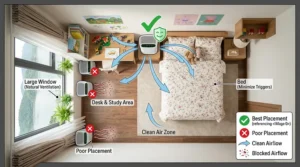
- Placing the purifier in a corner or against a wall. Most units need a few inches to a foot of clearance on all sides for proper airflow — tucking it behind furniture can meaningfully cut its real-world effectiveness.
Long-Term Cost and Maintenance: What Filters Really Cost Over a Year
Filter replacement is the cost most buyers underestimate going in. Budget units like the GermGuardian AC4825 typically need filter swaps every 6–8 months, while the carbon component (which also acts as the pre-filter on that model) can saturate faster in dustier homes. Mid-tier units like the Medify MA-40 are rated for roughly 3,000 hours of use — about 4–5 months of continuous run time — per filter set. The Winix 5500-2’s washable AOC carbon filter is the standout for long-term savings here, since you’re not buying a replacement carbon filter on the same schedule as the HEPA layer.
Across the 7 units here, expect to budget somewhere in the range of $25–$50 per filter change, roughly twice a year for most models, once you factor in realistic household dust and pet-dander loads — closer to $50–$100 annually depending on the unit and how dusty your specific home environment is.
Features That Actually Matter (And Those That Don’t)
Actually matters: AHAM-verified CADR for your room size, a noise rating you’ve confirmed at the speed you’ll actually use overnight, and clarity on whether any ionizing feature can be switched off.
Doesn’t matter much for asthma specifically: Wi-Fi/app connectivity (convenient, but doesn’t affect air quality outcomes), aesthetic design, and most UV-C add-ons at the wattage typically found in consumer-grade units.
Matters more than people expect: Filter replacement cost and frequency, since this is the ongoing expense that determines whether you’ll actually keep the filter changed on schedule — a unit with filters you keep putting off buying isn’t doing its job.
Practical Usage Guide: Setting Up Your Air Purifier for Best Results
Getting a new unit running correctly in the first 30 days matters more than most people assume:
- Placement: Keep at least a few inches of clearance on all sides (check your specific model’s manual — some need closer to a foot), and avoid corners or behind furniture, which restrict airflow.
- Run it continuously for the first week rather than only switching it on when symptoms flare — particle levels build up gradually, and continuous filtration keeps a baseline low rather than playing catch-up.
- Set a filter-change reminder the day you unbox it, even if the unit has a built-in indicator — those indicators are often based on estimated runtime, not actual filter saturation, and can be optimistic in dusty homes.
- If the unit has a switchable ionizer, turn it off before first use for a child’s bedroom, rather than leaving the default factory setting (which is often “on”).
- Common early mistake to avoid: running a unit on its lowest, quietest speed 24/7 in a room it’s actually undersized for. If you’ve bought correctly sized for the room, low speed should be sufficient — if you’re hearing yourself say “it doesn’t seem to be doing much,” check the AHAM coverage rating against your actual room size before assuming the unit is faulty.
Nighttime Asthma Symptoms and Where to Place the Purifier
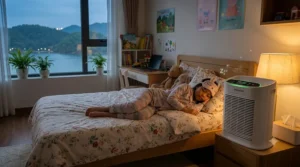
Placement relative to the bed matters more than most buying guides mention. Position the purifier a few feet from the head of the bed rather than directly underneath the air intake — close enough to clean the air your child is actually breathing overnight, far enough that the lowest fan-speed white noise doesn’t disrupt sleep. For nighttime asthma symptoms specifically, running the purifier continuously through the night (rather than on a timer that shuts off mid-sleep) keeps particle levels from creeping back up in the hours symptoms most often spike.
Frequently Asked Questions
❓ What is the best air purifier for child asthma in a bedroom?
❓ Does an air purifier help a child breathe better at night?
❓ How often should I change the filter in a kid's room air purifier?
❓ Is it safe to run an air purifier all night in a child's room?
❓ Are ionizer air purifiers safe for asthma in kids?
Conclusion
There’s no single “best” air purifier for asthmatic child needs across every household — there’s a best fit for your room size, your noise tolerance at night, and your budget for ongoing filter costs. If you need one anchor recommendation: for a standard-size kid’s bedroom, the Coway AP-1512HH Mighty’s combination of proven reliability, AHAM-verified coverage, and a switchable ionizing feature makes it the safest “can’t go wrong” pick on this list. If your room is smaller or quiet is the priority, the Blue Pure 411+ is the stronger fit; if budget is the binding constraint, the GermGuardian AC4825 still gets a genuine True HEPA filter into the room for meaningfully less money.
Whichever you choose, the EPA’s core guidance is worth keeping in mind long after you’ve made the purchase: an air purifier is one piece of a broader approach that also includes regular dusting, vacuuming with a HEPA-filter vacuum, and reducing dust mite and pet dander sources at the room level — not a standalone fix.
✨ Don’t Miss These Exclusive Deals!
🔍 Take your search for an air purifier for kids with asthma further — click through on any of the seven models above to check current pricing and availability before making your final choice.
Recommended for You
- 7 Best Air Purifiers for Asthma in 2026 (Real HEPA Picks)
- Air Purifier for Dust Mite Allergy: 7 Best Picks in 2026
- Best Air Purifier for Seasonal Allergies: 7 Picks That Work (2026)
Disclaimer: This article contains affiliate links. As an Amazon Associate, I earn from qualifying purchases. If you purchase products through these links, we may earn a small commission at no additional cost to you.
✨ Found this helpful? Share it with your friends! 💬🤗
