
In This Article
Your garage workshop is a bit of a liar. After a quick sweep it looks spotless, yet the stuff that does the damage is floating at head height, invisible and patient. An air purifier for garage workshop fumes goes after exactly that: the fine particles from sanding and routing, plus the chemical vapors rising off stains, lacquers, glues, and solvents.
The dust side alone is serious. OSHA’s woodworking guidance links woodworking dust to skin reactions, allergic respiratory effects, asthma, and cancer. It also flags sanders, shapers, and routers as the biggest dust producers. NIOSH recommends keeping total wood dust at or below 1 mg/m³, far stricter than the 15 mg/m³ nuisance-dust limit OSHA enforces. Add finish fumes, and a closed garage door turns your hobby space into a small, poorly ventilated chemistry lab.
Here’s the catch most product pages skip: dust and fumes are different problems. Dust is a particle job, solved by airflow plus good filter media. VOC fumes are a gas job. They need a real mass of activated carbon, and a HEPA filter does nothing for them. One machine rarely nails both, which is why this guide ranks seven real units by what each one actually does well.
A transparency note: I haven’t tested these units myself. Everything below comes from published specs, manufacturer manuals, and aggregated reviewer sentiment, run through plain arithmetic and shop-floor logic. Where the evidence is thin, I’ll say so.
Quick Comparison: Which Air Purifier for Garage Workshop Fumes Fits Your Shop?
| Product | Type | Rated Coverage | Carbon for VOC Fumes | Price Range* | Best For |
|---|---|---|---|---|---|
| WEN 3410 | Hanging dust filter | ~400 sq ft | None | ~$110-$180 | Budget dust control in small shops |
| ALORAIR Purecare 1350IG | Hanging high-airflow dust filter | Claimed 1,700 (verify) | None | Varies by retailer | Large, dusty woodworking shops |
| DEWALT DWXAF101 | Hanging/portable HEPA-style | ~452 sq ft | None | ~$250-$320 | Quieter, auto-sensing dust cleanup |
| Honeywell HPA300 | Floor True HEPA | ~465 sq ft | Thin carbon pre-filter | ~$180-$270 | Fast dust turnover per dollar |
| LEVOIT Core 400S-P | Floor True HEPA + carbon | ~403 sq ft | Light-to-moderate (~250 g standard) | ~$180-$220 | Occasional finishing plus dust |
| Austin Air HealthMate HM400 | Floor HEPA + heavy carbon | Up to 1,500 sq ft at ~1 air change/hr | 15 lbs carbon/zeolite | ~$550-$850 | Heavy, repeated VOC fumes |
| Winix 5500-2 | Floor True HEPA + pellet carbon | ~360 sq ft | Moderate, washable | ~$150-$190 | Budget dust plus odors |
*Prices change constantly. These ranges reflect research at the time of writing, so check current price before buying.
Read the table in two halves. The top three units are dust specialists with no carbon at all, so they’re woodworking tools rather than fume tools. In the bottom four, the carbon column decides everything. The Austin Air HealthMate HM400 is the only one carrying a serious adsorbent load. The LEVOIT Core 400S-P and Winix 5500-2 sit in the useful-but-limited middle, and the Honeywell HPA300‘s carbon is more garnish than main course.
If your garage sees both sanding and spraying, plan on pairing a dust unit with a carbon unit. A realistic two-unit setup, such as the WEN 3410 plus the Winix 5500-2, lands around $260-$370. That is still well under a single Austin Air HealthMate HM400, though it carries far less carbon.
💬 Just one click — help others make better buying decisions too!😊
Top 7 Picks: Expert Analysis of Each Air Purifier for Garage Workshop Fumes
1. WEN 3410 — budget ceiling cleaner for small, dusty shops
The WEN 3410‘s big selling point is simplicity: hang it from the rafters, grab the remote, and let it work the haze out of the air while your floor space stays free. It moves 300, 350, or 400 CFM through a 1/6 HP motor. A 5-micron outer filter and a 1-micron inner filter do the catching, and WEN rates it for rooms up to about 400 sq ft.
On rated airflow, that works out to roughly 5-7 air changes an hour in a 20×20 garage with 9-foot ceilings. That’s my own arithmetic, not a WEN claim. The trade-off is that a 1-micron filter isn’t True HEPA, so the finest respirable particles slip past more easily.
Based on the spec sheet, this is a woodworking dust tool, full stop. There’s no carbon stage, so it won’t touch VOC fumes from finishes. Hobbyists running a sander, router, and table saw in a one- or two-car garage get the most from it.
Retailer reviewers consistently call it an effective, affordable fix for small workshops. A recurring reminder is that it’s air filtration, not a replacement for sawdust collection at the tool. One forum owner found it too loud at top speed (rated 50-60 dB).
Pros:
- ✅ Remote and timer make daily use effortless
- ✅ Ceiling mount frees up precious floor space
- ✅ Lowest entry cost on this list
Cons:
- ❌ No carbon, so zero help with fumes
- ❌ 1-micron filter is not True HEPA
Price: roughly $110-$180 at the time of research. For dust-only duty, it’s the lowest-risk way in.
2. ALORAIR Purecare 1350IG — brute airflow for big woodworking shops
The ALORAIR Purecare 1350IG is the muscle car here. It’s a vortex-fan unit with a 360-degree intake wrapped around four MERV 11 filters. It runs at 1,050 or 1,350 CFM, and the maker says the filters stop about 90% of 3-10 μm particles and 85% of 1 μm particles.
Put that in context. In a 3,600 cubic-foot garage, the nominal airflow implies roughly 17-22 air changes an hour. Real-world numbers will be lower once sawdust loads the filters. The listing also muddles “sq ft” and “cubic feet” for its 1,700 coverage claim, so do your own volume math.
Two details matter for this article’s topic. The user manual warns against using the unit around poisonous gases or fumes. The maker’s listing also says it doesn’t meet California air cleaner regulations and can’t ship there, which comes down to the built-in ionizer. Treat this as a woodworking dust machine and pair it with a carbon unit if you finish in the same space.
Roundup sites rank it highly for heavy dust. I couldn’t verify a consistent review count across retailers, so I’d rather say that than invent one. Its noise rating (about 69 dBA) is the recurring caveat.
Pros:
- ✅ Massive airflow suits large or very dusty shops
- ✅ 360-degree intake with easy-to-clean filters
- ✅ IR remote reaches about 27 feet
Cons:
- ❌ Loud at about 69 dBA
- ❌ Not intended for fume-laden air
Price: listings varied widely, so check current price before deciding. Value is strong if you need airflow and the price checks out.
3. DEWALT DWXAF101 — sensor-driven AUTO mode with a HEPA-grade final stage
The DEWALT DWXAF101 answers a simple question: what if a ceiling cleaner thought for itself? Its dust sensor drives an AUTO mode alongside HI, MID, and LO. The two-stage filtration pairs a cleanable medium-efficiency static cotton pre-filter with an H11 HEPA filter rated above 95% at 0.3 μm. That’s good, but short of True HEPA’s 99.97%.
Airflow is the trade-off. At 200/350/400 m³/h, the top speed is about 235 CFM, or roughly 3.9 air changes an hour in a 20×20 garage. It’s rated for about 452 sq ft at 105 watts and under 64 dB, with an IR remote and 1-8 hour timers.
NIOSH’s hazard-control series targets dust at sanders, shapers, routers, and table saws for a reason. Capture at the source comes first, and ambient cleanup is the second layer. This unit is that second layer, built for people who hate babysitting settings.
Aggregated scores vary by retailer, roughly 3.9 to 4.4 out of 5. Woodworking forum commenters generally say the filter quality beats cheaper hanging units but the CFM looks modest for the money.
Pros:
- ✅ AUTO mode adjusts to dust levels
- ✅ H11 HEPA-grade final stage
- ✅ Three-year limited warranty
Cons:
- ❌ Modest airflow versus cheaper units
- ❌ No carbon for VOC fumes
Price: high-$200s at launch, so check current price. It’s fair value if you prize filter quality over raw CFM.
4. Honeywell HPA300 — most CADR per dollar in a floor unit
The Honeywell HPA300 wins on a number that’s easy to verify: AHAM-verified CADRs of 320 (dust), 300 (smoke), and 300 (pollen). It’s rated for about 465 sq ft at 4.8 air changes an hour. In a 3,600 cubic-foot garage, 300 CFM works out to about 5 changes an hour, solid for a floor unit.
Filtration pairs three True HEPA filters with an activated-carbon pre-filter. That pre-filter is where expectations need adjusting. Reviewers describe the carbon layer as too thin for meaningful VOC removal, so it takes the edge off odors rather than managing paint or lacquer vapors.
What the spec sheet won’t tell you: filter upkeep adds up. The carbon pre-filter needs replacing roughly every three months, and annual running costs in reviews range from about $70 to $190 depending on the source.
Reviewers consistently praise raw performance and simple controls. The loudest complaint is fan noise, roughly 41 dB on low to nearly 60 dB on turbo. There’s no remote or app either.
Pros:
- ✅ Strong verified CADR for the price
- ✅ True HEPA for fine woodworking dust
- ✅ Simple dial controls
Cons:
- ❌ Thin carbon, so weak against VOC fumes
- ❌ Loud on turbo, with recurring filter costs
Price: about $180-$270 depending on retailer. Best for dust-heavy garages where fumes are an occasional nuisance.
5. LEVOIT Core 400S-P — smart, carbon-equipped all-rounder under $250
The LEVOIT Core 400S-P is the Swiss Army knife of this list. It combines a pre-filter, True HEPA, and an activated-carbon layer in one 3-in-1 cartridge, with app control and air-quality monitoring. Levoit rates it at 260 CFM and 403 sq ft, which is about 4.3 air changes an hour in our model garage.
The carbon is what makes it interesting. One independent review measured about 250 g in the standard filter, with up to 400 g in the Toxin, Smoke, or Pet editions. That is a meaningful step above bargain purifiers, though still tiny next to a 15-pound canister. Expect it to handle light-to-moderate VOC fumes, such as water-based finishes and the odd stain session, not weekly solvent marathons.
One roundup’s informal garage test reported a 61% drop in primer vapors within 30 minutes. That’s a single, unverified source, so treat it as directional.
Reviewers consistently highlight value, quiet low settings, and easy filter swaps. Filter life runs about six months, so budget for that.
Pros:
- ✅ Carbon plus True HEPA in one cartridge
- ✅ App and sensor help automate cleanup
- ✅ Better carbon than many rivals at this price
Cons:
- ❌ Carbon mass still limits heavy fume use
- ❌ Filter replacements every six months or so
Price: about $180-$220. It’s the best “one machine” compromise for hobbyists who sand more than they spray.
6. Austin Air HealthMate HM400 — 15 pounds of carbon for serious chemical vapors
The Austin Air HealthMate HM400 is the heavyweight, in both senses. It packs 60 sq ft of medical-grade True HEPA media and a blend of about 15 lbs of carbon and zeolite, in a 45-lb all-steel body on casters. Austin quotes roughly 400 CFM, although some retailers list lower figures and the unit isn’t AHAM-CADR certified. Its coverage is about 1,500 sq ft at one air change an hour, or roughly 500 sq ft at six.
Do the math on the carbon. At roughly 6.8 kg, it carries about 27 times the 250 g found in the standard LEVOIT Core 400S-P filter. More carbon means more capacity to adsorb vapors before saturating, which is why it suits repeated finishing.
Be careful with sawdust. Heavy fine dust can load the pre-filters and HEPA, so I’d run it downstream of a ceiling dust unit rather than as your only defense.
Reviewer praise centers on chemical and odor removal. Complaints are price, weight, and replacement cost, with the combined HEPA/carbon filter listing around $395. One review lab reported a 94% formaldehyde drop in 45 minutes in a small room. That’s a single source, so take it as a signal, not gospel.
Pros:
- ✅ Largest carbon load of any unit here
- ✅ Five-year warranty on unit and filter
- ✅ Sturdy steel build with casters
Cons:
- ❌ Expensive upfront and for replacement filters
- ❌ Heavy, with no smart features
Price: roughly $550-$850 depending on retailer. It’s costly but unmatched here for sustained VOC fumes.
7. Winix 5500-2 — washable carbon and the easiest upkeep
The Winix 5500-2 is the thrifty one. It stacks a washable pre-filter, a washable pelleted carbon filter, and True HEPA. CADRs are 243 (dust), 246 (pollen), and 232 (smoke), and it’s rated for 360 sq ft. In our model garage, 243 CFM works out to about 4.1 air changes an hour.
Pellet carbon beats the impregnated-fabric carbon in older Winix models, so odors and light vapors get a more credible stage. Noise ranges from about 28 dB to 55 dB, and the HEPA and carbon filters last roughly a year.
One garage tip: the Winix 5500-2 includes PlasmaWave, an ionization feature you can switch off. Winix says it emits no ozone, though one tester reports a small amount when it’s active. In a space that already smells like finish, I’d leave it off.
Reviewers consistently praise price-to-CADR value. Common gripes are loud high speeds, no Wi-Fi, and PlasmaWave being switchable only on the unit.
Pros:
- ✅ Washable pre-filter and carbon cut upkeep
- ✅ Excellent CADR per dollar
- ✅ Remote and timer included
Cons:
- ❌ Moderate carbon mass for heavy VOC fumes
- ❌ Loud at higher speeds
Price: about $150-$190. It’s a smart budget floor unit for dust plus everyday odors.
Spec Showdown: Rated Airflow vs. Real-World Air Changes
| Product | Rated Airflow | Particle Filter | Gas/VOC Stage | Approx. Air Changes/Hr* | Best For |
|---|---|---|---|---|---|
| WEN 3410 | 300-400 CFM | 5-micron + 1-micron | None | 5.0-6.7 | Budget dust |
| ALORAIR Purecare 1350IG | 1,050-1,350 CFM | 4× MERV 11 | None (ionizer) | ~17.5-22.5 (nominal) | Big dusty shops |
| DEWALT DWXAF101 | ~118-235 CFM | Medium + H11 HEPA | None | ~2.0-3.9 | Auto-sensing cleanup |
| Honeywell HPA300 | 300 CADR | True HEPA | Thin carbon pre-filter | ~5.0 | Dust per dollar |
| LEVOIT Core 400S-P | 260 CADR | True HEPA | ~250 g carbon | ~4.3 | Mixed use |
| Austin Air HealthMate HM400 | ~275-400 CFM | True HEPA | 15 lbs carbon/zeolite | ~4.6-6.7 | Heavy VOC fumes |
| Winix 5500-2 | 243 CADR (dust) | True HEPA | Washable pellet carbon | ~4.1 | Budget mixed use |
*Based on a 20×20×9 ft garage (3,600 cubic feet): air changes per hour = CFM × 60 ÷ 3,600.
The ALORAIR Purecare 1350IG number looks heroic, but free-air CFM drops as filters load with sawdust, so treat it as a ceiling, not a promise. For fumes, air changes only matter if the carbon is big enough to hold what flows through it. The Austin Air HealthMate HM400 is the only entry where both numbers are respectable.
Practical Usage Guide: Setting Up Your Air Purifier for Garage Workshop Fumes
A great machine in the wrong spot is an expensive paperweight. Here’s how to get real value from your air purifier for garage workshop fumes.
Placement and Setup
- Hanging units (WEN 3410, ALORAIR Purecare 1350IG, DEWALT DWXAF101): mount them over the main work zone, away from walls, so air can loop through the room. The ALORAIR manual calls for about 2 feet of clearance around intake and outlet.
- Floor units: place them near your work but outside the direct dust stream, with the intake clear of walls. Give a LEVOIT Core 400S-P or Austin Air HealthMate HM400 breathing room.
- Timing: start the purifier before you work and keep it running 30-60 minutes afterward. Fine dust stays suspended, and VOC fumes can linger after the job ends.
Maintenance Schedule
- Weekly: vacuum or wash pre-filters. A clogged pre-filter is the number-one airflow killer.
- Monthly: check the carbon stage. A returning chemical smell is a sign of saturation.
- Every 6-12 months: replace HEPA and carbon on the manufacturer’s schedule, sooner under heavy use.
Common First-30-Day Mistakes
- Running the unit only after finishing, not during.
- Pushing a floor unit flat against a wall.
- Relying on a ceiling dust unit for fumes it was never built to handle.
- Skipping outside air. Crack the door so the room exchanges air with outdoors.
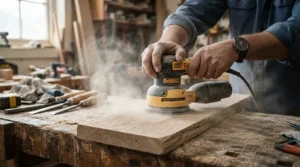
Real-World Scenarios: Matching an Air Purifier for Garage Workshop Fumes to Your Shop
Scenario 1: The weekend woodworker. A one-car garage (about 12×20 with 8-foot ceilings, ~1,920 cubic feet), sanding on Saturdays, occasional water-based poly, a budget near $200. The LEVOIT Core 400S-P gives about 8 air changes an hour at 260 CFM, with enough carbon for light finishing. Move it near the bench on a cart.
Scenario 2: The daily furniture builder. A 20×20 two-car garage, daily sanding, oil-based finish weekly, a budget around $400-$500. Pair a hanging WEN 3410 for fine dust with the Winix 5500-2 for odors and light vapors. This stays well below the cost of a Austin Air HealthMate HM400 while covering both problems.
Scenario 3: The heavy finisher. Regular spraying or solvent-heavy finishes, with ventilation and a proper respirator already in place. Here the Austin Air HealthMate HM400 earns its price by managing lingering VOC fumes, and a DEWALT DWXAF101 handles overspray and sanding dust. Run purifiers after spraying, never inside an active flammable spray cloud, and follow every manual.
What Is an Air Purifier for Garage Workshop Fumes?
An air purifier for garage workshop fumes is a filtration device designed to clean both airborne particles and chemical vapors in a garage shop. It pairs particle filters, from pleated media to HEPA, for woodworking dust with a substantial activated-carbon stage that adsorbs VOC fumes from paints, stains, glues, and solvents.
That two-job description is the key to shopping smartly. Many “garage” purifiers excel at one half and merely advertise the other. A hanging dust filter like the WEN 3410 is a particle specialist. A heavy-carbon unit like the Austin Air HealthMate HM400 is a vapor specialist that still handles particles. Everything else lands somewhere between those poles.
It also helps to know what this category is not. It isn’t a dust collector, which captures chips at the tool. It isn’t a ventilation system, which swaps garage air for outdoor air. And it isn’t personal protective equipment. A purifier supplements those three, and it never replaces them.
How to Choose an Air Purifier for Garage Workshop Fumes
- Measure volume, not just floor area. Multiply length × width × height. A tall ceiling quietly cuts the air changes a unit delivers.
- Target roughly 4-6 air changes per hour. Room-size ratings typically assume about 4.8 air changes, so use CFM or CADR × 60 ÷ your volume.
- Name your dominant hazard. Sanding-heavy shops need particle capacity first. Finishing-heavy shops need carbon first.
- Check carbon mass, not the word “carbon.” A thin pre-filter and a 15-pound bed share a label but not a capability.
- Plan for dust loading. Washable, easily accessible pre-filters protect your HEPA investment.
- Check noise, ionizers, and mounting. Ear-splitting fans get switched off, and ozone-producing features don’t belong in a chemical-rich room.
- Budget the upkeep. Filter costs and replacement intervals can outweigh the sticker price over several years.
Air Purifier for Garage Woodworking: Taming Woodworking Dust
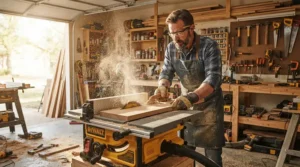
Choosing an air purifier for garage woodworking starts with understanding where woodworking dust comes from. Table saws and planers throw chips and coarse sawdust, which your dust collector or shop vac should grab. Sanding, routing, and shaping create the fine fraction that hangs in the air long after the tool stops.
That fine fraction is the reason to filter ambient air. OSHA lists asthma, hypersensitivity pneumonitis, and chronic bronchitis among the documented respiratory effects of wood dust exposure. It also notes that certain hardwoods such as oak, walnut, birch, and ash have been associated with nasal cancer in woodworkers.
For this job, ceiling units like the WEN 3410, ALORAIR Purecare 1350IG, and DEWALT DWXAF101 give you airflow with low floor-space cost. The Honeywell HPA300 and Winix 5500-2 bring True HEPA for finer particles. In practice, tackling woodworking dust well means three layers: capture at the tool, ambient air filtration, and a respirator when sanding. Skip any layer and the other two work harder.
Sawdust Collection vs Air Filtration: Why You Need Both
Think of sawdust collection as the bouncer and air filtration as the cleanup crew. Source capture, such as a dust collector, a hooded saw, or a shop vac on a sander, stops chips and coarse dust at the door. Air filtration deals with whatever slipped through. NIOSH lab testing of a table-saw exhaust hood reported emission cuts above 90 percent, which is why capture comes first.
| Approach | Coarse Chips | Fine Dust | VOC Fumes | Typical Cost | Best For |
|---|---|---|---|---|---|
| Source capture (dust collector/shop vac) | Excellent | Moderate (filter-dependent) | None | $$-$$$ | Stopping dust at the tool |
| Open door + box fan | Poor | Poor-moderate | Dilutes some | $ | Quick fume dilution |
| Hanging filter (WEN 3410) | None | Good | None | $-$$ | Lingering fine dust |
| HEPA + carbon floor unit (LEVOIT Core 400S-P) | None | Very good | Light-moderate | $$ | Mixed dust and light fumes |
| Heavy-carbon unit (Austin Air HealthMate HM400) | None | Very good | Strong | $$$ | Repeated finishing |
| Respirator | n/a | Protects wearer | Protects wearer (cartridge-dependent) | $ | Personal protection |
Notice that no row wins every column. Sawdust collection can’t see invisible particles, and an air filter can’t swallow a chip pile. For anyone serious about an air purifier for garage woodworking, the winning recipe is a collector at the machine, a ceiling or floor unit overhead, and a respirator for sanding.
VOC Fumes Explained: Why Carbon Weight Matters More Than the HEPA Label
VOC fumes are gases, and filters don’t catch gases, so HEPA is irrelevant here. According to the EPA’s indoor air guidance, paints, strippers, solvents, wood preservatives, adhesives, and hobby supplies are all sources. Indoor VOC levels often run 2 to 5 times higher than outdoors, and during activities like paint stripping they can spike to about 1,000 times background outdoor levels. EPA also notes that elevated concentrations can persist long after the job is done.
Activated carbon works by adsorption, with molecules sticking to a huge internal surface area. But the surface is finite. When it’s full, it stops working, quietly. That’s why the amount of carbon matters so much. A standard LEVOIT Core 400S-P filter holds roughly 250 g, while the Austin Air HealthMate HM400 carries about 15 lbs, nearly 27 times as much. The Winix 5500-2 offers a washable pellet bed in between, and the Honeywell HPA300‘s pre-filter is more of a deodorizing mat.
Practical rule: if you smell the finish returning through the purifier, the carbon is probably spent. Low-VOC products reduce the load, too. Zero-VOC paints are generally defined as under 5 g/L, but check labels, since additives and solvents vary.
Air Purifier for Garage Paint Fumes: What Works and What Doesn’t
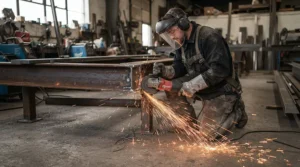
An air purifier for garage paint fumes is a cleanup tool, not a shield. It lowers lingering vapor concentrations over time. It does not protect your lungs while you spray, because the highest concentrations sit right at your face.
For that, you need ventilation during the job and a respirator fitted with organic vapor cartridges. A basic dust mask stops particles, not vapors. Even for dust alone, NIOSH investigators evaluating hardwood floor sanding concluded that workers needed at least a NIOSH-approved half-mask N95. Vapors raise the bar further.
Then there’s fire safety. Solvent-based finishes create flammable vapors. Manufacturers generally don’t design consumer purifiers for flammable atmospheres, and the ALORAIR Purecare 1350IG manual explicitly cautions against fume-laden environments. Read your own manual, keep ignition sources away, and run purifiers after the spraying stops, with the door open.
Among the seven, the Austin Air HealthMate HM400 is the most credible for lingering paint vapors thanks to its carbon bed. The LEVOIT Core 400S-P and Winix 5500-2 suit smaller, occasional jobs.
Features That Actually Matter (And Those That Don’t)
Matter: carbon mass, verified CFM or CADR, washable or accessible pre-filters, and sensible noise. A unit you can’t stand will be switched off, and an off purifier cleans nothing. Remotes and timers, as on the WEN 3410 and DEWALT DWXAF101, matter more in a workshop than most people expect, because you can’t always walk over with sawdust on your hands.
Matter less: big “sq ft” coverage claims with no stated air-change rate. The ALORAIR Purecare 1350IG listing shows how confusing these can get when units and assumptions aren’t clear. Smart apps are nice, as on the LEVOIT Core 400S-P, but they won’t rescue weak carbon.
Be wary of: ionizers and similar add-ons. The Winix 5500-2 lets you turn PlasmaWave off, and in a chemical-rich garage that’s the setting I’d pick. The ALORAIR Purecare 1350IG isn’t sold into California because of its air-cleaner regulations, a useful reminder to check local rules.
Also ignore: headline filtration percentages without the particle size attached. “H11 HEPA” on the DEWALT DWXAF101 and “True HEPA” on the Honeywell HPA300 are different grades. The details matter more than the adjectives.
Long-Term Cost & Maintenance: What Your Air Purifier for Garage Workshop Fumes Really Costs
| Product | Price Range | Filter Upkeep | Value Verdict | Best For |
|---|---|---|---|---|
| WEN 3410 | ~$110-$180 | Replaceable 5- and 1-micron filters | Best dust per dollar | Small dust-only shops |
| ALORAIR Purecare 1350IG | Varies by retailer | Four MERV 11 filters, easy to clean or replace | Great airflow if price checks out | Large woodworking shops |
| DEWALT DWXAF101 | ~high-$200s at launch | Cleanable medium filter + replaceable HEPA | Fair mid-range value | Auto-sensing dust control |
| Honeywell HPA300 | ~$180-$270 | Pre-filter ~quarterly + HEPA; ~$70-$190/yr by source | Great CADR, higher running cost | Dust-heavy garages |
| LEVOIT Core 400S-P | ~$180-$220 | Combined filter ~6 months | Strong all-rounder | Mixed dust and light fumes |
| Austin Air HealthMate HM400 | ~$550-$850 | ~$395 list filter, 3-5 years reported | Costly upfront, lowest cost per carbon pound | Heavy VOC fumes |
| Winix 5500-2 | ~$150-$190 | Washable pre-filter and carbon; yearly HEPA/carbon | Lowest upkeep | Budget mixed use |
Sticker price is only the first chapter. A Honeywell HPA300 looks cheap until quarterly pre-filters pile up, while a Winix 5500-2 keeps costs down with its washable stages. Spread a roughly $700 Austin Air HealthMate HM400 across its five-year warranty window and it’s about $140 a year before filters, which is less scary when you’re actually spraying finishes weekly.
For maintenance, treat the pre-filter like an air filter in a car. Clean it often and everything downstream lasts longer.
FAQ
❓ Can a HEPA air purifier remove VOC fumes from a garage?
❓ How many CFM do I need for a two-car garage workshop?
❓ Is it safe to run a purifier while spraying paint?
❓ How often should I replace the carbon filter in a garage?
❓ Are ionizers safe in a woodworking shop?
Conclusion
There’s no single winner, only the right match. For budget dust control, the WEN 3410 is hard to beat, while the DEWALT DWXAF101 adds sensor smarts and a HEPA-grade final stage. If your shop is large and filthy, the ALORAIR Purecare 1350IG brings serious airflow. Just keep it out of fume duty.
For mixed jobs, the LEVOIT Core 400S-P, Winix 5500-2, and Honeywell HPA300 cover dust with varying carbon. The Austin Air HealthMate HM400 is the heavy hitter when VOC fumes are a weekly reality. The best air purifier for garage workshop fumes is often two machines: a particle workhorse overhead and a carbon workhorse on the floor.
Whatever you buy, remember the hierarchy: capture dust at the tool, ventilate during finishing, wear the right respirator, then let your purifier mop up what’s left. Do that, and your garage stops being a place you recover from and becomes one you can happily spend hours in.
Recommended for You
- Air Purifier For Shared Office: 7 Top Picks That Beat Fumes 2026
- Desk Air Purifier For Office: 7 Best Quiet Picks (2026)
- Air Purifier For Home Office Allergies: 7 Best Picks (2026)
Disclaimer: This article contains affiliate links. As an Amazon Associate, I earn from qualifying purchases. If you purchase products through these links, we may earn a small commission at no additional cost to you.
✨ Found this helpful? Share it with your friends! 💬🤗
