
In This Article
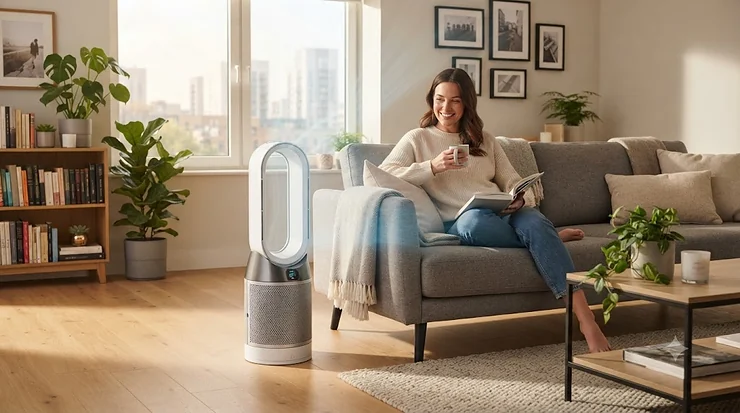
Let’s be honest about what brought you here: something in your apartment smells like an ashtray, and you’re tired of it. Maybe it’s your own habit, maybe it’s the guy two doors down whose Marlboro clouds apparently consider your living room a connecting suite. Either way, an air purifier for smokers apartment life needs to do something most purifiers were never built for — it has to fight sub-micron smoke particles and the gnarly gas-phase chemicals that make a room smell like a bar at 2 a.m., all while fitting in a 450-square-foot floor plan where every inch of counter space is already spoken for.
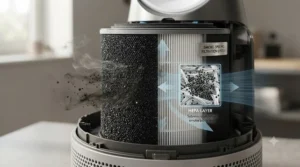
What is an air purifier for smokers apartment use? In short: it’s a compact HEPA-plus-activated-carbon unit sized to a bedroom or living room rather than a warehouse, designed to strip both the visible particles and the invisible VOCs that define tobacco smoke, so an apartment stops smelling like the inside of a lighter. Renters have less control over their air than homeowners do — you can’t rip out drywall or install commercial-grade HVAC filtration in a unit you don’t own — so the purifier itself has to carry most of the weight.
We dug into lab-tested CADR numbers, AHAM certification data, and aggregated real owner reviews to build this guide, and we leaned on the EPA’s own guidance on selecting air cleaners for the baseline science. Below you’ll find seven genuinely different machines — from a $100 tower to a 47-pound steel tank — so whether you’re renting a studio or trying to protect a nursery from a neighbor’s habit, there’s a real option waiting.
Quick Comparison Table
| Product | Best For | Smoke CADR | Room Size |
|---|---|---|---|
| GermGuardian AC4825 | Tightest budget | ~99-108 CFM | up to 167 sq ft |
| Levoit Core 300S | Small room, smart control | ~141 CFM | up to 219 sq ft |
| Blueair Blue Pure 411+ | Quiet compact spaces | ~105-123 CFM | up to 190 sq ft |
| Winix 5500-2 | Best all-around value | ~232 CFM | up to 360 sq ft |
| Coway Airmega AP-1512HH(W) | Apartment living rooms | ~240 CFM | up to 874 sq ft |
| Alen BreatheSmart FLEX | Heavier smoke load | ~300 CFM | up to 800 sq ft (VOC filter) |
| Austin Air HealthMate HM400 | Heavy or chain smokers | ~400 CFM | up to 1,500 sq ft |
Looking at this table, the pattern that jumps out is the trade-off between footprint and staying power: the smaller, cheaper units in a small room cigarette smoke situation clear a bedroom respectably but saturate fast under continuous smoking, while the carbon-heavy machines at the bottom cost more upfront but go months longer between filter changes. If your apartment is under 250 square feet, you genuinely don’t need the Austin Air’s brute force — but if you’re a heavy or daily smoker, the lighter units will leave you buying replacement filters every few weeks, which erases any savings.
💬 Found a favorite already? Bookmark this page so you can compare specs side-by-side before you buy.
💬 Just one click — help others make better buying decisions too!😊
Top 7 Air Purifiers for a Smoker’s Apartment: Expert Analysis
Coverage area matters, but so does carbon volume, noise at 2 a.m., and whether you’re fighting your own smoke or someone else’s drifting through the walls. Here’s how these seven actually stack up once you look past the marketing copy.
1. GermGuardian AC4825 — cheapest true HEPA tower with a washable pre-filter
If your budget for an air purifier for smokers apartment living is closer to “whatever’s left after rent” than “whatever works best,” the AC4825 is where most people land first. Its True HEPA filter captures 99.97% of particles down to 0.3 microns, and a carbon-coated pre-filter sits in front of it to blunt odors from smoke, cooking, and pets. On paper, a smoke CADR in the 99-108 CFM range and a 167-square-foot rating means this is strictly a single-bedroom or small-office tool, not a living-room solution — don’t expect it to keep pace with a chain smoker in an open floor plan. Reviewers consistently note that the fabric-style carbon layer, rather than dense carbon pellets, saturates faster under heavy smoke than the pricier units on this list, so odor control fades within weeks rather than months if you’re smoking indoors daily. It’s still a reasonable pick for light, occasional smoke exposure — say, a roommate who smokes outside but tracks the smell back in — or for parking in a home office where cigar smoke drifts in from a balcony next door. The optional UV-C bulb is more marketing flourish than functional upgrade; independent testing has found no measurable particle-removal benefit from switching it on.
Pros:
- ✅ Lowest price point of any real HEPA option here
- ✅ AHAM-certified CADR you can actually trust
- ✅ Simple 3-speed dial with no learning curve
Cons:
- ❌ Fabric carbon layer saturates fast under heavy smoke
- ❌ Underpowered for anything beyond a small bedroom
Expect to find the GermGuardian AC4825 priced under $100, with replacement filters running affordably every 6-8 months — it’s a fair value if your smoke exposure is light to moderate.
2. Levoit Core 300S — best small room cigarette smoke fighter with app control
For a best air purifier small room cigarette smoke situation — think a 180-square-foot bedroom or a studio’s sleeping nook — the Core 300S punches well above its size. Its CADR of roughly 141 CFM against a 219-square-foot recommended coverage gives it nearly five air changes per hour in the space it’s designed for, and Levoit’s VeSync app lets you check air quality and adjust fan speed from your phone without getting out of bed. What most buyers overlook about this model is that its 26-watt motor sips power compared to the older Core 300’s 45 watts, which matters if you’re running it 24/7 in a rental where you’re footing the electric bill. Reviewers consistently note that its auto mode can be a touch too relaxed, dropping fan speed once PM2.5 readings look “good” by the unit’s internal scale even though that threshold sits well above WHO guidance — so if you’re an active smoker, running it on a fixed medium-to-high speed manually will serve you better than trusting auto mode blindly. The three-stage filter (pre-filter, HEPA, activated carbon) handles both particles and odor reasonably well for its price class, though the carbon layer here is modest rather than the pelletized, high-volume carbon found in pricier units.
Pros:
- ✅ Excellent CADR-per-dollar ratio in its size class
- ✅ Quiet on low, app and voice control included
- ✅ Low energy draw for round-the-clock use
Cons:
- ❌ Auto mode under-responds to cigarette smoke
- ❌ Carbon filter thinner than mid-range competitors
The Levoit Core 300S typically sits in the $130-$160 range, making it one of the strongest value plays for anyone whose smoke problem is confined to a single small room.
3. Blueair Blue Pure 411+ — quietest compact pick, great for a nursery next to a smoky wall
When neighbor smoke seeping walls is the actual problem — not your own habit, but secondhand drift from an adjoining unit — you often need something small enough to tuck into a corner of a nursery or home office without becoming furniture. The Blue Pure 411+ is barely over three pounds, uses Blueair’s HEPASilent technology (combining mechanical HEPA with an electrostatic charge on the intake air), and posts CADR figures around 105-123 CFM for smoke depending on the exact sub-model. Based on the spec comparison, its 190-square-foot rating undersells it slightly; independent lab testing found it clearing incense smoke from rooms up to 320 square feet in around an hour, just less thoroughly than in its rated space. What sets it apart from same-price competitors is noise: even at max speed it stays in the low-50-decibel range, and its lowest setting barely registers, which matters enormously if you’re placing this in a bedroom to protect a light sleeper from a neighbor’s late-night smoking habit. A common complaint in user reviews is the always-on center light, which some owners find useful as a nightlight and others find intrusive in a pitch-black room — worth checking before you commit if you’re a dark-sleeper. The washable, colorful fabric pre-filter is a nice touch for anyone tired of beige plastic boxes dominating their apartment decor.
Pros:
- ✅ Whisper-quiet even at top speed
- ✅ HEPASilent tech handles small-room smoke fast
- ✅ Compact, lightweight, easy to move between rooms
Cons:
- ❌ Always-on indicator light bothers some sleepers
- ❌ Non-pelleted carbon saturates quicker than premium units
Pricing generally lands in the $120-$150 range, making the Blueair Blue Pure 411+ a smart pick specifically for bedroom-adjacent smoke problems rather than heavy indoor smoking.
4. Winix 5500-2 — the value benchmark, with real pellet-based carbon
Here’s where the “you get what you pay for” logic starts breaking down in a good way. The Winix 5500-2 uses actual carbon pellets housed in a honeycomb frame — not the thin fabric-and-carbon-dust layers found in budget units — and that difference matters enormously for tobacco smoke air purifier apartment performance, because pelleted carbon has dramatically more surface area to adsorb VOCs before it saturates. Independent smoke-box testing clocked this unit clearing a sealed glass chamber of visible smoke in around 20 seconds, and its CADR of 232 CFM for smoke against a 360-square-foot rating gives it real living-room capability, not just bedroom coverage. The spec sheet won’t tell you this, but user reports suggest the included PlasmaWave ionizer function can be switched off entirely without meaningfully hurting particle removal, which is worth knowing if you’d rather avoid any ionization technology. On the downside, replacement filters run pricier than the unit’s bargain reputation suggests — official filters cost more than some entire budget purifiers — though the pre-filter and carbon layer are washable, which stretches the HEPA filter’s working life. Winix has reportedly discontinued this exact model in favor of the visually updated 5510 with app control, but the filtration internals are identical, so either version delivers the same real-world result.
Pros:
- ✅ Pellet-based carbon outperforms fabric filters on smoke
- ✅ Strong CADR for a mid-tier price point
- ✅ Auto mode with genuinely responsive air quality sensor
Cons:
- ❌ Replacement filters cost more than the segment average
- ❌ Loud at turbo speed, best run on speed 2-3 for smoke
Expect a $150-$200 range for the Winix 5500-2 (or its 5510 successor), which remains one of the strongest all-around picks in this guide.
5. Coway Airmega AP-1512HH(W) — the living-room workhorse apartment dwellers actually love
If you need one purifier to handle an entire apartment living room — not a bedroom corner — the Coway Airmega AP-1512HH(W), commonly called the Mighty, is the name that comes up again and again in owner forums and professional test labs alike. Its four-stage filtration (pre-filter, odor filter with activated carbon, HEPA, and an ionizer you can disable) delivers a smoke CADR around 240 CFM against an 874-square-foot AHAM rating, which is enormous headroom for a typical 500-700 square foot one-bedroom unit. Here’s what the spec sheet doesn’t fully capture: the Mighty’s minimum noise level is a remarkably low 24 dB, meaning you can run it continuously overnight in eco mode without it becoming background static in your sleep. Based on the spec comparison, its slim vertical profile (under 10 inches wide) also makes it one of the more apartment-friendly designs here — it slides beside a couch or bookshelf without eating floor space the way boxier units do. A common complaint in user reviews centers on the odor filter’s relatively modest carbon volume compared to true heavy-duty units, meaning very heavy, continuous cigarette smoke will require more frequent filter swaps than the marketing suggests, even though particle filtration remains excellent throughout.
Pros:
- ✅ Whole-apartment coverage from one unit
- ✅ Remarkably quiet minimum fan speed
- ✅ Slim design fits real apartment furniture layouts
Cons:
- ❌ Carbon odor filter modest for heavy daily smoking
- ❌ Filter replacements needed more often under smoke load
Typically priced in the $230-$280 range, the Coway Airmega AP-1512HH(W) earns its reputation as the go-to apartment air purifier smoke smell solution for anyone who wants one machine to cover the whole unit.
6. Alen BreatheSmart FLEX — heavyweight carbon in a mid-size body
Step up to the Alen BreatheSmart FLEX and you’re buying into a fundamentally different approach to filtration: instead of one fixed filter, Alen lets you choose the carbon load at checkout, and for a smoker’s apartment the VOC/Smoke filter option (loaded with roughly 2.3 lbs of pelleted activated carbon) is the one that matters. What most buyers overlook about this model is that this carbon volume is genuinely closer to premium heavy-duty units than to typical mid-range purifiers — it’s more carbon than you’ll find in most $400+ competitors, tucked into a machine that still covers a 300-square-foot room comfortably at a quieter noise profile. Independent testing clocked the FLEX clearing a smoke-filled test room in roughly the same time as Alen’s pricier 45i model, meaning you’re not paying extra for smart-app features you may not need. Reviewers consistently note that filters with this level of carbon last 9-12 months under normal conditions, though heavy daily smoking will shorten that window meaningfully — plan on the low end of that range if you smoke indoors regularly. Alen also backs its filters with a lifetime warranty on the unit itself, provided you stay on their filter subscription, which is an unusual and genuinely valuable perk if you intend to keep this purifier running for years rather than replacing it as trends shift.
Pros:
- ✅ Heavy-duty pelleted carbon rarely seen at this price
- ✅ Quiet operation even at higher fan speeds
- ✅ Lifetime warranty available with filter subscription
Cons:
- ❌ No smart app or auto mode on this model
- ❌ Filter subscription required to keep warranty active
Pricing generally falls in the $300-$380 range depending on the filter option selected, positioning the Alen BreatheSmart FLEX as the smart upgrade for anyone whose smoke problem has outgrown mid-range units.
7. Austin Air HealthMate HM400 — the heavy-smoker’s tank, built to outlast the lease
There’s a reason chemical-sensitivity clinics and post-9/11 environmental health researchers gravitated toward the Austin Air HealthMate: it carries roughly 15 pounds of granular activated carbon and zeolite around its central HEPA core, dwarfing every other filter in this guide by a factor of six or more. For a genuinely heavy or chain-smoking household, this isn’t overkill — it’s the difference between replacing filters every few months and replacing them once every five years, which the manufacturer backs with published testing. Based on the spec comparison, its 400 CFM CADR and steel-and-powder-coat construction explain both its 47-pound weight and its $750-$850 price range; this machine is built like appliance-grade equipment, not consumer electronics, and it shows in the near-total absence of plastic parts that can crack or discolor from nicotine residue over time. What the spec sheet won’t tell you is that the trade-off for that industrial-grade carbon bed is noise: at high speed it runs 50-66 dB, loud enough that most owners settle permanently on low or medium for continuous use rather than treating the top setting as a normal operating mode. It’s also the only unit here without any digital display, sensor, or app — just a three-speed rotary knob — which some buyers read as refreshingly simple and others find frustratingly bare-bones for the price.
Pros:
- ✅ 15 lbs of carbon dwarfs every competitor here
- ✅ Five-year filter life keeps long-term costs low
- ✅ Steel construction built to last decades
Cons:
- ❌ Loud at high speed, no auto or smart features
- ❌ Heavy purchase price and 47-pound bulk to move
At $750-$850, the Austin Air HealthMate HM400 is a serious investment, but for heavy indoor smokers the five-year filter life often makes it cheaper to own over time than replacing budget units’ filters every few months.
Setting Up Your Apartment Air Purifier for Maximum Smoke Removal
Buying the right machine solves half the problem; placement solves the rest. Position your purifier as close as reasonably possible to where smoke originates — near a cracked window if you smoke there, or against the shared wall if the smoke is drifting in from a neighbor — rather than in a far corner where it has to pull polluted air across the whole room first. Run it continuously rather than switching it on only when you notice the smell; by the time you can smell smoke again, particle and VOC concentrations have already climbed for a while, and a correctly sized unit needs 20-40 minutes of runtime to complete several full air changes before odor drops below the point most people can detect. In the first 30 days, the most common mistake is under-estimating how fast carbon saturates under real smoking conditions versus the manufacturer’s “normal household” estimate — check your filter indicator weekly rather than trusting a 6-12 month default. Crack a window for cross-ventilation whenever weather allows; a purifier works best as a supplement to fresh air exchange, not a replacement for it. Finally, wash fabric curtains and vacuum upholstery regularly, since smoke particles settle into fibers where no air purifier can reach them — this “thirdhand smoke” residue keeps re-releasing odor into the air long after the cigarette is out.
Real Renters, Real Smoke Problems
Consider three common apartment scenarios. A college student in a 300-square-foot studio who smokes occasionally near a cracked window needs something small, affordable, and easy to move — the Levoit Core 300S or GermGuardian AC4825 covers that use case without overspending on capacity they’ll never need. A family with a newborn in a two-bedroom unit where a neighbor’s smoke seeps through a shared wall into the nursery has a very different priority: near-silent operation matters more than raw CADR, making the Blueair Blue Pure 411+ a natural fit for the baby’s room, paired with a stronger unit like the Coway Airmega in the main living space. A heavy daily smoker in a 700-square-foot one-bedroom apartment who’s tired of buying filters every month is the exact profile the Austin Air HealthMate or Alen BreatheSmart FLEX was built for — the higher upfront cost pays for itself in filter longevity within the first year or two of continuous heavy use. Matching the machine to your actual smoke exposure, room size, and noise tolerance matters more than chasing the highest CADR number on the shelf.
When the Smoke Isn’t Yours: Dealing With a Neighbor’s Cigarette Smoke
An air purifier for neighbor cigarette smoke situations requires a slightly different strategy than filtering your own habit, because the smoke is entering continuously through gaps you can’t control — electrical outlets, shared HVAC returns, under doors, or straight through porous drywall. Start by identifying the entry point: if smoke smell concentrates near one wall or vent, that’s where your purifier belongs, not in the center of the room. Weatherstripping around doors and door-sweep gaskets can meaningfully reduce infiltration for a few dollars, and an outlet gasket kit addresses the surprisingly common path of smoke traveling through electrical boxes shared between units. If the smell is severe and persistent, document it and review your lease — many jurisdictions and an increasing number of private landlords have adopted smoke-free policies modeled on HUD’s smoke-free public housing rule, which established the 25-foot smoking buffer now common in multifamily housing nationwide. In the meantime, running a high-carbon purifier like the Alen BreatheSmart FLEX continuously in the affected room, combined with sealing the physical entry points, is the most realistic path to relief while you sort out longer-term options with your property manager.
How to Choose an Air Purifier for a Smoker’s Apartment
- Match CADR to your actual room, not your whole apartment. A unit rated for 360 square feet won’t perform at its best crammed into a tiny bedroom’s corner behind a dresser — but it also won’t help a living room if you buy something rated for a closet.
- Prioritize carbon volume over brand name. A quarter-inch of carbon-coated fabric behaves nothing like a pound of activated carbon pellets; check the actual filter composition, not just the marketing claim of “odor reduction.”
- Factor in noise tolerance for your living situation. If the purifier lives in your bedroom, a 24-30 dB minimum speed matters more than a few extra CADR points.
- Calculate true filter costs, not just sticker price. A cheap unit needing $80 replacement filters every three months can cost more over two years than a pricier machine with a five-year filter life.
- Consider whether the smoke source is your own or a neighbor’s. Your own smoking calls for placement near your smoking spot; a neighbor’s drift calls for placement near the shared wall or vent.
- Check for a sealed housing design. Some budget units allow unfiltered air to leak around filter edges — for smoke removal, a fully sealed intake-to-exhaust path matters enormously.
- Avoid ozone generators marketed as “smoke eliminators.” The CDC’s research on secondhand smoke exposure underscores how harmful the underlying particles and gases already are; adding ozone, itself a lung irritant, only compounds the air quality problem.
Common Mistakes When Buying an Air Purifier for Cigarette Smoke
The single biggest mistake buyers make is choosing based on the room-size number alone without checking whether the filter actually includes substantial activated carbon — HEPA filters excel at particles but do essentially nothing for the gas-phase VOCs that make smoke smell like smoke. A close second is assuming any air purifier can replace source control entirely; even the Austin Air HealthMate, with its 15 pounds of carbon, works far better paired with reduced smoking indoors than as a total substitute for it. Buyers also frequently underestimate noise — ordering the highest-CADR unit available without checking its decibel rating, then discovering it’s too loud to sleep near on anything but its lowest setting. Finally, many shoppers skip checking whether a filter is washable or requires full replacement, which meaningfully changes long-term maintenance costs and effort, especially for renters trying to keep costs predictable month to month.
Air Purifiers vs Other Smoke Removal Methods
| Method | Removes Particles | Removes Odor/VOCs | Ongoing Cost |
|---|---|---|---|
| HEPA + carbon purifier | Excellent | Good to excellent (carbon-dependent) | Filter replacement |
| Scented candles/sprays | None | Masks only, doesn’t remove | Low but recurring |
| Open windows only | Weather-dependent | Weather-dependent | Free |
| Ozone generators | Poor, and adds a lung irritant | Poor, masks via oxidation | Low, but health risk |
The comparison makes clear why a real purifier remains the only method on this list that actually removes rather than masks the problem: scented products and candles simply overlay a second smell atop the first, while open windows only work when outdoor air happens to be clean and the weather cooperates. Ozone generators deserve special caution — despite smoke-elimination marketing claims, ozone itself is classified as a lung irritant, meaning you’d be trading one airborne hazard for another rather than solving anything.
What to Expect: Real-World Performance in a Smoky Apartment
Manufacturer CADR numbers are measured in sealed lab chambers, so real apartment performance will run somewhat slower — expect visible haze to clear in 20-45 minutes depending on unit size and room volume, but odor to linger noticeably longer since gas-phase VOCs adsorb into carbon more slowly than particles get trapped by HEPA media. Within the first week of continuous operation, most owners report a clear reduction in the “walking into a smoky room” sensation, even if faint background odor persists during active smoking. By month two or three, filter performance for odor typically begins declining even if particle capture stays strong, which is your cue to check the carbon filter’s saturation regardless of what the manufacturer’s default replacement schedule suggests. Don’t expect any purifier, however powerful, to eliminate odor absorbed into carpet, curtains, and upholstery — that requires cleaning those surfaces directly, since the purifier can only address what’s currently airborne.
Air Purifiers for Rental Apartment Air Quality: What Renters Need to Know
Rental apartment air quality comes with constraints homeowners don’t face: you generally can’t modify HVAC systems, install duct-mounted filtration, or seal walls permanently, which puts more weight on a portable purifier’s shoulders. Before buying, check your lease for any restrictions on continuous-use appliances, and consider a unit with a lower average wattage if your utilities are included and your building has rules about excessive electricity draw. If secondhand smoke is entering from a neighboring unit, review your local jurisdiction’s landlord-tenant law and any building-wide smoke-free policy — protections vary considerably, since <a href=”https://www.lung.org/policy-advocacy/tobacco/smokefree-environments/multi-unit-housing”>the American Lung Association’s research on multi-unit housing</a> notes that federal smoke-free rules cover public housing but leave private market-rate rentals governed by a patchwork of state and local ordinances. Documenting the problem with photos, smell logs, or even a low-cost air quality monitor strengthens any complaint you file with property management. When you eventually move, most portable purifiers travel well between apartments, making them a better investment than built-in solutions you’d have to leave behind.
Long-Term Cost & Maintenance for Tobacco Smoke Filtration
| Product | Filter Life (Smoke Use) | Approx. Annual Filter Cost |
|---|---|---|
| GermGuardian AC4825 | 3-6 months | ~$40-$60/year |
| Levoit Core 300S | 6-8 months | ~$40-$60/year |
| Winix 5500-2 | 9-12 months | ~$70-$90/year |
| Coway Airmega AP-1512HH(W) | 6-12 months | ~$60-$80/year |
| Alen BreatheSmart FLEX | 9-12 months | ~$100-$150/year |
| Austin Air HealthMate HM400 | Up to 5 years | ~$40-$50/year averaged |
Once you annualize the filter cost, the picture shifts meaningfully from the sticker price alone: the Austin Air’s enormous upfront cost gets diluted across five years of use, ultimately averaging out cheaper per year than several budget units replaced every few months under heavy smoke load. The mid-range units like the Winix 5500-2 and Coway Airmega sit in a comfortable middle ground, balancing reasonable upfront cost against manageable annual maintenance. Electricity is a smaller factor than most people assume — even run continuously, most of these units add only a few dollars a month to a utility bill, so filter replacement remains the dominant long-term cost to plan around.
Features That Actually Matter (And Those That Don’t)
A compact high CADR purifier — meaning strong airflow output relative to its physical footprint — matters far more in an apartment than raw square-footage ratings alone, since floor space is at a premium and you need a unit that performs without dominating a room. Genuine activated carbon volume matters enormously; a sealed intake-to-exhaust design matters enormously; a low minimum noise level matters if the unit lives anywhere near where you sleep. On the other hand, Wi-Fi app control, while convenient, does nothing to improve actual filtration and shouldn’t be a deciding factor over a unit with better carbon capacity. UV-C sanitizing lights, similarly, add cost without meaningfully improving smoke or particle removal according to independent testing. Ionizers and “plasma” technologies can typically be disabled without hurting core performance, so treat them as an optional extra rather than a core selling point — the marketing language around them often outpaces the measurable benefit.
Frequently Asked Questions
❓ Does an air purifier really remove cigarette smoke smell from an apartment?
❓ What CADR do I need for a small apartment bedroom?
❓ Can an air purifier help if my neighbor smokes and it seeps through the walls?
❓ How often should I replace filters in a smoker's apartment?
❓ Are ionizing air purifiers safe for removing smoke?
Conclusion
There’s no single best air purifier for smokers apartment life across every situation — the right pick depends on whether you’re managing your own smoke or someone else’s, how big your space is, and how much noise you can live with overnight. For a tight budget and a small bedroom, the Levoit Core 300S or GermGuardian AC4825 gets the job done without overspending. If you need whole-apartment coverage without turning your living room into a machine shop, the Coway Airmega AP-1512HH(W) is the name that keeps earning its reputation. And if you’re dealing with heavy, daily indoor smoking, the Alen BreatheSmart FLEX or Austin Air HealthMate HM400 will save you money over years of ownership even though the upfront price looks steep. Whatever you choose, remember that placement, continuous operation, and realistic filter-replacement schedules matter as much as the model you pick — the best machine in the world underperforms if it’s tucked in the wrong corner with a saturated filter nobody’s checked in eight months.
✨ Don’t Miss These Exclusive Deals!
🔍 Ready to clear the air in your apartment for good? Click on any of the highlighted picks above to check current pricing and availability, and start breathing easier tonight.
Recommended for You
- Air Purifier for Cigarette Smoke: 7 Proven Picks for 2026
- Portable Air Purifier for Wildfire Smoke: 7 Real Picks (2026)
- Air Purifier for Wildfire Smoke: 7 Picks That Actually Work (2026)
Disclaimer: This article contains affiliate links. As an Amazon Associate, I earn from qualifying purchases. If you purchase products through these links, we may earn a small commission at no additional cost to you.
✨ Found this helpful? Share it with your friends! 💬🤗
