
In This Article
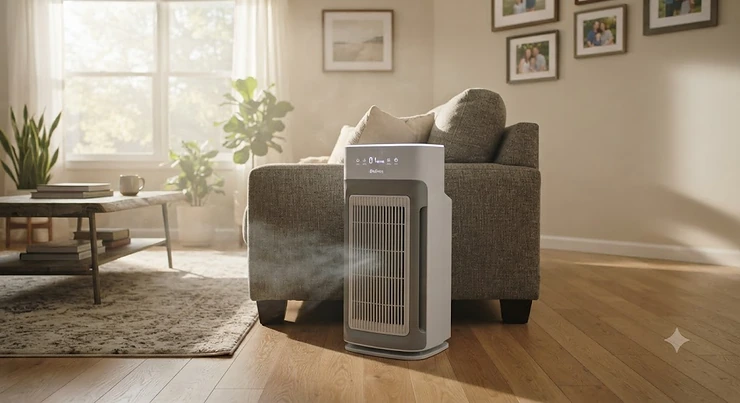
Here’s the thing nobody tells you when you move in with a smoker, live below one, or share a duplex wall with one: the smell is the least of your problems. The best air purifier for secondhand smoke isn’t a luxury gadget — it’s damage control for something the CDC flatly states has no safe exposure threshold at all. According to the EPA’s health risks factsheet on secondhand smoke and aerosols, secondhand tobacco smoke contains more than 7,000 chemicals, several of them proven human carcinogens, and it doesn’t politely stay on the smoker’s side of the room. It drifts through hallway gaps, rides the HVAC system between apartment units, and settles into your couch cushions long after the cigarette is out.
An air purifier will not turn a smoky apartment into a mountain cabin. Nothing short of eliminating the source does that completely, and we’ll be straight with you about that limitation throughout this guide. What the right unit can do — genuinely, measurably — is pull fine combustion particles and a meaningful share of gas-phase VOCs out of the air you’re breathing every hour you run it. That’s not nothing. For a nonsmoker sharing space with tobacco smoke, it’s often the difference between a headache-inducing haze and air you can tolerate.
We researched real, currently available units spanning budget pellet-carbon machines up through Swiss-engineered HyperHEPA systems, cross-referenced their specs against independent lab testing and aggregated owner feedback, and built the comparison below around one question: which of these actually moves the needle on smoke, not just dust and pollen. Let’s get into it.
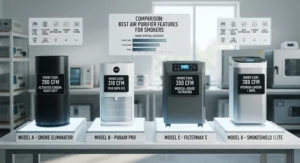
Quick Comparison Table
| Product | Coverage Area | Smoke CADR | Best For |
|---|---|---|---|
| Winix 5510 | 392 sq ft | ~232 CFM (est.) | Best budget pick for renters |
| PuroAir 240 | ~1,000 sq ft (claimed) | Not AHAM-rated | Quietest option for small bedrooms |
| Levoit Core 600S | 635 sq ft | 410 CFM | Smartest app control for the price |
| Coway Airmega 400 | 1,560 sq ft | 350 CFM | Best coverage for open floor plans |
| Alen BreatheSmart 75i | 1,300 sq ft | 350 CFM | Heaviest carbon load under $800 |
| Austin Air HealthMate HM400 | 1,500 sq ft | 400 CFM airflow | Built for constant, heavy smoke |
| IQAir HealthPro Plus | 1,125 sq ft | 300 CFM (HyperHEPA-rated) | Smallest particles captured, period |
Look at that table long enough and a pattern jumps out: CADR and carbon weight don’t move together. The Levoit Core 600S posts the highest raw CADR number here, but it’s still working with a bonded carbon layer measured in ounces, not pounds. Meanwhile the Austin Air HealthMate HM400 and Alen BreatheSmart 75i trade a bit of headline CADR for a genuinely different filtration philosophy — more carbon mass, longer dwell time, better odor and VOC capture. If your household’s main complaint is “it reeks in here,” carbon weight matters more than the number on the box. If your complaint is “there’s a haze,” CADR and HEPA grade matter more. Most secondhand smoke situations need both, which is exactly why we didn’t just rank by CADR.
💬 Found a pick you like already? Tap through and check today’s price before it changes.
💬 Just one click — help other golfers find the right club for their game too!😊
Top 7 Air Purifiers for Secondhand Smoke: Expert Analysis
1. Winix 5510 — best budget pick for renters
If you just need to stop apologizing to guests about how your apartment smells, start here. The Winix 5510 opens by briefly expanding on what actually makes it worth considering at this price: a genuine 4-stage stack rather than the single-filter setups you find on cheaper knockoffs. It pairs a washable pre-filter, a true HEPA layer, and a pelleted activated carbon filter, backed by an AHAM-verified air-changes-per-hour rating of 4.8 in its rated 392 sq ft space — meaning it’s cycling a bedroom-sized room’s air nearly five times an hour on its top setting, which is the range indoor air quality researchers generally consider meaningful for particle reduction. Based on the spec comparison with everything else on this list, the 5510’s carbon layer is genuinely the thinnest here, so don’t expect it to keep pace with heavy, all-day smoking. Reviewers consistently note it handles occasional or light secondhand exposure — a roommate who smokes on the balcony, a neighbor’s drift-in odor — noticeably well for the money, while heavier daily smoke saturates the carbon faster than pricier units. It’s the right call for a college apartment, a starter budget, or a first purifier before you know how serious your smoke problem really is.
Pros:
- ✅ Covers 392 sq ft with a 4.8 ACH rating
- ✅ 4-stage system layers HEPA, carbon, and PlasmaWave
- ✅ Priced well below most true HEPA-plus-carbon rivals
Cons:
- ❌ Carbon layer is thin, so it saturates faster under heavy smoke
- ❌ PlasmaWave ionizer should stay switched off for the cleanest air
In the $180–$230 range, the Winix 5510 delivers a fair-value entry point, especially if you turn off the ionizer and lean on the mechanical filtration alone.
2. PuroAir 240 — quietest option for small bedrooms
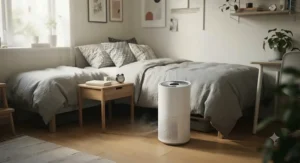
Bedrooms are where secondhand smoke exposure hurts most, because you’re breathing that air for seven or eight uninterrupted hours. The PuroAir 240 was built with exactly that use case in mind: a compact footprint, a dedicated sleep mode, and a three-layer stack that pairs a pre-filter with HEPA and the brand’s CarbonTech activated carbon layer. What most buyers overlook about compact bedroom units is that manufacturer coverage claims and independently measured performance can diverge, and that’s worth knowing here — one respected independent test lab found the 240’s real-world clean air delivery came in well under the “up to 1,000 sq ft” marketing figure, which honestly tracks with what you’d expect from a smaller motor and thinner filter media at this size class. That doesn’t make it a bad purchase; it means you should size it to an actual bedroom (200–350 sq ft) rather than an open loft. Reviewers consistently praise how quiet it runs on sleep mode, which matters more than raw CADR if smoke-triggered congestion is keeping you up. For a single bedroom shared wall with a smoking neighbor, it’s a sensible, low-noise layer of protection.
Pros:
- ✅ Compact footprint built specifically for bedrooms and small rooms
- ✅ CarbonTech layer targets smoke odors alongside HEPA filtration
- ✅ Sleep mode keeps nighttime noise to a minimum
Cons:
- ❌ Independent lab testing found real-world CADR below marketed coverage claims
- ❌ Filter needs replacing roughly every 90 days under regular use
Priced around $220–$280, the PuroAir 240 is best treated as a genuine bedroom-sized unit, not the near-1,000-sq-ft solution its marketing implies.
3. Levoit Core 600S — smartest app control for the price
Here’s what most buyers overlook about the Levoit Core 600S: it’s not marketed as a smoke specialist, yet its raw numbers actually out-CADR several purifiers twice its price. The three-stage system stacks a pre-filter, a true HEPA H13 layer rated to trap 99.7% of particles at 0.3 microns, and a bonded activated carbon layer, all pushing a genuinely strong 410 CFM CADR that clears its rated 635 sq ft room with real five-times-an-hour air exchange. The app is where this one earns its spot — scheduling, remote monitoring, and swappable panels mean you can dial in toward smoke-and-odor performance without hunting for a separate unit. Reviewers consistently note the carbon layer does a solid job cutting the smell of secondhand tobacco and the occasional burnt-popcorn incident, though because carbon and particle media are bonded into one filter, you’re replacing the whole thing once the carbon saturates rather than swapping carbon alone. For a shared living room or open studio apartment where a smoker frequently visits, this is the CADR-per-dollar leader on our list.
Pros:
- ✅ 410 CFM CADR clears a 635 sq ft room fast
- ✅ Smart app lets you schedule and monitor remotely
- ✅ Interchangeable panels for smoke, pet, or toxin-focused filters
Cons:
- ❌ Carbon layer is bonded into the filter, not swappable alone
- ❌ Full filter replacement needed even if only carbon is spent
At $230–$280, the Levoit Core 600S is arguably the best all-around value here for anyone who wants strong particle removal without heavy-duty carbon needs.
4. Coway Airmega 400 — best coverage for open floor plans
Open-concept living rooms and combined kitchen-dining spaces are brutal on undersized purifiers, which is exactly the gap the Coway Airmega 400 fills. Its Max2 filter combines a washable pre-filter with a HEPA-and-activated-carbon cartridge, and independent Kill-A-Watt testing during a real wildfire smoke event found the unit’s rated 350 CFM smoke CADR held up remarkably close to spec in an actual furnished room — a claim that doesn’t survive contact with reality on plenty of competing units. Based on the spec comparison, what stands out is the real-time particle sensor and auto mode, which ramps the fan the moment smoke drifts in and dials back once levels settle, rather than running full blast around the clock. Reviewers consistently describe it as appliance-like and quiet at low-to-medium settings, with noise becoming noticeable only at the top speed. For a household managing 1,000+ square feet of open living space where a smoker regularly visits or lives, the Airmega 400’s combination of coverage, sensor-driven automation, and one-year filter life makes it a low-maintenance workhorse.
Pros:
- ✅ 350 CFM smoke CADR covers up to 1,560 sq ft
- ✅ Real-time air quality display shows results, not just settings
- ✅ Filters last a full year under normal use
Cons:
- ❌ Max2 filter bundles HEPA and carbon, so you can’t upgrade carbon alone
- ❌ Noticeably louder than average on its top fan speed
In the $380–$430 range, the Coway Airmega 400 earns its keep in larger rooms where a smaller unit would simply be overmatched.
5. Alen BreatheSmart 75i — heaviest carbon load under $800
This is where the carbon conversation gets serious. The Alen BreatheSmart 75i, when configured with its optional Fresh filter, packs roughly 3.6 lbs of activated carbon alongside its HEPA H13 media — the third-largest carbon load in independent testing among all air purifiers benchmarked for smoke and VOC removal, trailing only the Austin Air HealthMate and IQAir HealthPro Plus further down this list. What that means in practice: this unit is built to chemically adsorb the gas-phase compounds in tobacco smoke, not just trap the visible particulate. Its 350 CFM smoke CADR covers a genuinely large 1,300 sq ft, and Consumer Reports rated it “excellent” for smoke, dust, and pollen removal in its own testing. Reviewers consistently mention how quiet it stays even at higher fan speeds, plus a Forever Guarantee warranty that only requires an active filter subscription — a meaningful long-term perk if you’re planning to run this unit around the clock for years. The tradeoff is cost: stepping up to the Fresh filter configuration pushes this toward premium territory.
Pros:
- ✅ Fresh filter option adds 3.6 lbs of activated carbon
- ✅ 350 CFM smoke CADR across up to 1,300 sq ft
- ✅ Forever Guarantee warranty backs the unit long-term
Cons:
- ❌ Fresh filter costs meaningfully more than the standard Pure filter
- ❌ One of the pricier mid-tier units on this list
Expect a $750–$820 range with the Fresh filter configuration — a legitimate investment for anyone whose main complaint is lingering smoke odor rather than just visible haze.
6. Austin Air HealthMate HM400 — built for constant, heavy smoke
If you live with a daily, indoor, pack-a-day smoker and have basically given up hoping the problem goes away, the Austin Air HealthMate HM400 is the machine built for exactly that reality. Fifteen pounds of activated carbon and zeolite surround a 60-square-foot medical-grade HEPA filter inside an all-steel housing — a carbon mass that “out-filters” nearly everything else in this guide by sheer volume, according to independent testing that measured the unit’s filter life at up to five years under normal use, compared to the 6-to-12-month cycles typical of thinner competitors. Zeolite is worth understanding here: where standard activated carbon handles most VOCs well, zeolite specifically targets ammonia-based compounds that carbon adsorbs less efficiently, which matters because tobacco smoke contains both. Reviewers consistently describe the HM400 as a no-nonsense workhorse — no app, no sensors, just a three-speed dial — and note that the high setting genuinely gets loud pushing air through that much dense media. For someone managing chronic, heavy indoor smoke exposure in a 1,500 sq ft space, this is less a gadget purchase and more a long-term infrastructure decision.
Pros:
- ✅ 15 lbs of activated carbon and zeolite dwarfs typical filters
- ✅ Filter rated for up to 5 years under normal use
- ✅ All-steel housing built to last decades, not seasons
Cons:
- ❌ No app, sensors, or auto mode — manual dial only
- ❌ Top fan speed gets genuinely loud pushing air through that much carbon
At around $800–$860, the Austin Air HealthMate HM400‘s five-year filter life actually makes it one of the cheaper units here to operate over time, even with the higher upfront cost.
7. IQAir HealthPro Plus — smallest particles captured, period
Every product on this list captures cigarette smoke’s larger particles. The IQAir HealthPro Plus is built to go after the ones the others miss. Its Swiss-engineered HyperHEPA filter is independently tested to remove particles down to 0.003 microns — for context, a standard true HEPA filter is rated to 0.3 microns, meaning the HyperHEPA media is working at a scale roughly 100 times smaller. That matters specifically for tobacco smoke, whose ultrafine combustion particles — the ones small enough to bypass standard HEPA and lodge deep in lung tissue — fall squarely in HyperHEPA’s wheelhouse. It’s paired with a V5-Cell gas and odor filter carrying about 5 lbs of activated carbon, the largest carbon load on this entire list, engineered for broad-spectrum VOC and gas coverage rather than a single target compound. Reviewers consistently point to its 10-year warranty and 3-to-4-year filter life as evidence this is engineered for the long haul, not planned obsolescence. It’s also, unsurprisingly, the priciest unit here, and the standard model skips auto mode (the XE version adds it). For anyone dealing with serious respiratory sensitivity to secondhand smoke, this is the closest thing to a medical-grade answer in a residential package.
Pros:
- ✅ HyperHEPA filter captures particles down to 0.003 microns
- ✅ V5-Cell carbon filter targets gases most HEPA units miss
- ✅ 10-year warranty with filters that last up to 4 years
Cons:
- ❌ Highest upfront cost of any product on this list
- ❌ No auto mode on the standard (non-XE) model
Priced around $880–$950, the IQAir HealthPro Plus is a premium investment best justified by genuine chemical sensitivity, asthma, or a household simply done compromising on air quality.
Practical Usage Guide: Setting Up Your Air Purifier for Secondhand Smoke
Buying the right machine is maybe 60% of the battle; placement and habits are the rest. Position your unit as close to the smoke source as the room layout allows — a doorway, a shared wall, or right next to where smoking actually happens indoors — rather than tucked in a corner for aesthetics. Indoor air quality field notes from 2026 testing cycles put it bluntly: a correctly sized purifier needs roughly 20–40 minutes to complete 4–5 full air changes before odor drops below the point most people can detect it. That’s not a flaw; it’s just physics, and it means running the unit continuously rather than switching it on only when you notice the smell already lingering. In the first 30 days, the most common mistake is under-sizing for the room — buying a 300 sq ft unit for an open 600 sq ft living space and blaming the purifier when it can’t keep up. Check your filter indicator weekly during the break-in period, since carbon exposed to heavy smoke saturates faster than manufacturer estimates assume, and swap or wash pre-filters on schedule so they don’t choke airflow to the more expensive media behind them. Finally, crack a window when you can; a purifier recirculates and filters existing air, but it can’t replace the dilution effect of fresh outdoor air entirely.
Real-World Scenarios: How These Air Purifiers Reduce Secondhand Smoke Exposure
Consider three household types. A college student in a 400 sq ft studio, roommate smokes on the porch but drift-in odor is constant: the Winix 5510 or PuroAir 240 covers this footprint affordably, and running it continuously on auto or low actually reduces measurable secondhand smoke exposure without breaking a student budget. A family of four in a 1,400 sq ft apartment below a heavy indoor smoker, dealing with smoke migrating through shared HVAC and stairwells: this calls for something with real coverage and carbon depth — the Coway Airmega 400 or Alen BreatheSmart 75i with the Fresh filter, run 24/7 in the main living area plus a smaller unit in each bedroom at night. A chemically sensitive adult living with a partner who smokes indoors daily, seeking maximum ultrafine particle and gas removal: the Austin Air HealthMate HM400 or IQAir HealthPro Plus is the honest answer here, since both are engineered specifically around sustained, heavy exposure rather than occasional drift. In every scenario, the frequency of exposure and the size of the affected space — not just budget — should drive the decision.
How to Choose the Best Air Purifier for Secondhand Smoke
What is the best air purifier for secondhand smoke? In short, it’s a unit combining a true HEPA filter (0.3 microns or finer) with at least 2–3 lbs of activated carbon, sized correctly for your room, and run continuously — because particle-only filtration misses the gas-phase compounds that make secondhand smoke smell and linger. Beyond that baseline, here’s how to narrow it down:
- Measure your actual room, not your whole apartment. CADR and coverage numbers assume a single enclosed space; open floor plans need the higher end of a unit’s rated range.
- Prioritize carbon weight over CADR alone if odor is your main complaint. A thin carbon layer saturates within weeks under heavy smoke.
- Check the smoke-specific CADR, not just the dust or pollen number. AHAM tests these separately, and they aren’t interchangeable.
- Factor in filter replacement cost and frequency over a full year, not just the sticker price of the unit.
- Confirm the fan can run 24/7 without a punishing electricity bill or intolerable noise — this is a machine you’re leaving on, not switching on occasionally.
- Look for real, independently verified test data, not just manufacturer marketing coverage claims.
- Match ultrafine particle capture to your actual health sensitivity — HyperHEPA-tier filtration is genuinely useful for asthma or chemical sensitivity, and overkill for casual odor control.
Does an Air Purifier Help With Secondhand Smoke? What the Science Actually Says
Yes, meaningfully — but with real limits worth naming honestly. According to the EPA’s guidance on secondhand tobacco smoke and indoor air quality, ventilation, filtration, and air cleaning techniques can reduce secondhand smoke indoors, though they do not eliminate it entirely. That distinction matters: a properly sized HEPA-plus-carbon purifier, run continuously, measurably lowers airborne particulate concentration and can noticeably reduce lingering odor, which is why every product in this guide pairs HEPA media with some form of activated carbon. What it doesn’t do is neutralize smoke that has already bonded to walls, fabric, and HVAC ducts — the thirdhand smoke residue that keeps re-releasing compounds into the air long after the cigarette is out. Reviewers testing units under controlled smoke conditions consistently report particulate counts dropping dramatically within 30–45 minutes of continuous operation, which lines up with the exponential-decay math researchers use to model air changes per hour. The honest takeaway: an air purifier is real harm reduction for airborne exposure, not a substitute for a smoke-free policy.
Air Purifiers vs Traditional Alternatives for Secondhand Smoke
| Method | Removes Particles? | Removes Odor/Gases? | Ongoing Effort |
|---|---|---|---|
| HEPA + carbon purifier (e.g. Alen BreatheSmart 75i) | Yes, continuously | Yes, with sufficient carbon mass | Low — runs unattended |
| Opening windows | Partial, weather-dependent | Partial | Constant, manual |
| Scented candles/sprays | None | Masks, doesn’t remove | Constant, manual |
| Ionizer-only devices | Some, can produce ozone byproducts | Minimal | Low, but ozone is a health tradeoff |
A purifier like the Coway Airmega 400 or Winix 5510 wins on consistency: it runs whether or not you remember to open a window, and unlike candles or sprays, it removes compounds rather than covering the smell with a new one. Ionizer-only devices deserve a specific caution — some generate ozone as a byproduct, which the EPA advises against, so any purifier you choose should let you disable ionization if it’s included. None of these alternatives beat source elimination, but among the realistic day-to-day options, a properly sized purifier does the most consistent work for the least ongoing effort.
✨ Ready to breathe easier tonight? Check today’s price on any pick above before you decid
Air Purifier for Secondhand Smoke in the Bedroom: What Changes
Bedroom placement changes the calculus in a few specific ways. First, noise becomes a real constraint — a purifier that’s fine in a living room can be genuinely disruptive at 2 a.m. on its top setting, which is exactly why compact, sleep-mode-equipped units like the PuroAir 240 get consistently praised for nighttime use despite modest coverage numbers. Second, dwell time works in your favor: you’re typically in a bedroom for 7–8 uninterrupted hours, which is more than enough time for even a modest CADR unit to complete several full air changes if it’s sized appropriately for the room. Third, placement near the door or a shared wall — rather than by the window — puts the intake closer to where smoke is actually entering, which meaningfully shortens the time to a noticeable reduction in odor. For light sleepers dealing with a neighbor’s secondhand smoke migrating through shared walls or ductwork, a smaller, quieter unit run continuously on low often outperforms a larger, more powerful machine cycled on and off because someone couldn’t tolerate the noise.
Carcinogen Filtration 101: HEPA, Carbon, and the Smoke Particle Size Range
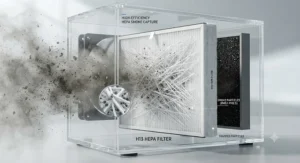
Tobacco smoke isn’t one uniform pollutant — it’s a mix spanning an enormous smoke particle size range, from solid particulates in the 0.1–1 micron zone down to ultrafine combustion byproducts smaller than 0.1 microns, plus a separate category of gas-phase carcinogens like formaldehyde and benzene that aren’t particles at all. This is precisely why carcinogen filtration HEPA claims need context: a standard true HEPA filter captures 99.97% of particles at 0.3 microns, which handles the mid-range particulate well but does nothing for gas-phase compounds and only partially addresses the smallest ultrafine particles. That’s where activated carbon earns its place — its porous surface chemically adsorbs VOCs and odor molecules that would otherwise pass straight through HEPA media untouched. HyperHEPA filtration, used in the IQAir HealthPro Plus, extends particle capture down to 0.003 microns specifically to address that ultrafine gap. In practice, this means a HEPA-only purifier is genuinely incomplete for tobacco smoke; you need both particle filtration and sufficient carbon mass working together, which is the exact combination every product in this guide was selected for.
Common Mistakes When Buying an Air Purifier for Smoke
The single most common mistake: buying based on square footage alone and ignoring smoke-specific CADR, which measures something meaningfully different from a unit’s dust or pollen rating. A close second is underestimating carbon saturation — heavy, constant smoke exhausts a thin carbon filter in weeks, not months, no matter what the box says about “typical” use. Buyers also frequently skip the noise spec entirely, then discover the unit they bought for a bedroom is too loud to run on the setting that actually clears the air. Another overlooked detail: ionizer functions that can’t be disabled, which risk generating ozone as an unwanted byproduct rather than genuinely improving air quality. Finally, plenty of shoppers treat filter replacement cost as an afterthought, then get blindsided a year in by carbon cartridges running $50–$100 each — a detail that changes the real cost comparison between units that looked similarly priced at checkout.
Long-Term Cost & Maintenance: What Owning One of These Actually Costs
Upfront price tells maybe half the story. The Austin Air HealthMate HM400 costs more at checkout than most units here, but its five-year filter life means total filter spend over that period lands meaningfully lower than machines needing 6-to-12-month replacements — independent estimates put its five-year filter cost at roughly $200-$250 total, versus $250-$400+ for typical HEPA-plus-carbon competitors over the same span. The IQAir HealthPro Plus follows a similar long-game logic: its HyperHEPA filter lasts 3-4 years even though the initial filter cost runs higher per unit. On the other end, budget units like the Winix 5510 cost less upfront but typically need full filter replacements every 6-12 months, and heavy smoke exposure can shorten that further. Electricity is a smaller but real factor — most of these units draw modest wattage on auto or low settings, generally landing in the $20-$40 per year range for continuous operation. Bottom line: run the actual five-year math before assuming the cheaper unit is the better deal.
Secondhand Smoke Health Risks: What the EPA and CDC Actually Found
According to the CDC’s overview of secondhand smoke, exposure to smoke from burning tobacco products causes disease and premature death among people who don’t smoke, and there’s no safe level of exposure — even brief contact can cause immediate harm. The EPA classifies secondhand smoke as a Group A carcinogen, a designation reserved for substances with sufficient evidence of causing cancer in humans, putting it in the same category as asbestos and radon. Adults who don’t smoke but are regularly exposed to secondhand smoke see their lung cancer risk climb by roughly 20–30%. Children face a distinct set of secondhand smoke health risks EPA and CDC research has documented extensively, including increased ear infections, more frequent asthma attacks, and a well-established link to sudden infant death syndrome. None of this is meant to alarm you into panic-buying the priciest purifier on this list — it’s meant to explain why filtration matters at all, and why “just crack a window” isn’t the complete answer public health agencies once assumed it was.
Can an Air Purifier Really Protect You From Secondhand Smoke? Setting Realistic Expectations
Here’s the honest answer, without the marketing gloss: an air purifier meaningfully reduces your airborne exposure to secondhand smoke, but it doesn’t fully protect you from it the way removing the smoking source does. Public health guidance, including the CDC’s page on preventing secondhand smoke exposure at home, is direct on this point — separating people who smoke from those who don’t, cleaning the air, and ventilating buildings are not considered effective substitutes for eliminating smoking altogether. That’s a genuinely important caveat, and it’s why every product recommendation in this guide is framed as harm reduction, not a cure. What a well-matched purifier does deliver is a real drop in particulate concentration and lingering odor when run continuously in the affected space — which, for someone who can’t control whether a neighbor, roommate, or family member smokes indoors, is a legitimately useful tool rather than a false promise. Pair it with source control where you have any influence over that (smoke-free house rules, sealing gaps around shared walls, using exhaust fans) and the purifier becomes one layer in a broader strategy rather than a standalone fix.
Problem → Solution: Fixing the Most Common Secondhand Smoke Complaints
Problem: Smoke smell lingers for hours after someone smokes nearby. Solution: prioritize carbon weight — units like the Alen BreatheSmart 75i with the Fresh filter or the Austin Air HealthMate HM400 are built specifically to adsorb the odor-causing VOCs a thin carbon layer can’t keep up with. Problem: Smoke drifts in from a neighboring apartment through shared walls or ducts. Solution: place your purifier near the shared wall or vent rather than centering it in the room, and run it continuously rather than reactively. Problem: The unit is too loud to run overnight in the bedroom. Solution: look specifically at sub-45 dB low-speed ratings — the PuroAir 240 and Levoit Core 600S both perform well here. Problem: Filters are saturating faster than expected. Solution: heavy, constant smoke exposure genuinely does exhaust carbon faster than manufacturer “typical use” estimates assume, so budget for more frequent replacement than the box suggests. Problem: Coverage claims don’t match real-world performance. Solution: cross-reference AHAM-verified CADR figures against independent lab testing rather than trusting marketing copy alone, since not every manufacturer’s square-footage claim holds up under scrutiny.
✨ Don’t Miss These Exclusive Deals!
🔍 Take your air quality goals to the next level with these carefully selected purifiers. Click on any highlighted product above to check current pricing and availability. The right unit here can mean noticeably fresher air in your home starting today.
FAQ
❓ Does an air purifier help with secondhand smoke?
❓ What size air purifier do I need for secondhand smoke in a bedroom?
❓ Can an air purifier fully protect me from secondhand smoke?
❓ How much activated carbon do I need to remove smoke odor?
❓ Do ionizing air purifiers work better for cigarette smoke?
Conclusion
If there’s one thing worth taking away from all seven of these products, it’s that the best air purifier for secondhand smoke isn’t a single “best overall” pick — it’s whichever combination of HEPA grade, carbon mass, and room-appropriate CADR matches your actual exposure level. Light, occasional drift-in odor calls for something like the Winix 5510 or Levoit Core 600S. Heavy, constant indoor smoking calls for the carbon-heavy approach of the Austin Air HealthMate HM400 or Alen BreatheSmart 75i. Genuine chemical sensitivity or asthma pushes the conversation toward the IQAir HealthPro Plus‘s ultrafine particle capture. None of them replace a smoke-free policy, and we’d be doing you a disservice to pretend otherwise — but run continuously and sized correctly, every product on this list will measurably improve the air you’re breathing every single day. That’s a real, achievable win, even while the underlying source problem gets sorted out.
✨ Don’t Miss These Exclusive Deals!
🔍 Whichever pick fits your space and budget, check current pricing before you commit — availability and pricing shift, and a small window of savings can make a real difference.
Recommended for You
- 7 Best Air Purifier for Smokers Apartment Picks (2026 Guide)
- Air Purifier for Cigarette Smoke: 7 Proven Picks for 2026
- Portable Air Purifier for Wildfire Smoke: 7 Real Picks (2026)
Disclaimer: This article contains affiliate links. As an Amazon Associate, I earn from qualifying purchases. If you purchase products through these links, we may earn a small commission at no additional cost to you.
✨ Found this helpful? Share it with someone who’s dealing with the same problem! 💬🤗
