
In This Article
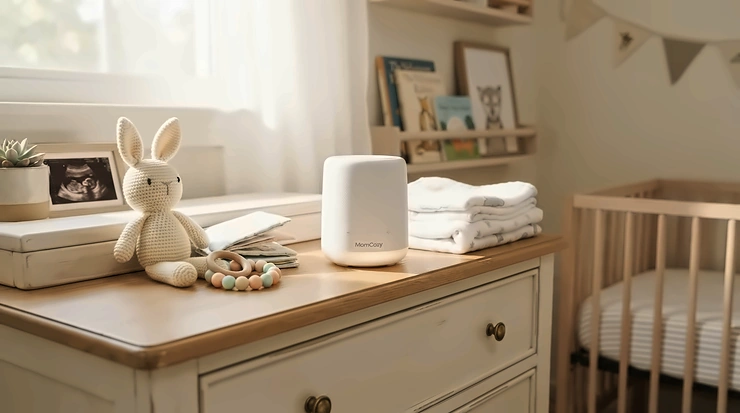
Somewhere between the third 2 a.m. feeding and the fortieth Google search for “is my baby’s room too dusty,” most parents land on the same question: does a genuinely good air purifier for nursery under $100 actually exist, or is that just marketing wishful thinking? Good news — it exists, and you don’t need a $400 tower with a glowing touchscreen to get real HEPA filtration next to the crib.
This guide skips the fluff. We researched real, currently sold models — checking actual specs, AHAM-verified CADR numbers, and aggregated customer sentiment from independent testers and long-term owners — to find seven true HEPA purifiers that consistently land in or near the sub-$100 range. Some are quiet workhorses. One or two occasionally creep just over $100 depending on the sale cycle, and we’ll flag that honestly rather than pretend otherwise. 🍼
You’ll find budget-first picks, a couple of nursery-specific standouts, and one design-forward splurge that’s still shockingly affordable for what it delivers. Along the way, we’ll unpack what a HEPA air purifier for baby room use actually needs to do, how much a HEPA filter cost really adds up to over a year, and where an air purifier for baby room allergies genuinely earns its keep versus where it’s overkill. Affiliate disclosure: this post contains Amazon affiliate links, and we may earn a small commission on qualifying purchases at no extra cost to you.
Quick context before we dive in: indoor air in a nursery can carry dust, pet dander, pollen tracked in on shoes, and lingering paint or furniture off-gassing, especially if the room was freshly decorated. A dedicated purifier next to the crib gives that space its own clean-air bubble, separate from whatever’s happening in the rest of the house.
What Is an Air Purifier for a Nursery?
An air purifier for a nursery is a compact, quiet HEPA-filtration device sized for a small bedroom (typically under 250 square feet) that pulls dust, pollen, pet dander, and fine particulates out of the air a sleeping baby breathes. The best models run under 30 dB on their lowest setting, use a True HEPA filter rated to capture 99.97% of particles down to 0.3 microns, and skip ionizers or ozone-generating features entirely.
That last part matters more than most listings admit. The EPA’s explanation of HEPA filtration makes clear that mechanical HEPA media is the gold standard for particle capture, precisely because it doesn’t rely on emitting anything into the air the way ionizers or ozone generators do — a meaningful distinction when the room in question belongs to an infant.
Quick Comparison Table
If you’re short on time, here’s the fast version. Every unit below uses a genuine True HEPA filter and comes in at or near the under-$100 mark.
| Product | Best For | Room Coverage | Noise (Low) | Price Range |
|---|---|---|---|---|
| Levoit Core 300 | Overall budget pick | ~219 sq ft | ~24 dB | $80-$100 |
| Honeywell HPA100 | Long warranty/brand trust | ~155 sq ft | ~23 dB | $80-$120 |
| GermGuardian AC4825 | Optional UV-C layer | ~155-167 sq ft | ~30 dB | $70-$100 |
| Honeywell HPA020B | Tiniest nurseries/shelves | ~90 sq ft | ~22 dB | $75-$90 |
| Levoit Core P350 | Baby + shedding pets | ~215-219 sq ft | ~24 dB | $85-$105 |
| PARTU BS-08 | Lowest entry price | ~200 sq ft (mfr est.) | ~35 dB | $45-$55 |
| Blueair Blue Pure 411 | Design-forward splurge | ~161 sq ft | ~31 dB | $95-$120 |
Reading across this table, the Levoit Core 300 and Honeywell HPA100 are the two safest defaults for a typical nursery-sized room, while the Honeywell HPA020B and PARTU BS-08 trade coverage area for a smaller footprint or lower price. The Blueair Blue Pure 411 is the one unit here that sometimes drifts a bit past $100 depending on the retailer, so treat it as an “if it’s on sale, grab it” pick rather than a guaranteed sub-$100 buy.
Found a favorite already? Tap through and check today’s price before it changes — nursery-ready HEPA units like these tend to sell out during allergy season. 💬
Top 7 Air Purifiers for a Nursery Under $100: Expert Analysis
Before the individual breakdowns, here’s the full spec comparison side by side.
| Product | Filter Type | CADR (approx.) | Fan Speeds | Standout Feature |
|---|---|---|---|---|
| Levoit Core 300 | 3-stage True HEPA + carbon | 141 CFM | 3 | 360° cylindrical intake |
| Honeywell HPA100 | True HEPA + carbon pre-filter | ~100-106 CFM | 3 | 5-year limited warranty |
| GermGuardian AC4825 | 4-stage HEPA + charcoal + UV-C | ~108-125 CFM | 3 | Optional UV-C sanitizing light |
| Honeywell HPA020B | True HEPA tabletop | ~53 CFM (smoke) | 2 | Compact tabletop footprint |
| Levoit Core P350 | 3-stage True HEPA + pet filter | ~140-145 CFM | 3 | Pet-specific odor filter, shares parts with Core 300 |
| PARTU BS-08 | 5-in-1 True HEPA | Manufacturer-rated, not AHAM-certified | 3 | Lowest price point of the group |
| Blueair Blue Pure 411 | Washable pre-filter + particle + carbon | 105-120 CFM | 3 | Interchangeable fabric pre-filter colors |
Looking at this table, the Levoit Core 300 offers the best CADR-to-price ratio of the group, which is why independent budget-purifier roundups keep naming it the default pick for a bedroom or nursery. The PARTU BS-08 is worth noting for a different reason: it’s the cheapest true HEPA unit here, but its CADR isn’t independently AHAM-certified the way the others are, so treat its coverage claims with a little more skepticism. Meanwhile, the Levoit Core P350 and Core 300 share the same replacement filter, which is a small but genuinely useful detail if you’re comparing long-term costs between the two.
1. Levoit Core 300 — quietest true HEPA pick under $100
The standout here is right there in the tag: on its lowest setting, the Levoit Core 300 measures around 24 decibels, which is quieter than a whispered conversation and genuinely hard to notice running overnight. Under the hood, it uses a 3-stage True HEPA filter (pre-filter, H13 HEPA, activated carbon) with a CADR around 141 CFM, rated for rooms up to roughly 219 square feet — comfortably large enough for the average nursery. Its 360-degree cylindrical intake design pulls air in from every side rather than just the front, which in practice means you don’t have to fuss over exact wall clearance the way you would with a flat-faced unit.
Based on the spec comparison against similarly priced purifiers, the Levoit Core 300 is the pick for parents who want maximum filtration per dollar and don’t care about app connectivity or air-quality sensors — this is the base model, not the smart “S” version, and that’s precisely why it’s cheaper. Reviewers consistently note that it’s the rare budget purifier that doesn’t feel like a compromise, with several independent buying guides naming it the top overall pick under $100 specifically because its filtration performance rivals purifiers costing 50% more.
Pros:
- ✅ Whisper-quiet 24 dB operation on sleep mode
- ✅ 360° intake simplifies placement near a crib or wall
- ✅ Filters cost around $20 and last 6-8 months
Cons:
- ❌ Base model skips the air-quality sensor and app
- ❌ Only 3 manual fan speeds, no auto mode
Price sits in the $80-$100 range depending on sales, and for the filtration you’re getting, it’s hard to beat as a straightforward value pick.
2. Honeywell HPA100 — five-year warranty, old-school reliability
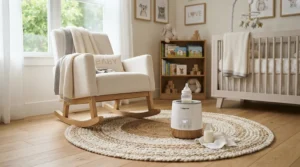
What most buyers overlook about the Honeywell HPA100 is that its unglamorous, decades-old design is backed by one of the longest warranties in the category — five years, compared to the one- or two-year terms typical of newer competitors. Specs-wise, it delivers a CADR around 100 CFM and covers rooms up to about 155 square feet, with a True HEPA filter capable of capturing 99.97% of particles down to 0.3 microns, plus a carbon pre-filter for basic odor control.
Here’s what to weigh: the HPA100 isn’t the quietest or the most feature-rich unit on this list, but it’s built by a brand with decades of HVAC and filtration manufacturing behind it, and that pedigree shows up in long-term reliability reports. On the lowest of its three fan speeds it measures around 23 decibels — genuinely bedroom-appropriate — and its no-frills three-speed dial means there’s very little to break. Aggregated reviews consistently describe it as a dependable, if dated, workhorse; it lacks any app or particle sensor, which more tech-forward reviewers count against it, but that same simplicity is exactly what some parents want in a nursery gadget.
Pros:
- ✅ Five-year warranty, longest in this roundup
- ✅ Quiet 23 dB low setting, good for overnight use
- ✅ AHAM-verified CADR from a long-trusted HVAC brand
Cons:
- ❌ No app, sensor, or auto mode — fully manual
- ❌ Replacement filters cost more than Levoit’s equivalents
Expect to pay somewhere in the $80-$120 range, with the lower end far more common at big-box retailers than at full MSRP.
3. GermGuardian AC4825 — optional UV-C sanitizing layer
The GermGuardian AC4825 has been a top-selling budget purifier for over a decade, and its standout feature is the optional UV-C light built into its 4-stage filtration stack — a pre-filter, charcoal filter, True HEPA filter, and a UV-C bulb you can switch on or off independently. Coverage sits around 155-167 square feet depending on which source you check, with a CADR in the 108-125 CFM range across dust, smoke, and pollen.
On paper this means you get HEPA filtration plus an extra sanitizing layer for the same rough price as competitors offering HEPA alone — a reasonable value proposition. What the spec sheet won’t tell you, but independent lab testing has shown, is that the AC4825’s real-world clearing speed in a sealed test room ran noticeably slower than its CADR rating would suggest, taking substantially longer to fully clear a test space than similarly rated competitors. That’s a meaningful caveat if raw clearing speed matters more to you than the UV-C extra. Reviewers still rate it well for noise and build quality, and it remains an Amazon best-seller in its category, but a straight CADR comparison alone may overstate how it performs against something like the Levoit Core 300.
Pros:
- ✅ Optional UV-C sanitizing bulb, switchable independently
- ✅ Long sales track record with a large owner base
- ✅ CARB-certified and Energy Star rated
Cons:
- ❌ Real-world clearing speed lags behind its CADR rating
- ❌ Replacement filters run pricier than budget competitors
Typical pricing lands around $70-$100, occasionally dipping lower during retailer sales events.
4. Honeywell HPA020B — smallest true HEPA for tight nurseries
If your nursery is genuinely small — a converted closet room, a shared space, or a corner carved out of a home office — the Honeywell HPA020B solves a problem the bigger units on this list don’t: it’s a true tabletop unit, small enough to sit on a dresser, shelf, or changing table without eating floor space. Its CADR (smoke) rating of around 53 CFM is modest, rated for roughly 90 square feet, but that’s by design — this is a personal-zone purifier, not a whole-room one.
Reviewers consistently note that the HPA020B is one of the smallest true-HEPA units on the market, and here’s what to weigh before buying: its coverage claim is honest and conservative, so it’s genuinely well-matched to compact spaces rather than overstretched to look competitive on paper. It runs around 22 decibels on its lowest of two speeds, which is essentially inaudible, and its True HEPA filter still captures 99.97% of particles at 0.3 microns despite the small size. Where it falls short is raw airflow — if your nursery is a full 200+ square foot room, this unit will run constantly at max speed just to keep pace, which shortens filter life and increases noise.
Pros:
- ✅ True HEPA filtration in a genuinely compact tabletop size
- ✅ Near-silent 22 dB on the lowest setting
- ✅ Energy Star certified, low ongoing electricity cost
Cons:
- ❌ Coverage limited to roughly 90 square feet
- ❌ Only two fan speeds, less flexibility than competitors
Pricing typically falls between $75 and $90, making it one of the cheaper true-HEPA options here despite the compact build.
5. Levoit Core P350 — built for babies and shedding pets
The Levoit Core P350 shares its core hardware with the Core 300 — same motor, same 3-stage filtration architecture, nearly identical CADR around 140-145 CFM across dust, smoke, and pollen — but swaps in a pet-focused filter formulated to chemically break down odor molecules rather than simply trap them. For households where a dog or cat shares space with the new baby, that’s a genuinely useful distinction, not just marketing language.
Based on the spec comparison, the P350’s filter is interchangeable with the standard Core 300 filter, so you’re never locked into paying a premium just because you own this specific model — a detail that matters more for long-term cost than most buying guides mention. Reviewers who’ve tested both units side by side consistently conclude that if you don’t have pets, the plain Core 300 is the smarter buy at a similar or lower price, since the two perform almost identically. But for a nursery in a pet-owning household trying to manage dander alongside baby-safe air quality, the P350’s odor-focused filter earns its slightly higher price.
Pros:
- ✅ Pet-specific filter chemically targets odor molecules
- ✅ Filter interchangeable with the cheaper Core 300 line
- ✅ Same strong CADR and quiet 24 dB low setting
Cons:
- ❌ Minimal benefit over the Core 300 without pets in the home
- ❌ Base model still lacks an air-quality sensor
Expect pricing around $85-$105, occasionally overlapping with or slightly above the standard Core 300.
6. PARTU BS-08 — lowest entry price for true HEPA
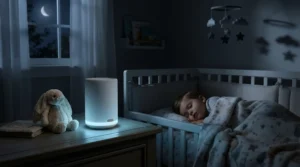
For parents working with a genuinely tight budget, the PARTU BS-08 is the cheapest true-HEPA option in this roundup by a wide margin, often priced under $55. It uses a 5-in-1 True HEPA filter stack and is sized comparably to more established compact units like the Levoit Core 200S.
Here’s what to weigh honestly: the PARTU BS-08 delivers real HEPA filtration for a fraction of the price of the other units here, which matters if the alternative is no purifier at all. But independent long-term reviewers have grown more cautious about recommending it over time, citing average real-world performance relative to its claimed specs and inconsistent confidence in the brand’s build quality and support compared to established names like Levoit or Honeywell. If your budget genuinely caps out well under $100, it still beats having nothing running in the nursery — just go in with realistic expectations rather than assuming it will match a Levoit or Honeywell unit spec-for-spec.
Pros:
- ✅ Lowest price point of any true HEPA unit here
- ✅ Compact size fits easily into a small nursery corner
- ✅ Simple single-button operation, no learning curve
Cons:
- ❌ Independent reviewers flag inconsistent brand reliability over time
- ❌ Real-world performance runs only average versus its claimed specs
Typical pricing runs $45-$55, making it the true budget floor of this list.
7. Blueair Blue Pure 411 — nursery-ready Scandinavian design
The Blueair Blue Pure 411 stands out for a reason that actually matters in a nursery: it doesn’t look like an appliance. Its washable fabric pre-filter comes in swappable colors, letting it blend into a nursery’s decor rather than sitting in the corner like a hospital device. Underneath the design, it’s a legitimate 3-stage unit — washable pre-filter, particle filter, and a fibrous carbon layer — with a CADR around 105-120 CFM across smoke, dust, and pollen, covering rooms up to about 161 square feet.
What most buyers overlook about the 411 is that its washable outer pre-filter genuinely reduces long-term filter costs, since it catches larger particles like pet hair and dust before they ever reach the particle filter, extending that filter’s life. Aggregated parent reviews — including from one reviewer who specifically bought it for a nursery during a wildfire-smoke event while pregnant — describe it as a trustworthy pick for a baby’s room, praising both its filtration and its quiet-enough operation for overnight use. On the honesty side: pricing on this one has crept upward, and it’s now commonly found closer to $100-$120 rather than reliably under $100, so treat it as a “watch for a sale” pick rather than a guaranteed budget buy.
Pros:
- ✅ Washable pre-filter cuts long-term filter costs
- ✅ Distinctive fabric design actually fits nursery decor
- ✅ Real parent reviews specifically praise nursery/baby-room use
Cons:
- ❌ Price has drifted above $100 on many listings
- ❌ No timer or smart air-quality sensor
At the time of research, pricing ranged roughly $95-$120, so check current price before assuming it clears the $100 line.
Benefits vs Traditional Alternatives
Parents often ask whether a dedicated purifier even beats simpler options like a humidifier, an open window, or just relying on central HVAC. Here’s how they stack up.
| Approach | Removes Fine Particles? | Best For | Nursery Suitability |
|---|---|---|---|
| True HEPA purifier (e.g. Levoit Core 300) | Yes, 99.97% at 0.3 microns | Dust, pollen, dander, smoke | High |
| Central HVAC filter alone | Partial, depends on MERV rating | Whole-house circulation | Moderate |
| Humidifier | No | Dry air/congestion, not particulates | Low (different job entirely) |
| Open window / natural ventilation | No, and can add outdoor allergens | Fresh air exchange | Low during pollen/smoke season |
The takeaway here is that a dedicated purifier and a humidifier solve two completely different problems and aren’t really substitutes for each other — plenty of nurseries genuinely benefit from running both. Central HVAC filtration helps the whole house, but unless you’ve upgraded to a high-MERV filter, it’s rarely doing the fine-particle work a dedicated HEPA unit like the Honeywell HPA100 or Levoit Core 300 can do right next to the crib. As the American Lung Association notes on air cleaning, portable HEPA units are best suited to protecting the specific room where a vulnerable occupant — in this case, an infant — spends the most time.
Practical Usage Guide: Setup, Placement & the First 30 Days
Getting a new purifier running correctly on day one avoids most of the common regrets people report later.
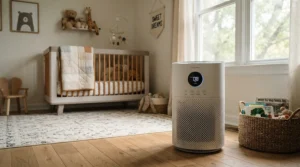
Placement matters more than people expect. Position the unit at least a few feet from the crib rather than directly against it, and keep its power cord routed along the wall rather than draped anywhere near the crib itself. This isn’t purifier-specific advice — it echoes broader nursery safety guidance. The American Academy of Pediatrics’ updated safe-sleep recommendations specifically flag dangling cords and electric wires near the sleep area as a strangulation risk, so route any purifier cord along a wall or behind furniture, out of reach.
First 30 days: run the unit continuously rather than only turning it on at bedtime — particulate levels build up gradually, and a purifier works best as ambient background filtration rather than a quick burst treatment. Most units in this list default to a mid-speed setting out of the box; drop it to the lowest or sleep setting for overnight use once you’ve confirmed the noise level suits your baby.
Common early mistakes: placing the unit in a corner with restricted airflow on more than one side (cuts effective CADR significantly), forgetting to remove the plastic film often wrapped around a brand-new filter, and skipping the first filter check at the 30-day mark, since dust accumulation in a freshly renovated or recently furnished nursery tends to be heaviest in the first month.
Maintenance schedule: vacuum the pre-filter (or wipe it, for washable versions like the Blueair Blue Pure 411) every 2-4 weeks, and mark a calendar reminder for full HEPA filter replacement at the 6-8 month mark most manufacturers recommend.
Real-World Scenarios: Which Purifier Fits Your Nursery?
Scenario 1 — the apartment nursery with a shared wall and no pets. A smaller room, tight budget, and no pet dander to worry about points toward the Levoit Core 300 or the even more compact Honeywell HPA020B if the room is genuinely under 100 square feet. Both keep noise low enough for thin apartment walls and don’t demand much floor space.
Scenario 2 — the family adding a nursery to a home with a shedding dog. Here, the pet-specific filtration of the Levoit Core P350 earns its slightly higher price, tackling both baby-safe air quality and dog dander in one device rather than running two separate units.
Scenario 3 — the parent who wants the nursery to look intentional, not clinical. If the nursery has been carefully decorated and a beige plastic tower feels like a compromise, the Blueair Blue Pure 411‘s fabric pre-filter options let the purifier blend into the room’s palette — worth the stretch toward (or slightly past) $100 for parents prioritizing aesthetics alongside filtration.
How to Choose an Air Purifier for a Nursery
- Confirm it’s a True HEPA filter, not a “HEPA-type” filter. Only true HEPA media is independently rated to capture 99.97% of particles at 0.3 microns; “HEPA-type” or “HEPA-like” language on a listing is a marketing softening of that standard.
- Match CADR to your actual room size, not just the manufacturer’s headline number — a unit rated for 220 square feet will run quieter and last longer in a 150-square-foot nursery than one rated exactly at your room’s size.
- Check the noise level at the lowest setting specifically, since that’s the speed it’ll run overnight — a purifier that’s whisper-quiet on turbo but loud on low defeats the purpose.
- Skip anything with an always-on ionizer or ozone feature. The EPA’s guidance is clear that mechanical HEPA filtration is the safer, better-studied approach for a room where an infant sleeps for most of the day.
- Price out the first year of filter replacements, not just the sticker price — a cheaper unit with expensive filters can cost more over 12 months than a pricier one with affordable filters.
- Consider the room’s other occupants — pets in the house change which filter type (like the P350’s odor-focused media) actually makes sense.
- Look at real owner sentiment, not just the star average — a 4.6-star rating built on thousands of reviews still often hides a consistent complaint pattern worth reading before you buy.
Air Purifier for Baby Room Allergies: What Actually Helps
If allergies — yours or your baby’s — are the main driver behind this purchase, the good news is that an air purifier for baby room allergies doesn’t need to be expensive to be effective. The particles that trigger most seasonal and pet allergies (pollen, dander, dust mite debris) fall squarely within the 0.3-10 micron range that True HEPA filtration is specifically built to capture, regardless of whether the unit costs $90 or $900.
Here’s what actually moves the needle: consistent runtime beats occasional bursts, since allergen levels rebuild continuously rather than in one-time spikes. A carbon layer, present in most of the units above, adds meaningful help against pet odor and household VOCs but does little for pollen or dander specifically — that’s purely the HEPA layer’s job. For households managing both a new baby and existing pet allergies, the Levoit Core P350‘s pet-formulated filter is the most purpose-built option on this list; for pollen-driven seasonal allergies with no pets involved, the plain Levoit Core 300 or Honeywell HPA100 perform just as well at a lower price, since pet-specific filtration doesn’t add value there.
HEPA Filter Cost & Filter Replacement: What to Budget For
The purchase price is only half the real cost of ownership — HEPA filter cost and filter replacement frequency determine what you’ll actually spend over the unit’s lifespan, and it’s a detail original Amazon listings rarely spell out clearly.
| Product | Filter Cost (approx.) | Replacement Frequency | Est. Annual Cost |
|---|---|---|---|
| Levoit Core 300 | ~$20 | Every 6-8 months | ~$30-$40/yr |
| Honeywell HPA100 | ~$25-$30 | Every 3-6 months | ~$50-$80/yr |
| GermGuardian AC4825 | ~$25-$30 | Every 6-8 months | ~$40-$50/yr |
| Honeywell HPA020B | ~$15-$20 | Every 3-6 months | ~$30-$50/yr |
| Levoit Core P350 | ~$20-$25 | Every 6-8 months | ~$30-$45/yr |
| PARTU BS-08 | ~$15-$20 | Every 3-6 months | ~$30-$50/yr |
| Blueair Blue Pure 411 | ~$25 (particle) + washable pre-filter | Every 6 months | ~$40-$50/yr |
Reading across this table, the Levoit Core 300 and Levoit Core P350 post the lowest realistic annual filter cost of the group, largely because their shared filter platform stays affordable even as Levoit expands the product line. The Honeywell HPA100, by contrast, needs more frequent filter replacement and pricier individual filters, meaning its higher upfront reliability comes with a real ongoing cost that adds up over a two- or three-year window. If total cost of ownership matters as much as the sticker price, factor this table in before comparing purchase prices alone.
Common Mistakes When Buying an Air Purifier for a Nursery
Buyers consistently trip up on the same handful of issues. First, sizing a purifier to the room’s square footage on paper while ignoring furniture, closets, and dividers that actually break up airflow — real coverage is usually a bit less generous than the box implies. Second, prioritizing a long feature list (apps, displays, multi-color lighting) over the two specs that matter most in a nursery: true HEPA media and a genuinely quiet low-speed setting. Third, buying based on sticker price alone and getting blindsided a year later by expensive replacement filters, which is exactly why the cost table above is worth returning to before checkout. Fourth, placing the unit too close to the crib rail or routing its cord across the crib’s blind spot, which runs against basic nursery safety guidance regardless of which purifier you choose. Fifth, assuming any air purifier with the word “ionizer” on the box is automatically better — extra ionization features add negligible real-world benefit for a nursery and introduce ozone-related trade-offs some experts prefer to avoid entirely near an infant.
Features That Actually Matter (And Those That Don’t)
Actually matters: a genuine True HEPA rating (not “HEPA-type”), a documented AHAM-verified CADR, noise level specifically at the lowest setting, and realistic filter replacement cost. These four specs predict almost everything you’ll care about a year from now.
Doesn’t really matter for a nursery: app connectivity (nice, but not filtration-relevant), colored ambient lighting, multi-speed counts beyond three or four (most parents settle on low or sleep mode and rarely touch the rest), and marketing language like “hospital-grade,” which has no standardized definition in consumer air purifiers and isn’t a regulated claim the way “True HEPA” is.
Baby Registry: Should an Air Purifier Be On It?
An air purifier is a genuinely practical baby registry addition, and one that’s easy to overlook next to the bottles and swaddles. Unlike many registry items that see limited use after the newborn stage, a nursery purifier keeps working for years — through pollen seasons, a future move, or a second child eventually inheriting the same room. Because the units on this list stay under or near $100, they also sit in a sweet spot for group gifting: a few relatives can go in together on the Levoit Core 300 or Honeywell HPA100 without anyone overspending on a single item, and it’s a far more usable gift than another stuffed animal. If you’re building out a registry, consider listing the purifier alongside its first replacement filter, since that’s the detail new parents often forget to budget for until the filter-change light comes on.
FAQ
❓ Do I really need an air purifier for a nursery?
❓ What's the difference between True HEPA and 'HEPA-type'?
❓ How often should I replace the filter?
❓ Is it safe to run an air purifier all night next to a baby?
❓ Can an air purifier replace a humidifier in a nursery?
Conclusion
Across all seven picks, the throughline is simple: you don’t need to spend $300 to get real, independently rated HEPA filtration next to your baby’s crib. The Levoit Core 300 remains the safest all-around default, the Honeywell HPA100 rewards buyers who value warranty and brand history over smart features, and specialty picks like the Levoit Core P350 or Blueair Blue Pure 411 earn their place for pet-owning or design-conscious households respectively. Budget-strapped parents still get a legitimate true-HEPA option in the PARTU BS-08, while tight spaces are well served by the tabletop Honeywell HPA020B.
Whichever you choose, the two specs worth anchoring your decision on are true HEPA filtration and a genuinely quiet low-speed setting — everything else is a nice-to-have. Check current pricing before you buy, since even budget purifiers fluctuate with sales cycles, and keep that first replacement filter on your list so you’re not caught off guard in six months.
Recommended for You
- Quietest Air Purifier for Baby Room Sleep: 7 Picks for 2026
- Air Purifier for Nursery Safety: 7 Ozone-Free Picks (2026)
- 7 Best Air Purifiers for Living Room Smoke Odor in 2026
Disclaimer: This article contains affiliate links. As an Amazon Associate, I earn from qualifying purchases. If you purchase products through these links, we may earn a small commission at no additional cost to you.
✨ Found this helpful? Share it with your friends! 💬🤗
