
In This Article
Somewhere around week thirty of pregnancy, most parents fall down the same rabbit hole: is the air in this room actually okay for a newborn to breathe? It’s a fair question. Nurseries are small, they’re closed up for months at a time, and they’re full of things that off-gas — fresh paint, new carpet, that adorable stuffed elephant fresh out of plastic wrap. Choosing the right air purifier for nursery safety isn’t about chasing a trend; it’s about giving a developing respiratory system one less thing to fight. The tricky part is that “safe” and “effective” aren’t always the same word in this category. Some machines marketed for babies quietly produce ozone, a lung irritant nobody wants drifting over a crib. Others are simply too loud to survive bedtime. This guide walks through seven real, currently available models — budget, mid-range, and premium — with honest analysis of what each one actually does, not just what the box says.
Before we get into individual picks, it helps to define the category clearly, because “air purifier for nursery safety” gets thrown around loosely online.
What Is an Air Purifier for Nursery Safety?
An air purifier for nursery safety is a portable HEPA-based device chosen specifically for use around infants — meaning it’s certified ozone-free, quiet enough for uninterrupted sleep (generally under 30 dB on its lowest setting), and sized correctly for the room using its Clean Air Delivery Rate (CADR). It’s a comfort and filtration tool, not a substitute for a pediatrician’s guidance on respiratory concerns.
That last point matters more than marketing copy usually admits. Air purifiers reduce airborne dust, pollen, pet dander, and smoke particles — genuinely useful work — but they don’t replace ventilation, they don’t fix a mold problem behind the wall, and they aren’t medical devices. The EPA’s consumer guidance on residential air cleaners is refreshingly blunt about this: portable purifiers are a supplement to source control, not a cure-all. Keep that framing in mind and the rest of this decision gets a lot simpler.
Quick Comparison Table
If you’re short on time (understandable — you have a baby), here’s the fast version before the deep dive.
| Product | Best For | Ozone-Free | Price Range |
|---|---|---|---|
| Levoit Core 300S | Best overall budget pick | Yes (CARB) | Around $90–$110 |
| Momcozy Nursery Air Purifier | Nursery-specific features | Yes | Around $70–$100 |
| Blueair Blue Pure 411+ | Compact bedrooms | Effectively yes (CARB) | Around $100–$130 |
| Winix AM90 | Mid-size rooms, smart control | Switchable | Around $180–$210 |
| Levoit Core 600S | Large or combined nursery-playroom | Yes | Around $280–$310 |
| Coway Airmega AP-1512HH | Long-term reliability | Switchable | Around $230–$260 |
| Levoit Core Mini-P | Travel and tight spaces | Yes (CARB) | Around $50–$65 |
A few of these — the Winix AM90 and the Coway Airmega AP-1512HH — include an ionizer that can be switched off, rather than shipping with zero ionization hardware at all. That’s not automatically disqualifying (both stay well under CARB’s ozone ceiling even with it running), but if a completely ionizer-free machine is non-negotiable for your household, the Levoit Core 300S, Momcozy Nursery Air Purifier, and Levoit Core Mini-P skip the ionizer question entirely. Room size is the other variable worth flagging early: a purifier rated for 150 square feet will run itself ragged in a 300-square-foot combined nursery-and-playroom, so match the CADR to the actual space before price or aesthetics.
💬 Found your frontrunner already? Tap through below to check today’s price and current stock.
Top 7 Air Purifiers for Nursery Safety: Expert Analysis
We picked these seven after comparing CADR data, certification records, and aggregated owner feedback across budget, mid-range, and premium tiers. Every one of them is ozone-free by design or has an ionizer that can be fully disabled.
1. Levoit Core 300S — best all-around budget pick
The standout here is simple: full CARB certification and true ozone-free operation at a genuinely low price point. The Core 300S runs a 3-stage system — pre-filter, H13 True HEPA, and activated carbon — with a CADR around 141 CFM, enough to handle a room up to roughly 219 square feet at close to five air changes per hour. That’s plenty for a standard nursery, though it starts to strain in anything resembling an open-concept loft space.
Where this model earns its reputation is the combination of specs that actually matter for a baby’s room: a documented sleep mode that dips into the low-20s dB range, an onboard air quality sensor with auto mode, and Energy Star certification that keeps the electric bill from creeping up if you run it around the clock. Based on the spec comparison against pricier competitors, the Core 300S delivers filtration performance that punches well above its price bracket — you’re not paying a premium tax for a brand name here.
Reviewers consistently note that the touch controls are intuitive even at 3 a.m., and the filter-change indicator prevents the common mistake of running a saturated filter for months past its useful life. On the review-sentiment side, aggregated feedback across major retailers points to high satisfaction with noise levels specifically, which is the metric that tends to make or break a nursery purchase.
Pros:
- ✅ CARB certified with zero ionizer, fully ozone-free
- ✅ Near-silent sleep mode suited to light-sleeping infants
- ✅ Low filter replacement cost keeps ownership affordable
Cons:
- ❌ Coverage tops out around 219 sq ft, tight for larger rooms
- ❌ No numeric PM2.5 display, just a color-coded ring
At around $90–$110, this is one of the easiest recommendations in the entire lineup — check current price before buying, since Levoit runs frequent promotions.
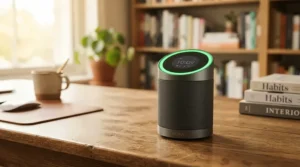
2. Momcozy Nursery Air Purifier — purpose-built for baby rooms
Every design decision on this one traces back to a single question: what does a parent actually need at 2 a.m.? The standout feature is the quad-layer filtration paired with a live numeric PM2.5 readout, so instead of guessing at a vague “good/bad” light, you get an actual number on the display.
The filtration stack runs a pre-filter, H13 True HEPA, activated carbon for diaper-pail odors, and a silver-ion layer — no ionizer, no UV-C stage, nothing that generates ozone as a byproduct. AHAM Verifide independently confirms its CADR claims, which is worth calling out because plenty of nursery-marketed purifiers skip third-party verification entirely and just print numbers on the box. Here’s what to weigh: this is a newer entrant compared to legacy brands like Levoit or Coway, so it doesn’t have a decade of long-term reliability data behind it yet, but the underlying engineering checks the right boxes.
What most buyers overlook about purpose-built nursery purifiers is the value of small quality-of-life features — the dimmable night light here means you’re not flipping on an overhead light for a 3 a.m. diaper change, which matters more than it sounds like it should when you’re the one doing the changing.
Pros:
- ✅ Real-time numeric PM2.5 display, not just a color light
- ✅ No ionizer, UV-C, or ozone-generating stage at all
- ✅ Built-in dimmable night light for nighttime changes
Cons:
- ❌ Shorter market track record than legacy competitors
- ❌ Proprietary replacement filters cost more than generic options
Price sits in the roughly $70–$100 range depending on retailer, making it a strong mid-budget nursery-specific choice.
3. Blueair Blue Pure 411+ — best compact pick for smaller bedrooms
The standout advantage is the Scandinavian-simple design paired with a genuine certification trifecta: CARB for ozone safety, AHAM Verifide for CADR accuracy, and Energy Star for efficiency, plus a Quiet Mark award from the Noise Abatement Society that few competitors bother pursuing.
Blueair’s HEPASilent technology blends mechanical filtration with a low-level electrostatic charge, which is a more honest way of saying it, than pure marketing would prefer, since that electrostatic stage is technically a form of ionization. The spec sheet won’t tell you this outright, but independent testers have confirmed the ionizer here can’t be manually switched off — however, CARB certification confirms ozone output stays effectively undetectable, well under the 50 ppb legal ceiling. For most nurseries this is a non-issue; for the small subset of parents who want zero ionization hardware present under any circumstances, this isn’t your pick.
CADR lands around 120 CFM, covering roughly 185 square feet comfortably. Aggregated owner reviews consistently praise the compact footprint and the near-whisper operation, with common complaints centered on filter replacement costs adding up over a year of continuous use — a fair trade-off given the design quality, but worth budgeting for.
Pros:
- ✅ CARB, AHAM, and Energy Star certified — a rare full set
- ✅ Compact, attractive design fits nightstands and small shelves
- ✅ Quiet Mark certified for genuinely low operating noise
Cons:
- ❌ Built-in ionizer can’t be manually disabled
- ❌ Lower CADR than similarly priced competitors
Expect a price in the $100–$130 range, with the washable pre-filter sleeve helping offset some long-term costs.
4. Winix AM90 — best mid-range pick with smart controls
The standout feature is Wi-Fi and voice-assistant integration bolted onto genuinely strong filtration — this isn’t a smart gimmick layered over a weak purifier. AHAM-verified CADR sits around 233–240 CFM, enough to cover a 360-square-foot room, which is meaningfully more capacity than most nursery-specific competitors offer.
The four-stage system pairs True HEPA with a washable activated carbon filter (a real cost-saver over time, since you’re not replacing the carbon stage every few months) and Winix’s PlasmaWave ionization technology. On paper this means slightly more particle capture at the smallest size range; in practice, what most buyers overlook is that PlasmaWave can be switched off entirely, and independent testing on comparable Winix models shows negligible performance loss when it’s disabled — so if you want it ozone-neutral, you’re not sacrificing much by turning it off. One honest caveat worth noting from user reports across the Winix lineup: settings like this have occasionally reset after a power outage or unplugging, so it’s worth double-checking your unit’s behavior against the manual after any power interruption.
Reviewers consistently flag the auto-mode sensor as one of the more accurate on the market, adjusting fan speed in real time rather than lagging behind actual air quality changes.
Pros:
- ✅ Strong 360 sq ft coverage from AHAM-verified CADR
- ✅ Washable carbon filter reduces long-term running costs
- ✅ PlasmaWave ionizer can be manually switched off
Cons:
- ❌ Larger, heavier tower design than most nursery competitors
- ❌ Ionizer setting may reset after power interruptions
Price generally falls in the $180–$210 range — a fair mid-tier ask for the coverage and smart features included.
5. Levoit Core 600S — best for large or combined nursery spaces
When the “nursery” is really a converted guest bedroom or an open-plan layout, this is the standout option: a CADR near 410 CFM, roughly three times the output of entry-level Core models, while staying completely ozone-free with no ionizer at all.
The filtration stack is the same trusted H13 True HEPA and activated carbon combination found across the Core line, just scaled up with a more powerful motor. Based on the spec comparison against smaller units, the real-world benefit isn’t just raw speed — it’s headroom. A purifier running at 40% capacity to clean a large room is quieter and lasts longer than one running flat-out to compensate for being undersized, and the 600S has that headroom built in.
An onboard air quality sensor drives genuine auto mode, adjusting fan speed to actual particulate levels rather than a fixed schedule, and app connectivity lets you check on things from another room without walking in and risking a wake-up. The spec sheet won’t tell you this, but reviewers note the trade-off for that extra power is a noticeably larger footprint — this isn’t a nightstand unit, it’s closer to floor-standing furniture.
Pros:
- ✅ High 410 CFM CADR handles large or combined rooms
- ✅ Fully ozone-free with no ionizer hardware present
- ✅ Real air quality sensor drives an accurate auto mode
Cons:
- ❌ Higher price point than smaller Core siblings
- ❌ Larger footprint needs dedicated floor or shelf space
Budget around $280–$310, positioning it as the premium-tier pick for parents who need genuine large-room capacity without compromising on ozone-free operation.
6. Coway Airmega AP-1512HH — best for long-term reliability
The standout advantage here is reputation backed by data: this has been an industry benchmark pick for roughly a decade, with AHAM-verified CADR figures around 233–246 CFM covering rooms up to 361 square feet, and thousands of documented long-term ownership reports.
Here’s the honest trade-off. The AP-1512HH includes a built-in ionizer, and unlike the Core series, it isn’t ozone-free by default — CARB testing shows it emits approximately 9 ppb of ozone with the ionizer active, which sits well under the 50 ppb legal limit but isn’t zero. The good news, based on the spec comparison and independent lab testing, is that disabling the ionizer costs you almost nothing in cleaning speed — a few extra minutes in most test scenarios — while eliminating the ozone question completely. What most buyers overlook is that the ionizer defaults back to “on” after a power cycle, so if you unplug it to move rooms or ride out a power outage, you’ll want to manually switch it off again each time.
Aggregated owner reviews consistently mention units still running strong after seven or eight years of continuous use, which matters for total cost of ownership calculations — a purifier that lasts twice as long effectively halves its annual cost even at a higher upfront price.
Pros:
- ✅ AHAM-verified CADR with a decade-long reliability track record
- ✅ Ionizer can be disabled with minimal performance trade-off
- ✅ Filters typically last around 12 months between changes
Cons:
- ❌ Ionizer produces trace ozone (under CARB limits) when left on
- ❌ Resets to ionizer-on after every power cycle
Price generally lands around $230–$260, and given the documented multi-year lifespan, the value calculation holds up even at the higher end of that range.
7. Levoit Core Mini-P — best for travel and tight spaces
The standout feature is sheer portability: at roughly 2 pounds, this is small enough to toss in a diaper bag for grandma’s house, a hotel crib setup, or a car seat corner, while still carrying full CARB certification for ozone-free operation.
Don’t mistake small for underpowered relative to its intended use — the CADR sits in the 40–50 CFM range depending on the exact configuration, which comfortably handles spaces up to around 150–175 square feet at reasonable air-change rates, though it’s not meant to compete with full-size units in a large room. Reviewers consistently point out that the sleep mode noise floor, around the low-20s dB, is among the quietest in this entire lineup, small motor size working in its favor here. The optional aromatherapy pad is worth a mention only because it’s easy to skip — for a newborn’s room, most pediatric guidance leans toward skipping added fragrances entirely, so treat that feature as optional rather than a selling point.
What most buyers overlook about ultra-compact purifiers is the filter economics: because the filter is smaller, it also captures less total particulate before needing replacement, so the cost-per-CADR ends up higher than a full-size unit even though the sticker price is lower. It’s still the right call for travel and secondary spaces — just don’t expect it to be your only purifier if the nursery itself is larger than a small bedroom.
Pros:
- ✅ CARB certified, fully ozone-free at a very low price
- ✅ Extremely portable for travel cribs and secondary rooms
- ✅ Whisper-quiet sleep mode among the quietest tested
Cons:
- ❌ Limited coverage, best suited to small spaces only
- ❌ Higher filter cost per unit of cleaning capacity
At around $50–$65, this is less a primary nursery purifier and more an ozone-free travel companion or backup unit — priced accordingly.
Top 7 Products at a Glance
| Product | CADR (approx.) | Room Size | Ionizer | Best For |
|---|---|---|---|---|
| Levoit Core 300S | 141 CFM | ~219 sq ft | None | Standard nursery on a budget |
| Momcozy Nursery Air Purifier | ~130 CFM | ~250 sq ft | None | Nursery-specific features |
| Blueair Blue Pure 411+ | 120 CFM | ~185 sq ft | Fixed, negligible ozone | Small, stylish bedrooms |
| Winix AM90 | ~233 CFM | 360 sq ft | Switchable | Larger rooms, smart control |
| Levoit Core 600S | ~410 CFM | Large/combined rooms | None | Big or open-plan nurseries |
| Coway Airmega AP-1512HH | 233–246 CFM | 361 sq ft | Switchable | Long-term reliability |
| Levoit Core Mini-P | 40–50 CFM | ~150–175 sq ft | None | Travel, tight spaces |
Looking at the numbers side by side, the pattern is pretty clear: coverage and price move together almost linearly, except for the Coway Airmega AP-1512HH, which delivers premium-tier CADR at a price closer to the mid-range thanks to its age in the market. If your nursery doubles as a playroom or nursery-plus-office combo, the Levoit Core 600S and Winix AM90 are the only two here with genuine headroom to spare; everything else is sized for a standalone bedroom-sized nursery.
How to Choose an Air Purifier for Nursery Safety
Cutting through the marketing noise comes down to checking a short, specific list in order.
- Confirm ozone-free or fully disableable ionization first. This is the one non-negotiable safety filter — everything else is a preference, but ozone exposure risk isn’t something to compromise on for an infant’s developing lungs.
- Match CADR to actual square footage. Measure the room and look for a CADR rating that supports at least four to five air changes per hour at that size, not just the manufacturer’s maximum-room-size claim.
- Check the lowest noise rating, not the average. A unit that’s quiet on medium but loud on its lowest useful setting will disturb naps; look specifically for sub-30 dB sleep or night modes.
- Verify independent certification. AHAM Verifide for performance claims and CARB for ozone safety are the two marks worth trusting over unverified manufacturer numbers.
- Budget for filter replacement, not just the unit price. A cheaper purifier with expensive, frequent filter changes can cost more over two years than a pricier unit with a 12-month filter cycle.
- Consider placement and cord length before buying. Nurseries have limited safe outlet placement away from a crib; make sure the unit and its cord can sit at a safe distance without an extension cord running near the crib rail.
- Read aggregated review sentiment, not just star averages. A 4.6-star average with recurring complaints about a specific noise or reliability issue tells you more than the number alone.
Common Mistakes When Buying an Air Purifier for Nursery Safety
Even well-researched parents trip over a handful of predictable errors here. The first is buying based on room size marketing rather than CADR math — a box that says “covers up to 400 square feet” is usually citing a single air change per hour, which is far less thorough than the four-to-five changes per hour you actually want in a nursery.
The second common mistake is assuming “HEPA-type” and “True HEPA” mean the same thing. They don’t. True HEPA (often labeled H13) is independently defined to capture 99.97% of particles at 0.3 microns; “HEPA-type” or “HEPA-like” filters are a marketing label with no enforced standard behind them, and they routinely underperform in real testing.
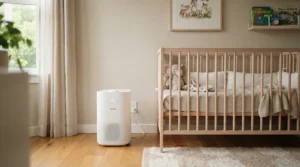
A third mistake, and a surprisingly common one, is placing the purifier too close to the crib out of a well-meaning instinct to “maximize protection.” In practice, air purifiers work by cycling the whole room’s air repeatedly, not by creating a protective bubble around one specific spot — placing it a few feet away with clear airflow on all sides does the job better than crowding it against the crib rail, and it also reduces any risk of cord or unit proximity to a curious toddler down the line.
Air Purifier for Nursery No Ozone: Why Ozone-Free Matters
Ozone sounds almost wholesome — it’s the same molecule associated with “fresh air after a thunderstorm” — which is exactly why some manufacturers have historically leaned on that association to market ozone-generating devices as beneficial. It isn’t. Ground-level ozone is a lung irritant, and the concern is proportionally larger for infants, whose airways are smaller and still developing. Looking for an air purifier for nursery no ozone operation isn’t an overcautious parenting choice; it’s the baseline safety filter every pediatric-focused buying guide leans on.
The practical way to verify this is CARB certification, since California’s air cleaner regulation requires any device with electronic components capable of producing ozone — ionizers, UV-C stages, plasma technology — to be tested and capped at 0.050 parts per million. Devices that fail this threshold, or that are marketed as “ozone generators” outright, land on CARB’s public list of hazardous ozone-generating air purifiers, which is worth a quick check before buying anything unfamiliar. Among the seven products above, the Levoit Core 300S, Momcozy Nursery Air Purifier, Levoit Core 600S, and Levoit Core Mini-P ship with zero ionization hardware, while the Winix AM90 and Coway Airmega AP-1512HH include a switchable ionizer you can turn off entirely. The Blueair Blue Pure 411+ sits in a middle category — its ionizer is fixed on but tested at effectively undetectable ozone output.
Air Purifier for Nursery Air Quality: What to Expect Night and Day
Specs on a box don’t tell you what a purifier feels like to actually live with, so here’s the practical translation. During the day, a properly sized unit running on auto mode should visibly bring a color-coded or numeric air quality indicator down within fifteen to thirty minutes of a triggering event — a diaper change, a dusty blanket shake, someone walking in from outside. That responsiveness is the real-world payoff of a solid CADR rating; it’s not abstract lab performance, it’s the difference between lingering odors and a room that resets itself quickly.
Overnight is where air purifier for nursery air quality expectations diverge most from marketing claims. A unit on its loudest setting might clean faster, but nobody’s running full blast next to a sleeping newborn. On sleep mode, expect a gentler, slower air-change rate — which is the right trade-off, since a slightly slower cleaning cycle beats a fan loud enough to disrupt sleep cycles. The models with a genuine air quality sensor, like the Levoit Core 600S and Winix AM90, will automatically ramp up briefly if something shifts (a diaper pail lid left open, for instance) and then quiet back down, which is a meaningfully better experience than a fixed-speed fan running the same way regardless of conditions.
Child Safety Certification: What CARB, AHAM, and ETL Actually Mean
These acronyms get printed on every box, but they don’t all measure the same thing, and conflating them leads to false confidence. CARB certification, as covered above, is specifically about ozone emissions and electrical safety — it says nothing about how well a unit actually filters particles. AHAM Verifide, run by the Association of Home Appliance Manufacturers, is the opposite: it independently verifies a manufacturer’s claimed Clean Air Delivery Rate through third-party lab testing, but it doesn’t test for ozone at all. ETL and UL marks, meanwhile, cover electrical safety and fire risk — a baseline you want on any device plugged in near a crib, but again unrelated to filtration performance.
The practical takeaway for child safety certification is that you generally want all three types of assurance represented, not just one impressive-sounding badge. A unit with a beautiful AHAM-verified CADR but no CARB certification could still be an undisclosed ozone source. A CARB-certified unit with no AHAM verification might be filtering far less air than its marketing copy implies. Among this lineup, the Coway Airmega AP-1512HH, Winix AM90, Blueair Blue Pure 411+, and Levoit models across the board carry combinations of these certifications — check the current listing for each, since certifications can be updated or renewed between production runs.
Indoor Air Quality Beyond the Purifier: Building a Safer Nursery
A purifier is one layer of a broader indoor air quality strategy, not a complete solution on its own. Fresh paint and new furniture off-gas volatile organic compounds for weeks after installation, so airing out a newly painted or furnished nursery for several days before a baby moves in — windows open, weather permitting — does more heavy lifting than any single appliance. The American Academy of Pediatrics’ guidance on indoor air pollutants points to reducing pollutant sources first and treating filtration as a supplement, which lines up with how the EPA frames portable air cleaners as well.
Beyond the purifier itself, a handful of low-effort habits compound over time: washing new bedding and crib sheets before first use to cut down on manufacturing residue and dust, keeping humidity in the 30–50% range to discourage mold and dust mites without drying out a baby’s airways, and vacuuming with a sealed HEPA vacuum rather than one that recirculates fine dust back into the room. None of these replace a good purifier, but together they mean the purifier isn’t working against a constant tide of new pollutants — it’s maintaining an already-decent baseline.
Setting Up and Maintaining Your Nursery Air Purifier
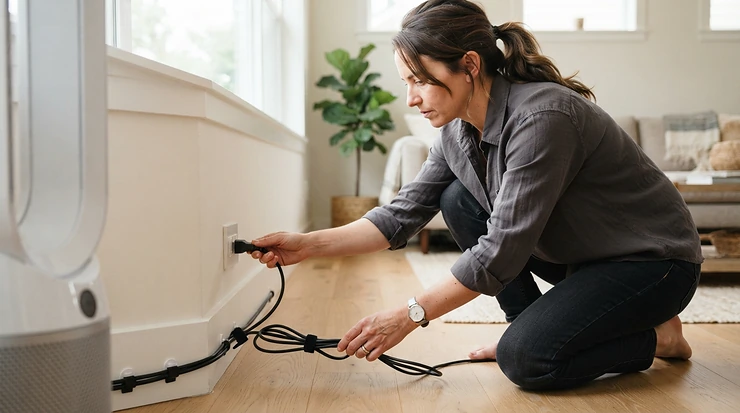
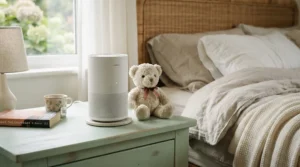
Getting the setup right in the first week matters more than most parents expect. Start by placing the unit at least three feet from the crib, on a stable, elevated surface if possible — a low dresser or shelf works better than the floor, since it keeps intake vents away from settled dust and out of a crawling toddler’s reach down the line. Make sure the cord runs along a wall rather than across open floor space, both for safety and to avoid the temptation to route it near crib rails.
For the first thirty days, run the unit continuously rather than cycling it on and off — air purifiers do their best work maintaining a steady baseline, not playing catch-up after being off for hours. Check the filter indicator weekly even if it hasn’t triggered yet; a quick visual check for visible dust buildup on a pre-filter can tell you if the room is dustier than expected and needs more frequent pre-filter vacuuming between full filter changes. A common first-month mistake is forgetting to remove factory plastic wrapping from the filter itself — it sounds obvious, but it’s one of the most frequently reported “why isn’t this working” issues in aggregated owner reviews.
Ongoing maintenance is refreshingly low-effort: vacuum washable pre-filters every two to four weeks, replace the main HEPA/carbon filter on the manufacturer’s recommended schedule (typically six to twelve months depending on the model), and wipe down the exterior vents monthly to keep intake airflow unobstructed.
Real Nursery Scenarios: Matching the Purifier to Your Family
The apartment-dwelling new parent with a small nursery corner. If you’re working with a converted closet-sized nursery in a city apartment, budget and footprint both matter more than raw power. The Levoit Core 300S or Levoit Core Mini-P covers a small room easily without eating up shelf space you don’t have, and the lower price leaves more room in the budget for everything else a first month with a newborn demands.
The family with a combined nursery-playroom or open floor plan. When the nursery isn’t a separate closed room — maybe it’s part of a great room, or shares space with a home office — undersized purifiers get overwhelmed constantly cycling air that’s also affected by kitchen smells or foot traffic from other rooms. The Levoit Core 600S or Winix AM90 has the CADR headroom to keep up without running at max speed around the clock.
The parent prioritizing long-term value over upfront cost. If you’re planning to use this purifier well past infancy — moving it to a toddler room, then a kid’s bedroom — the Coway Airmega AP-1512HH‘s documented multi-year reliability track record makes the higher upfront cost easier to justify, especially once you disable the ionizer and treat it as a straightforward HEPA workhorse.
Common Nursery Air Quality Problems and Solutions
Problem: The nursery still smells like diaper pail even with the purifier running. Odor molecules are gaseous, not particulate, so a unit without a substantial activated carbon stage won’t touch them regardless of HEPA performance. Solution: prioritize models with a real carbon layer — the Winix AM90‘s washable carbon filter and the Momcozy Nursery Air Purifier‘s dedicated carbon stage both target this specifically, and emptying the diaper pail more frequently helps more than any purifier setting.
Problem: The purifier seems to run constantly on high without ever settling down. This usually means the unit is undersized for the room, working overtime to keep up. Solution: recheck the CADR-to-square-footage math from the “How to Choose” section above; sizing up, even one tier, often solves this instantly.
Problem: A parent is worried about noise waking the baby during naps. Solution: confirm the sleep-mode dB rating specifically, not the average operating noise — the Levoit Core 300S, Momcozy Nursery Air Purifier, and Levoit Core Mini-P all post sleep-mode ratings in the low-20s dB range, quiet enough to double as gentle white noise rather than a disruption.
Problem: Visible dust seems to reappear quickly after cleaning the room. Solution: check pre-filter cleanliness first — a clogged pre-filter reduces total airflow through the HEPA stage significantly, so a two-minute vacuum of the washable pre-filter can restore performance faster than a full filter replacement.
Air Purifier vs Traditional Humidifier/Fan for Nursery Safety
Parents often ask whether a humidifier, a simple fan, or an air purifier solves the “nursery comfort” problem, and the honest answer is that they solve different problems entirely. A fan moves air around without removing anything from it — useful for white noise and mild temperature comfort, useless against allergens or dust. A humidifier adds moisture to combat dry-air congestion, which matters in winter heating season, but it does nothing for particulate matter and can actually encourage mold growth if oversaturated or poorly maintained.
| Feature | Air Purifier | Humidifier | Fan |
|---|---|---|---|
| Removes allergens/dust | Yes | No | No |
| Removes odors | Yes (with carbon filter) | No | No |
| Adds moisture | No | Yes | No |
| White noise benefit | Some (low hum) | Minimal | Yes |
| Best For | Air quality, allergy-prone infants | Dry air, congestion | Airflow, mild white noise |
Looking at the comparison, none of these three appliances is a strict upgrade over the others — they’re complementary, not competing, tools. A nursery in a dry winter climate genuinely benefits from running a humidifier alongside a purifier, since the purifier’s fan won’t correct low humidity and the humidifier won’t touch airborne dust. Parents chasing pure white noise for sleep training are often better served by a dedicated sound machine than expecting a purifier’s fan hum to do that job reliably.
Long-Term Cost & Maintenance
The sticker price is only the entry fee; filter replacement is where nursery air purifiers separate into genuinely affordable and quietly expensive over a two- or three-year window. Budget units like the Levoit Core 300S typically run $40–$50 a year in filter costs, while larger units like the Levoit Core 600S or Coway Airmega AP-1512HH can run closer to $60–$90 annually given their larger filter surface area — though the Coway’s washable pre-filter stage offsets some of that.
Total cost of ownership also depends heavily on how long the unit lasts before mechanical failure, not just filter costs. This is where the Coway Airmega AP-1512HH‘s well-documented multi-year lifespan changes the math: a $250 unit that reliably runs for seven-plus years works out to well under $40 a year in amortized hardware cost, competitive with units that cost half as much upfront but may need replacement sooner. Washable-filter models like the Winix AM90‘s carbon stage further reduce ongoing costs by extending the interval between full filter replacements, since only the HEPA layer needs periodic swapping rather than the entire filter assembly.
Frequently Asked Questions
❓ Is it safe to run an air purifier in a nursery all night?
❓ How do I know if an air purifier for nursery safety is truly ozone-free?
❓ What CADR rating do I need for a standard nursery?
❓ Can an air purifier help with a baby's allergies or congestion?
❓ How often should nursery air purifier filters be replaced?
Conclusion
Picking the right air purifier for nursery safety really comes down to three checks in order: confirm it’s ozone-free (or has a disableable ionizer that stays under CARB limits), size the CADR to your actual room, and verify independent certification rather than trusting box copy alone. Every product covered here clears that bar, which is why they made the list in the first place — from the budget-friendly Levoit Core 300S to the large-room capable Levoit Core 600S, the nursery-specific Momcozy Nursery Air Purifier, and the long-proven Coway Airmega AP-1512HH.
None of these seven is objectively “the best” in a vacuum — the right pick depends entirely on your room size, your budget, and how strongly you feel about zero ionization hardware versus a switchable one under legal ozone limits. What matters more than any single spec is treating the purifier as one layer of a broader indoor air strategy: source control, ventilation, and sensible habits do real work too, and a purifier’s job is to handle what’s left over. Get that framing right, and any of the seven models above will serve a nursery well.
Recommended for You
- 7 Best Air Purifiers for Living Room Smoke Odor in 2026
- Air Purifier for Living Room Smoke Odor: 7 Best Picks 2026
- Air Purifier for Living Room With Pets: 7 Top Picks for 2026
Disclaimer: This article contains affiliate links. As an Amazon Associate, I earn from qualifying purchases. If you purchase products through these links, we may earn a small commission at no additional cost to you.
✨ Found this helpful? Share it with your friends! 💬🤗
