
In This Article
You know the moment. Dinner’s done, the pan’s soaking, and somehow it’s now 9 p.m. and your hallway still smells like seared salmon. That’s the exact problem an air purifier for kitchen cooking smells is built to solve, and it’s a different job than the one your range hood is doing. A hood vents steam and grease straight up and out — when it’s working, and when you remember to turn it on. But the second those odor molecules drift past the hood’s reach, into the living room, the hallway, your throw pillows, it’s on its own. That’s where a dedicated purifier earns its keep.
Here’s the short version, since it deserves a straight answer before anything else: an air purifier for kitchen cooking smells uses activated carbon to adsorb the gaseous compounds — think trimethylamine from fish, sulfur compounds from garlic, acrolein from scorched oil — that a standard HEPA filter physically cannot catch, since HEPA media is built for particles, not gas molecules. Pair that carbon layer with True HEPA for the smoke and grease particulate, and you’ve got a legitimate two-front defense.
This guide breaks down seven real, currently available units — budget stragglers to serious odor-killers — plus the buying logic behind each one, so you’re not gambling $200 on a purifier that turns out to be mostly a fan with a sticker on it.
Quick Comparison Table
Before the deep dive, here’s the shape of the market. These are the standouts across price tiers, picked for how much activated carbon they’re actually carrying — the spec that quietly separates a real odor solution from a HEPA unit wearing a “deodorizing” label.
| Purifier | Coverage | Carbon Focus | Best For |
|---|---|---|---|
| Levoit Core 300S | ~215 sq ft | Light carbon layer | Small kitchens, countertop use |
| Coway Airmega AP-1512HH (Mighty) | 361 sq ft | Dedicated deodorization filter | All-around mid-range pick |
| Blueair Blue Pure 211i Max | Up to 674 sq ft | SmokeBlock carbon upgrade | Open-plan kitchen-living spaces |
| Alen BreatheSmart 45i (VOC/Smoke filter) | Up to 800 sq ft | 2+ lb activated carbon | Heavy frying, wok cooking, smoke |
| Austin Air HealthMate HM400 | Up to 1,500 sq ft | 15 lb carbon/zeolite bed | Fish, curry, chronic odor problems |
The Alen BreatheSmart 45i’s VOC/Smoke filter option carries over 2 pounds of activated carbon on top of its HEPA layer, engineered to trap smoke vapors and volatile organic compounds specifically, which is exactly why it edges out lighter units when the meal in question is stir-fry, not toast. Meanwhile the Austin Air HealthMate has earned a reputation as one of the strongest options on the market for chemical gases, unwanted odors, and VOCs specifically, thanks to roughly 15 pounds of carbon inside it — though that firepower comes at a real price, both upfront and in the size of the unit sitting on your floor. If your kitchen is under 300 square feet and mostly deals with weeknight pasta and the occasional pan-seared chicken, you likely don’t need that much machine — the Coway Airmega AP-1512HH or Levoit Core 300S will do the job without the footprint or the bill.
💬 Bookmark this table — you’ll want to scroll back to it once you see what each unit actually costs to run long-term.
Top 7 Air Purifiers for Kitchen Cooking Smells: Expert Analysis
Real products, real specs, real trade-offs. Budget to premium, here’s what’s actually worth your counter space.
1. Levoit Core 300S — smallest footprint, honest countertop pick
The Core 300S is the one to consider if your “kitchen” is really a kitchenette, or if a full-size console purifier would just be in the way of the coffee maker.
Levoit’s Core 300 line runs around $100 with a CADR near 141 CFM, and the 300S adds an app and auto-mode on top of that base. Its cylindrical, low-profile shape is specifically built to sit on a counter or narrow shelf rather than take up floor space — a real advantage in apartment kitchens where every inch of surface is already spoken for. What most buyers overlook about this tier of purifier is that its carbon filter is a thin layer bonded to the HEPA media, not a dedicated cartridge, so it’s genuinely good at knocking down light, everyday odors (toast, coffee, a quick sauté) but starts to lose the fight against something as assertive as fried fish or a heavy curry reduction.
Reviewers consistently describe the Core 300S as quiet at low-to-medium speeds and easy to live with overnight, which matters if your kitchen opens into a bedroom or studio layout. It’s a strong fit for renters, small households, and anyone who cooks moderately but doesn’t want a large appliance-sized purifier competing for outlet space.
Pros:
- ✅ Genuinely compact — built for countertop or small-shelf placement
- ✅ Low price point makes it an easy first purchase
- ✅ Quiet operation on low and medium fan speeds
Cons:
- ❌ Thin carbon layer struggles with strong odors like fish or curry
- ❌ Coverage tops out around a small kitchen, not open-plan spaces
Expect this one in the budget range, generally under $150 depending on bundle. For light cooking in a small space, it’s solid value; for anything more aggressive, keep reading.
2. Winix 5500-2 — washable carbon filter, ionizer you can switch off
The Winix 5500-2 carves out its niche with a washable activated carbon filter, which is a genuinely useful feature in a kitchen environment where grease and cooking residue clog filters faster than they would in a bedroom.
The unit is rated for 360 square feet, uses a three-stage system combining True HEPA, a washable AOC carbon filter made from activated carbon granules for odor removal, and Winix’s PlasmaWave technology, with CADR ratings of 232 for smoke, 243 for dust, and 246 for pollen. Based on the spec comparison with other units in this range, the washable carbon filter is the standout: instead of replacing a saturated carbon cartridge every few months like most competitors, you rinse it and put it back — meaningful savings over a few years of daily cooking. One independent tester also noted a strong price-to-CADR ratio, working out to roughly 74 cents per CADR cfm, a genuinely good value marker in this category.
The PlasmaWave ionizer can be fully disabled, which matters if you’d rather not run an ionizer continuously — some purifiers bury that option or omit it entirely. What most buyers overlook: Tom’s Guide flagged replacement filters as comparatively expensive when you do eventually need the HEPA stage replaced, even though the carbon portion is washable.
Pros:
- ✅ Washable carbon filter cuts long-term replacement costs
- ✅ Ionizer (PlasmaWave) can be switched off entirely
- ✅ Strong CADR-to-price ratio for a mid-size kitchen
Cons:
- ❌ HEPA filter replacements run pricier than competitors
- ❌ Bulkier, plainer design than newer app-connected models
Typically found in the $180-$250 range, with frequent sales bringing it well under $150 — worth watching if you’re patient.
3. Coway Airmega AP-1512HH (Mighty) — the default recommendation, and for good reason
If you only read one entry on this list, make it this one. The Coway Airmega AP-1512HH, better known as the Mighty, has been a go-to pick for years, and the reason is boring in the best way: it just works.
It’s built around a 4-stage system — pre-filter, dedicated deodorization filter, True HEPA, and an ionizing Vital Ion stage — rated for rooms up to 361 square feet, with CADR scores of 246 for dust, 240 for pollen, and 233 for smoke, running as quiet as 24.4 dB on its lowest setting. Here’s what the spec sheet doesn’t spell out clearly: that deodorization filter is a separate physical stage from the HEPA layer, not a coating on it, which is precisely the design choice that lets it handle kitchen odors better than units that treat carbon as an afterthought. It’s specifically called out as a strong pick for households dealing with odor on top of dander and dust.
The deodorization filter needs replacing roughly every 6 months, while the HEPA stage lasts about a year — a maintenance rhythm worth knowing before you buy, since kitchen use tends to saturate that carbon faster than a bedroom would. Aggregated buyer sentiment consistently praises the real-time color-coded air quality indicator, which gives you honest feedback on whether the unit is actually doing anything, rather than running blind.
Pros:
- ✅ Dedicated deodorization filter, not just a HEPA coating
- ✅ Real-time air quality sensor with color-coded feedback
- ✅ Quiet even on higher fan speeds relative to output
Cons:
- ❌ Deodorization filter needs replacing roughly twice a year
- ❌ 361 sq ft ceiling means open-plan kitchens may need two units
Street pricing on the Mighty regularly dips into the $140-$180 range during sales, with list price closer to $230 — genuinely strong value for what it does.
4. Levoit Core 400S — the smart upgrade with real sensor logic
The Levoit Core 400S is what you buy when you’ve outgrown the 300S but don’t need Austin Air-level firepower. It runs around $220 with a CADR near 260 CFM, sitting comfortably between entry-level and heavy-duty tiers.
It earns its spot here through the smartest auto-detection in this price bracket — a laser-based particle sensor that picks up cooking smoke within seconds and auto-ramps fan speed in response, rather than waiting for you to notice the smell and manually crank it up. That responsiveness matters more than raw CADR in a lot of real kitchens, because the biggest failure mode for any purifier isn’t weak filtration — it’s running on low while you’re searing something at 500°F. The app control also lets you check and adjust it from another room, which is genuinely convenient if you start a purifier before you even start cooking (the single best habit for controlling kitchen odor, according to multiple independent testers).
Its three-stage filtration pairs an activated carbon layer with a high-efficiency H13 HEPA filter behind it, targeting both odor-causing VOCs and fine particulates from cooking smoke together. Based on that combination, it’s a legitimate step up from the 300S for anyone cooking daily rather than occasionally.
Pros:
- ✅ Laser sensor auto-detects smoke and ramps fan speed fast
- ✅ App control for remote start before you begin cooking
- ✅ Balanced carbon-plus-HEPA combo for mid-size kitchens
Cons:
- ❌ Pricier than the 300S for a meaningful but not massive jump in carbon capacity
- ❌ App dependency won’t appeal to everyone
Expect this one in the $180-$230 range depending on promotions.
5. Blueair Blue Pure 211i Max — the open-plan kitchen’s best friend
Most kitchens aren’t sealed rooms anymore — they bleed into the dining area, the living room, sometimes the whole downstairs. That’s the exact problem the Blue Pure 211i Max is sized for.
It covers up to 674 square feet with a CADR of 450 cfm for pollen, 452 for dust, and 435 for smoke — numbers that put it in a different weight class than the countertop-sized units earlier on this list. Blueair specifically recommends pairing it with their SmokeBlock filter, which carries roughly twice the activated carbon of the standard Particle + Carbon filter that ships with the unit. That’s a meaningful detail: the base filter is fine for general use, but if cooking odor is your actual priority, the upgrade filter is where the real odor-fighting capacity lives — don’t assume the stock configuration is optimized for your use case.
The reasoning here is straightforward: range hoods handle steam and some grease particulate, but do very little for odors that have already spread beyond the cooking zone, and an open floor plan means that migration happens fast. What most buyers overlook is that a purifier this size isn’t overkill for a kitchen alone — it’s sized for the kitchen plus everything it’s connected to.
Pros:
- ✅ Coverage large enough for genuinely open-plan homes
- ✅ SmokeBlock filter option doubles down on carbon capacity
- ✅ Blueair’s app-based fan control and filter tracking
Cons:
- ❌ Overkill and a waste of money for a small, closed-off kitchen
- ❌ SmokeBlock upgrade filter adds to the ongoing cost
Typically priced in the $300-$400 range for the unit alone, with SmokeBlock filters as a recurring add-on cost.
6. Alen BreatheSmart 45i (VOC/Smoke Filter) — built for the wok, not just the toaster
If your cooking style runs toward high-heat searing, stir-fry, or regular indoor grilling, the Alen BreatheSmart 45i configured with its VOC/Smoke filter is worth the premium.
The FL40-H Smoke filter option carries over 2 pounds of activated carbon, with the HEPA layer capturing 99.9% of particles down to 0.1 microns while the carbon layer traps smoke vapors, VOCs, and other gaseous contaminants. It’s rated to clean 800 square feet every 30 minutes, with SmartSensor technology displaying live air quality status through five LED colors — genuinely useful for the “is this thing actually doing anything” doubt every purifier owner eventually has.
Here’s the honest trade-off, framed the way Amazon’s policy actually wants it framed: this isn’t the cheapest way to handle kitchen smells, and it’s arguably too much purifier for someone who cooks pasta twice a week. But Alen offers four filter customization options — Pure, Fresh, Odor, and VOC/Smoke — letting you match the filter to your specific problem rather than buying one-size-fits-all filtration, which is a genuinely smart design choice for a household with mixed needs (allergies plus cooking odor, for example).
Pros:
- ✅ Filter customization matches the unit to your specific odor problem
- ✅ 800 sq ft coverage handles large or open kitchens comfortably
- ✅ Lifetime “Forever Guarantee” backs the purifier itself
Cons:
- ❌ Meaningfully pricier than Coway or Levoit alternatives
- ❌ Specialty filters (Odor, VOC/Smoke) cost more to replace than base filters
Retail pricing generally lands between $430 and $500 depending on filter choice and panel design, with replacement VOC/Smoke filters running $100-$130.
7. Austin Air HealthMate HM400 — the heavyweight for serious, recurring odor problems
This is the nuclear option, and it’s listed last for a reason: most kitchens don’t need it. But if you’ve tried lighter units and still catch last night’s fish in your curtains, this is the one that actually solves it.
Independent testing has called the Austin Air HealthMate the best air purifier on the market specifically for severe air quality issues tied to chemical gases, unwanted odors, and VOCs. The unit uses a four-stage filter system removing particles larger than 0.3 microns, built around an all-steel housing weighing 45-53 pounds, with 360-degree intake and a recommended coverage of 313 square feet for six air exchanges per hour, or up to 938 square feet at a slower exchange rate. Its carbon stage alone contains over 780 cubic inches of activated carbon and zeolite — an order of magnitude beyond anything else on this list, which is exactly why it clears stubborn odors that thinner-carbon units simply can’t.
That capability comes with real cost: roughly 15 pounds of carbon and a price surpassing $700 makes this overkill if your actual problem is just everyday dust and pollen. Reviewers frame it correctly as a specialist tool, not a general-purpose purifier — buy it because odor is your specific, ongoing problem, not because it’s the “best” purifier in the abstract.
Pros:
- ✅ Carbon capacity in a different league from HEPA-first competitors
- ✅ All-steel build with a long service life and filter longevity
- ✅ Purpose-built for chemical gas and VOC removal, not just particulates
Cons:
- ❌ Significant upfront cost compared to every other unit here
- ❌ Large, heavy footprint — genuinely a floor unit, not countertop-friendly
Expect pricing in the $700-$850 range at full retail, occasionally lower through certified refurbished listings.
Top 7 at a Glance
| Product | Price Range | Coverage | Best For |
|---|---|---|---|
| Levoit Core 300S | Under $150 | ~215 sq ft | Countertop / small kitchen |
| Winix 5500-2 | $180-$250 | 360 sq ft | Budget-conscious, washable carbon |
| Coway Airmega AP-1512HH | $150-$230 | 361 sq ft | All-around mid-range value |
| Levoit Core 400S | $180-$230 | ~350 sq ft | Smart auto-sensing daily cooks |
| Blueair Blue Pure 211i Max | $300-$400 | Up to 674 sq ft | Open-plan kitchen-living spaces |
| Alen BreatheSmart 45i | $430-$500 | Up to 800 sq ft | Frequent high-heat, wok cooking |
| Austin Air HealthMate HM400 | $700-$850 | Up to 938 sq ft | Chronic, stubborn odor problems |
Looking at the table as a whole, the jump from Coway Airmega AP-1512HH to Blueair Blue Pure 211i Max roughly doubles coverage for about double the price — a fair trade if your kitchen genuinely opens into a larger living space. The bigger gap sits between the Alen BreatheSmart 45i and Austin Air HealthMate HM400: you’re not really paying for more square footage at that point, you’re paying for carbon depth, which is the metric that decides whether fish smell actually disappears or just fades.
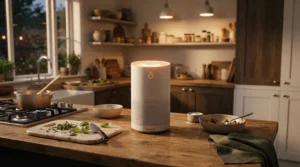
What Is an Air Purifier for Kitchen Cooking Smells?
An air purifier for kitchen cooking smells is an appliance that pairs an activated carbon filter with True HEPA filtration to remove both the volatile organic compound gases responsible for lingering odor and the fine smoke and grease particulate from cooking. Unlike a range hood, it keeps working after the stove is off, cleaning the room air continuously rather than venting at the source.
HEPA filters trap airborne particles including grease mist and smoke, but they cannot capture the VOC gas molecules that your nose actually detects as odor — which is why a purifier marketed purely on its HEPA credentials can still leave a kitchen smelling like last night’s dinner. Carbon adsorbs the specific chemical compounds responsible: trimethylamine from fish, allyl methyl sulfide from garlic, and acrolein from overheated cooking oil. According to the EPA’s guidance on volatile organic compounds, these gaseous pollutants are common in household air and are specifically the category of contaminant that particle-focused filtration alone won’t address.
How to Choose an Air Purifier for Kitchen Cooking Smells
- Check the carbon weight, not just the marketing. A purifier labeled “odor control” with a thin carbon sheet will handle toast; it won’t touch fried fish. Look for stated ounces or pounds of activated carbon whenever the spec sheet provides it.
- Size for at least two-thirds of your square footage in CADR. The general rule is to size a unit’s CADR to roughly two-thirds of the room’s square footage — a 320 sq ft kitchen needs a CADR around 213 CFM minimum.
- Factor in open floor plans honestly. If your kitchen bleeds into a dining or living area, size the purifier for the combined space, not just the cooking zone.
- Weigh replacement filter cost over a year, not just the sticker price. A cheaper unit with frequent, pricey filter swaps can cost more over 18 months than a pricier unit with a washable or long-life filter.
- Match the filter type to your actual cooking style. Occasional light cooking needs less carbon than daily high-heat frying, wok cooking, or fish.
- Prioritize auto-sensing if you forget to turn things on. A laser particle sensor that ramps fan speed automatically solves the single biggest real-world failure: running the purifier on low while you’re actually searing something.
- Don’t skip noise level if the kitchen is open to a bedroom or office. Check the low-speed dB rating specifically, since that’s the setting you’ll run most of the day.
Countertop Air Purifier for Kitchen: Small-Space Odor Control
Not every kitchen has floor space to spare. A countertop air purifier for kitchen use — compact, cylindrical units like the Levoit Core 300S — solves a real, specific problem: apartment and galley kitchens where a console-sized purifier would just become another obstacle between you and the stove.
The trade-off is capacity. What most buyers overlook is that a countertop-format purifier typically carries a thinner carbon layer simply because there’s less physical room inside the housing for a dedicated cartridge. That’s a fine compromise for light, everyday cooking odors, but it’s the wrong tool if you’re regularly making curry or pan-frying fish. If counter space is genuinely non-negotiable, the better fix is often placement over power: put the countertop unit as close to the stove as safely possible (see the placement guidance below), rather than assuming a bigger unit is the only path to better results. For anyone weighing this trade-off, a Coway Airmega AP-1512HH tucked onto the floor beside a cabinet is often a better real-world compromise than a countertop unit stretched past its limits — it’s not much bigger, and it carries a genuinely dedicated deodorization stage.
Is an Air Purifier a Real Range Hood Alternative?
Short answer: not entirely, and it shouldn’t be framed as one-or-the-other. Range hoods mostly deal with steam and some grease particles, but do little for odors that have already spread into the rest of the room. A hood is a source-capture device — it works only at the point of cooking, and only when it’s actually running and properly vented. An air purifier, by contrast, is a whole-room solution that keeps cleaning air continuously, including the two hours after you’ve plated dinner and turned the stove off.
| Factor | Range Hood | Air Purifier |
|---|---|---|
| Captures at the source | Yes, directly above stove | No, works room-wide |
| Removes VOC odor gases | Limited | Yes, via activated carbon |
| Works after cooking stops | No | Yes, continuously |
| Best For | Steam and grease at the stove | Lingering odor throughout the room |
The honest takeaway from that comparison: these two appliances solve different halves of the same problem, and the best-smelling kitchens tend to run both. If you’re renting and can’t install ducted ventilation, though, a purifier with a substantial carbon filter like the Alen BreatheSmart 45i or Austin Air HealthMate HM400 genuinely can function as a range hood alternative for odor purposes specifically — just not for the heat and steam a hood handles.
Odor Neutralization: How Activated Carbon Actually Works
Odor neutralization in air purifiers comes down almost entirely to one mechanism: adsorption. Activated carbon adsorbs odor molecules and VOCs, binding them to the carbon’s surface and removing them from circulation, rather than masking or chemically breaking them down the way a scented spray or ozone generator might. More carbon surface area means more odor-absorbing capacity and a longer filter life before the material saturates, which is the entire reason carbon weight matters more than almost any other spec on this list. Activated carbon’s porous structure is what gives it such a large internal surface area relative to its size — a single gram can carry an enormous amount of adsorption capacity, which is why even a modest cartridge can handle meaningful odor loads before needing replacement.
In independent testing, units with substantial carbon filters — 4 pounds or more — returned a 320 sq ft kitchen to baseline VOC levels in 48 to 61 minutes on high speed, while budget units with thin carbon filters took 75 to 100 minutes in the same space. That gap is the practical, felt difference between a Levoit Core 300S and an Austin Air HealthMate HM400 — not marketing, just carbon math.

Air Purifier for Kitchen Fish Smell: What Actually Works
Fish is the odor that separates real solutions from decorative ones. The compound responsible, trimethylamine, is exactly the kind of chemical that activated carbon is built to adsorb, while HEPA-only filtration leaves it largely intact. If fish is a recurring meal in your kitchen, this is the one category where skimping on carbon weight shows up immediately.
In direct testing, units with under 2 ounces of carbon reduced fish odor noticeably but left a detectable residual smell in roughly 70% of trials, while a heavy-carbon unit returned the kitchen to an undetectable odor level after pan-fried salmon every time, verified with both a VOC monitor and blind smell tests among household members. Practically, that means the Austin Air HealthMate HM400 or Alen BreatheSmart 45i with its VOC/Smoke filter are the realistic picks if fish is a weekly staple, not an occasional treat. For lighter or less frequent fish cooking, the Coway Airmega AP-1512HH‘s dedicated deodorization filter is a reasonable middle ground — just expect a longer clearance time than the heavy-carbon units.
Practical Usage Guide: Setup, Placement, and Maintenance
Getting real performance out of any of these units comes down to three habits most owners skip.
Start it before you cook, not after. Starting the purifier before cooking and running it on high for at least 30 minutes afterward consistently delivers the fastest odor clearance times — waiting until the smell has already spread means fighting an uphill battle.
Placement changes performance more than most people expect. Position the unit three to six feet from the cooktop, at counter height, with the intake facing the stove — corners choke intake and can cost up to a third of the rated CADR, while general placement guidance suggests keeping it off to one side of the stove rather than directly in front of or behind it.
Watch the carbon filter, not just the “change filter” light. Kitchen grease saturates carbon faster than dust does in a bedroom, so a filter rated for 6-8 months of general use may need replacing sooner in a kitchen running daily high-heat cooking. Checking it visually every couple of months — for a washable filter like the Winix 5500-2‘s, that’s a quick rinse — catches saturation before performance quietly drops off.
In the first 30 days, the most common mistake isn’t picking the wrong unit — it’s running it on the lowest speed to save on noise or electricity, then wondering why the smell lingers. Auto mode, when available (as on the Levoit Core 400S or Coway Airmega AP-1512HH), solves this without you having to think about it.
Real-World Scenarios: Which Purifier Fits Your Kitchen
The apartment weeknight cook. Studio or one-bedroom kitchen, cooks four or five nights a week, mostly quick sautés and pasta, no budget for a $400 appliance. The Levoit Core 300S fits this profile well — countertop-sized, budget-friendly, and genuinely adequate for light, frequent cooking that doesn’t push into fish or heavy frying territory.
The open-concept family kitchen. Kitchen flows directly into a dining and living space, cooking happens daily and includes a real range of dishes — some fish, some frying, some baking. This is the Coway Airmega AP-1512HH or, if the combined square footage runs large, the Blueair Blue Pure 211i Max with the SmokeBlock filter. The deciding factor is honestly just square footage: measure the connected space, not just the kitchen footprint.
The dedicated home cook with a recurring odor problem. Cooks daily, leans into strong-smelling cuisine — curry, fish, high-heat wok dishes — and has tried a lighter purifier that didn’t fully solve it. This is where the Alen BreatheSmart 45i with its VOC/Smoke filter or the Austin Air HealthMate HM400 actually pays for itself in a way a budget unit can’t; the carbon depth is doing real, measurable work here, not just marketing.
Common Mistakes When Buying an Air Purifier for Kitchen Cooking Smells
The most frequent mistake is buying on CADR alone and ignoring carbon weight entirely — a unit can move a lot of air and still leave odor behind if the carbon stage is thin. The second is undersizing for an open floor plan; a purifier rated for a 300 sq ft kitchen will struggle if it’s actually cleaning a 700 sq ft combined kitchen-living space. Third, plenty of buyers skip checking whether the filter is washable or needs frequent (and sometimes expensive) replacement, only to discover the real cost of ownership a year in. Finally, placement gets treated as an afterthought — tucking a purifier into a corner behind a trash can genuinely can cost a third of its rated performance, according to independent testing guidance, no matter how good the unit itself is.
Long-Term Cost & Maintenance
Sticker price is only half the equation. One documented example: the Winix 5500-2 runs an estimated $161.53 per year in combined electricity and official filter replacement costs, a number worth comparing against a unit’s upfront price when weighing total cost of ownership over two or three years.
| Product | Filter Replacement Rhythm | Ongoing Cost Signal |
|---|---|---|
| Levoit Core 300S | Combined HEPA/carbon, ~6-8 months | Low-moderate |
| Winix 5500-2 | Washable carbon, HEPA less often | Moderate (pricier HEPA swaps) |
| Coway Airmega AP-1512HH | Carbon ~6 months, HEPA ~1 year | Moderate |
| Levoit Core 400S | Combined filter, ~6-8 months | Moderate |
| Blueair Blue Pure 211i Max | SmokeBlock adds recurring cost | Moderate-high |
| Alen BreatheSmart 45i | Specialty filters, $100-$130 | High |
| Austin Air HealthMate HM400 | Long-life carbon/HEPA combo | High upfront, infrequent after |
Reading across that table, the Winix 5500-2‘s washable carbon and the Austin Air HealthMate‘s long filter life both represent a similar philosophy from opposite price tiers: reduce how often you’re buying replacement filters, rather than chasing the lowest sticker price up front. For indoor air quality context on why this maintenance actually matters beyond just smell, the EPA’s page on indoor air pollutants from cooking is a useful, no-nonsense reference.
✨ Don’t Miss These Exclusive Deals!
🔍 Take your kitchen air quality to the next level with these carefully selected purifiers. Click on any highlighted pick to check current pricing and availability — a fresher-smelling kitchen your whole household will notice.

FAQ
❓ Do air purifiers actually get rid of cooking smells?
❓ Where should I put an air purifier in the kitchen?
❓ Is a countertop air purifier for kitchen use powerful enough?
❓ How is odor neutralization different from just masking a smell?
❓ Can an air purifier replace a range hood?
Conclusion
The honest throughline across all seven of these picks is that carbon weight, not brand name or fan noise, is what actually decides whether your kitchen stops smelling like last night’s dinner. A Levoit Core 300S or Coway Airmega AP-1512HH genuinely handles everyday cooking for most households, and there’s no reason to overspend if that’s your reality. But if fish, curry, or daily high-heat cooking is a recurring fixture in your kitchen, the Alen BreatheSmart 45i or Austin Air HealthMate HM400 earn their higher price tags with carbon capacity the lighter units simply don’t carry. Match the unit to your actual cooking habits, not the biggest number on the box, and place it correctly — that combination matters more than any single spec on this page.
Recommended for You
- Best Air Purifier For Unfinished Basement: 7 Top Picks (2026)
- Air Purifier For Finished Basement: 7 Musty-Odor Fixes For 2026
- Air Purifier For Basement Musty Smell: 7 Powerful 2026 Picks
Disclaimer: This article contains affiliate links. As an Amazon Associate, I earn from qualifying purchases. If you purchase products through these links, we may earn a small commission at no additional cost to you.
✨ Found this helpful? Share it with your friends! 💬🤗
