
In This Article
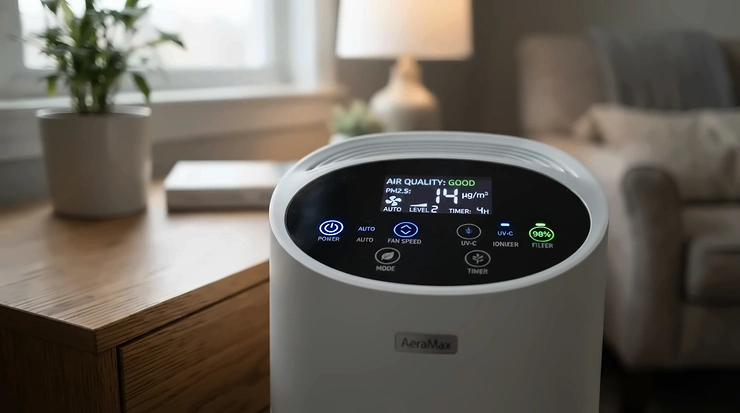
Your kitchen is lying to you. It looks clean — countertops wiped, dishes done, that nice lemon-and-basil candle doing its quiet work by the window. But the air telling a different story. Every time you sear a steak or crisp up bacon on a Sunday morning, you’re launching a cloud of ultra-fine particles and gas byproducts into a room that’s usually smaller and worse-ventilated than your living room. An air purifier for small kitchen use isn’t a luxury gadget — it’s the thing standing between you and a house that smells like last night’s salmon for three days straight.

This guide skips the marketing fluff and gets into what actually matters for a compact cooking space: real CADR numbers, actual dimensions that will (or won’t) fit on your counter, and honest trade-offs pulled from spec sheets and aggregated owner feedback. We researched seven real, currently-available models spanning budget to premium, so whether you’re working with a galley kitchen the size of a closet or an open-plan layout where the stovetop bleeds straight into your dining table, there’s a fit here. Let’s get into it.
What Is an Air Purifier for a Small Kitchen?
An air purifier for a small kitchen is a compact HEPA filtration device — typically rated for 150 to 400 square feet — built to handle the specific pollution profile of cooking: fine PM2.5 smoke particles, grease aerosols, and lingering odor compounds that a standard range hood often misses. It differs from a bedroom or living-room unit mainly in filter composition (heavier activated carbon for odors) and physical footprint (small enough to sit on a counter or in a corner without blocking traffic).
Cooking and even simply operating gas stoves can emit a mix of potentially hazardous chemicals that, without proper ventilation, get trapped indoors rather than diluted. That’s the whole reason this category exists — a range hood pulls some of it straight up and out, but everything that escapes into the room is now your air purifier’s job.
Quick Comparison Table
| Product | Best For | Coverage | Price Range |
|---|---|---|---|
| Levoit Core 200S | Smallest countertop footprint | 140 sq ft | $85–$100 |
| GermGuardian AC4825E | Cheapest with real carbon filter | 167 sq ft | $75–$100 |
| Levoit Core 300 | Best balance under $100 | 222 sq ft | $95–$105 |
| Coway Airmega Mighty (AP-1512HH) | Kitchen + dining combo | 361 sq ft | $160–$220 |
| Levoit Core 400S | Smart auto-mode for cooking spikes | 375 sq ft | $150–$190 |
| Honeywell HPA300 | Open-plan / large kitchen | 465 sq ft | $200–$260 |
| Blueair Blue Pure 311i+ Max | Best all-around odor control | 525 sq ft | $250–$320 |
A quick read of this table tells you most of what you need before diving deeper: coverage area should roughly match — or slightly exceed — your kitchen’s square footage, and price climbs fast once you cross into open-plan territory. If your kitchen and dining area function as one room, don’t shop by kitchen size alone; measure the combined footprint, because the Levoit Core 200S and GermGuardian AC4825E simply weren’t built to keep up with that volume of air.
💬 Found a pick that fits your kitchen already? Scroll down to grab it — your future self (and your nose) will thank you.
Top 7 Air Purifiers for a Small Kitchen: Expert Analysis
1. Levoit Core 200S — smallest footprint for tight counters
If your counter real estate is measured in inches, not feet, the standout feature here is the cylindrical 8.1 x 8.1-inch base — smaller than most stand mixers. Levoit rates the Core 200S for an ideal room size of 672 square feet at 1 air change per hour, or 140 square feet at the more meaningful 4.8 air changes per hour, with a CADR of 90 CFM. In practice, that CADR number means it’ll cycle a small galley kitchen’s air roughly five times an hour, which is plenty for background odor control but not for clearing a bacon-grease haze fast.
This is the pick for renters, studio-kitchen dwellers, and anyone whose “kitchen” is really a kitchenette bolted onto a living room. Based on the spec comparison, the trade-off is straightforward: you’re sacrificing raw clearing speed for a unit that disappears visually and won’t compete with your knife block for space. Reviewers consistently note the dial controls are refreshingly simple — no app required, no bugs to troubleshoot at 7 a.m. Aggregated owner sentiment on the Core 200S skews positive for quiet operation, with the low setting doubling as background hum rather than an intrusive whir.
Pros:
- ✅ Barely bigger than a large coffee canister
- ✅ Whisper-quiet on low, per owner reports
- ✅ No subscription or app needed to operate
Cons:
- ❌ CADR too low for heavy frying or searing
- ❌ No auto mode to react to cooking spikes
At around $85–$100, the Core 200S earns its keep purely on footprint — pair it with good range-hood habits and it’s a solid value pick.
2. GermGuardian AC4825E — cheapest tower with real activated carbon
The standout here is simple: a genuine four-stage filter stack — pre-filter, HEPA, carbon, and UV-C — for less than a decent skillet costs. The AC4825e has been one of the top-selling units in its category for years, and its main claim to fame is that it’s AHAM verified and available for under $100. Specs put it at a 167-square-foot recommended coverage with dust, smoke, and pollen CADR numbers in the 99–125 range — modest, but workable for a small enclosed kitchen.
Here’s what the spec sheet won’t tell you: independent lab testing found CADR performance landing at only 125 CFM on the dust rating, weaker than expected for the category, and the UV-C feature made no measurable difference in testing, so it’s worth skipping the version that includes it if a cheaper non-UV model is available. What most buyers overlook about this model is that its tall, narrow tower shape (21.5″ high, under 7″ wide) actually saves counter footprint despite the height — it tucks into a corner rather than eating into workspace. Aggregated reviews consistently praise the tower’s low profile-width and long-standing reliability track record over its dozen-plus years on the market.
Pros:
- ✅ Real activated carbon filter for cooking odors
- ✅ Slim tower shape hugs a corner nicely
- ✅ Three-year manufacturer warranty
Cons:
- ❌ UV-C feature adds cost with no proven benefit
- ❌ Runs louder than newer competitors at top speed
Prices for the AC4825E swing between roughly $75 and $100 depending on retailer and whether the UV-C version is in stock — check current price before buying, since this is one of the more frequently discounted models on the market.
3. Levoit Core 300 — best balance of size and CADR under $100
The standout feature on the Levoit Core 300 is CADR-per-dollar: it carries smoke CADR of 143, dust CADR of 153, and pollen CADR of 167, with a recommended room size of 222 square feet at 4.8 air changes per hour, all while staying at a nearly identical $99.99 price point to the smaller Core 200S. What that CADR bump means in practice is roughly 60% faster particle clearance than its little sibling — noticeable the next time you’re pan-frying fish and want the smell gone before company arrives.
The compact circular design makes it easy to place in most small spaces, and at 7.9 lbs it’s light enough to shuffle between counter and floor depending on what’s cooking. Based on the spec comparison against pricier smart models, the honest trade-off is the lack of an air-quality sensor or auto mode — you’re manually flipping between three speeds rather than letting the machine react to a smoke spike on its own. Reviewers consistently flag it as a strong pick for anyone who wants “set it and mostly forget it” simplicity without paying smart-home premiums.
Pros:
- ✅ Meaningfully higher CADR than the 200S at similar cost
- ✅ Compact, light enough to relocate easily
- ✅ AHAM-verified numbers, not marketing estimates
Cons:
- ❌ No auto mode or air-quality sensor
- ❌ No smart/app connectivity at this tier
At right around $100, the Core 300 is arguably the sweet spot for anyone shopping specifically for a kitchen air purifier under $100 who still wants meaningful clearing speed.
4. Coway Airmega Mighty (AP-1512HH) — smartest pick for kitchen-dining combos
The Coway Airmega Mighty‘s standout is a genuinely 4-stage filtration system built for moderate odor duty. Its deodorization filter paired with a True HEPA filter handles moderate kitchen odors in rooms up to 361 square feet, with CADR ratings around 246 CFM for dust, 240 for pollen, and 233 for smoke. That coverage number matters if your kitchen bleeds into a small dining nook — 361 square feet is enough for a combined space roughly the size of a studio apartment’s main room.
What most buyers overlook about this model: it’s not a heavy-duty odor solution, but it’s capable for a smaller kitchen with standard cooking smells, and it includes an air quality indicator that shows when particle levels from cooking spike, with auto mode adjusting fan speed in response — a genuinely useful feature at this price tier that many budget models skip entirely. Aggregated review sentiment consistently highlights the auto-mode responsiveness and the app connectivity as standout conveniences for a unit in this price bracket, alongside praise for energy efficiency during 24/7 operation.
Pros:
- ✅ Auto mode reacts to real-time cooking spikes
- ✅ Covers kitchen-plus-nook combos, not just one room
- ✅ Smartphone app for remote monitoring
Cons:
- ❌ Not built for heavy-duty frying/wok odors
- ❌ Bulkier footprint than the Levoit Core line
Typically found in the $160–$220 range, the Mighty earns its name on versatility rather than raw power — a genuinely smart middle-tier choice.
5. Levoit Core 400S — best smart auto-mode for cooking spikes
The headline feature on the Levoit Core 400S is a real air-quality sensor paired with true auto mode — something its Core 200S sibling skips entirely. Compared feature-for-feature, the 400S adds an air quality sensor, an air quality indicator, and auto mode functionality that the 200S lacks outright, while also stepping up to five fan speeds versus four on the smaller model. On paper, this means the 400S can detect the moment you start pan-searing and ramp up before the smell fully spreads — rather than you remembering to crank it manually.
CADR climbs to roughly 256, a meaningful step above the Core 300, which translates to faster real-world clearance after a heavy cooking session. Here’s what most spec sheets bury: top-speed noise reaches into the 59.9 dBA range, noticeably louder than the 200S’s ceiling of 53.9 dBA — a fair trade for the extra airflow, but worth knowing if your kitchen sits right next to a home office or nursery. Reviewers consistently rate this as the pick for people who want a genuinely “smart” purifier without jumping to premium pricing.
Pros:
- ✅ True auto mode reacts to cooking without input
- ✅ Noticeably higher CADR than entry-level Levoit units
- ✅ App control and voice assistant compatibility
Cons:
- ❌ Top speed is audibly louder than smaller siblings
- ❌ Filter replacement costs more than base Core models
Expect to pay somewhere in the $150–$190 range — a reasonable premium for the auto-sensing convenience if you cook daily.
6. Honeywell HPA300 — most power for open-plan kitchens
The standout feature is brute-force CADR: 300 for pollen removal, 320 for dust, and 300 for smoke, numbers that put it well ahead of every other unit on this list. Coverage lands at 465 square feet, which is precisely the scale you need once your kitchen has no walls separating it from a dining or living area. This is the unit for households where a single stir-fry session can be smelled from the front hallway.
The spec sheet’s flip side: the HPA300 skips an auto mode, sleep mode, and remote control entirely, so you’re manually cycling through its three speeds plus a turbo setting. Reviewers consistently note it runs on the loud side at full blast and pulls more power than the compact Levoit units — a fair trade for a machine tasked with scrubbing nearly half a house’s worth of air. Historical pricing has swung from around $146 up to roughly $269 depending on retailer and sales cycle, generally settling near the $245 mark, so it’s worth comparison-shopping before buying.
Pros:
- ✅ Highest CADR numbers on this list by a wide margin
- ✅ Rated coverage matches true open-plan kitchens
- ✅ Five-year manufacturer warranty
Cons:
- ❌ No auto mode — manual speed adjustment only
- ❌ Noticeably louder and more power-hungry at top speed
At a check-current-price range of roughly $200–$260, the HPA300 is the pick when square footage — not aesthetics — is your deciding factor.
7. Blueair Blue Pure 311i+ Max — best all-around odor control
The standout on the Blue Pure 311i+ Max is genuinely balanced coverage for a dedicated small-to-medium kitchen. For a separate kitchen or a smaller space under 525 square feet, this is the better-sized option compared to Blueair’s larger open-plan units. Its auto mode with PM2.5 sensors picks up smoke and particulate spikes from high-heat cooking automatically and ramps up fan speed in response — meaning it reacts to a sudden smoke alarm-adjacent moment before you even notice the smell.
What most buyers overlook: HEPASilent filtration is designed to run continuously without the drone of a traditional HEPA fan, which reviewers consistently cite as the standout quality-of-life difference versus louder competitors on this list. Based on the spec comparison, you’re paying a premium here for genuinely quiet 24/7 operation and Blueair’s reputation for durable build quality — not for the single highest CADR number on the page. Aggregated owner sentiment leans heavily positive on noise levels and app polish, with occasional notes about the higher cost of replacement filters compared to Levoit’s ecosystem.
Pros:
- ✅ Auto mode reacts to cooking smoke in real time
- ✅ HEPASilent design stays quiet at higher speeds
- ✅ Sized correctly for enclosed small-to-medium kitchens
Cons:
- ❌ Premium price versus the rest of this list
- ❌ Replacement filters cost more than Levoit’s
Typically priced in the $250–$320 range, the 311i+ Max is the splurge pick for anyone who wants near-silent, sensor-driven odor control and has the kitchen size — not an open floor plan — to justify it.
Top 7 Products: Full Comparison
| Product | CADR (Smoke) | Coverage | Auto Mode | Best For |
|---|---|---|---|---|
| Levoit Core 200S | ~90 CFM | 140 sq ft | No | Tightest counter space |
| GermGuardian AC4825E | 99 CFM | 167 sq ft | No | Rock-bottom budget |
| Levoit Core 300 | 143 CFM | 222 sq ft | No | Best value under $100 |
| Coway Airmega Mighty | 233 CFM | 361 sq ft | Yes | Kitchen + dining nook |
| Levoit Core 400S | ~256 CFM | 375 sq ft | Yes | Smart auto-response |
| Honeywell HPA300 | 300 CFM | 465 sq ft | No | Open-plan, max power |
| Blueair 311i+ Max | High (HEPASilent) | 525 sq ft | Yes | Quiet, all-around pick |
Lined up side by side, the pattern is obvious: CADR and coverage climb almost in lockstep with price, but auto mode is where the real value jump happens — it shows up starting at the Coway Airmega Mighty and stays through the premium tier. If you cook daily and hate fiddling with speed dials, that’s the line worth crossing even if it means skipping the cheapest options entirely.
✨ Ready to stop guessing and start breathing easier? Compare current prices on your top pick before it sells out.
Kitchen Air Purifier Under $100: Practical Usage Guide
Buying a kitchen air purifier under $100 is only half the job — placement and habits determine whether it actually earns its keep. First, position it three to six feet from the stove at counter height, with the intake facing the cooktop rather than the wall; air pulled from directly above your pan clears particles before they spread across the room. Don’t tuck it into a corner behind the toaster — restricted airflow on the intake side quietly tanks real-world performance even on a unit with solid CADR numbers.
Run it on a higher speed for the first 15–20 minutes of any high-heat cooking (searing, frying, wok work), then drop to low or sleep mode once the pan’s off the heat — this “burst mode” habit does more for odor control than leaving it on low all day. In the first 30 days, the most common mistake is ignoring the pre-filter: a thin foam or mesh layer that catches grease and hair before it reaches the real HEPA filter. Wipe it down weekly with a damp cloth; skipping this step is the single biggest reason budget purifiers underperform their rated CADR within a few months. Replace the main filter on the manufacturer’s schedule (usually 6–8 months for budget units) rather than waiting for a visible odor to return — by then, the filter’s already saturated and doing far less work than it should.
Real-World Scenarios: Matching a Purifier to Your Kitchen
The studio-apartment cook. You’ve got a 90-square-foot kitchenette that opens directly into your one living space, you cook maybe four nights a week, and counter space is nonexistent. The Levoit Core 200S or a floor-placed GermGuardian AC4825E covers this without eating into your workspace — you don’t need serious CADR when the room itself is this small.
The daily home cook with a proper galley kitchen. Enclosed, roughly 150–250 square feet, frying and roasting a few times a week. The Levoit Core 300 or Coway Airmega Mighty hits the right balance — enough CADR to matter, without paying for coverage you’ll never use.
The open-plan household with kids or guests often around. Kitchen flows straight into dining and living space, cooking smells travel fast, and you want something that reacts on its own rather than needing manual adjustment mid-recipe. The Honeywell HPA300 for raw coverage, or the Blueair Blue Pure 311i+ Max if quiet, sensor-driven operation matters more than the single highest CADR number on the shelf.
How to Choose an Air Purifier for a Small Kitchen
- Measure your actual space — including any connected dining or living area, not just the kitchen footprint alone.
- Match CADR to coverage, not marketing copy — AHAM’s own rule of thumb is that a unit’s CADR should equal at least two-thirds of the room’s square footage, or the full square footage for wildfire-level smoke.
- Prioritize activated carbon capacity for odors — HEPA alone captures particles, not the gas molecules responsible for lingering smells.
- Check the physical footprint against your counter or floor space — a high-CADR unit that doesn’t fit anywhere useful won’t get used consistently.
- Decide if auto mode is worth the premium — daily cooks benefit most; occasional cooks can save money with a manual-speed unit.
- Factor in noise at the speed you’ll actually run it — a quiet low setting matters more than a loud turbo mode you’ll rarely touch.
- Confirm AHAM Verifide certification — this program requires manufacturers to submit units for independent CADR testing at certified labs, rather than relying on self-reported numbers.
Countertop Footprint: Why Size Matters More Than CADR in a Small Kitchen
Here’s what most buying guides skip: in a genuinely small kitchen, countertop footprint often matters more than the CADR number on the box. A purifier with excellent clearing power that ends up stuffed on the floor behind the trash can, its intake blocked by a cabinet, will underperform a smaller unit placed correctly on open counter space. The Levoit Core 200S‘s 8.1-inch cylindrical base and the GermGuardian AC4825E‘s narrow (under 7-inch-wide) tower shape both solve this by prioritizing a small horizontal footprint over raw airflow.
Before shopping by CADR alone, measure the actual clear space you have — next to the coffee maker, on a shelf, or in an unused corner — and cross it against the unit’s base dimensions, not just its overall height. A tall, narrow tower like the GermGuardian actually beats a squat, wide console in tight kitchens, since height rarely competes for usable workspace the way width does.
Air Purifier for Kitchen and Dining Area vs. an Enclosed Galley Kitchen
An air purifier for kitchen and dining area use needs meaningfully more coverage than one serving an enclosed galley kitchen, because there’s no wall stopping cooking particles from drifting straight to the dinner table. An enclosed kitchen under 300 square feet can typically get by with a smoke CADR of at least 200, while open-concept layouts where cooking pollution spreads into adjacent living areas call for 300 or higher. That’s roughly the gap between the Coway Airmega Mighty and the Honeywell HPA300 on this list — one is sized for a contained room, the other for a combined space.
The practical test: if you can smell dinner cooking from the dining table before it’s plated, treat your purifier shopping like you’re covering both rooms, not one. Undersizing here is the single most common mistake — a unit rated for a 200-square-foot kitchen alone will run constantly at max speed trying (and failing) to also clear a 150-square-foot dining area on top of it.

Open-Plan Kitchen Air Purifiers: What Changes When the Walls Disappear
Open-plan layouts change three things: required coverage, ideal placement, and how much you’ll lean on auto mode. Coverage needs jump — you’re now filtering the volume of two or three rooms combined, not one. Placement shifts too: rather than counter-height near the stove, a unit for a genuinely open kitchen often does better positioned toward the boundary between cooking and living zones, so it intercepts particles as they spread rather than only cleaning air that’s already dissipated.
An air purifier in the kitchen or adjacent open living area catches what the range hood misses — odors that have already diffused into the room, fine particles circulating in the broader space, and VOCs from gas stoves. Running both the range hood and a dedicated purifier together is generally the most effective approach for open floor plans specifically, since neither device alone is built to handle the combined job.
Features That Actually Matter (And Those That Don’t)
Actually matters: activated carbon weight (more carbon means longer odor-control life before saturation), true auto mode with a real particle sensor (not just a timer-based “smart” label), and AHAM Verifide certification confirming CADR claims are independently tested rather than self-reported.
Doesn’t matter much: UV-C sterilization — independent testing found no measurable difference with the feature switched on versus off on at least one popular budget model — and ionizer functions, which can produce trace ozone without meaningfully improving odor control. Flashy app dashboards are nice-to-have but rarely change day-to-day performance versus a well-placed unit with a simple three-speed dial.
Common Mistakes When Buying an Air Purifier for a Small Kitchen
Buyers routinely size by kitchen square footage alone, forgetting a connected dining or living area entirely — leading to a unit that’s perpetually overwhelmed. Others chase the highest CADR number without checking noise ratings at the speed they’ll actually run daily, ending up with a machine so loud on medium that it gets left on low, defeating the purpose. A third common error: placing the purifier somewhere convenient (behind the microwave, wedged in a cabinet gap) rather than where airflow is actually unobstructed, quietly cutting real-world performance well below the rated CADR regardless of how good the unit is on paper.
Long-Term Cost & Maintenance: What a Kitchen Purifier Really Costs to Run
The sticker price is only the entry fee. One well-reviewed small-space model runs a relatively modest $65 per year on filter replacements and electricity combined, while a larger unit like the Honeywell HPA300 can pull roughly one kWh of energy over 24 hours on a medium setting — potentially $40 or more per year in electricity alone — with HEPA filter replacements running around $34 a set. Budget models with smaller filters generally need replacement every 6–8 months, while premium units with denser carbon beds can stretch closer to a year between changes.
| Tier | Est. Annual Filter Cost | Est. Annual Energy Cost |
|---|---|---|
| Budget (Core 200S / AC4825E) | $25–$40 | $15–$25 |
| Mid-range (Core 400S / Coway Mighty) | $40–$60 | $20–$35 |
| Premium (HPA300 / Blueair 311i+ Max) | $50–$80 | $30–$45 |
Running the numbers this way, the real gap between a $90 unit and a $280 one narrows meaningfully over a two-year ownership window once electricity and filters are factored in — the upfront price tag tells only part of the value story.
FAQ
❓ Can I put an air purifier right next to my stove?
❓ Does HEPA filtration remove cooking smells?
❓ What CADR do I need for a small kitchen?
❓ Is a $100 air purifier good enough for daily cooking?
❓ How often should I replace the filter in a kitchen air purifier?
Conclusion
A small kitchen doesn’t need the biggest, loudest air purifier on the market — it needs the right-sized one, correctly placed, with enough carbon to actually handle what your stove throws at it. If your kitchen is enclosed and modest, the Levoit Core 300 delivers real performance without breaking $100. If it opens straight into your dining room, don’t undersize — the Honeywell HPA300 or Blueair Blue Pure 311i+ Max are built for that reality. And if counter space is your real constraint, the Levoit Core 200S disappears in a way bigger units simply can’t.
Whatever you land on, the biggest lever isn’t the model number — it’s placement and consistency. Run it during and right after cooking, keep the pre-filter clean, and swap filters on schedule rather than waiting for the smell to come back.
Recommended for You
- Air Purifier For Kitchen Smoke: 7 Real Picks That Work In 2026
- Air Purifier For Kitchen Cooking Smells: 7 Real Picks That Actually Clear The Air (2026)
- Best Air Purifier For Unfinished Basement: 7 Top Picks (2026)
Disclaimer: This article contains affiliate links. As an Amazon Associate, I earn from qualifying purchases. If you purchase products through these links, we may earn a small commission at no additional cost to you.
✨ Found this helpful? Share it with your friends! 💬🤗
