
In This Article
You scrubbed the porch, swallowed the antihistamine, and then climbed into a car that has been quietly collecting pollen for months. Seats. Mats. Vents. Here’s the cruel joke of allergy life: the one room you can’t easily hose down is the one you sit in every single day. A portable car air purifier for allergies won’t cure anything, but it can knock down the airborne particles that turn a 25-minute drive into a sneezing seminar.
It’s late October 2026, so the fall weed-pollen rush is fading. Tree pollen returns in early-to-mid February. That makes this a good moment to shop calmly rather than in a panic.
This guide covers seven real models, from cup-holder minis to a Swiss-built heavyweight. It also covers the real-world details spec sheets skip, like how often a HEPA filter cartridge needs replacing and which setups suit commute allergies versus long road trips. Everything here is based on manufacturer specs, independent testing where it exists, and aggregated review signals. I haven’t tested these units myself, and I’ll flag where a data point couldn’t be verified.
What Is a Portable Car Air Purifier for Allergies?
A portable car air purifier for allergies is a compact, plug-in or battery-powered unit that pulls cabin air through a filter, ideally True HEPA, to trap pollen, dust, pet dander, and fine particles. The EPA explains that a HEPA filter can theoretically remove at least 99.97% of airborne particles at 0.3 microns. These units reduce airborne triggers. They are not medical treatment.
Quick Comparison: 7 Portable Car Air Purifiers for Allergies at a Glance
| Product | How It Mounts | Filter | Power | Price Range | Best For |
|---|---|---|---|---|---|
| IQAir Atem Car | Headrest or seat strap | HyperHEPA Plus (particles + gas) | 12-24V car adapter | Around $400 | Sensitive noses, daily drivers wanting maximum filtration |
| Philips GoPure GP5212 | Armrest, headrest, under seat | 3-stage SelectFilter Plus | 12V socket | Mid-range; verify current price | Pollen plus traffic fumes, hands-off use |
| Luftrum C401A | Plug-in unit | 4-stage H13 HEPA | 12V socket | Mid-to-premium; check current price | Drivers who like sensor-driven auto mode |
| Scosche FrescheAir 2 | Cup holder | H13 HEPA | USB-C | Roughly $30-$60 | Budget cup-holder convenience |
| Pure Enrichment PureZone Mini | Cup holder, lap, desk | Carbon + True HEPA | Rechargeable battery via USB | Around $40-$55 | Short trips, cordless flexibility |
| SimPure MS6 | Cup holder | 3-stage True H13 HEPA | Check listing | Roughly $50-$65 | Cup-holder fit with a replacement reminder |
| Aucleia Portable Car Air Purifier | Compact (check fit) | H13 HEPA | Check listing | Budget; check current price | Quiet cabins, tight budgets |
Looking at the table, the IQAir Atem Car is the only unit built for ultrafine particles and gases, and it costs several times what the rest do. If your budget sits under $60, the cup-holder group (Scosche FrescheAir 2, Pure Enrichment PureZone Mini, SimPure MS6) is where the value lives. Prices drift, so confirm current pricing before you buy.
💬 Just one click — help others make better buying decisions too!😊
Top 7 Portable Car Air Purifiers for Allergies: Expert Analysis
1. IQAir Atem Car — premium filtration with a crash-tested mount
The Atem Car is the heavyweight here, built less like a gadget and more like a small appliance that happens to ride along. It’s the one pick on this list that targets gases as well as particles.
IQAir claims its HyperHEPA Plus filter removes 99% of particles down to 0.003 microns and adds gas-phase media for traffic fumes. It draws under 4 watts on any of three speeds and runs at roughly 35-55 dB(A) sound power. In practice, that means pollen sits comfortably inside its range, and the tiny power draw won’t bother your 12-24V outlet. HouseFresh’s independent test found it cleared incense smoke from a roughly 97-cubic-foot Tesla Model 3 in 37 minutes at top speed, about 10 minutes faster than the Smart Air QT3.
Based on the spec comparison, it suits drivers with asthma, heavy commute allergies, or a nose that detects a dusty vent from three lanes away. It isn’t a portable car air purifier for cup holder use. It straps to a headrest and weighs about 5.3 lbs with the mount.
IQAir’s own page shows a 4.8 average across 72 reviews, though that’s manufacturer-hosted, so weigh it accordingly. HouseFresh found the touch buttons less intuitive than the app.
Pros:
- ✅ Filters particles down to 0.003 microns
- ✅ Filter-life chip plus app reminders
- ✅ Mount crash-tested by Germany’s ADAC
Cons:
- ❌ Bulky and far from pocket-portable
- ❌ Highest running cost (HouseFresh estimated around $106 a year)
Priced around $400, it’s overkill for a casual hay fever sufferer and a sound investment for a daily highway driver.
2. Philips GoPure GP5212 — set-and-forget automation with gas filtering
This is the “I don’t want to think about it” option. Plug it in, and it turns on and off with the ignition.
The Philips GoPure GP5212 uses a three-stage SelectFilter Plus cartridge. Its stated CADR is 16 m³/hour for PM2.5, with figures for NO2 (13) and SO2 (7.9) as well. Philips says its Airmid-certified filter removes up to 90% of airborne allergens, a manufacturer claim worth reading as “meaningful, not magic.” At about 7 x 7 x 2.7 inches and 1.7 lbs, it can hang from a seat back or sit under a seat. A 12-foot cable gives you real placement freedom.
My analysis: this suits families, rideshare drivers, and anyone for whom “remember to switch it on” is a failure point. The 350-hour filter lifetime is the number to plan around. That works out to roughly 11 months at an hour a day, but closer to six months with a two-hour commute.
I couldn’t verify a deep pool of recent buyer reviews for the current model, and Philips’ US page showed one variant as no longer available. Check stock before falling in love.
Pros:
- ✅ Auto on/off tied to ignition
- ✅ Targets traffic gases alongside pollen
- ✅ Flexible armrest, headrest, or under-seat placement
Cons:
- ❌ Availability looked patchy for some variants
- ❌ 350-hour cartridge needs timely replacing
Expect mid-range pricing and confirm the current price. It’s good value for hands-off drivers who value gas filtering.
3. Luftrum C401A — sensor-driven plug-in with H13 HEPA
If the Philips is the quiet butler, this is the one with a thermometer in its pocket. The Luftrum C401A pairs an H13 HEPA stage with a PM2.5 sensor and automatic on/off.
Its listed four-stage filtration is rated to 0.1 micron, and it runs off the 12V socket with a claimed silent operation. The sensor matters because it lets the unit speed up when particle levels spike, such as behind a diesel truck or after you open a door under a blooming tree. Without it, you’d be guessing.
Here’s what the spec sheet won’t tell you, and what I couldn’t verify: independent airflow numbers. Treat “silent” as marketing until measured. An editorial roundup placed it in a premium slot, but that’s one site’s opinion, not buyer feedback. I found no verifiable review pool, so rely on the return policy rather than on hype.
It fits drivers who want automation without paying IQAir money, and who don’t need a portable car air purifier for cup holder compatibility.
Pros:
- ✅ H13 HEPA stage for fine pollen
- ✅ PM2.5 sensor with automatic operation
- ✅ Simple 12V plug-in power
Cons:
- ❌ Few independent performance measurements
- ❌ Not a cup-holder-friendly shape
Pricing sits in the mid-to-premium band, so check the current price. Value hinges on whether you’ll use the auto mode.
4. Scosche FrescheAir 2 — budget cup-holder convenience
A portable car air purifier for cup holder duty lives or dies by fit, and this one was designed for the spot.
The Scosche FrescheAir 2 ships with an H13 HEPA filter and a USB-C cable, and Scosche says it captures 99.5% of PM2.5 particles. Scosche recommends replacing the cartridge every three to six months. That interval is shorter than most, and it matters for budgeting. The original FrescheAir pitched motion-activated controls with two fan speeds, so check whether your version keeps them.
Here’s the practical read: a cup-holder unit sits low, so it cleans air around your lap and knees first. That’s useful for kicked-up dust and pet dander, and less direct for pollen drifting in from the windshield vents. For a 20-minute commute, that’s usually fine.
Retailer listings I found showed an average around four stars across several hundred reviews. I couldn’t verify specific complaint themes from the sources reviewed, so read recent reviews on your retailer of choice.
Pros:
- ✅ Genuine cup-holder form factor
- ✅ H13 HEPA filter included
- ✅ USB-C powered
Cons:
- ❌ Cartridge changes every three to six months
- ❌ Low placement limits face-level reach
Expect roughly $30-$60 depending on retailer. For a first-time buyer, that’s strong value.
5. Pure Enrichment PureZone Mini — cordless and honest about its size
The PureZone Mini is a personal-bubble device, and it knows it.
It weighs 0.58 lbs, measures about 8.5 x 3.3 x 2.7 inches, and runs on a rechargeable battery for roughly 12 hours on low, 6 on medium, and 2.5 on high. Its two-in-one filter pairs a carbon pre-filter with True HEPA. The coverage claim is telling: “6 ft² of air in 12 minutes.” That’s your immediate space, not your whole cabin, which means it works best close to you. It’s a lightweight accessory, not a cabin overhaul.
Replace the filter every six months. There’s no filter-indicator light, so set a calendar reminder. A five-year warranty is a real confidence signal at this price.
Retailer listings showed high-4-star averages across several hundred reviews, which suggests general satisfaction for a small device. Verified complaint specifics weren’t available to me.
Pros:
- ✅ Cordless with up to 12 hours on low
- ✅ Five-year warranty
- ✅ Light enough to move between car and desk
Cons:
- ❌ Small coverage, not a whole-cabin cleaner
- ❌ No filter indicator light
At around $40-$55, it’s good value for short trips and flexible use.
6. SimPure MS6 — cup-holder fit with a filter-replacement reminder
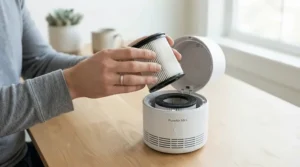
The SimPure MS6 is built around the cup holder, at about 2.67 x 2.67 x 7.4 inches. It’s the third cup-holder option on the list, and its differentiator is a replacement reminder.
It uses a three-stage True H13 HEPA setup. Reminders matter more than they sound. A saturated HEPA filter cartridge doesn’t announce itself like a dead battery. It just quietly stops being useful. A reminder removes that guesswork.
I’d use it for a commute under 30 minutes, where the cup holder placement is convenient and the filter is the main running cost. I couldn’t find a verifiable review pool or independent performance measurements for the MS6, so treat it as a promising spec sheet rather than a proven performer.
Pros:
- ✅ Snug cup-holder dimensions
- ✅ True H13 HEPA filtration
- ✅ Replacement reminder for the filter
Cons:
- ❌ Limited independent testing data
- ❌ Power details vary, so check the listing
Direct pricing was in the roughly $50-$65 range. Good value if the reminder matters to you.
7. Aucleia Portable Car Air Purifier — quiet, budget, and fragrance-optional
The Aucleia Portable Car Air Purifier shows up repeatedly in roundups, listing an H13 HEPA filter, 99.97% efficiency, and a 22 dB noise rating. One version adds a fragrance function.
That fragrance feature deserves a skeptical eyebrow. For allergy sufferers, added scent can irritate a sensitive nose, so I’d skip aromatherapy and run it plain. The quiet rating is the real draw for anyone who hates the hum of a cabin fan.
Be aware that roundup sites featuring this model are affiliate-driven editorial lists, not independent lab testing. Check the dimensions before you assume it fits your cup holder.
Pros:
- ✅ H13 HEPA at a budget tier
- ✅ Very low listed noise level
- ✅ Compact footprint
Cons:
- ❌ Fragrance option can aggravate sensitivities
- ❌ Little independent testing available
Treat it as a budget entry; confirm the current price.
How to Choose a Portable Car Air Purifier for Allergies
Shopping for a portable car air purifier for allergies gets easier with a checklist. Here it is, in order of importance:
- Demand real HEPA. Look for True HEPA or H13, meaning 99.97% at 0.3 microns. “HEPA-type” or “HEPA-like” is marketing language.
- Match the format to your car. A cup-holder unit suits sedans with spare holders. A strap-mounted unit suits families.
- Check the power source. A 12V socket, USB, or rechargeable battery each changes where the unit can live.
- Price the HEPA filter cartridge. The unit is the down payment, and the filter is the subscription.
- Listen to the noise spec. If it drones, you’ll switch it off, and a switched-off purifier cleans nothing.
- Skip gimmicks if you’re sensitive. Fragrance and ionizer extras add little for allergies. The EPA has guidance on ozone-generating air cleaners, which sensitive drivers should avoid.
- Confirm availability and returns. Models get discontinued, as one Philips variant showed.

Pollen Season: How It Gets Into Your Car (and What Actually Helps)
Pollen season isn’t one event. The Asthma and Allergy Foundation of America notes tree pollen typically begins early to mid-February and runs through April. Grass follows in mid-April and lingers through summer. Weeds take over in late summer and fall.
Pollen rides into your car on shoes, jackets, pets, and open windows. It settles into fabric, then lifts into the air every time you brake. That’s why a portable car air purifier for allergies earns its keep: it keeps scrubbing after you’ve closed the door.
The basics still come first. Keep windows up, run the A/C, and consider recirculation mode so the system isn’t pulling in fresh pollen. Replace your factory cabin filter before pollen season starts, since filter vendors commonly suggest about every 12 months or 12,000 miles for allergy sufferers. A purifier is the second layer, not the first.
Timing matters too. AAFA’s guidance points to midday as peak pollen time for many people. If your schedule is flexible, shifting a drive earlier or later can help. And if medication is part of your routine, ask a pharmacist about non-drowsy options before you drive.
Commute Allergies: Problems and Practical Fixes
Commute allergies are repetitive by nature. Same seat, same vents, same 40 minutes, twice a day. A few specific problems come up again and again:
- Sneezing at startup. Dust settles into vents overnight. Start your purifier the moment you start the car, rather than five minutes into the drive.
- Dusty floors. Pollen on shoes becomes airborne with every foot movement. Rubber mats and a weekly vacuum cut that down.
- Traffic fumes. Idling behind a truck is its own irritant. Recirculation mode plus a gas-capable unit like the IQAir Atem Car or Philips GoPure GP5212 addresses this better than particle-only filters.
- Pollen on your clothes. Change jackets and shower before bed, a habit AAFA recommends during pollen season.
- Sneeze safety. Industry guidance notes a sneeze can take your eyes off the road long enough to matter at speed. If symptoms are heavy, treat that as a safety issue, not a nuisance.
None of these fixes requires heroics. They require consistency, and a purifier that runs automatically helps with that.
Portable Car Air Purifier for Cup Holder: Fit, Airflow, and Limits
A portable car air purifier for cup holder use sounds ideal until you check your car’s actual cup holders. Dimensions matter. The SimPure MS6 is about 7.4 inches tall, and the Pure Enrichment PureZone Mini runs 8.5 inches with its handle. The archived JVC KS-GA100, a classic of this category, stood about 12 cm tall and 7 cm wide, with a 3 to 6 month replacement cadence and a KS-GA10F replacement filter. Check your car’s holder depth and width.
Airflow is the honest limit. Cup holders sit low and often near the center console, so these units clean the air around your lap before the air near your face. That’s useful, but it isn’t a substitute for a seat-mounted unit in a large SUV.
Practical tips: keep the intake clear, never place a unit on the dashboard (one manual says so explicitly), and remember that cup-holder real estate is shared with coffee. If you routinely carry drinks, consider a portable car air purifier for cup holder alternatives like the Philips GoPure GP5212, which mounts elsewhere.
HEPA Filter Cartridge: Replacement Schedules and True Cost
The unit is a one-time purchase. The HEPA filter cartridge is the recurring cost, and it’s easy to ignore until your air stops improving. The EPA stresses that all air cleaners need periodic filter replacement.
| Product | Cartridge Cadence | Indicator? | Best For |
|---|---|---|---|
| IQAir Atem Car | About 1 year at 3 hours daily | Yes (chip, LED, app) | Drivers who want automatic tracking |
| Philips GoPure GP5212 | 350 hours | Yes (indicator light) | Commuters who can do the math |
| Pure Enrichment PureZone Mini | Every 6 months | No | Calendar-reminder people |
| Scosche FrescheAir 2 | Every 3-6 months | Check listing | Frequent replacers |
| SimPure MS6 | Check listing | Replacement reminder | Set-and-forget shoppers |
The Philips 350-hour figure is the easiest to misjudge. At an hour a day, it lasts most of a year, but at two hours it’s closer to six months. The IQAir Atem Car‘s year-long rating assumes about three hours daily, which is generous for a casual driver. Budget for cartridges as an annual cost, not a surprise.
Portable Car Air Purifier for Long Trips: What Changes on the Highway
A portable car air purifier for long trips has different priorities than a commuter’s. Power and noise decide everything. A battery model like the Pure Enrichment PureZone Mini gives about 12 hours on low but only about 2.5 hours on high, so a long drive means plugging in or running low. Plug-in units like the Luftrum C401A and Philips GoPure GP5212 avoid the battery math entirely.
Noise matters more on long drives. A fan that’s invisible for 20 minutes becomes irritating at hour six. Quiet ratings like the 22 dB listed for the Aucleia Portable Car Air Purifier deserve real weight here, though they’re listed figures, not measured ones.
Trip logistics matter too. Rest stops under trees and gas-station air are pollen magnets, so run your unit during the first minutes after you re-enter the car. If wildfire smoke is in the forecast, a gas-capable unit has a clear edge over particle-only filters. A portable car air purifier for long trips works best paired with recirculation mode and a fresh cabin filter.
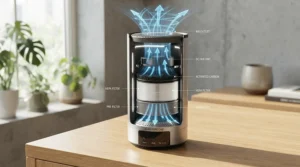
Practical Usage Guide: Set Up Your Unit and Survive the First 30 Days
The first month decides whether a purifier becomes a habit or a drawer ornament.
Day one: Vacuum the car, wipe vents and dashboard, then install the unit. Place it where airflow reaches your breathing zone, not buried under a bag.
Week one: Note whether the noise annoys you. If it does, drop a speed.
Week two: Set a calendar reminder for filter replacement, especially for units without an indicator.
Day thirty: Wash the exterior and vacuum again. Pollen on the car body ends up inside.
Common mistakes in the first 30 days include blocking the intake, using fragrance add-ons that irritate sensitive noses, and ignoring the cabin filter. AAFA’s August 2026 weed pollen alert is a reminder that the allergy calendar overlaps seasons, so a maintenance routine beats a one-time fix.
✨ Don’t Miss These Exclusive Deals!
🔍 Take your drive to the next level with these carefully selected purifiers. Click on any highlighted product to check current pricing and availability. A cleaner cabin could make every commute a little easier on your family!
Real-World Scenarios: Which Purifier Fits Which Driver
The college student. An 8-mile daily commute, a small sedan, and a budget under $60. The cup-holder trio fits: Scosche FrescheAir 2, SimPure MS6, or the cordless Pure Enrichment PureZone Mini. Pair it with rubber floor mats and a weekly vacuum.
The parent with road-trip plans. A minivan, two kids, and four-hour drives to grandma’s. Cup holders are already full of juice boxes. The Philips GoPure GP5212 mounts on an armrest or under a seat and runs automatically with the ignition. If budget allows and someone in the family has asthma, the IQAir Atem Car is the upgrade.
The rideshare driver. Eight hours a day, constant door openings, heavy traffic. Duty cycle drives the decision. A plug-in with sensor-driven automation like the Luftrum C401A or gas-capable units suit this better, and the filter replacement cadence needs a hard calendar reminder.
Features That Actually Matter (And Those That Don’t)
Matter: True HEPA grade, a sealed filter housing (so air can’t sneak around the filter), realistic airflow, filter availability, noise, and a power source that suits your driving.
Don’t matter much: “Removes up to 100 pollutants” headlines, flashy LED rings, and aromatherapy modules. Ionizers deserve special caution. If you have asthma or sensitivities, favor filter-only designs or confirm no ozone output.
A good rule is to read the filter spec first and the marketing copy last.
Portable Car Air Purifier vs Cabin Air Filter: Do You Need Both?
Your car’s factory cabin filter cleans incoming air. A portable car air purifier for allergies cleans the air already inside. They do different jobs, and for allergy sufferers they complement each other.
| Option | Pollen Handling | Upkeep | Limits | Best For |
|---|---|---|---|---|
| Portable purifier | Cleans air already inside | Cartridge changes | Limited coverage | Interior dust and dander |
| Factory cabin filter | Filters incoming air | Roughly every 12 months | Standard filters may miss fine fragments | Everyone, as a baseline |
| Windows up + recirculation | Reduces entry of outdoor air | Free | Air gets stale on long drives | Peak pollen days |
| Vacuum and wipe routine | Removes settled allergens | Weekly effort | Doesn’t clean airborne particles | All allergy sufferers |
The table makes one thing clear: no single option covers everything. A fresh cabin filter plus closed windows is the baseline, and a purifier handles what’s already inside. If budget is tight, do the free items first.
Common Mistakes When Buying a Portable Car Air Purifier for Allergies
- Trusting “HEPA-type.” Only a 99.97% at 0.3 micron rating counts as True HEPA.
- Ignoring the cartridge. A cheap unit with expensive or short-lived filters isn’t cheap.
- Buying for the cup holder you don’t have. Measure first.
- Skipping the cabin filter. A purifier can’t rescue a clogged factory filter.
- Expecting a cure. These devices reduce airborne triggers. They don’t replace medical advice.
FAQ
❓ Do portable car air purifiers actually reduce pollen?
❓ How often should I replace a HEPA filter cartridge in my car purifier?
❓ Will a USB-powered unit work for a portable car air purifier for cup holder use?
❓ Is a portable car air purifier for long trips better with a battery or a plug?
❓ How much should I spend on a portable car air purifier for allergies?
Conclusion
Allergies don’t care that you’re late for work. A portable car air purifier for allergies is a small, practical layer in a bigger plan that includes closed windows, a fresh cabin filter, and regular cleaning.
If you want the strongest filtration and can handle the price, the IQAir Atem Car stands alone. For hands-off automation and gas filtering, the Philips GoPure GP5212 is worth checking for current availability. The Luftrum C401A appeals to sensor-driven fans. On a budget, the Scosche FrescheAir 2, Pure Enrichment PureZone Mini, SimPure MS6, and Aucleia Portable Car Air Purifier cover cup-holder and cordless needs. Whatever you choose, remember the HEPA filter cartridge is the running cost, so put the replacement date on your calendar.
With tree pollen returning in early-to-mid February, now is a calm time to prepare. Your future sneezing self will be grateful.
✨ Ready to breathe easier on your next drive?
🔍 Compare the models above, check current prices and availability, and pick the portable car air purifier for allergies that fits your commute. Your cabin air is worth the upgrade!
Recommended for You
- Rechargeable Portable Car Air Purifier: 7 Best & Honest Picks 2026
- Portable Car Air Purifier For Odor: 7 Top Picks That Work (2026)
- Car Air Purifier For Allergies: 7 Smart, Safe Picks (2026)
Disclaimer: This article contains affiliate links. As an Amazon Associate, I earn from qualifying purchases. If you purchase products through these links, we may earn a small commission at no additional cost to you.
✨ Found this helpful? Share it with your friends! 💬🤗
