
In This Article
Your car is a strange little room. It’s a sealed box that breathes in traffic exhaust, brake dust, pollen, and the ghost of last Tuesday’s fries. You sit inside it for an hour a day and wonder why your throat feels scratchy.
That’s the problem a rechargeable portable car air purifier tries to solve, and the idea is sound. A small, battery-backed fan pulls cabin air through a filter, and you don’t need to wire anything into the dashboard. No tools, no install, no drama.
Here’s the catch, and it’s where most listicles go quiet. These gadgets are tiny. Some are genuinely useful and some are cupholder-shaped wishful thinking, so the spec sheet alone won’t tell you which is which.
So this guide does the sorting. I pulled real specs, compared reviewer findings, and weighed each purifier against what a car cabin demands. Where I couldn’t verify something, I say so. You’ll find seven picks across budget, mid-range, and premium tiers, along with a straight answer on which ones have a true built-in battery and which just run off a USB power bank.
Prices below are ranges only and shift often, so check current pricing before you buy.
Quick Comparison: Best Rechargeable Portable Car Air Purifier Picks at a Glance
| Product | Power Type | Filter | Price Range | Best For |
|---|---|---|---|---|
| Pure Enrichment PureZone Mini | Built-in USB-C battery (up to 12 hrs) | True HEPA + carbon | Around $35-$50 | All-round cordless value |
| Conair Portable Small Air Purifier | Built-in battery (up to 22 hrs) | HEPA 10 | Budget tier, check current price | All-day battery life |
| Scosche FrescheAIR AFP2-SP | USB-C rechargeable + pass-through port | 3-stage H13 HEPA | Mid-range, check current price | Cars short on USB ports |
| Arint Mini Car Air Purifier | USB-C, cordless per listings | H13 HEPA + carbon | Budget-to-mid, check current price | Quiet commutes |
| MOOKA M01 | USB-C (power bank or car charger) | H13 HEPA | Budget tier, check current price | Car-to-office flexibility |
| Philips GoPure GP5212 | USB/car power | Particle filter + gas-phase layer | Mid-range, check current price | Traffic exhaust |
| IQAir Atem Car | USB/12V power | HyperHEPA | Roughly $350-$450 | Maximum performance |
Read the table with one caution: “rechargeable” doesn’t mean the same thing in every row. The Pure Enrichment PureZone Mini and Conair Portable Small Air Purifier are the clearest battery-first designs. The IQAir Atem Car, by contrast, is powered rather than battery-driven, so it earns its place as the performance benchmark rather than the cordless champion.
On price versus performance, the Pure Enrichment PureZone Mini is the easiest value argument in the group. If hill-and-highway commuting means you want real airflow, the IQAir Atem Car‘s extra cost buys a measurably stronger fan. Buyers chasing the lowest price should note that Conair Portable Small Air Purifier trades filter grade for battery endurance.
💬 Just one click — help others make better buying decisions too!😊
Top 7 Rechargeable Portable Car Air Purifier Picks: Expert Analysis
1. Pure Enrichment PureZone Mini — best cordless all-rounder
The Pure Enrichment PureZone Mini is the one most roundups reach for first. Roundups from Automoblog and AutosFreak both single it out for portability, and the reasoning holds up.
It pairs an activated carbon pre-filter with a True HEPA stage. The HEPA layer handles dust, pollen, and dander, while the carbon helps with some odors, though not all gases. A rechargeable lithium-ion battery runs up to 12 hours on low, and it weighs under a pound.
On paper that means a full workday of filtration without hunting for an outlet. Based on the spec comparison, this is the buyer-friendly default for commuters, students, and anyone who wants one unit that moves between car, desk, and hotel room.
Reviewers consistently note one trade-off: it can get loud on the higher fan settings. Published coverage figures vary between roundups and describe a very small personal zone, so treat it as a close-range purifier, not a cabin-wide one.
Pros:
- ✅ Up to 12 hours of battery on low
- ✅ True HEPA plus carbon pre-filter
- ✅ Lightweight with removable handle
Cons:
- ❌ Noticeably loud on high speed
- ❌ Small effective coverage area
Price range: around $35-$50 in published roundups, so it’s strong value for a battery-powered HEPA unit. Check current price.
2. Conair Portable Small Air Purifier — longest battery life in the group
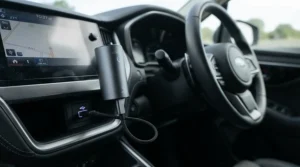
The Conair Portable Small Air Purifier plays a different game. It’s all about endurance: listings and roundups cite up to 22 hours of battery, which outlasts most of its rivals by a wide margin.
That number matters more than it sounds. A 22-hour runtime means you can charge it on Sunday and forget about it through a few commutes, rather than treating it like one more device that needs a nightly plug-in.
The filter is HEPA 10, which sits near the lower end of the HEPA classification scale. In practice that means it will still trap common dust and pollen, but it isn’t the pick if your priority is the finest particles. Think of it as the low-maintenance companion rather than the lab-grade cleaner.
Roundup reviewers describe it as slim and cordless, with a coverage claim of up to 15 sq ft. I couldn’t verify a large pool of owner reviews, so treat those figures as manufacturer-adjacent. It suits solo drivers who want a quiet nudge toward cleaner air without managing another charging routine.
Pros:
- ✅ Up to 22 hours of battery
- ✅ Slim, genuinely cordless body
- ✅ Simple, low-fuss operation
Cons:
- ❌ HEPA 10 is a lower filter grade
- ❌ Tiny coverage zone
Price range: generally positioned as budget-friendly, so the value case rests on battery life. Check current price.
3. Scosche FrescheAIR AFP2-SP — the one that doubles as a charging port
The Scosche FrescheAIR AFP2-SP comes from a company that has made car accessories since 1980, and it shows. This design thinks like a car product rather than a repurposed bedroom gadget.
It’s a USB-C rechargeable cylinder with a three-stage H13 HEPA setup, rated to capture 99.5% of PM2.5 and dust. The clever bit is the pass-through USB-A port, which solves a very real problem in older cars: too few ports and too many things to charge.
Here’s what the spec sheet won’t tell you: pass-through charging means the purifier earns its cupholder real estate twice. That’s a small, practical edge over competitors that only do one job.
One reviewer-style verdict describes it as a sensible, no-frills HEPA pick, and I’d agree with that framing. I couldn’t verify a broad base of customer reviews, so I’m leaning on that expert-style assessment rather than inventing a consensus.
Pros:
- ✅ H13 HEPA with strong PM2.5 rating
- ✅ Pass-through USB-A charging port
- ✅ USB-C rechargeable cylinder design
Cons:
- ❌ Limited independent review data
- ❌ Small cabin-wide impact
Price range: sits in the mid-range tier, which is fair given the extra port. Check current price.
4. Arint Mini Car Air Purifier — quiet cordless pick with a 4-layer filter
The Arint Mini Car Air Purifier is the sleeper in this lineup. Listings describe a four-layer filter with H13 HEPA and activated carbon, a 360° air intake, and USB-C charging.
The headline number is noise: it’s listed at 15 dB. In a quiet car on an early commute, that’s the difference between a purifier you forget about and one you resent.
The listing also mentions negative ions. That’s worth a pause, because ionizing features can produce trace ozone in some designs. Stick to the filter and treat the ion function as optional, as the safety section below explains.
I couldn’t verify a deep pool of independent customer reviews for this one, and most of its performance claims come from listing-level data. Honest take: promising on paper, but the evidence is thinner than for the Pure Enrichment PureZone Mini.
Pros:
- ✅ Very low listed noise level
- ✅ H13 HEPA plus activated carbon
- ✅ 360° air intake with USB-C charging
Cons:
- ❌ Thin independent review evidence
- ❌ Ion feature needs cautious use
Price range: budget-to-mid, which is reasonable if quiet matters most. Check current price.
5. MOOKA M01 — most flexible between car, office, and home
The MOOKA M01 is marketed as a small purifier you can run in a car, bedroom, or office. The listing describes an H13 True HEPA filter, a 360-degree inlet and outlet, and a fragrance sponge for essential oils.
Power is USB-C, and the listing says it works from a power bank, car charger, or computer. I couldn’t confirm a built-in battery, so treat it as power-bank-friendly rather than battery-first. Pair it with a decent power bank and you have a workable cordless setup.
The 15 dB sleep-mode noise rating is the main perk for a car, since low noise helps cabin comfort. There’s also a filter reminder that lights up after 1,440 hours of use, which saves you from guessing when to swap.
The listing claims the unit is ozone-free and doesn’t use UV-C light. That’s worth noting for a closed cabin. The coverage claims, though, are written for rooms rather than cars, so I’d read them as a general capability, not a promise about your hatchback.
Pros:
- ✅ H13 True HEPA filter
- ✅ Filter-change reminder after 1,440 hours
- ✅ Works from power bank or car charger
Cons:
- ❌ No confirmed built-in battery
- ❌ Room-sized claims, not car-specific
Price range: positioned as budget-friendly, which makes it good value if you already own a power bank. Check current price.
6. Philips GoPure GP5212 — best for traffic fumes
The Philips GoPure GP5212 is the pick for drivers whose real enemy is exhaust rather than pet hair. A roundup from The Air Purifier HQ highlights its gas-phase filter layer, which targets NO2 and SO2 rather than just particles.
That distinction matters. A plain HEPA filter, as the filter’s own Wikipedia entry explains, doesn’t capture gases or odor molecules. If you sit in stop-and-go traffic, a gas-phase layer addresses something a particle filter can’t.
In practice, that means the Philips GoPure GP5212 makes the most sense for urban commuters and rideshare drivers. It’s less about allergies and more about the diesel truck idling next to you at every red light.
Power runs through USB/car accessory power rather than a confirmed built-in battery, so it’s better described as portable than rechargeable. I couldn’t verify a large owner-review base, so lean on the filter design rather than a star rating.
Pros:
- ✅ Gas-phase layer targets NO2 and SO2
- ✅ Trusted brand with accessible support
- ✅ Suits heavy-traffic commuting
Cons:
- ❌ No confirmed built-in battery
- ❌ Gas filters wear out and need replacing
Price range: mid-range, and the value depends on whether exhaust is your real concern. Check current price.
7. IQAir Atem Car — highest performance, highest price
The IQAir Atem Car is the outlier, and it’s worth including so you know what the ceiling looks like. It uses HyperHEPA filtration rated down to 0.003 microns, and HouseFresh’s testing, as cited by Blueair, measured a CADR of 39 CFM.
CADR is the number that tells you how much clean air a purifier delivers. At 39 CFM, it moves far more air than the roughly 10 CFM class of mini units, and that gap is exactly what the research later in this guide says matters.
Reviewers praise its quiet operation and directional nozzle, which lets you aim cleaner air toward your breathing zone. The downsides are cost and size: it’s bulky for small cars and, per one roundup, has no auto-on with ignition.
It runs on USB or 12V power and isn’t a battery-powered unit, so it fits the cordless crowd only if you add a power bank. Choose it if you drive long hours and want the strongest option available.
Pros:
- ✅ Highest CADR among car purifiers tested
- ✅ Very quiet even on top speed
- ✅ Directional nozzle for breathing-zone airflow
Cons:
- ❌ Expensive compared with alternatives
- ❌ Large body limits mounting options
Price range: roughly $350-$450, so it’s a premium buy that makes sense only for high-mileage drivers. Check current price.
✨ Don’t Miss These Exclusive Deals!
🔍 Take your clean-air commute to the next level with these carefully selected products. Click on any highlighted item to check current pricing and availability. These picks will help you build a fresher, calmer cabin your passengers will notice!
What Is a Rechargeable Portable Car Air Purifier?
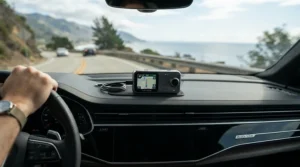
A rechargeable portable car air purifier is a compact, fan-driven filter with a built-in battery. It moves cabin air through a filter, usually HEPA and often carbon, without needing a permanent installation. You charge it by USB, then place it in a cupholder, console, or seat area.
The name is easy to stretch. A high-efficiency particulate air filter is a standard for capturing very fine particles, not a magic shield. It’s excellent on dust and pollen but, as that same entry notes, it doesn’t filter out gases and odor molecules.
That’s why carbon layers matter and why “air purifier” on a listing can mean very different things. A mini portable car air purifier is typically the smallest class, designed for a personal breathing zone rather than the entire cabin. A larger portable car air purifier moves more air but costs more and takes more space.
Keep one rule in your pocket: a purifier is only as good as its filter grade, its airflow, and the honesty of its claims.
How to Choose a Rechargeable Portable Car Air Purifier
Follow these seven steps before you buy.
- Check the power type. Confirm whether it has a true built-in battery or just runs from USB. Many listings blur the two.
- Look at the filter grade. True HEPA or H13 beats vague “HEPA-type” wording. The EPA’s description of HEPA filters explains why 0.3 microns is the benchmark size.
- Add carbon if you want odor help. HEPA alone won’t tackle smells, so carbon is a useful second layer.
- Find the airflow number. CADR or CFM tells you how much air actually moves. Tiny numbers mean a tiny effect.
- Judge the noise. A unit that’s loud on high speed will end up switched off.
- Plan for filter replacement. Check how often filters change and what they cost.
- Avoid ozone and heavy ionizers. Stay with mechanical filtration, which sidesteps the safety issues covered below.
Quick example: if two units cost about the same, choose the one with a clearer filter grade and honest airflow data. A confident-sounding listing isn’t evidence.
Mini Portable Car Air Purifier: What Small Size Really Buys You
A mini portable car air purifier earns its keep through convenience. It’s light, it fits a cupholder, and it moves between vehicles without fuss. That’s genuinely valuable if you rent cars, share a vehicle, or drive more than one.
But smallness has a cost, and it’s airflow. A smaller fan pushes less air, so a mini unit works best close to you rather than across the whole cabin. Think of it as a personal umbrella rather than a roof.
This is where expectations matter. The Pure Enrichment PureZone Mini, the Arint Mini Car Air Purifier, and the Conair Portable Small Air Purifier all live in this category, and all three suit solo drivers better than a full family.
Here’s a practical placement tip: aim the output toward your chest or face, not toward the floor. Position it on a center console or seat-adjacent surface where airflow isn’t blocked. The MOOKA M01 and Scosche FrescheAIR AFP2-SP follow similar logic.
If you carry four passengers regularly, step up in airflow, or accept that a mini unit is a personal aid. Know the limit and you’ll be happier with the result.
Portable Car Air Purifier vs Built-In Cabin Filter
Your car already has a cabin air filter, so why add another device? Because the built-in filter isn’t always doing as much as you’d hope.
A 2025 study in Environmental Science: Atmospheres, on portable air purifiers and cabin air filters, found that built-in filters can be inefficient when the HVAC fan runs on high. It also found that a portable purifier of roughly 10 CFM showed no reduction in particle levels beyond the stock filter alone. That’s a sobering result for the smallest units.
| Factor | Built-In Cabin Filter | Portable Car Air Purifier |
|---|---|---|
| Installation | Fixed, needs service | None, plug and place |
| Airflow | High, but filter efficiency varies | Lower in mini units |
| Moves between cars | No | Yes |
| Best For | Everyday baseline protection | Targeted, personal-zone boost |
Looking at the comparison, the built-in filter handles volume while a portable unit handles flexibility. Based on the study, a strong unit like the IQAir Atem Car has more realistic chances of adding value than a very small one, while a Pure Enrichment PureZone Mini works better as a personal-zone supplement. Pair the two, replace your stock cabin filter on schedule, and use the portable unit as a targeted extra.
Cordless Design: Why the Battery Matters More Than You Think
Cordless design is the feature everyone mentions and few people examine. A cord might sound minor until you’ve routed one across a console, snagged it on a gear shifter, or lost the only open port to a phone charger.
A true cordless design gives you placement freedom. You can set the unit near a rear passenger, in a cupholder, or on a seat, with no cable in the way. That’s the real appeal of the Conair Portable Small Air Purifier, which leans on its long battery life.
Battery numbers deserve scrutiny, though. Runtime is usually quoted on the lowest fan speed, so the Pure Enrichment PureZone Mini‘s up-to-12-hour figure shrinks at higher settings. Expect less if you run it on medium or high.
Here’s the pragmatic approach. If your drives are short, a built-in battery is a luxury. If you rely on one trip a day, a USB-powered unit like the MOOKA M01 with a small power bank gets you close. Either way, charge it at your desk or at home so it’s full before you leave.
Multi-Use Portability: One Purifier, Four Places
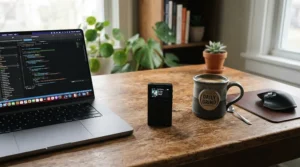
The best case for these devices is multi-use portability. A unit that cleans your car, then your desk, then a hotel room earns its price several times over.
The Pure Enrichment PureZone Mini was described by AutosFreak as easy to move between a car, desk, bedroom, or hotel room. The MOOKA M01 is marketed the same way, with a universal voltage rating that supports travel. That flexibility changes the value math.
Think about a typical week. Monday through Friday it rides in your cupholder. Saturday it sits on a bedside table during allergy season. Sunday it goes in a suitcase.
Multi-use portability also affects how you evaluate noise. A purifier that’s acceptable in a car might be too loud for a bedroom, so check low-speed noise ratings, such as the 15 dB figure listed for the Arint Mini Car Air Purifier and the MOOKA M01.
One caution: don’t let flexibility fool you into overestimating room coverage. These units are personal-zone tools. Treat them that way and the versatility is a genuine bonus.
What to Expect: Real-World Performance
Let’s translate the specs into an actual commute. With any of the small units above, expect a modest, close-range effect rather than a dramatic shift.
The research backs this up. If a roughly 10 CFM purifier couldn’t beat the stock cabin filter in testing, a small battery unit is best seen as a supplement. It nudges the air near you without transforming the whole cabin.
What you’ll likely notice: a softer dust feeling after a dry-weather drive, less pollen irritation in spring, and gentler smoke odors if the unit includes carbon. What you won’t get: instant removal of a heavy smell or a guarantee against traffic pollutants.
Here’s the honest hierarchy. The IQAir Atem Car, with its much higher airflow, is the model most likely to produce a measurable result. The Philips GoPure GP5212 targets exhaust-type gases that others skip. The smaller Scosche FrescheAIR AFP2-SP and Pure Enrichment PureZone Mini work best as personal-zone tools.
Set expectations accordingly. Running the purifier before you drive, with windows closed and recirculation on, usually gives it the best chance.
Safety, Ozone, and Regulations: What Every Buyer Should Know
Not every gadget sold as an air purifier is safe in a closed space. Ozone generators and some ionizers can emit ozone, a lung irritant, and the car is the worst possible room for that.
The California Air Resources Board recommends against ozone generators in spaces occupied by people or animals. It also notes that ozone does little to remove chemical pollutants. California limits ozone emissions from indoor air cleaners to 50 parts per billion, and the state’s list of hazardous devices has included car products.
That’s why I steer you toward mechanical filters. Choose HEPA and carbon designs, and treat optional ion modes, like the one on the Arint Mini Car Air Purifier, as something you leave off. The MOOKA M01 listing states it is ozone-free, which is reassuring but still a manufacturer claim.
A few practical checks:
- Look for CARB certification if you live in California.
- Avoid products promising “activated oxygen.”
- Skip any device meant to run only when the car is empty, because the risk is for you when you re-enter.
When in doubt, a plain filter beats a clever gimmick.
Long-Term Cost & Maintenance
The sticker price is only the opening bid. Filters are the real recurring cost, and they vary a lot between brands.
| Product | Upkeep Notes | Value Verdict | Best For |
|---|---|---|---|
| Pure Enrichment PureZone Mini | Replaceable filter, USB-C charging | Strong value | Everyday cordless use |
| Conair Portable Small Air Purifier | Battery-first, check filter plan | Good for low upkeep | Set-and-forget commuters |
| MOOKA M01 | Reminder light after 1,440 hours | Good budget value | Flexible home-and-car use |
| IQAir Atem Car | Filter roughly yearly per one roundup | Premium, costly upkeep | High-mileage drivers |
Total cost of ownership is where the IQAir Atem Car gets pricey, though its yearly filter cycle and stronger airflow can justify it for heavy drivers. Budget buyers should note that the cheapest unit isn’t always cheapest over two years if its filters are hard to find. Check current filter prices before you commit.
On maintenance, Wikipedia’s HEPA entry notes that clogged filters can cause airflow to bypass the filter, and in commercial settings filters are inspected and changed at least every six months. In a dusty car, that’s a decent mental benchmark. Always follow the manufacturer’s schedule.
Practical Usage Guide: Your First 30 Days
Buying the purifier is step one. Using it well is where the value shows up.
Week 1: Set it up. Fully charge the unit before first use. Place it where airflow can reach your face, and avoid blocking the intake with a bag or jacket.
Week 2: Build a routine. Turn it on a few minutes before you drive, with windows closed. Leave the fan on low for daily use and use higher speeds only for dusty or smoky stretches, since low speed saves battery and noise.
Week 3: Check the filter. Look at the intake for visible dust. A visibly gray filter is a sign to replace it early rather than waiting for a reminder.
Week 4: Evaluate. Ask whether you notice less dust or smell in the air near you. If not, check placement and consider a stronger unit.
Common first-month mistakes: leaving it in a hot parked car for hours, which is rough on batteries, and ignoring the filter indicator. Keep the charging cable in the glove box so a dead battery never becomes an excuse.
Real-World Scenarios: Which Purifier Fits Which Driver
The college commuter. Eight miles each way, a shared car, and a tight budget. The Pure Enrichment PureZone Mini fits: cordless, cheap, and easy to carry between the car and the library.
The rideshare driver. Ten hours a day in city traffic, windows up, doors opening constantly. The Philips GoPure GP5212 addresses exhaust gases, and a long-shift driver could also justify the IQAir Atem Car for stronger airflow.
The allergy-prone parent. School runs, pollen season, and the occasional snack explosion. The Scosche FrescheAIR AFP2-SP gives HEPA filtration plus a charging port for tablets. The Conair Portable Small Air Purifier is a low-maintenance backup for the passenger seat.
The traveling salesperson. One day in a rental car, the next in a hotel. The MOOKA M01 with a power bank handles that, as does the Arint Mini Car Air Purifier for quiet overnight use.
Match the tool to your daily pattern, and the choice usually becomes obvious.

FAQ
❓ How long does a rechargeable portable car air purifier battery last?
❓ Can a mini portable car air purifier remove cigarette smoke smell?
❓ Where should I place a portable car air purifier in my car?
❓ Are ionizer car air purifiers safe to use?
❓ How often should I replace a car air purifier filter?
Conclusion
The best rechargeable portable car air purifier is the one that matches how you really drive. For most people that means the Pure Enrichment PureZone Mini: affordable, battery-powered, and backed by a real HEPA and carbon filter. If battery endurance is your priority, the Conair Portable Small Air Purifier is the long-haul choice, and the Scosche FrescheAIR AFP2-SP wins for cars with too few ports.
For quiet commutes, the Arint Mini Car Air Purifier and MOOKA M01 are worth a look, with the caveat that their evidence base is thinner. The Philips GoPure GP5212 suits exhaust-heavy routes, and the IQAir Atem Car is the performance benchmark for anyone willing to pay for airflow.
Remember the honest bottom line. Small units are personal-zone tools, and the research suggests airflow matters, so keep your built-in cabin filter fresh and avoid anything that produces ozone. Choose a mechanical filter, charge it before you leave, and enjoy a cleaner breath on the road.
✨ Ready to freshen up your commute?
🔍 Compare the picks above, check current pricing and availability, and choose the purifier that fits your drive. Your lungs will thank you on the next red light!
Recommended for You
- Portable Car Air Purifier For Odor: 7 Top Picks That Work (2026)
- Car Air Purifier For Allergies: 7 Smart, Safe Picks (2026)
- Car Air Purifier For Pet Odor: 7 Best Picks Ranked (2026)
Disclaimer: This article contains affiliate links. As an Amazon Associate, I earn from qualifying purchases. If you purchase products through these links, we may earn a small commission at no additional cost to you.
✨ Found this helpful? Share it with your friends! 💬🤗
