
In This Article
An air purifier for studio apartment living is a portable HEPA unit sized to clean the single open room where you sleep, cook, and work, usually 300 to 500 square feet. The right one has a clean air delivery rate (CADR) of roughly two-thirds of your floor area, runs quietly overnight, and doesn’t swallow your floor space.
Studios are strange little ecosystems. Your bed sits eight steps from your stove. Your couch shares a zip code with your laundry basket. Last night’s garlic sauté has nowhere to go but straight into your pillow. A one-bedroom can wall off a bad smell. A studio has to out-filter it.
That’s why shopping here is different. A giant “whole-home” tower is overkill, and a tiny desk gadget is hopeless. You need real coverage for one room, a low-speed hum you can sleep through, and a footprint that won’t eat your only free corner.
A note on method. This guide rests on published specs, AHAM-style sizing rules, and aggregated review sentiment from independent roundups. I haven’t personally tested these machines, and I won’t pretend otherwise. Where sources disagree on a number, I say so instead of picking a winner. Prices are approximate ranges, so check current listings before you buy.
Air Purifier for Studio Apartment: Quick Comparison
Here’s the fast version for a studio. Each row maps a pick to a studio size and a priority.
| Pick | Rated Coverage | Low-Speed Noise (Published) | Best For |
|---|---|---|---|
| Coway Airmega AP-1512HH Mighty | ~360 sq ft | ~24 dB | One-machine studios of 300-400 sq ft |
| Levoit Core 300S | ~219 sq ft | ~24 dB | Micro studios under 250 sq ft, tight budgets |
| Blueair Blue Pure 311i Max | ~440-525 sq ft | ~23 dB | Cooking-heavy, larger open studios |
| Winix 5500-2 | ~350 sq ft | ~28 dB | Odor and pet-heavy studios |
| Dyson HushJet Purifier Compact | ~203 sq ft | Check spec sheet | Small studios where design matters |
The pattern is simple: coverage buys you headroom, and headroom buys you quiet. The Mighty and Blue Pure 311i Max have enough muscle to run on gentle speeds in a typical studio, while the Core 300S and HushJet are sized for tighter rooms. Pick the biggest unit your footprint and budget tolerate, not the smallest that technically qualifies.
💬 Just one click — help others make better buying decisions too!😊
Top 7 Air Purifier for Studio Apartment Picks: Expert Analysis
I ranked these on how well each fits a studio’s quirks: open layout, shared air, sleeping nearby, limited floor space. The order runs from the safest all-rounder to specialist picks.
1. Coway Airmega AP-1512HH Mighty — best all-rounder for most studios
The Mighty is the rare purifier that feels neither oversized for a bedroom nor timid in a living area. Its rated coverage sits around 360 square feet, which fits most open studios.
Published CADR figures land in the roughly 230-245 cfm band across smoke, pollen, and dust, and sources shuffle which number belongs to which category. Under AHAM’s two-thirds rule, that supports about 350 square feet. A 330-square-foot studio therefore gets a margin, so the unit can idle on a low, quiet speed instead of sprinting. Filtration is four-stage: pre-filter, deodorization filter, True HEPA, and an optional ionizer. I’d leave the ionizer off and let the HEPA and carbon do the work.
The auto mode matters most in a studio. When cooking spikes particle levels, the fan ramps up, then settles when the air clears. If your studio runs 300-400 square feet and you want one machine, this is the sensible default. If you’re under about 220 square feet, you’d be paying for CADR you can’t use.
Independent roundups consistently name it a top pick for apartments, citing its CADR-per-dollar and cheap replacement filters. A recurring caveat is that it’s overbuilt for very small bedrooms. I couldn’t verify individual customer reviews directly, so treat that as editorial consensus.
Pros:
- ✅ Strong CADR for the price
- ✅ Auto mode reacts to cooking spikes
- ✅ Low-cost replacement filters
Cons:
- ❌ Overbuilt for micro studios under 220 sq ft
- ❌ Utilitarian looks, not a design statement
Price range: typically the low-$100s at the time of research; check current price. Verdict: the best value-per-square-foot here.
2. Levoit Core 300S — smallest footprint with smart controls
The Core 300S is the pick for studios where floor space is the real currency. Its base is only about 8.7 inches across and it weighs roughly 6 pounds, so it fits on a shelf, a nightstand, or a kitchen counter corner.
Published specs show a CADR around 140-141 cfm and rated coverage of about 219 square feet, with an H13 True HEPA filter, activated carbon, and a pre-filter. Apply the two-thirds rule and 141 cfm supports roughly 210 square feet. That makes it a fit for compact studios of 250 square feet or less, and a stretch for anything bigger. Published noise runs about 24-50 dB, so the low end is bedside-friendly. Wi-Fi control lets you schedule it to run before you get home.
I’d put it on the shortlist for renters in dense buildings where 200-square-foot studios are normal. In a 400-square-foot loft-style space, you’d be running it flat out, which defeats the quiet that made you buy it.
Reviewers keep praising its compact build, quiet low setting, and cheap filters, which several roundups put near $25 a year. The reservation is the same everywhere: it’s honest about its size limits.
Pros:
- ✅ Tiny footprint, easy to relocate
- ✅ Very low yearly filter cost
- ✅ Wi-Fi scheduling and display-off option
Cons:
- ❌ Undersized for studios above ~250 sq ft
- ❌ Fan noise climbs at higher speeds
Price range: around $100 or a bit more; check current price. Verdict: the best budget move for small studios.
3. Blueair Blue Pure 311i Max — auto mode for cooking-heavy open layouts
The 311i Max is for studios where dinner is a contact sport. Its air-quality sensor and auto mode raise fan speed when particles climb and drop it when the reading falls, which suits an open floor plan where the kitchen shares air with the bed.
Blueair’s HEPASilent filtration is rated to capture 99.97 percent of particles down to 0.1 micron, and the low setting is cited around 23 dB. Sources disagree on the exact numbers. One roundup cites a 283 cfm smoke CADR and about 439 square feet at 4.8 air changes per hour. Another, covering the “+” variant, cites 339 cfm and about 525 square feet, with a footprint near 12.5 inches. Treat it as a roughly 440-525 square foot machine and confirm the exact variant on the listing.
On paper this means a 400-square-foot studio gets generous headroom. You can run it low for hush, then let auto mode surge during a stir-fry. It’s the pick I’d look at if a studio’s open-concept kitchen is your biggest air-quality problem.
Reviewers highlight its quiet low setting, sensor-driven automation, and coverage. The consistent trade-off is price and proprietary filters.
Pros:
- ✅ Sensor-driven auto mode for cooking spikes
- ✅ Very quiet low setting around 23 dB
- ✅ Generous coverage for larger studios
Cons:
- ❌ Costs more than the Coway and Levoit options
- ❌ Variant naming and specs confuse listings
Price range: roughly $200-$300 at the time of research; check current price. Verdict: worth it for bigger, cook-heavy studios.
4. Blueair Blue Pure 211+ — biggest studio coverage with one-button simplicity
If your studio nudges toward 500 square feet, the 211+ deserves a look. One review guide pegs its CADR at 350 cfm, which under the two-thirds rule covers up to about 525 square feet. That’s rare muscle for a machine that reads as a minimalist cylinder.
The one-button design is the real charm. No app, no menu, just speed settings, which suits people who want a purifier that disappears into the room. That muscle is also what lets a big studio run on lower speeds, since a unit this strong rarely needs full blast.
The trade-off is the filter bill. The same guide estimates roughly $80-$100 per year, several times what the Core 300S costs. Over three years that gap becomes a real chunk of the purchase price, so I’d budget for it before buying.
Editorial reviewers lean positive, with one guide scoring it 4.5 out of 5 and naming it a studio top pick. The recurring grumble is filter cost, not performance.
Pros:
- ✅ CADR around 350 cfm for large studios
- ✅ One-button controls, zero learning curve
- ✅ Clean design blends into small spaces
Cons:
- ❌ Pricier yearly filters than most rivals
- ❌ Larger footprint than compact units
Price range: roughly $250-$350 at the time of research; check current price. Verdict: a strong choice if your studio is large and you hate fiddling.
5. Coway Airmega 100 — small-room auto mode on a budget
The Airmega 100 is Coway’s purpose-built small-room unit, not the bigger Mighty everyone keeps recommending. One roundup lists its CADR at 152 cfm, the strongest on that list of small units, which under the two-thirds rule supports about 225 square feet.
It also brings auto mode to a budget price. That matters because a studio’s air changes constantly: cooking, opening the door, laundry day. A machine that adapts beats one you forget to adjust.
Noise needs a careful read. One roundup lists a low setting near 20 dB. An independent test that measured every speed logged about 40 dBA at its lowest and about 61 dBA at its highest. Methods differ, so I’d expect something between the claim and the measurement, quiet enough for sleep in most cases but not silent. If you’re noise-sensitive, that gap is worth knowing about.
Reviewers like the compact footprint, the auto mode, and the lower cost. The common note is that it fits small studios best.
Pros:
- ✅ Auto mode at a budget-friendly price
- ✅ Compact footprint fits small rooms
- ✅ CADR strong for its size class
Cons:
- ❌ Measured noise higher than claimed lows
- ❌ Too small for studios beyond ~225 sq ft
Price range: roughly $100-$150 at the time of research; check current price. Verdict: good value for compact studios.
6. Winix 5500-2 — odor and pet defense for 350-square-foot studios
The 5500-2 is the pick when your studio smells like life: pets, cooking, a neighbor’s weekend plans. Roundups list it as the best option for cooking odors and pets, with a rated coverage near 350 square feet.
Noise is quoted at about 28 dB on low and about 55 dB on high. That makes it a fine daytime workhorse, but a touch louder than the quietest bedroom-first units at night. If your bed sits close to the machine, think about placement and sleep-mode behavior before buying.
Odor control is where I’d weigh it. Filtering particles and handling smells are different jobs, and a unit with a meaningful carbon layer does the second better than one with a thin carbon sheet. Check that the carbon stage is substantial. Also check whether any optional ionizer-style feature can be switched off, because I’d keep that off in a room where you sleep.
Reviewers frame it as a value pick for studios up to about 360 square feet, with good odor and pet-hair handling. The limits are low-speed noise compared with the quietest rivals, and a design that favors function over looks.
Pros:
- ✅ Strong match for odor- and pet-heavy rooms
- ✅ Covers studios up to roughly 350 sq ft
- ✅ Good value among mid-range options
Cons:
- ❌ Low setting louder than the quietest rivals
- ❌ Utilitarian look and bulkier footprint
Price range: roughly $150-$200 at the time of research; check current price. Verdict: smart for smells, less ideal if silence is the top priority.
7. Dyson HushJet Purifier Compact — premium design for small studios
The HushJet Compact is the splurge. Forbes’ tester called it a high-tech compact splurge, and it’s Dyson’s first purifier built for small spaces like apartments. It stands only about 18.5 inches tall, which makes it unusually easy to tuck beside a desk or couch.
Published specs list a CADR of about 131 cfm and rated coverage up to roughly 203 square feet. Under the two-thirds rule, 131 cfm supports about 195 square feet, so it’s strictly for small studios. You’re paying for design, brand polish, and a tidy footprint more than raw air-moving power.
That’s a legitimate reason to buy, just not a cheap one. If your studio doubles as your showroom and sits under 200 square feet, the HushJet can look like furniture. If you’re above that size, pay less and buy the Mighty instead.
Reviews are limited and mostly editorial so far, since the product is newer. I couldn’t verify a deep pool of customer reviews, so weigh that in.
Pros:
- ✅ Compact, tall-and-slim footprint
- ✅ Premium design suits small living spaces
- ✅ Purpose-built for apartment-sized rooms
Cons:
- ❌ Premium cost for modest CADR
- ❌ Limited track record and review volume
Price range: premium, roughly $300-$400 at the time of research; check current price. Verdict: a design-first pick, not a value pick.
How the Top 7 Stack Up
| Product | Published CADR | Rated Coverage | Approx. Price Range | Best For |
|---|---|---|---|---|
| Coway Airmega AP-1512HH Mighty | ~230-245 cfm | ~360 sq ft | Low-$100s | All-rounder for most studios |
| Levoit Core 300S | ~140 cfm | ~219 sq ft | ~$100 | Micro studios, budget buyers |
| Blueair Blue Pure 311i Max | ~283-339 cfm | ~440-525 sq ft | ~$200-$300 | Cooking-heavy open layouts |
| Blueair Blue Pure 211+ | ~350 cfm | ~525 sq ft | ~$250-$350 | Large studios, simple controls |
| Coway Airmega 100 | ~152 cfm | ~225 sq ft | ~$100-$150 | Small studios wanting auto mode |
| Winix 5500-2 | Not verified | ~350 sq ft | ~$150-$200 | Odors and pets |
| Dyson HushJet Purifier Compact | ~131 cfm | ~203 sq ft | ~$300-$400 | Design-first small studios |
Prices are approximate; check current listings. Reading the table, the Mighty wins on overall value. The Core 300S and Airmega 100 are the sensible picks under about 250 square feet, and the two Blue Pure models are the headroom plays for bigger or smokier spaces. The HushJet is the outlier: you’re buying the object as much as the airflow.
How to Choose an Air Purifier for Studio Apartment Living
Choosing well is mostly arithmetic plus honesty about your habits. Here are six steps.
- Measure the real space. Multiply length by width for the whole open area, not just the sleeping nook. In a studio, the air is shared.
- Apply the two-thirds rule. AHAM recommends a smoke CADR of at least two-thirds of your room’s floor area. A 450-square-foot studio therefore wants about 300 cfm. If you want smoke-season margin, AHAM suggests aiming closer to the room’s area.
- Account for ceiling height. CADR math assumes an 8-foot ceiling. A loft ceiling means you’ll want a unit rated for a larger room.
- Check third-party verification. Look for the AHAM Verifide label and low-ozone certification where available. Marketing coverage claims vary by brand and test method.
- Judge noise at the speed you’ll actually use. Overnight you’ll live on the lowest or second-lowest setting. A bigger machine at a low speed often beats a smaller one at a high speed.
- Price the filters. Yearly replacement costs range from roughly $25 to $100 across popular models. That gap compounds.
The sizing logic is why I keep saying “headroom.” A purifier rated near your room size runs hard to keep up. One rated above it can coast, and coasting is quiet.
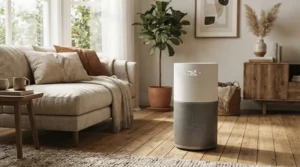
Compact Air Purifier for Apartment: Features That Actually Matter (And Those That Don’t)
Spec sheets are written to impress. Here’s how to filter the hype for a compact air purifier for apartment use.
What matters:
- True HEPA filtration. This is the baseline for capturing fine particles. If it isn’t True HEPA, it isn’t a serious studio purifier.
- Real carbon for odors. A meaningful activated-carbon stage handles cooking smells. A thin carbon sheet mostly won’t.
- Footprint and weight. If it’s a pain to move, you’ll leave it in a bad spot. The Core 300S at roughly 6 pounds is easy to relocate, while the Mighty at about 12 pounds is still manageable.
- Auto mode with a sensor. In a room that changes constantly, automation earns its keep.
- A display that turns off. In a studio, a glowing panel is a nightlight you never asked for.
- Filter cost. It’s the hidden half of the price.
What doesn’t:
- Ionizers and “plasma” labels. More on this in the safety section below. For a room where you sleep, I’d skip them.
- Aromatherapy trays. They add scent, not clean air.
- Huge “whole-home” coverage claims. These are vague, and coverage numbers vary by brand and test method.
- Maximum-speed bragging. You’ll rarely run it there.
The takeaway is pleasantly boring. A good compact air purifier for apartment life is a sealed HEPA unit with decent carbon, a sensible footprint, and cheap filters. Everything else is garnish.
Quiet Air Purifier for Apartment Bedroom: What to Expect in Real-World Performance
In a studio, your bedroom is the whole apartment, so a quiet air purifier for apartment bedroom use has to be quiet in the room where you also work and cook. That changes how you read the decibel numbers.
Claims versus measurements. Manufacturers publish lows, often between about 20 and 28 dB. Independent testers who measure every speed sometimes log higher numbers. The Airmega 100 is a good example: one list claims about 20 dB, while another test logged about 40 dBA at its lowest. Neither is “wrong.” They measure at different distances and under different conditions. Plan for the real-world number to land between the claim and the measurement.
Speed beats model. A unit with more CADR than you need can run on a low setting and clear the air at a whisper. A unit sized right at your limit has to run harder, and louder, to keep up. That’s the quiet logic behind picking the Mighty or 311i Max for a 350-square-foot studio instead of a smaller unit.
Placement affects perceived noise. A purifier on a nightstand sounds louder than the same unit across the room. In an open studio, aim for the middle ground, between the kitchenette and sleeping area, rather than right at your pillow.
Light matters too. If a unit lets you switch the display off completely, use that. A studio has nowhere to hide a glowing panel.
Open Floor Plan Studios: Placement and Setup Tricks Amazon Listings Skip
An open floor plan makes air moves freely and quickly, and it shuffles smells, dust, and kitchen particles across the whole room. That’s a feature if you set the purifier up properly.
Practical Usage Guide
Placement. AHAM notes that some designs aren’t as effective in a corner. Put the unit nearer the center of the room, a foot or so from walls and furniture, away from foot traffic. In a studio, that usually means the zone between the kitchenette and the bed.
First-day setup. Remove all packaging from the filters before powering on. It’s a classic mistake. Run the unit on its highest speed for a short stretch to clear accumulated dust, then drop to auto or a low speed.
First 30 days. Keep doors and windows mostly closed during the first runs so you can feel the difference. Notice how the unit behaves after you cook, and lean on the sensor if there is one.
Maintenance schedule.
- Weekly: wipe the exterior and check the intake isn’t blocked.
- Monthly: vacuum or rinse the pre-filter per the manual.
- Every 6-12 months: replace the main filter, depending on the model and your usage. Check the manual and any filter-life indicator.
Common first-month mistakes. Parking it behind the couch, running it only when the air “feels bad,” and forgetting the pre-filter. Studios are small, so mistakes show up fast.
With a true open floor plan, there’s one more trick: think in zones. The purifier doesn’t need to sit next to the stove. It needs to sit where it can pull the whole room’s air through its filter without being starved by furniture.
Single-Room Coverage: Why One Purifier Usually Beats Two
Here’s a counterintuitive truth. A studio is a single room, so single-room coverage is exactly the spec you need, and one right-sized unit usually beats two small ones.
The sizing logic is straightforward. Public health guidance, like King County’s HEPA guidance, suggests a CADR of about 65 for every 100 square feet. A 300-square-foot studio needs about 195, and a 500-square-foot studio needs about 325. That delivers roughly 4-5 air changes per hour, and the guidance notes 5 is the minimum the CDC recommends in some settings. If one machine can’t hit the number, they suggest adding another so the combined CADR reaches the target.
Notice what that means for you. If a single unit can meet the CADR for your whole studio, buy that unit. Two small units cost more, take up more floor, and double your filter bill. Reserve the two-unit approach for oddly shaped studios, very large lofts, or when you want one unit near the bed and one near the kitchen.
One caution: don’t size against your whole building. Size against the open room you’ll actually run the unit in. A tower rated for 1,000 square feet is wasted on a 350-square-foot studio, and it will usually cost more in noise, power, and filters.
Real-World Scenarios: Three Studio Dwellers, Three Picks
These are hypothetical profiles, designed to show the decision logic rather than describe real customers.
Scenario 1: The micro-studio renter (about 220 square feet, tight budget, nightly use). This renter sleeps three steps from the kitchenette and doesn’t cook elaborate meals. The Core 300S fits the footprint and the budget, and its roughly 219-square-foot rating matches the room. Filters stay cheap, which suits a tight budget.
Scenario 2: The home cook (about 400 square feet, open floor plan, cooks most nights). The air in this studio gets hammered daily. The Mighty is the sensible default, with its roughly 360-square-foot rating and auto mode. If cooking is truly heavy, the 311i Max adds headroom and a sensor-driven response.
Scenario 3: The pet owner (about 350 square feet, one cat, light cooking). Odor and dander are the daily issues. The Winix 5500-2 is built around that profile, with a rated coverage near 350 square feet. Check the carbon stage and keep the optional ionizer-style feature off while you sleep.
In every case, the winning move was matching the CADR to the room, then choosing for the person’s daily friction: budget, cooking, or pets.
✨ Don’t Miss These Exclusive Deals!
🔍 Take your air purifier for studio apartment search to the next level with these carefully selected products. Click on any highlighted item to check current pricing and availability. These picks will help you create cleaner, fresher air your whole household will love!
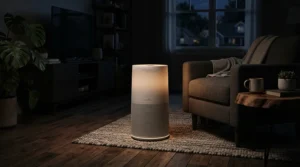
Problem → Solution Guide for Studio Air Quality
Problem 1: Cooking smells linger in the bedding. Run the purifier on auto or a higher speed while cooking and for 20-30 minutes afterward. Units with strong carbon stages, like the Winix 5500-2, and sensor-driven models, like the 311i Max, handle this best.
Problem 2: Smoke or cooking odors drift in from a neighbor. Shared walls and hallways leak air. Place the unit between the likely source and your bed, and run a higher CADR unit like the Mighty on a steady low-to-medium speed. A purifier reduces particles but doesn’t seal the leak.
Problem 3: The fan is too loud at night. Check whether the unit is undersized and running too hard. Move it farther from the bed. If you’re stuck with a small unit, step up to a model with more headroom.
Problem 4: Filter costs keep creeping. Price the yearly filter before buying. The Core 300S sits near the cheap end of published estimates, while the Blue Pure 211+ sits near the high end. Set a calendar reminder so you replace filters on time instead of in a panic.
Problem 5: Dust keeps coming back. A purifier cuts airborne dust but doesn’t replace cleaning. Pair it with regular vacuuming and damp-dusting, and keep the pre-filter clean.
Common Mistakes When Buying an Air Purifier for Studio Apartment Spaces
Most regrets come from a handful of avoidable errors.
Buying by the “up to” number. Brands quote coverage at different air-change rates, and some round generously. Check the CADR, then run the two-thirds math yourself.
Ignoring ceiling height. A loft studio with 10-foot ceilings has more air to clean than the floor area suggests.
Oversizing for the wrong reasons. Bigger helps up to a point. Beyond it you’re paying for noise, power, and a footprint you can’t spare.
Undersizing to save money. A tiny unit in a 450-square-foot studio runs flat out and still lags. That’s the worst of both worlds: loud and slow.
Skipping filter math. A cheap unit with expensive filters isn’t cheap.
Hiding it behind furniture. Airflow needs room. Blocked intakes mean a purifier that’s technically running but practically useless.
Believing marketing about ionizers and “plasma.” More on that next. In short: treat them as optional at best.
Long-Term Cost & Maintenance: What You’ll Really Spend
The sticker price is the opening bid. The real cost is purchase price plus filters plus electricity, over several years.
| Model | Typical Yearly Filter Cost (Published) | Cost Pattern Over 3 Years |
|---|---|---|
| Levoit Core 300S | ~$25 | Low upfront, low ongoing |
| Coway Airmega AP-1512HH Mighty | Low (roundups note cheap filters) | Low upfront, low ongoing |
| Blueair Blue Pure 211+ | ~$80-$100 | Higher ongoing; filters add up |
| Blueair Blue Pure 311i Max | Check current filter price | Higher upfront; verify filters |
| Dyson HushJet Purifier Compact | Check current filter price | Premium upfront; verify filters |
Price ranges and filter costs are approximate; verify before buying. Interpreting this, the cheapest purifier over three years isn’t necessarily the cheapest on day one. The Core 300S and Mighty keep ongoing costs low, while the 211+ can cost noticeably more to keep running than it did to buy. Always compare total cost of ownership, not just the purchase price.
Maintenance itself is light. Wipe the unit, rinse or vacuum the pre-filter as directed, and replace the main filter when the indicator or manual says so. Missing a replacement is the most common way to waste the machine’s performance.
Air Purifier vs Alternatives: Do You Really Need One?
A purifier isn’t the only way to improve studio air. Here’s how the main options compare.
| Option | Strength | Weakness | Best For |
|---|---|---|---|
| Portable HEPA purifier | Targets fine particles in a defined room | Ongoing filter costs, some noise | Studios with smoke, dust, pets, cooking |
| Opening windows | Free, brings in fresh air | Outdoor pollution, noise, weather | Mild days with clean outdoor air |
| Upgraded HVAC/AC filter | Passive, always on when system runs | Only works when airflow runs; varies by system | Studios with central or ducted systems |
| Vacuuming and damp-dusting | Removes settled particles | Doesn’t clean air you’re breathing now | Everyone, as a baseline habit |
The table shows these approaches complement each other. Cleaning handles what’s settled and ventilation handles stale air, but a purifier handles what’s floating right now. If your studio sees cooking, pets, or outside smoke, a HEPA purifier is the only option here that targets fine particles directly. The EPA also notes air cleaners don’t replace the need to ventilate and address pollutant sources, so use them as one layer, not the whole plan.
Safety, Ozone, and Certification Guide
Not every “air cleaner” is a harmless appliance. Some technologies can generate ozone, a lung irritant, as a byproduct. That’s why certification matters, especially in a room where you sleep.
Look for third-party verification. AHAM’s directory lets you check certified CADR ratings and suggested room sizes, and King County’s guidance recommends checking AHAM verification and the California Air Resources Board list of low-ozone-emitting units. The EPA’s guide to air cleaners in the home walks through CADR sizing and cautions about ozone-generating devices.
Practical rules for a studio:
- Prefer filter-based units (True HEPA plus carbon) over ozone-prone technologies.
- Keep any optional ionizer switched off where you sleep.
- Check for UL listing and Energy Star certification where available.
- Don’t use a purifier to mask a moisture or mold problem. It treats symptoms, not causes.
Boring is good here. A well-certified, filter-based purifier is the low-drama choice, and low drama is exactly what you want in the room where you sleep.
FAQ
❓ Can I run a purifier all night in a studio apartment?
❓ Will a compact air purifier for apartment use handle a 500-square-foot studio?
❓ How often should I replace filters in a small apartment?
❓ Do purifiers actually help with cooking smells in a studio?
❓ Is an air purifier worth it for a studio apartment?
Conclusion
Here’s the short version. Measure your studio, apply the two-thirds rule, and buy for headroom so the machine can run quietly.
For most studios of 300-400 square feet, the Mighty is the sensible default: strong CADR, auto mode, and low filter costs. If your studio is under about 250 square feet, the Core 300S or Airmega 100 fits the footprint and the budget. If you cook a lot or your studio is large, the Blue Pure 311i Max or Blue Pure 211+ gives you the headroom. The Winix 5500-2 is the odor-and-pet specialist, and the HushJet is the design-first splurge for small rooms.
Whatever you pick, place it in the middle of the action, keep the intakes clear, replace filters on schedule, and treat it as one layer alongside ventilation and cleaning. A studio has no spare air. Make the air you’ve got worth breathing.
✨ Ready to breathe easier in your studio? 🌿
🔍 Compare the picks above, check current pricing and availability, and choose the unit that matches your room, your routine, and your budget. Your lungs, and your pillow, will thank you!
Recommended for You
- Air Purifier For Small Apartment: 7 Best Picks For 2026
- Compact Air Purifier For Bathroom: 7 Smart Buys For 2026
- Air Purifier For Bathroom Mold And Mildew: 7 Smart Picks 2026
Disclaimer: This article contains affiliate links. As an Amazon Associate, I earn from qualifying purchases. If you purchase products through these links, we may earn a small commission at no additional cost to you.
✨ Found this helpful? Share it with your friends! 💬🤗
