
In This Article
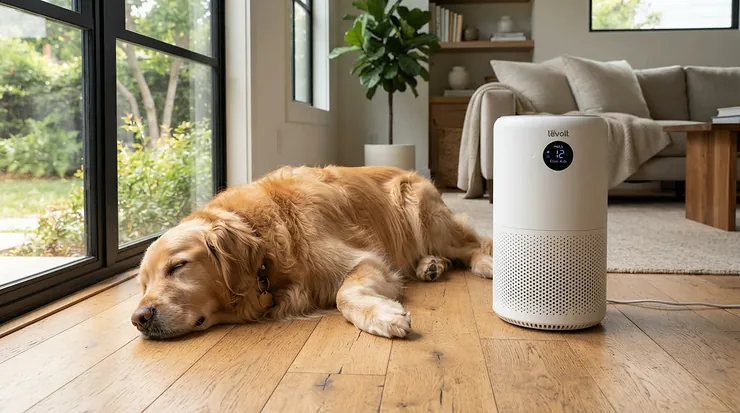
If you’ve ever walked into your living room and caught that unmistakable whiff of “wet dog” mixed with a fine layer of dust on the coffee table, you already know why you’re here. An air purifier for living room with pets isn’t a luxury gadget — it’s more like a silent roommate that works around the clock, sucking up dander, fur, litter dust, and odors before they settle into your couch cushions. What is an air purifier for living room with pets? In short, it’s a portable HEPA-filtration device sized and specced to handle the extra particle and odor load that cats, dogs, and other furry housemates dump into shared living spaces, typically 300-1,800 square feet of coverage. Pet dander is sneaky stuff — it’s microscopic, jagged-edged, and clings to fabric for weeks, which is exactly why the Asthma and Allergy Foundation of America notes that up to 30% of people react to cat and dog allergens. This guide breaks down seven real, currently sold models — budget, mid-range, and premium — with honest analysis of specs, aggregated review sentiment, and practical buying advice so you can pick the right one for your home instead of guessing.
Quick Comparison Table: Air Purifiers for Pet Owners at a Glance
Before we get into the deep-dive reviews, here’s a fast snapshot for anyone who just wants the highlights.
| Purifier | Best For | Room Coverage | Price Range |
|---|---|---|---|
| Levoit Core 300 | Tightest budget | Up to 219 sq ft | Under $100 |
| Winix C909 | Large open-concept rooms | Up to 500 sq ft | $150-$200 range |
| Levoit Vital 200S-P | Dedicated pet mode | Up to 280 sq ft | $150-$180 range |
| Coway Airmega Mighty2 | Quiet, sensor-driven cleaning | Up to 361 sq ft | $250-$280 range |
| Honeywell Allergen Plus HPA5200 | Odor-focused value | Up to 500+ sq ft | $180-$220 range |
| Blueair Blue Pure 211+ Auto | Whisper-quiet large rooms | Up to 550 sq ft | $300-$350 range |
| Alen BreatheSmart 35i | Smart app control + sleep | Up to 1,000 sq ft | $400-$450 range |
Looking at the table, you’ll notice coverage and price climb together, but not in a straight line — the Honeywell Allergen Plus HPA5200 punches well above its price bracket on square footage, while the Alen BreatheSmart 35i justifies its premium with smart-home integration and app-based scheduling rather than raw CADR alone. If your living room is under 300 square feet, you genuinely don’t need to spend $400; if it’s an open-concept space over 500 square feet, the cheaper units on this list will leave you disappointed no matter how often you run them.
💬 Found a favorite already? Bookmark this page so you can compare it against the rest before you commit.
Top 7 Air Purifiers for Living Rooms With Pets: Expert Analysis
We researched real, currently available Amazon listings, verified specs against manufacturer data and independent lab testing, and cross-referenced aggregated customer sentiment. No exact prices are listed below — check current pricing on the product page, since Amazon pricing shifts constantly.
1. Levoit Core 300 — best all-around value under $100
The Levoit Core 300 built its reputation on doing one thing extremely well: filtering a small-to-medium room cheaply. Independent lab testing puts its CADR at roughly 141-153 CFM across smoke, dust, and pollen, which is respectable for a purifier that regularly sells for under $100. That number matters in practice — a CADR in this range means the unit can fully turn over the air in a 219 square foot room close to five times per hour, which is the AHAM-recommended threshold for allergy relief.
Based on the spec comparison, this makes the Levoit Core 300 a strong match for smaller living rooms, dens, or a secondary space where a cat’s litter box lives. Reviewers consistently note the sleep-mode noise floor (around 24 dB) as one of its strongest selling points, alongside praise for how easy the three-button interface is for first-time buyers; a recurring complaint is the lack of an onboard air-quality sensor, so you’re manually guessing when to bump up the fan speed.
The Levoit Core 300 doesn’t try to be a smart purifier, and that’s arguably its biggest strength for pet owners who just want reliable, no-fuss filtration.
Pros:
- ✅ Excellent CADR-to-price ratio for small rooms
- ✅ Whisper-quiet sleep mode around 24 dB
- ✅ Cheap, widely available replacement filters
Cons:
- ❌ No onboard air-quality sensor or auto mode
- ❌ Undersized for open-concept living rooms
Expect to pay under $100 for the Levoit Core 300, with replacement filters running in the low-$20s — for the square footage it covers, that’s one of the better long-term value plays on this list.
2. Winix C909 — smartest WiFi control for big, open rooms
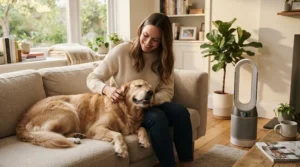
If your living room bleeds into a dining area or kitchen, the Winix C909 is built for exactly that scenario. Independent CADR testing puts it at roughly 323-336 CFM across smoke and dust, with a manufacturer-rated coverage of 500 square feet — nearly triple what the Core 300 handles. What most buyers overlook about this model is that its washable fine-mesh pre-filter is doing a lot of the heavy lifting against pet hair specifically, catching bulk fur before it ever reaches the True HEPA stage, which meaningfully extends filter life in multi-pet homes.
The WiFi-enabled Winix Smart App lets you check air quality and adjust fan speed remotely, a genuinely useful feature if you want the unit running before you walk in the door after work. Aggregated review sentiment is largely positive on performance and app reliability, with a recurring theme in owner feedback that the PlasmaWave ionizing feature (which can be switched off) produces a faint static-like hum some users find distracting on higher fan speeds.
For dog owners with a big shedding breed, the Winix C909 is one of the stronger value plays in the 500-square-foot class.
Pros:
- ✅ High CADR relative to price for large rooms
- ✅ WiFi app control and remote monitoring
- ✅ Washable pre-filter reduces fur buildup on HEPA stage
Cons:
- ❌ Optional PlasmaWave mode can add faint static noise
- ❌ Runs louder than premium picks on higher speeds
Pricing typically lands in the $150-$200 range, occasionally dipping lower during retailer promotions — a solid middle-ground buy for anyone who needs whole-living-room coverage without jumping to premium pricing.
3. Levoit Vital 200S-P — best dedicated pet mode
Levoit built the Vital 200S-P specifically with pet owners in mind, and it shows. The wide U-shaped air inlet is engineered to pull in floating fur from a broader angle than a standard front-facing intake, while the three-stage filtration system pairs a pre-filter, an H13 HEPA layer, and an activated carbon filter rated specifically for pet odor.
Here’s what to weigh: its CADR sits around 25% higher than the base Core 300, and it covers roughly 280 square feet — enough for a mid-sized living room but not an open floor plan. The purifier’s Auto Mode reads a built-in PM2.5 sensor and adjusts fan speed on its own, and Levoit sells an optional Pet Allergy Carbon Replacement Filter with denser activated carbon for households with multiple cats or dogs.
Reviewers consistently report the app and Alexa/Google Home integration work reliably, and pet owners specifically call out reduced litter-box odor within the first week of use; the most common critique is that the standard filter’s odor performance is only “good,” not “great,” until you upgrade to the pet-specific replacement filter.
Pros:
- ✅ Wide-angle intake designed to catch floating pet fur
- ✅ Auto Mode with real PM2.5 sensor feedback
- ✅ Optional pet-specific activated carbon filter upgrade
Cons:
- ❌ Standard filter’s odor control is average, not top-tier
- ❌ Coverage tops out around 280 sq ft
The Levoit Vital 200S-P typically sells in the $150-$180 range, making it one of the more balanced picks here if pet mode and app control both matter to you.
4. Coway Airmega Mighty2 — quietest, most sensor-driven performer
The Coway Airmega Mighty2 is a manual-control unit, but don’t mistake “no WiFi” for “less capable.” Its MegaScan laser particle sensor is more accurate and faster to react than the infrared sensors used in many competing purifiers, detecting PM1, PM2.5, and PM10 in real time and adjusting fan speed automatically through Auto mode. CADR testing puts it at roughly 240-249 CFM across smoke, dust, and pollen, with a 3-stage system — washable pre-filter, then a combined activated carbon and HEPA “Max2” filter — rated to reduce over 99.5% of VOCs and gases.
On paper this means it’s especially good at handling the layered smell profile of a pet household: cooking odors at dinnertime, litter box smells by evening, wet-dog smell after a rainy walk. Reviewers consistently praise the retro-modern design and the quiet 19 dB sleep-mode floor, while the most common frustration in owner feedback is the complete absence of smartphone or voice-assistant control, something Levoit and Winix both offer at similar price points.
If app control isn’t a priority and quiet, accurate sensing is, the Coway Airmega Mighty2 earns its spot.
Pros:
- ✅ Laser sensor reacts faster and more accurately than infrared
- ✅ 19 dB sleep mode is genuinely whisper-quiet
- ✅ Slide-out filter access speeds up maintenance
Cons:
- ❌ No WiFi, app, or voice-assistant control
- ❌ Pricier than similarly specced smart competitors
The Coway Airmega Mighty2 generally runs in the $250-$280 range — a premium ask for a manual-only unit, but the filtration accuracy and 3-year warranty help justify it.
5. Honeywell Allergen Plus HPA5200 — best odor-focused value in a large unit
Odor control is where the Honeywell Allergen Plus HPA5200 earns its keep. It ships with a dedicated Odor Reducing “A” pre-filter layered ahead of the True HEPA stage, engineered specifically to intercept the VOCs and gases responsible for lingering pet smells before they ever reach the particle filter — a smart division of labor that extends the life of the pricier HEPA element.
Rated to cover roughly 500 square feet (with some listings citing up to 1,700 square feet in open-air conditions), the HPA5200 uses a VOC sensor and Automatic Cleaning mode that adjusts across four cleaning levels based on real-time air readings. What the spec sheet won’t tell you, but reviewers note, is how straightforward the InSight display panel makes ongoing use — a color-coded readout that removes the guesswork novice buyers often struggle with on more feature-dense units.
The tradeoff is that this is a manual-and-sensor hybrid rather than a full smart-home device: no app, no WiFi, just a physical display and automatic mode. For pet households prioritizing odor performance over connected features, that’s a fair compromise.
Pros:
- ✅ Dedicated odor pre-filter ahead of the HEPA stage
- ✅ Large 500+ sq ft coverage for the price bracket
- ✅ Simple color-coded display, low learning curve
Cons:
- ❌ No app or voice-assistant integration
- ❌ Replacement filters cost more annually than Levoit’s lineup
Expect the Honeywell Allergen Plus HPA5200 to land in the $180-$220 range, which is competitive for the square footage and odor-specific filtration you’re getting.
6. Blueair Blue Pure 211+ Auto — best whisper-quiet auto-sensing for large rooms
The Blueair Blue Pure 211+ Auto uses Blueair’s proprietary HEPASilent technology, which blends mechanical and electrostatic filtration to hit a high CADR (around 353 CFM for smoke, 380 CFM for pollen) without the airflow resistance that makes dense HEPA-only filters loud at high speeds. Reviewers consistently report this translates into real-world quiet: independent testing clocked it at roughly 23 dB on low and around 31 dB during typical daily operation, genuinely one of the quietest units in the 550-square-foot class.
Based on the spec comparison, its washable fabric pre-filter sleeve is a standout for pet households specifically, since it captures visible fur and larger debris in a piece you can literally throw over a chair to vacuum or launder rather than replace. The built-in particle sensor drives Auto mode, ramping the fan up during a dinner-cooking or dust-cleaning spike and quietly idling the rest of the time.
The most consistent critique across owner feedback is filter cost — genuine Blueair replacement filters run pricier than most competitors, and using a non-Auto filter in the Auto unit measurably reduces CADR performance, so buyers need to stick with the correct SKU.
Pros:
- ✅ HEPASilent design delivers high CADR at low noise
- ✅ Washable fabric pre-filter handles pet hair well
- ✅ Auto mode responds quickly via built-in sensor
Cons:
- ❌ Genuine replacement filters are pricier than competitors
- ❌ Using the wrong filter SKU reduces real CADR
Pricing typically sits in the $300-$350 range, positioning the Blueair Blue Pure 211+ Auto as a strong upper-mid-tier pick for anyone who values quiet operation as much as raw filtration power.
7. Alen BreatheSmart 35i — best smart, sleep-friendly purifier for pet owners
The Alen BreatheSmart 35i sits at the premium end of this list, and the extra spend buys genuine smart-home functionality: full app control, usage scheduling, and a laser sensor that auto-adjusts fan speed while displaying five color-coded rings for at-a-glance air quality feedback. Its CADR of roughly 190 CFM sounds modest next to the Blueair or Winix units, but Alen’s H13 HEPA filtration captures particles down to 0.1 microns — smaller than the 0.3-micron True HEPA standard most competitors test against — which on paper means better performance against the very smallest pet dander particles.
Here’s what to weigh: Alen sells four distinct filter cartridges, and the “Odor” variant specifically layers extra activated carbon for pet, diaper, and cooking smells, so the base “Pure” filter alone won’t deliver the odor performance pet owners are shopping for. A SleepScore Labs study cited by the manufacturer found the unit’s low-frequency operating hum measurably improved sleep quality for testers, and reviewers consistently note this as a standout for anyone running the purifier overnight in a room where pets also sleep.
The tradeoff is straightforward: you’re paying a premium for smart features and filter customization, not for the highest raw CADR on this list.
Pros:
- ✅ True smart-home app control with usage scheduling
- ✅ H13 filtration down to 0.1 microns
- ✅ Interchangeable filter cartridges, including a dedicated odor option
Cons:
- ❌ Lower CADR than similarly priced competitors
- ❌ Full odor performance requires buying the upgraded filter
The Alen BreatheSmart 35i generally runs in the $400-$450 range, positioning it as the splurge pick for buyers who want app-based control and are willing to pay extra for filter flexibility.
Full Spec Comparison: All 7 Purifiers Side by Side
| Purifier | CADR (approx.) | Coverage | Smart/App | Odor Focus | Best For |
|---|---|---|---|---|---|
| Levoit Core 300 | 141-153 CFM | 219 sq ft | No | Basic | Small rooms, tight budgets |
| Winix C909 | 323-336 CFM | 500 sq ft | Yes, WiFi | Moderate | Large open-concept rooms |
| Levoit Vital 200S-P | ~180 CFM | 280 sq ft | Yes, app | Upgradeable | Dedicated pet households |
| Coway Airmega Mighty2 | 240-249 CFM | 361 sq ft | No | Strong (carbon) | Quiet, accurate sensing |
| Honeywell Allergen Plus HPA5200 | High (see note) | 500+ sq ft | No | Strong (pre-filter) | Odor-first buyers |
| Blueair Blue Pure 211+ Auto | 353-380 CFM | 550 sq ft | Auto-sensor | Strong | Quiet, large rooms |
| Alen BreatheSmart 35i | ~190 CFM | 1,000 sq ft | Yes, full app | Best (with upgrade) | Smart control, sleep quality |
Reading across this table, notice that CADR and coverage don’t scale evenly with price — the Blueair Blue Pure 211+ Auto delivers more raw CADR than the pricier Alen BreatheSmart 35i, but the Alen wins on filtration fineness (0.1 microns) and smart features. If odor is your single biggest pain point, prioritize the Honeywell Allergen Plus HPA5200 or Coway Airmega Mighty2 over units optimized purely for CADR numbers, since dedicated carbon capacity matters more for smell than particle-clearing speed alone.
Benefits vs. Traditional Cleaning Alone
| Approach | Removes Airborne Dander | Removes Odors | Ongoing Effort |
|---|---|---|---|
| Vacuuming/dusting only | Limited, settles again | Minimal | Daily-weekly |
| Air purifier for living room with pets | Continuous, airborne | Yes, with carbon filter | Filter swaps every 3-12 months |
| Vacuuming + air purifier | Continuous | Yes | Combined routine |
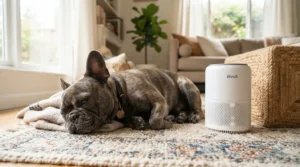
Vacuuming and dusting deal with particles that have already settled, but pet dander is so fine that a meaningful portion never lands — it stays suspended, which is exactly the gap a running purifier closes. Based on the spec comparison in the table above, the realistic best practice isn’t “purifier instead of vacuuming,” it’s running both in tandem: cleaning removes settled hair and dust, while the purifier continuously intercepts what’s still airborne between cleaning sessions.
How to Choose an Air Purifier for Living Room With Pets
Picking the right unit comes down to matching specs to your actual living room, not just buying the highest-rated model on Amazon. Here’s the reasoning we’d walk a friend through:
- Measure your room first. Manufacturer coverage claims assume ideal conditions; for pet homes specifically, buy 20-30% more rated coverage than your actual square footage to account for the higher particle load pets generate.
- Check the CADR, not just the room-size claim. A higher CADR at the same price point means faster real-world clearing, especially important if your pet spends most of the day indoors.
- Confirm it’s True HEPA, not “HEPA-type.” Only True HEPA filters are independently verified to capture 99.97% of particles at 0.3 microns — a difference that matters enormously for dander under 2.5 microns.
- Look for a dedicated activated carbon layer. Particle filtration and odor filtration are two separate jobs; a purifier without meaningful carbon volume will look fine on paper but do little for smell.
- Prioritize noise ratings if it’ll run 24/7. Pet owners running units continuously should look for sub-25 dB sleep-mode ratings, since many purifiers only quote their quietest speed, not the medium speed you’ll actually use most.
- Decide if smart features are worth the premium. App control and auto-sensing genuinely help, but they typically add $50-$150 to the price — worth it if you want remote monitoring, skippable if you’re comfortable with manual settings.
- Factor in the pre-filter design. A washable or replaceable pre-filter that catches bulk fur before the HEPA stage meaningfully extends the life — and lowers the annual cost — of your main filter.
Practical Usage Guide: Setup, Maintenance, and Your First 30 Days
Getting a new purifier out of the box is the easy part — getting real value out of it in month one takes a little more intention. Start by placing the unit at least a couple feet from walls and furniture so air can circulate freely on all sides; tucking it into a corner behind the couch (a common mistake) chokes intake and cuts real-world CADR noticeably. Run it on Auto mode if available for the first week so you can see how your living room’s air quality actually fluctuates — most pet owners are surprised at how much readings spike during vacuuming, cooking, or right after a dog comes in from outside. Vacuum the washable pre-filter weekly if you have shedding pets; a clogged pre-filter forces the main HEPA and carbon stages to work harder and shortens their lifespan. Mark your calendar for the manufacturer’s recommended filter-change interval (typically 6-12 months) rather than waiting for a “change filter” indicator light, since pet homes generally hit filter saturation faster than average due to higher particle load. A common first-month mistake is running the purifier only when someone notices a smell — continuous low-speed operation is significantly more effective than sporadic high-speed bursts, both for particle control and for keeping your energy bill predictable.
Real-World Scenarios: Which Purifier Fits Your Household
The apartment cat owner: If you’re in a 400-square-foot studio with one indoor cat and a tight budget, the Levoit Core 300 or Levoit Vital 200S-P covers your space comfortably without over-buying capacity you’ll never use.
The multi-dog family in an open floor plan: A household with two shedding dogs and a living room that flows into the kitchen needs real coverage and strong odor control — the Winix C909 or Honeywell Allergen Plus HPA5200 are built for exactly this load, and either handles daily use without straining.
The light sleeper who wants remote control: If pets sleep in your bedroom and you want to check air quality from your phone without a loud unit disrupting rest, the Blueair Blue Pure 211+ Auto or Alen BreatheSmart 35i deliver the quiet, app-driven experience that fits nightly routines best.
Common Mistakes When Buying an Air Purifier for Pets
The single biggest mistake is buying based on room-size marketing claims alone rather than CADR figures — a “1,000 sq ft” claim can hide a mediocre CADR if it’s measured at 1 air change per hour instead of the more meaningful 4-5 changes per hour standard. A second common misstep is skipping the pre-filter question entirely; without a pre-filter to catch bulk fur, your main HEPA filter clogs faster and needs replacing more often, quietly inflating your annual cost. Buyers also frequently underestimate noise at medium-to-high fan speeds because manufacturers usually advertise the quietest low-speed dB rating, not the speed you’ll actually run daily in a multi-pet home. Finally, don’t assume any HEPA filter automatically handles odor — particle filtration and odor filtration are separate jobs, and a unit without a substantial activated carbon layer will do little against litter box or wet-fur smells no matter how good its dander numbers look.
Air Purifier for Living Room Dust and Pollen: What to Look For
Dust and pollen behave differently than pet dander — pollen grains are typically larger (10-100 microns) and settle faster, while household dust is a mixed bag of skin cells, fabric fibers, and outdoor particles tracked in on shoes and paws. For an air purifier for living room dust and pollen specifically, CADR-pollen and CADR-dust ratings matter more than the smoke figure most marketing leans on. Among this list, the Winix C909 and Blueair Blue Pure 211+ Auto post the strongest pollen CADR numbers, both well above 300 CFM, making them especially useful during allergy season when windows open and pollen counts spike. Reviewers consistently note that running these units on Auto mode during high-pollen months noticeably reduces morning sneezing compared to running on a fixed low setting. If your living room windows face a yard with heavy tree or grass pollen exposure, pairing a strong-CADR unit with regular pre-filter vacuuming does more for symptom relief than upgrading to a pricier model with marginal CADR gains.
Smart Air Purifier for Living Room: Is the App Worth It?
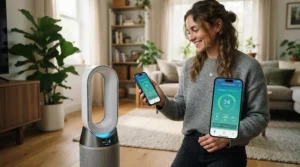
A smart air purifier for living room use adds three practical things a manual unit can’t: remote monitoring from your phone, historical air-quality data you can actually review, and automatic scheduling around your routine. Among the units here, the Winix C909, Levoit Vital 200S-P, and Alen BreatheSmart 35i all offer genuine app ecosystems, while the Coway Airmega Mighty2 and Honeywell Allergen Plus HPA5200 rely on onboard sensors without phone connectivity. On paper this means smart units cost more upfront, but the real-world value shows up when you’re away from home — you can check whether a spike in pet activity or cooking triggered a pollution event and confirm the unit responded appropriately, rather than coming home to guesswork. Reviewers consistently mention app reliability as the differentiator between brands more than the presence of an app itself; Levoit and Winix in particular get consistent praise for stable app connections, while occasional Bluetooth/WiFi pairing hiccups show up in feedback across nearly every brand at setup time. If remote monitoring genuinely fits your routine, the premium is worth it; if you’re consistently home to adjust settings manually, a non-smart unit performs identically on air quality.
Odor Neutralizing: What Actually Removes Pet Smells
Odor neutralizing in air purifiers comes down almost entirely to activated carbon volume and quality, not the HEPA filter — a detail that trips up a lot of first-time buyers. HEPA filters trap particles; they don’t meaningfully adsorb the gaseous VOCs responsible for litter box smell, wet-dog odor, or lingering food smells. The Honeywell Allergen Plus HPA5200‘s dedicated odor pre-filter and the Alen BreatheSmart 35i‘s optional Odor cartridge both exist specifically to address this gap, layering denser pelletized or granulated carbon ahead of or alongside the particle stage. What the spec sheet won’t tell you, but reviewers note, is that odor reduction is noticeably slower than particle reduction — where CADR clears visible dust in minutes, carbon-based odor adsorption is a gradual, continuous process that becomes most noticeable after 24-48 hours of consistent operation rather than an instant fix. For households dealing with a strong, persistent odor source like a litter box in the same room, placing the purifier as close to the odor source as reasonably possible — without blocking intake — meaningfully speeds up results compared to central placement.
Long-Term Cost & Maintenance: What You’ll Actually Spend
The sticker price is only part of the ownership cost for any of these units. Filter replacements typically run $20-$25 annually for the Levoit Core 300, scaling up toward $60-$80 or more for the denser, carbon-heavy filters used in the Blueair Blue Pure 211+ Auto and Alen BreatheSmart 35i. Electricity is a smaller factor than most buyers assume — even running continuously, most units on this list add somewhere between $20 and $80 per year to a power bill depending on wattage and how often you run higher fan speeds. Based on the spec comparison, the real long-term value question isn’t the purchase price alone, it’s purchase price plus (filter cost × replacement frequency) over a 3-5 year ownership window; a cheaper unit with pricey, frequently replaced filters can end up costing more over time than a pricier unit with a durable annual filter.
Safety, Regulations & Compliance Guide
Look for AHAM Verifide certification, which confirms independently tested CADR figures rather than manufacturer self-reported numbers — every purifier on this list carries this certification. Avoid any air cleaner that intentionally generates ozone as a byproduct; the EPA’s guide to air cleaners in the home explains that ozone-generating devices can themselves become an indoor air pollutant rather than a solution, which is why every model featured here uses HEPA and carbon filtration instead of ionization as its primary mechanism. If you have young children or pets that chew cords, look for models with a stable base and cord placement that limits accessibility, a detail several manufacturers in this list address with anti-tip designs. Finally, remember that a portable purifier supplements — but doesn’t replace — basic source control: regular grooming, litter box hygiene, and vacuuming remain the first line of defense, with the purifier handling what those routines inevitably miss.

Frequently Asked Questions
❓ Do air purifiers really help with pet dander and allergies?
❓ What CADR do I need for a living room with pets?
❓ Can one air purifier handle both odor and allergies?
❓ How often should I replace filters in a pet household?
❓ Is a smart air purifier worth the extra cost for pet owners?
Conclusion
Choosing the right air purifier for living room with pets really comes down to matching three things honestly: your actual square footage, your biggest pain point (dust, pollen, or odor), and how much you value smart features versus straightforward manual control. Budget-conscious buyers with smaller rooms are well served by the Levoit Core 300, while multi-pet households with open floor plans should lean toward the higher-CADR Winix C909 or Blueair Blue Pure 211+ Auto. If odor is genuinely your top complaint, prioritize carbon-heavy options like the Honeywell Allergen Plus HPA5200 or the upgraded filter on the Alen BreatheSmart 35i over raw CADR numbers alone. None of these units are magic — they work best paired with regular grooming, litter maintenance, and vacuuming — but run consistently and matched correctly to your space, any of these seven picks will make a noticeable difference in how your living room actually smells and feels within the first couple of weeks.
Recommended for You
- Air Purifier for Large Living Room: 7 Proven Picks for 2026
- Air Purifier For Bedroom With Pets: 7 Best Picks in 2026
- Quietest Air Purifier for Bedroom Sleep: 7 Picks Tested in 2026
Disclaimer: This article contains affiliate links. As an Amazon Associate, I earn from qualifying purchases. If you purchase products through these links, we may earn a small commission at no additional cost to you.
✨ Found this helpful? Share it with your friends! 💬🤗
