
In This Article
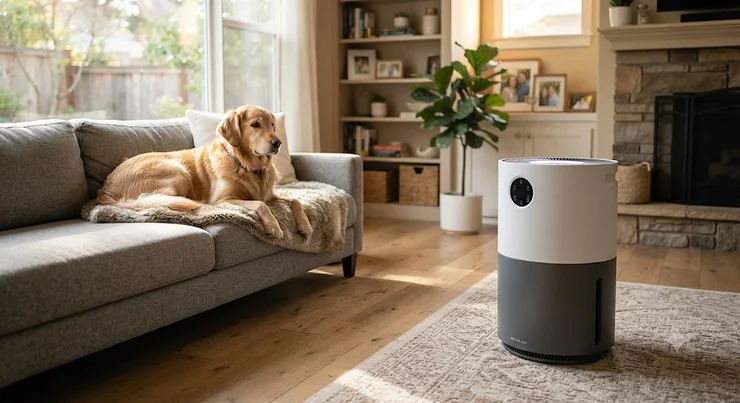
If you’ve ever walked into your own living room and caught a whiff of something you’d rather your guests didn’t notice, you already know why you’re here. An air purifier for pets isn’t a luxury gadget — it’s closer to a basic utility, right up there with a good vacuum and a lint roller you keep in every coat pocket. Between shedding fur, dander, and the occasional litter box drama, pet households carry a heavier particulate load than the average home, and no amount of sweeping fixes what’s floating in the air you breathe all night.
What is an air purifier for pets? It’s a HEPA-based air cleaner built or filtered specifically to capture pet dander, hair, and odor-causing compounds, usually pairing a washable pre-filter with a true HEPA layer and an activated carbon stage for smell control. That combination matters because dander is small enough to stay airborne for hours, while pet hair is large enough to clog a filter that isn’t designed to catch it first.
We dug into real spec sheets, verified CADR numbers, and aggregated review sentiment across seven genuinely useful models — from a $100 bedroom unit to a $800 odor-annihilating workhorse — so you can match a machine to your actual home instead of guessing from a listing photo. According to the Asthma and Allergy Foundation of America, roughly six in ten U.S. households have a pet, and pet dander remains one of the most common indoor allergy triggers doctors see. Let’s get into what actually works.
Quick Comparison Table
| Product | CADR (Smoke) | Room Size | Best For |
|---|---|---|---|
| Levoit Core 300 | ~145 CFM | Up to ~220 sq ft | Tightest budget |
| Levoit Vital 200S | ~242 CFM | Up to ~380 sq ft | Best all-around pet pick |
| Winix 5500-2 | ~232 CFM | Up to ~360 sq ft | Persistent odor |
| Coway Airmega AP-1512HH Mighty | ~233 CFM | Up to ~361 sq ft | Best overall value |
| Levoit Core 400S | ~231 CFM | Up to ~358 sq ft | Smart features, quiet operation |
| Blueair Blue Pure 211i Max | ~410 CFM | Up to ~635 sq ft | Large or open-plan homes |
| Austin Air HealthMate | N/A (carbon-focused) | Up to ~1,500 sq ft | Multi-pet odor, litter boxes |
Looking at the table, the split is pretty clean: anything under 250 square feet points you toward the Levoit Core 300, mid-size rooms with a shedding dog or two land on the Levoit Vital 200S or Coway Airmega AP-1512HH Mighty, and open floor plans or genuinely stubborn odor call for the Blueair Blue Pure 211i Max or the carbon-heavy Austin Air HealthMate. Price and CADR climb together here, but the jump from budget to mid-range buys you real, measurable filtration gains — the jump from mid-range to premium buys you room coverage and odor control, not necessarily “better” particle removal.
💬 Already spotted your match? Tap through to check today’s price before it changes!
💬 Just one click — help others make better buying decisions too!😊
Top 7 Air Purifiers for Pets: Expert Analysis
Coverage below spans budget, mid-range, and premium tiers, plus a few variants worth knowing about — because the “best” pick genuinely depends on your square footage and what’s bothering you more, hair or smell.
1. Levoit Core 300 — unbeatable price-to-CADR ratio for small rooms
The Core 300 has stuck around for years for one simple reason: nobody has matched its CADR-per-dollar in the sub-$110 tier. Its three-stage setup — a mesh pre-filter, a true HEPA layer, and a thin activated carbon sheet — pulls a CADR of roughly 140-145 CFM, enough for about 4.8 air changes per hour in a room around 220 square feet. Based on the spec comparison, that’s plenty for a single cat’s bedroom or a home office where a dog naps most of the day, but it starts to strain once you pass 300 square feet or add a second pet. Reviewers consistently note that its sleep mode drops to a genuinely silent 22-24 dB, which matters if the unit is going to live next to your bed. What most buyers overlook is that the carbon layer here is thin — fine for everyday dust and light dander, but it won’t touch a strong litter box smell. Price sits in the $90-$110 range depending on the retailer and sale cycle, and at that price it’s hard to argue with as an entry point.
Pros:
- ✅ Best CADR-to-price ratio in the sub-$110 category
- ✅ Compact cylindrical footprint fits bedrooms and small offices
- ✅ Whisper-quiet sleep mode around 22-24 dB
Cons:
- ❌ No auto mode or onboard air-quality sensor
- ❌ Thin carbon layer struggles with strong odors
Price range: around $90-$110. Value verdict: the strongest small-room pick if odor isn’t your main complaint.
2. Levoit Vital 200S — best all-around pick for pet-heavy households
If you’re only reading one entry on this list, make it this one. The Vital 200S was engineered around a U-shaped air inlet specifically to swallow pet hair without clogging, backed by a washable pre-filter you can rinse under the tap instead of throwing away every few weeks. What most buyers overlook about this model is that Levoit sells four different swap-in filter variants — Pet Allergy, Smoke Remover, Toxin Absorber, and the standard — so the same unit can be retuned as your household’s needs change. Its CADR lands around 242 CFM for smoke, translating to roughly 380 square feet of effective coverage at a strong 5 air changes per hour, and a dedicated Pet Mode alternates fan speeds to balance filtration against energy use. Reviewers consistently note the pre-filter noticeably extends the life of the bonded HEPA-carbon core, since it intercepts the bulk of visible fur before it reaches the finer stages. Here’s what to weigh: the carbon and HEPA layers are bonded together, so you’re replacing both at once, typically every 6-8 months in a busy pet home rather than the full year Levoit advertises for light use.
Pros:
- ✅ Washable U-shaped pre-filter built specifically for pet hair
- ✅ Dedicated Pet Mode balances filtration and energy use
- ✅ Four swappable filter variants target allergy, smoke, or odor
Cons:
- ❌ Bonded filter means carbon and HEPA replace together
- ❌ Air-quality sensor needs manual cleaning every couple of months
Price range: around $150-$190. Value verdict: the single best-rounded choice for most multi-pet homes.
3. Winix 5500-2 — best for lingering pet odor
The Winix 5500-2 earns its spot through one feature most competitors skip: PlasmaWave technology that works alongside particle filtration to break down odor molecules at a chemical level, rather than just trapping them and hoping the carbon holds. On paper this means it’s tackling both the visible dander and the invisible smell compounds simultaneously. Its CADR ratings come in strong — 232 CFM smoke, 243 dust, 246 pollen — good for around 360 square feet, and the washable AOC carbon filter keeps long-term costs from ballooning the way disposable-only designs do. What the spec sheet won’t tell you, but reviewers note, is that the ionizer function can be fully disabled if you’re sensitive to that technology, and the unit is CARB-certified for ozone safety either way. Aggregated review sentiment consistently flags the remote control and auto mode as genuinely convenient day-to-day, though several owners mention the unit loses its settings memory if power is interrupted, which is a minor but real annoyance.
Pros:
- ✅ PlasmaWave technology addresses odor molecules, not just particles
- ✅ Washable AOC carbon filter reduces long-term filter spend
- ✅ CARB-certified with a fully disable-able ionizer
Cons:
- ❌ Replacement filters cost more than most Levoit equivalents
- ❌ No memory setting if power is briefly interrupted
Price range: typically $170-$220, occasionally on sale closer to $150. Value verdict: the pick if odor control matters more than hair capture.
4. Coway Airmega AP-1512HH Mighty — best overall value and track record
Few air purifiers have the multi-year reputation the Coway Airmega AP-1512HH Mighty carries, and it’s earned through independently verified CADR scores rather than marketing copy. Its four-stage system — pre-filter, deodorization filter, true HEPA, and an optional ionizer — captures 99.97% of particles at 0.3 microns, with CADR ratings around 233 smoke, 246 dust, and 240 pollen, covering roughly 361 square feet at close to five air changes per hour. Based on the spec comparison, what sets this one apart from similarly priced rivals is energy efficiency: its motor draws noticeably less power at equivalent output, which adds up over a year of continuous running. Reviewers consistently note the air-quality indicator light is unusually accurate day-to-day, cycling from blue to red as pollutant levels shift, which makes it easy to gauge whether your pet just had a shedding episode without checking an app. The one real trade-off is that its Vital Ion ionizer can be switched off but not physically removed, a minor point for anyone who prefers to avoid ionization technology entirely.
Pros:
- ✅ Independently verified CADR with a decade-long trusted track record
- ✅ Lowest energy draw of the units tested at this performance tier
- ✅ Real-time air-quality light makes performance easy to monitor
Cons:
- ❌ Vital Ion ionizer can be disabled but not removed
- ❌ Noticeable fan noise at maximum speed in open layouts
Price range: around $180-$240, frequently discounted closer to $155-$175. Value verdict: the safest default pick for most allergy-prone pet households.
5. Levoit Core 400S — best smart features for medium-to-large rooms
The Core 400S steps up from the Core 300 with a laser particle sensor that actually drives a responsive auto mode, rather than the vague air-quality estimates some “smart” purifiers rely on. Its CADR sits around 231-249 CFM depending on testing methodology, translating to roughly 358 square feet of coverage at close to 4.8 air changes per hour, and it’s AHAM Verifide for accuracy. What most buyers overlook is the dedicated Pet Allergy filter option, which swaps in extra carbon specifically tuned for pet-related compounds rather than general household odor. Reviewers consistently note this model runs quieter at high speed than its CADR would suggest, making it a genuinely livable option for a shared living room rather than a bedroom-only device. Here’s what to weigh: the cylindrical pre-filter design is a bit fiddlier to vacuum clean than the flat, slide-out designs on rival models, and the WiFi pairing occasionally needs a router reset to connect cleanly on first setup.
Pros:
- ✅ Laser air-quality sensor drives a genuinely responsive auto mode
- ✅ Dedicated Pet Allergy filter with additional carbon capacity
- ✅ Quiet high-speed performance for a mid-to-large room
Cons:
- ❌ Cylindrical pre-filter is harder to vacuum than flat designs
- ❌ WiFi setup occasionally requires a router reset to pair
Price range: around $170-$230. Value verdict: the smart-home pick for pet owners who want app control done right.
6. Blueair Blue Pure 211i Max — best for large or open-plan pet homes
When a room is simply too big for a standard console unit, the Blueair Blue Pure 211i Max is the model that actually keeps up. Its HEPASilent technology combines mechanical and electrostatic filtration to hit a CADR around 410 CFM, and Blueair recommends it for rooms up to roughly 635 square feet at a full four air changes per hour — with the ability to circulate air in spaces up to 3,000+ square feet at a slower single pass. What most buyers overlook about this model is that Blueair sells an AllergenBlock pre-filter specifically formulated to trap and neutralize pet dander before it reaches the main filter, on top of the standard washable fabric pre-filter that comes in several colors. Reviewers consistently note it’s remarkably quiet for its size, running around 23 dB on low, which is louder-room-worthy without being disruptive overnight. On paper this means it’s one of the few consumer units genuinely built for a two-dog household in an open-concept space rather than a single closed bedroom. The trade-off is real floor space commitment and an always-on ionizer that, unlike the Winix or Coway, can’t be switched off.
Pros:
- ✅ HEPASilent tech moves significantly more air than standard HEPA-only designs
- ✅ AllergenBlock pre-filter option targets pet dander specifically
- ✅ Covers open floor plans that console-sized units can’t reach
Cons:
- ❌ Built-in ionizer runs continuously and can’t be disabled
- ❌ Bulky footprint demands genuine floor space
Price range: around $330-$380. Value verdict: the large-room champion for multi-pet or open-plan homes.
7. Austin Air HealthMate — best for serious multi-pet odor and litter box smell
This is the outlier on the list, and deliberately so. The Austin Air HealthMate trades smart features and sleek design for 15 pounds of activated carbon and zeolite packed around a medical-grade HEPA core rated to capture 99.97% of particles at 0.3 microns. Based on the spec comparison, that carbon volume is roughly ten to fifteen times what most consumer purifiers carry, which is exactly why it’s the model people reach for when litter box ammonia or multi-dog odor has become genuinely unmanageable rather than a mild nuisance. What the spec sheet won’t tell you, but reviewers note, is that the filter is engineered to last around five years under normal residential use rather than the 6-12 months typical of HEPA-and-carbon combo filters — a detail that changes the long-term math significantly once you factor in replacement costs. Its steel cylindrical body pulls air in from all four sides and covers up to roughly 1,500 square feet, making it a whole-floor solution rather than a single-room device. It’s not subtle, it’s not app-connected, and it’s not cheap — but for households where odor is the primary complaint, nothing else on this list comes close on carbon volume alone.
Pros:
- ✅ 15 lbs of carbon and zeolite handles litter box and urine odor at a level nothing else here matches
- ✅ Filters engineered to last around five years, not months
- ✅ Solid steel construction built for continuous, whole-floor duty
Cons:
- ❌ Premium price well above typical HEPA-and-carbon purifiers
- ❌ No app control, sensors, or smart features of any kind
Price range: around $700-$850. Value verdict: the specialist pick when odor, not just dander, is the core problem.
Practical Usage Guide: Setting Up Your Air Purifier for Pets
Getting a unit home is only half the job. Placement matters more than most people assume: put your purifier at least a few feet from walls and furniture so air can circulate freely into the intake, and avoid tucking it into a corner where airflow gets trapped. If your dog or cat sheds heavily, position the unit near where they sleep or spend the most time rather than in a hallway they rarely visit — dander disperses from wherever the animal actually is, not from where you’d prefer to clean it.
In the first 30 days, the most common mistake is neglecting the pre-filter, assuming the main HEPA stage handles everything. It doesn’t — a clogged pre-filter throttles airflow through the whole unit and quietly tanks your real-world CADR long before the indicator light says anything’s wrong. Rinse or vacuum a washable pre-filter weekly in a heavy-shedding household, and check it every few days for the first month just to learn your pet’s actual shedding rhythm. Run the unit on auto mode if it has one; manually cycling between speeds tends to leave a purifier idling on low exactly when a grooming session just kicked particulate levels up. Finally, resist the urge to run it only when guests are coming — continuous operation is what actually keeps baseline dander levels low, since Fel d 1 protein from cats can stay airborne and sticky on surfaces for extended periods, long after the cat itself has left the room.
Real-World Scenarios: Matching a Purifier to Your Household
Picture a college student in a 250-square-foot studio with one cat and a tight budget — the Levoit Core 300 covers that room comfortably and won’t wreck a semester’s budget on filters. Now picture a family of four with two dogs in a 1,600-square-foot open-plan house — no single console unit realistically covers that footprint, which is exactly the gap the Blueair Blue Pure 211i Max or a pair of mid-range units is built to close. And consider a household managing three cats and a litter box in a converted garage apartment, where hair capture isn’t the issue but ammonia definitely is — that’s the scenario the Austin Air HealthMate‘s carbon volume was designed around, not a marketing afterthought.
For a more typical two-bedroom apartment with a single moderately shedding dog and a renter’s budget somewhere in the middle, the Levoit Vital 200S or Coway Airmega AP-1512HH Mighty hits the sweet spot of coverage, pet-specific filtration, and manageable running costs. Match the scenario that’s closest to your actual square footage and pet count before the price tag, not after — a $700 unit in a 200-square-foot room is wasted potential, and a $100 unit in an open-plan house is undersized no matter how good its reviews look.
✨ Don’t Let Pet Dander Win This Year!
🐾 Whichever room you’re tackling, there’s a match on this list. Click through on any highlighted pick to check current availability and pricing before you decide!
How to Choose an Air Purifier for Pets
- Measure your room first. CADR and coverage claims mean nothing if your space is bigger than the unit’s rated square footage — measure before you shop, not after.
- Prioritize a washable pre-filter. In a pet home, this single feature protects your main filter’s lifespan more than any other spec on the box.
- Check the carbon volume, not just “has carbon.” A thin impregnated sheet handles light odor; multiple pounds of granular carbon handles litter boxes and urine.
- Confirm AHAM Verifide or independently tested CADR. Manufacturer-only claims can run optimistic; third-party verification is the more honest number.
- Decide on ionization upfront. Some pet owners want it disabled entirely for sensitivity reasons — check whether it’s switchable before you buy, not after.
- Factor in noise at the speed you’ll actually use. A quiet low setting matters more than a quiet high setting, since most units run on low most of the time.
- Price the filters, not just the unit. A cheap purifier with expensive proprietary filters can cost more over two years than a pricier unit with affordable replacements.
HEPA Air Purifier for Pets: What CADR and Micron Ratings Actually Mean
Pet Dander Particle Size in Microns
Pet dander typically measures somewhere in the 0.5 to 10 micron range depending on species, which sits comfortably within what a properly certified HEPA filter is built to catch. The EPA explains that the 0.3-micron benchmark used to rate HEPA filters represents the most penetrating particle size — meaning particles larger or smaller than that benchmark, including most dander, are actually captured with even higher efficiency than the 99.97% headline number suggests. What most buyers overlook is the difference between a true HEPA filter and a “HEPA-type” or “HEPA-style” label, which are unregulated marketing terms in the U.S. and can perform meaningfully worse. If a listing doesn’t specify true HEPA or H13-equivalent performance backed by independent testing, treat the dander-capture claim with some skepticism.
CADR Rating for Pets Explained
CADR — Clean Air Delivery Rate — measures how many cubic feet of filtered air a unit produces per minute at its highest fan speed, tested separately for smoke, dust, and pollen particles. For a pet home specifically, the smoke CADR number is the most useful proxy, since it reflects performance on the smallest particles, which is the same size range dander falls into. Here’s what to weigh: a higher CADR number always means faster air changes in your specific room size, but a unit rated for 361 square feet at 4.8 air changes per hour will underperform in a 500-square-foot room, even though the CADR number itself hasn’t changed. Match the CADR to your actual square footage rather than assuming bigger numbers automatically mean better everyday performance.
Air Purifier for Pet Allergies: What to Expect
If pet allergies are the primary driver behind this purchase, expect gradual rather than instant relief. Reviewers running units continuously for 12+ hours a day consistently report noticeable symptom improvement within three to seven days, not overnight, since airborne dander needs several full air changes to drop to meaningfully lower baseline levels. An air purifier for pet allergies works best paired with regular vacuuming and washing pet bedding, since a purifier only addresses what’s airborne — it does nothing for dander embedded in carpet fibers or upholstery. Look specifically for a true HEPA stage combined with a carbon layer, since allergic reactions to pets often involve both the dander protein itself and irritation from associated odor compounds. Reviewers consistently note that running a unit on auto mode, rather than only during flare-ups, produces the most consistent allergy relief over time, because baseline particulate levels stay lower rather than spiking and dropping.
Best Air Purifier for Multiple Pets
Multiple pets change the math in two ways: shedding volume goes up, and odor compounds compound rather than simply add. For a genuinely multi-pet household, the Blueair Blue Pure 211i Max and Austin Air HealthMate are the strongest picks on this list, but for different reasons — the Blueair handles higher air volume across a larger space, while the Austin Air handles concentrated odor load from litter boxes or multiple dogs. A single mid-range unit like the Coway Airmega AP-1512HH Mighty can work in a smaller home with two cats, but three or more pets in anything larger than a standard bedroom usually calls for either a higher-CADR single unit or two mid-range units running in different rooms rather than one unit trying to do everything.
| Scenario | Recommended Pick | Why |
|---|---|---|
| 2 cats, apartment | Coway Airmega AP-1512HH Mighty | Reliable CADR at moderate cost |
| 2-3 dogs, open floor plan | Blueair Blue Pure 211i Max | Highest air volume on this list |
| Multiple pets, litter box odor | Austin Air HealthMate | Unmatched carbon capacity |
| Mixed species, budget-limited | Levoit Vital 200S x2 | Room-by-room coverage at lower unit cost |
Reading across this table, the pattern holds: more pets means either more carbon (odor) or more CADR (particulate volume), and rarely does a single budget unit solve both at once. Be honest about which problem — hair or smell — is actually the bigger complaint in your home before choosing between these routes.
Pre-Filter for Pet Hair: Why It’s the Single Most Important Spec
A pre-filter pet hair rating rarely gets top billing on a spec sheet, but it’s arguably the most consequential feature for anyone with a shedding animal. The pre-filter’s job is to intercept larger particles — visible fur, dust clumps, larger dander flakes — before they ever reach the main HEPA or carbon layers. Without one, or with a poorly designed one, that debris accumulates on the primary filter, restricting airflow and quietly reducing real-world CADR long before a filter-replacement indicator lights up. A washable pre-filter, like the ones on the Levoit Vital 200S and Blueair Blue Pure 211i Max, lets you rinse away accumulated hair every couple of weeks instead of accepting gradual performance decay between full filter changes. What most buyers overlook is that a good pre-filter genuinely extends the life of the more expensive main filter underneath it — in a heavy-shedding household, that can mean the difference between replacing a $50 filter every six months versus every three.
Common Mistakes When Buying an Air Purifier for Pets
The most frequent mistake is buying based on square-footage marketing claims rather than the AHAM-verified number, which is typically the more conservative and more honest figure. A close second is ignoring noise ratings at the speed you’ll actually run the unit — a purifier rated at 22 dB on its quietest setting can still hit an uncomfortable 55-65 dB on high, which matters if you plan to run it there most of the day. Buyers also frequently skip checking whether a filter is washable or fully disposable, then get surprised by ongoing replacement costs that erode the “budget” appeal of a cheaper unit within the first year. Finally, plenty of pet owners buy a single small unit expecting it to handle an entire open floor plan, when the physics of air circulation simply don’t support that — a unit rated for 300 square feet won’t meaningfully clean a 900-square-foot great room no matter how long you leave it running.
Air Purifier for Pet Owners Home: Room-by-Room Placement
Where you place an air purifier for pet owners home setups matters almost as much as which unit you buy. Bedrooms benefit from quieter, smaller units run continuously overnight, since that’s often where a pet sleeps and dander concentrates most. Living rooms and shared spaces, where pets spend waking hours and shedding is heaviest, generally need the highest-CADR unit in the house — this is where a Blueair Blue Pure 211i Max or Coway Airmega AP-1512HH Mighty earns its keep. Litter box areas and mudrooms, meanwhile, benefit more from carbon volume than raw CADR, making a compact carbon-heavy option worth considering even if it’s not rated for a large room. If budget allows only one unit, place it in the room where the pet spends the most waking hours rather than the room you personally spend the most time in — the source of the particulate matters more than your own habits.
Long-Term Cost & Maintenance for Pet Owners
Filter replacement is where a “budget” purifier can quietly become the more expensive option over two or three years. A unit with a $30 filter replaced every six months costs $60 a year in filters alone, while a unit with a $50 washable-pre-filter design that only needs a full filter swap annually can end up cheaper despite the higher sticker price. Energy draw matters too, though less dramatically — most HEPA purifiers in this list run somewhere between 25 and 80 watts depending on fan speed, translating to roughly $10-$30 a year in electricity at typical usage patterns and national average rates.
| Model | Filter Cost | Replacement Frequency | Estimated Annual Filter Cost |
|---|---|---|---|
| Levoit Core 300 | ~$30 | 6-8 months | ~$45-$60 |
| Levoit Vital 200S | ~$50-$65 | 6-8 months | ~$75-$100 |
| Winix 5500-2 | ~$46-$50 | 6-12 months | ~$50-$90 |
| Coway Airmega AP-1512HH Mighty | ~$40-$57 | 6-12 months | ~$50-$90 |
| Austin Air HealthMate | ~$200+ | 5 years | ~$40-$50 |
Looking at this table, the Austin Air HealthMate’s five-year filter life actually makes its long-term cost surprisingly competitive with cheaper units that need frequent replacement, even though the upfront purchase price is dramatically higher. Total cost of ownership, not sticker price, is the number worth comparing before you commit to any single model. For general sizing and safety guidance on portable air cleaners, the EPA’s guide to indoor air cleaners is a useful independent reference point beyond manufacturer marketing.
Features That Actually Matter (And Those That Don’t)
Genuinely matters: a washable pre-filter, verified CADR at the correct room size, and real carbon volume for odor. Genuinely doesn’t matter much: UV-C light add-ons, which have limited real-world impact in a moving-air purifier context, and elaborate app dashboards that look impressive but rarely change day-to-day performance. Smart auto mode is a middle case — it’s genuinely useful when paired with an accurate sensor, as on the Levoit Core 400S or Coway Airmega AP-1512HH Mighty, but nearly worthless on units with cheap, slow-responding sensors that lag well behind actual air-quality changes. Ionizer technology is worth understanding rather than dismissing outright — Winix and Coway let you disable it, while Blueair’s HEPASilent design bakes it into the core filtration process, which matters if you’re specifically trying to avoid ionization for sensitivity reasons.
Frequently Asked Questions
❓ What is the best air purifier for pets overall?
❓ Do air purifiers really help with pet odor?
❓ How often should I replace filters in a pet household?
❓ Can an air purifier reduce pet allergy symptoms?
❓ What CADR rating do I need for pet dander?
Conclusion
There isn’t a single universal best air purifier for pets, because the right pick depends on your square footage, your pet count, and whether hair or odor is the bigger daily annoyance. Budget-conscious single-room households do well with the Levoit Core 300, most multi-room pet homes land comfortably on the Levoit Vital 200S or Coway Airmega AP-1512HH Mighty, and genuinely large or heavily-odored spaces call for the Blueair Blue Pure 211i Max or the carbon-heavy Austin Air HealthMate. Whatever you choose, prioritize a washable pre-filter and a verified CADR that actually matches your room — those two factors predict real-world satisfaction far more reliably than a longer feature list or a flashier app.
Run whichever unit you choose continuously rather than only when company’s coming, keep the pre-filter clean, and give it a few days before judging results. Clean air in a pet home isn’t a one-time fix — it’s a routine, and the right machine just makes that routine easier to keep.
Recommended for You
- Air Purifier for Baby Secondhand Smoke: 7 Safe Picks (2026)
- Best Air Purifier for Secondhand Smoke: 7 Picks That Actually Work (2026)
- 7 Best Air Purifier for Smokers Apartment Picks (2026 Guide)
Disclaimer: This article contains affiliate links. As an Amazon Associate, I earn from qualifying purchases. If you purchase products through these links, we may earn a small commission at no additional cost to you.
✨ Found this helpful? Share it with fellow pet parents! 💬🐶🐱
