
In This Article
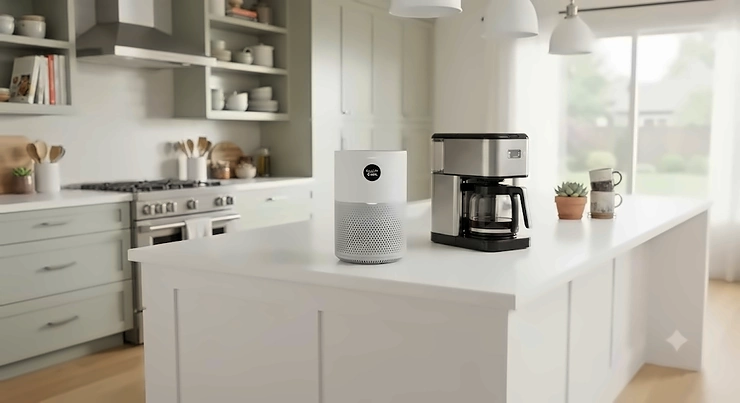
Your kitchen is lying to you. It looks clean, smells like dinner, and feels perfectly normal — but for the twenty minutes after you sear a steak or fry an egg, the air above your stove can carry more fine particulate matter than a smoggy downtown street corner. The EPA notes that indoor particulate matter is generated through cooking and other combustion activities, and that buildup is exactly what a kitchen air purifier countertop unit is built to fight. It’s a small, plug-in appliance that sits on your counter and pulls cooking smoke, grease particles, and lingering odors out of the air using a combination of HEPA filtration and activated carbon — without any ductwork, installation, or electrician required.
We get it: range hoods are supposed to handle this, and to some extent they do. But a recirculating hood mostly redistributes air rather than cleaning it, and even a ducted hood does nothing for the curry smell that’s already drifted into your living room by the time dinner’s ready. That’s the gap a small air purifier for kitchen counter placement is built to fill.
This guide breaks down seven real, currently available countertop purifiers — spanning ultra-budget to premium — based on genuine specs, coverage ratings, and aggregated customer feedback, not marketing fluff. We’ll cover CFM and airflow numbers that actually matter, where to place a unit relative to your stove, and why “no ductwork required” is the single biggest advantage this category has over built-in kitchen ventilation. By the end, you’ll know exactly which compact HEPA kitchen unit fits your space, your budget, and your cooking habits.
Quick Comparison Table: Kitchen Air Purifier Countertop Picks
| Purifier | Best For | Footprint | Price Range |
|---|---|---|---|
| Levoit Core Mini-P | Tiniest counters, RVs, dorm kitchens | 6.5″ x 6.5″ x 10.4″ | Under $65 |
| GermGuardian AC4100 | Budget buyers who want UV-C germ control | 11″ tall, 6.5″ x 7.75″ base | $50–$90 range |
| MOOKA B-D02L | Silent operation near a breakfast bar | 7.7″ wide cylinder | $45–$80 range |
| Blueair Blue Pure 411+ | Design-conscious open-concept kitchens | 13″ tall, compact cylinder | $130–$170 range |
| Winix A231 (Zero Compact) | Dedicated cooking-odor auto-response | 15″ tall tower | $80–$130 range |
| Levoit Core 300S | Smart-home integration and app control | 14.2″ tall cylinder | $100–$150 range |
| Coway Airmega 150 | Premium quiet performance, daily heavy cooks | 13.4″ x 6.5″ x 18.5″ | $150–$200 range |
Looking at the spread above, there’s no single “best” unit — there’s a best unit for your counter depth, your cooking frequency, and how much silence you need at 7 a.m. Budget picks like the Levoit Core Mini-P and MOOKA B-D02L trade raw airflow for a tiny footprint, which matters enormously if your counter space is already fighting with a coffee maker and a knife block. Mid-range and premium options like the Winix A231, Levoit Core 300S, and Coway Airmega 150 add sensor-driven auto modes that ramp up the moment they detect frying smoke, which is genuinely useful if you tend to walk away from the stove.
💬 Just one click — help others make better buying decisions too!😊
Top 7 Kitchen Air Purifier Countertop Picks: Expert Analysis
1. Levoit Core Mini-P — smallest true HEPA unit that still fits a crowded counter
The Core Mini-P (model LAP-C161-KUS) is built for the exact problem a lot of small kitchens have: there simply isn’t twelve inches of clear counter space to spare. At 6.5 inches square and just 2.3 pounds, it tucks into the gap between your toaster and your spice rack without stealing prep room.
Its 3-stage system — pre-filter, True HEPA, and activated carbon — is AHAM-certified for spaces up to roughly 100 square feet of continuous cleaning, which is realistic for a galley kitchen or a studio kitchenette rather than an open-plan great room. What most buyers overlook about this model is that its low CADR is a direct trade-off for its 25 dB noise floor on low speed; it’s one of the quietest units in this roundup, which matters if it’s running six feet from where you eat breakfast. For anyone in an apartment, RV, or tiny-house kitchen, that quiet-and-small combination outweighs raw filtering muscle.
Reviewers consistently report that the built-in aromatherapy pad is a pleasant bonus rather than a gimmick, letting you mask residual odors with a drop of essential oil while the carbon layer does the actual filtering work. A recurring theme in user feedback is that it handles simmering, boiling, and light sautéing well but gets overwhelmed by heavy frying smoke — an honest limitation given its size class, not a defect.
Pros:
- ✅ Fits counters where nothing else physically fits
- ✅ 25 dB low-speed noise, barely audible during meals
- ✅ Cheapest filter replacements in this entire lineup
Cons:
- ❌ Struggles with heavy frying or high-heat searing smoke
- ❌ Coverage tops out around 100 sq ft for real cleaning power
At around $50–65, the Levoit Core Mini-P delivers solid value if your kitchen is genuinely small; check current price before buying since Levoit runs frequent seasonal promotions.
2. GermGuardian AC4100 — budget pick with UV-C germ-killing on top of odor control
The AC4100 takes a different approach than most purifiers on this list: alongside its HEPA and charcoal filtration, it adds a UV-C light paired with titanium dioxide, aimed at neutralizing airborne bacteria and viruses rather than just particles. For a kitchen — where food-safety-adjacent air quality is a genuine concern — that extra layer is more than a marketing checkbox.
At 11 inches tall with a compact 6.5 x 7.75-inch footprint, it sits comfortably on a tabletop or counter corner. Consumer Reports rates its effective continuous-cleaning coverage conservatively at around 78 square feet, while retail listings advertise up to 338 square feet for a single air-change cycle; treat the larger number as an occasional-refresh claim rather than an everyday-use guarantee. Here’s what to weigh: the HEPA filter here captures 99% of particles at 0.7 microns rather than the stricter 99.97%-at-0.3-micron standard of a True HEPA filter, so it’s a notch below premium units on fine-particle capture, though its charcoal layer still handles cooking odors reasonably well.
Aggregated customer feedback from major retailers consistently praises the compact size and odor reduction, while a recurring complaint flags occasional noise at higher speeds and UV-C bulbs that need periodic replacement to stay effective.
Pros:
- ✅ UV-C plus titanium dioxide adds a germ-fighting layer
- ✅ Genuinely compact 11-inch tabletop footprint
- ✅ Filter-life indicator takes the guesswork out of upkeep
Cons:
- ❌ HEPA-type filter, not certified True HEPA at 0.3 microns
- ❌ Some users report audible noise on the highest of 3 speeds
Pricing on the GermGuardian AC4100 typically lands in the $50–90 range depending on retailer and bundle, making it a reasonable budget pick if UV germ control matters to you specifically.
3. MOOKA B-D02L — the quietest option for a breakfast bar or open kitchen
If your kitchen purifier has to run within earshot of a dining table, the B-D02L’s 20 dB brushless-motor operation is close to genuinely inaudible — reviewers testing it side-by-side with competitors have called it the quietest unit in its price class. Its narrow 7.7-inch cylindrical body is designed to slide onto tight countertop real estate, including galley-style kitchens where wider units crowd your cutting board.
The 3-layer stack (pre-filter, H13 True HEPA, activated carbon) genuinely uses certified True HEPA media rather than the “HEPA-type” filters common at this price point, which matters because true H13-grade filtration captures 99.97% of particles down to 0.3 microns instead of the looser 85–95% capture rate typical of budget-tier “HEPA-type” claims. What the spec sheet won’t tell you, but reviewers note, is that the plastic housing feels noticeably less premium than metal-bodied competitors like the Blue Pure or Coway — a fair trade for the sub-$80 price tag.
Marketing materials list an aggressive 1,076-square-foot maximum coverage figure; treat that as a best-case single-pass number rather than a continuous-cleaning rating for a room that size, since a unit this compact and quiet is realistically best matched to a kitchen and adjoining dining nook rather than an entire open floor plan.
Pros:
- ✅ 20 dB operation — the quietest unit in this roundup
- ✅ Genuine H13 True HEPA media, not a “HEPA-type” filter
- ✅ Narrow 7.7-inch width fits tight galley counters
Cons:
- ❌ Coverage claims are optimistic; size it for a kitchen, not a floor
- ❌ Filter replacements needed more often than premium competitors
The MOOKA B-D02L typically runs $45–80, with filters budgeted around $60–80 a year — solid value if quiet operation is your top priority.
4. Blueair Blue Pure 411+ — the design-forward pick for open-concept kitchens
Blueair’s 411+ is the unit you buy when you don’t want your air purifier to look like an appliance. Its cylindrical Scandinavian silhouette, interchangeable fabric pre-filter skirts, and compact height make it one of the more attractive options to leave permanently visible on an open kitchen counter that flows into a living space.
Rated for up to 185 square feet, it’s sized appropriately for a kitchen-plus-dining-nook layout rather than a full open floor plan, and independent lab testing has clocked it clearing a comparably sized room in around 43 minutes — competitive against units costing several times more. On paper this means you’re paying a premium for design and efficiency rather than raw CADR: at a peak draw of roughly 7.65 watts, it sips far less power than most Levoit or Winix units in this class, which adds up over a unit that realistically runs most of the day.
A common theme in aggregated reviews is that buyers appreciate the low noise floor and energy efficiency but note the washable fabric pre-filter needs more frequent vacuuming in a kitchen environment than it would in a bedroom, since grease-laden dust accumulates faster near a stove.
Pros:
- ✅ Stylish design that doesn’t look like medical equipment
- ✅ Very low power draw for near-continuous daily operation
- ✅ Genuine HEPA plus activated carbon combination filter
Cons:
- ❌ Higher upfront price than budget-tier competitors
- ❌ Fabric pre-filter needs frequent cleaning in greasy kitchen air
Expect to pay in the $130–170 range for the Blue Pure 411+, which is a fair value proposition if you want a countertop purifier that also functions as a design object.
5. Winix A231 (Zero Compact) — purpose-marketed for kitchen odor duty
Winix explicitly positions this unit for kitchen odor control, and the spec sheet backs that framing up: a 4-stage filtration system (pre-filter, carbon, True HEPA, and optional PlasmaWave ionization you can disable) rated for spaces up to 230 square feet, which comfortably covers most U.S. kitchens including an adjoining breakfast nook.
Independent testing has clocked the A231 finishing particle-clearing tests roughly five minutes faster than the popular Levoit Core 300 in a head-to-head comparison, a meaningful edge when you want cooking smoke gone before guests notice it. Reviewers consistently note the standout feature is genuinely useful for kitchen duty: auto mode with a built-in air quality sensor that ramps the fan the moment it detects a spike, which is exactly the behavior you want when you’re distracted plating food and forget the pan is still smoking.
Based on the spec comparison against its closest budget rivals, the A231’s CADR-to-price ratio is one of the strongest in the sub-$100 category when purchased on sale, though its full retail price of $129.99 puts it closer to mid-range territory before discounts.
Pros:
- ✅ Explicitly designed and marketed for kitchen cooking odors
- ✅ Auto mode reacts to smoke spikes without manual adjustment
- ✅ Faster particle-clearing speed than similarly priced rivals
Cons:
- ❌ PlasmaWave ionizer feature draws mixed reviewer opinions
- ❌ Full retail price is less competitive than sale pricing
The Winix A231 typically sells in the $80–130 range depending on promotions, and it’s a genuinely strong value pick specifically because its engineering targets the kitchen-odor use case rather than treating it as an afterthought.

6. Levoit Core 300S — best for smart-home households that want app control
The Core 300S upgrades the long-running Core 300 with a laser dust sensor, Auto Mode, and full app and voice control through the VeSync ecosystem, all while keeping the same compact cylindrical body that fits comfortably on a kitchen counter or side table. Its AHAM-certified CADR of 140 CFM covers spaces up to 219 square feet, putting it solidly in the mid-tier for this category.
Levoit’s kitchen-specific filter variant for this line (marketed as the ARC Formula filter) packs noticeably more activated carbon than the standard filter, targeted directly at neutralizing smoke, fumes, and VOCs rather than just particulates — worth specifically requesting when you order, since the base filter is comparatively light on carbon. What most buyers overlook about the smart features is that Auto Mode relies on a general particle sensor rather than a dedicated odor sensor, so aggregated reviews note it can be a beat slower to react to a smell-only event (like garlic sautéing) than to visible smoke.
A recurring theme in user feedback is genuine praise for the app’s remote monitoring — useful if you want to check whether your kitchen air cleared up while you’re still at the dinner table in another room — paired with mild frustration that replacement filters cost more than the original Core 300’s.
Pros:
- ✅ App and voice control via Alexa and the VeSync ecosystem
- ✅ Laser sensor enables genuine Auto Mode response
- ✅ Kitchen-specific carbon filter variant available
Cons:
- ❌ Lacks a dedicated odor sensor, so it reacts to particles first
- ❌ Replacement filters cost more than the base Core 300’s
Priced around $100–150, the Levoit Core 300S is the pick for anyone who already has a smart-home setup and wants their kitchen purifier folded into it.
7. Coway Airmega 150 — the premium choice for daily heavy cooking
Coway’s Airmega 150 is the most polished unit on this list, both in build quality and in real-world sensor responsiveness. Independent testers have specifically noted it reacts within seconds when someone starts cooking nearby, ramping the fan automatically via its built-in air quality sensor and color-coded LED display — genuinely useful feedback you can glance at from across the kitchen.
Reported CADR figures vary by testing methodology, landing anywhere from roughly 150 to 178 CFM depending on the source, with AHAM-style coverage estimates ranging from 214 to 237 square feet — enough for most kitchens plus an adjoining dining area. Based on the spec comparison with budget alternatives, the Airmega 150’s washable pre-filter (rather than a disposable one) meaningfully lowers long-term filter costs, since only the HEPA and carbon cartridge needs periodic replacement rather than every layer.
Aggregated reviews are consistently positive on noise: at roughly 19–20 dB on low or Auto mode, testers describe it as background-level soft airflow rather than fan noise, which means it can realistically run 24/7 in a kitchen without becoming annoying. The recurring criticism is that its advertised coverage numbers run a bit optimistic for larger open-plan spaces, and it lacks smartphone app connectivity that some competitors offer at a lower price.
Pros:
- ✅ Sensor ramps up within seconds of detecting cooking activity
- ✅ Whisper-quiet 19–20 dB operation on low and Auto mode
- ✅ Washable pre-filter reduces long-term filter replacement costs
Cons:
- ❌ No smartphone app, unlike similarly priced smart competitors
- ❌ Coverage claims optimistic for genuinely large open kitchens
At $150–200, the Coway Airmega 150 is the premium value pick for anyone who cooks daily and wants a quiet, sensor-driven unit that just works without a companion app.
Top 7 Kitchen Air Purifiers: Full Spec Comparison
| Purifier | Coverage | Filtration | Noise (Low) | Best For |
|---|---|---|---|---|
| Levoit Core Mini-P | ~100 sq ft | 3-stage HEPA + carbon | 25 dB | Tiniest counters |
| GermGuardian AC4100 | ~78 sq ft | HEPA-type + carbon + UV-C | ~30 dB | Budget + germ control |
| MOOKA B-D02L | Best suited under 400 sq ft | H13 True HEPA + carbon | 20 dB | Silent operation |
| Blueair Blue Pure 411+ | 185 sq ft | HEPA + carbon | Low, energy-sipping | Open-concept design |
| Winix A231 | 230 sq ft | 4-stage incl. optional ionizer | Auto-adaptive | Dedicated odor duty |
| Levoit Core 300S | 219 sq ft | 3-stage, kitchen carbon variant | Auto-adaptive | Smart-home integration |
| Coway Airmega 150 | 214–237 sq ft | 3-stage, washable pre-filter | 19–20 dB | Daily heavy cooking |
The pattern here is straightforward once you interpret the numbers: coverage and CADR climb roughly in step with price, but noise floor doesn’t — the MOOKA B-D02L and Coway Airmega 150 both undercut units that cost less, proving quiet operation is more about motor engineering than sticker price. If your kitchen is under 150 square feet, spending up past the Winix A231 or Levoit Core 300S buys you smart features more than it buys you cleaner air; if you’re covering an open-plan kitchen-dining combo, the Coway Airmega 150 is the only unit here rated with real margin to spare.
Getting Your Countertop Purifier Set Up Right
Unboxing a new purifier and plugging it in blind is the single most common way people undersell what they paid for. Start by removing all plastic packaging from inside the unit, not just the outer box — nearly every budget model ships with a thin protective film wrapped around the filter itself, and running the unit with that film still on effectively blocks airflow entirely.
Run the unit on its highest setting for the first two to three hours after setup, regardless of how loud that feels. New activated carbon filters “off-gas” a faint manufacturing smell for the first day of use, and a high initial fan speed clears that faster than leaving it on low. After the initial burn-in period, most kitchen units perform best left on Auto mode (if equipped) or a fixed low-to-medium speed running continuously, rather than being switched on only during active cooking — continuous operation maintains a baseline clean-air level so cooking spikes have less ambient pollution to fight against.
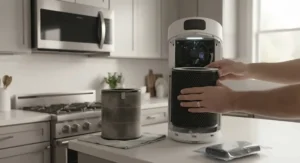
For maintenance, mark your calendar rather than trusting a filter-life indicator alone; most compact carbon filters saturate faster in kitchen use than in a bedroom, since cooking grease and oil vapor clog carbon pores faster than household dust does. Budget for a filter swap every three to four months in a kitchen that sees daily cooking, even if the unit’s indicator suggests six months — a common mistake in the first thirty days is assuming bedroom-rated filter life applies to kitchen conditions, and running a saturated carbon filter well past its capacity means you’re paying for a fan that no longer actually removes odor.
Real Kitchens, Real Fixes: Scenario Guide
Different kitchens have genuinely different problems, and matching the right unit to your specific situation matters more than chasing the highest CADR number on the spec sheet.
The studio-apartment cook with an 8-foot galley kitchen: Counter space is the binding constraint here, not filtering power — a Levoit Core Mini-P or MOOKA B-D02L fits a narrow strip of counter without crowding a cutting board, and neither unit’s smaller coverage rating is a real limitation in a room this size.
The open-concept family kitchen that flows into the living room: Odors don’t stay contained, so coverage rating matters more than footprint. The Winix A231 or Coway Airmega 150 are sized to handle both the cooking zone and the adjacent space, and their auto-sensing modes catch cooking spikes before they spread to where the family is sitting.
The renter who can’t install a range hood or make permanent changes: A countertop purifier is genuinely the only practical odor-control option available, and portability becomes a real feature — the GermGuardian AC4100 or Levoit Core 300S are light enough to move between kitchen and living room depending on the time of day, and neither requires any installation beyond a wall outlet.
Kitchen Placement: Why Proximity to the Stove Matters
Where you set a countertop purifier changes its real-world performance more than almost any spec on the box. Placing a unit directly beside the stovetop seems intuitive, but it’s often the wrong move: intense heat and grease-laden steam rising straight off a pan can shorten filter life dramatically and, in some cases, trigger a unit’s smoke or heat sensors into constant high-speed cycling that’s both loud and unnecessarily hard on the motor.
A better approach is positioning the purifier three to six feet from the stove — close enough to catch the drifting plume of smoke and odor as it spreads across the room, but far enough to avoid direct grease exposure and extreme heat. Counters near a doorway or the transition point into an adjoining room work particularly well, since that’s the chokepoint where cooking odor would otherwise escape into the rest of your home. For a kitchen island or peninsula layout, placing the unit at the end farthest from the burners but still within the open sightline of the cooking zone tends to balance intake efficiency against filter longevity.
Avoid tucking a unit fully inside a cabinet or behind an appliance, even a compact one — restricted airflow on the intake or exhaust side measurably reduces effective CADR regardless of how powerful the fan inside actually is.
✨ Don’t Miss These Exclusive Deals!
🔍 Take your kitchen air quality to the next level with these carefully selected purifiers. Click on any highlighted item to check current pricing and availability. These compact units will help you create a fresher, more welcoming home your family will love!
How to Choose a Kitchen Air Purifier Countertop Unit
- Measure your actual counter space first. A unit that’s technically “compact” on paper can still be too wide for a narrow strip of counter between appliances — measure the footprint before you measure square footage coverage.
- Match coverage rating to your kitchen plus any open adjoining space. If your kitchen flows into a dining or living area, size for the combined square footage, not just the kitchen alone.
- Prioritize activated carbon weight over HEPA rating for odor control. HEPA filters trap particles, not smells; a thin carbon layer will be overwhelmed by real cooking odor regardless of how impressive the HEPA certification looks.
- Check the noise rating at the speed you’ll actually run it. A unit’s quietest published dB figure is almost always its lowest fan speed — look for real-world noise at medium or Auto mode if you plan to run it during meals.
- Factor in filter replacement cost and frequency, not just sticker price. A cheaper unit with expensive, fast-saturating filters can cost more over two years than a pricier unit with a durable washable pre-filter.
- Decide whether auto mode and sensors are worth the premium. If you’re consistently present while cooking, manual speed control saves money; if you tend to walk away from the stove, sensor-driven auto response is genuinely worth paying for.
- Confirm it fits your actual routine, not just your kitchen. A unit you find annoying to clean or too loud to leave running will end up unplugged in a drawer within a month, regardless of its spec sheet.
Countertop Purifier CFM and Airflow Explained
CFM — cubic feet per minute — measures how much air a purifier physically moves through its filter, and it’s the raw number behind every CADR rating you’ll see on a box. According to the EPA’s Guide to Air Cleaners in the Home, a higher CADR means the air cleaner can filter more particles and serve a larger area, and general guidance recommends a minimum CADR of roughly 65 CFM for every 100 square feet of room space to achieve adequate air changes per hour.
| Room Size | Minimum Recommended CADR | Example Fit |
|---|---|---|
| Under 100 sq ft | ~65 CFM | Levoit Core Mini-P, GermGuardian AC4100 |
| 100–200 sq ft | ~130 CFM | MOOKA B-D02L, Blueair Blue Pure 411+ |
| 200–300 sq ft | ~195 CFM | Winix A231, Levoit Core 300S, Coway Airmega 150 |
What this table means in practice: a kitchen-plus-breakfast-nook combo around 250 square feet needs a genuine CADR near 160–195 CFM to actually clear the air at a reasonable pace, not just technically “cover” the space per a marketing claim. Buyers frequently size down to save money and end up with a purifier that’s perpetually playing catch-up against a gas range, since it’s the CADR — not the wattage or the filter stage count — that determines how much particulate-laden air actually gets filtered per minute.
Kitchen Air Purifier No Ductwork: Why Portable Beats Built-In
The biggest practical advantage a countertop unit has over any hardwired kitchen ventilation system is also the simplest: there’s no ductwork, no electrician, and no permit involved. You plug it in, and it works — full stop.
That matters more than it sounds like for two very different groups of buyers. Renters legally can’t cut holes in walls or modify built-in appliances in most leases, which makes a portable purifier the only real odor-control upgrade available to them. And homeowners in older houses often discover that retrofitting a properly vented range hood means running new ductwork through finished ceilings or exterior walls — a project that can run into the thousands of dollars before a single fan is installed.
A ducted range hood is still the better long-term solution if you’re already renovating, since the Washington State Department of Health notes gas cooking without adequate ventilation can push indoor NO2 exposure well above outdoor safety standards. But for anyone not gutting their kitchen, a countertop purifier with a genuinely heavy carbon filter closes most of that gap without touching a single wall.
Under Cabinet vs Countertop: Best Compact Placement Options
“Under cabinet” air purification is a slightly different category than most people expect — there are very few true under-cabinet-mounted purifiers on the market, since most under-cabinet kitchen hardware is built for range hoods, not standalone filtration units. What “under cabinet” placement realistically means for a portable purifier is tucking a small unit onto the counter directly beneath your upper cabinets, where it’s out of the way of prep space but still pulling from open room air.
This placement style favors the smallest units in this roundup — the Levoit Core Mini-P and MOOKA B-D02L — since taller towers like the Coway Airmega 150 need clearance above their intake vents that a low cabinet overhang can restrict. If under-cabinet clearance is under 14 inches, double-check a unit’s height spec before ordering; several models in this guide, including the Winix A231 and Levoit Core 300S, run close to 15 inches tall and may not comfortably fit beneath standard upper cabinets with typical counter-to-cabinet clearance.
The trade-off is straightforward: true countertop placement in open air (not tucked under cabinetry) generally performs closer to a unit’s rated CADR, since restricted airflow around the intake or exhaust measurably reduces real-world performance regardless of the model.
Common Mistakes When Buying a Compact HEPA Kitchen Unit
The single most common mistake is buying based on square-footage marketing claims alone, without checking whether that number reflects continuous cleaning capacity or a one-time “single air change” scenario — the two can differ by a factor of three or more on the same product listing, as we saw comparing the MOOKA B-D02L‘s conservative and aggressive coverage figures.
A second frequent error is ignoring carbon filter weight entirely and shopping purely on HEPA certification. HEPA filters are excellent at particles and essentially useless against gaseous odor molecules; a purifier with an impressive HEPA rating but a thin carbon layer will still leave your kitchen smelling like last night’s fish. Reviewers consistently note that units marketed primarily for allergy or bedroom use, rather than kitchen-specific models, tend to skimp on carbon mass since odor control isn’t their primary design goal.
Third, buyers often underestimate filter replacement cost over a two-year ownership period, focusing only on the unit’s sticker price. A $50 purifier with $30 filters needed every three months can cost more over two years than a $150 unit with a washable pre-filter and a filter that lasts nine months. Finally, a genuinely common mistake in the first thirty days is placing the unit too close to the stove out of a mistaken assumption that “closer is stronger” — as covered above, that positioning shortens filter life and can trigger unnecessary high-speed cycling without meaningfully improving odor capture.
Kitchen Air Purifier vs Range Hood: What Each Actually Does
These two appliances solve overlapping but genuinely different problems, and understanding the difference prevents buying the wrong solution for your specific complaint.
| Factor | Countertop Air Purifier | Range Hood (Ducted) |
|---|---|---|
| Installation | Plug-and-play, zero setup | Requires ductwork or professional install |
| Best For | Room-wide odor and lingering VOCs | Capturing smoke/steam at the source |
| Coverage | Whole kitchen and adjoining rooms | Directly above the cooktop only |
| Renter-Friendly | Yes | Rarely, without landlord approval |
A ducted range hood excels at capturing steam, grease, and smoke at the exact moment and location it’s produced — before it ever spreads into the room. A countertop purifier, by contrast, cleans the air after odors and particles have already dispersed, which is precisely why the two are complementary rather than competing solutions. Households with a recirculating (non-ducted) hood, which mostly filters through a thin charcoal pad and dumps air right back into the kitchen, see the biggest benefit from adding a genuine countertop purifier, since cooking and other combustion activities generate indoor particulate matter in ways a weak recirculating filter never fully addresses.
💬 Just one click — help others make better buying decisions too!😊
Long-Term Cost & Maintenance for Kitchen Air Purifiers
Sticker price tells you almost nothing about what a kitchen purifier actually costs to own. Filters are the real ongoing expense, and kitchens are harder on filters than any other room in the house — grease vapor saturates activated carbon faster than household dust, and a filter rated for six months of bedroom use might need replacing every three to four months above a stove that sees daily cooking.
Run the math over two years rather than judging by upfront price alone. A budget unit like the GermGuardian AC4100 costs less initially but needs more frequent filter swaps; a unit like the Coway Airmega 150 with a washable pre-filter and a longer-lasting cartridge tends to close that cost gap over eighteen to twenty-four months of daily kitchen use. Energy use matters too, though it’s a smaller line item: ENERGY STAR reports a standard room air cleaner running continuously uses roughly 394 kWh per year, while a certified unit uses meaningfully less, which adds up to real savings on a unit that’s realistically running most of the day in an active kitchen.
Beyond filters, wipe down any washable pre-filter or exterior housing monthly in a kitchen environment specifically, since airborne grease accumulates on surfaces faster here than in a bedroom or office — a habit that extends the working life of the more expensive HEPA and carbon layers underneath.
Frequently Asked Questions
❓ Do I need a HEPA filter for kitchen odors, or just activated carbon?
❓ Can a small air purifier for kitchen counter placement really compete with a range hood?
❓ How often should I replace filters in a kitchen air purifier?
❓ Is a countertop air purifier with no ductwork actually effective for cooking smoke?
❓ Where's the best kitchen placement proximity stove for a countertop purifier?
Conclusion
There’s no single best kitchen air purifier countertop pick for everyone, and that’s genuinely fine — the right unit depends on your counter space, your kitchen’s square footage, and how often you’re standing at the stove versus stepping away mid-recipe. If you’re working with a tiny galley kitchen, the Levoit Core Mini-P or MOOKA B-D02L deliver real filtration without eating your prep space. If odor control is your specific complaint, the Winix A231 was engineered directly for that problem and it shows in the sensor response. And if you cook daily and want something that quietly handles business without a second thought, the Coway Airmega 150 earns its premium price with genuinely quiet, sensor-driven performance.
Whichever unit you land on, remember that placement and filter maintenance matter nearly as much as the spec sheet — a great purifier positioned badly or running on a saturated filter performs like a mediocre one. Measure your counter, size your CADR to your actual square footage, and budget realistically for filter replacements, and any of the seven units above will noticeably change how your kitchen smells by dinnertime tomorrow.
Recommended for You
- Air Purifier for Fish Smell Cooking: 7 Best Picks for 2026
- Best Air Purifier for Cooking Smells in 2026: 7 Picks That Work
- Air Purifier for Sick Room: 7 Best Picks That Stop Flu Spread (2026)
Disclaimer: This article contains affiliate links. As an Amazon Associate, I earn from qualifying purchases. If you purchase products through these links, we may earn a small commission at no additional cost to you.
✨ Found this helpful? Share it with your friends! 💬🤗
