
In This Article
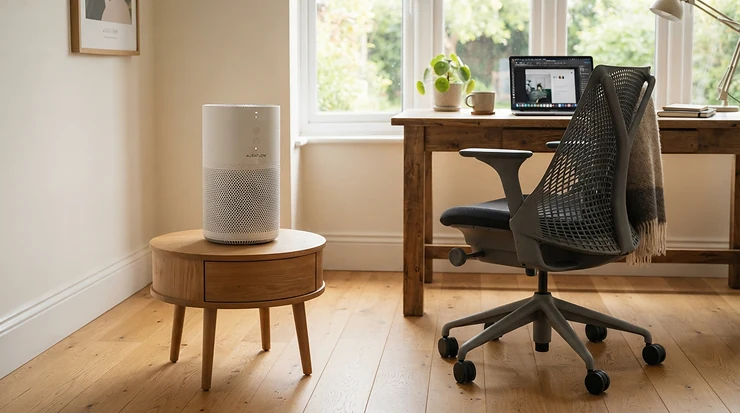
An air purifier for home office allergies is a portable, HEPA-based air cleaner sized to the room where you work. It captures airborne dust, pollen, pet dander, and dust mite debris while staying quiet enough for video calls. Its value comes from three things: matched airflow (CADR), a sealed HEPA path, and consistent runtime.
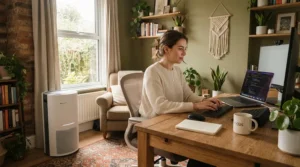
Now the fun part. Working from home was supposed to be a perk. Then came the 10 a.m. sneezing fit, the itchy eyes during the quarterly review, and the mystery scratchy throat that shows up every Tuesday. A home office is usually small, carpeted or upholstered, packed with electronics that attract dust, and occupied for eight-plus hours a day. That’s a concentrated dose of whatever floats in the air.
The good news is that this is a solvable problem. The EPA’s guide to air cleaners in the home explains that a portable cleaner with a high enough CADR (clean air delivery rate) can filter particles for the room it’s sized for. It also warns that the CADR system rates particles only, not gases. Keep that caveat in mind, because it shapes every recommendation below.
Here is what this guide does. It compares seven real, currently sold models across budget, mid-range, and premium tiers. It translates spec sheets into what they mean at your desk. And it covers the practical stuff Amazon listings skip: placement, filter costs, ozone safety, and how to handle dust mites, dust, and odor. Every pick is grounded in published specs and independent testing. I haven’t personally tested any of them, and I’ll flag where the evidence is thin.
Quick Comparison: Best Air Purifier for Home Office Allergies at a Glance
| Product | Best For | Rated Room Size | Price Range* |
|---|---|---|---|
| Clorox Medium Room True HEPA (11030) | Tight budgets, small offices | About 225 sq ft at 5 air changes/hr | Under $150 |
| Levoit Core 300S-P | Desk-side smart control | About 219 sq ft | Roughly $100-$150 |
| Coway Airmega AP-1512HH Mighty | Proven all-rounder | 361 sq ft | Under $250 |
| Winix 5510 | Big CADR per dollar | 392 sq ft (AHAM) | Roughly $160-$200 |
| Levoit Core 400S-P | Smart-home allergy setups | 358 sq ft | Roughly $180-$230 |
| Blueair Blue Pure 311i+ Max | Light, quiet, movable | Roughly 465-525 sq ft (sources differ) | Mid-tier; check current price |
| Rabbit Air A3 | Premium, wall-mounted, long-term | 535 sq ft at 4 air changes/hr | Roughly $700-$800 |
*Price ranges reflect what I found at the time of research and change often. Check current price before buying.
Looking at the table, the Coway Airmega AP-1512HH Mighty and Winix 5510 deliver the most cleaning power per dollar for a typical spare-bedroom office. If you work in a closet-sized nook, the Clorox Medium Room True HEPA (11030) and Levoit Core 300S-P are enough, and they leave money for filters. The Rabbit Air A3 only makes sense if you want a long-haul, near-silent machine and can accept the price.
💬 Just one click — help others make better buying decisions too!😊
Top 7 Air Purifier for Home Office Allergies Picks: Expert Analysis
1. Clorox Medium Room True HEPA (11030) — cheapest ticket to genuine HEPA
If you want real HEPA filtration without turning your budget into a cautionary tale, this is the entry point.
Clorox lists CADR at 148 (smoke), 154 (dust), and 160 (pollen). By the EPA’s two-thirds rule of thumb, that comfortably supports a 200-square-foot office. The three-layer filter (pre-filter, HEPA, carbon) works alongside a PM2.5 display and auto mode, so the fan speeds up when the air turns ugly. The quietest setting is listed at about 30 dB.
On paper, this is the pick for renters and first-timers who want to find out whether purification helps before spending more. One listing quirk deserves a warning: the 1,000-square-foot figure is for one air change per hour, which is useless for allergies. The 225-square-foot, five-changes-per-hour figure is the honest number.
Forbes’ testing panel called it effective for medium rooms at a price well under $150. I couldn’t verify a deep pool of independent long-term owner reviews, so treat durability as less proven than the Coway or Levoit models.
Pros:
- ✅ Real HEPA filter at a bargain price
- ✅ PM2.5 display with auto mode
- ✅ Compact footprint fits a desk corner
Cons:
- ❌ Carbon layer is light-duty for odors
- ❌ Less long-term owner data than rivals
Price range: under $150. Value verdict: excellent for a small room, with the caveat that its durability record is thinner than the pricier picks.

2. Levoit Core 300S-P — smart control in a desk-friendly body
Small footprint, big convenience: this one talks to your phone and your voice assistant.
The Core 300S family is reported at roughly 141 CFM smoke CADR for about 219 square feet, or about 4.8 air changes per hour. Levoit lists sleep-mode noise as low as 22 dB. In practice, that means you can schedule it to run at full blast before your workday and drop to a murmur during calls. The VeSync app, schedules, and Alexa or Google Assistant control make that painless.
Here’s the analytical take: it suits a bedroom-sized office of up to about 200 square feet. Beyond that, you’ll live on the loudest speed. A sibling model, the Core 300-P, cleared about 63% of fine smoke particles from a 200-square-foot lab room in ten minutes, according to TechGearLab. That’s a useful proxy for this shared platform, though it isn’t a test of this exact unit.
Owners and testers generally describe quiet low speeds and easy filter swaps, but a noticeable hum at top speed. Levoit’s pet and toxin filters are interchangeable across the line.
Pros:
- ✅ App scheduling and voice control
- ✅ Very quiet on the lowest setting
- ✅ Interchangeable filter variants for pets or odors
Cons:
- ❌ Too small for rooms over roughly 220 sq ft
- ❌ Filter swaps every 6-8 months add up
Price range: roughly $100-$150 depending on version. Value verdict: the best budget pick if smart scheduling matters to you.
3. Coway Airmega AP-1512HH Mighty — proven workhorse with a washable pre-filter
It’s the “nobody ever got fired for buying it” option, and the spec sheet backs that up.
AHAM-verified CADR sits at 233 (smoke), 246 (dust), and 240 (pollen) for 361 square feet at 4.8 air changes per hour. That dust and pollen performance is exactly what allergy sufferers should care about. It has a washable pre-filter, a deodorization filter (about six months), a HEPA filter (about a year), and a 3-year warranty. Auto mode reads a dirt sensor, and Eco mode sips power.
What most buyers overlook is the optional Vital Ion bipolar device, which you can turn off if you prefer purely mechanical filtration. The lack of Wi-Fi is the main modern gripe. Also note that a review site reports Coway launched a successor, the Mighty2 (AP-1512N), in March 2026, so compare both when shopping.
A retailer listing I checked showed roughly 4.7 stars across more than a thousand ratings. HouseFresh called it hard-working, though not a chart-topper.
Pros:
- ✅ Strong dust and pollen CADR for the size
- ✅ Washable pre-filter cuts running costs
- ✅ Three-year warranty inspires confidence
Cons:
- ❌ No Wi-Fi or app control
- ❌ Higher fan speeds are clearly audible
Price range: under $250. Value verdict: outstanding for spare-bedroom offices, as long as you can live without apps.
4. Winix 5510 — big CADR, Wi-Fi, and a PlasmaWave off-switch
This is the muscle-car of the mid-range: strong airflow, modern controls, and one feature worth understanding.
The 5510 is AHAM-verified for up to 392 square feet, with a smoke CADR around 253 CFM. Winix lists its lowest speed at 23.5 dB and adds a light-sensing sleep mode that dims the LEDs and quiets the fan when the room darkens. The four stages include a washable pre-filter, carbon, HEPA, and PlasmaWave, which you can switch off. Because the EPA notes that plasma air cleaners may emit ozone, being able to disable it is a real advantage. Check the CARB certification either way.
HouseFresh reported the 5510 reached zero fine particles in its 728-cubic-foot test chamber in about 24 minutes at top speed. However, it also found the unit much louder at top speed than the older 5500-2, and noted a smaller filter set whose carbon layer isn’t washable.
Pros:
- ✅ High CADR for the price
- ✅ Wi-Fi app and light-based sleep mode
- ✅ PlasmaWave can be turned off
Cons:
- ❌ Loud at top speed
- ❌ Carbon layer is not washable
Price range: roughly $160-$200. Value verdict: the best cleaning-power-per-dollar pick if you’ll run it mostly on low or auto.
5. Levoit Core 400S-P — the smart-home allergy workhorse
Forbes’ panel named the Core 400S its best pick for allergies, and the reasons are practical.
Current listings show updated AHAM-verified CADR of about 231 (smoke), 240 (dust), and 259 (pollen), rated for roughly 358 square feet at 4.8 air changes per hour. Older reviews still quote 260 CFM and 403 square feet from the 2021 version, so match the numbers to the model you’re buying. A PM2.5 sensor drives auto mode, and noise runs from about 24 dB in sleep to about 52 dB at top speed.
One honest note: Levoit’s parent company dropped “True HEPA” wording in 2023 after a competitor challenged it. Independent measurements still describe the filter as HEPA-grade, so I’d judge performance rather than the label.
Testers praise the feature set and results, but say the air-quality sensor could be more accurate, the top-speed tone is higher-pitched, and the footprint is large. Filters run about $75 a year.
Pros:
- ✅ Strong pollen and dust CADR
- ✅ Sensor-driven auto mode and app
- ✅ Reasonable yearly filter cost
Cons:
- ❌ Sensor accuracy could be better
- ❌ Higher-pitched noise at top speed
Price range: roughly $180-$230. Value verdict: the best all-round choice for a smart, allergy-focused setup.
6. Blueair Blue Pure 311i+ Max — featherweight and whisper-quiet
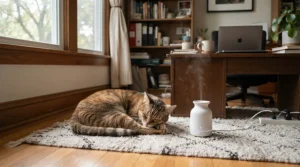
At about 8 pounds and 21 inches tall, it’s the purifier you can carry from office to bedroom without a chiropractor.
Blueair advertises CADR of 339 (smoke), 370 (dust), and 446 (pollen) with coverage up to 525 square feet. Consumer Reports rates its room size lower, at up to 465 square feet, and one review site says about 387, so plan around the conservative figure. Blueair’s HEPASilent technology combines mechanical filtration with electrostatic ionization, according to HouseFresh. Sleep mode measured about 23 dB in one review, and TechGearLab put running cost at roughly $19 a year in electricity.
Reviewers consistently note the quiet operation and low energy use. The trade-offs are a thin carbon layer that struggles with heavy cooking smells and filter costs of about $44 every six months, so roughly $90 a year.
Pros:
- ✅ Very quiet and lightweight
- ✅ Very low electricity cost
- ✅ App, sensor, and filter-life alerts
Cons:
- ❌ Thin carbon layer for odors
- ❌ Filters cost about $90 per year
Price range: mid-tier; check current price. Value verdict: great for quiet, movable, particle-focused cleaning, less so for smells.
7. Rabbit Air A3 — premium, wall-mountable, and built for years
If a purifier were a piece of furniture, this would be the designer sideboard.
Rabbit Air rates it for 1,070 square feet at 2 air changes per hour, which drops to 535 square feet at the 4 air changes an allergy sufferer should want. The lowest speed measures about 20.3 dBA, and listings put CADR anywhere from roughly 257 to 315 CFM. The six-stage system includes a BioGS HEPA filter and a swappable custom filter (pet allergy, odor, toxin, or germ defense). It’s wall-mountable and carries a 5-year warranty. Filters last up to two years at 12 hours a day, or about a year at 24 hours.
For a home office, this is overkill on size but excellent on silence. Reviewers praise the quiet and the customization, while criticizing the high upfront cost, expensive filters, and lack of HomeKit or Google Assistant support.
Pros:
- ✅ Near-silent low speed for calls
- ✅ Custom filter options for your triggers
- ✅ Five-year warranty and wall-mount option
Cons:
- ❌ Very high upfront price
- ❌ Oversized for small offices
Price range: roughly $700-$800. Value verdict: worth it only if you’ll keep it for years and want maximum quiet.
Side-by-Side: Top 7 Specs
| Product | CADR (cfm) | Lowest Noise | Smart Features | Independent Note |
|---|---|---|---|---|
| Clorox Medium Room True HEPA (11030) | 148/154/160 | About 30 dB | Auto mode, PM2.5 display | Forbes value pick |
| Levoit Core 300S-P | About 141 smoke | About 22 dB | App and voice | Sibling tested by TechGearLab |
| Coway Airmega AP-1512HH Mighty | 233/246/240 | About 24 dB | Auto and Eco, no Wi-Fi | Reviewed by Consumer Reports |
| Winix 5510 | About 253 smoke | 23.5 dB | Wi-Fi app | AHAM-verified to 392 sq ft |
| Levoit Core 400S-P | 231/240/259 | About 24 dB | App and sensor | Forbes best for allergies |
| Blueair Blue Pure 311i+ Max | 339/370/446 (Blueair-listed) | About 23 dB | App and sensor | Energy Star; low running cost |
| Rabbit Air A3 | About 257-315 (varies) | About 20.3 dBA | Wi-Fi, Bluetooth, Alexa | 5-year warranty |
Read this table by the CADR order: smoke, dust, pollen. The Levoit Core 400S-P and Coway Airmega AP-1512HH Mighty are nearly matched for dust and pollen, so the tiebreaker is Wi-Fi versus a three-year warranty and a washable pre-filter. Blueair’s own CADR figures look higher than the others, but they aren’t directly comparable to CR’s room rating, so use them as a directional guide only. For office use, the noise column matters as much as CADR, because a purifier you switch off during calls isn’t cleaning anything.
✨ Don’t Miss These Exclusive Deals!
🔍 Take your home office air quality to the next level with these carefully selected purifiers. Click on any highlighted item to check current pricing and availability. These picks will help you build a workspace where you can finally breathe easy. 🌿
Setup Guide: Placing Your Air Purifier for Home Office Allergies
Even a great machine underperforms when it’s parked badly. Here’s a practical routine that Amazon listings don’t give you.
Step 1: Give it airflow. Leave roughly 6 to 12 inches of clearance around the intake and outlet. Pushing it into a corner behind the desk chokes it.
Step 2: Place it near you, not near the door. Put it within a few feet of where you sit, ideally with the outlet pointed away from your face. You want it capturing what you’re breathing, not just what’s drifting past the hallway.
Step 3: Run it before you need it. Start it 30 to 60 minutes before your workday, or use the schedule on the Levoit Core 300S-P, Winix 5510, or Levoit Core 400S-P. The EPA notes that longer run times and higher fan speeds increase the amount of air filtered.
Step 4: Use the highest speed for spikes. Run it on high while you vacuum, dust, or make the bed, then drop back to low or auto.
Step 5: Keep windows closed on high-pollen days. Otherwise the purifier is bailing out a boat with the tap still running.
Step 6: Set a filter calendar. Vacuum washable pre-filters monthly, and replace HEPA and carbon filters according to the maker’s schedule.
First-30-days mistakes to avoid: running it only on the lowest speed, ignoring the filter light, and buying a unit sized for a bigger room than yours.
Real-World Scenarios: Which Air Purifier for Work From Home Life?
Specs are abstract. Here are three realistic profiles and the reasoning behind each match.
Scenario 1: The renter in a converted closet office (about 100 square feet, $150 budget). The EPA’s sizing chart suggests a minimum CADR of about 65 cfm for 100 square feet. Either the Clorox Medium Room True HEPA (11030) or Levoit Core 300S-P clears that easily. Run it on low most of the day, and budget for a filter every 6 to 12 months.
Scenario 2: The full-time remote worker in a 12-by-12 spare bedroom, dust-sensitive, on daily calls. At 144 square feet, the two-thirds rule points to about 96 cfm, but going well above that lets you run quietly. The Coway Airmega AP-1512HH Mighty or Winix 5510 works here, with the Winix’s Wi-Fi scheduling as a bonus.
Scenario 3: The hybrid worker with a large open-plan corner (about 350 square feet), a dog, and a smart-home setup. The Levoit Core 400S-P handles that size, while the Blueair Blue Pure 311i+ Max is the easier choice if you move the purifier between rooms. If you want a custom filter for pet dander, the Rabbit Air A3 covers it, at a much higher price.
The pattern: match the machine to the smaller of your two real constraints, room size or noise tolerance, and then buy one step up in CADR.
How to Choose an Air Purifier for Home Office Allergies
Follow these six steps in order.
- Measure your room and use the EPA sizing chart. For a 200-square-foot room, the chart suggests at least 130 cfm. Add a margin if your ceilings exceed eight feet.
- Prioritize dust and pollen CADR. For allergies, dust and pollen CADR matter more than smoke CADR, although the three usually track each other.
- Insist on genuine HEPA-grade filtration. Look for independently verified performance, not just a marketing label.
- Check the noise at the speed you’ll actually use. The Washington State Department of Health notes the EPA recommends keeping indoor noise below 45 dB, and that loud devices are more likely to get switched off.
- Add carbon only if odors matter. A thick carbon bed helps with gases. A thin layer is mostly a marketing checkbox.
- Calculate filter cost. A cheap purifier with pricey filters isn’t cheap. Multiply yearly filter cost by three before you buy.
HEPA Filtration Explained: Features That Actually Matter (And Those That Don’t)
HEPA filtration is the baseline. A true HEPA filter captures at least 99.97% of particles at 0.3 microns, and most common allergens, including pollen, pet dander, and much dust mite debris, are larger or comparable. That’s why every pick above leans on it.
What matters beyond that? First, CADR, because a great filter in a weak airflow path is a strong lock on a door nobody walks through. Second, a sealed housing, so air can’t bypass the filter. Third, a washable pre-filter, which extends the life of the expensive HEPA layer.
What matters less? Marketing add-ons. Ionizers, plasma modes, and UV lamps come with trade-offs. The EPA notes that ionizers and plasma air cleaners may emit ozone, and that typical home UV units have limited effectiveness. That doesn’t mean every ionizer-equipped model is unsafe, since the Coway Airmega AP-1512HH Mighty, Winix 5510, and Blueair Blue Pure 311i+ Max all use them in some form. But if you want the simplest option, choose mechanical filtration and switch optional ionizers off.
And smart features? Genuinely useful for scheduling, but they won’t make your air any cleaner. Pay for them only if you’ll use them.
Air Purifier for Home Office Dust: What Actually Moves the Needle
Dust in a home office is stubborn because it’s constantly regenerated. Skin flakes, clothing fibers, paper, printer toner, and cable clutter all feed it. A purifier captures what’s airborne, but it can’t stop your bookshelf from shedding.
For an air purifier for home office dust, prioritize dust CADR and a large-capacity pre-filter. That’s why the Coway Airmega AP-1512HH Mighty (dust CADR 246) and Levoit Core 400S-P (dust CADR 240) are strong fits. The Clorox Medium Room True HEPA (11030) also rates well at 154 for small offices.
Pair the machine with a few habits. Use a damp or microfiber cloth rather than a dry duster, which just relaunches particles. Keep the purifier off the floor if you have deep carpet, since a stand or low table reduces the dust it inhales from the ground. And run it on high for 15 to 20 minutes after cleaning.
Finally, watch the pre-filter. If it looks like a lint trap, that’s proof the machine is working. Vacuum it monthly, and the HEPA filter behind it will last much longer.
Air Purifier for Office Allergies and Odor: The Carbon Reality Check
An air purifier for office allergies and odor has to do two different jobs, and the specs for each are measured differently. HEPA captures particles. Activated carbon adsorbs gases and odors. The EPA points out that CADR rates particles only, and that there’s no widely used performance rating for gas removal. Carbon works best when there’s a large amount of it.
That’s why not all purifiers are equal on odor. The Blueair Blue Pure 311i+ Max has a thin carbon layer, and reviewers note it barely dents heavy cooking smells. The Levoit Core 400S-P and the Rabbit Air A3, which has dual activated carbon layers and swappable odor or toxin filters, are better bets.
If your office sits next to a kitchen or you have a pet, treat odor as a separate purchase decision. Consider a carbon-upgraded filter variant, such as Levoit’s toxin or pet options, or the Rabbit Air A3‘s Odor Remover filter. And be realistic: no portable unit replaces ventilation, so open a window on low-pollen days when possible.
Dust Mites and Work From Home: The Hidden Trigger Under Your Desk
Dust mites are a stealth trigger. They don’t bite, and you can’t see them. The allergic reaction comes from proteins in their waste and body fragments, and they thrive in warm, humid places like bedding, upholstery, and carpet. If you work from home in a bedroom, you’re probably sitting a few feet from their favorite habitat.
The Asthma and Allergy Foundation of America recommends keeping humidity between 30 and 50% and washing bedding weekly. It also reminds readers that freestanding air cleaners only filter air in a limited area. That’s a key honest limit: a purifier catches mite debris once it’s airborne, but it doesn’t remove the reservoir.
So build a system. Encase the mattress and pillows, wash bedding in hot water, and use a HEPA vacuum. Add a $10-$20 hygrometer to check humidity. Then let the purifier handle the airborne fraction during and after activity like making the bed.
For work-from-home setups, placing the purifier in your office, and a second one in the bedroom if budget allows, gives the biggest benefit. The Levoit Core 300S-P is a reasonable second unit for that job.
Air Purifier vs Traditional Alternatives
| Approach | What It Does | Main Limitation | Best For |
|---|---|---|---|
| Portable HEPA purifier (like the Coway Airmega AP-1512HH Mighty) | Continuously filters airborne allergens in one room | Only treats the room it’s in | Daily desk-side relief |
| HEPA vacuum | Removes settled dust from surfaces | Stirs up dust and doesn’t remove most mites | Weekly deep cleaning |
| Opening windows | Dilutes indoor pollutants | Lets pollen and outdoor pollution in | Low-pollen days |
| Upgraded HVAC filter | Filters whole-home air when the system runs | Only works while the system runs | Whole-house baseline |
The takeaway is that these tools do different jobs. A purifier is best for the hours you actually sit at your desk, while vacuuming and humidity control shrink the source. AAFA suggests pairing a certified filter in your central system with room cleaners for the spaces you use most. Think of them as a stack, not a competition.
Long-Term Cost and Maintenance: What You’ll Really Spend
| Product | Upfront Range | Filter Cadence | Best For |
|---|---|---|---|
| Clorox Medium Room True HEPA (11030) | Under $150 | 6-12 months | Lowest entry cost |
| Levoit Core 300S-P | About $100-$150 | 6-8 months | Small rooms, smart control |
| Coway Airmega AP-1512HH Mighty | Under $250 | HEPA yearly, deodorizer about 6 months | Long-term value |
| Winix 5510 | About $160-$200 | Varies with use | Raw power |
| Levoit Core 400S-P | About $180-$230 | 6-9 months, about $75/yr | Smart allergy setups |
| Blueair Blue Pure 311i+ Max | Mid-tier | 6-9 months, about $90/yr | Quiet, low energy use |
| Rabbit Air A3 | About $700-$800 | Up to 1-2 years | Premium longevity |
Total cost of ownership tells a different story than sticker price. Over three years, the Levoit Core 400S-P costs roughly $225 in filters, and the Blueair Blue Pure 311i+ Max roughly $270, so filters can rival the purchase price. The Rabbit Air A3 front-loads the cost but stretches filter intervals. Electricity is minor, since TechGearLab estimated about $19 a year for the Blueair. Buy on total cost, not the price tag, and note the filter model number before checkout.
Safety, Regulations, and Compliance: Ozone and Certifications
Safety is where a little knowledge saves a lot of regret. Ozone is a lung irritant, and the EPA advises avoiding air cleaners that intentionally produce it. It also notes that ionizers, some UV lights, and plasma cleaners may emit ozone in some cases.
The practical defense is certification. The California Air Resources Board maintains a list of certified air cleaners and advises matching CADR to the space. AHAM also runs a CADR verification program at cadr.org. Check both before buying, especially for models with ionizers or plasma features.
Two more points. The EPA states that removing particles is not, by itself, proof that an air cleaner reduces health effects. It also notes that it doesn’t certify or recommend specific brands. So treat any purifier as one tool in an allergy plan. If you have asthma or severe allergies, talk to a clinician, and don’t let a gadget replace medical advice.
FAQ
❓ How many air changes per hour do I need for an air purifier for home office dust?
❓ Can a small HEPA purifier handle dust mites when I work from home?
❓ What CADR do I need for a 12-by-12 home office?
❓ Will an air purifier for office allergies and odor remove cooking smells from next door?
❓ How often should I replace the filter in my home office purifier?
Conclusion
Choosing an air purifier for home office allergies comes down to matching three things: room size, noise tolerance, and long-term filter cost. For most spare-bedroom offices, the Coway Airmega AP-1512HH Mighty and Levoit Core 400S-P are the safest bets. The Winix 5510 wins on raw airflow per dollar, while the Clorox Medium Room True HEPA (11030) and Levoit Core 300S-P keep tight budgets happy. The Blueair Blue Pure 311i+ Max is the lightweight, quiet mover, and the Rabbit Air A3 is the premium, buy-it-once option.
Remember the limits. A purifier reduces airborne dust, dander, and mite debris, but it doesn’t remove the source, and it doesn’t rate gases. Combine it with humidity control, hot-water bedding washes, a HEPA vacuum, and smart placement. Sized correctly and run consistently, your purifier becomes the quietest colleague you’ll ever have, and the only one who never asks to “circle back.”
Recommended for You
- Air Purifier For Small Kitchen: 7 Picks That Actually Work (2026)
- Air Purifier For Kitchen Smoke: 7 Real Picks That Work In 2026
- Air Purifier For Kitchen Cooking Smells: 7 Real Picks That Actually Clear The Air (2026)
Disclaimer: This article contains affiliate links. As an Amazon Associate, I earn from qualifying purchases. If you purchase products through these links, we may earn a small commission at no additional cost to you.
✨ Found this helpful? Share it with your friends! 💬🤗
