
In This Article
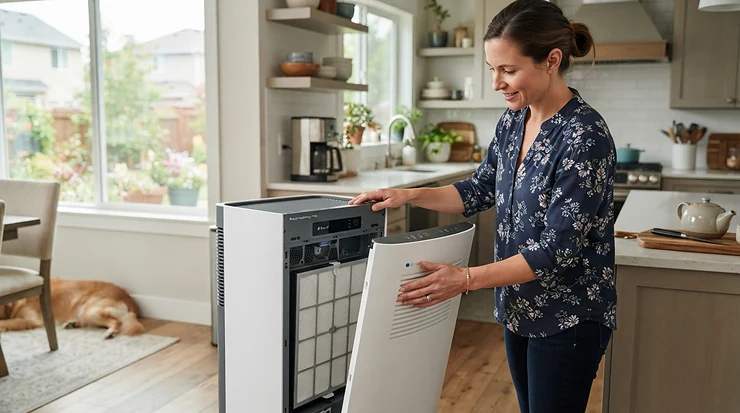
Your kitchen lies to you. It smells fine by dinner, but for the twenty minutes after you sear a steak or fry an egg, the air in there is doing things you can’t see. An air purifier for kitchen smoke isn’t a luxury gadget — it’s the difference between a room that clears itself in fifteen minutes and one that still smells like Tuesday’s salmon on Friday.

Here’s the uncomfortable part: most range hoods, especially the recirculating kind bolted under a microwave, barely touch the problem. They move air around; they don’t scrub it. Meanwhile, every time oil hits a hot pan you’re releasing a cloud of PM2.5 particles small enough to lodge deep in your lungs, plus a chemical soup of volatile organic compounds your nose picks up as “smell” long after the visible haze is gone. If you cook on gas, add nitrogen dioxide to that list — a byproduct of combustion that has nothing to do with the food and everything to do with the flame.
None of this means you need to panic about dinner. It means the purifier you park near your stove has a very specific job description, and most bedroom-grade units were never built for it. Below, we break down seven real, currently available models — spanning sub-$50 budget picks to design-forward premium units — based on their actual filtration hardware, not marketing copy. We’ll cover what a proper air purifier for kitchen grease odor needs that a basic model skips, how an air purifier for kitchen with gas stove differs from a standard one, and where a grease filter earns its keep. Let’s get into it.
Quick Comparison Table
| Model | Best For | Price Range | Key Filtration |
|---|---|---|---|
| MOOKA B-D02L | Budget kitchens | Under $50 | H13 HEPA + carbon |
| Levoit Core300-P | Compact/near-stove use | $90–$110 range | 3-stage carbon HEPA |
| Winix 5500-2 | Daily heavy cooking | $180–$230 range | Washable AOC carbon + PlasmaWave |
| Coway Airmega 400 | Open-concept kitchens | $350–$450 range | Max2 HEPA + carbon |
| Blueair Blue Pure 211i Max | Fast whole-room clearing | $250–$350 range | HEPASilent + carbon |
| Alen BreatheSmart 45i | Swappable smoke/odor media | $450–$550 range | H13 HEPA + smoke-tuned carbon |
| Rabbit Air MinusA2 | Design-conscious small kitchens | $550–$600 range | Customizable multi-stage |
Looking at the spread above, the gap that matters most isn’t price — it’s carbon depth. Budget units like the MOOKA B-D02L lean on thin carbon layers that handle light smoke fine but saturate fast under daily frying, while the Alen BreatheSmart 45i and Coway Airmega 400 carry enough activated carbon mass to keep pulling VOCs out of the air for months. If your cooking is occasional and light, the cheap end works; if you fry, sear, or cook with gas most nights, budget up toward the carbon-heavy end of this table.
💬 Just one click — help others make better buying decisions too!😊
What Is an Air Purifier for Kitchen Smoke?
An air purifier for kitchen smoke is a portable filtration unit built with a dense activated-carbon stage alongside HEPA filtration, specifically to handle the combination of grease aerosols, fine smoke particulates, and lingering cooking VOCs that standard bedroom or living-room purifiers aren’t optimized to catch. The carbon stage matters because HEPA media alone captures particles, not gas-phase odor molecules.
That distinction trips up a lot of buyers. Volatile organic compounds are emitted as gases from certain solids or liquids, and concentrations of many VOCs run consistently higher indoors — up to ten times higher — than outdoors. A technical overview from the EPA explains why a HEPA-only purifier can leave a kitchen looking clear while it still smells like last night’s garlic and onions — the gas molecules responsible for that smell pass straight through particulate filtration and need to be adsorbed by carbon instead.
Top 7 Air Purifiers for Kitchen Smoke: Expert Analysis
1. MOOKA B-D02L — quietest budget pick for tight kitchens
The MOOKA B-D02L opens this list by proving a sub-$50 unit doesn’t have to be a toy. Its 20dB noise rating is genuinely low — quiet enough to run continuously without becoming background static in a small kitchen.
Under the hood, it runs a three-stage system: a pre-filter, an H13 True HEPA layer, and an activated carbon stage, rated to handle particles down to 0.3 microns. That H13 designation matters more than it sounds — many bargain purifiers advertise “HEPA-type” filtration that doesn’t meet the actual efficiency standard, while the MOOKA B-D02L uses genuine H13-grade media. For anyone cooking bacon or chili in a small galley kitchen without wanting to spend real money, this is a legitimate starting point, though it’s built for supplementary duty rather than being the sole line of defense against heavy daily frying.
Reviewers testing the unit against bacon smoke and chili vapors reported it handled both effectively, and praised how unobtrusive the noise level is even at close range. The carbon layer, however, is thin by design at this price — expect it to saturate faster than the premium options further down this list if you’re cooking with oil every single day.
Pros:
- ✅ Genuine H13 HEPA media, not a “HEPA-type” imitation
- ✅ 20dB noise floor — nearly silent in daily use
- ✅ Compact footprint fits tight counter or floor space
Cons:
- ❌ Thin carbon bed saturates quickly under daily frying
- ❌ Claimed 1,076 sq ft coverage is optimistic for kitchen-duty smoke clearing
At under $50, the MOOKA B-D02L is best treated as a secondary unit stationed right beside the stove rather than a whole-kitchen solution, and at that price the value is hard to argue with.
2. Levoit Core300-P — best compact all-rounder near the stove
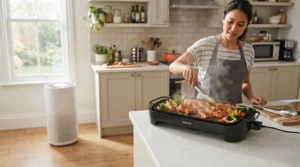
The Levoit Core300-P earns its slot as the pill-shaped, countertop-friendly option. Levoit’s own published specs put its CADR at 143 CFM, with an ideal room size around 222 square feet at close to five air changes per hour — squarely in “apartment kitchen” territory rather than open-concept great room.
What most buyers overlook about this model is that Levoit sells multiple carbon filter variants for the same housing — the Original filter, and heavier-carbon options built for pets, toxins, or smoke specifically. Swapping to the Smoke Remover cartridge roughly doubles the carbon weight compared to the standard filter, which is a meaningful upgrade path if cooking odor turns out to be your primary complaint after buying the base unit. The 360-degree VortexAir intake also means placement is forgiving — it doesn’t need to face the stove directly to pull in cooking air.
Independent testing has found the Core300-P’s CADR numbers solid for the price but not class-leading; it’s outperformed by pricier units of similar size. Reviewers also note the lack of an onboard air-quality sensor, so there’s no auto mode reacting to a sudden smoke spike — you’re manually bumping the fan speed when the pan starts smoking.
Pros:
- ✅ Compact, attractive design fits small counters
- ✅ Upgradeable carbon cartridge specifically built for smoke and odor
- ✅ Quiet operation with a genuine two-year warranty
Cons:
- ❌ No onboard air-quality sensor or auto mode
- ❌ Base filter’s carbon amount is modest until upgraded
Priced in the $90–$110 range, the Levoit Core300-P rewards anyone willing to spend a little extra on the smoke-specific filter cartridge from day one.
3. Winix 5500-2 — best carbon-to-price ratio for daily cooking
The Winix 5500-2 is the value pick that keeps showing up in independent testing for a reason: a washable AOC (Advanced Odor Control) carbon filter built from granular pellets rather than the thinner impregnated-fabric carbon found in many competitors, plus AHAM-verified CADR numbers of 232 for smoke, 243 for dust, and 246 for pollen across a 360-square-foot rating.
Here’s what the spec sheet doesn’t tell you outright: the fact that the carbon filter is washable, not disposable, changes the long-term math significantly. Instead of buying a full replacement cartridge every few months, you’re rinsing and reusing the carbon pellets, which stretches the cost of ownership further than a comparable unit with sealed, disposable carbon. Pair that with the PlasmaWave stage — an ionization technology Winix claims breaks down odors and chemical vapors at a molecular level without generating meaningful ozone — and you get a purifier engineered around kitchen odor specifically, not as an afterthought.
Independent lab testing recorded a 728-cubic-foot test room cleared in 23 minutes with PlasmaWave engaged, and reviewers have flagged this as one of the strongest price-to-CADR ratios on the market. Worth noting: Winix has phased out the original 5500-2 in favor of the newer 5510, so availability of this exact model may vary by retailer, though functionally similar units remain easy to find.
Pros:
- ✅ Washable carbon filter cuts long-term replacement costs
- ✅ Strong 232 CFM smoke CADR for the price bracket
- ✅ PlasmaWave stage with a manual off switch if you’d rather skip ionization
Cons:
- ❌ Original model is being phased out for the newer 5510
- ❌ No memory setting — a power outage resets PlasmaWave to on by default
At a typical $180–$230 range, the Winix 5500-2 remains one of the smartest buys here for anyone who cooks with oil most nights of the week.
4. Coway Airmega 400 — best for open-concept kitchen-living combos
Where the previous three units are built for a contained kitchen, the Coway Airmega 400 is built for the open floor plan where your stove and your living room share the same air. Coway rates it for 1,560 square feet at two air changes per hour — nearly quadruple the coverage of the Levoit unit above — using a pre-filter plus dual Max2 HEPA-and-carbon filter cartridges.
The honest analytical take here involves a real tension in the data. Coway’s own published CADR figures put smoke clearance at 328 CFM, but some independent forum testing has pointed out that per dollar spent, cheaper units like the Winix 5500-2 deliver a higher percentage of that performance at roughly 30% of the price — worth knowing if raw CADR-per-dollar is your priority rather than smart features and coverage area. What the number alone won’t tell you is that the 400’s automatic mode, which relies on a built-in pollution sensor to ramp the fan without input, is what owners are actually paying for.
Real owners running this unit in kitchen-adjacent spaces for years report it performing reliably in rooms up to roughly 600 square feet, though at least one long-term user noted the auto mode can be slow to react to a sudden burst of cooking smoke, since it samples air in intervals rather than continuously.
Pros:
- ✅ 1,560 sq ft coverage suits open-concept layouts
- ✅ Real-time pollution sensor with automatic, eco, and sleep modes
- ✅ Five-year warranty, among the longest in this category
Cons:
- ❌ Lower CADR-per-dollar than budget rivals like the Winix 5500-2
- ❌ Auto mode can lag behind sudden cooking-smoke spikes
Expect to pay in the $350–$450 range, positioning the Coway Airmega 400 as the choice for square footage first, price efficiency second.
5. Blueair Blue Pure 211i Max — fastest clearance in large kitchens
The Blueair Blue Pure 211i Max leans on Blueair’s HEPASilent technology, a hybrid mechanical-and-electrostatic filtration approach the brand says delivers more clean air with less noise and energy draw than mechanical HEPA filtration running alone. The published numbers back that speed claim: roughly 635 square feet cleared in about 12.5 minutes on high, with a rated coverage up to 1,618 square feet.
What matters for kitchen use specifically is a caveat straight from Blueair’s own filter documentation: the carbon layer is described as designed to trap “light household odors from smoking, pets and cooking.” That phrasing is honest, and it’s also a flag — this unit was engineered primarily as a fast particle-clearing machine with odor control as a secondary feature, not a heavy-carbon odor specialist like the Alen unit further down this list. For someone whose kitchen produces occasional light cooking smells rather than daily heavy frying or fish, that’s a fair trade for the speed and near-silent operation.
The app-connected RealTrack system calculates filter life based on actual usage and pollution exposure rather than a flat calendar countdown, which is a genuinely useful touch — you’re not replacing a filter early just because nine months passed on paper if the air quality in your home has been mild.
Pros:
- ✅ Extremely fast air clearance — full-size rooms in about 30 minutes
- ✅ Quiet HEPASilent tech avoids the fan-motor whine of cheaper units
- ✅ App-based RealTrack filter monitoring based on actual usage
Cons:
- ❌ Carbon filter is tuned for light odors, not heavy daily grease
- ❌ Genuine replacement filters run around $60 each
Priced typically in the $250–$350 range, the Blueair Blue Pure 211i Max is the pick for speed and quiet operation over maximum odor-fighting depth.
6. Alen BreatheSmart 45i — best swappable smoke-and-odor filter
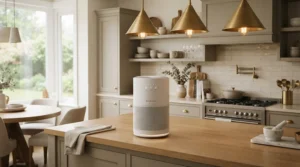
The Alen BreatheSmart 45i stands apart on one specific feature: filter modularity. Alen sells the same housing with interchangeable cartridge options — including a “Fresh” HEPA filter explicitly marketed for allergens, dust, odors, and smoke, alongside a Pure option built for general allergens. That means you’re not locked into one filtration profile; if kitchen odor turns out to dominate your air-quality complaints, you swap in the odor-and-smoke-tuned cartridge without buying a new unit.
CADR figures for the 45i vary slightly by source and fan speed, landing around 245–255 CFM at top speed according to Alen’s own published specs, with coverage estimates ranging from 800 up to roughly 1,600–1,900 square feet depending on how aggressively you want air turned over per hour — a spread worth double-checking against your actual kitchen square footage before buying. Independent testing clocked it clearing a test room in 33 minutes, putting it a notch behind the fastest units here but ahead of most budget purifiers.
The Forever Guarantee warranty program is a genuine differentiator, though it’s tied to an active filter subscription, which is worth factoring into total cost of ownership rather than treating as free. SleepScore Labs validation and the “pink noise” operating profile are aimed more at bedroom use, but they translate to a purifier that isn’t obnoxious to have running non-stop in a kitchen either.
Pros:
- ✅ Swappable filter cartridges tuned specifically for smoke and odor
- ✅ Strong CADR relative to its physical footprint
- ✅ Forever Guarantee warranty with active filter subscription
Cons:
- ❌ Coverage estimates vary confusingly across Alen’s own listings
- ❌ Premium price plus an ongoing filter subscription cost
Sitting in the $450–$550 range, the Alen BreatheSmart 45i is the pick for buyers who want to tune their filtration specifically around cooking odor rather than accept a one-size-fits-all cartridge.
7. Rabbit Air MinusA2 — most design-forward wall-mount option
The Rabbit Air MinusA2 closes this list as the outlier: a wall-mountable, design-forward unit built to disappear into a kitchen rather than sit as a visible appliance. Available research on this model points to a recommended coverage under roughly 400 square feet, positioning it for smaller or medium kitchens rather than open-concept great rooms, with genuine replacement filters running $70–$80 per set.
Because verified third-party lab data on this specific model is thinner than for the mass-market purifiers above, the honest take is this: choosing it means prioritizing form alongside function. Its customizable middle-filter system — a well-documented feature of the MinusA2 line that lets buyers select cartridges targeted at specific concerns like toxin absorption or odor — is a genuine practical advantage for kitchen duty, since it lets you bias the unit’s filtration toward VOC and odor control rather than a fixed, generic blend. What we can’t verify with the same confidence as the CADR-certified units above is a precise smoke-clearance time, so treat any specific performance claim for this model with a bit more skepticism than the AHAM-tested competitors on this list.
Pros:
- ✅ Wall-mountable design keeps counters and floor space clear
- ✅ Customizable middle filter can be biased toward odor and VOC control
- ✅ Quiet operation praised specifically in design-focused reviews
Cons:
- ❌ Best suited to kitchens under roughly 400 sq ft, not open floor plans
- ❌ Less independently verified performance data than AHAM-tested rivals
At a typical $550–$600 range, the Rabbit Air MinusA2 is a design-first choice, not a budget-conscious one.
How to Choose an Air Purifier for Kitchen Smoke
- Match CADR to your room, not just the box. AHAM’s certification program recommends the smoke CADR equal roughly two-thirds of your room’s square footage as a baseline — as a rule of thumb, the CADR of your air cleaner should be equal to at least two-thirds of the room’s area, though for heavy smoke situations a 1:1 ratio is recommended, according to AHAM’s own certification guidance.
- Weigh the carbon, not just the HEPA rating. A HEPA filter alone won’t touch gas-phase VOCs — you need a genuine activated-carbon stage, and heavier carbon beds simply last longer between saturating.
- Consider gas versus electric. If you cook on gas, prioritize a unit with strong sensor responsiveness, since combustion byproducts spike fast and fade fast.
- Check real (not “HEPA-type”) certification. Genuine H13 or H14 HEPA claims matter more than marketing language that sounds similar but isn’t independently verified.
- Factor in noise for continuous use. A kitchen purifier that’s annoying at high speed won’t get run at high speed when it matters most — during and after cooking.
- Price the filters, not just the unit. A cheap purifier with expensive, frequent replacement filters can cost more over two years than a pricier unit with a washable or long-life cartridge.
- Match coverage to your actual layout. Open-concept kitchens need dramatically more CADR than a closed galley kitchen of the same square footage, since the air isn’t contained.
Air Purifier for Kitchen Grease Odor: Why Carbon Depth Matters
Grease odor is stubborn in a specific way: frying and sautéing release both airborne grease aerosols (microscopic oil droplets) and odor-carrying VOC gases simultaneously, and they behave differently once airborne. The grease aerosols get trapped by mechanical filtration — your pre-filter and HEPA stage — but they also coat and gum up thinner filters faster than almost any other household pollutant, which is why cheap purifiers running in a kitchen often need filter changes far sooner than their rated lifespan suggests.
The odor molecules themselves are a separate fight. Reviewers testing purifiers specifically against curry, fried fish, and garlic-heavy cooking have consistently found that units with substantial carbon beds clear lingering smell in under an hour, while thin-carbon budget units can take well over 75 minutes in an identical space. If grease odor specifically — not just visible smoke — is your main complaint, that pushes the calculus toward units like the Winix 5500-2 or Alen BreatheSmart 45i, both of which carry meaningfully more carbon mass than compact budget picks.
Air Purifier for Kitchen With Gas Stove: Handling NO2 and Combustion Byproducts
Cooking with gas introduces a pollutant electric ranges simply don’t produce in the same quantity: nitrogen dioxide, released any time a burner is lit, independent of whatever’s in the pan. This is where the case for a dedicated air purifier for kitchen with gas stove gets more serious than odor control alone.
Recent nationwide research has found gas stoves punch well above their weight as a pollution source. Pollution from gas stoves accounts for more than half of some Americans’ total exposure to nitrogen dioxide, and for those who use their stoves more often and for extended periods, indoor exposure can account for more than half of their total nitrogen dioxide exposure. As reporting from Yale’s e360 publication notes, stovetops typically lack the direct, sealed ventilation that other gas appliances have, and a range hood — especially a recirculating one — doesn’t capture all of that emission before it disperses.
It’s worth being precise here about what a portable air purifier can and can’t do for NO2 specifically: most consumer HEPA-and-carbon units are built primarily for particulates and VOCs, not gas-phase combustion pollutants like nitrogen dioxide, which require specialized sorbent media to meaningfully reduce. If you cook on gas frequently, the strongest practical combination is running your range hood’s exhaust (not recirculating mode, if you have a choice) every time you cook, alongside a carbon-and-HEPA purifier like the ones above for the particulate and odor load left behind.
Grease Filter vs Standard Pre-Filter: What’s the Difference
Every purifier on this list includes some kind of pre-filter, but not all pre-filters are built the same way, and the distinction matters more in a kitchen than almost anywhere else in the house. A standard pre-filter is typically a fine mesh screen designed to catch dust, hair, and large debris before it reaches the HEPA stage — fine for a bedroom, but it saturates with sticky grease film far faster in a kitchen.
A true grease filter, the kind found in commercial range-hood systems and higher-end residential units, uses a different structure — often a metal baffle or aluminum mesh specifically designed so grease condenses and drips away rather than clogging the filter media. Commercial-grade kitchen air systems typically layer a metal grease baffle ahead of any electrostatic or carbon stage precisely because grease will otherwise coat and blind those finer filters within weeks. For home purifiers, the practical takeaway is simpler: wipe or wash your unit’s pre-filter far more often in kitchen duty than the manual suggests, since a grease-coated pre-filter throttles airflow to everything downstream of it, including your expensive carbon stage.
Smoke Particles vs VOC Exposure: Two Different Problems
It’s tempting to treat “kitchen air pollution” as one problem, but smoke particles and VOC exposure are functionally different fights that happen to occur at the same time over your stove. Smoke particles are physical matter — PM2.5 and smaller, solid or liquid droplets suspended in air — and they’re what a HEPA filter is specifically rated to capture, down to 0.3 microns and smaller.
VOC exposure is a gas-phase problem. EPA’s Total Exposure Assessment Methodology studies found levels of about a dozen common organic pollutants to be 2 to 5 times higher inside homes than outside, regardless of whether the homes were rural or industrial, and elevated concentrations can persist in the air long after the activity producing them has ended. That persistence is the part that surprises people — the visible smoke from searing a steak clears in minutes, but the VOC signature (the smell) can linger for an hour or more if there’s no meaningful carbon filtration pulling those gas molecules out of circulation. Practically, this means judging a purifier by how fast the haze disappears is misleading; judge it instead by how fast the smell is actually gone.

Kitchen Air Purifier vs Range Hood: Do You Need Both?
| Factor | Range Hood (Ducted) | Range Hood (Recirculating) | Portable Air Purifier |
|---|---|---|---|
| Captures smoke at source | Yes | Partial | No |
| Removes gas byproducts (NO2, CO) | Yes | No | No |
| Filters VOC odor | No | Minimal (carbon add-on varies) | Yes, with carbon stage |
| Best For | New builds, renovations | Existing recirculating setups | Any kitchen, any hood type |
The table above settles a question a lot of people ask backwards. A ducted range hood is the only tool here that actually removes combustion byproducts and pulls smoke outside before it spreads through the room, which is why it should be your first line of defense, especially on a gas stove. A portable purifier is the second line — mopping up the particulates and VOCs that escape the hood’s capture zone, which happens constantly even with a good hood running. Neither replaces the other; a recirculating hood especially benefits from a dedicated purifier nearby, since it’s only filtering, not exhausting, air to begin with.
Common Mistakes When Buying a Kitchen Air Purifier
The single most common mistake is buying based on square-footage marketing numbers without checking the smoke-specific CADR figure, since some manufacturers highlight only their highest number (often pollen) on packaging. A second frequent error is placing the unit too far from the stove — even a powerful purifier loses effectiveness if it’s pulling in already-diluted air from across the room rather than intercepting cooking emissions near the source. Buyers also routinely underestimate filter replacement costs, comparing sticker prices without factoring in a $50–$80 annual filter budget that can flip which unit is actually cheaper over two years. Finally, people often assume “HEPA” alone solves odor — as covered above, it’s the carbon stage doing that job, and a unit light on carbon will disappoint on smell even while performing well on visible particulates.
Long-Term Cost & Maintenance
Total cost of ownership over three years tells a different story than sticker price alone. A MOOKA B-D02L at under $50 with modest filter costs might run $100–$150 total over three years including replacements, while a Winix 5500-2‘s washable carbon filter can actually undercut units with pricier disposable cartridges despite a higher upfront cost. Premium units like the Alen BreatheSmart 45i carry ongoing subscription costs tied to their warranty programs, which need to be budgeted as a recurring expense rather than a one-time purchase. Across the board, indoor air quality guidance from the EPA on reducing indoor pollutant exposure points toward source control and ventilation as complementary, ongoing habits — not one-time fixes a purchase alone solves. Budget for filter changes every 6–12 months depending on cooking frequency, and clean or replace pre-filters more often than the manual suggests if you fry regularly.
Practical Usage Guide: Setup, Placement & Maintenance
Getting a kitchen air purifier working well comes down to placement and habit more than the unit itself. Position it within roughly six to eight feet of your primary cooking zone, ideally where it can pull air across the stove rather than sitting in a far corner catching only what drifts its way. Start the unit before you begin cooking, not after — giving it a five-minute head start on high speed means it’s already pulling volume when the smoke and odor load peaks, rather than playing catch-up.
During the first thirty days, get in the habit of wiping down the pre-filter weekly rather than waiting for a scheduled cleaning, since kitchen grease accumulates faster than dust does in any other room. A common early mistake is running the unit exclusively on auto or low speed to save on noise and energy — for the ten to fifteen minutes immediately after cooking, bump it to its highest setting, then let it drop back down once the air clears. Keep it on for at least thirty minutes after you finish cooking; that’s roughly when carbon-heavy units finish pulling residual VOCs back down to baseline, based on independent testing of comparable units.
Real Kitchen Scenarios: Matching Purifiers to Your Cooking Style
Consider a college student in a 300-square-foot studio kitchen who cooks simple meals a few times a week and is watching every dollar — the MOOKA B-D02L or base Levoit Core300-P covers that use case without overspending on capacity they’ll never need. Compare that to a home cook in an 800-square-foot open-concept kitchen-living space who fries and sears several nights a week and has family members with mild asthma — that situation calls for the higher CADR and stronger carbon load of the Coway Airmega 400 or Alen BreatheSmart 45i, where coverage and odor depth both matter. Finally, picture someone in a small, design-conscious apartment kitchen with a gas stove and limited counter space who wants filtration without a visible appliance cluttering the room — the wall-mountable Rabbit Air MinusA2 solves the space constraint even if it means paying a premium for that footprint advantage.
Frequently Asked Questions
❓ Does an air purifier actually help with cooking smoke?
❓ Can an air purifier remove gas stove fumes like NO2?
❓ What CADR do I need for a kitchen air purifier?
❓ How often should I replace the carbon filter in a kitchen purifier?
❓ Is HEPA or activated carbon more important for kitchen odor?
Conclusion
Kitchen air is a different challenge than any other room in the house, and the right purifier reflects that: heavier carbon for odor, solid CADR relative to your actual square footage, and placement close enough to the stove to matter. Whether that means the no-frills MOOKA B-D02L for a small apartment kitchen or the swappable-filter flexibility of the Alen BreatheSmart 45i for a household that cooks hard every night, the honest comparison above should get you to the right pick faster than scrolling through marketing pages built to make every unit sound identical. Match the model to your actual cooking habits and room size, budget realistically for filter replacement, and remember that even the best purifier works best paired with good ventilation habits, not as a replacement for them.
Recommended for You
- Air Purifier For Kitchen Cooking Smells: 7 Real Picks That Actually Clear The Air (2026)
- Best Air Purifier For Unfinished Basement: 7 Top Picks (2026)
- Air Purifier For Finished Basement: 7 Musty-Odor Fixes For 2026
Disclaimer: This article contains affiliate links. As an Amazon Associate, I earn from qualifying purchases. If you purchase products through these links, we may earn a small commission at no additional cost to you.
✨ Found this helpful? Share it with your friends! 💬🤗
