
In This Article
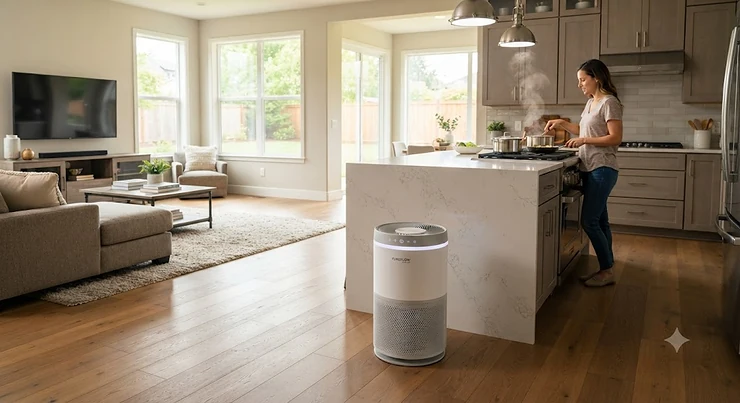
You know the moment. You sear salmon at 6:15, and by 7:30 your throw pillows smell like a seafood restaurant. That’s the tax you pay for an open floor plan: no wall between the stove and the couch means no wall between the smell and, well, everything you own. An air purifier for open floor plan cooking is a device sized and filtered specifically to clear cooking smoke, grease particles, and lingering odor across a connected kitchen-living-dining space rather than a single closed room. That’s the 40-word version. The longer version is messier, because most air purifiers on the market are rated for boxy, sealed bedrooms — not the 600, 900, or 1,400 square feet of shared air that a modern open-concept home actually has.
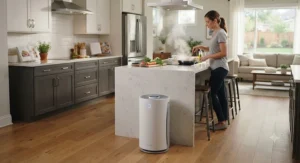
Here’s what nobody tells you at the appliance store: a purifier that’s “great for large rooms” on the box might still lose badly to a garlic-heavy stir-fry in a home with vaulted ceilings and no doors to contain the mess. Cooking is uniquely brutal on indoor air — it throws off fine particulate matter, grease aerosols, and volatile organic compounds (VOCs) that a HEPA filter alone can’t touch. The EPA’s guidance on cooking and indoor air quality recommends running a range hood during and for 10 to 20 minutes after cooking, plus filtering the air with a portable air cleaner sized correctly for the space and free of ozone output. That’s the baseline. This guide goes further: real products, real CADR math, and the specific mistakes that leave people wondering why their $300 purifier still can’t beat a Tuesday night curry.
We researched seven real, currently available purifiers spanning budget to premium, broke down what their specs actually mean for a connected kitchen-living space, and built out the practical playbook — placement, sizing, multi-zone strategy — that turns a purifier from decoration into a tool that actually works.
Quick Comparison Table
| Purifier | Smoke CADR | Best For |
|---|---|---|
| Coway Airmega 400S | 350 CFM | Large open-concept homes |
| Blueair Blue Pure 211i Max | 435 CFM | Heavy cooking odor + carbon capacity |
| Levoit Core 600S | 410 CFM | Best CADR-per-dollar mid-range |
| Winix 5510 | ~245 CFM | Budget pick with app control |
| Coway Airmega AP-1512HH | 233 CFM | Studio apartments and small kitchens |
| Shark Air Purifier MAX | ~300 CFM | Auto-detecting tower fan combo |
| IQAir HealthPro Plus | 260 CFM | Multi-zone, heavy VOC and gas odor |
Looking at this table, the pattern is clear: raw CADR doesn’t map neatly to price, and that’s the trap most buyers fall into. The Coway Airmega 400S and Blueair Blue Pure 211i Max justify their higher price tags with genuine open-concept coverage, while the Levoit Core 600S punches well above its price bracket on smoke CADR alone. Budget buyers shouldn’t assume the cheapest option is underpowered, either — the Winix 5510 and Coway Airmega AP-1512HH are sized honestly for smaller connected spaces rather than trying to oversell square footage they can’t actually clean.
💬 Just one click — help others make better buying decisions too!😊
Top 7 Air Purifiers for Open Floor Plan Cooking: Expert Analysis
Coverage below spans budget, mid-range, and premium tiers, plus a couple of category outliers worth knowing about before you buy.
1. Coway Airmega 400S — best overall for large open-concept homes
The standout here is coverage: this unit is built for the reality of a kitchen that bleeds into a dining room and living room with zero walls in between. Dual True HEPA filters combine with a 350 CFM smoke CADR to cover roughly 1,560 square feet, which is genuinely large-room territory rather than marketing-speak stretched thin.
Based on the spec comparison, the dual-filter setup also means each filter processes a smaller share of grease and smoke, which should translate into a longer usable life than single-filter units running the same air volume. This is the pick for anyone whose kitchen island opens straight into a great room — beginners get a smart auto mode that does the thinking, while anyone chasing max square footage gets a legitimate high-ceiling contender.
Reviewers consistently note that the smart app control and air-quality display make it easy to confirm the unit is actually reacting to cooking events, not just running on a fixed schedule; a recurring theme in aggregated feedback is that the unit is bulkier and heavier than single-filter towers, which matters if you plan to move it between rooms.
Pros:
- ✅ Genuine large-room coverage near 1,560 sq ft
- ✅ Dual HEPA filters extend usable filter life
- ✅ Smart auto mode reacts to cooking in real time
Cons:
- ❌ Heavier and bulkier than single-filter alternatives
- ❌ Higher upfront cost than mid-range options
Expect a price in the $400-$500 range at the time of research; for a household that genuinely spans 1,000+ open square feet, the coverage-per-dollar math still works out favorably.
2. Blueair Blue Pure 211i Max — heaviest carbon capacity for cooking odor
What most buyers overlook about this model is that its optional SmokeBlock filter carries roughly double the activated carbon of the standard particle-plus-carbon filter, which is the single biggest lever for actual odor control. HEPASilent technology blends mechanical and electrostatic filtration, and the unit posts a 435 CFM smoke CADR across up to 674 square feet — sized correctly for a kitchen-living-dining combo rather than a single room.
Here’s what the spec sheet won’t tell you, but reviewers note: the extra carbon volume specifically pays off on lingering smells (fish, curry, fried food) rather than just particle counts, which is exactly the problem open kitchens create. This is the pick for anyone whose primary complaint is smell rather than visible haze — home cooks who fry regularly or live somewhere ventilation is weak.
Aggregated review sentiment consistently praises the quiet high-speed operation relative to its air-moving capacity, though a repeated caveat is that the SmokeBlock filter is a separate purchase from the base carbon filter and adds to ongoing costs.
Pros:
- ✅ SmokeBlock filter option doubles carbon for odor control
- ✅ 435 CFM smoke CADR covers connected kitchen-living space
- ✅ HEPASilent design keeps high-speed noise manageable
Cons:
- ❌ SmokeBlock filter is a separate add-on purchase
- ❌ Base filter alone underperforms on heavy cooking odor
Price sits in the mid-$300s to low-$400s range depending on filter bundle, making it a strong value pick specifically for smell-driven kitchen problems.
3. Levoit Core 600S — best CADR-per-dollar in the mid-range
The 410 CFM smoke CADR on this unit is the headline, and it’s a genuinely strong number for the price bracket it sits in. Based on the spec comparison, that CADR is high enough to hit AHAM’s suggested 4.8 air changes per hour in rooms up to roughly 635 square feet, which covers most single-zone open kitchen-living combinations without needing the premium-tier price.
What most buyers overlook is that the laser particle sensor drives a genuinely responsive auto mode — it ramps up when cooking starts rather than waiting for smell to build, which matters more than the marketing copy suggests. This is a strong fit for budget-conscious buyers who still want real large-room performance and don’t need the extra-large coverage of the premium tier.
Reviewers consistently report smooth VeSync app scheduling and reliable auto-mode response, while a common complaint in user reviews is that the carbon layer, while decent, saturates faster than advertised under regular kitchen use rather than occasional bedroom duty.
Pros:
- ✅ 410 CFM CADR rivals units costing much more
- ✅ Laser sensor drives responsive real-time auto mode
- ✅ VeSync app adds scheduling and remote monitoring
Cons:
- ❌ Carbon layer saturates faster under daily cooking use
- ❌ Coverage claims on marketing exceed AHAM-verified sizing
Expect a price around the $250-$300 range, which places it as arguably the strongest value pick on this list for single-zone open kitchens.
4. Winix 5510 — budget pick with app control
This is the direct successor to the long-running 5500-2, and the standout is that it adds Wi-Fi app control at essentially the same footprint and price tier as its predecessor. The CADR lands in the low-to-mid 200s CFM range across smoke, dust, and pollen, covering roughly 360 square feet — a realistic single-room or small-kitchen number rather than an inflated whole-floor claim.
What most buyers overlook here is the PlasmaWave feature, which supplements the carbon filter for odor work; it can be switched off entirely if you’d rather run mechanical filtration only, which matters for anyone cautious about ionizing technology. This is the pick for renters, studio-adjacent kitchens, or anyone testing whether a dedicated cooking-odor purifier is worth the investment before spending premium money.
Reviewers consistently note reliable everyday performance and easy filter access, while a recurring theme in feedback is that owners wish the carbon filter shipped with more density for serious frying and searing sessions.
Pros:
- ✅ Budget price with genuine Wi-Fi app control added
- ✅ PlasmaWave can be disabled for HEPA-only operation
- ✅ Reliable everyday performance in a compact footprint
Cons:
- ❌ ~360 sq ft coverage is modest for larger open layouts
- ❌ Thinner carbon filter than dedicated odor-focused models
Price runs in the $150-$200 range, making this the easiest low-risk entry point for someone dipping a toe into dedicated kitchen air purification.
5. Coway Airmega AP-1512HH — best for studio apartment cooking
The standout feature on this long-running model is its balance: a four-stage system (washable pre-filter, odor filter, True HEPA, optional ionizer) delivering a 233 CFM smoke CADR in a compact housing built for smaller footprints. Based on the spec comparison, that CADR covers up to roughly 360 square feet at a strong air-change rate — which lines up almost exactly with a studio or one-bedroom apartment kitchenette bleeding into a living area.
What most buyers overlook is that the auto mode’s air-quality indicator ramps fan speed the moment it detects cooking particles, so a studio dweller doesn’t need to remember to manually crank it before frying an egg. This is the pick for studio and small-apartment cooks who need real filtration without premium-tier square footage or price.
Reviewers consistently praise its multi-year reliability track record, and a common theme in aggregated feedback is that the low-speed noise level is quiet enough to run overnight, though the ionizer, if left on, adds a faint operational hum some owners choose to disable.
Pros:
- ✅ Compact four-stage design fits tight studio kitchens
- ✅ Auto mode reacts quickly to cooking particles
- ✅ Long, well-documented reliability track record
Cons:
- ❌ 360 sq ft ceiling limits it for larger open layouts
- ❌ Optional ionizer adds slight hum if left enabled
Price ranges from roughly $180-$230 depending on retailer, and for a genuinely small connected kitchen-living footprint, it remains one of the strongest value propositions available.
6. Shark Air Purifier MAX — best tower fan air purifier combo
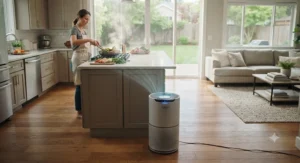
The standout here is the Clean Sense IQ system paired with a dedicated Odor Neutralizer mode — this is a purifier built to detect the moment cooking starts and respond before smell spreads, not after. A NanoSeal H13 HEPA filter pairs with a granular activated carbon layer, and the tower-fan form factor pulls double duty: circulating room air like a standing fan while filtering it, which matters in open layouts where stagnant corners are the real problem.
Here’s what the spec sheet won’t tell you: reviewers report the auto mode ramping to top speed within roughly 45 seconds of oil hitting a hot pan, which is unusually fast reaction time for a consumer unit. This is the pick for wok cooking, high-heat searing, or anyone who reliably forgets to switch a purifier on manually before cooking starts.
Aggregated review sentiment consistently highlights the tower design’s dual role as air mover and filter, while a repeated caveat is that the roughly 500 square foot rating, while honest, is smaller than the premium large-room picks on this list.
Pros:
- ✅ Odor Neutralizer mode reacts within seconds of cooking
- ✅ Tower form factor doubles as room air circulator
- ✅ NanoSeal HEPA plus granular carbon handles smoke well
Cons:
- ❌ 500 sq ft coverage trails the largest open-concept picks
- ❌ Tower shape takes more floor footprint than boxy towers
Expect a price in the $230-$280 range — solid mid-tier value for anyone specifically drawn to the combined fan-and-filter format.
7. IQAir HealthPro Plus — premium pick for multi-zone VOC and gas odor
The standout feature is the V5-Cell Gas & Odor filter, a genuinely oversized carbon stage that separates this unit from nearly everything else on this list when it comes to gas-phase odor rather than just particles. Three-stage HyperHEPA filtration (H12/H13-equivalent) pairs with a 260 CFM smoke CADR, positioning it for medium-to-large rooms rather than the biggest open floor plans outright — but its real strength is chemical-level odor and VOC removal that particle-focused competitors simply can’t match.
Based on the spec comparison, this makes it the strongest single-zone anchor in a multi-zone strategy: pair one HealthPro Plus at the cooking zone with a smaller unit at the far end of an open layout, and you cover both the source and the drift. This is the pick for anyone dealing with chemical sensitivity, strong recurring odors like fish or curry, or a household member with respiratory concerns who needs more than mechanical filtration alone.
Reviewers consistently describe the build quality and filter engineering as a step above consumer-grade competitors, while a recurring theme in feedback is the noticeably higher price and heavier annual filter cost than every other unit on this list.
Pros:
- ✅ V5-Cell filter targets gas-phase VOCs, not just particles
- ✅ HyperHEPA filtration exceeds standard True HEPA thresholds
- ✅ Ideal anchor unit for a multi-zone purifier strategy
Cons:
- ❌ Premium price well above every other pick here
- ❌ Smoke CADR trails the largest dedicated large-room units
Price lands in the $800-$900 range, positioning it firmly as a specialist investment rather than a default first purchase.
✨ Don’t Miss These Exclusive Deals!
🔍 Take your open floor plan air quality to the next level with these carefully selected purifiers. Click on any highlighted pick to check current pricing and availability — these are the tools that turn a smoky, garlic-scented kitchen into a home that just smells like home again.
Practical Usage Guide: Setting Up Your Air Purifier for Open Floor Plan Cooking
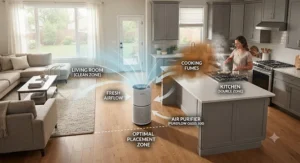
Placement matters more in an open floor plan than almost anywhere else. The instinct is to tuck the unit in a corner near the stove, but that’s usually the worst spot — corners are dead-air zones with limited circulation, and heat off the burners can stress the unit’s sensors. Instead, position your purifier 6 to 10 feet from the cooking surface, ideally along the natural airflow path between the kitchen and the rest of the open space, so it intercepts smoke and odor as they migrate rather than waiting for them to arrive.
Turn the unit on before you start cooking, not after you notice the smell — auto-sensing models will ramp up on their own, but giving them a head start closes the gap between “smoke happens” and “smoke gets captured.” Let it keep running for 20 to 30 minutes after you’re done cooking, since VOCs and fine particles continue off-gassing well after the burner’s off. In the first 30 days, the most common mistake is under-sizing: buyers install a bedroom-rated purifier expecting kitchen-living-dining performance and blame the machine when it’s really a mismatch. Check your filter’s carbon saturation more often than the manual suggests if you cook daily with oil — three to four months is realistic for heavy kitchen duty, not the six-to-eight-month window designed around light household dust.
Real-World Scenarios: Matching the Right Purifier to Your Open Floor Plan
Consider Maya, who lives in a 450 square foot studio apartment where the kitchenette sits ten feet from her bed. Her frying habit means she needs an air purifier for studio apartment cooking that’s compact, fast-reacting, and quiet enough for sleep — the Coway Airmega AP-1512HH or Winix 5510 both fit that footprint without overspending on square footage she doesn’t have.
Then there’s Devon and Priya, who share a 1,200 square foot open-concept condo where the kitchen island opens directly into a living room and dining nook — three zones sharing one air volume. For them, a single large-coverage unit like the Coway Airmega 400S or Blueair Blue Pure 211i Max, centrally placed between the kitchen and living room, handles the shared volume better than two small units fighting each other’s airflow.
Finally, consider a household with a member who has chemical sensitivity and cooks with strong spices daily across a 2,000 square foot open layout. Here, a multi-zone approach wins: an IQAir HealthPro Plus anchored near the stove for heavy VOC duty, paired with a secondary unit like the Levoit Core 600S at the far end of the living space to catch drift the first unit’s CADR can’t reach at that distance.
CADR Calculation for Open Floor Plan: The Math That Actually Matters
Here’s the number that matters more than any marketing claim: your purifier’s smoke CADR should equal at least two-thirds of your room’s total square footage, and ideally closer to a 1:1 ratio for kitchens where cooking is frequent. CADR ratings come from independent laboratory testing under the American National Standard ANSI/AHAM-AC-1, and the AHAM Verifide seal on packaging confirms those numbers were actually verified rather than self-reported by the manufacturer. For an open floor plan, you don’t measure just the kitchen — you measure the full connected volume, because pollutants disperse across the entire shared space with no wall to stop them.
| Open Floor Plan Size | Minimum Smoke CADR Needed | Example Pick |
|---|---|---|
| 400-600 sq ft | 270-400 CFM | Levoit Core 600S |
| 700-1,000 sq ft | 470-670 CFM (or dual units) | Coway Airmega 400S |
| 1,200+ sq ft | Multi-zone strategy recommended | IQAir HealthPro Plus + secondary unit |
The takeaway from this table is that most single-tower purifiers max out their honest coverage well before 1,200 square feet, no matter what the box claims. Past that threshold, buying two mid-tier units placed at opposite ends of the space consistently outperforms one oversized unit trying to move air across a distance it wasn’t built for.
How to Choose a High CADR Air Purifier for an Open Concept Home
- Measure the full connected volume, not just the kitchen footprint, since cooking pollutants travel freely across the whole open layout.
- Prioritize smoke CADR over marketing square footage claims, because smoke particles are the hardest to remove and the most representative of real performance.
- Confirm real activated carbon weight, since thin carbon “wraps” saturate fast under daily cooking and leave odor problems unsolved.
- Check for a laser or PM2.5 sensor, which drives auto mode responsiveness — the difference between catching smoke at second one versus minute five.
- Plan placement before buying, since a unit sized correctly on paper still underperforms if it’s stuck in a dead-air corner.
- Budget for filter replacement frequency, because kitchen duty saturates carbon filters faster than the manufacturer’s general-use estimate.
- Consider a multi-zone approach past 1,000 square feet, since no single consumer tower reliably covers that much connected air.
Air Purifier Kitchen Living Room Connected: Why Open Concept Changes the Rules
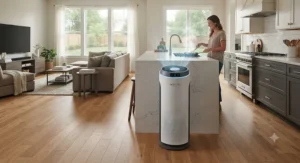
A closed kitchen door used to do a lot of unpaid work. It contained smoke, trapped smell, and gave pollutants a small volume to build up in before dissipating on their own. In an open-concept layout, there’s no barrier to slow that spread — the kitchen, dining area, and living space share one continuous air volume, so particles and gases generated at the stove begin dispersing immediately into the full connected space the moment the burner clicks on. That’s the core problem an air purifier kitchen living room connected setup has to solve: it’s not filtering a room, it’s filtering a shared atmosphere.
What most buyers overlook is that this changes where you place the purifier, not just which one you buy. A unit tucked in the kitchen corner is fighting only the source; a unit placed at the boundary between kitchen and living room intercepts pollutants as they cross into shared space, which is a meaningfully different job. Reviewers consistently note that repositioning an existing purifier toward that boundary — even without buying anything new — noticeably improves how fast smells clear from the living room specifically.
Air Purifier Multiple Zones: One Big Unit vs Several Small Ones
The instinct is to buy the single biggest, highest-CADR unit you can afford and place it centrally. That works well up to roughly 800-1,000 square feet of connected space. Past that point, air purifier multiple zones logic starts to win on both coverage and redundancy: two mid-tier units, one anchored near the cooking source and one at the far end of the living or dining area, consistently clear odor faster than one oversized tower trying to push clean air the full distance.
The tradeoff is upfront cost and two filters to maintain instead of one — but the ROI shows up in actual clearing time. A single large unit has to move air the entire span of an open floor plan before it can act on pollutants at the far end; a second unit positioned at that far end starts working on local air immediately, cutting total clearing time significantly during and after cooking. For households layering a heavy-VOC unit like the IQAir HealthPro Plus near the stove with a lighter secondary unit elsewhere, this is precisely the logic at play.
Tower Fan Air Purifier Combo for Open Space: Is It Worth It?
A tower fan air purifier combo open space setup — like the Shark Air Purifier MAX — solves a problem dedicated boxy purifiers often ignore: air circulation, not just filtration. In a large open room, a purifier can have excellent CADR and still underperform if the air near it never actually reaches the far corners. The tall, vertical tower design pulls double duty, moving air across the room while filtering what passes through it, which helps break up the stagnant pockets that form in deep, furniture-heavy open layouts.
The tradeoff is that combo units generally can’t match the outright CADR ceiling of dedicated large-room purifiers like the Coway Airmega 400S, so they’re a better fit for mid-size open spaces (400-600 sq ft) where circulation matters as much as raw filtering power, rather than the largest layouts where sheer volume is the bottleneck.
Common Mistakes When Buying an Air Purifier for Open Floor Plan Cooking
The single biggest mistake is sizing the purifier to the kitchen alone instead of the entire connected floor plan — a 300 square foot kitchen sitting inside 1,000 square feet of open living space needs a purifier rated for the full 1,000, not the smaller number. A close second is ignoring carbon filter weight entirely and shopping on HEPA rating alone; HEPA captures particles, but odor and VOCs are gas-phase problems that only activated carbon actually solves. Buyers also frequently run purifiers on “quiet” or “auto-low” mode constantly to save on noise, which undercuts the very air-changes-per-hour rate the CADR rating assumes. Finally, many people install the unit once and never reposition it, missing out on the meaningful gains available just from moving it toward the kitchen-living room boundary instead of a corner.
Long-Term Cost & Maintenance: What Cooking Does to Filter Life
Kitchen duty is harder on a purifier than any other placement in the home, and the ownership costs reflect it. EPA guidance on indoor particulate matter notes that indoor PM levels can exceed outdoor levels, and that changing filters on air cleaners according to manufacturer directions is part of keeping that particulate matter in check. In practice, that means budgeting for carbon filter replacement every three to four months under regular cooking use, roughly half the interval manufacturers quote for general household duty, since oil vapor and combustion byproducts saturate carbon faster than dust and pollen do.
Total cost of ownership varies meaningfully across the picks on this list. Budget units like the Winix 5510 run cheaper filters more often, while premium picks like the IQAir HealthPro Plus carry a higher annual filter cost but longer intervals between changes. Over a five-year span, the gap between the cheapest and most expensive filter programs on this list can run into the hundreds of dollars — a number worth factoring in before purchase, not after the first filter-change notification.
Features That Actually Matter (And Those That Don’t)
Real activated carbon weight matters enormously; a decorative light ring does not. A responsive laser particle sensor matters, because it’s the difference between a purifier reacting to smoke in seconds versus minutes; a smartphone app with elaborate scheduling matters less than most marketing suggests, since auto mode alone handles most day-to-day cooking events without you touching a phone. True HEPA certification matters — “HEPA-type” or “99% HEPA” language on a box is a meaningfully weaker filtration claim and worth skipping. Ionizer or plasma features are, at best, a minor bonus layered on top of mechanical filtration, and CARB has flagged ozone-generating air-cleaning devices as a concern rather than a benefit, so anyone drawn to an ionizer-equipped unit should confirm it carries CARB certification and can be switched off.
Safety & Regulations: Ozone, Ionizers, and What to Avoid
Cooking pollution is already a documented indoor air quality issue on its own, separate from anything a purifier introduces. Cooking can contaminate indoor air with harmful pollutants from heating oil, fat, and other food ingredients, especially at high temperatures, and self-cleaning ovens can create high levels of pollutants as food waste burns away. Given that baseline, the last thing a kitchen purifier should do is add a second pollutant to the mix — which is exactly the risk with uncertified ozone-generating devices.
If a purifier you’re considering includes an ionizer or plasma mode, confirm it carries CARB certification, and don’t hesitate to run it with that feature disabled if you’d rather rely on mechanical HEPA-plus-carbon filtration alone. None of the seven picks on this list require an ionizer mode to perform well — it’s a bonus at best, never the deciding factor.
FAQ
❓ How big of an air purifier do I need for an open floor plan kitchen?
❓ Can an air purifier fully replace a range hood in an open kitchen?
❓ Where should I place an air purifier for cooking smells in an open concept home?
❓ Does a HEPA filter remove cooking odor and smoke smell?
❓ How often should I replace filters in a kitchen air purifier?
Conclusion
An open floor plan turns every cooking session into a whole-home event, whether you want it to or not. The good news is that the fix isn’t complicated once you stop shopping on square-footage headlines and start matching real smoke CADR, real carbon weight, and smart placement to your actual connected space. Whether that means a single large-coverage unit like the Coway Airmega 400S, a carbon-heavy specialist like the Blueair Blue Pure 211i Max, or a two-zone strategy anchored by the IQAir HealthPro Plus, the right purifier turns “the whole house smells like dinner for three hours” into a problem that quietly solves itself. Size it to the space you actually have, place it at the boundary the smell has to cross, and budget for filters that work harder than the manual assumes — and your open floor plan stops paying the smell tax every time you cook.
Recommended for You
- 7 Best Kitchen Air Purifier Countertop Picks for 2026
- Air Purifier for Fish Smell Cooking: 7 Best Picks for 2026
- Best Air Purifier for Cooking Smells in 2026: 7 Picks That Work
Disclaimer: This article contains affiliate links. As an Amazon Associate, I earn from qualifying purchases. If you purchase products through these links, we may earn a small commission at no additional cost to you.
✨ Found this helpful? Share it with your friends! 💬🤗
