
In This Article
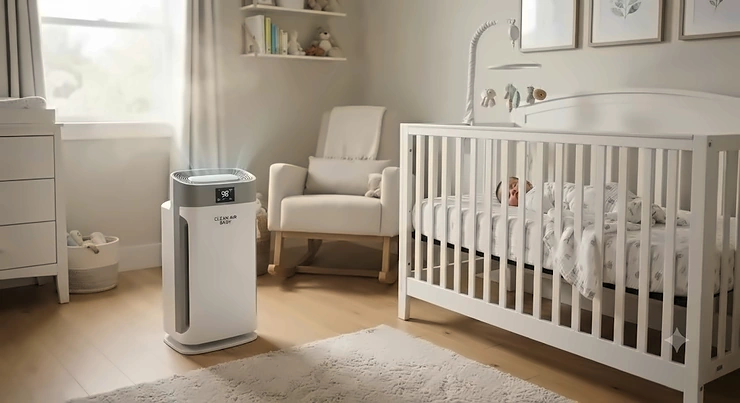
If you’ve found yourself standing in the nursery doorway at 2 a.m., sniffing the air and wondering whether that faint smoky smell drifting in from the porch or the neighbor’s balcony is actually reaching your baby’s crib, you’re not being paranoid. You’re being a parent who pays attention. An air purifier for baby secondhand smoke is a device built to pull fine smoke particles, tar residue, and volatile gases out of the air your infant breathes while sleeping, feeding, and playing, typically using a sealed HEPA filter paired with activated carbon and zero ozone output. It won’t undo every risk of a smoky household, but it’s one of the few tools that works around the clock without you having to do anything except plug it in. Below, we dig into real products, real specs, and the honest trade-offs between them, because a newborn’s lungs don’t get a rough draft.
Here’s the thing nobody tells you at the baby registry consultation: not every purifier marketed for nurseries is actually built for smoke. Plenty of them handle dust and pollen beautifully but have a paper-thin carbon layer that does almost nothing against the sticky, gaseous compounds in tobacco or wood smoke. Some even use ionizing technology that can generate trace ozone, which is exactly the kind of lung irritant you’re trying to avoid in the first place. So this guide isn’t a rehash of a generic “best purifiers” list. It’s specifically about which machines have the carbon depth, the CADR numbers, and the ozone-free certifications to actually make a dent in secondhand smoke exposure, and which room sizes and budgets they fit.
Quick Comparison Table
| Purifier | Best CADR (Smoke) | Room Coverage | Ozone-Free | Best For |
|---|---|---|---|---|
| Levoit Core 300S | ~126-145 cfm | Up to 219 sq ft | Yes, CARB certified | Tightest budget, small nursery |
| Coway Airmega 100 | ~108 cfm | Up to 405 sq ft (2 ACH) | Yes, CARB certified | Whisper-quiet small rooms |
| Winix 5500-2 | ~232 cfm | Up to 360 sq ft | Yes (PlasmaWave off) | Shared bedrooms, large nurseries |
| Blueair Blue Pure 511i Max | ~125 cfm | Up to 237 sq ft | Yes, CARB certified | Compact, ultra-quiet nursery |
| Blueair Blue Pure 311i Max | ~250-283 cfm | Up to 439 sq ft | Yes, CARB certified | Bigger rooms, high airflow |
| Alen BreatheSmart 45i | ~194-208 cfm | Up to 800 sq ft | Yes (ionizer optional/off) | Customizable smoke filtration |
| Austin Air HealthMate Junior | ~200 cfm | Up to 700 sq ft | Yes, mechanical only | Heaviest VOC and smoke load |
A quick read of this table tells a story that specs alone don’t: raw CADR isn’t the whole game when smoke is the target. The Austin Air HealthMate Junior and Alen BreatheSmart 45i trail the Blueair units on pure airflow numbers, but they carry far more activated carbon by weight, which is what actually adsorbs the gaseous, odor-carrying part of smoke rather than just the particulate. If your household situation is occasional drift-in smoke from outdoors, a high-CADR HEPA unit like the Winix 5500-2 will likely outperform on speed. If you’re dealing with someone smoking indoors or on an attached porch daily, the carbon-heavy options are worth the extra cost.
💬 Found a pick that fits your nursery? Save this comparison and come back to it before you check out!
💬 Just one click — help others make better buying decisions too!😊
Top 7 Best Air Purifiers for Baby Secondhand Smoke Protection
Choosing the right unit really comes down to matching your room size, your budget, and how much of your smoke exposure is airborne particulate versus lingering gas and odor. Here’s the honest breakdown of seven real, currently available machines that we’d actually put in a nursery.
1. Levoit Core 300S — best budget pick for small nurseries
The standout here is price-to-performance: this compact cylinder delivers real HEPA filtration for around $100, which is a low bar of entry for parents who don’t want to gamble on an unproven brand. Under the hood sits a three-stage setup — pre-filter, H13 True HEPA, and an ARC-formula activated carbon layer — rated at roughly 126-145 CADR for smoke depending on which lab you trust, enough to refresh a 219-square-foot room about five times an hour. It’s CARB certified and Energy Star rated, meaning California’s ozone-emission testing has already vetted it, so you’re not gambling on hidden ionizer output. Based on the spec comparison with pricier units, this is best suited to parents whose main worry is drift-in smoke from outside rather than someone smoking indoors daily, since the carbon bed here is thin compared to dedicated smoke-focused machines. Reviewers consistently report that the sleep mode is close to silent, and the smart app lets you check air quality from another room without creeping into the nursery. Pros:
- ✅ Real CARB-certified, zero-ozone HEPA filtration under $100
- ✅ Very low 26W power draw keeps it cheap to run 24/7
- ✅ Sleep mode drops to roughly 24 dB for undisturbed naps
Cons:
- ❌ Thinner carbon layer than dedicated smoke-focused purifiers
- ❌ Best suited to rooms under 220 sq ft, not larger shared bedrooms
Filters typically run in the $20-$30 range and last 6-8 months. If your budget caps out here, this is a genuinely defensible pick, not just a compromise.
2. Coway Airmega 100 — quietest option for a compact bedroom
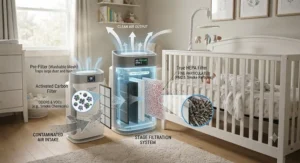
What Coway did well with the Airmega 100 is engineering a motor so well optimized that its sleep-mode noise floor drops to around 20 dB, which is quieter than a whispered conversation and genuinely won’t wake a light-sleeping infant. The three-stage filter (vacuumable pre-filter, True HEPA, deodorization filter) captures 99.999% of particles down to 0.01 microns on paper, and it’s CARB certified with zero ozone output. Here’s what most buyers overlook about this model: its official CADR for smoke sits around 108 cfm, modest next to the Blueair or Winix units, but Coway rates the same unit for one air change per hour in rooms up to 810 square feet, which only holds up in ideal conditions. Realistically, treat this as a genuinely excellent choice for rooms under 200 square feet, and expect it to work harder in anything larger. The deodorization filter doesn’t use carbon pellets, so aggregated reviewer sentiment notes it’s a bit weaker against strong lingering odors than pellet-based competitors, though it still meaningfully reduces smoke smell over time. Pros:
- ✅ Among the quietest purifiers tested at any price point
- ✅ CARB certified, ECARF allergy-certified, zero ozone
- ✅ Compact 6.6 lb build fits nightstands and small shelves easily
Cons:
- ❌ Modest smoke CADR compared to carbon-heavy competitors
- ❌ No smart app or remote monitoring on this model
Price sits in the $85-$130 range depending on retailer promotions, and replacement filters run around $35-$45 annually.
3. Winix 5500-2 — best for larger or shared nursery spaces
If your baby’s room doubles as a guest room, or you’re co-sleeping in a larger master bedroom, the Winix 5500-2’s CADR of roughly 232 cfm for smoke is the biggest number on this list among mid-priced units, rated to refresh 360 square feet nearly five times an hour. The three-stage filtration pairs a washable AOC pelleted carbon filter with True HEPA, and the pelleted design (versus a fibrous carbon sheet) genuinely does a better job adsorbing gaseous VOCs from smoke, based on the spec comparison with other carbon technologies in this price bracket. The catch, and it’s worth being upfront about, is the PlasmaWave ionizer bolted onto the top of the unit; Winix states it emits no harmful ozone and it complies with CARB’s limits, but for a nursery we’d recommend simply leaving PlasmaWave switched off, which the unit allows via a dedicated button, and independent testing shows performance barely changes without it. Reviewers consistently praise the auto mode’s color-coded air quality light and the included remote, handy for adjusting settings without disturbing a sleeping baby. Pros:
- ✅ Strongest CADR-per-dollar for smoke of any mid-range pick
- ✅ Pelleted carbon filter handles odor better than fibrous designs
- ✅ Auto mode with remote control for hands-off adjustment
Cons:
- ❌ Built-in ionizer best switched off for nursery peace of mind
- ❌ Genuine replacement filters run pricier than Levoit or Coway
Expect to pay in the $150-$200 range, with annual filter costs around $70-$80 for OEM parts.
4. Blueair Blue Pure 511i Max — best compact pick built for nurseries
Blueair specifically designed this model’s rounded, edge-free shape with kids’ rooms in mind, and the noise floor backs it up: as low as 19 dB on its lowest setting, which is genuinely close to silent. The HEPASilent dual filtration combines mechanical and electrostatic capture to remove 99.97% of particles down to 0.1 microns, slightly finer than the standard 0.3-micron HEPA benchmark, with an AHAM-verified CADR around 125 cfm suited to rooms up to roughly 237 square feet. What most buyers overlook about this model is that despite the compact size, it still carries a real activated carbon layer that traps light smoke and cooking odors, though housefresh’s independent testing found it isn’t the strongest choice if heavy, persistent smoke odor is the primary problem you’re solving. Reviewers consistently highlight the child-safe rounded design and display lock, which prevents a curious toddler from changing settings mid-nap. The Blueair app adds scheduling and a “Welcome Home” geofencing feature, a nice-to-have rather than a necessity. Pros:
- ✅ 19 dB whisper-quiet operation, among the quietest tested
- ✅ Rounded, child-safe design with a display lock
- ✅ CARB certified with independently verified CADR numbers
Cons:
- ❌ Lighter carbon bed struggles with heavy, persistent odor
- ❌ Coverage tops out around 237 sq ft for full effectiveness
Pricing runs in the $140-$220 range depending on promotions, with filters replaced roughly every 6-9 months.
5. Blueair Blue Pure 311i Max — best for bigger rooms needing real airflow
Stepping up from the 511i Max, the 311i Max roughly doubles the CADR to somewhere between 250 and 283 cfm depending on the testing source, enough to knock out a 728-cubic-foot test room’s incense smoke in under 30 minutes in independent lab tests. It’s the pick for parents whose nursery is on the larger side, or who are running one purifier for a combined nursery-and-living-space layout. Here’s what the spec sheet won’t tell you outright: Blueair’s HEPASilent technology relies on an electrostatic charging stage that some independent testers flag as a very-low-level ozone source, though the unit remains CARB certified and Blueair states it meets Intertek’s Zero Ozone standard. If a fully mechanical, zero-electrostatic filter matters to you specifically, that’s worth weighing against Levoit or Coway’s purely mechanical designs. On the plus side, the carbon-and-particle filter combination handles smoke and cooking odor noticeably better than the smaller 511i Max, and the app-based RealTrack filter-life tracker takes the guesswork out of replacement timing. Pros:
- ✅ High CADR clears a 728 cubic ft. test room in under 30 minutes
- ✅ Stronger carbon filtration than Blueair’s compact 511i Max
- ✅ Quiet for its power class, 23 dB low to 50-58 dB high
Cons:
- ❌ Electrostatic stage draws scrutiny from ozone-cautious parents
- ❌ Pricier than Winix at a similar smoke CADR
Expect to pay in the $230-$300 range, with filters costing roughly $45 every 6-9 months.
6. Alen BreatheSmart 45i — best customizable pick for heavy smoke odor
Alen built genuine flexibility into this machine: buyers choose between four interchangeable H13 HEPA filter types, and the VOC/Smoke variant specifically packs extra activated carbon designed to absorb noxious gases and secondhand smoke, a meaningfully different approach from a fixed one-size-fits-all filter. Rated at roughly 194-245 cfm CADR depending on the test source, it covers rooms up to 800 square feet, and Alen backs it with an industry-rare lifetime warranty as long as you keep an active filter subscription or can prove OEM filter use. Based on the spec comparison, the optional ionizer outputs less than 0.001 ppm ozone when engaged and zero when off, both comfortably under CARB’s 0.05 ppm ceiling, and for a nursery we’d simply leave it disengaged. Reviewers consistently note the pink-noise fan hum is genuinely soothing rather than grating, and SleepScore Labs’ independent study found participants reported measurably better rest while running it. The trade-off is cost: at $400-$450, it’s roughly four times the price of the Levoit pick for a meaningfully deeper carbon bed and a longer warranty runway. Pros:
- ✅ Dedicated VOC/Smoke filter option built specifically for this use case
- ✅ Industry-rare lifetime warranty with filter subscription
- ✅ Pink-noise fan sound independently linked to better infant sleep
Cons:
- ❌ Among the pricier options on this list by a wide margin
- ❌ Optional ionizer best left switched off in a nursery setting
Filter costs run about $69-$119 depending on which of the four filter types you choose.
7. Austin Air HealthMate Junior — best for the heaviest, most persistent smoke exposure
Where the other six units on this list lean on relatively modest carbon layers measured in ounces, the Austin Air HealthMate Junior packs over 270 cubic inches, roughly 6.5 pounds, of activated carbon and zeolite into its four-stage filter, alongside 30 square feet of true medical-grade HEPA media. That’s a fundamentally different design philosophy: this machine is built first for gas and odor adsorption, with particle filtration as the second priority, which is exactly the profile you want if someone smokes indoors regularly or the nursery sits close to a smoking area. Independent testing from Air Purifier First found its raw particle-capture speed actually lags behind smaller, cheaper HEPA-only units like the Levoit Vital 100S, but its odor and VOC neutralization consistently ranks near the top of every carbon-filter comparison. What the spec sheet won’t tell you is that the trade-off for that dense carbon bed is noise and lower airflow; expect a more noticeable hum than the Blueair or Coway picks, and a longer time to fully clear particulate matter from a smoke-filled room. The filter is rated to last five years under normal use, which meaningfully lowers the long-term cost of ownership despite the steep $400-$460 upfront price. Pros:
- ✅ Largest carbon bed on this list, purpose-built for gas and odor removal
- ✅ Purely mechanical filtration, no ionizer, no electrostatic stage
- ✅ Five-year filter life dramatically lowers long-term running costs
Cons:
- ❌ Noticeably louder and slower on raw particle removal than HEPA-first units
- ❌ Steep upfront price for a no-frills, no-app design
How to Choose an Air Purifier to Protect Newborn from Smoke
Picking the right air purifier to protect newborn from smoke exposure comes down to seven practical checks, and skipping any one of them tends to be where parents end up disappointed:
- Confirm true HEPA, not “HEPA-type.” Only a certified H13 filter reliably captures 99.97% of particles down to 0.3 microns; vague “HEPA-type” marketing language usually means a cheaper mesh filter with real gaps in performance.
- Check the carbon weight, not just its presence. A thin carbon sheet barely touches gaseous smoke compounds; look for pelleted or pound-rated carbon if smoke odor, not just particulate, is your concern.
- Verify CARB certification directly. Don’t trust “ozone-free” marketing copy alone; cross-check the model against CARB’s public certified device list.
- Match CADR to your actual room, not the marketing room size. AHAM recommends roughly 4-5 air changes per hour; divide the smoke CADR into your square footage to see if the unit is genuinely sized correctly.
- Weigh noise against your baby’s sleep sensitivity. A powerful unit that has to run on high to keep up will be louder than a slightly oversized unit cruising on low.
- Look at 12-month filter costs, not just sticker price. A cheap purifier with expensive, frequent filter changes can cost more over a year than a pricier unit with a five-year filter.
- Prioritize placement over specs. Even the best air purifier for baby secondhand smoke underperforms if it’s tucked in a corner behind furniture instead of positioned for open airflow near the crib, at a safe distance and out of reach.
✨ Don’t Miss These Exclusive Deals!
🔍 Take your nursery air quality to the next level with these carefully selected purifiers. Click on any highlighted pick to check current pricing and availability. These picks help create the cleaner, calmer sleep environment your baby deserves!
Nursery Air Purifier Safety: Ozone-Free Certifications Explained
A nursery air purifier safety ozone-free label sounds simple, but it covers a genuinely important regulatory distinction that most parents never get explained clearly. Ozone is a reactive gas that, according to the California Air Resources Board, can irritate the respiratory lining within hours of exposure and worsen asthma, which is the last thing you want layered on top of secondhand smoke exposure in a developing infant’s lungs. Since 2010, California law has required all indoor air cleaning devices sold or shipped there, including online sales nationwide, to test under 0.050 parts per million of ozone output and carry a “CARB certified” label. That single certification is honestly the fastest, most reliable safety check available to a parent standing in an aisle or scrolling a product page.
Here’s what most buyers overlook: CARB certification doesn’t mean a device is ozone-free in an absolute sense, it means measured emissions stay under a strict health-protective ceiling, and many electronic technologies (ionizers, electrostatic precipitators, UV devices) can still qualify if they test below that threshold. For a nursery specifically, we’d lean toward mechanical-only filtration like the Levoit, Coway, or Austin Air picks above, or an electronic unit with a hardware off-switch for its ionizing feature, like the Winix or Alen models. Reviewers consistently note that switching an ionizer off costs almost nothing in real-world particle-removal speed, so there’s little reason to run it in a room where a newborn sleeps for 16 hours a day.
Is It Safe? What to Know About a Safe Air Purifier for Infant Room Smoke
Parents searching for a safe air purifier infant room smoke solution are usually really asking two separate questions at once: is the device itself safe to have near my baby, and does it meaningfully reduce the actual health risk from smoke exposure? On the device-safety side, look for a cord that can be routed away from the crib, a stable base that can’t tip if bumped, and a child lock if your baby will eventually be mobile enough to reach the controls. On the exposure-reduction side, honest analysis says an air purifier is a genuinely useful layer, not a replacement for eliminating the smoke source. The CDC’s page on the health effects of secondhand smoke is explicit that infants exposed to secondhand smoke after birth face measurably higher SIDS risk, and no air purifier, however well-rated, changes that underlying exposure-response relationship on its own.
What a properly sized, ozone-free purifier can do is meaningfully cut the airborne particulate and much of the odor-carrying gas between smoking events, which reduces the baby’s cumulative particle load hour to hour. Based on the spec comparison across the seven units above, carbon-forward machines like the Austin Air HealthMate Junior or Alen’s VOC/Smoke filter option do noticeably more on the gaseous side than a HEPA-only unit. If smoking happens indoors at all, though, the single most protective change remains moving that activity fully outside, away from doors and windows, since thirdhand smoke residue settles into furniture and walls in ways no purifier filters out of the air.
Infant Lung Development and Air Quality: Why the First Year Matters
The infant lung development air quality connection is one of the more underappreciated pieces of this whole picture. A newborn’s airways are proportionally smaller and their alveoli, the tiny sacs where oxygen exchange happens, are still actively multiplying well into early childhood, a process that continues for years after birth. That means the same concentration of airborne smoke particulate that an adult barely notices can represent a proportionally much larger dose for a baby, who also breathes faster, roughly 30-60 breaths per minute compared to an adult’s 12-20. Here’s what most buyers overlook about air quality in this context: it isn’t only about smoke. VOCs off-gassing from new furniture, paint, and mattresses, along with everyday dust and pollen, all stack onto the same developing respiratory system, so a purifier running continuously does double duty against multiple pollutant sources at once, not just smoke.
Reviewers and pediatric air-quality researchers alike consistently note that continuous, low-speed operation on auto mode tends to outperform occasional high-speed bursts, since it keeps particulate concentrations low and steady rather than letting them spike between cleanings. For a nursery specifically, that argues for a unit sized generously enough for the room that it can run comfortably on a lower, quieter setting most of the time, rather than one so undersized it has to work at full noise around the clock.
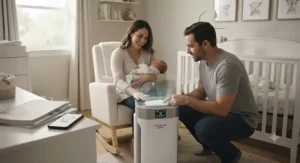
SIDS Risk and Secondhand Smoke: What the Research Shows
The link between SIDS risk and secondhand smoke exposure is one of the most consistently replicated findings in pediatric research, and it’s worth stating plainly rather than dancing around it. According to HealthyChildren.org, the American Academy of Pediatrics’ consumer resource, infants exposed to secondhand smoke face a measurably elevated SIDS risk, and that risk compounds further if a smoking parent bed-shares with the baby. Researchers believe the mechanism involves chemicals in secondhand smoke interfering with the brainstem’s regulation of infant breathing and arousal responses during sleep, which is part of why SIDS prevention guidance treats smoke avoidance as a frontline recommendation, alongside back-sleeping and a bare crib.
None of this means an air purifier is a SIDS-prevention device, and no honest source would claim that. What honest analysis can say is that reducing ambient particulate and gaseous smoke residue in the sleep environment removes one contributing variable from a multi-factor risk picture, alongside the sleep-position and bedding practices that remain the primary, evidence-backed prevention steps. If smoke exposure is a reality in your household, pairing a well-sized, ozone-free purifier with a firm commitment to smoke-free indoor spaces and safe-sleep practices is the layered approach pediatricians actually recommend, not a purifier as a standalone fix.
Practical Nursery Setup & Maintenance Guide
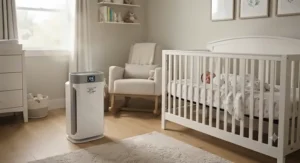
Getting the hardware right is only half the job; where and how you run it matters just as much. Start with placement: position the unit roughly three to six feet from the crib, on the floor or a low, stable surface, with open airflow on at least two sides. Tucking it into a corner behind a changing table or curtain can quietly cut its effective CADR by a noticeable margin, since these units draw air from multiple directions. For the first 24 hours after unboxing, run it on its highest setting to clear out any manufacturing off-gassing smell from the new filter before dialing back to auto or a lower nighttime setting.
A common first-30-days mistake is forgetting the pre-filter entirely; most parents fixate on the main HEPA/carbon cartridge and never touch the washable outer pre-filter, which clogs with visible dust within a few weeks and quietly throttles airflow to the main filter behind it. Wipe or rinse it weekly, more often if you have pets or recent renovation dust in the home. Set a recurring monthly reminder to check the filter-change indicator, and don’t stretch replacement intervals to save money in a smoke-exposed household; carbon media saturates faster under heavier gas load than the manufacturer’s default estimate assumes. Finally, keep the unit’s power cord fully secured along a wall or baseboard, out of crib reach, since cord safety becomes relevant the moment your baby starts pulling to stand.
Real-World Scenarios: Matching a Secondhand Smoke Baby Bedroom Purifier to Your Home
Every household’s secondhand smoke baby bedroom purifier needs look a little different depending on where the smoke is actually coming from, so here are three real-world profiles worth recognizing yourself in.
The apartment-dweller with a smoking neighbor. If smoke is drifting in occasionally through shared ventilation or a balcony below, a mid-CADR HEPA unit like the Levoit Core 300S or Coway Airmega 100 running continuously on auto mode is usually enough, since the exposure is intermittent rather than constant, and closing windows during peak drift-in hours adds meaningful extra protection.
The multi-generational household with an outdoor smoker. When a family member smokes on the porch or in the garage regularly, smoke residue tracks back indoors on clothing and hair even without indoor smoking, so a carbon-forward pick like the Alen BreatheSmart 45i with its VOC/Smoke filter, or the Winix 5500-2 for a larger shared space, does more work against that persistent low-level gas exposure than a pure HEPA unit.
The household actively working toward a smoke-free transition. If someone in the home currently smokes indoors and is in the process of quitting or moving that habit fully outside, the Austin Air HealthMate Junior’s dense carbon bed is built specifically for this heavier interim load, buying meaningfully cleaner air during the transition period while the underlying source gets addressed.
Problem → Solution: Common Smoke and Air Quality Issues in the Nursery
Problem: Lingering smoke smell even with the purifier running. This almost always traces back to an undersized carbon layer for the level of exposure; upgrading to a pelleted-carbon or dedicated smoke-filter option, like the Winix 5500-2 or Alen’s VOC/Smoke cartridge, typically resolves it within a few days of continuous operation.
Problem: The purifier seems to run constantly on its highest, loudest setting. That’s usually a sizing mismatch, the unit’s CADR is too small for the actual square footage. Check the room size against the manufacturer’s AHAM-rated coverage, not the “up to” marketing figure, and size up if you’re close to the ceiling.
Problem: Uncertainty about whether the unit is actually ozone-free. Cross-reference the exact model number against CARB’s public certified device list rather than trusting packaging language alone, and if the unit has an ionizer, switch it off in the nursery regardless of the manufacturer’s ozone claims.
Problem: Filter costs creeping up faster than expected. Heavier smoke exposure saturates carbon media faster than the default replacement schedule assumes; track the filter-change indicator rather than the calendar, and consider a longer-life option like the Austin Air’s five-year filter if ongoing cost is a concern.
Problem: Baby seems disturbed by fan noise at night. Move to a slightly larger-capacity unit that can maintain adequate CADR on a lower, quieter fan speed, rather than running an undersized unit at full volume; the Blueair 511i Max and Coway Airmega 100 both post some of the lowest sleep-mode decibel ratings on this list.
Air Purifiers vs Traditional Alternatives for Secondhand Smoke
It’s worth being direct about how air purifiers stack up against the older, more familiar tools parents reach for first. Opening a window seems intuitive, but it primarily dilutes indoor air with outdoor air, which does little against smoke already embedded in furniture, carpet, and walls, and it doesn’t help at all if outdoor air quality is itself compromised. Scented candles and plug-in air fresheners are arguably worse than doing nothing, since they mask the smell of smoke without removing any of the actual particulate or VOC load, and they add their own fragrance chemicals to an infant’s breathing air. Simply ventilating with a box fan moves air around a room without filtering anything out of it.
A properly sized HEPA-and-carbon air purifier is the only one of these options that actively removes particulate matter and gaseous compounds from the air rather than diluting, masking, or simply circulating them. That said, it’s not a replacement for source control; no purifier fully compensates for smoking indoors, and combining a good unit with a firm smoke-free indoor policy and reasonable ventilation delivers meaningfully better results than any single approach alone. Reviewers and pediatric air-quality researchers consistently frame purifiers as the “steady background layer” in a multi-part strategy, not a stand-alone fix.
Common Mistakes When Buying an Air Purifier for Baby Secondhand Smoke
The single most common mistake is buying based on room-size marketing claims rather than AHAM-verified CADR, since manufacturer “up to” figures often assume a single air exchange per hour, well below the 4-5 exchanges recommended for meaningful smoke and allergen control. A close second is choosing a unit with an ionizer or electrostatic stage without checking for an off-switch, then discovering later that trace ozone output was a factor they’d wanted to avoid entirely in a nursery. Parents also frequently underestimate ongoing filter costs, comparing only sticker prices and later facing $70-$120 annual filter bills that erase the “budget” appeal of a cheaper unit.
Another frequent misstep is placement: tucking the purifier behind a glider chair or inside a closet-adjacent alcove for aesthetic reasons, which starves it of open airflow and meaningfully cuts its real-world effectiveness regardless of its rated CADR. Finally, some parents assume a single living-room-sized purifier will adequately protect a nursery down the hall; airflow doesn’t reliably travel through closed doors and hallways, so the nursery genuinely needs its own dedicated unit if smoke exposure is a real concern there.
Long-Term Cost & Maintenance: What Nursery Air Purifiers Really Cost
The sticker price is only the opening bid in what an air purifier actually costs over its useful life, and filter replacement is where the real budgeting happens. A Levoit Core 300S filter runs roughly $20-$30 and needs replacing every 6-8 months, landing around $30-$50 annually. The Winix 5500-2’s OEM filters cost more per unit, roughly $70-$80 a year, reflecting its pelleted carbon design. At the premium end, Alen’s filters run $69-$119 depending on which of the four filter types you choose, but the company’s lifetime warranty on the unit itself offsets some of that if you stick with a subscription. The clear long-term value outlier is the Austin Air HealthMate Junior: its five-year filter life means the entire five-year cost of ownership can land lower than cheaper units that need filters replaced twice a year over the same period, even though the upfront price is steep.
Electricity is a smaller factor but worth a quick mention: the Levoit and Coway units draw 25-26 watts at full speed, translating to roughly $2 a month running continuously, while larger units like the Blueair 311i Max or Alen 45i draw closer to 30-50 watts, still a modest monthly cost in the context of overall nursery expenses. Bottom line: the cheapest purifier upfront isn’t always the cheapest over a full year, and matching filter longevity to your actual smoke exposure level, not just your initial budget, tends to produce the better long-term value.
Frequently Asked Questions
❓ Can an air purifier fully protect my baby from secondhand smoke?
❓ How do I know if an air purifier is actually ozone-free?
❓ What size air purifier does a typical nursery need?
❓ Is it safe to run an air purifier all night in a baby's room?
❓ How often should nursery air purifier filters be replaced?
Conclusion
Choosing an air purifier for baby secondhand smoke isn’t about finding one magic machine, it’s about honestly matching a device’s carbon depth, CADR, and ozone-free certification to how much smoke exposure your household actually deals with. A budget HEPA pick like the Levoit Core 300S handles occasional drift-in smoke perfectly well for a fraction of the price of an Austin Air HealthMate Junior, which earns its higher cost only if you’re dealing with heavier, more persistent gaseous exposure. What matters most across every price point is verifying real CARB certification, sizing the unit to your actual room rather than marketing claims, and understanding clearly that a purifier is one layer in a broader strategy, not a substitute for keeping smoking out of the home entirely.
None of the seven purifiers here are a promise, but each one is a genuinely researched, real, currently available tool that does measurably reduce what’s floating in the air your baby breathes every night. Pair the right pick with consistent smoke-free practices and safe-sleep guidance, and you’ve done what’s realistically within your control as a parent standing in that nursery doorway at 2 a.m.
✨ Don’t Miss These Exclusive Deals!
🔍 Ready to give your nursery cleaner air tonight? Check current pricing on today’s top picks above and bring home the protection your baby’s developing lungs deserve!
Recommended for You
- Best Air Purifier for Secondhand Smoke: 7 Picks That Actually Work (2026)
- 7 Best Air Purifier for Smokers Apartment Picks (2026 Guide)
- Air Purifier for Cigarette Smoke: 7 Proven Picks for 2026
Disclaimer: This article contains affiliate links. As an Amazon Associate, I earn from qualifying purchases. If you purchase products through these links, we may earn a small commission at no additional cost to you.
✨ Found this helpful? Share it with your friends! 💬🤗
