
In This Article
Here’s the blunt truth nobody selling you a purifier wants to lead with: a UV-C air purifier virus bacteria home setup only works if the light actually touches the germs for long enough, at the right strength, before the fan blows them past it. That’s it. That’s the whole trick. Everything else — the sleek towers, the touchscreens, the “hospital grade” stickers — is packaging around that one physics problem.
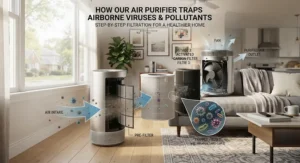
UV-C stands for ultraviolet-C, the shortest and most energetic band of ultraviolet light, and at the germicidal sweet spot of roughly 254 nanometers it damages the genetic material inside viruses and bacteria so they can no longer replicate. Air purifiers borrow this same principle used in hospitals, water treatment plants, and food processing lines, and shrink it into a household appliance. Used alongside — never instead of — a true HEPA filter, it becomes one more layer between your family and whatever is floating through the living room.
This guide skips the marketing fluff and gets into what actually separates a purifier that earns its keep from one that’s mostly for show. We dug through real product specs, verified availability, and aggregated review sentiment across seven actual models spanning $20 plug-ins to $1,000+ medical-grade units, so you can see exactly where your money goes. We’ll also walk through the wavelength science, the ozone question everyone’s afraid to ask, and the contact-time math that most listings conveniently leave out.
Quick Comparison Table
Before the deep dive, here’s the fast version. Coverage areas and prices are approximate — always check current listings, since specs and availability shift.
| Product | Best For | Coverage | UV-C Type | Price Range |
|---|---|---|---|---|
| GermGuardian GG1000 | Small rooms, budget | Single room | Pluggable, filterless | Under $30 |
| GermGuardian AC4825E | Budget HEPA + UV combo | ~743 sq ft | In-cabinet lamp | $70-$100 range |
| GermGuardian AC5250PT | Pet owners, larger rooms | ~915 sq ft | In-cabinet lamp | $150-$200 range |
| Medify MA-40 UV | Best CADR-to-price ratio | ~1,680 sq ft | In-cabinet lamp | $230-$280 range |
| Sans Whole Home | Allergy sufferers, design | ~720 sq ft | In-cabinet lamp | $600-$700 range |
| Airpura UV600 | Daily virus/bacteria exposure | Up to ~2,000 sq ft | Dedicated 18W lamp | Around $900-$1,000 |
| Airpura UV714 | Closest to hospital grade | Up to ~2,500 sq ft | Dedicated 16W lamp | $1,100-$1,300 range |
Looking at the spread, there’s a clear split between “HEPA purifier with a UV-C bulb bolted in” (the GermGuardian and Medify units) and “dedicated germicidal system that happens to also filter” (the Airpura pair). Neither approach is wrong, but they solve different problems — the first prioritizes particle capture with UV as a bonus layer, the second treats the UV lamp as the star and builds HEPA filtration around it. Budget buyers get real, verified UV-C exposure even under $100, so this isn’t a category where you need to spend big to get something working.
💬 Just one click — help others make better buying decisions too!😊
Top 7 UV-C Air Purifiers: Expert Analysis
Coverage below runs budget to premium, with a deliberate mix of pluggable, tower, and whole-room formats so you can match the format to your actual living situation instead of your Pinterest board.
1. GermGuardian GG1000 Pluggable UV-C Sanitizer — cheapest real UV-C exposure you can buy
The GermGuardian GG1000 skips the fan-and-filter format entirely and just plugs straight into a wall outlet, running a small UV-C bulb continuously behind a protective cap. At 7.5 inches tall with a 2.3-watt UV-C bulb, it’s built for closets, bathrooms, litter box corners, and nurseries rather than living rooms — this is a supplement to a real purifier, not a replacement for one. Manufacturer testing cites reductions against Staphylococcus albus, E. coli, Aspergillus niger, and the Phi-X174 bacteriophage (a common stand-in for virus-sized particles in lab testing), and the unit is CARB/ETL certified and verified zero-ozone. Retail feedback aggregated across Best Buy listings runs strongly positive — reviewers consistently highlight noticeable odor reduction in small, enclosed spaces, with an occasional mention of a faint hum on close listening. This is the purifier for someone who wants supplemental UV-C coverage in a specific problem room without touching their existing HVAC or main air purifier setup.
Pros:
- ✅ Lowest price point of any verified UV-C device in this guide
- ✅ Zero-ozone certified with no filters to buy or replace
- ✅ Ideal supplemental unit for bathrooms, nurseries, pet areas
Cons:
- ❌ No HEPA filtration — doesn’t capture or remove particles
- ❌ Effective radius limited to small, enclosed spaces only
At under $30, the value case is easy: it’s cheap enough to run in three rooms at once, and honest about being a sanitizer rather than a full air purifier.
2. GermGuardian AC4825E — best budget HEPA + UV-C tower for bedrooms
The GermGuardian AC4825E is where most people’s UV-C air purifier virus bacteria home search actually starts, and for good reason — it pairs a True HEPA filter rated to capture 99.97% of particles down to 0.3 microns with an internal UV-C lamp, all in a 22-inch tower rated for rooms up to 743 square feet. What most buyers overlook about this model is that the UV-C stage sits downstream of the HEPA filter, targeting the germs the filter has already trapped so they don’t get a second chance to circulate. The activated charcoal layer knocks down cooking and pet odors as a side benefit. Manufacturer testing lists reductions against Staphylococcus albus, E. coli, Aspergillus niger, and Phi-X174, and Amazon listing data confirms it as zero-ozone certified. Aggregated Amazon review sentiment consistently praises the low-setting white noise as genuinely sleep-friendly, with occasional complaints about filter replacement cost creeping up over a year of daily use.
Pros:
- ✅ True HEPA + UV-C combo verified under $100 price range
- ✅ Zero-ozone certified for daily bedroom or dorm use
- ✅ Quiet lowest setting works as ambient night noise
Cons:
- ❌ 743 sq ft coverage means diminishing returns in open floor plans
- ❌ Filter replacement costs add up over a full year
3. GermGuardian AC5250PT — best 5-in-1 pick for pet owners and larger rooms
Stepping up in the same family, the GermGuardian AC5250PT is a 5-in-1 system built specifically with pet households in mind, rated for rooms up to 915 square feet — noticeably larger coverage than the AC4825E, which matters if you’re trying to condition an open-concept living-dining space rather than a single bedroom. Its True HEPA filter is paired with a pet-specific pre-filter that’s designed to grab hair and dander before it clogs the main filter, extending replacement intervals in multi-pet homes. The UV-C lamp works the same way as its smaller sibling, treating captured particles after the HEPA stage rather than trying to zap moving air on contact. Based on the spec comparison with the AC4825E, the real upgrade here isn’t the UV-C hardware — it’s the larger fan motor and pet-focused pre-filtration, which matters more in homes generating heavier particle loads. Review sentiment aggregated from retail listings skews toward relief from pet odor and dander specifically, which tracks with how the pre-filter is engineered.
Pros:
- ✅ Largest coverage area in the GermGuardian lineup at 915 sq ft
- ✅ Pet-specific pre-filter extends main HEPA filter life
- ✅ UV-C and odor-reduction stages work on the same trapped particles
Cons:
- ❌ Bulkier tower footprint than the AC4825E
- ❌ Pre-filter needs more frequent vacuuming in multi-pet homes
4. Medify MA-40 UV — strongest CADR-to-price ratio with UV-C included
The Medify MA-40 UV variant takes Medify’s well-regarded H13 HEPA platform — a step above standard True HEPA, rated to capture particles down to 0.1 micron rather than 0.3 — and adds a UV-C stage, landing at a CADR around 380 CFM with coverage rated to roughly 1,680 square feet. Here’s what the spec sheet won’t tell you outright: independent testing has shown the standard MA-40 hitting 99.75% particle capture at 0.3 microns in real test-room conditions, outperforming several pricier competitors on raw purification speed, and the UV variant inherits that same filtration backbone. What most buyers overlook is that adding the UV-C stage on the UV model trades a bit of raw CFM (roughly 380 versus 406 on the non-UV version) for the extra germicidal layer — a reasonable trade if virus and bacteria exposure is your actual concern rather than just dust and pollen. Independent review coverage flags the six-month filter life and roughly $59 replacement cost as the main long-term expense to budget for.
Pros:
- ✅ H13 HEPA rated to 0.1 micron, finer than standard True HEPA
- ✅ Covers up to 1,680 sq ft — enough for open living areas
- ✅ Independently tested purification speed beats pricier rivals
Cons:
- ❌ Filters need replacing roughly every six months
- ❌ No smartphone app or air quality display
5. Sans Whole Home Air Purifier — best touchscreen medical-grade design for allergy sufferers
The Sans Whole Home Air Purifier markets itself explicitly as medical-grade, running a True HEPA H13 filter alongside a UV-C lamp in a 720-square-foot-rated unit with touchscreen controls. Independent testing that ran the unit roughly 14 hours a day over two months reported a noticeable, measurable reduction in allergy symptoms alongside quick-acting odor control — a real-world data point worth more than any spec sheet claim. The touchscreen is genuinely simple to navigate, which matters more than it sounds once you’re adjusting settings half-asleep at 11 p.m. On the honest downside, testers noted there’s no physical control lock, which is a real consideration if there are toddlers or curious cats in the house, and the fan does get audibly louder on its highest setting. This is the pick for someone prioritizing a clean, modern aesthetic and simple controls over raw square footage or industrial UV output.
Pros:
- ✅ H13 HEPA + UV-C combo tested for measurable allergy relief
- ✅ Touchscreen controls rated genuinely intuitive by testers
- ✅ Sleek design fits living rooms without looking clinical
Cons:
- ❌ No control lock — a concern around kids or pets
- ❌ Fan noise increases noticeably on the highest setting
6. Airpura UV600 — best dedicated germicidal UV-C lamp for daily virus exposure
This is where the category shifts from “HEPA purifier with a UV-C bonus” to “germicidal system built around the UV lamp.” The Airpura UV600 runs an 18-watt, 254-nanometer UV-C germicidal lamp — the same wavelength referenced throughout the peer-reviewed inactivation research on coronaviruses — paired with 18 pounds of activated carbon and a full 40-square-foot True HEPA filter surface, rated to cover spaces up to roughly 2,000 square feet. What most buyers overlook about this model is the sheer size of the carbon bed; 18 pounds is dramatically more than the few ounces found in most consumer tower purifiers, which matters for VOC and off-gassing control alongside the germicidal function. Documented use cases include gross anatomy labs managing formaldehyde vapor and fungal growth, and dental or medical offices running units continuously. Aggregated customer feedback on retailer sites consistently praises build quality and responsive customer service, with recurring mentions of long-term reliability over years of daily operation.
Pros:
- ✅ 18W, 254nm dedicated UV-C lamp — the germicidal industry standard
- ✅ 18 lbs of activated carbon dramatically outsizes typical towers
- ✅ Rated for up to 2,000 sq ft, real whole-room coverage
Cons:
- ❌ Around $900-$1,000 price range puts it out of budget reach
- ❌ Steel cabinet construction makes it heavier to relocate
7. Airpura UV714 — closest to true hospital-grade UV-C filtration for home
At the top of this lineup, the Airpura UV714 upgrades the same UV600 platform to a Super HEPA filter rated at 99.99% efficiency down to 0.1 micron — finer particle capture than the standard 99.97%-at-0.3-micron rating most consumer HEPA units carry — while running a 16-watt UV-C germicidal lamp and the same 18-pound carbon bed. Rated for up to 2,400-2,500 square feet with 635 CFM airflow, the manufacturer specifically positions this model for basements, isolation rooms, dental and medical clinics, kennels, and veterinary offices — settings where “good enough” filtration isn’t good enough. A hospital ICU study on airborne SARS-CoV-2 removal using combined HEPA and UV-C germicidal technology is cited directly by the manufacturer as supporting evidence for this filtration class, which is a meaningfully different claim than typical marketing copy. Reviewers on retailer platforms repeatedly describe the unit as quiet enough to run unnoticed in living spaces while handling both particulate and biological loads, with several noting it replaced daily allergy medication use.
Pros:
- ✅ Super HEPA rated 99.99% efficient down to 0.1 micron
- ✅ Backed by a cited ICU study on airborne virus removal
- ✅ Covers up to 2,500 sq ft — genuine whole-home capacity
Cons:
- ❌ Premium price range of roughly $1,100-$1,300
- ❌ Overkill for a single bedroom or small apartment
Top 7 Products Comparison
| Product | Filtration | UV-C Power | Ozone Status | Best For |
|---|---|---|---|---|
| GermGuardian GG1000 | None (UV-only) | 2.3W | Zero-ozone certified | Small supplemental spaces |
| GermGuardian AC4825E | True HEPA | In-cabinet | Zero-ozone certified | Budget bedrooms |
| GermGuardian AC5250PT | True HEPA + pet pre-filter | In-cabinet | Zero-ozone certified | Pet households |
| Medify MA-40 UV | H13 HEPA (0.1 micron) | In-cabinet | Not ozone-generating | Best CADR-to-price value |
| Sans Whole Home | H13 HEPA | In-cabinet | Not ozone-generating | Allergy relief, design |
| Airpura UV600 | True HEPA, 40 sq ft surface | 18W dedicated | Not ozone-generating | Daily germicidal use |
| Airpura UV714 | Super HEPA (0.1 micron, 99.99%) | 16W dedicated | Not ozone-generating | Hospital-grade home use |
Reading across the table, filtration grade and UV-C dedication scale together almost linearly with price, which is a fairer relationship than you find in most product categories — you’re rarely paying purely for a brand name here. The Medify MA-40 UV stands out as the value inflection point: it’s the cheapest unit on this list with H13-grade filtration, which is normally reserved for the $600+ tier. Meanwhile the two Airpura units justify their price gap over the GermGuardian pair almost entirely through dedicated germicidal lamp wattage and carbon volume rather than gimmicks.
Practical Usage Guide: Setting Up and Maintaining Your UV-C Air Purifier
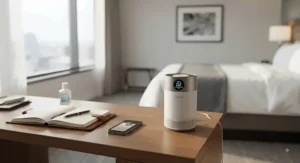
Getting a UV-C air purifier virus bacteria home setup to actually perform starts with placement, not power settings. Position the unit in open floor space with at least 8-10 inches of clearance on all sides — jamming it into a corner or behind a couch throttles the intake and cuts effective air changes per hour dramatically, no matter how strong the motor is. For rooms with doors, keep the door closed while it runs; open floor plans dilute the treated air across too large a volume for the unit’s rated coverage to mean much.
During the first 30 days, run the unit continuously rather than cycling it on and off — UV-C lamps typically need a brief warm-up period to reach full germicidal output, and constant operation also lets the HEPA stage build up a baseline reduction before you judge results. A common first-month mistake is running only the “auto” or sensor-triggered mode, which can leave the UV lamp powered down during quiet periods when airborne pathogen load might still be meaningful. Check the manufacturer’s lamp-life rating (commonly 9,000-10,000 hours) and mark a calendar reminder, since a dead UV bulb inside a still-running fan gives a false sense of ongoing protection. Vacuum the exterior grille monthly and wipe down light sensors on models that have them — dust buildup on the sensor itself can throttle fan speed even when the room air is genuinely dirty.
Real-World Scenarios: Who Actually Needs a UV-C Air Purifier
If you’re a college student in a shared dorm with a roommate who’s constantly cycling through colds, a pluggable unit like the GermGuardian GG1000 running in the shared bathroom, paired with a compact HEPA tower like the GermGuardian AC4825E in the bedroom, covers both the supplemental sanitizing angle and the particle-capture angle without blowing a student budget.
If you’re a household with young kids in daycare, and every seasonal bug seems to make its way home by Thursday, the GermGuardian AC5250PT or Medify MA-40 UV fits the profile — larger coverage for shared living spaces, HEPA filtration for the constant stream of daycare-borne particles, and a UV-C stage as backup insurance during the worst weeks of flu season.
If you or someone in your home is immunocompromised, recovering from a respiratory illness, or simply wants the highest realistic protection available outside a clinical setting, the Airpura UV600 or Airpura UV714 is the honest answer. The dedicated lamp wattage and Super HEPA option exist specifically for that use case, and the price reflects genuinely different internal hardware rather than a marketing tier.
Common UV-C Air Purifier Problems (and How to Actually Fix Them)
Problem: The unit runs constantly but the room still smells musty. UV-C addresses biological particles, not most odor molecules. Pair it with a purifier that has a substantial activated carbon stage — the Airpura UV600‘s 18-pound carbon bed exists precisely for this — rather than assuming germicidal power equals odor control.
Problem: You can’t tell if it’s actually working. Unlike a HEPA filter, which visibly darkens over months of use, a UV-C lamp gives no visual feedback on whether it’s still emitting effectively. Track hours run against the manufacturer’s rated lamp life rather than relying on “it still lights up,” since UV-C output degrades well before the bulb goes fully dark.
Problem: The unit seems undersized for the room. This is almost always a square-footage math error. Manufacturer coverage ratings typically assume a single air change per hour at the top fan speed — for meaningful pathogen reduction, look for a unit rated for roughly double your actual room size, or plan to run it on a higher, noisier setting than the rating alone suggests.
Problem: Ozone smell after cabinet cleaning. A faint “electrical” or “ozone-like” smell right after opening the cabinet is common and typically dissipates in minutes; a persistent chemical smell during normal operation is not normal for a verified zero-ozone unit and is worth a warranty inquiry.
Problem: Filter costs sneaking up over the year. Budget for replacement filters at purchase time, not six months later — the ongoing cost of HEPA and carbon replacement over 12 months on a budget unit can approach the price of the unit itself.
✨ Don’t Miss These Exclusive Deals!
🔍 Take your indoor air quality to the next level with these carefully selected UV-C purifiers. Click on any highlighted model to check current pricing and availability. These picks help you build genuinely cleaner air your family will actually notice.
How to Choose the Best UV Air Purifier for Viruses
Finding the best UV air purifier for viruses comes down to matching five criteria to your actual room and household, not chasing the highest wattage number on the box:
- Match coverage to your real square footage, doubled. A unit rated for your exact room size will underperform in practice — buy up a tier for genuine air-change frequency.
- Confirm the UV-C lamp sits downstream of HEPA filtration. This ensures the light treats particles the filter has already captured rather than trying to hit fast-moving air on a single pass.
- Check the ozone certification explicitly, not just implied by “UV-C” branding — look for CARB compliance or a stated zero-ozone rating.
- Weigh lamp wattage against your exposure risk. A 2-3 watt pluggable is fine for supplemental odor and germ control; sustained daily virus exposure concerns call for the 15-20 watt dedicated lamps found in Airpura-class units.
- Price in filter and bulb replacement costs, since a cheap unit with expensive consumables can cost more over three years than a pricier unit with a longer-lived filter.
- Read aggregated review sentiment for noise complaints, since a purifier that’s too loud to run at night defeats its own purpose through inconsistent use.
- Verify coverage claims against independent test data where available, since manufacturer-rated square footage and independently tested CADR performance don’t always agree.
UV-C HEPA Combo vs Standalone UV-C: Which Actually Matters More
This is the question most listings dodge entirely. A UV-C HEPA combo air purifier does two fundamentally different jobs: the HEPA filter physically removes particles from circulating air, while the UV-C lamp damages the genetic material of anything biological that gets trapped or passes near it. A standalone UV-C device, like the pluggable GermGuardian GG1000, does only the second job — it doesn’t remove dust, pollen, or pet dander at all, because there’s no filter media to capture them.
Here’s what most buyers overlook about air purifier hospital grade home marketing: genuine medical-grade filtration, like the 99.99%-at-0.1-micron rating on the Airpura UV714, is doing the bulk of the practical work, with the UV-C lamp adding a secondary layer against anything the filter has trapped rather than being the primary defense. For a household deciding between the two approaches, the honest answer is that combo units win for nearly every real scenario — particle allergens (dust, pollen, dander) are a daily, constant exposure, while airborne pathogen concentration spikes intermittently. A HEPA + UV-C combo addresses both; a UV-C-only device addresses neither particles nor pathogens comprehensively on its own.
UV-C Wavelength and Germicidal Effectiveness: What the Science Says
UV-C wavelength germicidal effectiveness isn’t a marketing abstraction — it’s measurable, published science. Research on SARS-CoV-2 inactivation has demonstrated that at a wavelength of 254 nanometers, viral inactivation occurs through direct UV-C absorption and photochemical damage to nucleic acid, which disrupts the virus’s ability to replicate — this is the same 254nm figure you’ll see quoted on the Airpura UV600 and UV714 spec sheets, and it’s not a coincidence; it’s the wavelength where most commercial low-pressure mercury germicidal lamps concentrate their output.
What most buyers overlook is that wavelength alone doesn’t determine effectiveness — dose does, meaning intensity multiplied by exposure time. Peer-reviewed research on coronavirus inactivation has found peak virucidal efficiency in a narrow band around 267-270 nanometers, slightly higher than the traditionally cited 260nm nucleic acid absorption peak, though 254nm remains the dominant commercial standard because it’s efficient to generate and well-studied across decades of use. Enveloped RNA viruses — the category that includes influenza and coronaviruses — have consistently shown greater UV sensitivity than non-enveloped viruses in comparative testing, which is genuinely good news for households mainly worried about cold and flu season rather than more UV-resistant pathogens.
UV-C Contact Time and Pathogen Kill Rate: Why Airflow Speed Determines Everything
UV-C contact time pathogen kill rate is the variable that separates a purifier that works from one that just looks like it’s working. Peer-reviewed dose-response research has found that for a 90% reduction in viral load, UV dose requirements ranged from roughly 1.3 to 8.1 millijoules per square centimeter depending on whether the virus carried single-stranded or double-stranded genetic material — with double-stranded viruses requiring notably higher doses to achieve the same reduction. Translated into plain terms: a stronger lamp or a slower-moving air stream both increase dose, and either one compensates for the other.
This is exactly why the dedicated 18-watt lamp in the Airpura UV600 matters more than it might seem on a spec sheet next to a 2-3 watt bulb in a budget tower — at typical consumer fan speeds, air spends only a fraction of a second near the lamp, so a higher-wattage source delivers meaningfully more germicidal dose in that brief window. Some published inactivation studies for SARS-CoV-2 specifically found that doses as low as roughly 16 millijoules per square centimeter achieved total inactivation of high-titer virus in controlled testing, while lower doses reduced infectivity by a smaller margin — underscoring that “has a UV-C light” and “delivers a germicidal dose” are not automatically the same claim on every product.
Ozone Byproduct Risk: Is Your UV-C Purifier Safe to Breathe Around?
The ozone byproduct UV purifier risk question deserves a straight answer: some UV lamps, specifically those emitting below roughly 240 nanometers, can generate ozone as a byproduct, while lamps engineered to concentrate output at 254nm and above are designed to minimize or eliminate that production. The EPA explicitly distinguishes UVGI (ultraviolet germicidal irradiation) air cleaners, which use UV lamps to damage biological pollutants, from ozone generators, which intentionally produce ozone gas as their working mechanism — these are not the same category of device, despite both sometimes using UV components.
Every product featured in this guide that lists an ozone certification is rated zero-ozone or non-ozone-generating, which is the specification worth checking on any UV-C unit you’re considering, rather than assuming “UV-C” and “ozone” are automatically linked. The EPA’s position is unambiguous on the reverse case, too — ozone is a documented lung irritant, and devices marketed specifically as ozone generators are not recommended for use in occupied spaces at any concentration meant to be therapeutic. If a listing doesn’t explicitly state zero-ozone or CARB-compliant status, that’s a legitimate reason to ask before you buy, not an oversight to ignore.
Common Mistakes When Buying a UV-C Air Purifier
The single most common mistake is buying based on square footage rating alone without checking whether the UV-C component is even a meaningful part of the design — some “UV-C air purifiers” include a token bulb that contributes negligible germicidal dose, essentially a marketing checkbox rather than functional hardware. Cross-reference wattage and published third-party test data where it exists, rather than trusting the phrase “UV-C” on the box alone.
A second frequent error is underestimating long-term maintenance cost. Filters and UV-C bulbs are both consumables with finite lifespans — HEPA filters commonly need replacement every 6-12 months, and UV-C bulbs in the 9,000-10,000 hour range translate to roughly a year of continuous use before germicidal output meaningfully drops. Skipping bulb replacement is the quiet failure mode nobody notices, since the fan keeps running and the light stays lit long after germicidal effectiveness has faded.
A third mistake is placement — running any air purifier behind furniture, in a closed closet with the door shut, or in a room far larger than its rating dramatically undercuts real-world performance regardless of how good the internal hardware is. And finally, buyers frequently skip checking ozone certification entirely, assuming any reputable brand has already handled it — verify it explicitly, especially on lesser-known imports.
Long-Term Cost and Maintenance: The Real Price of Owning a UV-C Purifier
The sticker price is only the entry fee. Budget purifiers like the GermGuardian AC4825E carry lower upfront cost but replacement filters add up over a few years of ownership, while premium units like the Airpura UV714 carry a higher purchase price but a UV-C lamp life rated around 10,000 hours — roughly a year of continuous use — plus a substantial 18-pound carbon bed that lasts considerably longer than the small carbon pads found in budget towers before needing replacement.
Total cost of ownership over three years typically narrows the price gap between budget and premium tiers more than buyers expect: a $90 unit needing $150-200 total in filters and no serviceable UV bulb ends up closer in lifetime cost to a $1,000 unit with a $60-80 annual bulb replacement than the sticker prices alone suggest. Factor in warranty length too — five-year parts-and-labor warranties, common on the premium end, meaningfully change the math if a motor or sensor fails outside year one.
FAQ
❓ Do UV-C air purifiers actually kill viruses in the air?
❓ Is a UV-C air purifier safe to run all day at home?
❓ What's the difference between UV-C and HEPA air purifiers?
❓ How often do UV-C bulbs need to be replaced?
❓ Can a UV-C air purifier replace opening windows or improving ventilation?
Conclusion
A genuinely effective UV-C air purifier virus bacteria home setup isn’t about finding the single “best” unit — it’s about matching lamp strength, filtration grade, and coverage to what your household actually faces day to day. A student in a dorm room and a family managing an immunocompromised member are solving different problems with the same underlying technology, and the seven models here span that entire range honestly, from a $20 pluggable sanitizer to a $1,200 near-hospital-grade system.
What ties every recommendation together is verification: zero-ozone certification, published UV wavelength and lamp wattage, and HEPA ratings backed by independent or peer-reviewed testing rather than vague marketing language. Skip anything that can’t answer those three questions directly. Whichever tier fits your budget, pairing real HEPA filtration with a properly rated UV-C lamp — and actually maintaining both — is what turns a purifier from a humming box in the corner into hardware that’s doing its job.
Recommended for You
- Air Purifier for Viruses: 7 Proven HEPA Picks for 2026
- Air Purifier for Musty Smell: 7 Picks That Actually Work (2026)
- 7 Best Air Purifier for Odors Picks That Actually Work (2026)
Disclaimer: This article contains affiliate links. As an Amazon Associate, I earn from qualifying purchases. If you purchase products through these links, we may earn a small commission at no additional cost to you.
✨ Found this helpful? Share it with your friends! 💬🤗
