
In This Article
Your house doesn’t smell like a house anymore. It smells like last night’s salmon, the dog’s third bath this month, and whatever mystery odor lives behind the couch. An air purifier for odors is a household filtration device — usually one built around a thick activated carbon layer alongside a HEPA filter — designed to adsorb gas-phase smell molecules and volatile organic compounds rather than simply trapping dust. That’s the whole ballgame: dust filters catch particles you can see under a flashlight beam, but odors are gases, and gases slip right through a standard filter like smoke through a screen door.
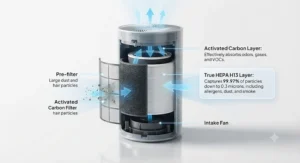
Here’s the part nobody tells you at the big-box store: most “HEPA air purifiers” on the shelf are built for allergies, not smells. They’ll pull pollen and pet dander out of the air beautifully and do almost nothing about the garlic smell that’s been haunting your kitchen since Tuesday. If what you actually want is an air purifier that eliminates household odors — cooking grease, litter boxes, basement mustiness, that weird closet smell — you need a machine with serious carbon mass, not just a token black-tinted filter pad.
We dug through real product specs, manufacturer filter data, and aggregated review sentiment from independent testers to build this guide. Below you’ll find seven genuinely different machines — from a $90 bedroom unit to a 15-pound carbon beast built for chemical sensitivity — plus the science of why carbon works, the difference between elimination and masking, and a decision framework so you’re not just guessing. No fluff, no invented five-star quotes. Just what actually gets the smell out of your air, and why some products are dramatically better at it than others despite looking nearly identical in a product photo.
Quick Comparison: Best Air Purifier for Odors at a Glance
| Product | Best For | Room Coverage | Carbon Load | Price Range |
|---|---|---|---|---|
| Levoit Core 300 | Budget bedrooms | ~219 sq ft (4 ACH) | Thin pelleted carbon | $80-$100 range |
| GermGuardian AC4825 | Tight budgets + UV-C | ~150-170 sq ft (4 ACH) | Thin charcoal pre-filter | $90-$130 range |
| Winix 5500-2 | Best value all-rounder | ~180-250 sq ft (4 ACH) | Washable AOC granular carbon | $130-$180 range |
| Blueair Blue Pure 211+ | High airflow, large rooms | ~260-350 sq ft (4 ACH) | Light carbon mesh | Around $300 |
| Rabbit Air MinusA2 | Design-forward, customizable | ~200-400 sq ft (4 ACH) | Pellet carbon + swappable odor filter | $600-$700 range |
| Alen BreatheSmart 75i | Big rooms, heavy odor | ~325-650 sq ft (4 ACH) | Up to 3.6 lbs pelleted carbon | Mid-$400s to high-$700s |
| Austin Air HealthMate | Whole-room chemical/odor overload | ~375 sq ft (4 ACH) | 15 lbs carbon + zeolite | $600-$800 range |
A quick read of that table tells you most of what you need to know before you spend a dime: carbon mass and price move together almost in lockstep. The Levoit Core 300 and GermGuardian AC4825 are entry points that will knock the edge off everyday cooking smells in a small room, but if you’re dealing with a smoker’s house, a litter box that never quite gets clean, or a musty basement, you need to look toward the Alen BreatheSmart 75i or Austin Air HealthMate, where the carbon load is measured in pounds instead of ounces. The Winix 5500-2 sits in the sweet spot for most households — enough carbon to handle daily odor load without asking you to remortgage the house.
💬 Found a match already? Tap through and check today’s availability before it changes!
Top 7 Air Purifiers for Odors: Expert Analysis
We picked these seven specifically to cover the full range of odor situations — small apartments, pet households, basements, whole-house chemical sensitivity, and everything between. Every unit below combines a real HEPA stage with genuine activated carbon, not a decorative charcoal sticker.
1. Levoit Core 300 — best budget pick for bedroom-sized odors
The standout here is value: a workable carbon stage and a certified 141 CFM smoke CADR for well under $100, which is hard to beat if you just want a bedroom or home office to stop smelling like last night’s stir-fry. Independent testing puts its AHAM-verified smoke CADR at 141 CFM, with a manufacturer-rated coverage around 219 square feet at four air changes per hour — realistic for a bedroom, tight for an open kitchen-living combo. The 3-in-1 filter bundles a nylon pre-filter, True HEPA media, and a thin layer of activated carbon in one swappable cartridge, which keeps maintenance simple but caps how much odor-fighting capacity you actually get.
Based on the spec comparison, this is a particle-filtration unit that happens to include carbon, rather than a purpose-built odor machine — the carbon layer here is a fraction of what you’ll find in the Alen BreatheSmart 75i or Austin Air HealthMate further down this list. It’s the right call for someone managing occasional cooking smells or light pet odor in a single room, not someone fighting a whole-house smoke or mildew problem. Reviewers consistently report that the Core 300 handles dust and everyday smells competently in small spaces, while noting the carbon filter saturates faster than pricier alternatives and could use more mass for anyone with a persistent odor source.
Pros:
- ✅ Excellent CADR-to-price ratio for small rooms
- ✅ Whisper-quiet on its lowest sleep setting
- ✅ Cheap, easy filter swaps every six months
Cons:
- ❌ Thin carbon layer struggles with strong or constant odors
- ❌ No auto mode or onboard air quality sensor
Expect this one in the $80-$100 range depending on retailer promotions — genuinely good value if your odor problem is mild and your room is small, but check current price before assuming it’s your best fit for anything larger than a bedroom.

2. GermGuardian AC4825 — most budget-friendly with UV-C backup
The standout advantage is the added UV-C sanitizer layer alongside a charcoal pre-filter, giving you a two-pronged approach to smell and airborne bacteria for one of the lowest prices on this list. Independent room-coverage estimates put the AC4825 at roughly 150-170 square feet for real four-air-change performance, even though the marketing copy references a much larger one-air-change figure closer to 740 square feet — a classic case of reading past the headline number. The charcoal pre-filter sits directly in front of the HEPA stage and is designed to control light household odors like cooking, pets, and smoke rather than heavy, persistent gas loads.
What most buyers overlook about this model is that the UV-C bulb targets airborne germs and some VOCs through a photocatalytic reaction, not the odor molecules directly — the actual odor-fighting still comes down to that comparatively thin charcoal layer, similar in scope to the Levoit Core 300. Reviewers consistently note it performs well against everyday smells like cooking and pet odor in small, closed rooms, with several mentioning the pre-filter needs vacuuming or swapping more often than expected if odor sources are constant. This is a smart pick for a dorm room, small home office, or bathroom, but not the unit to reach for if you’re dealing with a serious basement mustiness problem.
Pros:
- ✅ Lowest price point with genuine carbon filtration
- ✅ UV-C stage adds bacteria and mold-spore defense
- ✅ Compact 22-inch tower fits tight spaces easily
Cons:
- ❌ Real-world coverage is smaller than advertised
- ❌ Charcoal pre-filter saturates quickly with heavy odor loads
Look for it in the $90-$130 range, with replacement filter bundles keeping ongoing costs low — a smart entry point before committing to a pricier, heavier-carbon machine.
3. Winix 5500-2 — best all-around value for household odors
The standout feature is the washable AOC (Advanced Odor Control) carbon filter made from activated carbon granules, paired with PlasmaWave ionization technology that tackles gas-phase pollutants without generating measurable ozone. Independent lab testing puts its dust CADR around 232-246 CFM depending on the pollutant type, with certified coverage suitable for medium-to-large rooms in the 300-360 square foot range at one air change per hour. Unlike fibrous carbon pre-filters found in cheaper units, the pelleted granular design here gives gas molecules more surface area to bind to, which is the actual mechanism behind better odor performance.
Here’s what the spec sheet won’t tell you, but reviewers consistently note: the PlasmaWave function can be switched off entirely if you’re wary of ionizers, and independent testing found particle-clearing times were nearly identical with or without it enabled — so you’re not sacrificing much performance by leaving it dormant. Aggregated reviewer sentiment describes this as one of the best price-to-performance ratios in the mid-range category, particularly for pet owners and cooking-heavy households, with the washable pre-filter cutting long-term filter costs compared to fully disposable systems. The one recurring complaint is that this unit runs slightly louder and pulls more power at its top speed than some competitors of similar CADR.
Pros:
- ✅ Washable, real granular carbon (not fibrous mesh)
- ✅ Strong CADR-to-price ratio in the mid-range tier
- ✅ Optional ozone-free ionizer for gas-phase odors
Cons:
- ❌ Higher power draw at maximum fan speed
- ❌ Noticeably louder than quieter competitors on high
You’ll typically find the Winix 5500-2 in the $130-$180 range, and it remains one of the strongest all-around value plays if your main concern is everyday household odor rather than extreme chemical sensitivity.
4. Blueair Blue Pure 211+ — best for large rooms that need serious airflow
The standout here is raw air-moving power: an independently tested CADR around 350 CFM, the highest of its class in several third-party lab comparisons, letting it turn over air in rooms up to roughly 500-540 square feet quickly. The particle and carbon combination filter uses Blueair’s HEPASilent technology, blending mechanical filtration with an always-on ionization process to boost particle capture without a separate high-static HEPA media stack. That speed matters for odors indirectly — moving more air through the carbon layer more often means more total odor-molecule contact time over the course of a day, even with a comparatively thin carbon mesh.
Based on the spec comparison, this is fundamentally a particle-and-airflow machine first and an odor machine second: independent testers have noted the carbon layer here does meaningfully less for smell than dedicated odor filters like the one on the Alen BreatheSmart 75i, even though it will still measurably reduce everyday cooking and pet smells simply through sheer air turnover. What most buyers overlook is that the always-on ionizer can’t be disabled on this model, which matters if you’re specifically trying to avoid ionization technology. Reviewer sentiment consistently praises the near-silent operation at lower speeds and the large real-world coverage area, while flagging the higher-than-average lifetime filter cost as the main drawback.
Pros:
- ✅ Class-leading CADR for large open-plan rooms
- ✅ Whisper-quiet even at moderate-to-high fan speeds
- ✅ Simple one-button control, minimal learning curve
Cons:
- ❌ Thinner carbon layer than dedicated odor-focused models
- ❌ Always-on ionizer with no manual off switch
Prices for the Blue Pure 211+ typically land around $300, positioning it as a premium airflow pick rather than a premium odor pick — worth checking current price if square footage matters more to you than raw carbon mass.
5. Rabbit Air MinusA2 — best design-forward pick with customizable odor filtration
The standout advantage is flexibility: buyers choose between four swappable customized filters — Germ Defense, Toxin Absorber, Pet Allergy, or Odor Remover — letting you tailor the sixth filtration stage specifically to your household’s biggest smell source. The base system includes a BioGS HEPA filter plus a pellet-based activated carbon stage rated for rooms up to roughly 815 square feet in ideal conditions, though real-world four-air-change coverage lands closer to 200-400 square feet depending on layout. Choosing the Odor Remover customized filter adds a second carbon layer specifically formulated to trap and adsorb pet, cooking, cigarette, and mildew odors on top of the primary carbon stage.
What most buyers overlook about this model is that its wall-mountable, art-panel design isn’t just aesthetics — it lets you position the unit closer to the actual odor source (a litter box corner, a kitchen wall) without it looking like medical equipment in your living room, which matters for long-term compliance since people run purifiers they don’t mind looking at. Aggregated reviewer sentiment consistently praises the build quality, five-year warranty, and quiet BLDC motor, while independent testers have noted the primary carbon filter carries less total mass than heavyweight competitors like the Austin Air HealthMate, meaning the customized odor filter add-on is doing real work rather than being optional. This is the pick for someone who wants strong, targeted odor control without a utilitarian white box dominating the room.
Pros:
- ✅ Swappable customized filter targets your specific odor
- ✅ Genuinely quiet operation with a five-year warranty
- ✅ Design that blends into living spaces, not just utility rooms
Cons:
- ❌ Premium price relative to its base carbon mass
- ❌ Customized filter is an added cost on top of the unit
Budget for the $600-$700 range for the unit itself, plus a smaller ongoing cost for the customized filter cartridge — a real investment, but one that pays off if you want a purifier you’ll actually want visible in your home.

6. Alen BreatheSmart 75i — best for large rooms with heavy, persistent odor
The standout feature is the interchangeable Fresh and Odor filter options, with the Fresh filter alone packing up to 3.6 pounds of pelleted activated carbon — among the heaviest carbon loads of any mainstream consumer purifier short of the Austin Air HealthMate. Independently verified AHAM CADR sits around 347-351 CFM, with manufacturer coverage claims up to 1,300 square feet at two air changes per hour, dropping to a more realistic 500-650 square feet for allergy- or odor-grade four-air-change performance. The dedicated Odor filter option swaps some carbon mass for a proprietary molecular-conversion technology aimed specifically at pet, diaper, and heavy household odors rather than general VOCs.
Here’s what the spec sheet won’t tell you, but independent lab notes make clear: because Alen ships this unit with your choice of filter media, the actual odor performance varies significantly depending on which filter you select at checkout — the base Pure filter has essentially no carbon, so anyone shopping this model specifically for smell needs to actively choose the Fresh or Odor filter, not the default option. Reviewer sentiment consistently flags this as one of the quietest large-format purifiers on the market, with a lifetime warranty that meaningfully lowers the effective long-term cost compared to purifiers requiring frequent full-unit replacement. The main recurring critique is the size and price tag, which several testers noted feels like overkill for anyone without a serious, ongoing odor or smoke problem.
Pros:
- ✅ Heaviest carbon option short of Austin Air, with a choice of filter type
- ✅ Lifetime warranty meaningfully lowers total cost of ownership
- ✅ Quietest large-room purifier in independent decibel testing
Cons:
- ❌ Odor performance depends entirely on choosing the right filter
- ❌ Large footprint, arguably overpowered for smaller households
Pricing spans from the mid-$400s up to the high-$700s depending on cabinet finish and filter choice — check current price and filter options carefully before ordering, since the odor-fighting capability isn’t automatic on the base configuration.
7. Austin Air HealthMate — best for whole-room chemical sensitivity and heavy odor overload
The standout feature is sheer carbon mass: 15 pounds of activated carbon and zeolite media, roughly triple what most premium competitors ship with, making this the single heaviest-duty odor and VOC filter on this list. Independent estimates place its real-world PM1 CADR around 156 CFM, considerably lower than its 400 CFM marketing figure, though the manufacturer’s own coverage claims of up to 1,500 square feet reflect one-air-change performance rather than the faster turnover needed for acute odor situations. The four-stage system pairs double pre-filtration for particles with that massive carbon-zeolite bed and a 60-square-foot medical-grade HEPA layer, all housed in a steel body designed to avoid the plastic off-gassing some chemically sensitive users react to.
Based on the spec comparison, this unit trades raw airflow speed for filtration depth — it won’t clear a smoky room as fast as the Alen BreatheSmart 75i on paper, but the sheer volume of carbon means it keeps adsorbing odor molecules for years rather than months, with Austin Air rating filter life at four to five years under normal residential use. What most buyers overlook is that filter changes require a screwdriver and disassembly rather than a quick cartridge swap, a real trade-off for the dramatically longer filter lifespan. Reviewer sentiment, including institutional use by hospitals and a U.S. Army-backed deployment following the September 11th attacks, consistently frames this as the go-to choice for genuine chemical sensitivity, heavy smoke exposure, or households that have tried lighter-carbon units and found them insufficient.
Pros:
- ✅ Unmatched 15 lbs of carbon and zeolite media
- ✅ Steel housing avoids plastic off-gassing concerns
- ✅ Filters rated to last four to five years
Cons:
- ❌ Slower real-world air turnover than lighter, faster-fan competitors
- ❌ Filter replacement requires tools and full disassembly
Expect the $600-$800 range depending on model variant and color — a serious investment, but reviewers and institutional buyers alike consistently point to it as the ceiling for pure odor and VOC removal in a residential unit.
Top 7 Products at a Glance: Full Spec Comparison
| Product | CADR (Smoke/Dust) | Real-World Coverage | Noise Range | Best For |
|---|---|---|---|---|
| Levoit Core 300 | ~141-145 CFM | ~219 sq ft | 24-50 dB | Small bedrooms on a budget |
| GermGuardian AC4825 | ~125 CFM equivalent | ~150-170 sq ft | Low-moderate | Dorms, bathrooms, tight budgets |
| Winix 5500-2 | ~232-246 CFM | ~250-360 sq ft | Moderate-loud on high | Pet owners, cooking odor |
| Blueair Blue Pure 211+ | ~350 CFM | ~500-540 sq ft | Very quiet | Large open-plan rooms |
| Rabbit Air MinusA2 | Moderate-high | ~200-400 sq ft (4 ACH) | Very quiet | Design-conscious, targeted odor |
| Alen BreatheSmart 75i | ~347-351 CFM | ~500-650 sq ft (4 ACH) | Very quiet | Big rooms, heavy persistent odor |
| Austin Air HealthMate | ~156 CFM (real-world PM1) | ~375-400 sq ft (4 ACH) | Moderate | Chemical sensitivity, whole-room odor |
Looking at the comparison above, the pattern is clear: raw CADR and carbon mass don’t move together, so the fastest-clearing purifier isn’t automatically the best one for odors. The Blueair Blue Pure 211+ wins on airflow speed, but the Austin Air HealthMate and Alen BreatheSmart 75i win on the metric that actually determines long-term odor control — how much carbon is physically present to adsorb gas molecules before it saturates. Budget shoppers should note that the Levoit Core 300 and GermGuardian AC4825 are genuinely fine for light, occasional odors in small rooms, but neither was designed to compete with the heavy-carbon tier further up this table.
✨ Don’t Miss These Exclusive Deals!
🔍 Take your home air quality to the next level with these carefully selected picks. Click on any highlighted item to check current pricing and availability. These purifiers will help you create a fresher, more welcoming home your family and guests will actually notice.
How to Set Up Your Odor-Fighting Air Purifier for Best Results
Buying the right machine is only half the job — placement and setup determine whether that carbon actually gets a fair shot at the smell in your home. Start by positioning the unit as close to the odor source as reasonably possible: near the litter box corner, beside the stove (but not directly in cooking splatter range), or in the mustiest corner of the basement, rather than tucked in a hallway where it’s mostly filtering air that was never that smelly to begin with. Give it at least 12-18 inches of clearance on all sides so the 360-degree intake many of these units use isn’t partially blocked by furniture.
During the first 30 days, run the unit on a higher speed than you think you need. New carbon filters have their maximum available adsorption surface area on day one, and running a lower “eco” speed constantly under-uses that capacity while the odor keeps accumulating in the room air between low-speed cycles. A common mistake is assuming set-and-forget auto mode alone will handle a strong, ongoing odor source — auto sensors on most consumer units are tuned for particles like dust and smoke, not gas-phase VOCs, so they may not ramp up the fan just because a room smells bad. Manually boosting speed for the first hour after cooking, cleaning a litter box, or noticing a musty smell gives the carbon layer a concentrated shot at the problem while it’s fresh.
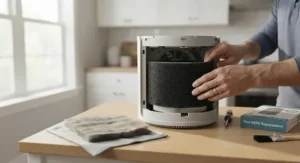
Maintenance matters just as much as placement. Vacuum any washable pre-filter monthly to keep airflow unrestricted, since a clogged pre-filter starves the carbon and HEPA stages of the volume they need to work. Track carbon filter replacement by calendar date, not just by indicator light — many budget units don’t have a dedicated gas-sensor to flag carbon saturation, so a six-month reminder on your phone is more reliable than waiting for a smell to creep back.
Real Homes, Real Odors: Three Scenarios and What Worked
Consider a college student in a 250-square-foot dorm room dealing with roommate cooking smells and the occasional questionable microwave incident. Budget and space are the two constraints here, which points squarely toward something like the Levoit Core 300 or GermGuardian AC4825 — small footprint, low upfront cost, and carbon that’s genuinely sufficient for an occasional, low-intensity smell rather than a constant heavy load.
Now picture a family of four with two dogs and a cat, living in a 1,200-square-foot open-concept home where pet odor, litter box smell, and cooking all compete for attention in the same shared air. This is where the Winix 5500-2 earns its keep — enough carbon and CADR to handle a moderate, near-constant odor load across a bigger footprint, without stepping into four-figure territory. A second unit near the litter box, even a budget one, often outperforms a single large purifier trying to cover the whole floor plan from one spot.
Finally, think about someone managing multiple chemical sensitivities in an 1,800-square-foot house, where new furniture off-gassing, cleaning product residue, and general household odor accumulation are a daily quality-of-life issue rather than an occasional annoyance. Based on the spec comparison, this scenario calls for the Austin Air HealthMate or the Fresh-filter configuration of the Alen BreatheSmart 75i — both carry enough carbon mass to keep adsorbing gas-phase pollutants around the clock without saturating within weeks, which lighter units simply aren’t built to do.
Air Purifier for Musty Smell Home: Basement, Bathroom & Laundry Fixes
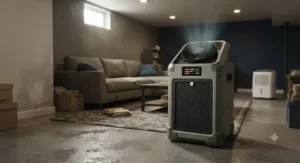
Musty smell is a special case because it’s usually a symptom, not just an odor — it typically signals mold or mildew growth feeding on moisture somewhere nearby, and no air purifier fixes the underlying dampness driving it. That said, a strong carbon filter absolutely helps manage the smell while you address the moisture source, and can meaningfully improve air quality in the meantime. According to the EPA’s guidance on mold and moisture, controlling indoor humidity below 60 percent, ideally between 30 and 50 percent, is the actual long-term fix — an air purifier is a supporting tool, not a substitute for a dehumidifier in a damp basement.
Problem: basement musty smell that returns within days of running a purifier. Solution: pair a heavy-carbon unit like the Austin Air HealthMate or Alen BreatheSmart 75i with a standalone dehumidifier running simultaneously, since damp carbon adsorbs moisture as readily as odor molecules and saturates faster in a humid room.
Problem: bathroom odor that lingers after showers despite ventilation. Solution: a compact unit like the GermGuardian AC4825 placed near — not inside — the bathroom, run on a boosted speed for 20-30 minutes after each shower, catches the odor while the exhaust fan handles the humidity itself.
Problem: laundry room smell from a front-loading washer or a hamper that never quite airs out. Solution: the Winix 5500-2‘s washable carbon filter is a practical fit here, since laundry rooms tend to be smaller and the washable pre-filter stands up well to the lint and moisture typical of that environment.
Your Buyer’s Decision Framework: Which Odor Fighter Fits Your Home?
If your main concern is occasional cooking smell in a single small room, choose a budget pick like the Levoit Core 300 because the odor load is light and infrequent, and a thin carbon layer genuinely keeps pace.
If you’re managing pets, a litter box, or moderate daily cooking odor across a mid-sized home, choose the Winix 5500-2 because its washable granular carbon and higher CADR handle a near-constant, moderate odor load without the price tag of the flagship units.
If square footage is your biggest constraint and odor is secondary to overall air movement, choose the Blueair Blue Pure 211+ because its class-leading CADR clears large rooms fast, even with a comparatively lighter carbon stage.
If you want targeted, swappable odor filtration in a piece that doesn’t look like a hospital device, choose the Rabbit Air MinusA2 because its customized filter system lets you dial in pet, smoke, or general odor specifically.
If you’re dealing with a large room and a persistent, heavy odor source like a serious pet or smoke situation, choose the Alen BreatheSmart 75i with the Fresh or Odor filter, because its 3.6-pound carbon load and lifetime warranty are built for sustained heavy use.
If you have chemical sensitivities or an odor problem that’s simply outlasted every lighter unit you’ve tried, choose the Austin Air HealthMate because 15 pounds of carbon and zeolite is, functionally, as much odor-fighting capacity as a residential unit can offer.
How to Choose an Air Purifier That Eliminates Household Odors
- Check the carbon weight, not just the word “carbon.” A filter that lists ounces of carbon behaves very differently from one listing pounds — manufacturers rarely lead with this number, so you may need to dig into the filter’s product page specifically.
- Match CADR to your actual room size, not the marketing headline. Coverage figures based on one air change per hour look impressive but overstate real performance; divide the advertised square footage by roughly three to four for realistic odor-grade coverage.
- Decide if you need a customizable or swappable filter system. Households with one dominant odor source — pets, smoke, or general VOCs — often benefit more from a targeted filter than a generalist one.
- Factor in noise tolerance for the room it’s going in. A purifier that’s powerful but too loud to run overnight in a bedroom will end up running on a lower, less effective speed most of the time.
- Calculate total filter replacement cost over two to three years, not just the sticker price. A cheaper unit with frequent, pricier filter swaps can cost more over time than a pricier unit with a long-life filter.
- Consider whether an ionizer matters to you. Some odor-focused purifiers include ozone-free ionization as a secondary gas-phase strategy; others avoid it entirely — neither is objectively wrong, but it’s worth knowing what you’re buying.
- Confirm the room’s actual pollutant source before buying anything. An air purifier for odors that come from cooking, pets, or smoke performs very differently than one being asked to fix a mold or moisture problem it was never designed to solve.
Air Purifier Odor vs HEPA Filter: What’s the Difference?
This is the single most common point of confusion in the entire category, and it’s worth being precise about. A HEPA filter is a mechanical filter — a densely pleated fiber mat that physically traps particles as small as 0.3 microns, including dust, pollen, pet dander, and some bacteria and mold spores. It does this extremely well, capturing 99.97 percent of particles at that size in certified units. What it does not do is remove gas-phase molecules, because odor and VOC molecules are individual gas molecules, thousands of times smaller than even the finest particle a HEPA filter is rated to catch — they pass straight through the fiber mat without being physically trapped at all.
Activated carbon works on a completely different mechanism called adsorption, where gas molecules stick to the surface of an enormous internal pore structure rather than being caught in a mesh. This is why a purifier’s actual odor performance has almost nothing to do with its HEPA certification and almost everything to do with how much carbon it carries and how porous that carbon is. A unit can be an excellent HEPA performer — clearing dust and allergens fast — while being a mediocre odor performer, and the Blueair Blue Pure 211+ on this list is a reasonably good real-world example of that exact gap: outstanding CADR, comparatively modest carbon mass. If odor is your primary concern, treat the carbon spec as the headline number, and treat HEPA certification as a secondary, separate feature.
Odor Molecule VOC Carbon Adsorption: The Science of How Carbon Traps Smells
Activated carbon is ordinary carbon — often derived from coconut shells, wood, or coal — processed at extreme heat to develop an almost unimaginably porous internal structure. A single gram of quality activated carbon can have a surface area exceeding 1,000 square meters once you account for every internal pore and crevice, according to material science research referenced by Wikipedia’s overview of activated carbon. Odor molecules and volatile organic compounds, drawn in by the purifier’s fan, pass through this porous carbon bed and get physically trapped inside those pores through van der Waals forces — a weak molecular attraction that’s strong enough in aggregate, across billions of pore sites, to pull gas molecules out of the air stream.
This is also exactly why carbon filters eventually stop working and need replacement: every pore that traps a molecule is a pore no longer available for the next one, and once the available surface area saturates, gas molecules start passing straight through untouched. The EPA’s guide on volatile organic compounds notes that indoor VOC concentrations can run significantly higher than outdoor levels, coming from sources like cleaning products, paint, and cooking, which is part of why a saturated carbon filter can feel like it “stopped working” fairly abruptly rather than gradually. Not every VOC adsorbs equally well either — some gases like formaldehyde require specially treated carbon, sometimes combined with a mineral like zeolite or infused with potassium iodide, which is exactly the additional treatment used in the Austin Air HealthMate‘s carbon-zeolite blend to broaden the range of chemicals it can capture.
Odor Elimination vs Masking: Why the Difference Matters
There’s a meaningful difference between an air purifier that eliminates odor molecules from the air and a plug-in fragrance diffuser or scented candle that simply layers a stronger, more pleasant smell over the top of an existing one. Masking doesn’t remove anything — the original odor molecules are still there, still circulating, just temporarily overwhelmed by a competing scent until that scent fades and the underlying smell reasserts itself, often within hours.
| Approach | What It Actually Does | Longevity | Health Consideration |
|---|---|---|---|
| Activated carbon air purifier | Physically adsorbs odor and VOC molecules | Continuous while running | No added chemicals into the air |
| Scented candles / plug-ins | Adds a stronger competing scent | Hours, until scent fades | Some release their own VOCs |
| Fabric sprays | Coats surfaces with fragrance | Very short-term | Doesn’t address air-phase odor at all |
| Ozone generators | Chemically alters odor molecules | Variable | Not recommended for occupied rooms |
Reading the table above, the practical takeaway is straightforward: a genuine carbon air purifier is the only approach on this list that actually removes the offending molecules from the room’s air rather than covering, coating, or chemically altering them in ways that can introduce their own indoor air quality concerns. Masking products aren’t inherently bad — a candle during a dinner party is fine — but relying on them as your primary strategy for chronic pet, smoke, or musty odors means the underlying problem never actually goes away, it just gets temporarily buried.
Long-Term Cost & Maintenance: What Carbon Filters Really Cost You
Sticker price tells you almost nothing about what an odor-fighting air purifier will actually cost over a few years of ownership, and this is where budget units can quietly lose their advantage. A cheaper unit with a thin carbon filter that needs replacing every three to four months under heavy odor load can rack up filter costs that rival or exceed a pricier unit with a filter rated to last a full year or longer.
| Product | Filter Replacement Interval | Approx. Annual Filter Cost |
|---|---|---|
| Levoit Core 300 | ~6 months | $30-$45/year |
| GermGuardian AC4825 | ~6-8 months | $30-$50/year |
| Winix 5500-2 | ~12 months (washable pre-filter) | $40-$55/year |
| Alen BreatheSmart 75i | ~12-15 months | $130-$140/year |
| Austin Air HealthMate | 4-5 years | ~$130-$160/year averaged |
Looking at the table, the Austin Air HealthMate‘s enormous upfront cost actually normalizes into one of the more reasonable annual figures on this list once you average its five-year filter life across the ownership period, while a budget unit run hard against a persistent odor source can end up costing nearly as much annually in replacement filters. Buyers focused purely on upfront price should still run this longer math before assuming the cheapest purifier is the cheapest purifier.
Air Purifiers for Renters, Pet Owners, and Smokers: Tailored Advice
Renters generally want something portable, quiet enough for a shared wall, and free of any installation requirements — the Levoit Core 300, Winix 5500-2, and Rabbit Air MinusA2 all fit that brief, with the MinusA2 additionally offering a genuine wall-mount option if a lease permits it, letting you reclaim floor space in a smaller unit.
Pet owners specifically dealing with litter box or wet-dog odor benefit most from a dedicated pet-formulated carbon filter where one exists, since standard carbon is still effective but a pet-specific blend is often chemically tuned toward ammonia and similar compounds common in pet waste — both the Rabbit Air MinusA2‘s Pet Allergy option and the Alen BreatheSmart 75i‘s Pet/Odor filter are built with this in mind.
Smokers or households dealing with wildfire smoke infiltration need both strong particle capture and heavy carbon mass simultaneously, since smoke is both a particulate and a VOC-heavy gas mixture. The Austin Air HealthMate and Alen BreatheSmart 75i with the Fresh filter both handle this dual burden meaningfully better than lighter, particle-focused units like the base configuration of the Blueair Blue Pure 211+.
Frequently Asked Questions
❓ Does an air purifier really remove odors, or just cover them up?
❓ How long does it take an air purifier to clear a smell from a room?
❓ What CADR do I need for odor removal specifically?
❓ Can an air purifier fix a musty basement smell permanently?
❓ How often should I replace the carbon filter in an odor-focused purifier?
Conclusion
If there’s one thing worth remembering from all of this, it’s that “air purifier” and “odor purifier” aren’t automatically the same product, even when they’re sitting on the same store shelf with nearly identical HEPA claims stamped on the box. Carbon mass — not CADR, not marketing language, not the number of filtration “stages” listed — is the number that actually predicts whether a machine will handle your specific smell problem. For light, occasional odors in a small space, the Levoit Core 300 or GermGuardian AC4825 genuinely gets the job done without overspending. For moderate, near-constant household odor across a bigger footprint, the Winix 5500-2 remains one of the smartest value picks available. And for serious, persistent, or chemically complex odor situations, the Alen BreatheSmart 75i and Austin Air HealthMate represent the real ceiling of what a residential carbon filter can accomplish.
Whatever you land on, remember that no purifier replaces fixing the actual source — ventilating a kitchen, addressing basement moisture, or staying on top of litter box cleaning still matters. But paired with the right carbon-forward machine and a little attention to placement and filter maintenance, most households can genuinely get their air back to smelling like nothing at all, which, it turns out, is exactly the goal.
👃 Ready to finally clear the air in your home? Compare today’s prices on our top picks and pick the one that matches your space.
Recommended for You
- Air Purifier for Construction Dust: 7 Picks That Work in 2026
- 7 Best Air Purifier for Dust Picks in 2026
- Air Purifier for Paint Fumes: 7 Picks That Clear VOCs Fast (2026)
Disclaimer: This article contains affiliate links. As an Amazon Associate, I earn from qualifying purchases. If you purchase products through these links, we may earn a small commission at no additional cost to you.
✨ Found this helpful? Share it with your friends! 💬🤗
