
In This Article
An air purifier for bathroom odor is a compact air cleaner built around an activated carbon filter, which adsorbs the gases behind sulfur, ammonia and cleaning-product smells. Most pair it with a HEPA filter for particles. Unlike a spray, it pulls odor molecules out of the air instead of covering them up.
That definition sounds simple, and yet the shopping experience is a swamp. Search for an air purifier for bathroom odor and you’ll wade through listings that scream “HEPA!” while saying almost nothing about carbon. Here’s the catch. According to the U.S. EPA’s guide to air cleaners in the home, you filter gases with an activated carbon filter, and those filters work best when a large amount of material is used. HEPA alone sails right past a bathroom smell.
So this guide does one thing: it sorts purifiers by how seriously they treat the smell problem. You’ll find seven real models, a plain-English read on what each spec means, and aggregated reviewer sentiment where it could be verified. You’ll also get setup tricks, cost math, and honest warnings about gimmicks. Whether you need a small air purifier for bathroom shelves or an air purifier for shared bathroom odor in a busy household, there’s a match below. Prices appear as ranges only, since they move constantly.
Quick Comparison Table: Air Purifier for Bathroom Odor at a Glance
| Product | Odor Approach | Size Class | Price Range | Best For |
|---|---|---|---|---|
| Levoit Core Mini-P | Carbon layer + HEPA-style filter | Tiny | Roughly $40–$60 | Powder rooms, shelves |
| GermGuardian GG1100W | Plug-in carbon-style filter + UV-C | Tiny | Typically under $50 | Outlet-only spaces |
| Levoit Core 300-P | 3-stage filter, carbon variants | Small–medium | Around $90–$130 | Everyday family bathrooms |
| Blueair Blue Pure 311i Max | HEPASilent, carbon variant optional | Medium | Roughly $200–$250 | Quiet, app-controlled setups |
| Winix 5500-2 | 4-stage with carbon + auto sensor | Medium | Around $150–$200 | Hands-off operation |
| Oransi TrueCarbon 200C | Heavy carbon bed | Small–medium | Premium tier, check current price | Stubborn, recurring smells |
| Shark Air Purifier MAX HP200 | Nano Seal HEPA + Odor Lock | Large | Mid-$200s range | Big master baths |
Look at the table sideways and a pattern shows up. The two cheapest picks, the Levoit Core Mini-P and the GermGuardian GG1100W, are built for tiny spaces and light odor loads. The Oransi TrueCarbon 200C costs more because it carries far more carbon, and carbon is the part that kills smell. Budget shoppers who treat the bathroom as an occasional-use space can stay in the lower rows. If the smell is chronic, the money belongs in the carbon.
💬 Just one click — help others make better buying decisions too!😊
Top 7 Air Purifier for Bathroom Odor Picks: Expert Analysis
1. Levoit Core Mini-P — pocket-size carbon for powder rooms
The Levoit Core Mini-P is the answer when your bathroom is more of a closet with plumbing. It stacks a pre-filter, a particle filter and an activated carbon layer into a unit about the size of a large water bottle. On paper, that means a genuine carbon stage in a body small enough to sit on a toilet tank or a vanity corner. In practice, the thin carbon layer is the limiting factor. It suits light, occasional odors, not a daily battle.
Based on the spec comparison, this is the model for a half bath or a guest bathroom. The airflow is modest, so don’t expect it to clear a large room quickly. Reviewers on testing sites gave the line a Best Buy-style nod for value in its class, with TechGearLab scoring it around 4.0 out of 5. Common themes are low noise and a tiny footprint, while the limited coverage is the usual caveat.
Pros:
- ✅ Fits shelves and tank tops easily
- ✅ Genuine carbon stage at a tiny price
- ✅ Quiet enough for overnight running
Cons:
- ❌ Thin carbon saturates quickly in heavy use
- ❌ Limited airflow for larger bathrooms
Price range: roughly $40–$60, a solid value for a small air purifier for bathroom use.
2. GermGuardian GG1100W — plug-in that vanishes into the wall
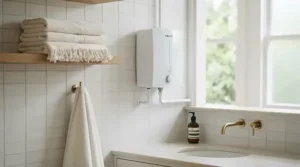
Floor space is the scarcest resource in a bathroom, and the GermGuardian GG1100W sidesteps it entirely by plugging straight into the outlet. It pairs a filter with a UV-C light, and it’s marketed for bathrooms, kitchens and small nooks. Here’s the nuance buyers overlook: the EPA states that research has not yet shown UV light can remove gases effectively in portable residential air cleaners. So treat the filter, not the lamp, as the odor fighter, and don’t pay extra for the glow.
Who is it for? Renters and anyone with a countertop already crowded with soap dispensers. Comparison sites repeatedly list it among small-room picks. I couldn’t verify a deep, independent review pool for this specific model, so I’d treat it as a modest outlet-friendly helper rather than a heavy-duty solution.
Pros:
- ✅ Zero counter or floor footprint
- ✅ Simple plug-in operation
- ✅ Very affordable entry point
Cons:
- ❌ Small filter means limited odor capacity
- ❌ UV-C adds little for gaseous smells
Price range: typically under $50. Fair value for a light-duty odor neutralizer.
3. Levoit Core 300-P — best all-round value
The Levoit Core 300-P is the sweet spot between toy and tank. It’s a cylindrical three-stage unit with real airflow. That extra fan muscle matters in a bathroom, because a smell source (toilet, hamper, drain) is only helped if air actually moves across the filter. Levoit sells carbon-focused filter variants for it, so confirm which filter ships with the listing you choose, since that single choice decides how well it handles odor.
For a family bathroom, it’s the one I’d put on a short list first. Reviewers at TechGearLab scored the line around 4.1 out of 5 with a Best Buy award, praising value and quiet operation. The usual critique is that standard filters are lighter on carbon than specialist odor machines, which is why the carbon variant matters.
Pros:
- ✅ Strong airflow for the price
- ✅ Carbon filter variants available
- ✅ Replacement filters widely stocked
Cons:
- ❌ Default filter has modest carbon
- ❌ Round body needs a clear surface
Price range: around $90–$130. A strong middle-class buy.
4. Blueair Blue Pure 311i Max — quiet, polished, app-friendly
The Blueair Blue Pure 311i Max is the Editors’ Choice at Reviewed, praised for particle filtering, quiet operation and a washable fabric prefilter. TechGearLab listed it around 4.8 out of 5. Those are real strengths for a bathroom you want silent at 2 a.m.
But here’s the part the spec sheet won’t spell out. Reviewed noted the Blue Pure line falls short at removing VOCs. This is exactly why smell-first shoppers should be careful. Blueair does sell a carbon-equipped filter option, but the base particle filter is not an odor specialist. If you pick this model, confirm the filter listing says carbon. Read the Reviewed roundup of the best HEPA air purifiers for the testers’ full reasoning.
Pros:
- ✅ Whisper-quiet operation
- ✅ Washable fabric prefilter
- ✅ Strong particle performance
Cons:
- ❌ Base filter is weaker on gases
- ❌ Premium price for odor-only needs
Price range: roughly $200–$250. Worth it only if you buy the carbon variant.
5. Winix 5500-2 — carbon plus an auto sensor
The Winix 5500-2 has been the “set it and forget it” favorite on several expert lists. It uses a four-stage setup with a carbon filter, a true HEPA stage and an air-quality sensor that adjusts fan speed. In a bathroom, that sensor is the quiet hero. The fan ramps up after a shower or a bad moment, then settles back. It also includes a PlasmaWave feature that can be switched off, and given the ozone concerns covered later, I’d leave it off.
Aggregators note the model was ranked first by The Spruce Pets and third by Wirecutter in 2024 lists, though rankings shift. It’s rated for medium rooms, so it’s more than a typical half bath needs, which is exactly why it clears odors quickly in a standard one.
Pros:
- ✅ Auto mode reacts to air quality
- ✅ Real carbon stage plus true HEPA
- ✅ Energy-efficient for continuous running
Cons:
- ❌ Larger than typical bathroom purifiers
- ❌ PlasmaWave toggle invites ozone worries
Price range: around $150–$200. Excellent value for a medium bath.
6. Oransi TrueCarbon 200C — heavy carbon for stubborn odors
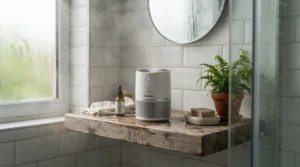
If your bathroom smell survives everything, the Oransi TrueCarbon 200C is the specialist. Oransi’s pitch is simple: only a carbon purifier removes odors, and a thick carbon layer is the key. That echoes California Air Resources Board guidance that larger quantities of charcoal are more effective and last longer. Oransi reports that Business Insider named it a top choice for odors like smoke, paint fumes and diaper-pail smells. Treat that as a manufacturer-cited claim.
What does that mean for you? A heavier carbon bed holds more odor molecules before it saturates. Think of it as a sponge versus a paper napkin. The tradeoff is cost and heft, and availability can vary by retailer. Verify current listings before planning around it.
Pros:
- ✅ Deep carbon bed for lasting odor control
- ✅ Built specifically for smells and fumes
- ✅ Longer intervals between carbon swaps
Cons:
- ❌ Highest price tier on this list
- ❌ Bulkier than shelf-friendly options
Price range: premium tier. Check current price. The value verdict: pays off for chronic odors.
7. Shark Air Purifier MAX HP200 — odor lock for big bathrooms
The Shark Air Purifier MAX HP200 targets large spaces, so in a typical bathroom it’s overkill on purpose. It uses a Nano Seal HEPA filter, a CleanSense IQ sensor and what Shark calls Odor Lock. The benefit for a large primary bath is that high capacity means fast air turnover, and fast turnover means shorter odor lingering time. The sensor-driven approach also reduces fiddling.
Review data here is thinner than for the Levoit and Winix lines. Retail listings show a modest review count for the refurbished variants, so I’d call independent verification limited. Shark’s marketing claims about particle capture should be read as manufacturer statements. For a spacious master bath or a bathroom attached to a bedroom, the airflow headroom is the main reason to consider it.
Pros:
- ✅ High airflow for large bathrooms
- ✅ Sensor-driven automatic adjustment
- ✅ Odor Lock design targets smell directly
Cons:
- ❌ Oversized for small bathrooms
- ❌ Independent review pool is limited
Price range: mid-$200s. Reasonable only if the room is large.
Top 7 Specs and Value Comparison
| Product | Particle Filter | Odor Stage | Ideal Bathroom | Best For |
|---|---|---|---|---|
| Levoit Core Mini-P | HEPA-style | Thin carbon layer | Half bath | Light odors on a budget |
| GermGuardian GG1100W | Filter + UV-C | Light filter | Tiny guest bath | Outlet-only rooms |
| Levoit Core 300-P | 3-stage | Carbon variants | Family bath | Daily value |
| Blueair Blue Pure 311i Max | HEPASilent | Optional carbon | Quiet bedroom suite | Quiet particle control |
| Winix 5500-2 | True HEPA | Carbon + sensor | Standard full bath | Hands-off odor control |
| Oransi TrueCarbon 200C | Particle stage | Heavy carbon | Problem bathrooms | Stubborn odors |
| Shark Air Purifier MAX HP200 | Nano Seal HEPA | Odor Lock | Large master bath | Big-room airflow |
Here’s the written takeaway. The Winix 5500-2 and Levoit Core 300-P deliver the best odor-per-dollar for typical bathrooms, as long as you confirm the carbon filter. The Oransi TrueCarbon 200C wins on raw odor capacity, but you pay for it. And the Blueair Blue Pure 311i Max is the quiet-luxury option that only earns its price if you pair it with the carbon filter.
How to Choose an Air Purifier for Bathroom Odor
Pick wrong and you’ve bought a quiet fan that looks smart. Pick right and the smell simply stops being a topic. Follow these six steps.
- Look for carbon first. The EPA is clear that gases require an activated carbon filter or similar sorbent. HEPA is not an odor filter.
- Judge the carbon amount. Thick beats thin. The California Air Resources Board says several devices carry 1 to 12 pounds of charcoal, and thin filters may only help briefly.
- Match airflow to the room. Multiply length by width to get square footage, then check the maximum room size on the box. For tall ceilings, size up.
- Check noise. Around 50 dB equals a modern refrigerator, per the EPA. A bathroom purifier should be lower if it runs overnight.
- Plan the filter schedule. All filters need replacement. Look for an indicator light and confirm replacements are easy to buy.
- Avoid ozone. Skip devices that intentionally generate ozone, and be cautious with ionizers and plasma features.
A quick reality check: a smaller filter in a tiny bathroom can still work well, because the volume of air to treat is small. The mistakes begin when people buy a bedroom purifier, put it in a hall, and expect the bathroom to smell fresh.
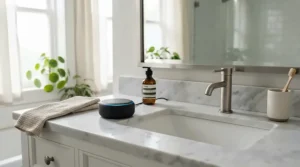
Small Air Purifier for Bathroom: Size, Placement and Plug-In Options
A small air purifier for bathroom use gets one big advantage: low volume means fast turnover. A bathroom of roughly 40 to 60 square feet, even with a modest fan, is cycled through quickly. This is why the Levoit Core Mini-P and GermGuardian GG1100W are legitimate choices despite their limits.
Placement matters more than people think. Put a small air purifier for bathroom shelves away from direct splash zones and steam. Keep the intake unobstructed by towels or curtains, which the EPA specifically warns against. Closer to the odor source usually works better, so a tank-top or vanity-corner spot beats a far wall. For plug-in models, check that the outlet isn’t a GFCI one near water you’ll constantly trip. Never place any device where it could fall into a tub or sink.
If you live in an apartment, a small air purifier for bathroom corners also solves the “where do I put this” problem. The tradeoff is carbon capacity. A tiny filter holds less and saturates sooner, so expect to change it more often than a bigger model. Think of a small air purifier for bathroom use as a daily-maintenance tool rather than a one-time fix.
Air Purifier for Shared Bathroom Odor: A Household Playbook
An air purifier for shared bathroom odor has a different job from a personal-bath unit. In a shared bathroom, odor events are frequent, unpredictable and sometimes awkward to discuss. Ideally the machine just handles it.
Here’s the scenario analysis. Imagine a family of four, one bathroom, mornings that collide. Airflow and automation matter here. The Winix 5500-2 with its sensor adjusts without anyone touching it, and the Levoit Core 300-P gives you decent air turnover at a gentler price. Now imagine roommates sharing a bathroom in a rental. A plug-in or small air purifier for shared bathroom odor like the GermGuardian GG1100W keeps footprint low, but expect to supplement it with ventilation.
For a guest bathroom with irregular use, the Levoit Core Mini-P is plenty. For a bathroom attached to a primary bedroom, the Blueair Blue Pure 311i Max with a carbon filter balances silence and capacity. The practical rule: run an air purifier for shared bathroom odor continuously on low, boost after peak use, and don’t rely on bursts alone. Shared spaces also mean shared maintenance, so tape a replacement date inside the cabinet.
Odor Neutralizer vs. Masking: What Actually Works
An odor neutralizer is any product that chemically or physically reduces odor molecules rather than covering them. That sounds like marketing, but the distinction is real. Sprays and plug-in fragrances add perfume on top of the smell. A carbon filter works by adsorption, trapping odor molecules on a porous surface. IQAir’s explanation of whether air purifiers remove odors or just reduce them says HEPA filters can’t remove odors and that activated carbon is the key to capturing gaseous emissions.
So where do other odor neutralizer products fit? Enzyme cleaners attack the source on surfaces, which is arguably the best odor neutralizer strategy of all. Moisture absorbers and baking soda have modest value in closets and cabinets. Fragrance cartridges, like the optional scent pads on some small purifiers, are cosmetic, not corrective. And a quick note on ozone: any odor neutralizer that works by making ozone is one to avoid.
The EPA’s advice is blunt: source control and ventilation come first, filtration supplements. Use an odor neutralizer on the surface, an exhaust fan on the humidity, and a carbon purifier on whatever is left floating. Together, they handle what none of them can alone.
Features That Actually Matter (And Those That Don’t)
Matter:
- Carbon quantity. The single biggest predictor of odor performance.
- Real airflow. A carbon filter does nothing if air doesn’t flow through it.
- Low-speed noise. You’ll run it constantly, so quiet wins.
- Filter availability. A great unit with unobtainable filters becomes landfill.
Doesn’t matter much:
- Scent pads. They perfume, not purify.
- UV-C lamps. The EPA says research hasn’t shown UV removes gases effectively in portable residential units.
- Color lighting. Lovely for a nightlight, irrelevant for odor.
- Giant square-foot claims. Those are particle-based marketing numbers at best, and they don’t tell you how long the carbon lasts.
Smart controls and sensors are a middle category. They’re genuinely helpful for hands-off use, like in the Winix 5500-2, but they won’t rescue a thin carbon layer. Think of features as the dashboard and carbon as the engine.
Common Mistakes When Buying an Air Purifier for Bathroom Odor
Mistake one: buying HEPA only. It looks impressive, but it won’t touch gases. Mistake two: ignoring the carbon weight. If the listing never states how much carbon is used, assume it’s thin. Mistake three: ignoring ozone. Some ionizer or plasma features can emit ozone, which the EPA calls a lung irritant. Mistake four: expecting it to fix a moisture problem. The EPA says air cleaners do not address the cause of mold or musty odors. Mistake five: forgetting the schedule. A saturated carbon filter can stop working well and, as some manufacturers warn, may release trapped compounds.
What most buyers overlook is the mismatch between where an air purifier for bathroom odor lives and what it’s asked to do. A bathroom is humid, small and smelly in bursts. That favors medium airflow, a decent carbon bed and a placement that lets it work near the source. A fancy unit hidden behind a door does nothing.
Air Purifier vs. Exhaust Fan vs. Sprays
| Option | How It Works | Strength | Weakness | Best For |
|---|---|---|---|---|
| Carbon air purifier | Adsorbs odor gases | Treats lingering smells | Needs filter changes | Chronic odors |
| Exhaust fan | Vents air outside | Removes moisture and smell | Needs ducting | Humidity control |
| Fragrance spray | Adds perfume | Instant | Masks only | Emergency cover |
| Enzyme cleaner | Breaks down residue | Hits the source | Surface only | Deep cleaning |
A table isn’t a verdict, so here is the interpretation. The exhaust fan and the air purifier aren’t rivals. The fan moves odor outside while the purifier cleans what stays behind, and the EPA specifically recommends ventilation alongside filtration. A fragrance spray is the weakest long-term option because it adds a layer rather than solving anything. For renters without a working fan, a carbon purifier is the most practical upgrade.
Practical Usage Guide: Setting Up Your Bathroom Purifier
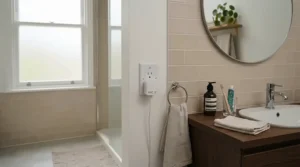
Set it up correctly. Place the unit within a few feet of the main odor source and leave several inches of clearance on all sides. Keep it off the floor if splashing is likely, and keep the cord away from water.
Run it right. The EPA notes that higher fan speeds and longer run times filter more air. Run it on low continuously and boost for 15 to 30 minutes after heavy use. Closing the door helps the purifier focus on one room.
Maintain it. Vacuum the pre-filter every couple of weeks if your model has one. Check the filter indicator, and replace the carbon on schedule. Humid bathrooms can shorten life, so replace earlier if smells return.
First 30 days checklist. Confirm the filter type, mark the replacement date on your calendar, and test the noise at night. Watch for steam on the intake, and relocate the unit if it gets soaked. Combine with the exhaust fan so the purifier isn’t fighting humidity alone.
Problem-Solution Guide for Bathroom Smell Scenarios
“It smells fine, then the odor returns.” The carbon is likely saturated. Replace the filter, or move to a larger carbon model like the Oransi TrueCarbon 200C.
“It’s too loud at night.” Drop to the lowest speed or choose a quiet model such as the Blueair Blue Pure 311i Max.
“My bathroom smells musty.” This is usually a moisture problem. Fix the leak or ventilation, then use a purifier as support. The EPA says purifiers won’t resolve a mold problem.
“There’s no space.” Go for a plug-in like the GermGuardian GG1100W or a compact Levoit Core Mini-P.
“The room is huge.” Step up to the Shark Air Purifier MAX HP200 or the Winix 5500-2, both of which have airflow to spare.
Long-Term Cost and Maintenance of a Bathroom Air Purifier
Sticker price is the smaller half of the story. Consider total cost of ownership across a year: the unit, replacement filters, and electricity. Small units have cheap filters but need more frequent changes. Larger units cost more up front but may stretch filter life. The EPA says all filters need regular replacement, and many manufacturers recommend swaps every few months for carbon.
| Tier | Typical Buyer | Upfront Range | Ongoing Cost | Best For |
|---|---|---|---|---|
| Budget | Occasional use | Under about $60 | Low but frequent filters | Levoit Core Mini-P, GermGuardian GG1100W |
| Mid-range | Daily family use | About $90–$200 | Moderate | Levoit Core 300-P, Winix 5500-2 |
| Premium | Chronic odors, large rooms | About $200 and up | Higher, but longer carbon life | Blueair Blue Pure 311i Max, Oransi TrueCarbon 200C, Shark Air Purifier MAX HP200 |
The written analysis: mid-range wins for most households because filters are widely available and the upfront cost is moderate. Premium units justify themselves when the odor problem is severe, since a thicker carbon bed reduces change-outs. Budget units can look cheaper on day one but cost more per year if you replace small filters often. Run the math on your own bathroom before deciding.
Safety Guide: Ozone, Ionizers and What to Avoid
Ozone is the one area where an air purifier for bathroom odor can backfire. The EPA warns against portable air cleaners that intentionally produce ozone, calling it a lung irritant. It also notes that some electrostatic, ionizer, UV and plasma units may emit ozone. The California Air Resources Board makes the same point, advising people to avoid ozone-generating purifiers and to use certified lists. See CARB’s guidance on indoor air cleaners for odors and gases for more.
What does this mean for shopping? Be skeptical of “filterless ionizer” bathroom products and anything claiming to “neutralize” odor with charged particles. CARB maintains a list of certified air cleaning devices, and AHAM keeps its own verified list. If a feature like PlasmaWave exists, switch it off. Also keep electrical safety in mind: no cords near water, no placement where a splash or fall is possible, and no covering the intake.
FAQ: Air Purifier for Bathroom Odor
❓ Does an air purifier get rid of toilet smell?
❓ How often should I replace the carbon filter in a bathroom?
❓ Can I leave a small purifier running all day in a bathroom?
❓ Is a plug-in odor neutralizer as good as a purifier?
❓ Will an air purifier fix a musty bathroom?
Conclusion: Choose the Carbon, Not the Hype
The best air purifier for bathroom odor is the one that brings enough carbon, enough airflow and a filter schedule you’ll actually follow. For most households, that points to the Winix 5500-2 or Levoit Core 300-P with a carbon filter. For tiny spaces, the Levoit Core Mini-P and GermGuardian GG1100W are budget-friendly, light-duty helpers. For stubborn smells, the Oransi TrueCarbon 200C is the heavy hitter, while the Shark Air Purifier MAX HP200 suits large baths and the Blueair Blue Pure 311i Max suits quiet-first buyers who add the carbon option.
Pair your purifier with an exhaust fan, clean the source with an odor neutralizer, and skip ozone gimmicks. A fresher bathroom isn’t magic. It’s the right filter in the right spot, working quietly while you forget it’s there.
✨ Ready for a Fresher Bathroom?
🔍 Click any highlighted product above to check current pricing and availability. Pick the carbon-first option that fits your space, and give your bathroom the calm, odor-free upgrade it deserves!
Recommended for You
- Air Purifier For Garage Gym: 7 Proven Picks For 2026
- Garage Air Purifier For Exhaust Fumes: 7 Best Picks (2026)
- Air Purifier For Garage Workshop Fumes: 7 Best Proven Picks (2026)
Disclaimer: This article contains affiliate links. As an Amazon Associate, I earn from qualifying purchases. If you purchase products through these links, we may earn a small commission at no additional cost to you.
✨ Found this helpful? Share it with your friends! 💬🤗
