
In This Article
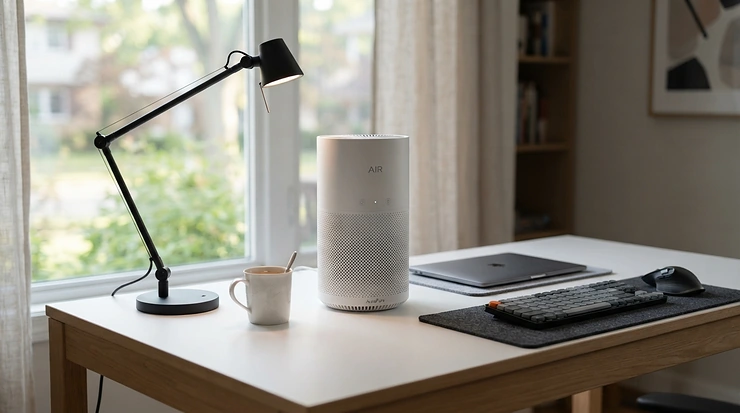
A desk air purifier for office use is a compact air cleaner, typically under 15 inches tall, that pulls in the air around your workstation, traps particles such as dust, pollen, and smoke in a HEPA filter, and often adds activated carbon for odors. It is built to serve one person’s breathing zone, not a whole floor.
Here is the catch nobody puts on the box. The marketing numbers were generated in a lab, and your desk is not a lab. It sits under an HVAC vent, two steps from a printer that sheds toner dust, and within sniffing range of someone reheating last night’s fish curry. The U.S. EPA is refreshingly blunt about this: portable air cleaners can help as a supplement, but they cannot remove every pollutant, and source control plus ventilation remain the biggest levers (EPA’s Guide to Air Cleaners in the Home). That honest framing shapes everything below.
I haven’t personally tested these seven models, and I won’t pretend otherwise. What you get instead is analysis built on published specs, independent measurements from testers like HouseFresh and AirPurifierFirst, and aggregated review sentiment. Each spec is translated into what it means at your desk.
The range runs from a USB-C mini in the mid-$20s to a 143 CFM workhorse under $100. Along the way we tackle the three questions readers ask most: how to find a quiet air purifier for office under $100, which air purifier for office cubicle setups actually fit, and whether USB powered units are strong enough to matter.
Quick Comparison Table: 7 Desk Picks at a Glance
Before the deep dive, here is the whole field on one screen. Prices are ranges only and change often, so check current pricing before you buy.
| Product | Power | Noise Range | Price Range | Best For |
|---|---|---|---|---|
| Levoit Core Mini-P | Wall adapter (12V) | 25–44 dB (brand) | Around $40–$50 | Budget cubicle starter |
| Pure Enrichment PureZone Mini | USB-C rechargeable | 15–46 dB (HouseFresh) | Around $40–$45 | Tiny desks, travel, hybrid workers |
| Smart Air QT3 | 5V USB | 29 dB low (brand) | Mid-to-high $40s | Directed airflow at your face |
| Blueair Blue Pure Mini Max | Wall adapter | 20–44 dB (brand) | Around $70–$100 | Quietest desk-sized performer |
| Levoit Core 300-P | Wall plug | 24–54.5 dB (brand) | Around $85–$100 | Private offices, larger cubicles |
| Blueair Blue Pure 411+ | Wall plug | 17–46 dB (HouseFresh) | Around $130–$140 | Premium whisper-quiet pick |
| KIKI Pure Mini A1 | USB-C | 18 dB (brand claim) | Around $25–$30 | Cheapest USB powered trial |
Read the table by power source first. Only three of these are truly USB powered, and they are also the three with the smallest cleaning capacity, which is not a coincidence. If you want a quiet air purifier for office under $100 that can genuinely refresh a small room, the two wall-powered Blueair Blue Pure Mini Max and Levoit Core 300-P are the serious contenders. The Blueair Blue Pure 411+ is the one pick here that lands above the $100 line.
💬 Just one click — help others make better buying decisions too!😊
Top 7 Desk Air Purifier for Office: Expert Analysis
Each pick below covers specs with real-world meaning, an honest read on who it suits, and what reviewers consistently report. Where I couldn’t verify review themes, I say so instead of guessing.
1. Levoit Core Mini-P — cheapest AHAM-verified starter
For roughly the cost of a nice dinner for two, this is one of the few sub-$50 units carrying independent AHAM verification. That matters in a category full of vague claims.
Levoit lists a CADR of 34 CFM, 7W rated power, and three-stage filtration (pre-filter, HEPA-grade filter, carbon). The footprint is about 6.5 × 6.5 inches. The EPA’s sizing chart calls for 65 CFM in a 100 sq ft room, so 34 CFM means “one cubicle or a compact office,” not open plan. At 7W it sips electricity, and the shape fits beside a monitor.
Two honest caveats. The power supply is a 12V wall adapter, so this is not USB powered. Also, Levoit’s 25 dB low-speed figure isn’t what your ears will hear at arm’s length. AirPurifierFirst measured the closely related Core Mini at about 42 dBA on low and roughly 54 dBA on high. Plan on a soft whoosh, not silence.
Review sentiment: A mid-2026 Amazon-tracking report put it near 4.6 stars and at the top of desk-purifier search results by sales volume. I couldn’t verify individual review themes, so treat the star average as directional.
Pros:
- ✅ Independently verified filtration at a budget price
- ✅ Compact footprint sits beside a monitor
- ✅ Two-year limited warranty from Levoit
Cons:
- ❌ Wall adapter only, not USB powered
- ❌ Modest CADR suits very small spaces only
Price & value: Around $40–$50 range. A strong value for a first desk air purifier for office use.
2. Pure Enrichment PureZone Mini — smallest cordless USB-C option
HouseFresh called this the smallest purifier it had ever handled. At about 0.58 lb and 8.5 inches long, it disappears into a bag.
It pairs a True HEPA filter with an activated-carbon pre-filter, three fan speeds, and a battery rated for up to 12 hours, recharged over USB-C. The brand quotes a CADR of 4 CFM, or roughly 6 sq ft cleaned in 12 minutes. HouseFresh listed 10 CFM, a 54 sq ft room ceiling, and nearly seven hours to clear its test room. Translation: this cleans the air within arm’s length, not the room.
HouseFresh also noted very little actual carbon, so don’t expect it to conquer lunchtime odors. On the plus side, its low speed measured about 15 dB, and there is no ionizer. Reviewers on retail listings repeatedly praise its portability, and the listing I found averaged around 4.1 stars across roughly 2,000 ratings. HouseFresh’s own rating was a middling 3 out of 5, mainly for the tiny effective range.
Think of it as a supplement for hot-desking and commutes, not a room solution.
Pros:
- ✅ Charges over USB-C with the cable you own
- ✅ About 15 dB on low speed (HouseFresh)
- ✅ Five-year manufacturer warranty
Cons:
- ❌ Very small effective range
- ❌ Minimal carbon for odor control
Price & value: Around $40–$45 range. Fair value if portability is the priority.
3. Smart Air QT3 — personal clean-air bubble on a USB tether
This is a genuinely USB powered design: 5V, 9W on high. Smart Air describes itself as a certified B Corp social enterprise, and its filosophy is plain: fewer gimmicks, honest numbers.
The published CADR is 37 m³/h (about 22 CFM), and HouseFresh measured 24 CFM. Smart Air rates its usable throw at 1.2 meters, which is why adjustable louvers matter. Aim the airflow at your face and it works like a small clean-air fan. The filter is an H11-class HEPA (95%+ capture) with no activated carbon, so it handles particles but won’t do much for smells.
A quick piece of math most listings skip: 9W ÷ 5V = 1.8 amps. Older laptop USB-A ports typically supply 0.5–0.9 amps, so use a wall charger for full speed. HouseFresh measured 32–49 dB, higher than Smart Air’s 29 dB low-speed claim, and rated it 3 out of 5.
Review sentiment: Smart Air’s store shows a perfect score from only a handful of reviews, too few to lean on.
Pros:
- ✅ True 5V USB power, no barrel adapter
- ✅ Adjustable louvers aim airflow
- ✅ Light at 1.4 lb with a carry strap
Cons:
- ❌ No activated carbon for odors
- ❌ Personal-zone cleaning power only
Price & value: Mid-to-high $40s range. Best when you want a personal fan-purifier hybrid.
4. Blueair Blue Pure Mini Max — quietest performer at desk size
Blueair’s HEPASilent design combines mechanical and electrostatic filtration, which is how a unit this small earns a 20 dB low-speed rating. It stays quiet without giving up much airflow.
Specs: CADR of 60 CFM for pollen, dust, and smoke; a 90 sq ft AHAM room rating; 10W; 11.4 × 6.8 × 5.9 inches; about 2.8 lb; a filter change every six months. That 60 CFM sits close to the EPA’s 65 CFM guideline for 100 sq ft, so this is the pick for a cubicle-plus or small private office.
Independent tests back the performance. AirPurifierFirst cut PM2.5 by about 92% in an hour in a 120 sq ft room on max speed. Their meter, however, read 40.4 dBA on low and 60.3 dBA on high, above Blueair’s 20–44 dB. That is a measurement difference, but it tells you something practical: keep it on low or medium during calls.
Review sentiment: Blueair’s own product page shows about 4.6 stars across roughly 150 reviews, with 89% recommending it. It is a brand-run page, so treat it as directional. Common themes: quiet running and slightly fiddly controls.
Pros:
- ✅ 60 CFM packed into a desk-sized body
- ✅ 20 dB low-speed rating (brand-stated)
- ✅ Washable pre-filters and six-month filter
Cons:
- ❌ No timer or air-quality sensor
- ❌ Wall-powered, not USB powered
Price & value: Around $70–$100 range. The best quiet air purifier for office under $100 in this lineup.
5. Levoit Core 300-P — most cleaning power under $100
Levoit lists a CADR of 143 CFM, a 222 sq ft rating at 4.8 air changes an hour, 24–54.5 dB, and a 14.2-inch height. Gizmodo cites AHAM figures of 143 (smoke), 153 (dust), and 167 (pollen) CFM. By the EPA’s chart, that comfortably serves a room of 200+ sq ft. Translation: a private office, a corner workspace, or a cubicle where you also want to protect the neighbors.
The catch is size. At about 14 inches and 7.9 lb it rarely fits on a crowded desk, so plan for a credenza, filing cabinet, or floor beside the desk. HouseFresh notes that a raised position captures air better than the floor.
Review sentiment: One deals roundup cited more than 100,000 reviews at roughly 4.7 stars. The iFixit wiki on the related Core 300-RAC lists recurring complaints: a filter smell, some fan rattle, and units that eventually won’t power on. That is a useful reminder to register the two-year warranty.
Pros:
- ✅ 143 CFM, the highest CADR here
- ✅ Serves roughly 220 sq ft rooms
- ✅ Huge review base and two-year warranty
Cons:
- ❌ Too tall for many desk surfaces
- ❌ Noise climbs to 54.5 dB on high
Price & value: Around $85–$100 range. Best cost per unit of cleaning power in this guide.
6. Blueair Blue Pure 411+ — whisper-quiet at 17 dB low
HouseFresh’s “best overall” for desks, rated 4 out of 5, measured a CADR of 120 CFM and 185 sq ft coverage, with noise from 17 to 46 dB. It cleaned their test room in 43 minutes. Energy cost is about $10.51 a year.
It runs a three-stage HEPASilent filter with a carbon layer, a washable fabric pre-filter, a magnetic cord clip, and one-button control. Blueair recommends changing the filter every six months. At 17 inches tall, it stands taller than most monitor bases, so it works best on a side surface.
HouseFresh’s gripes: no auto mode, and a bonded carbon sheet instead of pellets, meaning light odor control. Aggregated review summaries for the 411 family praise quiet running, low power draw, and washable pre-filters. Availability has been spotty at some retailers, so verify stock.
Pros:
- ✅ 17 dB on low, ideal for quiet offices
- ✅ 120 CFM handles about 185 sq ft
- ✅ Low running cost, about $10 a year
Cons:
- ❌ Above the $100 budget line
- ❌ No auto mode; thin carbon layer
Price & value: Around $130–$140 range. Worth it only if silence outranks price.
7. KIKI Pure Mini A1 — cheapest USB-C way to try one
This 136-gram, 5.2-inch unit ships with a USB-C cable. The brand claims HEPA filtration, 18 dB operation, and coverage up to 100 sq ft, with a 1-year warranty and 30-day money-back window.
Here is my skepticism. Smart Air’s QT3 measured 24 CFM and maps to about 13 sq ft in HouseFresh’s data. A smaller unit claiming 100 sq ft looks optimistic. I couldn’t find a published CADR or independent lab test for the KIKI, so read that 100 sq ft figure as marketing.
Review sentiment: The listings I found carried only a handful of ratings, and nothing verifiable beyond that. That is why it sits at number seven. It suits a low-stakes experiment: try a USB powered mini on your desk and see whether the airflow bothers you before investing more.
Pros:
- ✅ USB-C powered with cable included
- ✅ Featherweight at 136 grams
- ✅ Low cost with a 30-day return window
Cons:
- ❌ No published CADR or independent testing
- ❌ Coverage claims look inflated for its size
Price & value: Around $25–$30 range. Cheap enough to gamble on, with modest expectations.
Now the full spec sheet for side-by-side reading. Ratings come from mixed sources, so compare them loosely.
| Product | CADR | Room Size | Price Range | Rating Signal |
|---|---|---|---|---|
| Levoit Core Mini-P | 34 CFM | 53 sq ft (4.8 ACH) | Around $40–$50 | ~4.6 (tracker, mid-2026) |
| Pure Enrichment PureZone Mini | 4 CFM (brand) / 10 CFM (HouseFresh) | ~6 sq ft (brand) / 54 sq ft (HouseFresh) | Around $40–$45 | ~4.1 (retail listing); 3/5 HouseFresh |
| Smart Air QT3 | ~22 CFM | Personal zone, 1.2 m | Mid-to-high $40s | 3/5 HouseFresh |
| Blueair Blue Pure Mini Max | 60 CFM | 90 sq ft | Around $70–$100 | ~4.6 (brand page) |
| Levoit Core 300-P | 143 CFM | 222 sq ft (4.8 ACH) | Around $85–$100 | ~4.7 (100K+ reviews cited) |
| Blueair Blue Pure 411+ | 120 CFM | 185 sq ft | Around $130–$140 | 4/5 HouseFresh |
| KIKI Pure Mini A1 | Not published | ~100 sq ft (brand claim) | Around $25–$30 | Too few ratings |
Notice the pattern: the two Levoit Core 300-P and Blueair Blue Pure 411+ deliver the most cleaning, while the USB powered trio delivers convenience at the expense of coverage. Among the mid-priced units, the Blueair Blue Pure Mini Max balances noise and output best for a single-person workspace. Ratings are directional only, since a brand page, a retail listing, and a lab review do not measure the same thing.
How to Choose a Desk Air Purifier for Office
Match the purifier’s CADR to the space it must clean, favor low-speed quietness, and confirm HEPA filtration plus carbon if odors matter. Then check the power source and filter costs. Here is the order to work through:
- Start with CADR, not the “coverage” number. The EPA’s chart calls for a minimum CADR of about 65 CFM per 100 sq ft, and AHAM reports that the EPA has called CADR the most helpful parameter for judging portable cleaners (AHAM on CADR). Simply put, small numbers mean personal zone.
- Decide: personal bubble or room cleaner. A 4–24 CFM unit only affects air near you. A 60–143 CFM unit affects the whole cubicle or office.
- Check low-speed noise, and how it was measured. Brand figures usually come from lab conditions, while independent dBA readings taken close by run higher. Both are useful.
- Pick the power format. USB powered is convenient but limits output. A wall adapter enables higher airflow.
- Verify filtration type. HEPA handles particles. Odors need real activated carbon, and the EPA notes carbon works best when a substantial amount is used.
- Price the filters. Replacement costs over two years can rival the machine’s price.
- Skip ionizers and ozone generators. Look for plain filter-based designs.
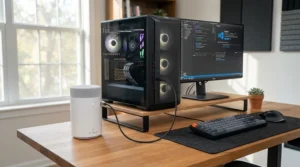
Quiet Air Purifier for Office Under $100: What Your Budget Really Buys
Shopping for a quiet air purifier for office under $100 means trading off three things: cleaning power, silence, and portability. Rarely do you get all three. Here is a rough cost-per-CFM view, calculated from midpoint prices and published or lab-measured CADR. These are my own approximations for comparison, not lab figures.
| Budget Tier | Picks | Rough $ per CFM | Trade-Off |
|---|---|---|---|
| Under $50 | KIKI Pure Mini A1, Pure Enrichment PureZone Mini, Smart Air QT3 | ~$2.10 for Smart Air QT3; $4+ for Pure Enrichment PureZone Mini; unknown for KIKI Pure Mini A1 | Personal zone only |
| Around $45 | Levoit Core Mini-P | ~$1.30 | Wall power, small room |
| $70–$100 | Blueair Blue Pure Mini Max, Levoit Core 300-P | ~$1.40 and ~$0.65 | Best real cleaning per dollar |
| Over $100 | Blueair Blue Pure 411+ | ~$1.10 | Quiet, but above budget |
The table tells a clear story. The Levoit Core 300-P delivers the cheapest clean air per CFM but is the loudest at full tilt, while the Blueair Blue Pure Mini Max costs more per CFM and buys you the quiet. If your keyword is truly “quiet” and “under $100,” the Blueair Blue Pure Mini Max is the most balanced answer. If your cubicle is bigger than 100 sq ft or you share air with a busy aisle, step up to the Levoit Core 300-P and run it on low.
USB Powered Desk Air Purifiers: Convenience vs Cleaning Power
The appeal of USB powered units is easy to see. Cable tidiness, laptop or power-bank compatibility, and no hunting for an outlet under a cramped desk. The Pure Enrichment PureZone Mini, Smart Air QT3, and KIKI Pure Mini A1 all qualify, and the first even runs cordless for up to about 12 hours.
But physics sets the ceiling. A typical wall unit like the Levoit Core 300-P draws far more power than a port can supply, which is why USB powered designs top out at low CADRs. Power draw is also why the Smart Air QT3 at 9W ideally wants a wall charger rather than an older laptop port, and why laptops that put ports to sleep can silently switch off your purifier.
Practical tips: use a proper USB charger for the Smart Air QT3, pick the battery-equipped Pure Enrichment PureZone Mini for hot-desking, and treat the KIKI Pure Mini A1 as a trial. In practice, USB powered models suit an air purifier for office cubicle life where you only need clean air within arm’s reach.
Air Purifier for Office Cubicle: Sizing, Placement and Etiquette
Cubicle partitions typically stop at about five or six feet, so the air above is shared with the whole floor. That is why an air purifier for office cubicle use works best when it targets your immediate zone, then relies on your neighbors’ good manners and your HVAC for the rest.
Sizing: A cubicle footprint of 36–64 sq ft is well within the Blueair Blue Pure Mini Max rating (90 sq ft) and the Levoit Core Mini-P‘s 4.8 ACH rating (53 sq ft). The Levoit Core 300-P is overkill for a cubicle unless you run it on low.
Placement: HouseFresh advises keeping inlets clear, avoiding walls and corners, and staying off the floor when possible. Aim personal units like the Smart Air QT3 toward your face, roughly a meter away.
Etiquette: Ask neighbors before running anything above low, keep cords out of walkways, and check office policy on personal devices. A humming purifier that annoys a coworker defeats the goal.
Desk Air Purifier for Office vs Larger Room Air Purifier
| Type | Coverage | Noise | Best For |
|---|---|---|---|
| Personal USB mini | Arm’s length | Very low | Smart Air QT3, Pure Enrichment PureZone Mini |
| Desk-sized wall unit | 90–185 sq ft | Low to moderate | Blueair Blue Pure Mini Max, Blueair Blue Pure 411+ |
| Floor-standing room unit | 220+ sq ft | Moderate | Levoit Core 300-P |
The middle row is where most office workers land. Personal minis sit closer to your nose but process very little air, so they act like a safety blanket more than a cleaner. A desk-sized wall unit like the Blueair Blue Pure Mini Max gives you measurable results in the cubicle without commandeering desk space, while a floor unit only makes sense if you have a private office.
In short: choose personal minis for mobility, desk-sized wall units for daily cubicle life, and floor units for private rooms.
What to Expect: Real-World Performance
HouseFresh’s timed tests are the most useful reality check available. In their test room, the Blueair Blue Pure 411+ cleared the air in 43 minutes, while the Pure Enrichment PureZone Mini needed about 6 hours 49 minutes and the Smart Air QT3 about 4 hours 27 minutes (HouseFresh desk purifier guide). The lab room size isn’t specified in what I could read, but the ratio is what counts: the minis are roughly ten times slower.
AirPurifierFirst’s test on the Blueair Blue Pure Mini Max shows what a mid-sized unit delivers: PM2.5 dropped from 104.9 to 8.9 µg/m³ in an hour in a 120 sq ft room on max speed. Expect that kind of improvement in a small office, but not from a USB powered mini.

Features That Actually Matter (And Those That Don’t)
Matter: CADR, low-speed noise, real carbon quantity, filter cost, and the power format. Don’t matter: aroma pads (the Levoit Core Mini-P has one), app connectivity on a unit you’ll set once, and eye-catching coverage claims.
Here is a tell-tale example. Levoit lists the Levoit Core Mini-P at 254 sq ft at 1 air change per hour but 53 sq ft at 4.8, and the Levoit Core 300-P at 1,066 sq ft versus 222 sq ft. Both are honest, but only the second number reflects meaningful cleaning. Always find the 4.8 ACH figure, which is closer to what allergen guidance cares about.
Also skip UV and “0.003 micron” headline claims. What you want is verified CADR, a decent filter, and a noise level you can live with beside your keyboard.
Practical Setup and 30-Day Maintenance Guide
Day 1: Unbox, remove any plastic wrap, and place the unit two feet from walls with inlets clear. Position it off the floor if possible.
Week 1: Run it continuously on low to build a habit. HEPA, in the formal sense, is defined around capturing very small particles, and you can read how that standard works in this HEPA overview.
Week 2: Vacuum the exterior of any fabric pre-filter. Blueair says its pre-filters can be vacuumed as often as you like and machine-washed on a gentle low-temperature cycle for deeper cleaning, then hung to dry. That applies to the Blueair Blue Pure Mini Max and Blueair Blue Pure 411+.
Day 30: Check the filter indicator, and log your replacement date. The Pure Enrichment PureZone Mini and both Blueair units call for about six months, while the Smart Air QT3 rates its filter for about 800 hours.
Common first-month mistakes: pushing the unit against a wall, running only on high, ignoring the filter, and forgetting that a USB powered unit dies if your laptop sleeps.
Real-World Scenarios: Three Buyers, Three Picks
The hybrid worker. Two days a week in a hot-desk seat, under $50, wants portability. The Pure Enrichment PureZone Mini fits a bag, runs cordless for a workday, and keeps expectations honest. Add a KIKI Pure Mini A1 only if you want a backup on your home desk.
The cubicle worker near a busy aisle. Eight hours daily, moderate allergies, budget around $70–$100. The Blueair Blue Pure Mini Max on low fits a cubicle and the noise won’t derail calls. Keep it off the floor and away from the partition wall.
The home-office worker. A 150 sq ft spare room, budget under $100, wants strong cleaning. The Levoit Core 300-P matches the room size on paper, and the Levoit Core Mini-P works only as a second, small unit near the desk. Run the bigger unit on low during calls and bump it up between meetings.
Problem → Solution Guide
Problem: fan noise wrecks video calls. Solution: drop to the lowest speed, or choose the Blueair Blue Pure 411+ at 17 dB low if budget allows. Position it behind your microphone’s pickup pattern.
Problem: lunchtime odors. Solution: particle filters won’t fix smells. Pick a unit with real carbon, and know that the Pure Enrichment PureZone Mini and Smart Air QT3 are weak on odors.
Problem: USB powered unit cuts out. Solution: use a wall charger, not a sleeping laptop port, especially for the Smart Air QT3.
Problem: cord clutter. Solution: the cordless Pure Enrichment PureZone Mini or a magnetic cord clip like the one on the Blueair Blue Pure 411+.
Problem: the purifier smells or rattles. Solution: check the filter and its seating, and use the warranty. Reviews of the Levoit Core 300-P family mention this.
Long-Term Cost & Maintenance
Running costs are tiny. HouseFresh estimated about $10.51 a year for the Blueair Blue Pure 411+, about $8.41 for the Smart Air QT3 and Pure Enrichment PureZone Mini, and roughly $30 a year for Levoit’s larger Core-series units.
Filters are the real bill. Blueair suggests six-month swaps, and reviewers put Mini Max filters in the low-$20s, so two years can rival the purchase price. Include that in your value math. Compare a cheap KIKI Pure Mini A1 with an unknown filter schedule against the Blueair Blue Pure Mini Max, and the “cheap” option may not stay cheap.
FAQ
❓ Is a desk air purifier for office use worth it in a small cubicle?
❓ What is the quietest quiet air purifier for office under $100?
❓ Can I run a USB powered air purifier from my laptop?
❓ How often should I change a desk purifier's filter?
❓ Do desk purifiers remove office kitchen odors?
Conclusion
Choosing a desk air purifier for office use comes down to honesty about scale. USB powered minis like the Pure Enrichment PureZone Mini, Smart Air QT3, and KIKI Pure Mini A1 are personal-zone tools that trade cleaning power for convenience. The Levoit Core Mini-P is the cheapest verified starter, though it needs a wall outlet.
For most people shopping a quiet air purifier for office under $100, the Blueair Blue Pure Mini Max is the balanced pick, and the Levoit Core 300-P wins on raw cleaning per dollar for bigger spaces. If budget allows and silence matters most, the Blueair Blue Pure 411+ is the whisper-quiet option. For any air purifier for office cubicle, keep it off the floor, keep inlets clear, and run it consistently.
Remember the EPA’s caution too: purifiers supplement good ventilation and source control, they don’t replace them. Check current pricing and stock before buying, since both change often.
Recommended for You
- Air Purifier For Home Office Allergies: 7 Best Picks (2026)
- Air Purifier For Small Kitchen: 7 Picks That Actually Work (2026)
- Air Purifier For Kitchen Smoke: 7 Real Picks That Work In 2026
Disclaimer: This article contains affiliate links. As an Amazon Associate, I earn from qualifying purchases. If you purchase products through these links, we may earn a small commission at no additional cost to you. Prices are approximate ranges at the time of research and may vary.
✨ Found this helpful? Share it with your friends! 💬🤗
