
In This Article
If you wake up sneezing before your alarm even goes off, the culprit is probably already in your bedroom. An air purifier for dust mite allergy is a HEPA-filtration appliance designed to capture the microscopic fecal particles and body fragments that dust mites shed into household air — the actual allergen, since the mites themselves rarely become airborne. It won’t get rid of the mites living in your mattress, but it can meaningfully cut down what you’re breathing in overnight.
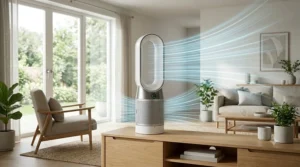
Here’s the part most buying guides skip: dust mite debris doesn’t float around your living room like pollen does. According to the Asthma and Allergy Foundation of America, both the bodies and waste of dust mites act as allergens, and they settle into bedding, carpets, and upholstery rather than staying suspended in the air. So a purifier is one tool in a toolkit, not a magic fix — and I’ll be upfront about that throughout this guide instead of overselling any single product.
What follows is a side-by-side look at seven real, currently available HEPA air purifiers spanning budget to premium, based on their AHAM-verified CADR ratings, published noise data, and how they actually hold up in homes dealing with year-round allergy symptoms. 🛏️
Quick Comparison Table: Best Air Purifiers for Dust Mite Allergy at a Glance
| Product | Best For | CADR (approx., CFM) | Room Coverage | Price Range |
|---|---|---|---|---|
| Coway AP-1512HH | Budget bedroom reliability | 233–246 | ~361 ft² | $180–230 |
| Medify MA-40 | Budget large-room coverage | ~406 | ~896 ft²/30 min | $170–230 |
| Winix 5500-2 | Allergens + odor combo | 232–246 | ~360 ft² | $200–250 |
| Levoit Core 400S-P | Smart monitoring | 231–259 | 358–1,733 ft² | $180–220 |
| Honeywell HPA300 | Max CADR per dollar | 300–320 | ~465 ft² | $200–250 |
| Blueair Blue Pure 211+ Auto | Large open-plan rooms | 347–380 | ~540–550 ft² | $300–340 |
| Alen BreatheSmart 45i | Certified allergen relief | 208–245 | ~800 ft²/30 min | $400–450 |
Looking at the table, the Coway and Medify give you the most CADR per dollar if budget is the deciding factor, while the Blueair and Alen pull ahead once room size or third-party allergen certification matters more than sticker price. Note that “room coverage” numbers vary by air-change-per-hour (ACH) assumption, so a unit rated for a huge square footage at 1 ACH may need to run on a higher speed to actually keep up with dust mite allergen levels in a bedroom you sleep in nightly.
💬 Just one click — help others make better buying decisions too!😊
✨ Don’t Miss These Exclusive Deals!
🔍 Take your indoor air quality to the next level with one of these seven picks. Click any highlighted product to check current pricing and availability on Amazon — the right HEPA purifier can make a real difference for sneeze-free, fully-rested nights. 😊
Top 7 Air Purifiers for Dust Mite Allergy: Expert Analysis
1. Coway AP-1512HH (Mighty)
The Coway AP-1512HH, nicknamed the “Mighty,” has stayed a bestseller for years for a simple reason: it punches well above its compact size. Its AHAM-verified CADR sits at 233 CFM (smoke), 246 CFM (dust), and 240 CFM (pollen), rated for rooms up to roughly 361 sq ft. In practice, that’s enough headroom for a typical 12×15 ft bedroom with margin left over for a closet door left open or a ceiling fan moving air around — exactly the kind of layout where dust mite allergen gets stirred up while you sleep.
What most buyers overlook about the Mighty is its eco mode: the fan shuts off automatically after 30 minutes of clean air, then kicks back on the instant the sensor detects a spike, which keeps energy costs down without you touching a button. It’s the right call for someone who wants dependable, no-fuss filtration in a single bedroom and doesn’t care about app connectivity. Reviewers consistently mention visible dust reduction within the first few days and a fast response when cooking smells drift in, though several note the top fan speed gets noticeably loud.
✅ Washable pre-filter cuts ongoing cost
✅ Auto + eco mode reduce manual adjustment
✅ Long track record and wide filter availability
❌ No smart app or voice control
❌ Dated, boxy design
Typically priced in the $180–230 range, the Mighty remains one of the strongest value picks here if your main goal is reliable bedroom-sized filtration without smart-home extras.
2. Medify MA-40
The Medify MA-40 pairs a true H13 HEPA filter with one of the highest CADR ratings on this list for the price. Its current listing shows a CADR of 406 CFM, capable of cycling 896 sq ft of air every 30 minutes or roughly 1,793 sq ft in an hour — numbers that matter most if dust mite allergens are triggering symptoms beyond just the bedroom, like in an open-plan living and dining area.
In my experience comparing units at this price point, the gap between “rated room size” and “room size that actually feels clean” is where buyers get tripped up, and the MA-40 is a good example: that 1,793 sq ft figure assumes only 1 air change per hour, which is fine for a large living room but not aggressive enough for someone who specifically needs allergen knockdown in a 250 sq ft bedroom overnight — for that, run it on a higher speed or size it to the smaller room instead. Owners frequently highlight the strong airflow and the touchscreen control panel, with some noting the H13 filter needs replacing sooner than expected under continuous heavy use.
✅ High CADR-to-price ratio
✅ Genuine H13-grade HEPA filtration
✅ Touch panel with child lock and 0–8 hr timer
❌ Louder at top speed (up to 66 dB)
❌ Optional ionizer some allergy-sensitive users prefer to leave off
At roughly $170–230 depending on the variant, this is the pick for buyers who want large-room coverage without paying premium-brand pricing.
3. Winix 5500-2
The Winix 5500-2 layers PlasmaWave ionization on top of a true HEPA filter and a washable activated-carbon layer, with an independently tested CADR of 232 CFM (smoke), 243 CFM (dust), and 246 CFM (pollen) for rooms up to about 360 sq ft. The washable carbon pre-filter is the detail worth knowing: instead of replacing the whole filter stack as often, you rinse this layer periodically, which stretches out the real annual cost compared to fully disposable designs.
What sets this one apart for dust mite households specifically is flexibility — PlasmaWave can be switched off entirely for anyone sensitive to ionization, something the Blueair on this list doesn’t allow. Add a included remote control, and you’ve got a unit you can adjust from bed at 2 a.m. without getting up. Long-running allergy and asthma forums frequently cite the Winix for how quickly its auto sensor reacts to a sudden air-quality dip, and its sleep mode runs as low as roughly 28 dB.
✅ Washable AOC carbon filter
✅ PlasmaWave can be toggled on or off
✅ Includes remote control
❌ Replacement HEPA filters cost more than Coway’s
❌ Utilitarian, boxy aesthetic
Priced around $200–250, it’s a strong middle-ground pick if odor control matters nearly as much as allergen capture in your home.
4. Levoit Core 400S-P
The Levoit Core 400S-P brings a laser PM2.5 sensor and VeSync app control to the table, with AHAM-verified CADR of 231 CFM (smoke), 240 CFM (dust), and 259 CFM (pollen). Coverage is listed at 358 sq ft for a thorough 4.8 air changes per hour, scaling up to roughly 1,733 sq ft if you only need a single air change hourly in a larger space.
The spec sheet won’t tell you this, but the live PM2.5 readout is genuinely useful for dust mite-specific tracking: you can watch the number visibly climb when you make the bed or vacuum, then watch it fall as the unit catches up — a small feedback loop that helps you understand your own triggers rather than just trusting the marketing. This makes it the right call for tech-comfortable households who want data alongside filtration, especially anyone planning to run it overnight in Sleep Mode at roughly 24 dB. One thing to double-check before buying: Levoit’s filter naming has shifted across revisions, so confirm you’re ordering the Core 400S-RF filter compatible with this specific 400S-P version.
✅ Real-time air quality display
✅ App and voice assistant control
✅ One of the quietest sleep modes tested
❌ Filter naming inconsistency across model revisions
❌ Smart features add setup complexity some buyers don’t want
At $180–220, it offers excellent value if you’ll actually use the monitoring feature — less essential if you just want a “set on auto and ignore it” purifier.
5. Honeywell HPA300
The Honeywell HPA300 trades smart features for raw filtering power, and it shows: its CADR comes in at 300 (smoke), 320 (dust), and 300 (pollen), AHAM-rated for around 465 sq ft at 4.8 air changes per hour — among the highest CADR-per-dollar figures of any unit reviewed here.
That headline number matters most in open living rooms and combined kitchen-dining spaces, which is exactly where dust mite debris gets launched into the air when bedding gets changed in an adjoining room or a couch cushion gets fluffed. This is the unit to reach for if your priority is maximum coverage for the price and you don’t mind a simple four-speed dial instead of an auto-sensor. It is, however, the loudest unit on this list at its Turbo setting, so it’s a better fit for a living room than a light sleeper’s bedroom. Reviewers commonly describe it as the purifier they bought after a smaller bedroom unit couldn’t keep up with whole-home pollen and dust loads.
✅ Highest CADR-to-price ratio reviewed
✅ Simple, durable controls
✅ Backed by a 5-year warranty
❌ No auto mode or app
❌ Noticeably loud on Turbo (~59–60 dB)
Typically $200–250, it’s excellent value specifically for large rooms — overkill if you only need bedroom-sized coverage.
6. Blueair Blue Pure 211+ Auto
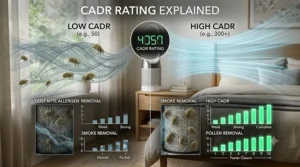
The Blueair Blue Pure 211+ Auto uses HEPASilent dual filtration — combining mechanical HEPA-grade media with electrostatic charging — to post the highest CADR on this list: 353 CFM (smoke), 347 CFM (dust), and 380 CFM (pollen), AHAM-rated for roughly 540–550 sq ft.
In real-world terms, this is the unit for an open-plan layout where the bedroom, closet, and a connected sitting area all need coverage from one machine, since the auto sensor ramps up quietly the moment it detects a disturbance — like right after you make the bed in the morning. The tradeoff worth knowing upfront: the electrostatic-assisted filtration can’t be switched off, unlike the ionizer toggle on the Winix, so anyone who wants zero ionization in their home should look elsewhere. Long a Wirecutter and Good Housekeeping pick, it draws consistent praise for staying quiet relative to its power, with the recurring filter cost (roughly $50–60 every six months) as the most common complaint.
✅ Largest coverage and CADR reviewed
✅ Genuinely quiet for its power output
✅ Washable, swappable fabric pre-filters for style
❌ Ionizer function cannot be disabled
❌ Among the pricier filters to maintain long-term
At $300–340, it’s worth the premium specifically if your trigger space is large — it’s overkill for a single average bedroom.
7. Alen BreatheSmart 45i
The Alen BreatheSmart 45i is the only unit on this list independently Asthma & Allergy Friendly® certified by AAFA and Allergy Standards Ltd specifically for allergen reduction. Its medical-grade H13 HEPA filter posts a CADR in the 208–245 CFM range depending on test source and filter chosen, with Alen’s own spec rating it for roughly 800 sq ft every 30 minutes, or 1,600 sq ft per hour.
The certification is the detail that actually matters here, not just marketing language: AAFA’s standard requires that a certified unit remove at least 90% of airborne allergens during testing and that the filter genuinely captures — not just redistributes — at least half of what it removes. For dust mite debris specifically, that’s a meaningfully higher bar than an uncertified HEPA claim. This makes it the pick for someone with a diagnosed dust mite allergy who wants third-party validation behind the purchase, plus four interchangeable filter formulas (Pure, Fresh, Odor, VOC/Smoke) if your needs shift later. Owners frequently describe a visibly dustier filter within the first week of use and report better sleep within days of running it overnight, while the most common gripe is the price and the active filter subscription required to keep the lifetime warranty valid.
✅ AAFA-certified allergen capture (not just a HEPA claim)
✅ Four interchangeable filter formulas
✅ Whisper-quiet pink-noise sleep mode (~23 dB)
❌ Highest price on this list
❌ Lifetime warranty requires an ongoing filter subscription
Priced around $400–450, it’s a genuine premium pick — justified specifically by documented third-party allergen-removal testing rather than coverage area alone.
Practical Usage Guide: Getting the Most Out of Your Purifier
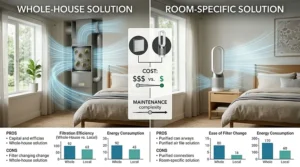
Buying the right unit is half the job; placement and habits do the rest. Put the purifier in the room where you spend the most consecutive hours — almost always the bedroom — and leave at least 18 inches of clearance on all sides so the intake isn’t blocked by furniture or curtains. Run it continuously rather than turning it on and off, since dust mite allergens regenerate constantly from skin flakes shed in bed; a purifier that’s off overnight is doing nothing during the exact hours of highest exposure.
During the first 30 days, resist the urge to leave it on the lowest speed permanently just for quiet — the EPA’s Guide to Air Cleaners in the Home notes that a unit’s rated CADR is measured at higher fan speeds, and running too low can mean it never reaches that performance. Vacuum or rinse washable pre-filters every two to four weeks, and mark your calendar for full HEPA filter swaps at the six-to-twelve-month mark rather than waiting for visible performance to drop, since allergen capture quietly declines well before a filter looks “full.”
Real-World Scenarios: Which Purifier Matches Your Situation?
A renter in a single bedroom dealing with nightly sneezing is usually best served by something compact and quiet enough for sleep — the Coway AP-1512HH or Levoit Core 400S-P both fit a typical 150–300 sq ft room without dominating the space or the budget.
A family with an open-plan living and dining area where allergy symptoms flare beyond just one room needs raw coverage more than smart features — the Honeywell HPA300 or Medify MA-40 deliver the CADR for that footprint without premium pricing.
Someone with a confirmed dust mite allergy diagnosis who’s already tried a basic HEPA unit without enough relief is the ideal candidate for the Alen BreatheSmart 45i — the AAFA certification adds a layer of verified performance that an uncertified unit simply can’t match, which matters more once symptoms are medically documented rather than just suspected.
Buyer’s Decision Framework
If budget is your main constraint, choose a unit rated for your actual room size with the highest CADR you can find under $250 — the Coway, Medify, or Winix all qualify. If your trigger space spans more than 400 sq ft, prioritize coverage over smart features and look at the Honeywell or Blueair. If you have a diagnosed allergy and want documented allergen-removal performance rather than a HEPA claim alone, the Alen’s certification justifies its higher price. And if you want to correlate symptom flare-ups with actual air-quality data, the Levoit’s live PM2.5 display is worth the smart-home learning curve.
How to Choose an Air Purifier for Dust Mite Allergy
Five things matter more than brand name when shopping for an air purifier for dust mite allergy:
- Match CADR to your actual room, not the marketing room size. A purifier’s listed coverage often assumes only 1–2 air changes per hour; for allergy relief, aim for a CADR that delivers 4–5 changes per hour in your specific room.
- True HEPA (H13) over “HEPA-type.” Only filters tested to the H13 standard reliably capture particles down to 0.3 microns, the range most allergen fragments fall into.
- Check the noise rating at the speed you’ll actually use overnight, not just the lowest published number — many units are quiet at speed 1 but loud at the speed needed to hit rated CADR.
- Factor in filter cost, not just sticker price, since annual filter spend can rival the unit’s purchase price over three years.
- Look for AHAM Verifide and, ideally, Asthma & Allergy Friendly® certification if your allergy is diagnosed rather than suspected — independent testing matters more than packaging claims.
HEPA Filtration vs. Dust Mite Allergens: What the Science Says
It’s worth being precise about what HEPA filtration actually does for dust mite allergies, because the marketing around this topic tends to overpromise. The EPA notes that most mechanical air filters are good at capturing larger airborne particles, including a portion of dust mite allergen, but that these particles settle out of the air relatively quickly — meaning a purifier captures only what’s currently disturbed and airborne, not what’s resting in your mattress or carpet.
Practically, that means an air purifier reduces your ongoing exposure during and after activities that stir up allergen — vacuuming, bed-making, kids jumping on furniture — rather than eliminating the source. This is exactly why allergists pair purifiers with source control, and why “does an air purifier kill dust mites” is the wrong question to ask in the first place; the honest answer is that it doesn’t, and shouldn’t be marketed as if it does.
Air Purifier vs. Mattress Encasements: Which Matters More?
| Method | Reduces Airborne Allergen | Reduces Allergen in Bedding | Ongoing Cost | Effort Level |
|---|---|---|---|---|
| HEPA Air Purifier | Yes | No | Filters every 6–12 mo | Low (passive) |
| Mattress/Pillow Encasements | No | Yes (blocks contact) | One-time | Low |
| Hot-water Washing (130°F+) | No | Yes | Water/energy | Weekly |
| Dehumidifier (under 50% RH) | Indirect | Yes (limits mite survival) | Electricity | Low (passive) |
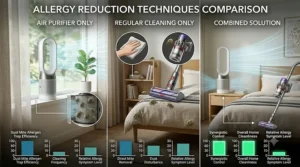
The table makes the case for redundancy rather than choosing one method: an air purifier and a mattress encasement solve genuinely different parts of the same problem, which is why the American Lung Association and most allergists recommend combining several approaches rather than relying on any single product. Skipping encasements because you bought a good purifier is one of the most common — and costly — mistakes allergy sufferers make.
Humidity Control and Dust Mites: The Partner Your Purifier Needs
Dust mites need humidity above roughly 50% to thrive, which is why a purifier paired with a dehumidifier consistently outperforms a purifier alone in homes with persistent symptoms. None of the seven units above measure or control humidity, so if your home regularly sits above 50% relative humidity — common in basements, humid climates, or poorly ventilated bedrooms — a standalone hygrometer and dehumidifier is a worthwhile second purchase. Bringing humidity down doesn’t just slow mite reproduction; it also keeps the allergen particles themselves from clumping and resettling as quickly, giving your purifier’s filter less to compete against.
✨ Don’t Miss These Exclusive Deals!
🔍 Pair any of these seven purifiers with a simple hygrometer, and you’ll know within days whether humidity — not just dust — is working against you. Click through to compare current pricing before allergy season ramps up. 🌬️
What to Expect: Real-World Performance
Across the units reviewed, expect a noticeably fresher-smelling room within the first hour of continuous operation, but expect allergy symptom improvement to take longer — typically one to three weeks of nightly use before sneezing, congestion, and itchy eyes meaningfully ease, since you’re also clearing the mattress, carpet, and fabric sources at the same time through washing and vacuuming. Don’t expect a purifier to outperform a closed bedroom door; running one with windows or doors open during pollen season undercuts even the highest-CADR unit on this list. And expect to notice a difference in noise more than in visible dust — most allergen particles relevant to dust mite reactions are too small to see, so judging performance by how “dusty” a room looks is misleading.
Common Mistakes When Buying an Air Purifier for Dust Mites
The most frequent error is buying based on square footage marketing alone rather than checking the CADR-to-room-size ratio at a usable noise level — a unit rated for 1,000 sq ft at top speed might be far less effective in your 200 sq ft bedroom running on low at night. The second is ignoring filter replacement cost until after purchase, only to discover a “budget” unit has premium-priced filters. The third is expecting any single purifier to replace mattress encasements, hot-water washing, and vacuuming rather than work alongside them — and the fourth is placing the unit in a corner behind furniture, which throttles intake airflow regardless of how good the filter inside is.
Features That Actually Matter (And Those That Don’t)
True HEPA (H13) media, a verified AHAM CADR rating, and a genuinely quiet sleep-speed noise rating matter — these directly determine whether the unit will run continuously where you need it most. App connectivity and PM2.5 displays are genuinely useful for understanding your own triggers but don’t filter a single extra particle on their own. Ionizer and “plasma” technologies are the most overhyped feature here: they can help with odor in some cases, but none of the independent allergen-removal certifications discussed above depend on them, and several allergy-sensitive users prefer units where ionization can be switched off entirely.
Long-Term Cost & Maintenance: What Air Purifiers Really Cost
The purchase price is rarely the full story. Budget roughly $50–90 per year in replacement filters for most units on this list, with washable-prefilter designs like the Coway and Winix trending toward the lower end and medical-grade options like the Alen toward the higher end once you include its subscription model. Electricity cost is comparatively minor — even the power-hungry Honeywell HPA300 running continuously adds only a modest amount to a monthly bill — so filter replacement, not power draw, is where total cost of ownership is actually decided over a three-year span.
✨ Don’t Miss These Exclusive Deals!
🔍 Whichever pick fits your room and budget, now’s the time to compare current Amazon pricing — allergy-season demand tends to push these models in and out of stock quickly. 🛒
Frequently Asked Questions
❓ Does an air purifier kill dust mites?
❓ What's the best air purifier for dust mites in a bedroom?
❓ Is a mattress cover or an air purifier better for dust mite allergy?
❓ What humidity level keeps dust mites under control?
❓ How often should I replace a HEPA filter for dust mite allergy relief?
Conclusion
There’s no single “best” air purifier for dust mite allergy — there’s a best match for your room size, budget, and how diagnosed or severe your symptoms are. If you want dependable bedroom coverage without overspending, the Coway AP-1512HH or Medify MA-40 deliver real value. If you want data alongside filtration, the Levoit Core 400S-P earns its smart-home premium. If your trigger space is large or open-plan, the Honeywell HPA300 and Blueair Blue Pure 211+ Auto are built for it. And if you’re working with a confirmed allergy and want independently certified allergen-removal performance, the Alen BreatheSmart 45i is the one purifier here that backs its claims with third-party testing rather than marketing language alone.
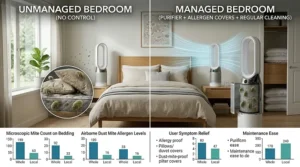
Whichever unit you choose, remember it’s one piece of a larger plan — pair it with mattress encasements, regular hot-water washing, and humidity control for results a purifier alone can’t deliver. If symptoms persist despite all of this, that’s a sign worth bringing to an allergist rather than a sign you bought the wrong machine.
✨ Don’t Miss These Exclusive Deals!
🔍 Ready to breathe easier tonight? Compare current pricing on any of these seven picks and choose the one that actually fits your room. 😊
Recommended for You
- 7 Best Air Purifiers for an Asthmatic Child in 2026
- 7 Best Air Purifiers for Asthma in 2026 (Real HEPA Picks)
- Best Air Purifier for Seasonal Allergies: 7 Picks That Work (2026)
Disclaimer: This article contains affiliate links. As an Amazon Associate, I earn from qualifying purchases. If you purchase products through these links, we may earn a small commission at no additional cost to you.
✨ Found this helpful? Share it with your friends! 💬🤗
